
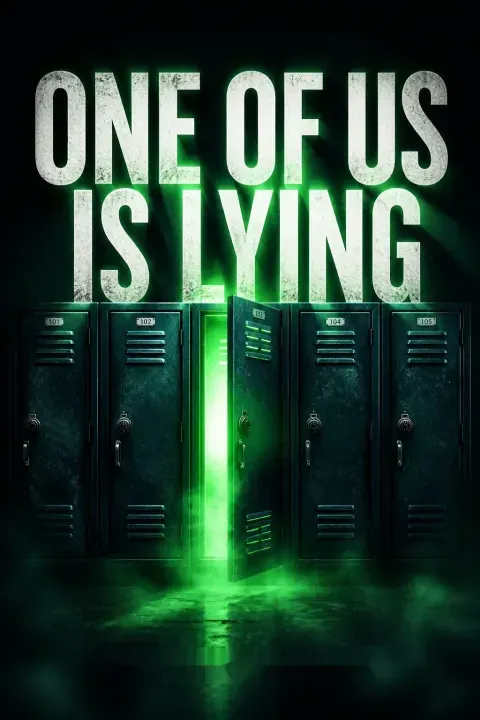


Plot Summary
Simon's Last Drink
Bronwyn Rojas,1 Nate Macauley,2 Addy Prentiss,3 and Cooper Clay4 all find themselves in Mr. Avery's lab on Monday afternoon, each caught with a phone they insist was planted. Simon Kelleher,5 the creator of the gossip app About That, is there too, smirking at the situation.
When a car crash outside draws everyone to the window, Mr. Avery leaves to investigate. Simon5 fills a cup from the tap, drinks deeply, and within minutes his face turns brick red. He gasps for air, clawing at his throat.
Nate2 searches desperately for an EpiPen in Simon's5 backpack while Cooper4 sprints to the nurse's office, only to find the emergency cabinet empty. Paramedics arrive too late. By dinnertime, the school learns Simon Kelleher5 died at the hospital from a massive allergic reaction to peanut oil.
The opening turns on a collision of chance and design: five teenagers in a room, one dead within minutes. The planted phones suggest orchestration, but the chaotic aftermath (the car crash, the missing EpiPens, the teacher's absence) makes the death feel both inevitable and impossible to pin down. Simon, the school's information broker, becomes information himself: a body surrounded by questions. The scene establishes the novel's central tension between truth as objective fact and truth as narrative weapon.
Four Secrets Exposed
After Simon's5 funeral, detectives pull each of the four into separate interrogation rooms. They reveal Simon's5 queued About That posts: Bronwyn1 cheated on a chemistry final by stealing test answers from a teacher's Google Drive. Nate2 continued dealing drugs while on probation.
Cooper's4 pitching velocity spiked because of performance-enhancing drugs. Addy3 slept with TJ Forrester while her boyfriend Jake6 was on vacation. Simon5 was about to publish all of it. The police theorize the four conspired to silence him, with the planted phones ensuring they were all in detention together when Simon5 drank the tainted water.
Each teenager leaves the station shaken, their private shames now evidence in a murder investigation. Unbeknownst to the others, each carries additional secrets the police have not yet uncovered.
The unpublished posts function as a narrative hand grenade. Simon, even dead, wields the power to define these four lives. The police theory (group conspiracy) is logically sound but emotionally hollow because we have witnessed the interiority of these characters: their shock, their panicked attempts to save Simon. The gap between what the evidence suggests and what the reader suspects creates the novel's central dramatic irony. Each character now operates under a double burden: proving their innocence while hiding the deeper truths Simon's posts only hinted at.
The Killer's Tumblr
A Tumblr page called About This appears the night after the first police questioning. The first post reads like a confession: someone who hated Simon5 took his water bottle and EpiPen, slipped peanut oil into the detention room, and watched him die.
Subsequent posts are taunting, laced with details only someone present could know. The anonymous author pits the Bayview Four against each other, hinting that one is the puppet master and the others are puppets. The blog reveals Simon's5 unpublished posts to the entire school, turning the four into pariahs.
When Mikhail Powers Investigates, a national true-crime show, picks up the story, reporters and cameras descend on Bayview High. The four find themselves united by shared catastrophe but unable to trust one another completely. Bronwyn,1 Addy,3 Cooper,4 and Nate2 each wonder: which of us is capable of murder?
The Tumblr transforms a private investigation into a public spectacle. The anonymous voice weaponizes the very format Simon perfected (digital gossip as social control) and turns it against his alleged killers. The posts function as both confession and misdirection, keeping the real story hidden while feeding the narrative the police already believe. The introduction of Mikhail Powers escalates the stakes from local tragedy to national entertainment, forcing the four to navigate not just legal jeopardy but the court of public opinion. The blog also raises the central question: who, besides the four, knew enough to write these posts?
Burner Phone Bonding
Nate2 hands Bronwyn1 a cheap flip phone in the school stairwell, advising her not to let the police find it. That night he calls, and they begin a ritual: talking until dawn about films, fears, and the families that shaped them. Nate2 describes his alcoholic father and the mother12 he claimed was dead (a lie he cannot unsay).
Bronwyn1 confesses the pressure of being the perfect daughter, the cheating that shattered that image, and the childhood promise she made when her sister Maeve7 nearly died of leukemia. She plays piano for him over the phone, and he downloads her piece.
The calls become the axis around which both their lives turn. At school they barely speak, maintaining distance for their lawyers. But when the news vans trap Bronwyn,1 Nate2 takes her on his motorcycle through the woods to the mall, where he almost kisses her in the parking lot.
Their relationship develops through voice alone, a courtship conducted in the dark. Stripped of social context (the overachiever, the criminal), they offer each other the interior selves no one else sees. The burner phone is both practical (evading police wiretaps) and symbolic: a connection outside the monitored channels of their lives. Bronwyn's piano playing becomes a form of emotional nudity she has never risked before. Nate's admission about his mother is the first truth he has told anyone willingly. This fragile intimacy will be tested by every revelation to come.
National News Nightmare
When Mikhail Powers Investigates airs its first Bayview segment, the four teenagers become national figures. The show digs into Bronwyn's1 Colombian-American family and Yale ambitions, Addy's3 beauty pageant history, Cooper's4 baseball prospects, and Nate's2 drug conviction. Reporters stake out their homes, and classmates pick sides.
At school, Addy's3 boyfriend Jake6 freezes her out after her cheating confession. She arrives one morning to find the word WHORE scrawled on her locker and her former friends laughing. Vanessa,14 once a confidante, tripped her during gym class, leaving Addy's3 knees torn open on the track.
Only Cooper,4 still navigating his own social circle, offers quiet solidarity. Addy3 cuts off her long blond hair at a strip-mall salon, a physical severing from the girl who defined herself entirely through Jake's6 approval. Janae,8 Simon's5 Goth best friend, unexpectedly offers her tissues and Visine in the bathroom after a crying jag.
Public exposure forces each character into a crucible. Addy's transformation is the most visible: shearing off the hair Jake loved is the first autonomous decision she has made in years. Her identity was so thoroughly fused to her boyfriend that losing him feels like losing herself. The hair-cutting scene is both a breakdown and a rebirth. The novel uses social ostracism as a lens to ask: who are you when the roles you played (homecoming princess, golden boy, brain, criminal) are stripped away? The answer, for Addy, is someone she does not yet recognize.
Cooper's True Self
Cooper4 spends weeks defending himself against the steroid accusation, submitting to weekly drug tests that come back clean. Then the police crack an encrypted file in Simon's5 admin panel. The original entry Simon5 wrote about Cooper4 was replaced: it did not mention steroids at all.
It revealed that Cooper4 is gay and secretly dating a German model named Kris.11 Detective Chang shows Cooper4 the original post, suggesting he killed Simon5 to swap the entries and protect his reputation. Cooper's4 father, a Mississippi transplant who calls gay people slurs, laughs when Cooper4 first tries to tell him.
When the truth sinks in, his father stops looking him in the eye. The news leaks to the school, and condoms fly at Cooper4 in the cafeteria while students jeer. Nate,2 to everyone's shock, steps forward and shames Vanessa14 for her hypocrisy, then Bronwyn1 kisses Nate2 publicly as a distraction. The moment binds the four in unexpected loyalty.
Cooper's outing inverts the expected structure: the secret he most feared was not the one Simon planned to expose. His father's conditional love (based entirely on baseball performance) fractures when Cooper no longer fits the mold of the straight Southern athlete. The cafeteria scene crystallizes the novel's moral stakes: the same students who worshipped Cooper now mock him. Nate's defense of Cooper is a turning point because it is wholly unnecessary for his own survival. It demonstrates that shared suffering has forged genuine connection among the four, complicating the suspicion they still harbor toward one another.
Simon's 4chan Obsession
Bronwyn's1 younger sister Maeve,7 a leukemia survivor with formidable hacking skills, infiltrates Simon's5 About That admin panel and traces his online alias AnarchiSK. On 4chan, she finds discussion threads where Simon5 glorified a school shooting, mocking the shooter's lack of imagination but praising the body count.
He wrote long, detailed posts about wanting to commit suicide in a way that would be remembered, that would surprise people. Maeve7 sends the threads to Mikhail Powers Investigates. When the show airs Simon's5 4chan posts, the public narrative shifts: Simon5 is no longer an innocent victim but a troubled boy with a dark inner life.
Janae8 becomes visibly distraught when Maeve7 mentions the 4chan research at lunch, grabbing Maeve's7 wrist and demanding to know how she accessed the information. Her reaction is so extreme that Bronwyn1 and Addy3 begin to wonder if Janae8 knows more than she has admitted.
Maeve's discovery introduces a crucial inversion: Simon, the boy who chronicled everyone's secrets, had his own hidden self. The 4chan posts recontextualize his gossip app not as public service but as a form of social violence: he was, in a sense, practicing for something larger. The show's pivot from 'poor victim' to 'troubled perpetrator' mirrors the novel's larger argument about the dangers of reducing people to a single story. Janae's panic suggests that Simon's online persona was not just fantasy; it was blueprint.
Car Crash Conspiracy
Eli Kleinfelter,9 the young lawyer from Until Proven who appeared on Mikhail Powers, tells Bronwyn1 to question the car accident that drew Mr. Avery out of the room. Cooper4 asks Luis's brother, who works at an auto repair shop, to track down a vintage red Camaro with recent fender damage. He finds it.
The car belongs to a boy named Sam Barron from a neighboring school. Bronwyn1 stakes out Eastland High and confronts Sam, who confesses: someone paid him and a friend a thousand dollars each to stage the crash in Bayview's parking lot at that exact time. Bronwyn1 expects him to identify Jake.6
Instead, Sam points to a photo of Simon Kelleher.5 Simon5 orchestrated the distraction himself, ensuring Mr. Avery would leave the room and the four students would be the only ones present when he died. The revelation means Simon5 planned his own death, but does not yet explain who kept the Tumblr going afterward.
The staged car crash reorders every assumption. Simon was not a victim of the four; he selected them as his audience. The plan required precision: the planted phones to corral the four in detention, the timed crash to isolate them with him, the missing EpiPens to ensure no one could reverse his decision. This revelation transforms Simon from passive victim to active architect of his own end, but it also creates a new question: if Simon killed himself, who has been posting on the Tumblr for weeks afterward? The accomplice's identity becomes the remaining mystery.
Mother of Lies
Bronwyn1 and Nate2 ride to his house after school, intending to meet Maeve7 before a police interview. A woman waits at the door. She turns, and Bronwyn1 watches Nate's2 face go blank. It is his mother, Ellen Macauley,12 who he told everyone died in a car accident three years ago.
The truth is uglier: she was a cocaine addict who abandoned him for an Oregon commune when he was fourteen. Nate2 sat on the front steps with a packed bag and his pet lizard Stan, waiting for her to take him with her. She never came. Now, three months sober and on new medication, she has returned after seeing her son on the national news.
Bronwyn1 leaves them to talk. When she and Nate2 speak later that night in her media room, he confesses the lie, his voice raw with shame. She kisses him and tells him she still trusts him. They fall asleep on the couch watching a horror movie.
Ellen's return forces Nate to confront his foundational wound: the parent who chose drugs and freedom over him. His 'she's dead' lie was self-protective magic thinking, a way to control a narrative of abandonment. Bronwyn's response (she does not flee; she draws closer) models the unconditional acceptance Nate has never experienced. The moment in the media room is the novel's emotional center, not because it resolves anything, but because it proves to Nate that his worst shame is survivable in another person's eyes. That proof will be tested severely when he is arrested.
Framed and Caged
An anonymous tip leads Bayview Police to search Nate's2 locker. Inside, they find Simon's5 missing water bottle, his EpiPen, and all the EpiPens taken from the nurse's office. A warrant for Nate's2 house turns up a laptop in his closet containing the full text of the About This Tumblr posts.
Nate,2 the only one of the four with a criminal record, is arrested on live television. He refuses to let Bronwyn1 visit him in juvenile detention and shuts down all contact. Bronwyn,1 frantic, convinces Eli Kleinfelter9 to take Nate's2 case pro bono by recounting every detail of Nate's2 neglected childhood.
Meanwhile, Addy3 remembers something: she told Jake6 a made-up story about Detective Wheeler eating doughnuts in an interrogation room, a detail that later appeared in one of the Tumblr posts. Only Jake6 could have written that. Cooper4 confirms with Luis that Jake6 was at football practice the whole time Simon5 died, but the doughnut detail is irrefutable proof of Jake's6 involvement.
Nate's arrest is the inevitable consequence of the framing: he was designed to be the scapegoat from the beginning. His withdrawal from Bronwyn is a trauma response, the same self-isolation he learned as a child. The doughnut detail is a classic detective-story clue: small, specific, and utterly damning. It also reveals the accomplice's fatal flaw: arrogance. Jake could not resist including a detail only he and Addy knew, a signature of his control. The question of who physically killed Simon now gives way to a clearer one: who has been controlling the story since his death?
Janae's Guilty Tears
Addy,3 following up on Janae's8 strange behavior, visits her at home. Janae8 is skeletal, her skin covered in hives from stress. She breaks down and hands Addy3 a printed manifesto Simon5 wrote, detailing everything. Simon5 had been depressed for years, obsessed with online forums that glorified violence.
He planned his suicide as a 'creative' act of revenge: frame the four students whose secrets he had collected, and let the investigation destroy their lives. He needed an accomplice to keep the Tumblr going after his death. Janae8 refused, so Simon5 turned to Jake,6 offering him revenge against Addy3 for cheating.
Jake6 embraced the plan, adding his own flourishes, like sending Addy3 to the nurse's office for Tylenol to make her look guilty. Janae8 was supposed to plant evidence on Addy3 but could not bring herself to do it. Instead, panicked by Jake's6 threats, she planted everything on Nate2 because his house was always unlocked, making him an easy target.
Janae's confession recontextualizes the entire narrative. Simon was neither innocent victim nor pure villain, but a suicidal teenager whose despair curdled into a desire for posthumous control. The plan's cruelty (framing four people for murder) was proportional to his own pain, magnified by the echo chamber of 4chan. Jake's participation reveals him as a willing predator, not a manipulated pawn. Janae's choice, driven by Addy's small kindness in the bathroom, is the novel's moral hinge: human connection disrupted the plan. It also implicates the entire social ecosystem of Bayview High, where Simon could plan this for months and no one noticed or intervened.
Addy's Narrow Escape
Addy3 hides in Janae's8 dining room with her phone recording while Janae8 confronts Jake.6 He admits everything: the plan, the framing, his enjoyment of watching the four suffer. When a text alert betrays Addy's3 presence, she bolts out the back door into the woods. Jake6 chases her, catches her, and slams her head against a rock.
His hands close around her throat, and Addy's3 vision goes black. Cooper,4 who drove Addy3 and waited outside, hears her screams and charges into the trees. He pulls Jake6 off her and knocks him to the ground. Janae,8 her jaw broken from trying to intervene, is found nearby.
Paramedics rush Addy3 to the hospital with a fractured skull and concussion. Jake6 is arrested at the scene. The recording on Addy's3 phone, combined with Simon's5 manifesto and Janae's8 testimony, provides overwhelming evidence. The Bayview Police announce that Nate Macauley2 will be released and all charges dropped.
The woods sequence is the novel's action climax, but its emotional weight comes from Addy's transformation. The girl who was described as a 'barnacle' needing a host fights back with everything she has. Jake's attempt to silence her is the logical endpoint of his need for control: if he cannot own her story, he will end it. Cooper's rescue is both heroic and redemptive. He has spent the novel hiding and then being exposed; here, he chooses visibility in the most consequential moment. The scene completes the quartet's arc from mutually suspicious strangers to people who save each other's lives.
The Suicide Plot Revealed
Nate2 walks out of juvenile detention to a gauntlet of cameras, his mother,12 Eli,9 and Bronwyn1 waiting for him. The media narrative flips overnight: the Bayview Four are victims, Simon5 was the architect, Jake6 was his willing accomplice. Jake6 is charged with assault, obstruction of justice, and evidence tampering.
Janae,8 cooperating with prosecutors, receives a plea bargain. The investigation's collateral damage becomes clear: Cooper's4 baseball prospects stalled, his father still refuses to discuss his sexuality. Bronwyn's1 Yale application now carries the asterisk of her cheating confession, which she made publicly on Mikhail Powers.
Nate,2 free but hollowed out, pushes Bronwyn1 away, convinced their relationship was a product of crisis and she deserves better. The four grieve in different directions: for Simon,5 the boy who might have been saved; for themselves, the teenagers they were before detention; for one another, bound by a trauma no one else can understand.
The resolution is deliberately ambivalent. Justice is served (Jake is punished, Nate is freed) but the damage cannot be undone. The novel refuses to redeem Simon, instead portraying him as a tragedy of untreated mental illness and online radicalization. The four are survivors, not heroes. Their futures are uncertain: Cooper's baseball career is compromised, Bronwyn's academic record is tarnished, Addy's skull is healing, and Nate's psyche is battered. The final scenes insist that closure is not a switch but a process, and that what was broken cannot always be rebuilt, only carried.
Epilogue
Bronwyn1 performs a piano solo with the San Diego Symphony, playing the same piece she once played for Nate.2 Afterward, in the foyer, she is surrounded by her friends: Cooper4 with Kris,11 Addy3 with her purple-streaked bob and track team jacket, even Eli9 and Ashton10 as an official couple.
Bronwyn1 knows Evan Neiman, the boy she has been casually seeing, did not attend. Outside, Nate2 waits beside his motorcycle. He tells her he watched the performance, apologizes for pushing her away after his release, and admits he has spent months regretting it. He asks if she will see a movie with him.
Bronwyn,1 still hurt but unwilling to let pride make her decisions, agrees to call him on the burner phone she has kept charged in her closet all this time. She tells him they will start as friends. He accepts her terms. As she slides into her father's car, she catches his reflection in the window. He is smiling. So is she.
The epilogue offers a deliberately modest resolution. Bronwyn's solo is triumphant (she has rediscovered her art), but her personal life remains unresolved. Her decision to start over with Nate as friends, not lovers, reflects hard-won wisdom: trust must be rebuilt incrementally after betrayal. The burner phone, once a symbol of secrecy, becomes a symbol of hope: she kept it charged because she believed he might come back. The epilogue's emotional register is not euphoria but quiet possibility. The four have survived, but survival is not the same as a happy ending. The novel closes on a note of earned optimism, grounded in the knowledge that the future will require the same courage the past demanded.
Analysis
One of Us Is Lying uses the structure of a whodunit to dismantle the very idea that a person can be reduced to a single story. Simon's5 About That app operated on a simple premise: everyone has a secret, and the secret is the truth. The novel methodically proves this wrong. Bronwyn1 is not just a cheater; she is a sister who made a childhood bargain with God. Nate2 is not just a drug dealer; he is a caretaker who feeds his lizard before himself. Cooper4 is not just a closeted athlete; he is someone learning that love requires visibility. Addy3 is not just an unfaithful girlfriend; she is a girl discovering that her voice exists.
The novel's rotating first-person narration is essential to its argument. By inhabiting each character's consciousness, the reader experiences the gap between what the world sees and what is actually true. This gap is where the mystery lives: not in whodunit (the answer is a suicide plot), but in whydunit. Simon's5 motive was not rage at four specific people but a generalized aggrieved entitlement, the belief that he was owed a significance the world denied him. His 4chan posts reveal a boy who wanted to be a protagonist and felt he was cast as an extra.
The book is also a study in how institutions fail teenagers. The school's response to the planted phones is rigid and incurious. The police, lacking physical evidence, rely on social prejudice (Nate's2 criminal record) and psychological pressure (the interrogation scenes). The media treats tragedy as entertainment. The only meaningful interventions come from peers: Maeve's7 hacking, Addy's3 kindness to Janae,8 Cooper's4 rescue in the woods. The solution to a system that sees teenagers as stereotypes is teenagers seeing one another as human beings.
Review Summary
One of Us Is Lying received mixed reviews, with many praising its fast-paced plot and engaging characters. Readers enjoyed the mystery element and found the book addictive, although some found it predictable. The portrayal of high school stereotypes and character development were appreciated by many. However, some critics found issues with the representation of mental health and sexuality. Overall, the book was widely considered entertaining and a page-turner, despite its flaws, with particular praise for the author's ability to create suspense and relatable characters.
People Also Read









Characters
Bronwyn Rojas
High-Achieving Brain with SecretsThe daughter of a Colombian-American CFO and an Irish-American dermatologist, Bronwyn is Yale-bound, academically flawless, and terrified of disappointing her family. Her younger sister Maeve7 nearly died of leukemia when they were children; she made a silent promise to be perfect so Maeve7 would not have to be. That promise shattered junior year when she cheated on a chemistry final. She is logical, determined, and sometimes bossy, treating problems like puzzles to be solved. Her growing feelings for Nate2 surprise her, challenging every assumption about what her future should look like. She plays piano with technical precision but has never made anyone feel something until Nate2 listens.
Nathaniel Macauley
Probation-Carrying OutsiderKnown as Nate, he has been in trouble since fifth grade, dealing drugs while on probation. His mother12, a bipolar cocaine addict, abandoned him at fourteen. He told everyone she died because the lie was easier than the truth. His father drinks disability checks, leaving him to fend for himself. He has three burner phones, a pet bearded dragon named Stan, and a motorcycle he uses for deliveries. Beneath the careless smirk is a boy who has never believed himself worthy of stability or love. Bronwyn's1 trust terrifies him because it demands he become someone he is not sure he can be. His arrest breaks something in him, reinforcing every lesson his parents taught: people leave, and he deserves it.
Addy Prentiss
Former Homecoming Princess RebornFor three years, she has defined herself solely through her boyfriend Jake Riordan6. Her mother, a serial marrier of younger men, taught her that a woman's worth depends on the man who keeps her. She cheated on Jake6 with TJ while drunk and insecure, a mistake she has hidden for months. When the secret explodes, Jake6 discards her and her friend group follows. Stripped of her social identity, she cuts off her long blond hair, learns to ride a bike, and discovers she has opinions she never voiced before. By the novel's end, she is the one who cracks the case open, confronting Janae8 and recording Jake's6 confession.
Cooper Clay
Golden-Boy Athlete Hiding HimselfA left-handed pitching prospect nicknamed 'Cooperstown' by his father, he is on ESPN's MLB draft watchlist. He is also gay and secretly dating Kris11, a German premed student. His father is a Mississippi transplant who uses homophobic slurs casually; his grandmother Nonny is the only family member who suspects the truth. He has always performed the role of the straight Southern jock, dating beautiful Keely13 as cover. When the police discover Simon's5 encrypted post about his sexuality, he is outed on national television. His father stops meeting his eyes. His journey is about learning to stop performing and start living, even when the cost is everything he thought he wanted.
Simon Kelleher
Dead Gossip App CreatorThe creator of About That, a gossip app that published students' worst secrets using only initials, he spent years as Bayview High's information broker. He was never wrong. Beneath the smug exterior, he was profoundly depressed and obsessed with 4chan forums glorifying school shootings. He believed he deserved admiration and resented everyone who denied him it. His suicide plan was years in the making: a scripted death designed to frame four students whose secrets he had collected. He wanted his ending to be creative, discussed, imitated. He nearly got what he wanted.
Jake Riordan
Controlling Boyfriend Turned AccompliceBayview's star running back and Addy's3 boyfriend since freshman year, he is handsome, popular, and pathologically controlling. When Simon5 reveals Addy's3 infidelity, he does not simply end the relationship. He joins Simon's5 plan, eager to see Addy3 framed and punished. He grew up watching his mother's affair destroy his family; the betrayal echoes a wound he has never processed. His need for control manifests as violence, culminating in his attempt to strangle Addy3 in the woods. His arrest and detention mirror Nate's2 unjust imprisonment, a deliberate structural irony.
Maeve Rojas
Bronwyn's Hacker SisterYounger sister to Bronwyn1, she survived childhood leukemia and spent years too sick for normal social development. Now healthy, she is a gifted hacker who infiltrates Simon's5 admin panel and uncovers his 4chan history. She is quiet, observant, and fiercely protective of her sister. Her investigation into Simon's5 online life provides the crucial evidence that shifts the public narrative.
Janae Vargas
Simon's Guilt-Ridden Best FriendThe only person who truly knew Simon5, she wears black, writes poetry, and has been losing weight steadily since his death. She knew about his suicide plan but could not stop him. Jake6 forced her compliance by threatening to frame her for the entire scheme. She was supposed to plant evidence on Addy3 but could not betray the only person at school who asked if she missed Simon5. Her eventual confession, and the manifesto she provides, cracks the case.
Eli Kleinfelter
Passionate Pro Bono LawyerA young lawyer at Until Proven, a legal nonprofit. He appears on Mikhail Powers Investigates to critique the police investigation, arguing they have ignored other suspects. Bronwyn1 recruits him to represent Nate2 after the arrest. He is overworked, underfunded, and utterly committed. He falls for Addy's3 sister Ashton10, providing a subplot of romantic possibility amid the darkness.
Ashton Prentiss
Addy's Supportive Older SisterAddy's3 sister, recently separated from her unfaithful husband Charlie. She moves back home and becomes Addy's3 primary emotional support, driving her to confront Jake6 and later to the hospital. She is pragmatic and protective, having learned hard lessons about relationships. Her budding romance with Eli9 provides hope for her own fresh start.
Kris Becker
Cooper's Secret BoyfriendA German premed student and part-time model, he has been Cooper's4 boyfriend for months. He is patient with Cooper's4 fear of being outed but refuses to be anyone's secret forever. His logical mind helps the group connect the final dots of Simon's5 plan.
Ellen Macauley
Nate's Returning MotherA former cocaine addict who abandoned Nate2 at fourteen, she returns three months sober after seeing him on the national news. Her reappearance forces Nate2 to confront the lie he told about her death. She is fragile but committed to recovery, providing him with money for bills and a tentative hope he does not trust.
Keely
Cooper's Ex-GirlfriendBeautiful, sweet, and genuinely in love with Cooper4, she was unaware she was a cover for his sexuality. She hooked up with Nate2 briefly before dating Cooper4, a fact Simon5 resented. Her post-breakup anger is laced with genuine hurt at being used.
Vanessa Merriman
Vicious Social ClimberA member of Addy's3 former friend group who delights in Addy's3 fall from grace. She scrawls WHORE on Addy's3 locker and trips her during gym class. Her cruelty represents the social ecosystem that made Simon's5 app possible.
Plot Devices
About That App
Gossip as Social WeaponSimon Kelleher's5 anonymous gossip blog, hosted on its own domain. Students submit tips, but Simon5 alone decided what to publish, using only initials to identify subjects. The app was never wrong, making it both feared and trusted. Simon5 used it to collect secrets on the four students he planned to frame. The unpublished posts queued on the day of his death became the police's primary evidence of motive. The app represents the novel's central theme: information is power, and the person who controls the narrative controls the truth.
About This Tumblr
Anonymous Killer's ConfessionA Tumblr blog created after Simon's5 death, written in the voice of his killer. The posts revealed details only someone present during detention could know, keeping suspicion focused on the Bayview Four. Jake6 wrote most posts from public computers, following Simon's5 outline. The blog functioned as both a taunt and a misdirection, feeding the police theory while obscuring the suicide plot. Its eventual undoing came from a single false detail: a story about Detective Wheeler eating doughnuts that Addy3 had invented and told only to Jake6.
The Planted Cell Phones
Orchestrated Detention TrapOn the morning of Simon's5 death, Jake6 slipped untraceable phones into the backpacks of Bronwyn1, Nate2, Addy3, and Cooper4, plus one in Simon's5 bag for cover. Mr. Avery, known for confiscating phones, found them and assigned detention. This ensured all four targets were in the same room with Simon5 when he died. The phones created the illusion of a prank while serving a lethal function. They were the first domino in Simon's5 script, designed to make the four look like co-conspirators.
The Burner Phones
Secret Communication ChannelNate2 keeps multiple prepaid phones for his drug business and personal use. He gives one to Bronwyn1 so they can talk without creating records the police might subpoena. The phones become their lifeline, carrying nightly conversations about movies, music, and their deepest fears. Bronwyn1 keeps her phone charged in her closet even after Nate2 pushes her away. In the epilogue, she tells Nate2 she still has it, and he still has his. The phones symbolize a connection that persisted despite everything.
FAQ
Synopsis & Basic Details
What is One of Us Is Lying about?
- A Deadly Detention: Five high school students enter detention, but only four come out alive, setting off a murder investigation.
- Secrets and Suspicions: Each of the surviving students harbors secrets that the deceased, Simon, was about to reveal, making them all suspects.
- Unraveling the Truth: The story follows the four students as they navigate the investigation, their own personal struggles, and the complex web of lies and deceit surrounding Simon's death.
Why should I read One of Us Is Lying?
- Intriguing Mystery: The novel presents a compelling whodunit with plenty of twists and turns, keeping readers guessing until the very end.
- Complex Characters: The story features well-developed characters with relatable flaws and motivations, making their struggles and relationships engaging.
- Exploration of Themes: The book delves into relevant themes such as the impact of gossip, the pressure to conform, and the search for truth and identity in a social media-driven world.
What is the background of One of Us Is Lying?
- Contemporary High School Setting: The story is set in a modern high school environment, reflecting the social dynamics and pressures faced by teenagers today.
- Social Media Influence: The novel highlights the pervasive influence of social media and gossip apps on high school life, showcasing their potential for both connection and destruction.
- Cultural Context: The story touches on themes of social status, academic pressure, and the challenges of navigating identity in a diverse community.
What are the most memorable quotes in One of Us Is Lying?
- "If people didn't lie and cheat, I'd be out of business.": This quote from Simon Kelleher encapsulates his cynical view of human nature and his justification for his gossip app.
- "Everybody's got secrets. Right?": Nate's line highlights the pervasive theme of hidden truths and the idea that everyone has something to conceal.
- "I'm not a sociopath. In that moment, as he turned that horrible color and fought for air—if I could have stopped it, I would have.": This quote from the Tumblr post reveals the killer's internal conflict and adds a layer of complexity to their character.
What writing style, narrative choices, and literary techniques does Karen M. McManus use?
- Multiple Perspectives: The story is told from the alternating viewpoints of the four main characters, providing a multifaceted understanding of the events and their individual struggles.
- Fast-Paced Plot: The narrative moves quickly, with short chapters and cliffhangers that keep readers engaged and eager to uncover the truth.
- Foreshadowing and Red Herrings: McManus uses subtle clues and misdirection to create suspense and keep readers guessing about the killer's identity.
Hidden Details & Subtle Connections
What are some minor details that add significant meaning?
- The Missing EpiPens: The absence of EpiPens in the nurse's office becomes a crucial detail, suggesting premeditation and raising questions about who might have removed them.
- The Red Camaro: The mention of a red Camaro involved in the staged car accident becomes a significant clue, eventually leading to the revelation of Jake's involvement.
- The "About This" Email: The email address used to send the Tumblr posts, "About This," is a subtle nod to Simon's app and the source of the gossip.
What are some subtle foreshadowing and callbacks?
- Simon's "Omniscient Narrator" Comment: Simon's claim to be the "omniscient narrator" foreshadows his control over the narrative and his manipulation of events.
- Bronwyn's Piano Piece: Bronwyn's struggle with "Variations on the Canon" mirrors her internal conflict and her journey to find her own voice.
- The Recurring Mention of the Beach: The beach becomes a recurring location, linking Addy's infidelity with TJ and the later revelation of Jake's involvement.
What are some unexpected character connections?
- Nate and Bronwyn's Shared Past: Their connection from elementary school, revealed through a shared memory of a Nativity play, adds depth to their unexpected bond.
- Addy and Janae's Unlikely Alliance: Their shared experience of being hurt by Simon leads to an unexpected connection, with Janae ultimately helping Addy.
- Cooper and Kris's Relationship: Cooper's relationship with Kris, initially a secret, becomes a source of strength and self-discovery, challenging his preconceived notions about himself.
Who are the most significant supporting characters?
- Maeve Rojas: Bronwyn's sister, Maeve, is a key figure, providing emotional support and using her hacking skills to uncover crucial information.
- Eli Kleinfelter: The lawyer from Until Proven becomes a significant ally, offering legal expertise and challenging the police's focus on the Bayview Four.
- Janae Vargas: Simon's former friend, Janae, plays a crucial role in revealing the truth, ultimately helping to expose Jake's involvement and clear Nate's name.
Psychological, Emotional, & Relational Analysis
What are some unspoken motivations of the characters?
- Simon's Desire for Control: Simon's actions are driven by a deep-seated need for control and a desire to punish those he perceives as having wronged him.
- Jake's Need for Revenge: Jake's involvement is fueled by a desire for revenge against Addy for her infidelity and a need to maintain control over his image.
- Bronwyn's Fear of Failure: Bronwyn's cheating stems from a fear of failure and a need to maintain her perfect image, highlighting the pressure she feels to succeed.
What psychological complexities do the characters exhibit?
- Nate's Self-Destructive Tendencies: Nate's self-destructive behavior and his tendency to push people away stem from his troubled past and his belief that he's not worthy of love or happiness.
- Addy's Insecurity and Dependence: Addy's insecurity and dependence on Jake highlight her struggle to define her own identity and her fear of being alone.
- Cooper's Internal Conflict: Cooper's internal conflict between his public image and his true self is evident in his struggle to come to terms with his sexuality.
What are the major emotional turning points?
- Addy's Confession to Jake: Addy's confession to Jake about her infidelity marks a major emotional turning point, leading to the breakdown of their relationship and her journey toward self-discovery.
- Bronwyn's Admission of Cheating: Bronwyn's admission of cheating to her parents is a significant emotional turning point, forcing her to confront her own flaws and the pressure she feels to be perfect.
- Cooper's Outing and Acceptance: Cooper's outing and his subsequent acceptance of his sexuality mark a major emotional turning point, allowing him to embrace his true self.
How do relationship dynamics evolve?
- Bronwyn and Nate's Evolving Bond: Their relationship evolves from an unexpected alliance to a deep connection, challenging their preconceived notions about each other.
- Addy and Ashton's Sisterhood: Addy's relationship with her sister, Ashton, deepens as they support each other through their personal struggles, highlighting the importance of family bonds.
- Cooper and Kris's Relationship: Cooper's relationship with Kris challenges his understanding of love and acceptance, leading him to embrace his true self.
Interpretation & Debate
Which parts of the story remain ambiguous or open-ended?
- Simon's True Motivations: While the story reveals Simon's plan, his true motivations and the extent of his bitterness remain somewhat ambiguous, leaving room for interpretation.
- The Future of the Bayview Four: The novel ends with the characters moving forward, but their long-term futures and the lasting impact of the events remain open-ended.
- The Nature of Truth and Justice: The story raises questions about the nature of truth and justice, leaving readers to ponder the complexities of morality and accountability.
What are some debatable, controversial scenes or moments in One of Us Is Lying?
- Jake's Actions: Jake's actions, driven by jealousy and a desire for revenge, raise questions about the nature of justice and the extent to which one can be held responsible for their actions.
- Simon's Manipulation: Simon's manipulation of events and his use of gossip to control others raise questions about the ethics of power and the impact of social media.
- The Police Investigation: The police's focus on the Bayview Four and their handling of the investigation raise questions about the fairness of the justice system and the potential for bias.
One of Us Is Lying Ending Explained: How It Ends & What It Means
- Jake's Arrest: The arrest of Jake Riordan reveals him as Simon's accomplice, driven by jealousy and a desire for revenge, bringing a sense of closure to the mystery.
- Nate's Exoneration: Nate's release from jail and the dropping of charges against him highlight the injustice of the initial investigation and the importance of uncovering the truth.
- Moving Forward: The ending emphasizes the characters' journey toward healing and self-discovery, highlighting the power of resilience and the importance of embracing one's true self.
About the Author
Other books by Karen M. McManus






Download PDF
Download EPUB
.epub digital book format is ideal for reading ebooks on phones, tablets, and e-readers.








































