
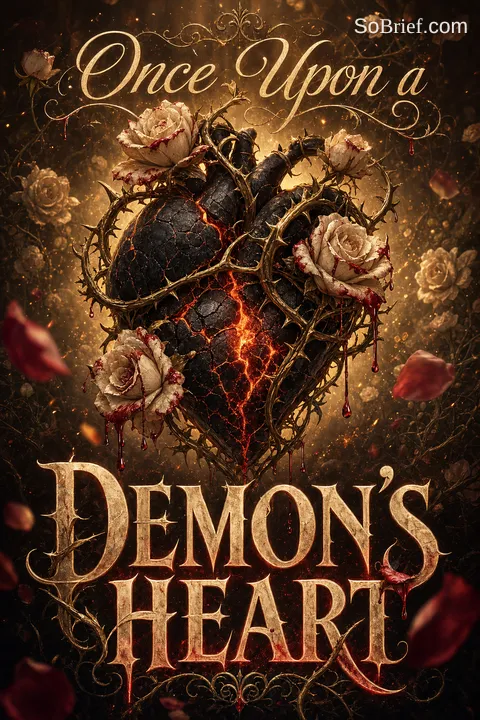


Plot Summary
Twenty Loops of Blood
Alira,1 a knight of Alzhor, has been murdered twenty times by the Blood Knight2 in a cruel time loop that resets one week before his raid on her kingdom. In this latest death, his amber eyes finally register something human, but she still awakens in her cot, right back at the start. Exhausted and hopeless, she decides to abandon her kingdom rather than watch her comrades slaughtered again.
She packs bread, honey, and her sword, leaving her armor behind, and rides her mare Venrey into the forbidden Florum Forest. She thinks of the old house mother's tales: "Wish upon a demon's heart, for it very well might save you." She no longer believes in such things, but anything is better than another death.
The time loop functions as a psychological prison where Alira's agency is nullified. Her decision to flee is not cowardice but a desperate reclaiming of self after trauma has eroded her belief in purpose. The repetition of death has desensitized her to violence but magnified her guilt over Thornhall, creating a complex relationship with suffering that makes her both a perpetrator and a victim. This opening establishes the central question: can hope survive after you've died twenty times?
The Demon Apothecary
Deep in the luminescent woods, Alira1 establishes a camp at a hollow tree she has used for years. She returns from gathering wood to find a tall, cloaked man sitting by her fire, stirring a pot of soup. He introduces himself as Kalel,2 an apothecary searching for rare toadstools. When he smiles, she sees fangs. She reaches for her sword, but he remains calm, even offers her his bowl.
He tells her his mother died in the Thornhall massacre. Alira1 lies, saying she was not there. He lends her his dragon-hide cloak when she shivers, and before vanishing into the night, he advises her: "Try something new. I doubt you've tried everything." His words lodge in her chest, and by dawn she decides to return to Alzhor.
This meeting is a classic romantic fatal encounter masked as chance. She and Kalel are two war-wounded souls recognizing something in each other without knowing their histories are already tangled. The lie about Thornhall plants the seed of guilt that will dictate their power dynamic, while his unexpected kindness undermines everything she was taught about demons, setting up the deconstruction of generational hatred.
Venus's Secret Heir
Returning to Alzhor, Alira1 requests an audience with King Borlin.6 She volunteers to be the demon king's demanded bride, hoping to end the war that will otherwise annihilate her people. When the king hesitates, she reveals her long-kept secret: she is a daughter of Venus, the fertility goddess, capable of bearing children easily, a trait near-extinct among demigods.
Borlin,6 pale with shock and desperate, sends a dove with the offer. After three agonizing days, a reply comes on the very evening the massacre was fated: the demons accept. But the groom is not some anonymous high lord. It is Duke Lornhelm,2 the Blood Knight himself, and he will arrive that night with his army to collect her.
Alira's choice is a radical act of agency within the role of sacrifice. By offering her body and her bloodline, she leverages the very thing that made her feel like an outcast (the heat cycles) into a bargaining chip. It reframes the timeline: instead of dying as a knight, she will live as a hostage bride, but on her own terms. The dramatic irony is that she unknowingly places herself directly into the hands of her killer.
The Devil's March
The demon army marches into Alzhor as snow begins to fall. Kalel2 dismounts, ignoring King Borlin's6 proffered hand, and addresses only Alira.1 He recounts her slaughters, her role at Thornhall, and promises her a suffering far worse than she can imagine. In a private chamber, he orders her to remove her helmet to verify her Venus mark.
When she unmasks, recognition freezes them both: it is the woman from the forest.1 His harsh demeanor cracks for an instant before he coldly pronounces the mark valid. As they leave the castle, he murmurs over his shoulder that he wishes it was not her. The demigod song of the gods, meant to send her off, is drowned by her dread.
This scene inverts the fairytale wedding retrieval into a hostage exchange. Kalel's public cruelty and private flicker of regret create a layered antagonist: he performs the role of conqueror, but his recognition suggests a personal wound. The verification of her body (the intimate examination) reasserts his power while exposing her vulnerability. The unspoken 'why' hangs between them: why does it matter that it's her?
A Heart Tied with Blood
At the demon camp, Kalel2 demands a sacred oath to ensure she will not attempt to kill him. Drawing deeply on her soul essence, Alira1 incants the binding words, and a golden mark sears itself onto both their chests. The magic drain sends her into a day-long unconsciousness. She wakes in a fresh tent, stripped of her armor and washed in Kalel's2 scent, his cold hand brushing her inner thigh.
He explains that demigod odor attracts violence and she must carry his mark to survive in Devicit. He then sinks his fangs into her neck and drinks, his venom causing a sharp, spreading paralysis. She realizes he is a Devourer,2 a demon who feeds on deity blood to sustain his immortal life.
The sacred oath represents a spiritual marriage before the physical one. It ties her power to his life, establishing a mutual dependence she does not yet grasp. The washing and scenting strip away her old identity as a knight and rebrand her as his possession, yet the tenderness of his touch while she slept hints at ambivalence. The first feeding is a violation that mimics erotic submission, confusing her body's response with her mind's revulsion.
Soup and Suppressed Heat
During a bitterly cold trek, Kalel2 leads Alira1 to an abandoned cottage to warm her. He brews a soup of foxflick and barbosi toadstools, revealing his genuine apothecary skills. As the fire thaws her, her dormant heat cycle flares. She finds herself grinding against his lap, and his body responds despite his loathing.
He bites her neck to divert the crisis, but the shift between them is palpable. He admits that the scenting is causing his own first heat cycle, a painful, unfamiliar condition for him. Though he resists fully claiming her, the boundary between punishment and intimacy has thinned. Before they leave, he drapes a fur blanket over her shoulders and feeds her soup himself.
The domestic setting of the cottage strips away the battlefield roles, revealing two lonely people who find comfort in the act of providing. The soup, a gift of sustenance rather than dominance, is Kalel's first unguarded kindness. The simultaneous heat cycles are both a curse of their incompatible species and an undeniable signal of a deeper, supernatural compatibility, forcing both to confront desire they have been conditioned to suppress.
The First Taking
That night, Kalel's2 heat erupts fully. Trembling with pain and barely restrained fury, he shouts at Alira1 to flee, but she refuses. She touches his sweat-drenched face, telling him she can bear his darkness. He snaps, pinning her to the ground, and ruts into her with brutal, punishing thrusts, his words a litany of hate while golden tears fall from his eyes.
She wraps her arms around him, whispering she would take his suffering if she could. He withdraws abruptly, storms out, and returns at dawn to give her a warding charm embedded in Korin's9 necklace, plus proper winter clothes. His apology is stiff, his shame palpable. He admits he has never experienced heat before and blames the scenting.
This scene is the raw core of their enemies-to-lovers dynamic: hatred and violence as a dysfunctional form of intimacy. Kalel's tears betray that his cruelty is partially self-directed, a projection of the monster he believes himself to be. Alira's embrace, rather than rejection, disrupts his narrative of pure villainy, planting the terrifying possibility that he might be loved despite his worst self. The necklace becomes a symbol of protection replacing control.
Lethal Blossoms
On the march, four demon knights ambush Alira1 near a cliffside, pinning her down and attempting to use a devilstone to destroy her reproductive organs so she cannot bear demon heirs. Kalel2 watches from the trees, arms crossed. Alira,1 desperate, unleashes her dormant deity gift: with a surge of essence, she transforms her attackers into blush-colored cherry blossom petals that scatter on the snow.
When she confronts Kalel,2 he shrugs, saying he is not her protector. She retorts that his knights would still live if he had intervened. Later, in the tent, he applies ointment to the gash on her back where one attacker cut her, and then holds her through the night, warming her with his purr, calling her a needy little godling.
The revelation of Alira's lethal ability rebalances their power. She is not merely a blood source or a womb; she is a weapon. Kalel's non-intervention is a cruel test, yet his later care demonstrates that he values her survival regardless. The mythic transformation into flowers (a motif of Venus) underscores her divine heritage, suggesting that creation and destruction are two sides of the same maternal power. She is her mother's daughter.
Jaws of the Forest Spirit
At the blood-soaked Fallen Ridge, a pack of dire wolves, drawn by spilled deity blood, attacks the caravan. The enormous white spirit wolf seizes Alira1 in its jaws. Kalel,2 desperate, bargains: the wolves may have all other demigods in exchange for her life.
The spirit accepts, releasing her, but dozens of captives are devoured or escape. Alira1 lies dying from massive wounds. Nikolai3 cannot save her, so Kalel2 forces his own blood down her throat.
A demon's blood on a demigod is a one-time miracle; it heals her completely and, unknown to her at the time, severs the time loop curse. When Alira1 regains consciousness, she is furious over the lost captives, slaps Kalel,2 and in retaliation he savagely bites her wrist until she screams his full name in submission.
Kalel's bargain is a dark moral calculus: he sacrifices many to save one, marking Alira as irreplaceable to him. The blood transfusion is an act of profound violation and salvation, linking them in an almost sacramental exchange. His subsequent wrist bite is regressive punishment that reveals how fragile his self-control is when she questions him. The broken loop, though unknown to her, represents the completion of the curse's function: she was meant to die by his hand, but now he chooses life.
The Wisp's Warning
Outside camp, a will-o'-the-wisp appears, and despite Kalel's2 reluctance, Alira1 follows it into the forest. The vision transports her to a turquoise field where she sees a young Kalel,2 scarred and weeping, cursing the demigods for their cruelty. The god Mercury8 materializes, radiant and mocking. He warns her that marrying Kalel2 will bring only misery, that Kalel2 is destined to kill all half-gods.
He also hints that a deity was responsible for her time loop curse. When she demands to know Kalel's2 story, Mercury8 vanishes with a wink. The vision fades, and Alira1 returns to the dark forest, shaken but unswayed. Kalel,2 who followed, finds her and sees the sorrow in her eyes. He coldly walks away when she mentions what she saw.
Divine intervention takes the form of a biased warning, raising the question of whether the gods want peace or their own entertainment. Alira's refusal to heed Mercury despite the ominous prophecy demonstrates her growing investment in the flesh-and-blood Kalel over mythological narratives. The vision plants the seeds of his tragic origin, reframing his hatred not as demonic nature but as a scar left by demigod cruelty.
Penance in Thornhall
The army enters the ruined village of Thornhall. Kalel2 pauses at his childhood home, touching the doorframe where his mother marked his height. Then he leads Alira1 to a hilltop overlooking his troops. He declares that her blood will pay the fare for the innocent souls into the underworld.
Before the assembled demons, he sinks his fangs into her throat and drains her until she is golden and lifeless, sustained only by his venom's stasis. She floats in a near-death void for three days while the army continues its march. When she wakes, she is in his lap on horseback, and Kalel's2 face is etched with exhaustion and unspoken guilt. He has not fed in days, as if punishing himself too.
The bloodletting is the public climax of Kalel's vendetta, transforming private rage into a ritual of communal catharsis. Yet it also reveals the cost of revenge: he must harm the person he is beginning to love to satisfy the ghosts of his past. His refusal to feed while she recovers suggests guilt or a strange fidelity. The three-day sleep mirrors a mythological death and rebirth, after which their dynamic subtly shifts toward something more complex.
Dragon Tamer of Devicit
At the gates of Devicit, massive skull-faced dragons ambush the fleet, decimating the ranks. As they close on Alira,1 Nikolai3 shields her. In a moment of instinct, she cries out for them to stop and to leave. Incredibly, the dragons freeze, then obey, flying away. The stunned army erupts in cheers, and Nikolai3 proclaims her a dragon tamer.
Kalel2 regards her with wary awe: this power could make her the most dangerous weapon in Faultore. They pass through the shimmering veil into the hidden kingdom, a lush, beautiful city of crystal streets and lantern-lit avenues. The demons gawk and whisper. Kalel2 pulls her close on his horse and whispers that they are home.
Commanding the dragons elevates Alira from a political hostage to a figure of mythic power, altering how everyone, including Kalel, perceives her. Her choice not to use the dragons against the demons affirms her commitment to peace, earning a measure of respect from the army. This moment also introduces the dragon lore and the possible connection to her Venusian bloodline, positioning her as a bridge between the mortal and the divine.
The Krinsle's Binding
The wedding ceremony in the grand Devicit chapel is a hostile affair. The ancient, eight-foot-tall Krinsle,10 a demon of ancient power, begins the rites. Before the binding can finish, a princess (King Achill's5 sister) lunges at Alira1 with a devilstone, searing her neck.
Kalel2 rips the woman's heart from her chest without hesitation. The Krinsle,10 unfazed, completes the binding, and the couple's lips meet in a kiss that feels both holy and haunted. That night, before the banquet, Kalel2 drunkenly pulls Alira1 into a dark corridor.
He confesses that he is the boy she found in Florum thirty years ago, the one she draped her coat over, the one who was beaten, used as bait, and left for dead until Pluto7 resurrected him. He has thought of her ever since.
The interrupted wedding ritual mirrors their entire relationship: violence and union are inseparable. Kalel's instantaneous lethal response to the assassin reaffirms that, despite his coldness, he will kill for her. The childhood confession retroactively transforms his hatred into something far more tangled: he punished the girl he once credited with saving him. The revelation that Pluto needed her prayer to revive him places her at the very origin of his second life, making her simultaneously the cause of his suffering and his salvation.
Claimed Beneath the Stars
After the ball dances, Kalel2 takes Alira1 to a marble tower overlooking the palace gardens. He feeds tenderly from her breast, then positions her on his lap, lowering her onto his thick cock. Despite the stretch and the ache, she welcomes him.
He knots her for the first time, the swollen base locking them together as he floods her womb with his seed, a full demon mating. She faints from the overwhelming sensation. As he carries her back, he stops in the garden, staring at the endless peonies.
His thoughts reveal the truth: each peony is a demigod he transformed. He also remembers that he was the one who cursed her with the time loop, petitioning Pluto7 for vengeance against the knight who led Thornhall.1 He loves her but knows she will hate him when she learns.
The physical consummation is framed as an act of love, yet undercut by Kalel's internal monologue of deception. The peonies, which Alira adores, are macabre trophies of his past murders, symbolizing the beauty that hides horror. The revelation of his role in her curse completes his character arc from wounded avenger to architect of her suffering. The knotting, a biological lock, metaphorically binds her to a man whose secrets could destroy her. The chapter ends on a terrible irony: the peace they built is poisoned at its root.
Epilogue
The god Pluto7 lounges in the underworld, watching the story unfold in dark pools. He muses on the mess Kalel2 has made, the chess pieces of fate nudged by Venus's wisp and Mercury's8 warning. He recalls the night he saved the dying boy: Alira's1 prayer over Kalel's2 corpse provided the holy blood invocation he required to intervene.
Pluto7 granted Kalel's2 curse on the Thornhall knight, never expecting it would fall on the girl who wept for him.1 He notes that a demon cursed by a deity is cold to touch, and that Kalel's2 warmth after giving his blood signals the breaking of the loop. Alira1 was too ignorant of old lore to see the clue. He smiles, a game master amused by the suffering of his pieces.
Pluto's perspective frames the entire narrative as divine entertainment, a Greek-style tragedy orchestrated by bored gods. The epilogue reveals the mechanics of the curse (a demon's cold touch indicates they are bound to a curse they cast) and explains why Kalel became warm after healing Alira: the loop was broken. It also clarifies that Venus's wisp and Mercury's visit were opposing moves in a celestial game, with Pluto as the amused arbiter. The final line ('only written in gilded blood can it be undone') suggests that the next book will require further sacrifice to resolve the tangled debts.
Analysis
This novel operates as a dark exploration of redemption through punishment, using the enemies-to-lovers framework to interrogate whether love can survive when the beloved is also the tormentor. Alira's1 journey is not simply about falling for a demon; it is about confronting her own guilt. She was a soldier who followed genocidal orders, and the narrative refuses to absolve her by claiming she was just following orders. Instead, it places her in a relationship where she willingly receives pain as penance, blurring the line between justice and masochism. Kalel,2 meanwhile, embodies the corrosive nature of vengeance: he became the very monster that demigod propaganda described, and his cruelty is rooted in genuine childhood trauma that the text does not dismiss. The central tragedy is that his love for Alira1 cannot undo his past actions, and his secrets (the time loop, the garden of transformed demigods, the trap for Alzhor) ensure that their union is built on a foundation of blood. The gods are not benevolent; they are callous players who view mortal suffering as a game, with Pluto7 explicitly framing the story as a chess match. The title's invocation of 'Once Upon a Demon's Heart' suggests a dark fairytale where wishes carry terrible costs. The novel ultimately asks: can you truly love someone if you do not know the worst of what they have done? Book one closes with that question unanswered, leaving Alira1 in a garden of beautiful corpses while the man she loves2 prepares to destroy her homeland.
Review Summary
People Also Read



Characters
Alira
Demigod Knight, Bride of PenanceA thirty-eight-year-old orphan knight of Alzhor with silvery hair and lavender eyes. She is the secret daughter of Venus, inheriting rare fertility and the power to turn living enemies into cherry blossoms with a touch. Trapped in a time loop where the Blood Knight2 kills her, she is consumed by guilt over her role in the Thornhall massacre. Her arc moves from suicidal desensitization to a determined search for meaning, finding unexpected compassion for demons and a forbidden love for the man who was once her executioner2. She struggles with self-worth, believing she deserves punishment, yet her innate empathy repeatedly breaks through her soldier's armor.
Kalel Lornhelm
The Blood Knight, Devourer DukeThe immortal duke of Devicit, a near-seven-foot-tall demon with sharp fangs, amber eyes, and a red scar across his left cheek. He is a Devourer who must drink demigod blood, a gifted apothecary, and the most feared knight in Faultore. As a child, he wandered into Florum Forest, where Alira1 found him; the subsequent betrayal and murder of his uncles by demigods scarred him physically and spiritually. Pluto7 resurrected him, and he grew into a man driven by vengeance, yet haunted by the memory of the silver-haired girl. He cursed the knight who led Thornhall (unknowingly Alira1) to a time loop. His love for her wars with his hatred, making him cruel and tender by turns.
Nikolai
Healer Apprentice, Mind ReaderA ninety-two-year-old demon with fawn hair, small goat horns, and warm brown eyes. He is Mav's apprentice, tasked with healing Alira1. He possesses the ability to read intentions and emotions, which he uses to verify Alira's1 genuine desire for peace. He is charming, kind, and deeply empathetic, having lost loved ones in Thornhall himself but choosing forgiveness. He becomes Alira's1 staunch ally, though his growing fondness for her stirs Kalel's2 jealousy. His philosophy, taught by his father, is to find good fortune in bad luck.
Tessa
Sea-Dweller LieutenantA loyal lieutenant in Kalel's2 army, with ruby eyes and golden scales at her hairline. She lost a sister-in-law in Thornhall and is the sole provider for her ill brother and his daughter. Initially wary of Alira1, she gradually warms to the demigod, recognizing that the real monsters were her own king's commanders. She is pragmatic, dutiful, and serves as a bridge between the hostile knights and Alira1, often sharing information that Kalel2 withholds.
King Achill
Young Monarch, Envious FriendThe youngest king in Devicit's history, with ash-blond hair and piercing cerulean eyes. He projects charm and generosity but is dangerously possessive and vain. He and Kalel2 trained together as boys, though he secretly envies Kalel's2 natural happiness and has repeatedly sent him into deadly battles hoping he would perish. He views Alira1 as a valuable breeding asset and openly suggests he might claim her if Kalel2 dies. His cool demeanor masks a volatile, vengeful nature.
King Borlin
Regretful Demigod RulerThe aging king of Alzhor, haunted by his own treacherous strategy in the war. He ordered the false treaty that led to Thornhall's slaughter, which in turn provoked the demons' relentless retaliation. He accepted Alira's1 offer with weary relief, treating her as a necessary sacrifice while mourning what his kingdom has become.
Pluto
God of the Underworld, ObserverA cloaked deity who appears only when holy blood and death intersect. He resurrected Kalel2 as a boy after overhearing Alira's1 prayer, and later granted Kalel's2 request to curse the Thornhall knight with a time loop. He watches the unfolding drama with detached amusement, playing a long game with the other gods. His touch is cold, his eyes like pomegranates.
Mercury
Messenger God, Warning BearerA glittering, sardonic deity who appears to Alira1 in a wisp vision. He warns her to abandon Kalel2, proclaiming that the union will bring only ruin and that Kalel2 is fated to kill demigods. He also hints that a god placed the loop curse, though he refuses to elaborate. His message, framed as helpful, seems more like a test of faith.
Korin
Alzhorian Fellow KnightAlira's1 closest friend in the Alzhor barracks, a Ceres-descendant who shares a sisterly bond with Alira1. She gifts Alira1 a silver heart-shaped pendant before the departure, which becomes a powerful talisman, later warded by Kalel2 and secretly embedded with a tracking spell by Borlin6.
The Krinsle
Ancient Binding DemonA towering, shadowy figure in crimson robes who performs the wedding ceremony. Its hands are skeletal, its voice ancient and haunting, and its touch leaves ash on the lips. Despite its fearsome appearance, its magic is gentle, and it offers Alira1 a cryptic warning that the gods watch her closely.
Plot Devices
The Time Loop Curse
Divine Punishment and Narrative EnginePluto7 granted Kalel's2 wish to curse the knight who led the Thornhall attack, causing that knight (Alira1, unknowingly) to relive the week of the demon raid twenty times, each ending with Kalel2 killing her. The loop resets upon her death. It is broken when Kalel2 gives Alira1 his own blood to save her life from dire wolf wounds, a one-time act that severs the curse. The curse served as both a torture device and a catalyst for the story, forcing Alira1 to seek escape and Kalel2 to eventually discover her identity.
Devilstone
Demigod-Slaying WeaponA black stone resembling coal that burns demigod flesh on contact and can render gods into ash. Thought to have been destroyed centuries ago, multiple stones appear in the story: knights attempt to use one to destroy Alira's1 womb, and a princess wields one during the wedding ceremony. Their reappearance suggests a hidden source or divine malevolence, and they represent a mortal threat to Alira1 that even Kalel2 struggles to guard against.
Scenting and Heat Cycles
Biological Bonding MechanismDemons mark their territory and partners by licking scent glands, transferring their signature odor to claim and protect. This process triggers heat cycles in both parties: Alira1, as a Venus daughter, has intense heats; Kalel2, as a Devourer who has never mated, experiences his first heat due to her proximity. The scenting ritual forces physical intimacy, creating a feedback loop where they crave each other's touch while their rational minds resist. It serves as a metaphor for their growing emotional bond overriding species enmity.
Will-o'-the-Wisps
Divine Vision Delivery SystemLuminous orbs that appear in forests, capable of transcending time to show visions of past, present, or future. Mercury8 uses one to warn Alira1 of Kalel's2 dangerous fate, while Venus previously sent one to Kalel2 to reveal the Thornhall attack in advance (though he arrived too late). The wisps require the observer to follow them to completion, and they can only be sent by gods or powerful spirits, making them instruments of divine communication and manipulation.
Kalel's Devourer Blood
Curse Breaker and Healing ElixirDevourer venom sustains demigods during exsanguination, preventing death. When Kalel2 fed Alira1 his own blood, it acted as a one-time miraculous cure that healed her fatal dire wolf wounds and, unknown to her, shattered the time loop curse. The act of a cursed demon giving his blood to the curse's victim creates a loophole in divine magic. This blood-sharing also deepened their connection, making him warm to her touch afterward, a physical sign of the curse's dissolution.


Download PDF
Download EPUB
.epub digital book format is ideal for reading ebooks on phones, tablets, and e-readers.








































