
Key Takeaways
1. Prioritize Quality of Life Over Quantity
We should strive, not to live long, but to live rightly; for to achieve long life you have need of Fate only, but for right living you need the soul.
Live fully, not just long. Seneca argues that the true measure of life is its fullness and quality, not its mere duration. A life is genuinely long if the soul has achieved its proper Good and gained control over itself. An eighty-year life spent in idleness is not truly lived; it is merely a prolonged dying.
Measure by performance. We should measure our lives by their accomplishments and the depth of our experience, rather than by the number of years. A person who fulfills their duties and attains wisdom, even if they die young, has lived a complete life. In contrast, one who merely exists without purpose has died even before their physical demise.
Embrace each day. Seneca encourages us to view each day as if it were our last, ensuring that we invest our allotted time wisely. This perspective frees us from the greedy hopes of a long future and allows us to live fully in the present, making our lives noteworthy for their weight, like precious jewels, rather than their width.
2. Embrace Fate and Endure Hardship
Whatever happens, assume that it was bound to happen, and do not be willing to rail at Nature.
Accept life's inevitable tax. Seneca asserts that complaining about hardships is often the only real misery. Life, like a long journey, inherently includes dust, mud, and rain. We should not hope to escape these "taxes of life," but rather train ourselves to not only obey God's decisions but to agree with them willingly.
Prepare for the unforeseen. To face dangers courageously, one must anticipate them and prepare the mind long in advance. Continual reflection on potential misfortunes prevents panic and allows us to withstand hardships with a stout heart. The unprepared are easily terrified, even by trifles.
Align with Nature. We cannot change the universal order of things, which brings cold, heat, illness, and various dangers. Our power lies in acquiring a strong spirit, worthy of good men, to courageously endure chance and live in harmony with Nature's changing seasons and inevitable laws.
3. Conscience is the Ultimate Judge of Vice
The first and worst penalty of sin is to have committed sin; and crime, though Fortune deck it out with her favours, though she protect and take it in her charge, can never go unpunished; since the punishment of crime lies in the crime itself.
Vices are timeless. Seneca refutes the idea that vices like luxury and moral decay are unique to any particular age. Instead, they are inherent to mankind, with no era being entirely free from blame. He cites historical examples, like the Clodius trial, to show that corruption and debauchery have always existed, often openly.
Inescapable inner torment. Even if a wrongdoer escapes legal punishment or public notice, they can never escape the internal torment of their conscience. This constant fear, terror, and distrust in one's own security is the primary and most severe penalty for sin. Fortune may grant temporary safety, but never true ease of mind.
Nature condemns crime. Our innate aversion to crime is evident because even in safety, wrongdoers feel fear. This internal loathing for what Nature has condemned serves as a constant whip, driving and torturing the conscience. This internal punishment ensures that grievous offenses against nature always pay their penalty, even if it's through fear rather than external suffering.
4. True Happiness is Internal, Independent of Fortune
You need never believe that anyone who depends upon happiness is happy!
Fragile external joys. Happiness derived from external, adventitious things is a fragile support, destined to depart as it arrived. True joy, however, springs wholly from within, remaining loyal and increasing over time, accompanying us to the very end.
Soul's power over Fortune. The soul is more powerful than any external Fortune. It possesses the agency to guide its affairs towards either happiness or wretchedness. A bad person makes everything bad, while an upright person corrects Fortune's wrongs, enduring hardship and accepting prosperity with moderation.
Prepare for loss. To be truly poised, one must reflect on the possible ups and downs of human affairs before they occur. Regard loved ones and possessions with the understanding that they may not be permanent. Grief for something lost is no different from the fear of losing it; therefore, cultivate a spirit of confidence and a mind resolved to endure all things.
5. Death is a Transition, Not an End
That day, which you fear as being the end of all things, is the birthday of your eternity.
Prelude to a greater life. Seneca views mortal existence as a preparation for a longer and better life, much like the womb prepares a child for birth. The delays of our earthly life are merely a prelude to a different beginning and condition.
Soul's boundless nature. The human soul is a great and noble entity, capable of reaching out into the boundless universe and sharing limits with the gods. It is not confined to a lowly birthplace or a narrow span of existence, but rather claims all time for the progress of thought.
Shedding the earthly burden. Death is not an annihilation but a stripping away of the body, which is merely a temporary dwelling or an inn. The soul, on that day, leaves its earthly prison and betakes itself to the gods, having been destined to pass into the infinity of time and the heritage of eternity.
6. Man is Man's Greatest Danger
But damage from man is instantaneous, and the nearer it comes the more carefully it is concealed.
Beware of fellow-men. Seneca warns that the most frequent, persistent, and insidious dangers come not from accidents like fires or shipwrecks, but from other people. Unlike natural disasters that often give warning, harm from man is instantaneous and often concealed until it's too late.
Human nature's dark side. While animals harm only when compelled by hunger or fear, man often delights in ruining man. Trusting the countenances of others is a mistake, as they may have the aspect of men but the souls of brutes, capable of inflicting harm without immediate provocation.
Philosophy as refuge. To navigate these dangers, one must strive to harm no one, rejoice in others' joys, and sympathize in their troubles. Ultimately, philosophy offers the best refuge, cherishing and protecting us in its sanctuary, making us safer from the collisions that occur when people travel the same path.
7. Peace of Mind Requires Internal Change, Not External Travel
If you would escape your troubles, you need not another place but another personality.
Travel in your own company. Seneca highlights the futility of seeking peace of mind through travel alone. As Socrates observed, if one travels in their own company, they bring their vexations, worries, and fears with them. Changing locations does not change one's inner state.
Internal transformation. True escape from troubles requires a fundamental change in personality and character. Whether one is vexed by poverty, ambition, or fear of death, these are internal states that cannot be outrun by crossing seas or visiting new cities. The mind must be reformed, its burdens shed, and cravings kept within safe limits.
Cultivate inner strength. Instead of seeking external remedies, we should cultivate a strong, healthy mind. This involves:
- Rejecting pleasures that weaken us.
- Spurning wealth, which is a "diploma of slavery."
- Living with wise companions (Socrates, Zeno, Cato) to strengthen our resolve.
By doing so, we can become superior to Fortune, ready to receive her missiles without flinching.
8. Philosophy's Purpose is to Live, Not Just Debate
All study of philosophy and all reading should be applied to the idea of living the happy life, that we should not hunt out archaic or far-fetched words and eccentric metaphors and figures of speech, but that we should seek precepts which will help us, utterances of courage and spirit which may at once be turned into facts.
Beyond mere words. Seneca frequently criticizes philosophical debates that devolve into subtle quibbles and mental gymnastics, such as discussing the corporeality of virtues or the distinction between "wisdom" and "being wise." Such pursuits, he argues, make men clever but not good, wasting precious time that should be dedicated to practical moral improvement.
Focus on character. The true aim of philosophy is to build character, to make one braver, more just, more restrained, and loftier of spirit. It should provide precepts and doctrines that can be immediately translated into action, helping us to live rightly and overcome life's challenges, rather than merely entertaining the mind with abstract concepts.
Teachers must embody wisdom. A philosopher's words are only truly their own if they live according to what they preach. A teacher who castigates faults while indulging in them themselves is useless, like a seasick pilot in a storm. The goal is to learn for life, not for the lecture-room, and to transform words into deeds.
9. True Riches Lie in Contentment, Not Possessions
He who has much desires more – a proof that he has not yet acquired enough; but he who has enough has attained that which never fell to the rich man's lot – a stopping-point.
Freedom from worry. Seneca reveals the secret to becoming rich quickly: borrow from yourself by desiring nothing. True wealth is not about possessing much, but about being free from craving and worry. He who has enough has reached a stopping-point that the truly rich, always desiring more, never attain.
Nature's simple demands. Nature's demands are few and easily satisfied, either without cost or very cheaply. She only requires that hunger be filled and thirst quenched, without concern for the quality of food or the vessel from which one drinks. Anything beyond these basic needs is superfluous and a mere "extra."
The illusion of wealth. Material wealth often blinds and attracts the mob, but it is ultimately useless to its possessors and onlookers alike. It brings greater agony in its possession than in its acquisition, and whatever cannot be gained in addition feels like a loss. True riches, free from fear and the sensation of poverty, are found in aligning one's affairs with nature's demands.
10. Character is Reflected in Style and Action
A man's speech is just like his life.
Style as a mirror. Seneca posits that a person's style of speech and writing is a direct reflection of their character and the moral state of their age. A wholesome, well-ordered soul produces sound and sober expression, while a degenerate soul leads to lax, effeminate, or eccentric language.
Beyond superficiality. Just as luxurious banquets and elaborate dress indicate disease in the state, a corrupt style, if popular, reveals a mind that has lost its balance. True dignity in expression comes from a vigorous, energetic, and manly soul, not from artificial polish or ostentatious wordplay.
Consistency reveals virtue. The greatest proof of a sound mind is consistency in action and character. Those who constantly shift their plans, prayers, and personas, vacillating between virtue and vice, demonstrate an evil and foolish mind. The wise man, however, maintains a single, unwavering character throughout life's drama.
11. Master Your Emotions by Preventing Their Inception
Every emotion at the start is weak. Afterwards, it rouses itself and gains strength by progress; it is more easy to forestall it than to forgo it.
Early resistance is key. Seneca argues that it is far easier to prevent emotions from taking root than to control them once they have gained strength. Every emotion begins weakly but grows powerful with indulgence. Allowing even a "certain amount" of grief or fear can lead to an uncontrollable excess.
Nature's intent for pleasure. Nature intermingled pleasure with necessary things not for pleasure's sake, but to make essential means of existence attractive. When pleasure claims rights of its own, it becomes luxury and a vice. We must resist these faults at their entrance, as it's easier to deny them admittance than to make them depart.
Know your weakness. Panaetius's advice regarding love—that those far from wisdom should not trust themselves to a disordered, uncontrolled state—applies to all emotions. We should step back from slippery places, knowing our unstable spirit. The Stoic ideal of rejecting emotions is attainable if we believe in our power and choose to shake off vices rather than make excuses for them.
12. The True Good is Attained by Reason, Unique to Man
Therefore, good can exist only in that which possesses reason.
Reason's supreme judgment. Seneca asserts that the Good is a matter of understanding, grasped by the mind, not the senses. If senses judged good and evil, we would never reject pleasure or voluntarily endure pain. Reason, as the governing element, makes decisions concerning the happy life, virtue, and honor.
Good is perfected reason. The true Good is not found in trees, dumb animals, or even infants, because they lack reason. It is the beginning of a Good, not the Good itself, that is present at birth. The Good exists only when both reason and man are perfected, manifesting as a free, upright mind that rivals God's.
Man's unique privilege. Man, as a reasoning animal, possesses the unique privilege of attaining this perfect reason. Unlike animals, who are surpassed by man in intellect, man should cultivate his mind, not his physical strength or beauty. True happiness comes when all joys are born of reason, and one desires nothing that the world clutches at or prays for.
Review Summary
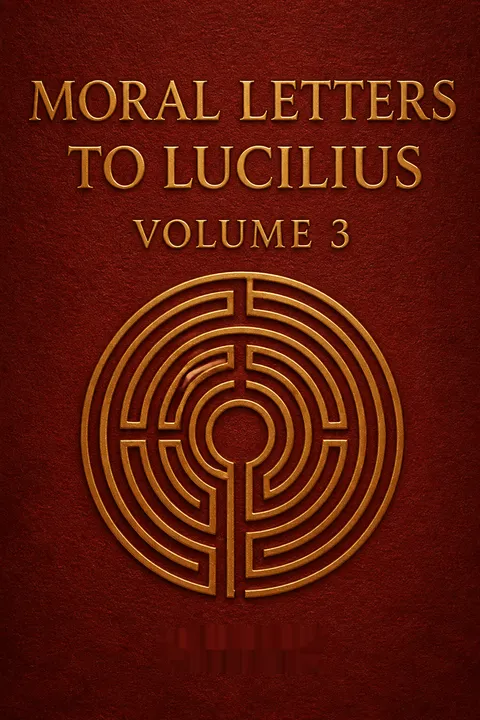
Readers highly praise Moral letters to Lucilius. Volume 3, giving it an impressive 4.53 out of 5 stars. Reviewers express a deep appreciation for Seneca's wisdom, with one wishing they could meet him personally. Another reader found the book intellectually challenging but rewarding, noting its theoretical and practical value. The concise yet enthusiastic "So good" review further emphasizes the book's impact. Overall, readers find the work thought-provoking and highly valuable, despite its challenging nature.
People Also Read




About the Author
Other books by Seneca


Download PDF
Download EPUB
.epub digital book format is ideal for reading ebooks on phones, tablets, and e-readers.








































