

Key Takeaways
Rehearse the worst each morning, then choose compassion anyway
Marcus's daily inoculation against bitterness. The most powerful man in Rome began each day with this exercise: "Say to yourself in the early morning: I shall meet to-day inquisitive, ungrateful, violent, treacherous, envious, uncharitable men." Not to breed cynicism, but to disarm it. By naming the inevitable friction of human contact before sunrise, he neutralized its sting.
The twist is what follows the warning. These difficult people share your nature — they possess reason, they are your kin. Their wrongdoing comes from ignorance of real good and evil, not deliberate malice. Marcus's morning meditation doesn't end with bracing for impact. It ends with cooperation, because working against one another "is to oppose Nature, and to be vexed with another or to turn away from him is to tend to antagonism."

Events are neutral — your judgments manufacture all your suffering
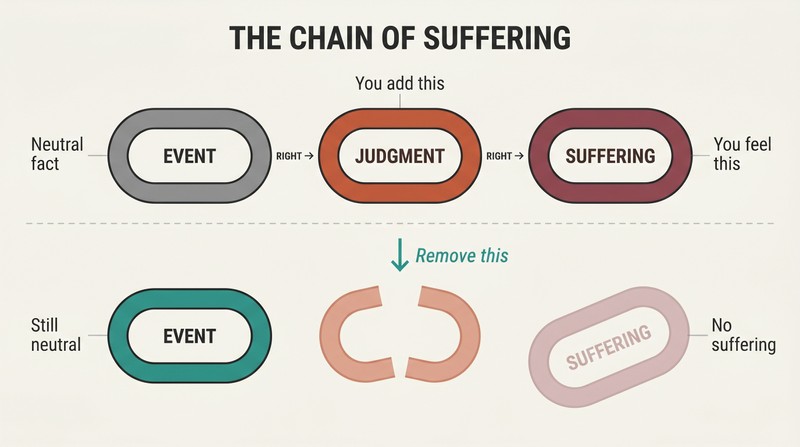
This three-step chain is Stoic psychology's core engine. External events — insults, losses, setbacks — stand outside the door of the soul. "Things as such do not touch the soul in the least: they have no avenue to the soul nor can they turn or move it." Only your mind's interpretation grants them entry. Marcus returns to this point dozens of times across twelve Books, suggesting he wrestled with it daily despite knowing it intellectually.
The practical technique is radical simplicity. When disturbed, identify the judgment you've attached to the raw event. Someone slighted you — that's the event. "I've been wronged" — that's the judgment you added. The cucumber is bitter? Put it down. Brambles in the path? Step aside. Don't also demand to know why they exist.
You carry the only retreat you'll ever need between your ears
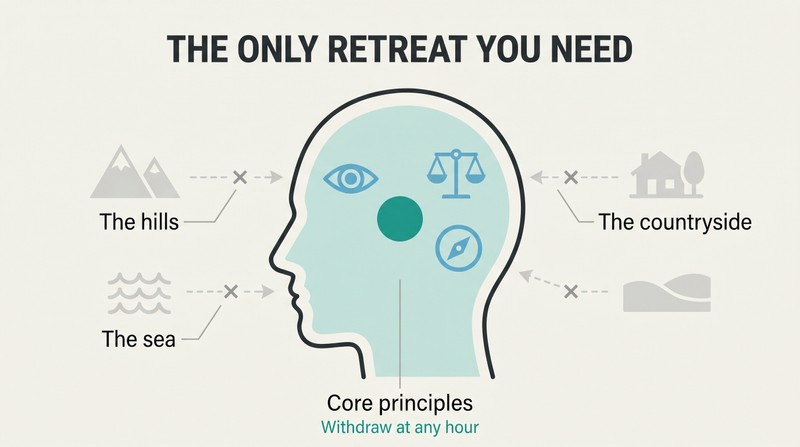
Marcus wrote this while commanding legions on the frozen Danube. No countryside villa in sight — yet he argues the longing for a physical retreat misunderstands what rest actually is. "Nowhere does a man retreat into more quiet or more privacy than into his own mind." You can withdraw at any hour and there find principles that restore calm instantly.
The practice isn't meditation in the modern sense. It's a rapid return to a handful of core truths that reset your orientation. When disturbed by wickedness, recall that people err involuntarily. When troubled by fate, remember "either Providence or blind atoms." When chasing glory, consider the applauders will soon be dead. These brief doctrines suffice "to wash away all sorrow, and to send you back without repugnance to the life to which you return."
Guard your mental diet — your soul absorbs the color of your thoughts
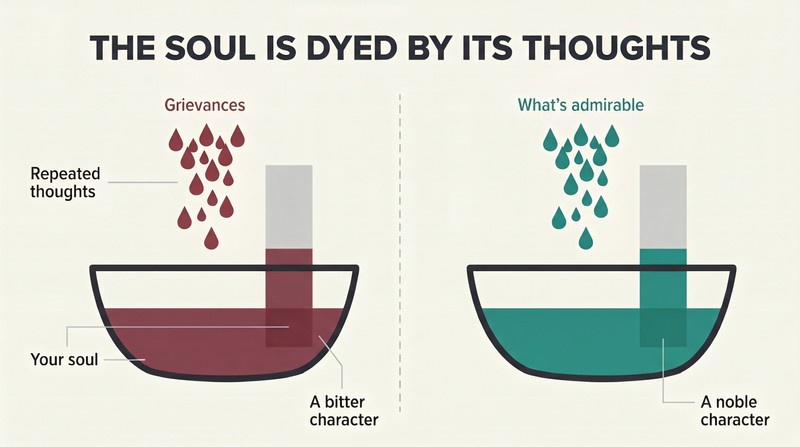
Marcus's dyer's-hand metaphor precedes cognitive psychology by eighteen centuries. Whatever you repeatedly imagine, contemplate, or expose yourself to stains your character permanently. Dwell on grievances and your soul turns bitter. Dwell on what's admirable and "nothing is so cheering as the images of the virtues shining in the character of contemporaries."
The prescription is active curation. "Dye it, then, in a succession of imaginations" that reinforce what you want to become. Marcus lists specific replacement thoughts: where it's possible to live, it's possible to live well; creatures are made for the purpose they serve; fellowship is the good of a reasonable creature. Guard the threshold of your mind, because "nothing you have not mastered may cross" it without your consent.
Convert every obstacle into raw material for the next virtue
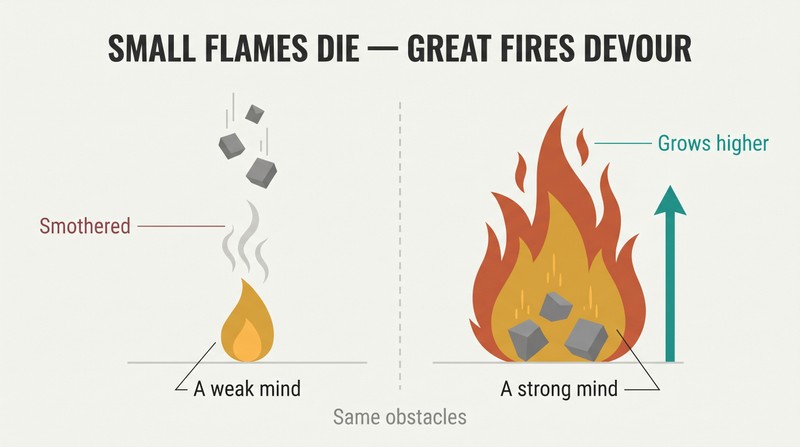
A small flame is extinguished by debris. A bonfire grows from it. Marcus opens Book IV with this metaphor that became the seed of an entire modern philosophy. Your mind can work the same way — transforming impediments into fuel. When someone blocks your intended action, you pivot to a different virtue: patience, forbearance, creativity. "A hindrance to a given duty becomes a help, an obstacle in a given path a furtherance."
This isn't optimistic spin. It's a specific claim about rational agency. Marcus prescribes setting out with what he calls a reservation — acting purposefully while accepting that outcomes may differ from your plan. If the original path closes, a new action "is at once substituted, which will fit into the plan of which we are speaking." Flexibility, not rigidity, is the mark of strength.
Love the people who stumble — they damage themselves more than you
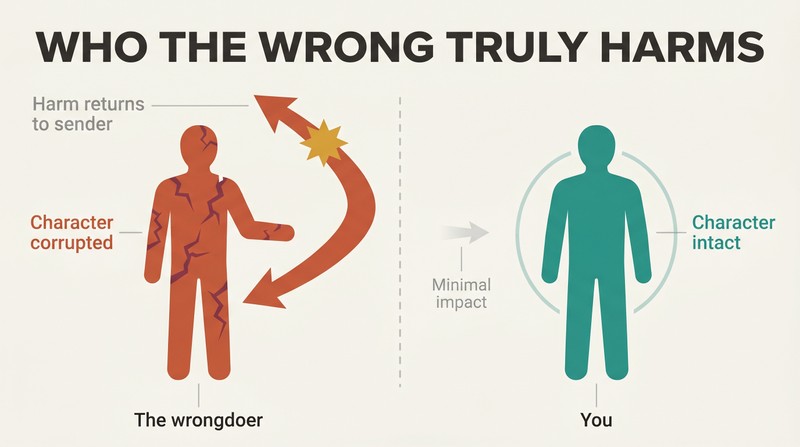
Marcus's charity toward wrongdoers is the most surprising theme in an Emperor's private journal. His reasoning: people do wrong from ignorance of what is truly good, not from malice. They pursue money, pleasure, or power believing these are genuine goods. Their error harms them more than it harms you, because it corrupts their character while leaving yours intact — unless you choose to be angry.
His practical framework for forgiveness:
1. Ask what misconception of good drove the offender
2. Examine whether you hold similar blind spots elsewhere
3. Remember both of you will shortly be dead
4. Recognize that "no soul is willing to be robbed of truth"
5. "If you can, change him by teaching, but if you cannot, remember that kindness was given you for this"
Fame is applause from people who can't tolerate themselves
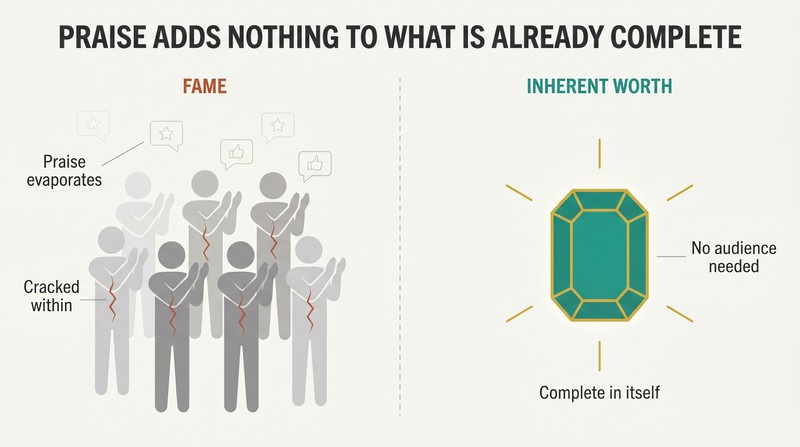
Marcus had more fame than almost any human alive. Emperor, conqueror, philosopher-king — yet he returns obsessively to fame's emptiness. The praise-givers will themselves be dead shortly, "and a little after not even your name nor his will be left." Furthermore, "how many whose praises have been loudly sung are now committed to oblivion: how many who sang their praises are long ago departed."
His antidote is the principle of intrinsic worth. "Everything in any way lovely is lovely of itself and terminates in itself, holding praise to be no part of itself." An emerald doesn't become worse if nobody praises it. Gold doesn't need applause. Neither does a just action. The cure for approval-seeking is recognizing that goodness is complete the moment it's done — no audience required.
Life is wrestling, not choreography — stay braced for the unforeseeable
Dancers rehearse choreographed sequences; wrestlers react to unpredictable attacks. Marcus uses this contrast to define the art of living: "The art of living resembles wrestling more than dancing, in as much as it stands prepared and unshaken to meet what comes and what it did not foresee." Preparation for life isn't about having the perfect plan but about cultivating the readiness to respond to anything.
The wrestler's stance — alert but calm, planted but mobile — is Marcus's image for a well-governed soul. Begin every action knowing it may be thwarted, every day knowing it might be your last. This stance requires neither panic nor apathy — "to be neither feverish nor apathetic." And it especially forbids performing goodness for an audience: "not to act a part."

Forget utopia — one honest step forward is no trifle
Marcus spent fourteen years fighting barbarians, watched plagues devastate his empire, and saw his trusted general revolt. He had every reason for disillusionment with grand schemes. His verdict on political idealists: "How cheap are these mere men with their policies and their philosophic practice… they are full of drivel. For who will change men's convictions?"
Rather than waiting for perfection, act now on what is possible. You cannot overhaul the world's character. You can be just in this conversation, honest in this decision, kind in this encounter. "The work of Philosophy is simplicity and self-respect; lead me not away to vainglory." Marcus, who governed the grandest empire on earth, considered each small act of integrity a sufficient victory for one day.

Death doesn't shorten life — only an unlived one is short
Marcus wrote his Meditations while commanding Roman legions during nearly continuous warfare. He died at 58, likely from plague. Yet his constant theme isn't fear of death — it's fear of wasting the time that remains. "Don't live as though you were going to live a myriad years. Fate is hanging over your head; while you have life, while you may, become good."
His argument flips the usual anxiety. Whether life lasts three acts or five, the plot is complete. The final words of the Meditations read like a dignified curtain call: a master of ceremonies dismisses his actor. "'But I have not spoken my five acts, only three.' 'What you say is true, but in life three acts are the whole play.'" What is terrifying is not death — it is reaching the end without ever having begun to live.

Analysis
The Meditations occupy a unique position in intellectual history: they are the only surviving document in which a sitting head of state — at the apex of the world's largest empire — conducts a private, unflinching examination of his own moral failures. This is not Machiavelli advising a prince; it is the prince advising himself, with no expectation of an audience. That biographical fact transforms what might otherwise read as Stoic boilerplate into something electrifying.
What Marcus achieves, philosophically, is a synthesis of Stoic determinism with radical moral agency. The universe is governed by inexorable law — 'either Providence or blind atoms' — yet within that framework, your judgments remain entirely your own. This is not the libertarian free will of Christianity nor the fatalism critics project onto Stoicism. It is closer to what Spinoza later called 'adequate ideas': freedom expressed through understanding necessity, not escaping it. The obstacle-as-material doctrine (Book IV) anticipates Nietzsche's amor fati by seventeen centuries.
The text's recurring tension — between pantheistic acceptance and visceral disgust at human pettiness — is its greatest literary asset. Marcus never resolves the contradiction between loving humanity as rational kin and finding most individuals revolting. This honesty is why the book endures: it documents not a saint's achieved serenity but a powerful man's daily struggle to be decent. The repeated themes are not evidence of poor editing; they are evidence of how hard the work actually is. You don't write 'stop being angry' forty times if you've mastered anger.
For modern readers, the Meditations function as cognitive-behavioral therapy avant la lettre. The core technique — intercepting automatic judgments before they generate emotional responses — maps directly onto Aaron Beck's cognitive model. Marcus's reservation principle anticipates what psychologists now call 'implementation intentions.' The book's enduring power lies not in its philosophy, which can be stated in a paragraph, but in its demonstration that even the most powerful person alive needs daily reminders to act on what he already knows.
Review Summary
Meditations receives high praise from most reviewers for its timeless wisdom and practical philosophy. Readers appreciate Marcus Aurelius' reflections on life, death, and human nature, finding them applicable to modern challenges. Many consider it a book to revisit regularly for guidance and perspective. Some note its repetitive nature and occasional difficulty in comprehension. Critics argue it may not resonate with everyone, but most agree on its enduring value as a classic work of Stoic philosophy, offering insights on virtue, duty, and living a meaningful life.
People Also Read








Glossary
Governing self
The mind's ruling rational facultyMarcus's term (translating the Stoic Greek 'hegemonikon') for the rational, decision-making core of human consciousness. It is the faculty that judges impressions, directs impulses, and determines conduct. Marcus holds that this governing self is the only part of a person that can be truly harmed or improved, and that it remains under the individual's control regardless of external circumstances.
Indifferent things
Morally neutral external circumstancesThe Stoic category for everything that is neither morally good nor morally evil—including death, life, pain, pleasure, wealth, poverty, honor, and dishonor. Marcus argues these 'befall men, good and bad alike, equally, and are themselves neither right nor wrong: they are therefore neither good nor ill.' Only virtue (right judgment and action) is truly good; only vice is truly evil.
Universal Nature
The rational force governing everythingMarcus's term for the divine Reason (Logos) that permeates and directs the entire universe as a living, purposeful whole. It creates, sustains, and dissolves all things according to necessary law. Marcus treats Universal Nature as both the source of providence and the standard against which human conduct should be measured. To 'live according to Nature' means to align one's rational will with this universal order.
Vital spirit
The body's animating breath-forceMarcus's term (translating the Stoic 'pneuma') for the material life-force that animates the physical body—distinct from both the flesh and the governing self. It encompasses biological drives, impulses, and sense-perceptions. In Marcus's tripartite model of the human being (body, vital spirit, mind), the vital spirit occupies a middle position, shared with animals, and should be subordinated to the governing rational faculty.
Reservation
Acting with built-in contingency plansA Stoic technical practice Marcus references when discussing purposeful action. It means undertaking any act with the mental qualification that the outcome may differ from your intention—accepting in advance that external obstacles may prevent completion. This allows the practitioner to act decisively while remaining undisturbed if circumstances change. Marcus writes: 'you set out with a reservation and were not aiming at the impossible.'
The Whole
The unified, organic universe itselfMarcus's preferred term for the cosmos understood as a single living organism—not a collection of separate parts but an interconnected unity governed by one Reason, one substance, and one law. 'There is one Universe out of all, one God through all, one substance and one law, one common Reason of all intelligent creatures and one truth.' Individual humans are members of this Whole, as limbs are members of a body.
FAQ
What's Meditations by Marcus Aurelius about?
- Philosophical Reflections: Meditations is a collection of personal writings by Marcus Aurelius, focusing on Stoic philosophy and life's nature. It serves as a guide for self-improvement and understanding one's place in the universe.
- Self-Examination: The text emphasizes self-reflection and maintaining a rational mind amidst chaos. Marcus encourages focusing on personal thoughts and actions rather than external influences.
- Acceptance of Fate: A recurring theme is accepting fate and the natural order. Marcus teaches embracing events as part of a greater design, promoting inner peace.
Why should I read Meditations by Marcus Aurelius?
- Timeless Wisdom: The insights are applicable to modern life, offering guidance on dealing with stress, adversity, and the human condition. Its teachings on resilience and virtue resonate today.
- Personal Growth: The book inspires personal growth and self-discipline, encouraging virtues like justice, temperance, and courage. Marcus's reflections motivate striving for a better self.
- Historical Context: Understanding a Roman Emperor's thoughts provides a unique perspective on leadership and ethics, exploring the intersection of philosophy and governance in ancient Rome.
What are the key takeaways of Meditations by Marcus Aurelius?
- Control Your Mind: Marcus emphasizes maintaining control over thoughts and reactions to external events, highlighting the importance of a rational mind.
- Embrace Change: The book teaches that change is a natural part of life, suggesting that accepting it can lead to tranquility.
- Live According to Nature: Marcus advocates living in harmony with nature and understanding one's role in the universe, emphasizing community and cooperation.
What are the best quotes from Meditations by Marcus Aurelius and what do they mean?
- "The Universe is change; life is opinion.": This encapsulates the Stoic belief that while circumstances change, perceptions shape experiences, encouraging a focus on mindset.
- "You have power over your mind—not outside events. Realize this, and you will find strength.": Marcus highlights that true power lies in responses to situations, reinforcing the Stoic principle of control.
- "Death is nature's way; it is not to be feared.": Reflects the Stoic acceptance of death as natural, alleviating fear of mortality and encouraging a fulfilling life.
How does Marcus Aurelius define virtue in Meditations?
- Moral Excellence: Virtue embodies qualities like justice, temperance, and courage, essential for a good life and societal role.
- Alignment with Nature: Virtue involves living in accordance with nature and reason, acting beneficially for oneself and others.
- Social Responsibility: Marcus asserts that virtue includes caring for others and contributing to the common good, highlighting humanity's interconnectedness.
What specific advice does Marcus Aurelius give for dealing with adversity in Meditations?
- Focus on the Present: Concentrate on the present moment, avoiding dwelling on past grievances or future anxieties.
- Reframe Your Thoughts: View challenges as opportunities for growth, emphasizing the power of perspective.
- Accept What You Cannot Control: Acceptance of fate is crucial, encouraging resilience by understanding that events are part of a greater design.
How does Meditations by Marcus Aurelius address the concept of death?
- Natural Process: Death is viewed as a natural part of life, encouraging acceptance rather than fear of mortality.
- Impermanence: Emphasizes life's fleeting nature, leading to a greater appreciation for the present.
- Legacy and Memory: Reflects on how quickly people are forgotten, urging a focus on living virtuously over seeking fame.
What role does community play in Meditations by Marcus Aurelius?
- Interconnectedness: Humans are inherently social beings, highlighting the importance of cooperation and mutual support.
- Moral Responsibility: Individuals have a duty to contribute positively to their communities, acting according to nature.
- Shared Experience: Recognizes shared human struggles, fostering empathy and understanding, reinforcing collective existence.
How does Marcus Aurelius suggest we cultivate inner peace in Meditations?
- Mindfulness: Advocates for mindfulness and self-awareness, examining thoughts to maintain calm amidst chaos.
- Acceptance of Fate: Accepting what comes to pass is essential for inner peace, promoting a mindset of acceptance.
- Focus on Virtue: Living virtuously aligns actions with moral principles, achieving harmony and contentment.
What is the significance of self-reflection in Meditations by Marcus Aurelius?
- Path to Understanding: Self-reflection is crucial for understanding thoughts and actions, encouraging examination of one's inner life.
- Personal Growth: Identifies areas for improvement, emphasizing the potential for change and personal growth.
- Connection to Nature: Helps align with true nature, navigating life's complexities and fulfilling one's role in the universe.
How does Marcus Aurelius view the relationship between individuals and the universe in Meditations?
- Interconnectedness: Emphasizes the interconnectedness of all beings, suggesting individual actions impact the greater whole.
- Divine Order: Believes the universe operates under a divine order, encouraging alignment with this order for peace.
- Moral Responsibility: Encourages just and compassionate actions, contributing to the universe's harmony.
What is the significance of the indwelling spirit in Meditations by Marcus Aurelius?
- Source of Guidance: Represents the rational and moral aspect of human nature, guiding towards virtuous living.
- Connection to the Divine: Connects individuals to the divine, suggesting a shared essence with the universe.
- Moral Integrity: Reminds of moral integrity and purpose, encouraging authentic living aligned with values.
About the Author
Download PDF
Download EPUB
.epub digital book format is ideal for reading ebooks on phones, tablets, and e-readers.








































