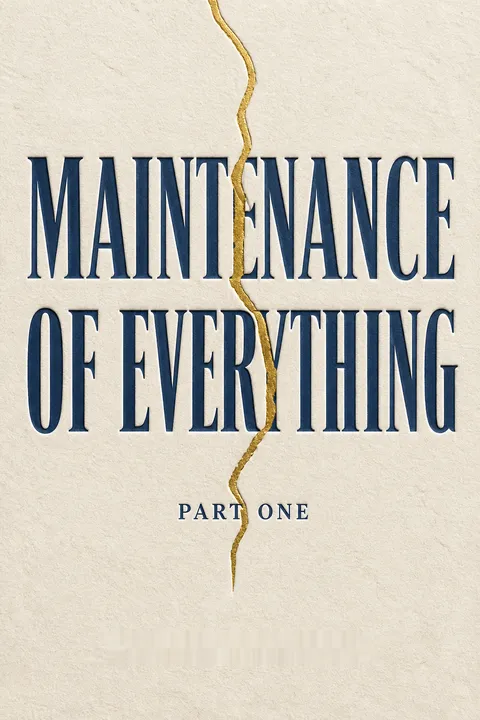

Key Takeaways
1. Maintenance is the Essential Art of Civilization
You should consider that the essential art of civilization is maintenance.
Fundamental necessity. Maintenance is the invisible, ceaseless effort that keeps all systems, from biological to societal, functioning. It's what prevents gradual decay from culminating in sudden, catastrophic failure, ensuring continuity and stability in everything we depend on.
The paradox of neglect. Despite its absolute necessity, maintenance is often perceived as optional, tiresome, and unrewarding, leading to deferral and neglect. This human tendency to shirk repetitive chores allows problems to accumulate invisibly until a system breaks, causing disruption, expense, and blame. Expanding the definition of maintenance to encompass the entire process of keeping a thing going, including occasional repair and eventual replacement, reveals its non-optional nature and inherent value.
A new perspective. Viewing maintenance as the "whole grand process" transforms it from a series of chores into a fundamental responsibility. This series aims to explore diverse maintenance domains—vehicles, buildings, cities, military, software, and the planet—to uncover universal insights and foster a "maintenance mind" that understands upkeep as a given, not an afterthought.
2. Maintenance Styles Dictate Outcomes and Survival
Probably a great many famous stories could be retold in terms of maintenance.
Three distinct approaches. The 1968 Golden Globe Race vividly illustrates how different maintenance philosophies lead to dramatically different fates. Robin Knox-Johnston embodied "Whatever comes, deal with it," relying on thorough preparation and ingenious improvisation to keep his boat, Suhaili, afloat for 312 days. Bernard Moitessier, with "Prepare for the worst," designed and outfitted his steel ketch Joshua for minimal, easy maintenance, allowing him to sail farther and faster with less worry.
The cost of neglect. Donald Crowhurst, in contrast, exemplified "Hope for the best," setting sail in an unready trimaran, neglecting critical repairs, and eventually resorting to a fraudulent logbook. His lack of preparation and disdain for "sailorizing" led to his psychological breakdown and suicide at sea, leaving behind a boat that reeked of unmethodical housekeeping and neglect. His story serves as a stark warning against the lethal consequences of an excessively optimistic view of the world when confronted with the gritty reality of decay.
Lessons from the sea. The race highlights that proactive, disciplined maintenance, whether through robust preparation or ingenious improvisation, is paramount for endurance in extreme conditions. Moitessier's meticulous attention to detail in Joshua's construction and his routine inspections freed him from worry, allowing him to enjoy the journey, while Knox-Johnston's "make do and mend" ethos enabled him to overcome relentless challenges.
3. Hands-On Maintenance Cultivates Mastery and Self-Reliance
You need an unhindered, open mind to detect subtle signals from the machine you’re trying to repair.
Beyond the workbench. Philosophers Matthew Crawford and Robert Pirsig argue that motorcycle maintenance is not just about fixing machines but about cultivating intelligence, self-reliance, and a deeper understanding of reality. Crawford, a professional mechanic, emphasizes that diagnosis is often more convoluted than simple decision trees, requiring logical investigation, a "larger gestalt," and experienced hunches.
Conquering gumption traps. Pirsig's seminal work introduces "gumption traps"—situations that destroy enthusiasm for repair. He identifies seven traps, five within the mechanic (hang-ups like value rigidity, ego, anxiety, impatience, boredom) and two in the machine (setbacks like out-of-sequence reassembly and intermittent failure). His advice for overcoming these includes:
- Stopping to think and emptying the mind Zen-style.
- Pretending to be open-minded to gradually develop it.
- Mapping out repairs on paper and allowing ample time.
- Periodically putting away tools to calm the mind.
- Taking tools on rides to diagnose intermittent failures in situ.
The essence of caring. Pirsig learned that true mastery comes from a "nondivided relationship between the mechanic and motorcycle, a craftsmanlike feeling for the work," rooted in caring. Understanding both how a machine works and how it's made, coupled with acquiring the best tools and performing routine inspections, transforms ownership into mastery, making one a "motorcycle scientist."
4. Precision Manufacturing Drives Progress and Repairability
For precision to be a phenomenon that would entirely alter human society, as it undeniably has done and will do for the foreseeable future, it has to be expressed in a form that is duplicable.
The quest for uniformity. The pursuit of precision, initially driven by military needs for interchangeable weapon parts, revolutionized manufacturing. John Wilkinson's 1774 cannon-boring technique, which created perfectly straight bores, was adapted to James Watt's steam engines, improving precision tenfold and fueling the Industrial Revolution. Honoré Blanc's 1785 demonstration of interchangeable musket parts in France, though initially suppressed by anti-mechanization sentiment, inspired American military leaders.
The American System. The US Army Ordnance Department, stung by the unrepairable weapons of the War of 1812, relentlessly pursued "armory practice." Innovations like Thomas Blanchard's lathe for gunstocks and John Hall's system for breech-loading rifles, which used 63 sets of gauges to achieve one-thousandth-of-an-inch precision, proved that genuinely interchangeable parts were possible. This system, openly shared by the government, became the "taproot of modern industrialism," spreading to sewing machines, bicycles, and eventually Henry Ford's Model T.
Ford's industrial precision. Henry Ford scaled precision to an unprecedented level, making parts so cheap and uniform that it was more economical to replace than repair them. His factories, equipped with specialized machine tools and Carl Edvard Johansson's gauge blocks (accurate to a millionth of an inch), produced a Model T every three minutes. This commitment to interchangeable parts, combined with a robust design that invited user adaptation, democratized car ownership and inspired widespread user creativity.
5. Accessible Knowledge Empowers User-Driven Maintenance
DOING THE VALVES, TIMING, AND MINOR MAINTENANCE ON YOUR OWN CAR WILL NOT ONLY CHANGE YOUR RELATIONSHIP WITH YOUR TRANSPORTATION BUT WILL ALSO CHANGE YOUR RELATIONSHIP WITH YOURSELF!
Democratizing repair. The most popular cars in history—the Ford Model T, Volkswagen Beetle, and Lada Classic—shared a common trait: they were cheap, durable, and designed for owner repair. This fostered a culture of self-reliance, where owners learned to fix their vehicles, often with the help of comprehensive manuals. John Muir's "How to Keep Your Volkswagen Alive: A Manual of Step-by-Step Procedures for the Compleat Idiot" became a legendary guide, empowering hippies to maintain their cars and, in doing so, transform their relationship with their transportation and themselves.
The internet's revolution. The advent of the internet, particularly YouTube, has profoundly democratized access to repair knowledge. Now, anyone can find how-to videos for virtually any device, often with detailed demonstrations, troubleshooting tips, and links to parts suppliers. This "telemaintenance" capability, combined with online parts retailers like Amazon and McMaster-Carr, has revolutionized personal repair, enabling amateurs to tackle complex tasks from plumbing to car engine rebuilds.
Empowering agency. YouTube's vast library of "how-to" and "teardown" videos fosters a "maintenance mind" by making advice readily available, easing the entry into self-repair. This accessibility confers agency, allowing individuals to take charge of their possessions and become calmly vigilant for troubling signs, rather than suppressing awareness of potential problems. The ability to learn and fix things on demand has unleashed ferocious democratization, allowing even niche communities to share expertise and collectively improve their skills.
6. Corrosion: Civilization's Costly and Unrelenting Foe
Because corrosion is exothermic, the skin of a corroding Ford becomes hotter than the metal underlying it, and this thermal gradient generates local stress called electrostriction.
The silent destroyer. Corrosion, essentially slow fire or "extractive metallurgy in reverse," is an incessant, often invisible process that converts metals back to their original ore state. It's a planet-scale expense, costing the global economy trillions annually. The most common form, rust (iron oxide), expands as it forms, flaking off and exposing more metal, leading to structural failure in everything from cars to concrete rebar.
The war on rust. Humanity's battle against corrosion is a continuous cycle of oiling, greasing, brushing, scraping, cleansing, and painting. Specialized coatings are the primary defense, with military organizations like the US Pentagon investing heavily in diverse paints—magnesium-rich, zinc-rich, epoxy-based, self-healing—designed for specific environments and applications. The goal is to create a perfect barrier, but defects like "cheesy, checked, rippled, wrinkled, peppery" coatings are common.
The Statue of Liberty's saga. The Statue of Liberty's century-long struggle with corrosion exemplifies the consequences of administrative neglect and botched maintenance. Gustav Eiffel's original design, which used asbestos to separate copper skin from an iron armature, inadvertently created a salt-water sponge that accelerated galvanic corrosion. Decades of changing custodianship and stopgap measures led to extensive damage, requiring a $1.5 billion restoration that involved replacing every iron armature bar with annealed, Teflon-taped stainless steel, a testament to the immense effort required to combat this pervasive enemy.
7. Sustainment: The Strategic Imperative for Prolonged Endurance
Sustainment is the provision of logistics, financial management, personnel services, and health service support necessary to maintain operations until successful mission completion.
Beyond maintenance. The US Army's adoption of "sustainment" as a core doctrine marks a shift from reactive "combat service support" to a proactive, strategic approach for "prolonged endurance" and "decisive action." Sustainment embraces a larger time frame than maintenance, focusing on managing the evolution of a system to maximize availability and minimize cost and footprint. It's a plan and a set of actions, not just a goal like "sustainability."
Mission command and adaptivity. Central to sustainment is "mission command," a philosophy empowering subordinates to act with initiative and flexibility based on a clear understanding of the commander's intent. This decentralized approach, honed by the Prussian army after Napoleon's victories, enables rapid adaptivity on the battlefield. In the 1973 Yom Kippur War, Israel's institutionalized maintenance mind and cross-trained NCOs allowed them to recover and repair half their damaged tanks, even capturing and repurposing Egyptian ones, turning the tide of the war.
Ukraine's modern sustainment. The 2022 Ukraine War further highlighted sustainment's criticality. Russia's neglect mind, characterized by poor truck maintenance, shoddy equipment, and a top-down command structure, led to stalled convoys and abandoned vehicles. Ukraine, by contrast, rapidly adopted NATO's mission command, empowered its NCOs, and leveraged a tech-forward sustainment mindset. This included:
- "Telemaintenance" with remote experts.
- Local fabrication of parts using CAD.
- The Delta battle-awareness platform, powered by Starlink.
- Converting captured Russian tanks into armored recovery vehicles.
This rapid adaptivity and robust sustainment proved pivotal in their defense of Kyiv and the Kharkiv counteroffensive.
8. Electrification and Software are Reshaping Maintenance
The world is still waiting, however, for an all-electric equivalent of the Model T or Volkswagen Bug—something dirt cheap, brilliantly simple and durable, that invites embellishment and repair by the owner.
The EV revolution. Tesla's 2012 Model S heralded a new era, transforming electric vehicles from "glorified golf carts" into irresistible, high-performance machines. EVs drastically reduce traditional maintenance needs due to:
- Far fewer moving parts (17-20 vs. hundreds in combustion engines).
- Elimination of oil changes, transmission fluid, and engine coolant.
- Regenerative braking reducing brake wear.
This disruption challenged traditional dealership revenue models, which relied heavily on parts and service.
Software-defined vehicles. Tesla pioneered over-the-air software updates, magically delivering new features, performance improvements, and bug fixes overnight, continuously upgrading the car throughout its ownership. This tight integration of hardware and software, combined with Elon Musk's "algorithm" for manufacturing (question, delete, simplify, accelerate, automate), allowed Tesla to achieve unprecedented efficiency and cost reduction, leading to innovations like "megacasting" that are now being copied by competitors.
Micromobility and the future. While luxury EVs are thriving, the market still awaits a truly cheap, simple, and owner-repairable electric vehicle akin to the Model T. However, electric two-wheelers (e-bikes, scooters) are rapidly filling this niche, especially in dense urban areas and the developing world. Innovations like Gogoro's battery-swapping networks in Taiwan offer convenient "refueling." The quiet operation of EVs, both for riders and the environment, enhances urban ambiance, signaling a future where maintenance is increasingly about software, battery management, and a renewed focus on simplicity and user empowerment.
Review Summary
Reviews of Maintenance of Everything are mixed, averaging 4.07/5. Many praise its engaging storytelling—particularly chapters on the 1968 Golden Globe race, the Model T, and weapons like the AK-47 vs. M-16—and its central message that maintenance is civilization's invisible backbone. Common criticisms include a lack of cohesive structure, feeling more like loosely connected anecdotes than a unified thesis, and an overly promotional ending focused on Tesla and Elon Musk. Several readers also note its narrow, US-centric lens and the absence of topics like right-to-repair.
People Also Read





Download PDF
Download EPUB
.epub digital book format is ideal for reading ebooks on phones, tablets, and e-readers.








































