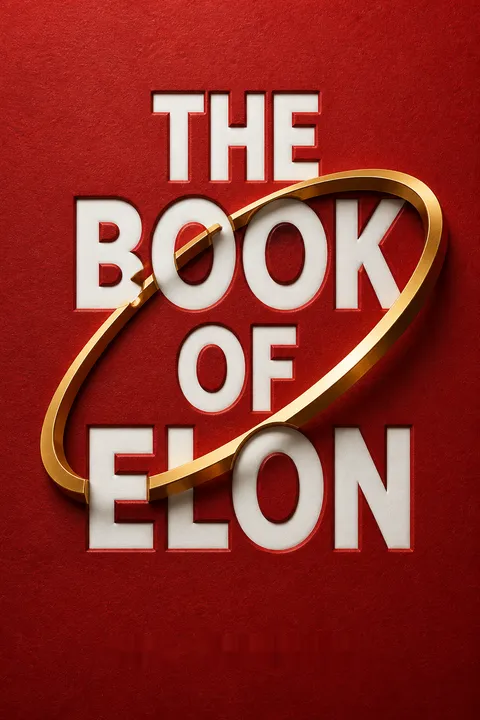

Key Takeaways
1. Pursue a Grand Purpose Beyond Yourself
I don’t mind if my legacy is accurate or inaccurate, as long as I die feeling I’ve done the right thing for the future of Consciousness.
Maximize utility. Elon Musk's driving philosophy centers on maximizing his usefulness to humanity. He wakes up daily asking, "How can I be useful today?" This isn't about glory or personal gain, but about making a positive net contribution to society, measured by the number of people helped and the extent of that help. His core purpose is to advance the scope and scale of consciousness, believing this is the only way for humanity to understand the universe and its meaning.
Fight for the future. Musk identifies critical areas for humanity's future: the internet, sustainable energy, and space exploration. He views the future as a branching stream of probabilities, and his actions are aimed at steering towards a "good future." He believes in building wondrous new technologies that inspire awe and make people excited about what's possible, rather than accepting a bleak outlook.
Obsess for success. Don't start a company to be an entrepreneur or make money; instead, build something useful that you wish existed. Musk emphasizes an obsessive nature about product quality and a deep love for what you do. This passion fuels the relentless effort required, making sacrifices easier and ensuring that even if a venture fails, there are no regrets.
2. Think from First Principles, Not Analogy
Physics is law. Everything else is a recommendation.
Obsess over truth. Musk's obsession with truth, rooted in his physics background, is fundamental to problem-solving. He advocates for rigorous self-analysis, questioning assumptions, and being prepared to adapt to reality. Wishful thinking, a natural human tendency, is identified as a major cause of mistakes, leading to unrealistic dreams rather than viable solutions.
Reason from fundamentals. First-principles thinking involves breaking down problems to their most basic, undeniable truths and building reasoning from there. This contrasts with reasoning by analogy, which leads only to slight iterations and is bound by convention. For example, when addressing battery costs for Tesla, he broke it down to the raw material cost, realizing it was far cheaper than industry assumptions.
- Battery Cost Example: Instead of accepting $600/kWh, he calculated raw materials cost at $80/kWh.
- Rocket Cost Example: Instead of accepting high historical costs, he calculated raw material cost as 1-2% of the finished product, revealing massive inefficiency.
Think in limits. Another powerful physics tool is "thinking in the limit," imagining ideas scaled to extremes. This helps identify fundamental possibilities and constraints. For instance, with The Boring Company, he realized there's no practical limit to tunnel levels, and by reducing tunnel diameter and enabling continuous tunneling, costs could be drastically cut.
- Tunneling: Shrinking diameter (26-28ft to 12ft) reduces area by 4x, cutting cost.
- Manufacturing: Asking if a part is still expensive at a million units/year reveals design flaws, not just volume issues.
3. Embrace Ultra Hardcore Work & Tenacity
Nobody ever changed the world on forty hours a week.
Work like hell. Musk is known for his extreme work ethic, often putting in 80-100 hour weeks. He believes that to achieve revolutionary outcomes, one must work significantly harder than competitors. This relentless effort, particularly in the early stages of a company, dramatically increases the odds of success.
- Simple Math: Working 100 hours vs. 50 hours means twice as much done in a year.
- Revolutionary Goals: Colonizing Mars or creating revolutionary cars cannot happen on a 40-hour workweek.
High pain threshold. Musk acknowledges that his life has involved long periods of intense pain and difficulty, describing himself as "wired for war." He emphasizes that starting a company is not always fun; it involves "eating glass and staring into the abyss," constantly facing the threat of failure. This requires immense tenacity and a high pain threshold.
- 2007-2022: Described as "nonstop pain" for Tesla's survival.
- Childhood Adversity: Early experiences with violence and bullying built a very high pain threshold.
Enjoy the journey. Despite the intensity, Musk advises finding enjoyment in the process. He reflects on missing opportunities to "smell the roses" during the Kwajalein Atoll rocket development. While driven by compulsion, he suggests a balance, recognizing that if "heat death will inevitably end the universe, it actually is all about the journey."
4. Build a Culture of Builders & Direct Communication
Any manager who attempts to enforce “chain of command” communication will soon find themselves working elsewhere.
Attract great people. A company is a collective of people and machines, far smarter than any individual. Musk believes the most important thing is to attract talented, hardworking individuals who are cohesively focused on a common goal. He aims to create an environment where great engineers can flourish, providing clear goals and allowing them to manage themselves.
- Small, Strong Teams: A small group of technically strong people will always beat a large group of moderately strong people.
- Exceptional Performance: Only exceptional performance constitutes a passing grade.
Remove organizational boundaries. Musk actively fights against silos and "us-versus-them" mentalities between departments. He mandates direct communication, allowing anyone to talk to anyone else to solve problems quickly, bypassing traditional "chain of command" structures. Managers who enforce such barriers are removed.
- "Box in a Box" Problem: Organizational silos lead to product inefficiencies, like a battery pack having its own enclosure inside a car's underbody.
- Go to the Source: Physically go to where the problem is and talk to the people doing the actual work, like welders, not just executives.
Feedback over feelings. Musk provides "hardcore feedback," focusing on actions, not people. He believes that physics doesn't care about hurt feelings, only results. He sees wanting to be liked as a "real weakness" that can be counterproductive to the success of the enterprise, especially when it prevents challenging colleagues' work.
- Bad News First: All bad news should be given loudly and often; good news quietly and once.
- Ego-to-Ability Ratio: A high ego-to-ability ratio breaks the feedback loop to reality, hindering improvement.
5. Master The Algorithm for Innovation
The most common mistake of smart engineers is to optimize a thing that should not exist.
The five-step algorithm. Musk rigorously implements a five-step process for engineering, emphasizing the critical order of operations to avoid common pitfalls. This algorithm is designed to prevent optimizing unnecessary elements and ensure efficiency.
- Step 1: Make your requirements less dumb. Question all requirements, even from smart people, and ensure a specific person takes responsibility for each.
- Step 2: Try very hard to delete the part or process. Over-delete, expecting to add back 10% of what was removed. The "best part is no part; the best process is no process."
- Step 3: Simplify or optimize. Only after deleting unnecessary elements should one focus on simplifying what remains.
- Step 4: Accelerate. Speed up the process only after ensuring it's necessary and simplified.
- Step 5: Automate. Automation is the final step, applied only after all previous steps have been thoroughly executed.
Avoid premature optimization. Musk highlights the mistake of automating, accelerating, or optimizing things that should have been deleted. He cites the example of fiberglass mats in Tesla battery packs, which were optimized for automation before being discovered to be entirely unnecessary for their stated purpose. This "Dilbert cartoon" scenario wastes immense resources.
Simplicity wins. Simplicity is a core mantra, improving both reliability and reducing cost. Fewer components mean fewer things to buy and fewer things that can go wrong. This applies to code (delete lines, don't just add) and physical design (combine parts, like casting large sections of a car body).
- Model 3 Body Line: Achieved 40% more output by simplifying designs and removing unnecessary robots.
- Idiot Index: A high ratio of finished product cost to raw material cost indicates design complexity or inefficient manufacturing.
6. Operate with Maniacal Urgency
The only true currency is time.
Don't waste time. Musk views time as the ultimate currency and operates with a "maniacal sense of urgency." He advocates for eliminating excessive and frequent meetings, walking out if not adding value, and avoiding serialized dependencies to accelerate timelines.
- Meeting Efficiency: Get rid of large or frequent meetings unless absolutely necessary and keep them short.
- Parallel Processing: Do as many "gestating elements" in parallel as possible to shorten overall timelines.
Speed is offense and defense. Rapid innovation is the best form of intellectual property protection. If a company innovates fast enough, competitors will always be copying outdated technology. A factory operating at twice the speed is equivalent to two factories, providing a significant competitive advantage.
- SR-71 Blackbird: Its only defense was speed; it was never shot down.
- Tesla's Agility: Cannot compete with large car companies in size, so must compete with intelligence and agility.
Aggressive timelines. Musk sets the most aggressive internal timelines possible, acknowledging that schedules tend to expand. While his public predictions can be optimistic, he emphasizes that they are his genuine belief, not fake deadlines. He believes that even if late, the radical technological advancements eventually come true, which is more important than precise timing.
- "Law of Gaseous Expansion": Schedules will rarely be shorter than initially set.
- Exponential Growth: Small calendar shifts have enormous percentage differences in outcomes for exponential growth.
7. Manufacturing is the Real Product
Prototypes are easy and fun. Reaching volume production with a reliable product at an affordable price is excruciatingly difficult.
Making stuff is fundamental. Musk challenges the "magic economy" view, asserting that "if we don't make stuff, there's no stuff." He laments the over-allocation of talent to finance and law, advocating for more people to engage in "real work" – manufacturing and creating tangible goods and services.
- Economic Reality: Goods and services don't magically appear; they require production, processing, and transport.
- Respect for Makers: Musk has "mad respect for the makers of things."
The factory is the product. Musk's biggest epiphany at Tesla was that the factory itself is the product – the "machine that builds the machines." Tesla's engineering focus shifted to designing the manufacturing system, aiming for a 5-10x improvement in automotive production efficiency.
- Philosophical Difference: Tesla believes in manufacturing innovation as much as, if not more than, car design.
- Problem Solving: A factory is a "cybernetic collective with ten thousand things going wrong," requiring rapid problem-solving to avoid massive financial burn.
Attack the constraint. The production line moves only as fast as its slowest, least lucky part. Musk emphasizes identifying and attacking bottlenecks, whether it's a specific machine or a supplier issue. He notes that 10-100 times more effort went into designing SpaceX's manufacturing system than the Raptor engine itself.
- Supplier Vulnerabilities: Natural disasters and unforeseen events affecting suppliers can halt production (e.g., trunk carpet delayed by a shoot-out).
- Design vs. Production: Design is overrated; manufacturing is underrated, especially for new technology.
8. Go All In and Persevere Through Hell
Starting a company is like eating glass and staring into the abyss.
Take calculated risks. Musk encourages taking risks, especially before having significant obligations like children. He believes that fear of failure is the biggest reason people don't try, and that the worst-case scenario is rarely as bad as imagined.
- "Go do it": People are "far too afraid to try."
- Risk-Reward: If something is important enough, do it even if the odds are not in your favor.
All-in commitment. From Zip2 to PayPal, Tesla, and SpaceX, Musk consistently invested nearly all his personal wealth, often borrowing for rent. He believes founders must be prepared to invest their own money before asking others. This "all-in" approach demonstrates conviction and commitment.
- PayPal Earnings: Rolled most of his $22M from Zip2 into X.com (PayPal).
- 2008 Crisis: Split his last $30-40M between Tesla and SpaceX, risking total bankruptcy for both rather than letting one die.
Adversity forges strength. Musk's journey has been marked by immense adversity, from childhood bullying to near-bankruptcy for multiple companies. He views failure as a learning tool, not a deterrent, and emphasizes the importance of not giving up unless "dead or completely incapacitated."
- SpaceX Failures: Budgeted for three rocket failures, then risked everything on a fourth, which succeeded.
- Tesla Production Hell: Lived in factories for three years, working "to the edge of sanity" to fix Model 3 production.
9. Accelerate Humanity Towards a Sustainable, Multiplanetary Future
Building mass-market electric cars was inevitable. It would have happened without me. But becoming a space-faring civilization is not inevitable.
Sustainable energy mission. Tesla's overarching purpose is to expedite the transition from a hydrocarbon economy to a solar-electric one. Musk believes this is the primary sustainable solution, essential for civilization's long-term survival and prosperity. He champions solar, wind, and nuclear power, while debunking "overpopulation" myths and advocating for carbon capture.
- Master Plan Part Deux: Build sports car -> affordable car -> even more affordable car, while providing zero-emission power.
- SolarCity: Founded to address the complex problem of scaling solar deployment on rooftops and managing distributed energy systems.
Multiplanetary imperative. SpaceX's mission is to make humanity a multiplanetary species, a goal Musk sees as not inevitable but crucial for preserving consciousness. He views this as an evolutionary-scale event, akin to life moving from oceans to land, providing "life insurance for life itself" against Earth-bound extinction events.
- Apollo's High-Water Mark: Concerned humanity peaked with the moon landing; wants to inspire further exploration.
- Mars as the Goal: Mars is the most viable option for colonization, despite its challenges, due to atmosphere and water ice.
Revolutionary space transport. The key to multiplanetary life is a rapidly reusable interplanetary transport system. SpaceX's Starship aims to reduce the cost per ton to Mars by 10,000 times, making a self-sustaining city feasible. This requires full and rapid reusability, like an airplane, where the cost of flight approaches only the cost of propellant.
- "Just Barely Possible": Reusable orbital rockets are one of the hardest engineering problems, but not impossible.
- Starship Scale: Aims for 1,000-2,000 Starships per Mars rendezvous, transporting a million tons per transfer window.
10. Navigate Existential Risks for an Age of Abundance
The biggest myth that exists right now is this “overpopulation” myth.
Age of abundance. Musk predicts that AI and robotics will usher in an "age of abundance," where labor is no longer the limiting factor for goods and services. Humanoid robots will perform dangerous, boring, and repetitive jobs, leading to a future without poverty and potentially universal basic income.
- Humanoid Robot Market: Expected to be larger than the car market, with potentially 10+ robots per person.
- Ubiquitous Computing: Exponential drops in computing cost will lead to pervasive intelligence.
Upgrading the human mind. The internet has already made humans "digitally superhuman" by providing instant access to vast knowledge. Neuralink aims to create a high-bandwidth brain-computer interface, overcoming the "tiny straw" bottleneck of current communication (speech, typing). This could lead to "consensual telepathy" and augmentation of human capabilities, including restoring sight or movement.
- Noland Arbaugh: First Neuralink patient played Civilization, demonstrating early success.
- Blindsight: Second Neuralink product aims to restore sight by directly stimulating the visual cortex.
Mitigating existential risks. Musk identifies several threats to civilization: misaligned AI, population collapse, and cosmic impacts. He advocates for proactive measures, such as rigorous adherence to truth in AI development to prevent "politically correct" but dangerous outcomes, and increasing birth rates to counter civilizational decline.
- AI Safety: "Maximally truthful AI" is crucial; forcing AI to lie (like HAL 9000) is dangerous.
- Population Collapse: Low birth rates are a "slow death for a civilization," a historical pattern overlooked by many.
- Asteroids/Comets: A "big rock will hit Earth eventually," and multiplanetary life is the ultimate insurance.
Review Summary
The Book of Elon has garnered an impressive 4.58 out of 5 rating, with most readers praising its distilled, actionable insights on first-principles thinking, innovation, and entrepreneurship. Frequently compared to The Almanack of Naval Ravikant, reviewers appreciate its curated format over traditional biography. Some noted repetition and wished for greater depth, while one reader found philosophical disconnects due to differing worldviews. Overall, the consensus highlights it as a high-density, thought-provoking read valuable for entrepreneurs, leaders, and anyone seeking to think bigger.
People Also Read


Download PDF
Download EPUB
.epub digital book format is ideal for reading ebooks on phones, tablets, and e-readers.








































