
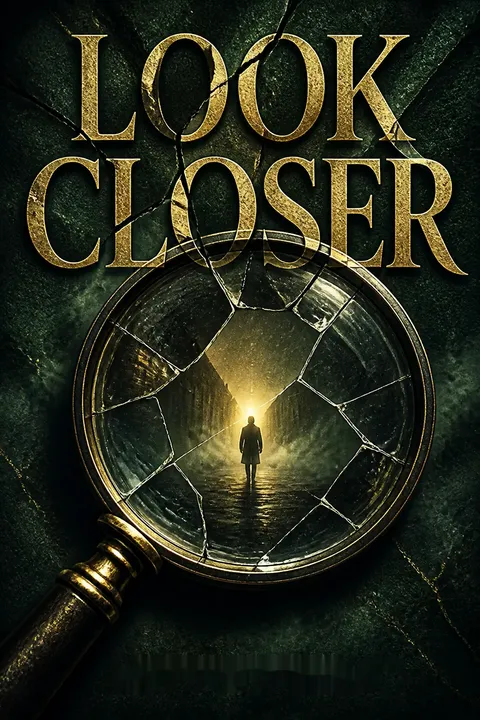


Plot Summary
Prologue
Simon Dobias1 checks his green burner phone inside Lauren Betancourt3's silent foyer on Halloween night. Her body dangles from the second-floor bannister, a knotted rope around her neck, her toes hovering above the marble floor. She wears a formfitting cat costume with painted whiskers and black polished nails. Shards of a shattered candy bowl crunch beneath his boots.
Outside, anonymous inside a Grim Reaper hood, he walks through Grace Village's darkened streets, where every house went lights-out at seven. By the park equipment shed, he collapses, pulls out a kitchen knife and his phone, and types a message apologizing to Lauren3 and declaring he will join her in death. His hand remains utterly still. He is ready.
The prologue weaponizes dramatic irony. Every detail, from Simon's inappropriate calm to the suicide-note text, reads one way on first encounter and entirely differently once we understand he is staging a crime scene rather than responding to one. The Grim Reaper costume evokes both menace and anonymity: Simon has become death's emissary, but the disguise also signals that someone else will be blamed. The shattered candy bowl and the absurd cat costume create a dissonance between domestic normalcy and calculated violence. His steady hand contradicts the emotional confession he types, revealing a man performing guilt rather than feeling it. The prologue sets the novel's central promise: nothing here is what it seems.
Michigan Avenue Ghost
On Friday, May 13, law professor Simon Dobias1 walks down Michigan Avenue toward his barbershop after the dean8 pressured him to withdraw his full professor application. A woman exits Bloomingdale's in oversized sunglasses and a pink dress.
He recognizes her instantly: Lauren Lemoyne,3 the paralegal who seduced him as a teenager, then seduced his father, then emptied the family's bank accounts and vanished. She passes without noticing him, talking on her AirPods. Simon1 follows her into a luxury condo building, where the doorman greets her as Mrs. Betancourt.3
That afternoon, he finds her Facebook profile: married to hedge fund manager Conrad Betancourt,7 living in Grace Village, the wealthy enclave adjacent to his own Grace Park. He tells himself he will forget he saw her. He knows immediately that he will not.
This encounter functions as a psychological tripwire. Simon has constructed an identity as a principled law professor, channeling his trauma into constitutional scholarship. Lauren's reappearance collapses that carefully built separation between past and present. The specificity of the date and time signals how trauma freezes moments into permanence. The irony is that Lauren's careless return, her apparent oblivion to the devastation she caused, is what ultimately seals her fate. She never imagined Simon would still care after two decades. She underestimated how some people measure time not in years but in unfinished business.
Champagne Flutes and Ruin
In 2003, eighteen-year-old Simon Dobias1 worked at his father Ted's law firm, where twenty-year-old paralegal Lauren Lemoyne3 seduced him on his birthday. Weeks later, Simon1 walked into Ted's office after hours and found his father having sex with Lauren.3
When confronted, Lauren3 laughed and said she assumed Simon1 was not planning to marry her. Ted refused to end the affair. By late 2004, Ted had added Lauren3's name to the family's money-market account. She emptied every dollar, over six million, and fled to Paris.
The Dobias family, now bankrupt, could no longer afford in-home care for Simon1's stroke-disabled mother Glory Dobias.10 She soon died of a deliberate painkiller overdose. Simon1 blamed Lauren,3 his father, and his own silence for his mother10's death.
Lauren's predation follows the classic pattern of a confidence artist targeting vulnerability. She identified two men, father and son, each craving validation: Simon, the insecure teenager desperate for adult approval, and Ted, the nouveau riche lawyer compensating for his wife's professional superiority. Her theft was not merely financial; it was existential. She took the money that provided Glory's medical care, transforming betrayal into a death sentence. Simon's subsequent guilt, the sense that his silence enabled his mother's suicide, fossilized into an obsession that would wait two decades for resolution. His hatred for Lauren became the organizing principle of his emotional life.
Survivors' Dark Alliance
Years after his mother10's death, Simon Dobias1 ran a Survivors of Suicide support group. One evening, a newcomer named Vicky Townsend2 raised her hand and asked if she was the only one who felt furious rather than guilty about her sister's suicide. Simon1 was immediately drawn to her bluntness.
Vicky2's sister Monica had become addicted to OxyContin, fallen under the spell of a con man4 who kept her drugged and isolated from her family, then stolen her money and abandoned her to overdose. Vicky2 had moved to Chicago with one purpose: finding and killing the man who destroyed her sister.
Simon1 understood that rage. He told Vicky2 about Lauren Betancourt,3 about his father's murder, which he implied he committed. They became lovers, then partners. Vicky2 refused Simon1's marriage proposals, but she said yes to revenge.
The SOS meeting is the novel's true origin story. Two people who have defined themselves by what they lost discover in each other a mirror and a mission. Their romantic relationship fails because it requires vulnerability and hope; their criminal partnership thrives because it channels their darkest impulses into shared purpose. The symmetry of their grievances (each lost a beloved woman to a remorseless predator) creates a moral framework that justifies everything that follows. They are not merely avengers; they are co-authors of a narrative in which the villains finally pay. Vicky's refusal of marriage signals self-awareness: she cannot be what Simon needs, but she can give him what he wants most.
The Fake Wife's Trap
Using an identity created by her private investigator Rambo,11 Vicky Townsend2 became 'Vicky Lanier Dobias,' supposedly married to Simon Dobias1 for nearly ten years. She researched financial advisers and selected Christian Newsome, a handsome, cocksure investment guru whose office featured rolling stock tickers and framed magazine profiles.
In truth, Christian Newsome was Nick Caracci,4 the same con man4 who had destroyed Monica under the alias David Jenner. Vicky2 told Nick4 she was about to access her husband's twenty-one-million-dollar trust on their tenth anniversary, November 3.
The trust's restrictive language, she explained, had made her a second-class citizen in her own marriage for a decade. She unzipped her dress during their second meeting and initiated sex on his office couch. Nick4 believed he had hooked another wealthy, unhappy wife ready to be fleeced.
Vicky's approach to Nick demonstrates a profound understanding of the predator's psychology. By presenting herself as transactional and amoral, she mirrors his own worldview, making her legible and therefore trustworthy to him. The sex is strategic: it activates his vanity and creates a false sense of control. Nick's ego, the engine of his cons, becomes his greatest vulnerability. He cannot conceive that a woman might be running a longer game than his own. The trust fund's ten-year restriction is a masterstroke of narrative engineering, providing both a ticking clock and a plausible explanation for why Vicky would stay in a loveless marriage.
Ink and Radio Waves
Throughout summer and fall 2022, Simon Dobias1 wrote entries in a green spiral notebook, creating a fictionalized account of rekindled romance with Lauren Betancourt.3 The journal described their 'accidental' reunion at the country club, passionate liaisons at her condo, and Lauren3's supposed manipulation: pushing him to divorce Vicky Townsend2 before November 3 to cut her out of the trust.
Simon1 included authentic details from his real past to make the narrative credible, and Vicky2 read drafts and suggested revisions. Simultaneously, Simon1 purchased two prepaid burner phones, green and pink, and began fabricating text messages between 'Simon' and 'Lauren' on a strict twice-daily schedule.
He sent the morning texts from near Nick Caracci4's downtown office and the evening texts from Wicker Park, near Nick4's apartment, so cell tower data would later implicate Nick.4
The journal is the novel's most ingenious device: a fictional document within the fiction that the reader initially accepts as truthful. Simon's fabrication process transforms narrative into weaponry. The journal functions on multiple levels: as bait for Nick (who will read it and perceive Lauren as a threat), as misdirection for any future investigation, and as a commentary on the nature of storytelling itself. The careful construction of false intimacy demonstrates how easily evidence can be manufactured. Simon, the legal scholar who teaches students to scrutinize government evidence, becomes the master of creating incontrovertible-seeming proof of something that never happened.
Con Man on the Leash
Nick Caracci,4 running his Christian Newsome persona, met Vicky Townsend2 regularly at his apartment while she played the neglected wife finally seizing pleasure. He showed her his titanium toiletry set, items so expensive they signaled enormous wealth.
Vicky2 probed his intentions, asking whether he planned to stay in Chicago, hinting at a future together. Nick4's friend and accomplice Gavin Finley6 warned him not to develop feelings. Nick4 dismissed the concern: Vicky2 was just another mark, and twenty-one million meant retirement at thirty-four.
He had no idea that Vicky2 already knew his real name, his history with her sister Monica, and every alias he had used over the years. She was not falling for him; she was systematically gathering the information she would need to destroy him.
Nick's seduction inverts the gender dynamics of the typical con. He believes he is the predator, but his sexual desire becomes the leash by which Vicky controls him. The titanium toiletry set functions as a symbol of vanity and vulnerability: objects so specific and traceable that they will later become forensic evidence against him. Gavin's warnings represent professional caution that Nick's narcissism overrides. The asymmetry of information is total: Vicky knows everything about Nick; he knows nothing true about her. His entire career has depended on women's emotional vulnerability; he cannot recognize when his own emotions are being weaponized against him.
The Trap Springs Shut
On October 25, Vicky Townsend2 arrived at Nick Caracci4's apartment visibly panicked. She had discovered Simon Dobias1's laptop and green journal, she claimed, and now knew about his affair with Lauren Betancourt.3
She showed Nick4 the divorce petition Simon1 had drafted, scheduled to be filed November 2, one day before the tenth anniversary. If filed, she would be cut off from the trust entirely. Nick4 read the journal entries: Simon1's infatuation, Lauren3's manipulations, her claim of pregnancy.
Nick4 saw Lauren3 as a competitor, a female version of himself threatening his score. Vicky2 raged and cried while Nick4 calculated. That night, he and Gavin Finley6 began evaluating how to eliminate Lauren.3 Every alternative collapsed against the November 3 deadline. Only murder remained.
This scene represents the novel's central narrative trap snapping shut. By presenting the journal as discovered evidence rather than manufactured fiction, Vicky transforms Nick from passive beneficiary of Simon's divorce into active participant in a murder plot. His greed and professional pride both demand that he eliminate Lauren, whom he perceives as a rival con artist. The November 3 deadline creates artificial scarcity, forcing a rushed decision that precludes careful scrutiny. Nick never asks why Simon would leave such incriminating evidence unsecured. His desire to believe the story overwhelms his skepticism, exactly as Vicky and Simon anticipated.
Halloween Becomes Deadline
Gavin Finley6 and Nick Caracci4 spent hours planning. Halloween was perfect: a night when costumes made anonymity effortless and Grace Village's strict seven o'clock lights-out would cloak him in darkness.
Vicky Townsend2 purchased matching Grim Reaper costumes and size thirteen Paul Roy Peak Explorer boots, the same model Simon Dobias1 owned, so forensic evidence would point to her husband. She also secured Nick4's gun, a Glock 17 with suppressor, through Gavin.6 Nick4 practiced shooting in the woods but could barely hit a soda can from ten feet.
Gavin6 cut down a thick knotted rope from a tree swing as backup. The plan: Nick4 would ring Lauren Betancourt3's doorbell minutes before seven, shoot her when she answered, and vanish into the Halloween crowds. Vicky2 insisted he practice with the weapon, knowing it would not save him.
The planning sequence reveals the psychological transformation required to commit murder. Nick, a con artist who has never used violence, must reframe himself as a killer. His rationalization follows a classic pattern: Lauren is not innocent, she was trying to steal his money, and the deadline leaves no alternative. The Halloween setting provides both practical cover and symbolic resonance: on a night when children pretend to be monsters, Nick will become one. The matching boots and costume connect to Simon's earlier insight about bullies: the best revenge uses the target's own behavior against them. The rope, initially a backup, foreshadows the improvisation murder always requires.
The Gold Digger's Last Breath
At 6:55 p.m., Nick Caracci4 in his Grim Reaper costume approached Lauren Betancourt3's front door. She answered, costumed as a cat. Nick4 drew the Glock, but the gun jammed. Panicked, he grabbed the knotted rope from his waist. Lauren3 shattered a glass bowl of candy fleeing toward the stairs.
Nick4 caught her on the second-floor landing, struck her head, looped the noose around her neck, and forced the rope's end into the wrought iron bannister's spiral design. He threw her over the railing. Her neck snapped. After Nick4 fled at seven, Simon Dobias1 entered wearing his own Grim Reaper costume over a Barack Obama mask.
He stomped boot prints in the dirt, kicked the front door, and used both burner phones to type the desperate text exchange that would prove Nick4's motive. He slid the pink phone under a hallway table and stole Nick4's electric razor from the master bathroom.
The gun jamming transforms a clinical execution into a primal act of violence. Strangulation requires proximity, sustained physical effort, and the killer's willingness to watch his victim die. Lauren's death is grotesquely theatrical, her cat costume transforming from flirtatious to funereal. Simon's staging is equally meticulous: every planted detail anticipates police methodology. His use of the Obama mask beneath the Grim Reaper hood is a darkly comic touch, layering anonymity behind a symbol of hope and change. The text messages, typed on two phones by one man, create a narrative of jealous rage that investigators will find irresistible. The crime scene is a confession written in evidence, but the confession names the wrong killer.
Vicky's Silenced Pistol
That afternoon, Vicky Townsend2 had visited Nick Caracci4's apartment, spiked his bourbon with Valium, and encouraged him to shower. When she returned hours later, Nick4 was groggy on the couch. She straddled him, told him she knew his real name and his entire con, and pressed the Glock under his chin.
The first shot missed, scarring the ceiling. The second killed him. Vicky2 staged the scene: spilled pills, bourbon bottle, gun in his limp hand. As she slipped out through the alley garage, a hand seized her arm. Gavin Finley6 pressed a gun to her cheek.
He had watched through the apartment's open blinds. He knew 'Vicky Lanier2' was a stolen identity (the real Vicky Lanier's remains had been found in West Virginia). He did not want justice; he wanted half the money. He kicked her ribs and gave her until November 3.
Vicky's execution of Nick completes her sister's unfinished revenge. The Valium disables his reflexes; the suppressed gunshot leaves no auditory witness. Her revelation of his true identity in his final moments is not strategic but personal: she needs him to know why he is dying. Gavin's ambush introduces the one variable Simon and Vicky failed to anticipate: a witness. His demand for money rather than justice reveals him as Nick's moral equivalent. The revelation about the real Vicky Lanier's remains exposes the fragility of stolen identities. Yet Gavin makes Nick's mistake: he underestimates his opponent, believing she is alone and desperate, unaware she has a partner who has spent decades perfecting the art of the long game.
Sergeant Burke's First Homicide
Grace Village police sergeant Jane Burke5 caught her first murder on the morning of November 1. Lauren Betancourt3's cleaning lady had found the body. Jane5 and her partner Andy Tate9 documented the scene: the dangling corpse, the shattered candy bowl, boot prints in the mud, and a hot-pink burner phone kicked under a hallway table.
The phone contained months of flirtatious texts with a single contact, culminating in a desperate Halloween exchange and a suicide confession sent hours after Lauren3's death.
The next day, Chicago police discovered Nick Caracci4's body in Wicker Park, a gunshot under his chin, a green burner phone with matching texts, a spilled Valium bottle. In his apartment: a Grim Reaper costume, size thirteen boots, and pieces of a titanium toiletry set. The missing pieces were found in Lauren3's bathroom.
The investigation scenes establish Jane as the novel's moral compass. She is competent, intuitive, and stubborn, but she faces an elaborately engineered crime scene designed to exploit every investigative assumption. The evidence against Nick is overwhelming by design: every detail Simon planted leads toward one neat conclusion. Yet Jane's instincts tell her the case feels too perfect. The pink phone's careful placement, not taken but not left in plain sight, suggests staging rather than oversight. Her knowledge of Simon's high school history plants the seed that will grow into certainty: someone patient and brilliant orchestrated this. The tragedy is that even if she solves the puzzle, she can never prove it.
The Imposter Agent Arrives
On November 3, a man identifying himself as FBI Special Agent John Crane arrived at Simon Dobias1's door. Simon1 recognized him as Gavin Finley.6 Gavin6 demanded to know about Simon1's affair with Lauren Betancourt,3 citing the diary.
Simon1 dismantled him: there was no marriage to Vicky Townsend,2 no diary (the journal was fiction), and no affair with Lauren.3 The entire narrative Gavin6 believed had been constructed to manipulate Nick Caracci.4 When Gavin6 threatened him, Simon1 noted that Grace Village police were arriving any minute for their scheduled interview.
He offered Gavin6 a choice: flee through the back door or explain to the police why he knew so much about a murder investigation. Gavin,6 terrified of scrutiny into his own financial scams, chose to run. Simon1 had neutralized the last loose end without lifting a finger.
This confrontation reveals the full architecture of Simon's scheme and provides the ultimate satisfaction of seeing the deception explained. Gavin, who believed himself a savvy operator, learns he was as thoroughly manipulated as Nick. Simon's calm contrasts with his earlier anxiety, suggesting that completing his revenge has brought him peace. The scene serves as a morality play: Gavin, who profited from Nick's destruction of vulnerable women, now faces the same helplessness his victims felt. Simon's warning about contingency plans is likely a bluff, but Gavin cannot afford to call it. The final loose end is not tied; it is simply cut free, left to dangle in fear of worse.
A Detective's Frustration
Jane Burke5 and Andy Tate9 interviewed Simon Dobias1 at his Grace Park home immediately after Gavin Finley6 fled. Simon1 was calm, cooperative, even amused. He admitted seeing Lauren Betancourt3 on Michigan Avenue but claimed he never spoke to her.
He denied knowing Nick Caracci4 or Vicky Townsend.2 When Jane5 mentioned Vicky2's name, color drained from his face: the only crack in his composure. Jane5 laid out her theory: someone used Nick4 to kill Lauren,3 then killed Nick4 to tie up loose ends.
She confronted Simon1 about the Mitchell Kitchens incident from high school, the spiked Gatorade that destroyed a bully's career, demonstrating his talent for patient, indirect revenge. Simon1 offered fingerprints and DNA, knowing he had worn gloves. Jane5 left knowing the truth and knowing she could never prove it.
The interview scene is a duel between two forms of intelligence: Simon's strategic cunning versus Jane's intuitive pattern recognition. Simon's offer of forensic samples demonstrates his confidence. Jane's invocation of the Mitchell Kitchens story is her strongest move, attempting to establish a behavioral signature: Simon destroys his enemies by making them agents of their own destruction. But behavioral patterns are not evidence. The scene crystallizes the novel's central anxiety: in a system governed by rules of evidence, truth can be perfectly visible and legally invisible. Jane knows what happened; she simply cannot prove it. Simon's momentary loss of composure at Vicky's name is the only crack, and it is not enough.
Cases Closed, Justice Incomplete
Under political pressure from frightened residents, Chief Carlyle pushed to close the Betancourt case. The Cook County medical examiner ruled Nick Caracci4's death a suicide, citing the Valium, alcohol, and suicide note.
The evidence against Nick4 for Lauren Betancourt3's murder was overwhelming: matching costumes, boots, phone records, and toiletry pieces. Meanwhile, St. Louis police processed Lauren3's fingerprints from her autopsy through national databases. They matched a champagne bottle used to bludgeon Ted Dobias twelve years earlier.
Simon Dobias1 had kept that bottle since 2003, used it as a weapon against his father in 2010, and left it at the scene knowing Lauren3's prints would someday solve the cold case. The investigation was closed with Lauren3 identified as Ted's killer, exonerating Simon1 just as his tenure committee evaluated him.
The dual resolution illustrates the novel's cynical view of institutional justice. Both cases are 'solved,' but neither captures the truth. The suicide ruling is convenient for everyone except Jane Burke; the cold case solution is factually wrong in its attribution of guilt. Simon achieves exactly what he intended: legal exoneration for his father's murder and freedom from suspicion in Lauren's. The champagne bottle, preserved for years as both memento and weapon, represents the novel's thesis: objects carry history, and patient people can make history serve their purposes. The system has declared Simon innocent, and the system's declarations, however flawed, are final. He even receives a kind of twisted redemption: the story now reads that Lauren destroyed his family, then killed his father.
Epilogue
In December, Simon Dobias1 met Vicky Townsend2 at a snow-dusted forest preserve outside Burlington, Wisconsin. She was radiant, happier than he had ever seen her. She had anonymously donated the million dollars in cash to Safe Haven, where her boss wept and counted the money ten times.
Simon1 had given the remaining twenty million to charities for stroke, suicide prevention, domestic violence, and runaways. They walked arm in arm through light snow, discussing their regrets. Vicky2 dreamed about her sister Monica, nightmares in which she watched Nick Caracci4 destroy her without intervening.
Simon1 admitted he could not forgive what his father did to his mother.10 Vicky2 kissed him softly, then pulled away. She would not stay; she had her nieces in Wisconsin. Simon1 watched Vicky2's minivan disappear and smiled, already puzzling over the word 'pithy.'
The Wisconsin meeting is a farewell between two people whose intimacy was forged in conspiracy rather than romance. Vicky's radiance signals that revenge, for her, was cathartic: she has expelled the poison and can now rebuild. Simon's charitable donations suggest a different resolution: he is purging his father's money, the source of so much destruction, redirecting it toward causes his mother would have championed. Their kiss carries the weight of everything they have shared and everything they cannot share going forward. Simon's final linguistic musing, about the definition of 'pithy,' returns him to his essential self: a man who finds comfort in precision, in words, in the quirks of language that defy easy categorization. The story ends not with triumph but with acceptance, two survivors walking separate paths through the same snowfall.
Analysis
Look Closer is a novel about the architecture of revenge, constructed with the same meticulous logic its protagonist applies to constitutional law. Simon Dobias1 teaches his students that the government can track citizens through cell tower data, that privacy is an illusion, that evidence can be manufactured. He then weaponizes every lesson to frame a con man for a murder he orchestrated and to solve a cold case in a way that exonerates himself. The novel's deepest subject is not crime but narrative: who controls the story, and how stories become official truth.
The book's structure mirrors its theme. Multiple first-person narrators, including Simon1's fabricated journal, force the reader to trust voices that are systematically lying. By the time the deception is revealed, we have been as thoroughly manipulated as Nick Caracci.4 The experience is unsettling because it implicates our own desire for coherent narratives. We want Simon1's journal to be real because it makes emotional sense. The revelation that it is fiction challenges not just our understanding of the plot but our complicity in believing convenient stories.
Simon Dobias1 and Vicky Townsend2 embody complementary responses to trauma. Simon1 intellectualizes his pain, transforming it into legal scholarship and elaborate schemes. Vicky2 somatizes hers, channeling rage into physical action. Their partnership works because each supplies what the other lacks. Yet their relationship also reveals the limits of shared trauma as a foundation for intimacy. They can kill together but cannot love together.
The novel offers no comfortable moral resolution. Simon Dobias1 and Vicky Townsend2 are murderers; their victims were also predators. The justice system, represented by Jane Burke5's frustrated investigation, can see the truth but cannot reach it. The book suggests that closure is a fiction, that some wounds can only be addressed outside the law, and that the most dangerous people are those with infinite patience, exceptional intelligence, and nothing left to lose.
Review Summary
Look Closer by David Ellis is a highly praised psychological thriller with clever twists and complex characters. Readers appreciate its intricate plot, unpredictable turns, and well-developed storyline. The novel follows Simon and Vicky, a married couple with secrets, as they approach their 10th anniversary and a significant trust fund payout. A murder investigation reveals hidden agendas, lies, and manipulation. Reviewers consistently praise Ellis's writing, calling it addictive, suspenseful, and brilliantly crafted. Many consider it one of the best thrillers they've read in years.
People Also Read





Characters
Simon Dobias
Brilliant, vengeful law professorA law professor specializing in Fourth Amendment privacy rights. Simon is methodical, intellectually meticulous, and deeply scarred by his family's destruction. His mother10 died by suicide after his father's infidelity and financial ruin left them unable to afford her care. He met Vicky Townsend2 at a Survivors of Suicide support group, where he fell in love with her blunt honesty and fierce independence. She refused his marriage proposals but became his closest ally. Simon's quiet, gentle academic demeanor masks a patient, calculating mind capable of elaborate long-term schemes. He runs marathons, plays word games to calm his anxiety, and believes the law is a beautiful but flawed instrument.
Vicky Townsend
Fierce survivor and avengerA survivor of childhood poverty, prostitution, and drug addiction. Vicky rebuilt her life working at Safe Haven, a domestic violence shelter in Wisconsin. Her sister Monica was destroyed by a con man4 who kept her addicted to opioids, stole her money, and abandoned her to die. Vicky tracked him to Chicago and planned to kill him. She met Simon Dobias1 at SOS, and though she could not reciprocate his romantic love, she found in him a kindred spirit and partner. Tough, blunt, and unapologetic, Vicky compartmentalizes sex from emotion, a skill learned during years of survival. She uses the alias Vicky Lanier to protect her identity.
Lauren Betancourt
Remorseless gold-digger and catalystBeautiful, self-interested, and indifferent to the wreckage she leaves behind. As a twenty-year-old paralegal, she seduced both Simon Dobias1 and his father Ted, then convinced Ted to add her name to the family's money-market account. She emptied it of over six million dollars and fled to Paris, leaving the Dobias family bankrupt and Simon1's disabled mother10 without care. She eventually married wealthy hedge fund manager Conrad Betancourt7 and moved to Grace Village, seemingly untroubled by the consequences of her past actions. Her return to Chicago triggers Simon1's elaborate revenge scheme.
Nick Caracci
Narcissistic con artist and targetA career con man who targets wealthy married women, seduces them, convinces them to divorce their husbands, and steals their divorce settlements. He operates under multiple aliases, most recently Christian Newsome, a fake financial genius. He destroyed Vicky Townsend2's sister Monica under the alias David Jenner. Handsome, narcissistic, and addicted to his own mythology, Nick believes his charm makes him invulnerable. He works with childhood friend Gavin Finley6, who creates his fake identities and financial backing. He sees people as marks and money as the only measure of success, unable to imagine anyone running a longer con than his.
Jane Burke
Intuitive, frustrated detectiveA Grace Village police sergeant investigating the first homicide in the town's history. Jane attended high school with Simon Dobias1 and remembers him as the quiet, brilliant valedictorian. She also remembers the Mitchell Kitchens incident, which taught her that Simon1 is capable of patient, devastating revenge executed through indirect means. Jane is sharp, stubborn, and unwilling to accept convenient answers when her instincts say otherwise. Her mother was also a cop. She balances political pressure for a quick resolution against her growing certainty that the obvious suspect was expertly framed.
Gavin Finley
Nick's partner in crimeNick Caracci4's childhood friend and criminal accomplice. Gavin creates fake identities, forges documents, and provides the financial expertise for Nick4's cons. He is physically imposing, more cautious than Nick4, and ultimately more ruthless. When Nick4 is killed, Gavin attempts to blackmail Vicky Townsend2 for half the money, then confronts Simon Dobias1 while posing as an FBI agent. His greed and anger blind him to the fact that he is walking into a trap designed by someone far more patient and cunning than Nick4 ever was.
Conrad Betancourt
Lauren's wealthy, estranged husbandA hedge fund manager twice divorced before marrying Lauren Betancourt3. He filed for divorce in October 2022, with a prenuptial agreement limiting Lauren3 to one million dollars. He moved out of the Grace Village house in September and was on a golf trip in Naples, Florida when Lauren3 was killed, giving him an ironclad alibi.
Dean Martin Comstock
Politically scheming law school deanThe dean of Simon Dobias1's law school who tries to force him out of the full professor competition to favor Reid Southern, whose father is a major donor. He threatens to expose Simon1's connection to his father's murder investigation unless Simon1 withdraws. His bow ties and self-importance mask a career politician rather than a genuine academic.
Andy Tate
Jane's practical partnerJane Burke5's partner in the Grace Village police department. He is practical, by-the-book, and initially convinced by the overwhelming evidence against Nick Caracci4. He serves as a foil to Jane5's intuitive leaps, representing the procedural approach that the planted evidence was designed to satisfy.
Glory Dobias
Simon's beloved, betrayed motherSimon Dobias1's mother, a brilliant law professor and marathon runner whose severe stroke left her wheelchair-bound and cognitively impaired. Her husband Ted's infidelity and the family's subsequent financial ruin (caused by Lauren Betancourt3's theft) led to her losing in-home care. She died of a deliberate painkiller overdose, a suicide that shattered Simon1 and became the emotional cornerstone of his lifelong obsession with revenge.
Rambo
Vicky's discreet private investigatorA former Indianapolis cop turned private detective who helped Vicky Townsend2 create her fake identity years ago. He does background checks, finds information on targets, and asks no questions about her motives. He was once a client during her prostitution days, and their history gives him both loyalty and discretion.
Plot Devices
The Green Journal
Fabricated evidence of fake affairA spiral notebook with a green cover in which Simon Dobias1 writes a fictionalized account of a rekindled romance with Lauren Betancourt3. Covering months of fabricated entries with specific dates, emotional turmoil, and Lauren3's supposed manipulations, it includes authentic details from Simon1's real past to make the narrative credible. Vicky Townsend2 reads drafts and suggests revisions to ensure the journal will manipulate Nick Caracci4 when he inevitably discovers it. The journal serves as the primary bait that convinces Nick4 that Lauren3 threatens his score and must be eliminated.
Burner Phones
Fabricated communication trailTwo prepaid phones, one green and one pink, purchased in different states for cash. Simon Dobias1 uses them to type fabricated text messages between 'Simon' and 'Lauren' on a strict twice-daily schedule. He sends morning texts from near Nick Caracci4's downtown office and evening texts from Wicker Park near Nick4's apartment, so historical cell-site location data will implicate Nick4. The phones are kept off at all other times, mimicking the behavior of two married people hiding an affair. The final texts, exchanged on Halloween night, create a narrative of jealous rage and rejection that provides motive for Lauren Betancourt3's murder.
The Trust Fund
Twenty-one million dollar incentiveSimon Dobias1's inheritance from his murdered father, held in a restrictive trust. According to the fabricated backstory Vicky Townsend2 feeds Nick Caracci4, the trust contains a provision that Simon1's spouse cannot access the money until ten years of marriage. Vicky2 claims their tenth anniversary is November 3, creating an urgent deadline. In reality, Simon1 and Vicky2 were never married. The trust exists, but the marriage and its restrictions are fiction. The approaching deadline forces Nick4 to act quickly, robbing him of the time to scrutinize the journal or question Vicky2's story.
Grim Reaper Costumes and Boots
Matching disguises to frame the killerTwo identical Grim Reaper costumes with elongated hoods, and two pairs of Paul Roy Peak Explorer boots in size thirteen (Simon Dobias1's actual shoe size is eleven). Vicky Townsend2 buys one set for Nick Caracci4, while Simon1 owns the matching set. Nick4 wears his to kill Lauren Betancourt3; Simon1 wears his to enter the crime scene afterward and plant incriminating footprints in the mud and on the front door. A neighbor child sees a figure in a Grim Reaper costume lurking near Lauren3's house, later identifying the costume from police photos. The matching evidence makes it appear that one person committed the crime.
Titanium Toiletry Set
Forensic link between crime scenesA five-piece Bentley-Kravitz Elite Men's Care Set worth nearly nine thousand dollars, made of titanium and matte-black finish. Nick Caracci4 owns the complete set (toothbrush, nail clippers, electric razor, nose-hair trimmer, and dental-floss holder), which Vicky Townsend2 observes in his bathroom. Simon Dobias1 steals the electric razor and nose-hair trimmer from Nick4's apartment and plants them in Lauren Betancourt3's master bathroom. When police discover the matching pieces at both crime scenes, the toiletry set becomes powerful physical evidence linking Nick4 to Lauren3's home and supporting the narrative that they were having an affair.
FAQ
Synopsis & Basic Details
What is Look Closer about?
- Complex web of deceit: Look Closer is a thriller centered around a law professor, Simon Dobias, who becomes entangled in a dangerous affair with a former lover, Lauren Lemoyne, while his wife, Vicky Lanier, harbors her own secrets and a hidden past.
- Intertwined lives and betrayals: The story explores the complex relationships and betrayals between these characters, set against the backdrop of a murder investigation that threatens to expose their carefully constructed lies.
- Moral ambiguity and consequences: The novel delves into themes of identity, manipulation, and the moral implications of one's actions, as the characters navigate a web of deception with deadly consequences.
Why should I read Look Closer?
- Intricate plot and suspense: The novel offers a suspenseful and intricate plot that keeps readers guessing, with unexpected twists and turns that challenge their assumptions.
- Complex and flawed characters: The characters are multifaceted and morally ambiguous, each with their own secrets and motivations, making them compelling and relatable despite their flaws.
- Exploration of dark themes: Look Closer delves into dark themes of betrayal, revenge, and the consequences of deception, providing a thought-provoking and emotionally charged reading experience.
What is the background of Look Closer?
- Suburban setting with hidden darkness: The story is set in the seemingly idyllic suburbs of Grace Village and Grace Park, Illinois, which serve as a backdrop for the dark secrets and betrayals that unfold.
- Legal and academic context: The protagonist, Simon Dobias, is a law professor, and the legal and academic world provides a framework for the story, with references to legal concepts and court cases.
- Personal histories and past traumas: The characters' personal histories and past traumas, such as Simon's family tragedy and Vicky's hidden identity, play a significant role in shaping their actions and motivations.
What are the most memorable quotes in Look Closer?
- "I'm sorry, Lauren. I'm sorry for what I did and I'm sorry you didn't love me. But I'm not sorry for loving you like nobody else could.": This quote, from Simon's final text, encapsulates his obsessive love and twisted sense of justification, highlighting the tragic consequences of his actions.
- "Would it make you feel any better if I told you my marriage was a train wreck?": Lauren's candid admission to Simon reveals the depth of her unhappiness and sets the stage for their dangerous affair, showcasing the characters' shared dissatisfaction.
- "You want to be able to call me whenever you want to fuck me.": Lauren's blunt assessment of Simon's intentions with the burner phone reveals her cynical view of their relationship and her willingness to engage in a purely physical connection.
What writing style, narrative choices, and literary techniques does David Ellis use?
- Multiple perspectives and timelines: Ellis employs multiple perspectives, shifting between Simon, Vicky, and other characters, to create a complex and layered narrative, revealing different sides of the story.
- Foreshadowing and suspense: The author uses subtle foreshadowing and callbacks to create suspense and keep readers guessing, with seemingly minor details gaining significance later in the story.
- Internal monologues and reflections: The narrative includes internal monologues and reflections, particularly from Simon, which provide insight into the characters' thoughts, motivations, and emotional states, enhancing the psychological depth of the story.
Hidden Details & Subtle Connections
What are some minor details that add significant meaning?
- The color green: The recurring use of the color green, such as in Simon's burner phone and journal, symbolizes new beginnings and fresh starts, which ironically contrasts with the dark path he chooses.
- The mention of "Mini-Me": Simon's high school nickname, "Mini-Me," reveals his past insecurities and the bullying he endured, which contributes to his complex character and his need for control.
- The description of the wrought iron bannister: The ornate, spiral pattern of the bannister where Lauren is found hanging foreshadows the intricate and twisted nature of the relationships and events in the story.
What are some subtle foreshadowing and callbacks?
- Simon's mother's words: Simon's mother's advice about lawyers knowing the answer before asking the question foreshadows Simon's meticulous planning and manipulation of events.
- The mention of the "Twin Towers": Conrad's comment about his marriage crashing like the Twin Towers foreshadows the tragic end of his relationship with Lauren and the chaos that ensues.
- The recurring use of language games: Simon's use of language games to calm his nerves foreshadows his calculated and analytical nature, which he uses to plan and execute his schemes.
What are some unexpected character connections?
- Vicky and Rambo: The connection between Vicky and Rambo, her former client and a retired cop, reveals her hidden past and her ability to navigate the criminal underworld, adding a layer of complexity to her character.
- Simon and Mitchell Kitchens: The recurring mention of Mitchell Kitchens, Simon's high school bully, highlights Simon's long-held grudges and his capacity for revenge, which foreshadows his actions against Lauren and Christian.
- Lauren and Ted Dobias: The revelation of Lauren's affair with Simon's father, Ted, adds a layer of complexity to the story, revealing the roots of Simon's anger and his desire for revenge.
Who are the most significant supporting characters?
- Anshu Bindra: Simon's colleague, Anshu, serves as a foil to Simon's more reserved nature, providing a contrasting perspective on academia and offering a glimpse into Simon's professional life.
- Ria Peraino: The forensics technician, Ria, plays a crucial role in uncovering the truth, her expertise in blood spatter analysis revealing key details about the crime scene and challenging the initial assumptions.
- Gavin Finley: Christian's friend, Gavin, serves as a confidant and accomplice, providing insight into Christian's motivations and adding a layer of complexity to his character.
Psychological, Emotional, & Relational Analysis
What are some unspoken motivations of the characters?
- Simon's need for control: Simon's meticulous planning and manipulation of events stem from a deep-seated need for control, rooted in his past traumas and feelings of powerlessness.
- Vicky's desire for security: Vicky's actions are driven by a desire for security and financial stability, stemming from her troubled past and her fear of losing control over her life.
- Lauren's pursuit of validation: Lauren's actions are motivated by a need for validation and attention, stemming from her past relationships and her desire to be seen as desirable and powerful.
What psychological complexities do the characters exhibit?
- Simon's obsessive tendencies: Simon's obsessive love for Lauren and his meticulous planning reveal a complex psychological profile, marked by a need for control and a tendency toward self-destructive behavior.
- Vicky's guarded nature: Vicky's guarded nature and her use of a false identity reveal a deep-seated fear of vulnerability and a need to protect herself from further harm.
- Christian's narcissistic traits: Christian's overconfidence and his focus on material gain reveal a narcissistic personality, driven by a need for validation and a lack of empathy for others.
What are the major emotional turning points?
- Simon's discovery of Lauren's pregnancy: The revelation of Lauren's pregnancy triggers a shift in Simon's emotions, intensifying his desire to be with her and leading him to make drastic decisions.
- Vicky's realization of Simon's betrayal: Vicky's discovery of Simon's affair with Lauren and his plan to divorce her triggers a sense of betrayal and a desire for revenge, leading her to take matters into her own hands.
- Christian's realization of Vicky's deception: Christian's realization that Vicky was using him and that he was not in control of the situation leads to a moment of vulnerability and fear, ultimately sealing his fate.
How do relationship dynamics evolve?
- Simon and Lauren's affair: The affair between Simon and Lauren evolves from a passionate reunion to a dangerous game of manipulation and control, as both characters' true motivations are revealed.
- Simon and Vicky's marriage: The marriage between Simon and Vicky deteriorates as secrets and lies come to light, revealing the fragility of their bond and the deep-seated issues that have always existed between them.
- Vicky and Christian's alliance: The alliance between Vicky and Christian is based on mutual exploitation and deception, ultimately unraveling as their individual desires and motivations clash.
Interpretation & Debate
Which parts of the story remain ambiguous or open-ended?
- The extent of Vicky's knowledge: The extent of Vicky's knowledge about Simon's plan and her true motivations remain ambiguous, leaving readers to question whether she was a victim or a willing participant.
- The nature of Simon's love for Lauren: The true nature of Simon's love for Lauren remains open to interpretation, with readers questioning whether it was genuine or simply an obsession fueled by his past traumas.
- The possibility of redemption: The possibility of redemption for the characters, particularly Simon and Vicky, remains open-ended, leaving readers to ponder the long-term consequences of their actions.
What are some debatable, controversial scenes or moments in Look Closer?
- The morality of Simon's actions: Simon's calculated manipulation and orchestration of events raise questions about the morality of his actions, with readers debating whether his desire for revenge justifies his methods.
- Vicky's role in the events: Vicky's role in the events leading up to Lauren's death is open to interpretation, with readers debating whether she was a victim of circumstance or a willing participant in the conspiracy.
- The portrayal of female characters: The portrayal of female characters, particularly Lauren and Vicky, raises questions about the representation of women in crime fiction, with readers debating whether they are portrayed as complex individuals or simply as manipulative and deceitful.
Look Closer Ending Explained: How It Ends & What It Means
- Simon's calculated plan: The ending reveals that Simon orchestrated the events, using Christian as a pawn to eliminate Lauren and then framing him for her murder, showcasing his manipulative nature and desire for revenge.
- Vicky's escape and betrayal: Vicky's escape from the situation and her betrayal of Christian highlight her cunning and self-preservation instincts, leaving readers to question her true motivations and loyalties.
- The cycle of violence and deception: The ending underscores the cyclical nature of violence and deception, with the characters' actions leading to further tragedy and leaving readers to ponder the long-term consequences of their choices.
Download PDF
Download EPUB
.epub digital book format is ideal for reading ebooks on phones, tablets, and e-readers.








































