

Plot Summary
Waking in the Ditch
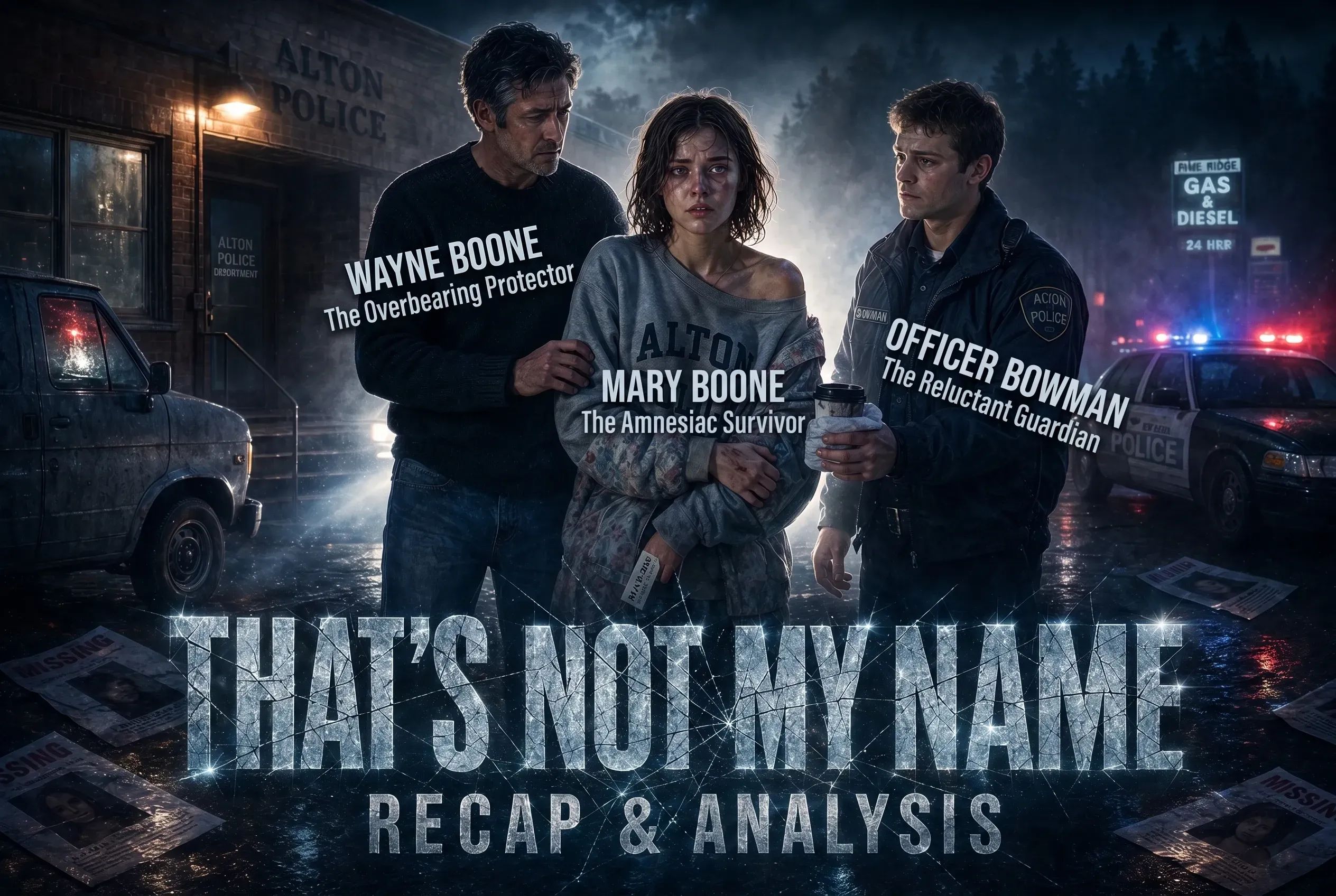
A teenage girl1 regains consciousness in a roadside ditch outside the small Oregon town of Alton, her face swollen, her body bruised, her memory scraped clean. She cannot summon her own name. A young patrolman named Bowman7 finds her staggering down the mountain and brings her to a tiny precinct, where she refuses the hospital and sits shivering under a borrowed blanket.
Stray flashes haunt her: a cluster mailbox, a burned-out light, big hands reaching for her. Paramedics guess a car accident from her injuries. Nothing feels familiar, not the town, not her reflection in the dark window. She is a blank, certain only that something violent happened and that she desperately needs to learn who she is.
The novel opens by weaponizing amnesia as both wound and metaphor. Stripped of memory, the girl becomes pure vulnerability, a self without narrative, which is precisely the condition predators exploit. Lally grounds horror in sensory specifics, the smell of decay, glass-and-nail eyelids, so dread feels bodily rather than abstract. The refusal of the hospital and rape kit signals a survivor's instinctive self-protection even before she knows what she survived. Crucially, the reader knows no more than she does, forging total identification. The opening question, who am I, is also the thriller's engine, since identity itself becomes the mystery to be solved.
A Father Named Wayne
Late that night a wiry, gray-flecked man named Wayne Boone2 walks into the precinct reporting a missing daughter whose description matches her exactly. He produces years of phone photos, a ninth-grade school ID, and a birth certificate, all naming her Mary Ellen Boone,1 seventeen, of McMinnville.
He explains they were driving separately to his fishing cabin when she never arrived, blaming her unreliable car. The girl1 feels no flicker of recognition, only the crushing weight of evidence.
Bowman7 verifies the documents and, lacking any better option than state custody, releases her into Wayne2's care. At the isolated mountain cabin she showers, collapses into bed, and whispers her new name into the dark before crying herself to sleep, decideing she must be Mary.
Documentation becomes destiny. The scene interrogates how easily institutional proof, IDs, certificates, photographs, can override a human being's own bodily intuition that something is wrong. Bowman's procedural caution is real yet insufficient, exposing the limits of paperwork against a confident impostor. The girl's choice to accept Mary is heartbreakingly rational: when memory fails, she outsources her identity to whoever offers the most coherent story. Wayne's performance of relieved paternal love is flawless, which is the horror. Lally dramatizes a chilling truth about coercive control, that captivity can be installed with kindness and credentials rather than chains, at least at first.
The Boyfriend Everyone Blames
In a parallel thread, seventeen-year-old Drew Carter-Diaz3 has spent five weeks as his town's pariah, blamed for the disappearance of his girlfriend, Lola Scott,8 who vanished from a Washington City boat launch. He plasters telephone poles with missing fliers while classmates, teachers, and even Lola8's parents treat him as a killer.
His loyal cousin Max5 trails him; Lola's best friend Autumn,4 the sheriff's daughter, stalks and accuses him. When a search party drags the river, Drew3 realizes the town has stopped hoping for a rescue and started hunting for a body. That night his two fathers12 deliver gutting news that a body has been found. It proves to be a hiker, not Lola,8 but the scare hardens Drew3's resolve to keep searching.
The second protagonist arrives carrying guilt rather than amnesia, the inverse of the girl's condition. Where she cannot remember, Drew cannot forget. Lally builds a study of communal scapegoating, how grief curdles into mob certainty and how privilege, his fathers' lawyer, his clean-cut image, is the only thing keeping him uncuffed. The river search reframes hope as morbid resignation. Introducing Drew's queer, multiracial adoptive family deepens the stakes, contrasting genuine chosen love with the counterfeit fatherhood unfolding on the mountain. His secret, withheld from the reader, generates suspense while signaling that his self-blame is rooted in something concrete he refuses to confess.
Comfort That Feels Like a Cage
Cabin life settles into an unnerving rhythm of elaborate breakfasts, woodstove warmth, and ceaseless supervision. Wayne2 feeds the girl1 eggs and she erupts in hives; he insists she has an egg allergy. He buys her clothes comically too small, then drives her ninety minutes down the coast to a thrift store. Small wrongnesses accumulate like static.
He muddles whether the home repairs involve floors or cabinets, scolds her V-neck shirt as inappropriate, and paints her as a homeschooled homebody who hates leaving the house, a portrait that fits her like someone else's coat. Craving normalcy, she clings to his gentleness while a low dread hums beneath everything. He2 locks every door and fondly calls her his Mary girl.
This section anatomizes coercive control as a slow tightening of contradictions. Each mistake, the wrong allergy, the wrong size, the wrong personality, is individually dismissible, which is exactly how gaslighting works: no single lie is damning enough to act on. Wayne's policing of clothing, books, and music reveals a purity ideology, an obsession with molding a docile, sexless girl. The cabin's coziness is the trap's bait, blurring care and captivity until the girl distrusts her own alarm. Lally captures the victim's exhausting cognitive labor, rationalizing a benefactor whose love is indistinguishable from ownership, and the way isolation makes dependency feel like safety.
The Voicemail That Damns Him
Autumn4 breaks into Drew3's bedroom hunting evidence and plays a voicemail Lola8 left the night she vanished, sobbing that Drew3 is a monster incapable of love. Cornered, Drew3 finally confesses the truth he has buried: at the river, panicked by Lola8's talk of marriage and children, he broke up with her and let her storm off on foot into the dark rather than driving her home.
That voicemail, he realizes, is the new evidence that pushed Sheriff Roane6 to seize his car. Understanding at last that Drew3 broke Lola8's heart but never harmed her, Autumn4 and Max5 throw in with him. Three former adversaries become a search party, convinced a stranger took her while police chase only Drew.3
The withheld secret detonates, and it is mundane cruelty, not violence, that fuels Drew's guilt. The reveal reframes him from suspect to grieving boy who believes his cowardice sent Lola into harm's way. Lally explores how shame distorts culpability: Drew conflates causing pain with causing disappearance, a logic the climax will dismantle. The alliance of accuser, comic cousin, and accused converts private grief into collective action, and Autumn's pivot models the courage of revising judgment against social pressure. The voicemail is doubly potent, a relic of Lola's living voice and the weapon nearly used to imprison an innocent boy.
Breaking Into the Precinct
To access official tip-line calls Roane6 ignores, the trio stages a heist. Max5 fakes a 911 emergency to lure the night deputies into town; Autumn4 storms the station to distract her father6 with manufactured teenage hysterics; Drew3 slips into Roane6's office, logs in with a password Autumn4 supplies, and copies five weeks of recordings onto a USB drive.
Nearly caught, he bluffs free by offering Roane6 a genuine statement about the breakup. Back at Autumn4's house, the three split the files and listen through hours of pranks, cruel rants, and alien-abduction claims. The reckless theft becomes their point of no return, transforming helpless mourning into coordinated rebellion against the adults who have written Lola8 off.
The heist is the thriller's tonal hinge, injecting caper energy into a grief narrative while raising the moral stakes: these kids commit crimes because the institutions meant to protect Lola have failed. Each teen's gift surfaces, Max's nerve, Autumn's theatrical precision, Drew's quick tongue, fusing them into a unit. Lally critiques small-town policing not as evil but as ego and inertia, Roane's confession-hungry tunnel vision. The mountain of useless tips dramatizes the needle-in-haystack agony of real searches and sets up the single recording that matters. Crossing into illegality marks their commitment, the moment hope becomes action with consequences they cannot undo.
The Mother Who Isn't Dead
Dreams begin overruling Wayne2's story. The girl1 remembers a dark-haired woman in nurse's scrubs hanging keys by the door, a red sofa, a lopsided birthday cake, the roar of a softball crowd, a mother vividly, achingly alive. Yet Wayne2 shows her a wallet photo of a blonde stranger and calls that her dead mother, and when she pretends to recognize it, his delight at her false memory turns her cold.
A genial neighbor, old Ben Hooper,9 remarks that her face looks oddly familiar; Wayne2 deflects. Then, in the dead of night, Wayne2 sits silently on the foot of her bed, watching her sleep. She starts cataloguing his lies, gripped by the terror that she might not be Mary Boone at all.
Memory returns as the body's rebellion against an imposed self. The recurring brunette mother, athletic and warm, is everything Wayne's docile blonde fiction is not, and the mismatch becomes the crack in the prison. Lally stages a profound psychological inversion: Wayne wants her to misremember, so accuracy becomes resistance and fabrication becomes compliance. His joy at her false recognition is the tell that something is deeply pathological. The bedside vigil escalates surveillance into violation. Ben Hooper's innocent comment plants a quiet bomb. The girl's transition from gratitude to dread tracks the dawning horror of realizing the author of your reality may be your captor.
A Floral Jacket on Tape
Brushing his teeth, Drew3 hears a tip-line caller, Meredith Hoyt,11 describe a girl1 outside a Waybrooke diner clawing at hives and wearing a one-of-a-kind floral jean jacket. Drew3 goes rigid, because Autumn4 hand-stitched that very jacket for Lola,8 her initials sewn into the tag. He sprints the recording to Roane,6 who, enraged that Drew3 stole evidence, crumples the flier and threatens jail.
Refusing to let the lead rot, Drew,3 Max,5 and Autumn4 ditch school and race to Waybrooke. By phone, Autumn4 flawlessly impersonates the precinct secretary to summon Meredith,11 who confirms the sighting and says the girl1 left in a battered gray van, heading north with an older man.2 The trail roars suddenly, dizzyingly to life.
The jacket is the structural keystone, a handmade object whose uniqueness converts coincidence into proof and finally fuses the two narratives the reader has tracked separately. Lally rewards patient cross-cutting: information lethal in one thread is heartbreakingly familiar in the other. Roane's contempt crystallizes institutional failure, prioritizing his case theory over a child's life. The teens' escalating audacity, impersonating an officer, abandoning school, dramatizes how desperation outpaces propriety when adults abdicate. Meredith's account, the hives, the van, also seeds dramatic irony, since readers recognize the captive's allergy attacks. Hope and horror arrive together: she is alive, and she is in terrible hands.
The Coyote's Grave
On her fifth day, as Wayne2 rushes to pack and leave, the girl1 fishes a crumpled flier from the burn pile: Ben Hooper,9 missing since the afternoon walk on which they met him. By the river, a coyote drags a severed hand from a shallow grave, and she stumbles onto Ben9's mutilated body. Wayne2 appears, calmly accusing her of ruining everything.
She smashes a rock into his skull and runs, and as she flees the truth detonates: there was no accident. Wayne2 abducted her, she escaped his van, and tumbled down an embankment into that ditch. He2 catches her at the neighbor's tree line, crushes his hands around her throat until she blacks out, and hauls her into the cabin basement.
The buried witness forces recognition that comfort was always a stage set over a graveyard. Memory and evidence return simultaneously, the body in the dirt and the body's recollection of the night, collapsing the gaslit fiction in a single horrifying instant. The girl's transition from passive captive to fighter, rock in hand, marks the reclamation of agency the cabin tried to erase. Lally times the revelation for maximum dread: she learns the truth precisely when escape is least possible. The chokehold and basement drag close the trap, converting psychological captivity into literal imprisonment and resetting the stakes from confusion to survival.
Dead End in Alton
Drew3's team reaches Nana's Favorites thrift store, where the cheerful owner, Eloise,10 recalls the girl1 mentioning the long drive back to Alton, while Max5 secretly photographs the diner's grainy security footage. The clue sends them up a remote mountain to spend a night in an Alton motel before bringing everything to the local police.
An officer named McCurry takes their statement seriously, but a young deputy, Bowman,7 shuts it down: he personally released that girl1 to her father days earlier and verified her identity down to a newspaper birth announcement. She is Mary Boone, he insists, not Lola.8 Crushed, Drew3 prepares to go home, until Autumn4 secretly copies Ben Hooper9's address and presses it into his hand.
The dead end is the novel's cruelest narrative feint, dangling rescue then snatching it through the very competence meant to ensure safety. Bowman's diligence becomes the instrument of catastrophe, a chilling argument that a skilled liar can defeat good-faith verification. Lally exploits the reader's omniscience: we know Bowman is wrong, which makes his certainty unbearable. Eloise's accidental clue and Max's footage reward the heist arc, yet evidence proves powerless against an officer's eyewitness conviction. Autumn's quiet theft of the address restores momentum and underscores the book's thesis, that institutional channels fail and only stubborn personal love finishes the job.
Nine Names in Concrete
Drew3 drives to the cabin beside Hooper9's and watches a man2 carry a limp girl1 in a floral jacket toward a basement door. He warns a neighbor to phone police, then breaks in. The captive1 chained to a cot is not Lola8 but a battered stranger, and along the concrete wall runs a column of scratched names ending with the freshest one, Lola.8
The full horror lands. The girl is Madison Perkins,1 the latest in a line of victims, and Lola8 is dead, her jacket handed down to a replacement. Grief buckles Drew3's knees, but he seizes a pair of brush trimmers and starts cutting the handcuff chain, refusing to abandon Madison1 the way everyone abandoned Lola.8
This is the convergence the whole book engineers, and it pays off by denying the wished-for reunion. The wall of names transforms a single tragedy into serial atrocity, recontextualizing every uncanny detail, the lookalike, the jacket, the purity rules, as a pattern of replacement. Madison's true name finally surfaces only as she is found, a poignant reversal of the opening's namelessness. Drew's grief is immediate but his action is immediate too, and his choice to free a stranger he cannot save Lola through is the novel's moral pivot: redemption not as undoing the past but as refusing to repeat its abandonment.
Poker, Battery, and Stairs
Wayne2 attacks, and the cramped basement explodes into a brutal brawl. He chokes Drew3 toward unconsciousness; Madison1 hammers him with the cot frame and a heaved car battery to the temple. The pair scramble upstairs only to find the gas burners cranked to full beside a lit fireplace, a plan to incinerate them all.
Wayne2 yanks Drew3 back down, but Madison1 shuts off the gas, fights free, and seizes the fireplace poker, swinging it like the softball bat her muscle memory still knows. She drives him2 toward the stairs and, with a final kick, sends him tumbling down to break his neck. As sirens climb the mountain, the two collapse together in the driveway, alive while Wayne2 lies dead below.
The climax restores the body's competence as salvation: Madison's buried athletic identity, the very self Wayne tried to erase, becomes the literal weapon of liberation. Lally choreographs survival as collaborative, neither teen wins alone, countering the lone-hero myth. The gas trap reframes Wayne's purity obsession as annihilation, preferring death to a daughter who deviates. Madison's killing blow is presented not as vengeance but as the only arithmetic left, him or her. Her insistence on her real name, weaponized against him, closes the identity arc: she destroys the man who tried to overwrite her by asserting precisely who she is not, and who she is.
The Daddy Dearest Killer
A later news account reconstructs the horror. Wayne Boone,2 dubbed the Daddy Dearest Killer, had murdered his own fifteen-year-old daughter Mary in a rage after she sneaked out to a Halloween party, then spent years abducting lookalike teenagers across five states, straining to mold each into the daughter he destroyed.
When they failed to become her, he killed them and hunted again, even aging his targets to match how old Mary would have grown. Nine girls and old Ben Hooper9 were buried around the Alton cabin. Lola8 lived too close to home, taken the day after she vanished, dead almost before anyone noticed. Madison Perkins1 became the one who escaped, while disgraced Sheriff Roane6 resigns to claim credit on a true-crime docuseries.
The clinical news register delivers catharsis and revulsion at once, recasting domestic abuse as the origin of serial violence: Wayne's controlling fatherhood was always lethal, the murders merely its logical extension. The reveal that he killed his real daughter exposes the engine beneath the purity rules, an attempt to resurrect and perfect what his own rage annihilated. Lally indicts true-crime culture preemptively through Roane, who converts failure into profit and self-mythology, a sharp commentary on how tragedy becomes content. The timeline, Lola dead within a day, is devastating yet merciful, planting the seed that Drew's guilt rests on an impossible counterfactual.
Epilogue
Four months later, on Lola8's birthday, Drew3 sits at the haunted boat launch with a red velvet cupcake he cannot bring himself to light, drowning in self-blame. Madison1 seeks him out, her hair newly dyed to escape her resemblance to Lola8 and Wayne2's other victims.
She insists his love for Lola8 is the only reason anyone ever came searching, and reveals that police records prove Wayne2 began hunting her the day after Lola8 disappeared. Lola could never have been saved; the blame belongs to Wayne2 alone. Together they light the candle, make Lola8's grand birthday wish that everyone she loved be okay, and let the river breeze blow it out. Drew3 begins, barely, to breathe.
The epilogue treats grief as ongoing labor rather than resolved wound. Lally refuses neat closure: Drew is not healed, only beginning, and the haunted boat launch insists trauma is geographic, embedded in place. Madison's dyed hair literalizes the survivor's need to outrun an imposed face, completing her identity arc through self-authorship. Her gift to Drew is exculpatory fact, the timeline proving Lola's doom was sealed before his guilt could matter, transferring blame from boy to killer. The shared cupcake ritual converts private mourning into communion between the two survivors, and the wish, made for the dead by the living, models grief as an act of continued love.
Analysis
Lally constructs a dual-engine thriller in which two opposite afflictions, one girl who cannot remember1 and one boy who cannot forget,3 hurtle toward the same mountain. The structural cross-cutting is the book's deepest pleasure and its argument: information that means terror in one thread reads as tender recognition in the other, so the reader assembles the truth before either protagonist can. At its core the novel is a study of imposed identity and coercive control. Wayne2 does not merely imprison a body; he tries to overwrite a self, scripting a daughter from clothing rules, sanitized media, and forced memories. The girl's recovery1 of her real history, athletic, defiant, mothered by a living woman, becomes literal resistance, and her survival hinges on reclaiming the very traits her captor tried to erase. Lally is pointed about institutional failure. Bowman's conscientious verification7 and Roane's ego-driven tunnel vision6 both endanger the missing, suggesting that procedure and authority are no match for a confident liar, and that only stubborn personal love finishes the search. The book also interrogates blame and the seductive logic of guilt: Drew's conviction3 that his breakup doomed Lola8 is dismantled by a timeline proving her fate was sealed regardless, a hard mercy that distinguishes responsibility from coincidence. The late pivot to true-crime media, with a disgraced sheriff6 cashing in on a docuseries, sharpens a contemporary critique of how atrocity becomes entertainment and how survivors are reduced to brand. Ultimately the novel insists that rescue is collaborative, never the work of a lone hero, and that healing is unfinished labor rather than tidy closure. Its final image, a wish made for the dead by the living, reframes grief itself as an ongoing act of love rather than a wound to be sealed.
Review Summary
That's Not My Name received mostly positive reviews, with readers praising its fast-paced plot, unexpected twists, and emotional impact. Many found it captivating and difficult to put down. The dual perspectives and character development were appreciated, though some felt the plot was predictable. Criticisms included plot holes, unrealistic police behavior, and occasional grammatical errors. Despite these issues, most readers found it an engaging YA thriller with a satisfying conclusion. The book's ability to evoke strong emotions and keep readers guessing was frequently mentioned.
Characters
The Amnesiac Girl
Nameless captive seeking selfWakes in a ditch with her memory erased and is told she is Mary Boone. Resilient, sharp-tongued, and instinctively self-protective, she copes by assembling a running mental list of facts about herself, hungry for any solid ground. She craves fresh air, movement, and autonomy, chafing against the sheltered, homebound identity pressed upon her. Her body remembers what her mind cannot: coordination, competitiveness, a love of attention and music. Caught between gratitude for her caretaker's tenderness2 and a deepening dread at his contradictions, she embodies the terror of having one's reality authored by someone else. Her arc is a fierce struggle to recover selfhood from an imposed narrative, learning to trust the alarms her own instincts keep sounding.
Wayne Boone
The man claiming herA wiry, gray-flecked handyman who appears at the precinct insisting the girl1 is his daughter and produces flawless documentation. Outwardly gentle, attentive, and endlessly apologetic, he cooks lavish breakfasts, stocks first-aid supplies, and frets over her comfort. Yet he polices her clothing, books, music, and movements with rigid notions of purity and obedience, isolating her on a remote mountain and locking every door. His warmth and his control are inseparable, a study in coercive love that has curdled into something far darker. Driven by a compulsion to mold her into one specific idealized girl, he cannot tolerate deviation, and his calm can tip without warning into chilling menace.
Drew Carter-Diaz
Accused, grieving boyfriendSeventeen, a swim-team captain and adopted son of two devoted fathers12, transformed overnight into his town's prime suspect when his girlfriend8 vanished. Guilt-ridden, stubborn, and self-punishing, he pours his anguish into missing fliers and a homemade investigation board, refusing to eat, sleep, or forgive himself. He guards a secret about their last night that convinces him everything is his fault. Loyal to the point of recklessness and propelled by a fierce moral compass, he keeps searching even when it endangers his freedom. Beneath his sarcasm lies a tender, devastated boy desperate to undo a single irreversible choice, learning slowly that love and blame are not the same thing.
Autumn
Fierce best friend, sheriff's daughterLola8's devoted best friend and the daughter of the local sheriff6. She begins as Drew3's most venomous accuser, stalking and confronting him, but proves intelligent, theatrical, and meticulously prepared once she changes her mind. Her loyalty, when finally aimed in the right direction, is relentless and resourceful, from forged passwords to flawless impersonations.
Max
Loyal, irrepressible cousinDrew3's tall, lanky cousin and steadfast companion. Comic relief with genuine heart, he treats the dangerous search as a sleuthing adventure, lightening the darkest moments while refusing to let Drew3 face anything alone. Tenacious and brave, he anchors Drew3 emotionally when guilt threatens to drown him.
Sheriff Roane
Stubborn, ego-driven lawmanWashington City's sheriff, fixated on Drew3 as the convenient answer to Lola8's disappearance. Confession-hungry and dismissive of alternative theories, he cares more about control, reputation, and a tidy narrative than the messy truth. His tunnel vision becomes its own obstacle, embodying institutional failure dressed in authority.
Officer Bowman
Earnest young patrolmanThe conscientious young Alton officer who finds the girl1 and handles her case. Kind, careful, and genuinely protective, he verifies identities thoroughly and believes he is safeguarding a vulnerable teen. His sincerity and competence make him sympathetic even when events test his judgment.
Lola Scott
The missing girlfriendDrew3's vivacious, demanding girlfriend who vanished from a boat launch. Glimpsed through memory, fliers, and an empty chair, she dreamed loudly of a shared future and clashed bitterly with her parents over independence and a car. Spirited and strong-willed, she haunts every page she does not appear on.
Ben Hooper
Friendly mountain neighborA warm, talkative elderly man living up Ridge Road who preaches community and old-fashioned family values. He greets the girl1 and Wayne2 kindly and remarks that her face seems strangely familiar.
Eloise
Cheerful thrift-store ownerThe pink-clad, big-hearted owner of Nana's Favorites thrift shop in Waybrooke. Chatty and eager to help, her vivid memory of a casual customer comment supplies the search a crucial geographic clue.
Meredith Hoyt
Pivotal diner witnessA diner patron who phones the tip line after spotting a hive-covered girl1 in a distinctive floral jacket leaving with an older man2 in a gray van. Her call is the spark that reconnects the two storylines.
Drew's fathers
His loving adoptive dadsDrew3's white and Guatemalan adoptive fathers, fiercely loving and increasingly frightened for their son. They supply lawyers, warm meals, and unwavering belief, embodying authentic chosen family against the counterfeit fatherhood on the mountain2.
Plot Devices
Amnesia
Erases identity, enables controlThe protagonist's1 total memory loss after a head injury is the engine of the entire captivity plot. Without recollection, she cannot contest the identity handed to her, must accept documentation over instinct, and depends on her captor2 for the story of her own life. Lally uses the slow, partial return of memory, first as dreams, then as full recall, as a ticking clock and a form of resistance, since every recovered truth threatens the imposed fiction. The device also forces total reader identification, since we learn alongside her, and it transforms ordinary details, an allergy, a jacket, a mother's face, into clues whose meaning she must painstakingly reconstruct.
The floral jean jacket
Unique clue linking two plotsA one-of-a-kind jean jacket with custom rose-gold buttons and hand-stitched floral sleeves, bearing sewn-in initials, becomes the object that bridges the two parallel narratives. Worn by the captive girl1 and recognized through a tip-line call, its uniqueness converts coincidence into evidence, allowing Drew3's search to intersect with her captivity. The jacket recurs across diner sightings, security footage, and thrift-store memories, functioning as a trackable beacon. Its presence on the wrong person ultimately carries devastating implications about what happened to its original owner8, making it both a literal trail and an emotional gut-punch that the reader decodes before the characters fully do.
Mismatched allergy attacks
Exposes the captor's false knowledgeThe girl1 suffers repeated allergic reactions because her caretaker2 cannot remember what she is actually allergic to, first blaming eggs, then strawberries. These hive outbreaks operate on multiple levels: they incapacitate her with sedating medication, they generate a public scene that a witness later reports, and most importantly they quietly prove that the man claiming to be her lifelong father2 does not truly know her body. Lally plants these episodes as accumulating evidence that the reader and eventually the girl1 read as wrongness, a domestic detail turned diagnostic, undermining the elaborate paternal performance with something as small and intimate as breakfast.
The tip-line recordings
Investigative engine for the teensFive weeks of recorded public tips, stolen from the sheriff6's computer during a staged break-in, become the resource that powers the amateur investigation. Buried in pranks, cruel rants, and absurd false sightings sits one genuine lead that cracks the case open. The device dramatizes both the futility and the necessity of crowdsourced information, and it indicts the police for ignoring what concerned citizens provide. By having teenagers do the listening the adults won't, Lally critiques institutional negligence while supplying a realistic mechanism for ordinary kids to leapfrog the official investigation toward a remote town they would never otherwise have found.
Names scratched in concrete
Reveals scope of the horrorA column of girls' names carved into the basement wall, in varied and fading handwriting, transforms a single abduction into evidence of a long, methodical pattern. Discovered near the climax, the names recontextualize every earlier uncanny detail, the lookalike features, the recycled jacket, the purity rules, as elements of serial replacement. For the captive1, the wall is both a warning that she is not the first and a record left by the doomed so someone might know they existed. For another character3, recognizing the freshest name8 delivers the story's most crushing revelation, fusing dread, grief, and the full horror of the antagonist's purpose2.
FAQ
Synopsis & Basic Details
What is That's Not My Name about?
- Dual Mysteries Unfold: The novel follows two seemingly separate narratives: a teenage girl who wakes up in a ditch with complete amnesia, struggling to piece together her identity after being found by police and claimed by a man who says he's her father, and a teenage boy desperately searching for his missing girlfriend, suspected by his town and the police.
- Search for Truth Converges: As the girl, identified as Mary Boone, grapples with fragmented memories and growing suspicions about her supposed father, the boy, Drew, follows a desperate lead that connects his missing girlfriend, Lola, to the same remote area where Mary was found.
- Hidden Darkness Revealed: Both protagonists navigate unreliable information and dangerous secrets, ultimately uncovering a horrifying truth that links their paths and exposes a pattern of abduction and violence hidden beneath a veneer of normalcy in a small Oregon town.
Why should I read That's Not My Name?
- Compelling Dual Perspectives: Experience the story through the eyes of two teenagers facing unimaginable circumstances – one stripped of her past, the other burdened by guilt and suspicion – creating a unique sense of suspense and emotional depth.
- Masterful Suspense and Pacing: The narrative expertly builds tension, weaving together subtle clues, psychological manipulation, and moments of intense action that keep you guessing until the shocking truth is fully revealed.
- Exploration of Identity and Control: Delve into themes of who we are without our memories, the insidious nature of control disguised as care, and the resilience of the human spirit in the face of trauma and deception.
What is the background of That's Not My Name?
- Remote Oregon Setting: The story is primarily set in the isolated, wooded areas around Alton and Washington City, Oregon, utilizing the natural environment's darkness and seclusion to enhance the thriller atmosphere.
- Focus on Missing Persons: The narrative taps into the real-world fear and media frenzy surrounding missing teenagers, particularly highlighting the public's tendency to assign blame and the challenges faced by families and law enforcement in such cases.
- Psychological Thriller Elements: The book employs conventions of the psychological thriller genre, focusing on unreliable perspectives, gaslighting, and the breakdown of trust within seemingly normal relationships to create a sense of unease and disorientation.
What are the most memorable quotes in That's Not My Name?
- "I think I might be dead.": This is the opening line, immediately establishing the protagonist's disorientation and the high stakes of her situation, setting a tone of mystery and vulnerability for the amnesiac girl.
- "Life really goes to shit when everyone thinks you killed your girlfriend.": Drew's opening thought encapsulates his isolation and the crushing weight of public opinion and police suspicion he faces, defining his narrative arc centered on clearing his name and finding Lola.
- "That's not my name, you asshole!": Mary/Madison's defiant scream during the climax is a powerful reclaiming of her identity and agency, directly confronting her captor's delusion and marking a pivotal turning point in her fight for survival.
What writing style, narrative choices, and literary techniques does Megan Lally use?
- Alternating First-Person POV: The story is told through the immediate, subjective perspectives of Mary/Madison and Drew, allowing readers direct access to their thoughts, fears, and fragmented understanding of events, enhancing suspense and empathy.
- Subtle Foreshadowing and Misdirection: Lally employs subtle clues (Wayne's inconsistencies, Mary's conflicting memories, environmental details) and narrative misdirection (Drew as the initial suspect, Wayne's seemingly kind actions) to build intrigue and surprise the reader with the true nature of the threat.
- Symbolism and Motif: Recurring elements like the floral jacket, the gray van, the isolated cabin, and the names scratched into the basement wall serve as powerful symbols of connection, confinement, and the hidden history of Wayne's crimes, adding deeper layers of meaning to the plot.
Hidden Details & Subtle Connections
What are some minor details that add significant meaning?
- The Floral Jean Jacket's Uniqueness: Lola's custom-made jacket, meticulously stitched by Autumn, is initially just a detail in her missing person flier, but it becomes a crucial, undeniable piece of evidence linking her to the girl found in Alton, proving the girl's identity is connected to Lola's disappearance despite initial police dismissal.
- Wayne's Allergy Confusion: Wayne's repeated confusion about Mary's allergies (initially saying eggs, then strawberries) seems like simple forgetfulness under stress, but it subtly hints that he doesn't truly know the girl he's claiming, foreshadowing his delusion and the possibility that she is not his real daughter, Mary Boone.
- Ben Hooper's Missing Person Flier: The flier for the missing neighbor, Ben Hooper, initially seems like background detail about the town's issues, but its presence in the cabin's burn pile and the timing of his disappearance immediately after meeting Mary/Madison and Wayne reveals Wayne's violent nature and confirms Mary/Madison's dawning fears about his true character.
What are some subtle foreshadowing and callbacks?
- Environmental Descriptions Mirroring Mood: The initial description of the ditch with "twigs twist up into the air like claws" and the "damp earth... smells like decay" subtly foreshadows the danger and death associated with the location and Wayne's actions, contrasting with later descriptions of the river as "breathtaking" when Mary/Madison feels a fleeting sense of peace.
- Wayne's Controlling Language: Wayne's seemingly innocuous comments about Mary being a "homebody," liking "clean books," and needing to avoid "inappropriate outfits" and "tainted friends" are early hints of his controlling nature and rigid worldview, foreshadowing the extreme measures he takes to enforce his idea of "purity" and "right path."
- The Red Sofa Memory: Mary/Madison's recurring, fragmented memory of a red sofa and a woman in scrubs initially seems disconnected, but it's a callback to her real home and mother, a persistent subconscious truth that conflicts with Wayne's fabricated reality and ultimately helps her realize his deception.
What are some unexpected character connections?
- Mary/Madison and Lola's Physical Similarity: The most striking and unexpected connection is the physical resemblance between Mary/Madison and Lola, which is so strong it leads multiple people (Drew, Autumn, Eloise, Meredith) to believe they are the same person, highlighting Wayne's pattern of targeting girls who resemble his deceased daughter.
- Officer Bowman's Dual Role: Officer Bowman, the kind officer who initially finds Mary/Madison and ensures her safety with Wayne, unexpectedly reappears later in Drew's narrative at the Alton precinct, becoming the very officer who dismisses Drew's lead, creating a direct link between the two storylines and the tragic misidentification.
- Autumn's Impersonation Skill: Autumn's seemingly random talent for impersonating the police secretary, Savannah, becomes a crucial plot point, allowing the teenagers to gather vital information from witnesses by posing as authorities, demonstrating how secondary character skills can significantly impact the main plot.
Who are the most significant supporting characters?
- Officer Bowman: He represents initial hope and safety for Mary/Madison, but his later dismissal of Drew's evidence highlights the limitations of official investigations and the tragic consequences of misidentification, serving as a bridge between the two main narratives.
- Autumn: Initially suspicious of Drew, her loyalty to Lola drives her to become a resourceful and determined ally, providing crucial information (Sheriff's password, witness contact) and emotional support, embodying the theme of friendship in the face of adversity.
- Max: Drew's loyal cousin provides unwavering support, comic relief, and practical help (transportation, breaking into the precinct), acting as a grounding force for Drew and demonstrating the importance of family bonds during a crisis.
Psychological, Emotional, & Relational Analysis
What are some unspoken motivations of the characters?
- Wayne's Delusional Grief and Control: Beyond simply kidnapping, Wayne's unspoken motivation is a desperate, twisted attempt to recreate his deceased daughter, Mary Boone. His actions are driven by profound, unaddressed grief and a need for absolute control, projecting his idealized version of Mary onto his victims and becoming enraged when they fail to conform, as evidenced by his outburst, "Every time I find you, it's the same!"
- Drew's Guilt-Driven Pursuit: Drew's relentless search for Lola is fueled by immense guilt over their final fight and his decision to let her walk home alone. His motivation isn't just finding his girlfriend; it's a desperate need for atonement and to prove to himself and others that he didn't cause her death, even if it means risking his own safety and freedom.
- Mary/Madison's Instinctive Distrust: Mary/Madison's growing unease and distrust of Wayne, even before fully recovering her memories, stems from an unspoken, primal instinct for self-preservation and a subconscious recognition that his behavior and the environment are fundamentally wrong, highlighting the body's innate ability to sense danger despite cognitive impairment.
What psychological complexities do the characters exhibit?
- Wayne's Dissociative Identity/Delusion: Wayne exhibits severe psychological complexity, likely a form of dissociative disorder or profound delusion stemming from trauma. He genuinely believes his victims are his daughter, Mary, compartmentalizing his violent actions and maintaining a facade of a caring father, as seen when he seamlessly shifts from rage outside to a smiling demeanor inside the cabin.
- Mary/Madison's Trauma and Identity Struggle: Mary/Madison experiences significant psychological trauma from the abduction and head injury, leading to amnesia and a struggle with identity. Her journey reflects the psychological process of recovering from trauma, where fragmented memories and conflicting information create confusion and a desperate need to anchor to reality, culminating in the horrifying realization of her true identity and situation.
- Drew's Survivor's Guilt and Obsession: Drew grapples with intense survivor's guilt, believing his actions led to Lola's death. This guilt manifests as an obsessive need to find her, driving him to reckless behavior (breaking into the precinct, confronting Wayne) and isolating him from those who care about him, showcasing the destructive power of unresolved grief and self-blame.
What are the major emotional turning points?
- Mary/Madison's Allergy Attack: The first allergy attack, triggered by eggs (which Wayne incorrectly attributes to strawberries), is a major emotional turning point for Mary/Madison, introducing the first concrete inconsistency in Wayne's story and planting the seed of doubt about his reliability and her own identity.
- Drew Hearing Lola's Voicemail: Autumn playing Lola's final, tearful voicemail is a devastating emotional turning point for Drew, confirming the depth of Lola's pain and his role in causing it, while also providing the first hint that her disappearance was connected to their breakup, not necessarily his violence.
- Mary/Madison's Dream of Her Real Mom: The dream featuring the woman with the red sofa and the "Happy birthday, baby girl" song is a critical emotional turning point, providing Mary/Madison with a clear, visceral memory of her real mother that directly contradicts Wayne's lies, shattering his fabricated reality and propelling her towards the truth.
How do relationship dynamics evolve?
- Mary/Madison and Wayne: From Trust to Terror: The relationship begins with Mary/Madison tentatively accepting Wayne as her father out of necessity and hope, evolving through growing suspicion fueled by his inconsistencies and controlling behavior, and culminating in pure terror and violent resistance as she uncovers his true, murderous nature.
- Drew and Autumn: From Antagonism to Alliance: Initially, Autumn views Drew with suspicion and hostility, believing he harmed Lola. Their relationship transforms as Drew shares his painful truth and demonstrates his genuine commitment to finding Lola, leading Autumn to trust him, share crucial information, and actively join his dangerous search, forging a bond based on their shared grief and determination.
- Drew and His Dads: Strain and Support: Drew's relationship with his dads is strained by his isolation, guilt, and reckless actions, which cause them immense worry. Despite their fear and disapproval of his methods, their underlying love and support remain constant, culminating in Dad providing the printer ink and Drew sending the crucial text message and photo, highlighting the enduring strength of family bonds even under extreme pressure.
Interpretation & Debate
Which parts of the story remain ambiguous or open-ended?
- The Full Extent of Wayne's Victims: While the names on the basement wall and the discovery of nine teenage girls' remains confirm Wayne was a serial killer, the story leaves ambiguous the exact circumstances of each girl's abduction and death, and whether there might have been other victims not found at the cabin or his home.
- The Real Mary Boone's Final Moments: The newspaper article reveals the real Mary Boone died from a broken neck at age fifteen after sneaking out to a Halloween party, but the specific details of the "fit of rage" and the immediate aftermath leading to her burial remain somewhat open to interpretation, leaving the reader to infer the full horror of that night.
- The Long-Term Psychological Impact: While the epilogue shows Drew and Madison beginning to heal and connect, the story leaves open the long-term psychological impact of their trauma, the challenges they will face navigating their survivor status, and how their experiences will continue to shape their identities and relationships in the future.
What are some debatable, controversial scenes or moments in That's Not My Name?
- Drew's Decision to Leave Lola: The most debatable moment is Drew's decision to let Lola walk home alone after their fight. While fueled by anger and hurt, readers may debate the extent of his responsibility for her subsequent abduction, especially given Wayne's predatory pattern, prompting discussion on accountability in relationships and the unpredictable nature of external threats.
- Autumn and Drew Stealing Evidence: The teenagers' decision to break into the police station and steal tip-line recordings is morally ambiguous and legally controversial. Readers might debate whether their actions were justified given Sheriff Roane's incompetence and bias, or if they crossed a line that put themselves and the investigation at risk.
- Sheriff Roane's Incompetence/Bias: Sheriff Roane's portrayal and actions are highly debatable. His immediate suspicion of Drew, dismissal of crucial evidence (the Waybrooke tip, the jacket description), and focus on a convenient narrative raise questions about police bias, professional negligence, and whether his actions actively hindered the investigation and potentially endangered Madison.
That's Not My Name Ending Explained: How It Ends & What It Means
- Wayne Boone's Reign of Terror Ends: The climax reveals Wayne Boone is a serial killer who abducted girls resembling his deceased daughter, Mary Boone, who he killed years prior. Madison Perkins, the girl found with amnesia, is his latest victim, mistaken for Mary. Drew, following his lead, finds Madison, and together they fight back, resulting in Wayne's death by battery and fall down the basement stairs.
- Truth and Identification Confirmed: The ending confirms Madison's true identity (Madison Perkins) and the tragic fate of Lola Scott, who was Wayne's previous victim, killed shortly after her disappearance. The names scratched on the basement wall are revealed to be other victims, confirming the horrifying scope of Wayne's crimes.
- Survivors and Aftermath: Drew and Madison survive the ordeal, rescued by Officer Bowman and other police. The epilogue, set months later, details the discovery of Wayne's victims, the public fallout (including Sheriff Roane's disgrace), and shows Drew and Madison beginning to process their trauma and connect as survivors, finding solace in their shared experience and the knowledge that they stopped Wayne, bringing closure to many families. This ending signifies the triumph of resilience and truth over deception and violence, highlighting that even in the darkest circumstances, connection and courage can lead to survival and healing.
Download PDF
Download EPUB
.epub digital book format is ideal for reading ebooks on phones, tablets, and e-readers.








































