
Key Takeaways
1. The Enduring Allure and Evolving Business of Running Shoes
If you’ve ever laced rubber to your feet for a run, you’ll be captivated by this delightfully probing book.
Personal connection. The author's lifelong fascination with running shoes began at age five with a pair of cherry-red sneakers, sparking a joy that correlated speed and positive feelings with footwear. This personal journey reflects a universal experience for many runners, where shoes become more than just gear—they're catalysts for self-discovery and inspiration. The emotional bond with "kicks" is a powerful, often inexplicable, force in the running community.
Industry transformation. The running shoe business has exploded from a niche market in the 1970s to a multi-billion dollar industry today, with annual sales increasing from $100 million in the early 1980s to over $3 billion by 2018. This growth has been fueled by:
- The "jogging craze" of the 70s and 80s.
- A shift from marathon-focused running to diverse fitness goals (5K, 10K, half-marathon).
- Increased participation from women and younger generations.
- The rise of athleisure and casual wear.
Retail challenges. Despite booming sales, specialty running stores face immense pressure from online retailers and big-box chains offering convenience and discounts. Successful shops like Naperville Running Company thrive by emphasizing expert fitting services, community engagement, and a deep understanding of running, proving that personalized service can still compete in the digital age. However, the ease of online price comparison and direct-to-consumer sales continues to reshape the retail landscape.
2. From Simple Leather to Cushioned Comfort: Early Shoe Evolution
How could runners have trained so hard, run so many miles, and run such fast marathons wearing shoes that offered so little protection and virtually no cushioning underfoot?
Minimalist origins. Early running shoes of the 1960s, like the New Balance Trackster or Onitsuka Tiger Marathon, were minimally designed with thin rubber outsoles and lightweight leather or nylon uppers, offering almost no cushioning. Elite runners like Derek Clayton and Frank Shorter achieved world-class performances in these basic shoes, raising questions about the necessity of modern cushioning. This era highlights a stark contrast to later designs, suggesting a natural resilience in runners of the time.
The cushioning revolution. The late 1960s saw the introduction of midsole cushioning, starting with the Nike Cortez (originally Onitsuka Tiger). This innovation, featuring a thin layer of soft rubber foam, aimed to absorb impact and reduce stress, quickly becoming a hit with the growing number of recreational joggers. The success of the Cortez sparked a "cushioning war" among brands, leading to the widespread adoption of:
- EVA (Ethylene-vinyl acetate) foam in shoes like the Brooks Villanova (1975).
- Nike's "waffle" outsoles for improved traction and energy return.
- The controversial but influential Nike Air-Sole cushioning system (1978).
Marketing and price. As innovations proliferated, so did marketing hype and shoe prices. The industry became obsessed with proprietary technologies, each promising better performance and injury reduction. Runner's World magazine's annual shoe reviews, though often controversial and suspected of advertiser influence, became a crucial guide for consumers, further fueling the competitive drive among brands to innovate and differentiate their products.
3. The "Cool" Factor: When Fashion Drove Running Shoe Design
They look a little big and bulky for running, but they sure look good with jeans.
Cultural shift. The late 1980s and 1990s marked a significant transition in running culture, moving from a performance-first mindset to one embracing participation and lifestyle. Running shoes transcended their athletic purpose, becoming fashionable casual wear. This "sneaker craze," ignited by shoes like the Air Jordan, meant aesthetics and comfort became as important, if not more so, than pure running performance.
Nike's dominance. Nike capitalized on this shift with groundbreaking marketing and design. The 1987 Air Max, with its "visible technology" (a cutaway window revealing the Air-Sole unit), was a revolution in both design and marketing. The iconic "Just Do It" campaign (1988) further cemented Nike's global influence, encouraging broader participation in fitness and positioning athletic shoes as a statement of an active lifestyle. This led to:
- The rise of "cross-trainers" for versatile gym and casual use.
- An explosion of bright, Day-Glo colors and bold design elements.
- Increased women's participation, with figures like Oprah Winfrey inspiring new runners.
Performance vs. aesthetics. While some innovative performance shoes emerged (e.g., Nike Air Stab, Air Huarache), the decade was largely characterized by heavier, "overbuilt" shoes designed for visual appeal and crossover lifestyle use. This split meant that true performance innovations often struggled for mainstream attention, leading to a "dead period in design as far as performance running was concerned," according to some experts. The focus on "cool" ultimately prioritized sales over optimal running efficiency for many brands.
4. The Minimalist Revolution: A Brief Return to Natural Running
I have a theory that to breathe is to live—and the more you breathe, like on a long mountain run, the more you live.
Natural running philosophy. The author's encounter with Micah True, a vagabond ultrarunner who ran in huarache sandals, introduced the concept of natural, minimalist running. True's experiences with the Rarámuri (Tarahumara) Indians, known for running long distances in primitive footwear without injury, planted seeds for questioning conventional shoe design. This philosophy emphasized a greater connection to the ground and a more nimble, efficient gait.
"Born to Run" impact. Christopher McDougall's 2009 book, Born to Run, brought minimalist running into the mainstream, asserting that modern running shoes were a primary cause of injuries. The book, coupled with Dr. Daniel Lieberman's 2010 Harvard study on forefoot striking, ignited a firestorm, leading to:
- A surge in demand for "barely there" shoes like Vibram FiveFingers and Nike Free.
- New brands like Newton Running (with its low heel-toe offset and midfoot strike focus) and Altra Running (zero-drop, foot-shaped toe box) emerging.
- A paradigm shift in shoe design towards lighter, less structured models with lower heel-toe offsets.
Rapid rise and fall. The minimalist trend peaked around 2012, but its rapid adoption without proper transition led to a spike in injuries (sore calves, Achilles tendinitis). Many runners found they couldn't adapt to the starkness of minimalist shoes, and a class-action lawsuit against Vibram for deceptive advertising further tarnished the movement. While minimalist sales plummeted, its legacy endured, forcing brands to rethink shoe design towards lighter, more flexible, and more functional models, even if not fully minimalist.
5. The Injury Paradox: Shoes, Science, and the Search for Solutions
The current approach of prescribing in-shoe pronation control systems on the basis of foot type is overly simplistic and potentially injurious.
Persistent injury rates. Despite decades of shoe evolution and massive investments in research, the annual injury rate among recreational runners remains stubbornly high, averaging 50-60%. Experts like Jay Dicharry and Reed Ferber argue that shoes themselves don't cause injuries; rather, they are a small piece of a complex puzzle. The primary culprits are often "doing too much, too fast, too soon" – overuse, inadequate fitness, and insufficient strength.
Pronation control debunked. For decades, the running industry was obsessed with "overpronation" (inward rolling of the ankle) as a cause of injuries, leading to the development of stability and motion-control shoes with features like medial posts. However, later research by biomechanists like Benno Nigg and subsequent studies revealed that pronation is a normal, natural movement, and excessive overpronation is rare. This debunking led to a radical shift:
- The realization that trying to control natural foot movement with restrictive shoes could cause more problems.
- A move towards supporting a runner's "preferred movement path" rather than correcting perceived flaws.
- The growing importance of "comfort" as the most reliable indicator for a suitable shoe.
Holistic approach. Physical therapists and coaches like Mark Plaatjes emphasize that comprehensive training—including core strength, form drills, and flexibility—is crucial for injury prevention, not just shoes. The minimalist movement, while flawed in its implementation, highlighted the need for stronger feet and lower legs. Ultimately, the consensus is that shoes are tools, and while they can enhance performance or comfort, they cannot prevent injuries; that responsibility lies with the runner's overall physical preparation and understanding of their unique gait.
6. The Pendulum Swings: From Minimalism to Maximalism and Beyond
I felt like I was running in racing flats or FiveFingers while running in a fully cushioned shoe on the roads.
Altra's zero-drop innovation. Inspired by his father's early tinkering and his own observations at Runner's Corner, Golden Harper, with Brian Beckstead, developed a new approach to shoe design. They "hacked up" existing shoes to create "zero-drop" (level platform) models with foot-shaped toe boxes, aiming to facilitate natural running form and reduce injuries. Their research, though informal, showed significant reductions in common overuse injuries, leading them to found Altra Running.
Hoka's maximalist counter-revolution. Simultaneously, French innovators Nicolas Mermoud and Jean-Luc Diard launched Hoka One One, introducing "maximalist" shoes with dramatically thick, oversized midsoles. This concept, initially met with skepticism, aimed to provide:
- Significantly more cushioning (30% more than traditional models).
- A wide, stable platform and a rockered profile for a smoother gait.
- Surprisingly lightweight construction using new foam materials (RMAT).
- Relief for runners struggling with impact and injuries, especially in ultrarunning.
Industry impact. Hoka's success, despite launching during the minimalist craze, proved that there was a strong demand for comfort and protection. It "swung the pendulum back" towards cushioning, forcing larger brands to re-evaluate their designs and incorporate similar concepts. Both Altra and Hoka, initially outliers, grew rapidly, demonstrating that disruptive innovation, even if contrarian to prevailing trends, can reshape the industry and lead to significant market share.
7. The Complex Journey: How a Running Shoe is Conceived and Made
It’s pretty amazing to see what a labor-intensive process it is to build a single pair of shoes.
Handcrafted complexity. The manufacturing of a running shoe is a surprisingly labor-intensive process, involving over 60 individual steps and dozens of workers on an assembly line. From die-cutting foam and fabric to gluing, stitching, and molding, each pair is hand-curated. This intricate process, often taking 90 minutes per shoe, highlights the human element behind mass-produced footwear, a fact often overlooked by consumers.
Global supply chain. While most running shoes are conceived and designed in hubs like Boston and Portland, over 95% are manufactured in East Asia (China, Vietnam). This global supply chain is driven by:
- Lower labor and production costs compared to Western countries.
- Access to advanced materials and specialized factories.
- Historical connections established by brands like Nike in the 1970s.
- Improved working conditions in many Asian factories due to increased competition and oversight.
The update cycle. Running shoe models are typically updated annually, a cycle driven by consumer demand for "new" and the assumption of "improvement." This constant evolution, whether minor aesthetic tweaks or significant overhahauls, is crucial for sales, even if it frustrates runners who find their favorite models changed. Brands balance:
- Consumer feedback and sales analytics.
- New materials (e.g., Fresh Foam, EVERUN) and construction techniques.
- Market trends (e.g., post-minimalist demand for cushioning).
- The need to differentiate products and maintain market share.
8. The Quest for Speed: "Magic Shoes" and the Sub-2-Hour Marathon
Our extrapolations suggested that with these shoes, the technology is in place to break the 2-hour marathon barrier.
Breaking barriers. The pursuit of seemingly impossible athletic feats, like the sub-4-minute mile or the sub-10-second 100-meter dash, has always captivated humanity. The marathon's "magical" 2-hour barrier became the ultimate challenge, with scientists like Michael Joyner theorizing its possibility. Nike, driven by competition and a vision for the impossible, launched the "Breaking2 Project" to achieve this feat, recognizing its potential to transform the sport.
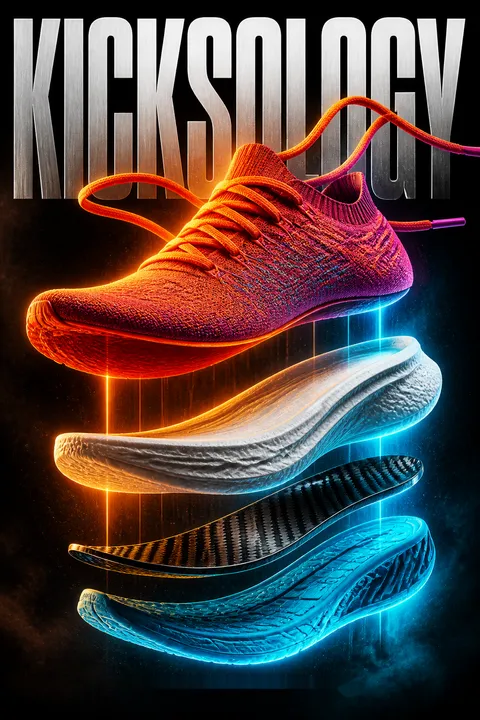
The Vaporfly innovation. Nike's top-secret Project Able (later Breaking2) focused on developing a "supershoe" to reduce the metabolic cost of running. This led to the creation of the Vaporfly 4% (and later Next%), featuring:
- ZoomX foam: An exceptionally light and responsive Pebax-based material, offering up to 87% energy return (compared to 50-60% for EVA).
- Curved carbon-fiber plate: Embedded in the midsole to increase stiffness, reduce fatigue, and propel the runner forward, acting as a lever rather than an illegal spring.
- Thick, yet lightweight design: Providing cushioning without excessive weight, addressing the needs of elite marathoners in the latter stages of a race.
Record-breaking impact. The shoes, worn by Eliud Kipchoge in his 2:00:25 Breaking2 attempt and later his 2:01:39 world record, demonstrated significant performance gains. Studies confirmed a 4% improvement in running economy, leading to widespread adoption by elite and sub-elite runners. This innovation sparked a "carbon-fiber plate" arms race among other brands (Hoka, New Balance, Saucony), fundamentally changing the landscape of competitive marathon footwear and raising questions about technological advantage in sport.
9. The Promise of Personalization: Tailoring Shoes to Unique Gaits
Always remember that you are absolutely unique. Just like everyone else.
Aesthetics vs. true customization. Early "custom" shoe programs like NIKEiD focused primarily on aesthetic personalization, allowing consumers to choose colors and materials for standard shoe silhouettes. While popular for self-expression, these services didn't address the deeper need for shoes tailored to an individual's unique biomechanics. The challenge remained: how to create a truly customized shoe for the masses that accounts for individual gait patterns and anatomical differences.
The need for individualized fit. Every runner possesses a unique gait, foot shape, and set of anatomical irregularities (e.g., leg-length discrepancies, pronation patterns). Off-the-shelf shoes, even with expert fitting, can only go so far. Custom insoles offer a semi-custom solution, providing targeted support and cushioning. However, the ultimate goal is a shoe where every component—from midsole density to upper volume—is precisely matched to the runner.
High-tech personalization. Major brands are now leveraging advanced technology to pursue true customization:
- Adidas Futurecraft: Uses 3-D printing to create midsoles tailored to individual pressure points and cushioning needs.
- Adidas Speedfactory (AM4): Designs shoes based on regional runner data and individual foot scans, with automated manufacturing for specific cities.
- Salomon ME:sh: Scans feet and gait to offer choices for heel-toe offset, outsole features, and cushioning, with heat-fused knit uppers.
- Brooks Genesys (FitStation by HP): Combines 3-D foot scanning, gait analysis, and Brooks's "Run Signature" principles to create one-of-a-kind shoes with unique midsole dimensions and densities.
Challenges and future. While prototypes exist, mass production of truly personalized shoes faces significant hurdles: high cost (initially $250-$500+), slow production speed, and the complexity of manufacturing unique components for every pair. However, the demand for high-end, performance-enhancing products suggests that certain runners will pay a premium for shoes precisely tuned to their bodies, pushing the industry towards a future where "made-to-order" becomes increasingly sophisticated.
10. What's Next: Innovation, Sustainability, and the Future of Footwear
The human foot is a masterpiece of engineering and a work of art.
Evolving market dynamics. The running shoe industry continues its whirlwind of change, driven by shifting consumer preferences and technological advancements. The rise of the "athleisure" market has created a new category of casual, athletic-looking shoes, diverting some consumers from expensive performance running shoes. Simultaneously, a decline in global race participation since 2016 suggests potential consolidation among shoe brands, intensifying the competition for innovation and market share.
Beyond traditional design. The future of running shoes will likely see continued investment in "magic shoes" with carbon-fiber plates and superlight foams, aiming for even greater efficiency gains (4-5% or more). However, innovation extends beyond just speed:
- Personalization: Dicharry envisions shoes "tuned" to individual body mass, gait style, and comfort preferences, offering a spectrum of cushioning and stability rather than broad categories.
- Radical mechanics: Concepts like Adidas's Springblade and ENKO Running's mechanical shock-absorbing shoes explore new ways to store and return energy.
- Adaptive equipment: Research into prostheses and exoskeletons (e.g., Dr. Alena Grabowski's work) challenges the very definition of a "running shoe" and human propulsion, raising ethical questions about competitive advantage.
Sustainability and social impact. The industry is also grappling with its environmental footprint. Adidas's FutureCraft Loop aims for 100% recyclable performance shoes, and its commitment to using recycled ocean plastic highlights a growing focus on sustainability. Brands like Enda, a Kenyan-American venture, demonstrate how running shoes can be a vehicle for social change, creating jobs and sharing cultural heritage.
The enduring "Run Happy" ethos. Ultimately, despite all the technological advancements and market shifts, the core appeal of running shoes remains tied to the emotional experience they enable. As Brooks's "Run Happy!" slogan suggests, shoes are tools that facilitate joy, self-expression, and personal achievement. Whether inspiring elite records or everyday fitness, the connection between runner and shoe continues to be a powerful, evolving narrative.
People Also Read







Download PDF
Download EPUB
.epub digital book format is ideal for reading ebooks on phones, tablets, and e-readers.








































