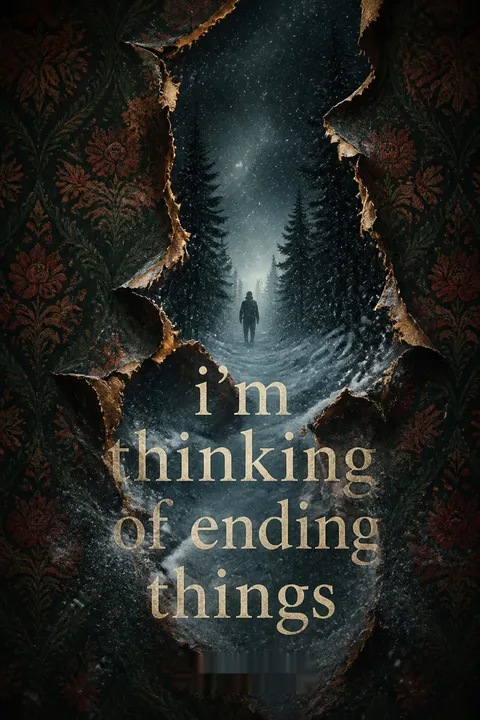

Plot Summary
The Thought That Lingers
From the very first line, the unnamed narrator is haunted by a single, unshakable thought: "I'm thinking of ending things." This idea is not just about a relationship but seeps into every aspect of her consciousness, coloring her perceptions and interactions. The thought is both new and ancient, as if it was always destined to arrive. It's a quiet, relentless refrain, suggesting not only the end of a romantic relationship but also a deeper existential unease. The narrator's internal monologue is fraught with anxiety, uncertainty, and a sense of inevitability. This opening sets the tone for the entire narrative, establishing a mood of dread and introspection, and foreshadows the unraveling of both the relationship and the narrator's sense of self.
Road Trip Into Isolation
The narrator and Jake, her boyfriend of a few weeks, embark on a road trip to visit Jake's parents at their remote farm. The landscape is bleak and empty, mirroring the narrator's internal state. As they drive, the narrator's doubts about the relationship intensify. She feels disconnected, unable to share her true feelings with Jake, and is haunted by the sense that she is performing rather than living authentically. The drive is filled with awkward silences, forced conversation, and a growing sense of unease. The isolation of the countryside amplifies her loneliness and the feeling that something is fundamentally wrong—not just with the relationship, but with reality itself.
Meeting Jake: Beginnings
Through flashbacks, the narrator recalls how she met Jake at a trivia night. Their connection was immediate but tinged with awkwardness and intellectual posturing. Jake is gentle, shy, and deeply intelligent, but also distant and enigmatic. The narrator is drawn to his quirks and intellect, yet senses an underlying sadness and isolation. Their early interactions are marked by a lack of true intimacy; both are holding back, hiding parts of themselves. The relationship, though intense, feels precarious—built on fleeting moments and unspoken doubts. The narrator's inability to share her anxieties with Jake foreshadows the unraveling to come.
The Caller's Cryptic Messages
A mysterious caller begins leaving strange, repetitive voicemails on the narrator's phone, always from her own number. The messages are cryptic, filled with fear and references to a single unresolved question. The caller's voice is distorted, sad, and oddly familiar. These calls become a source of mounting anxiety, invading the narrator's dreams and waking life. She is unable to confide in Jake, further deepening her sense of isolation. The calls seem to echo her own internal fears and doubts, blurring the line between reality and imagination. The repetition and eeriness of the messages suggest a deeper psychological disturbance at play.
Memory, Doubt, and Secrets
As the couple's journey continues, the narrator reflects on the nature of memory, secrets, and the impossibility of truly knowing another person. She fixates on Jake's habits, his family, and the small details that both endear and alienate him. Their conversations circle around philosophical questions—what is real, what is remembered, what is forgotten. The narrator's doubts about the relationship intensify, and she becomes increasingly preoccupied with the idea that all relationships are built on secrets and misunderstandings. The sense of unreality grows, as if the boundaries between self and other, past and present, are dissolving.
The Farm: Unsettling Welcome
Arriving at Jake's family farm, the narrator is struck by its dilapidation and the eerie atmosphere. The house is old, cold, and filled with mismatched, antique objects. Jake's parents are odd—his mother is overly made-up and fragile, his father reserved and distant. The dinner is awkward, punctuated by strange games and unsettling silences. The narrator feels like an outsider, unable to connect with Jake's family or even with Jake himself, who grows increasingly withdrawn. The farm, with its dead animals and decaying structures, becomes a symbol of stagnation and unresolved trauma. The sense of dread intensifies, and reality feels increasingly unstable.
Dinner With Ghosts
The dinner with Jake's parents becomes a surreal, almost hallucinatory experience. The conversation is disjointed, filled with non sequiturs and veiled references to mental illness, secrets, and suffering. Jake's mother speaks of hearing whispers and suffering from sleep paralysis; his father hints at family troubles and the burden of caring for someone fragile. The narrator's phone continues to ring with calls from the mysterious caller, adding to her anxiety. The family's interactions feel performative, as if they are playing roles rather than being themselves. The boundaries between past and present, reality and imagination, begin to blur, and the narrator feels increasingly trapped.
Descent Into the Basement
Exploring the house, the narrator descends into the basement—a space filled with dust, old boxes, and disturbing artwork. She discovers paintings and drawings depicting the basement itself, always featuring a mysterious, monstrous figure and a child. The images are unsettling, suggesting hidden trauma and a fractured psyche. Overhearing Jake's parents arguing about him, the narrator learns that Jake left his academic career and has struggled with isolation and mental health. The basement becomes a metaphor for the unconscious mind, a place where repressed memories and fears reside. The sense of unreality deepens, and the narrator's grip on her own identity begins to slip.
The Portrait and the Past
In Jake's childhood bedroom, the narrator finds photographs and objects that unsettle her sense of self. A portrait given to her by Jake's mother is said to be of Jake, but the face is disturbingly familiar—her own. Conversations with Jake's father reveal more about Jake's troubled past, his isolation, and the family's hope that the narrator will "help" him. The narrator feels herself dissolving into the house, the family, and Jake's history. The boundaries between self and other, past and present, become increasingly porous. The house is not just a setting but a manifestation of psychological distress and fractured identity.
The Dairy Queen Encounter
On the drive home, Jake and the narrator stop at a Dairy Queen, where they encounter three teenage girls. One of them, frail and anxious, delivers a cryptic warning to the narrator: "I'm worried… I'm scared. It's not good. It's bad. You don't have to go." The encounter is surreal, the girls' behavior unsettling, and the narrator is left with a sense of impending doom. The Dairy Queen, with its artificial brightness and chemical smells, contrasts sharply with the darkness and decay of the farm, but is no less disturbing. The warning goes unheeded, and the couple continues their journey into the night.
Detour to Nowhere
Jake insists on taking a detour to a remote high school to throw away their drinks. The school is massive, isolated, and shrouded in darkness. Jake becomes agitated after seeing a figure in the school window, and, after a tense argument, leaves the narrator alone in the car to confront the mysterious janitor. The narrator, increasingly anxious and disoriented, eventually follows him into the school. The setting shifts from the familiar to the nightmarish, as the school becomes a labyrinth of empty halls, locked doors, and echoing footsteps. The sense of reality unravels completely, and the narrator is plunged into a waking nightmare.
The School at Night
Inside the school, the narrator is pursued by an unseen presence—possibly the janitor, possibly Jake, possibly herself. The halls are endless, the exits chained, and the music from the car radio now plays over the school's PA system in an endless loop. The narrator's sense of self fragments; she is no longer sure who she is, or what is real. Memories, fears, and hallucinations intermingle. The school becomes a metaphor for the mind—a place of learning, but also of confinement and terror. The narrator is forced to confront the question that has haunted her from the beginning.
Fractured Realities
As the narrator hides and flees through the school, her sense of identity collapses. She recalls childhood traumas, failed relationships, and the impossibility of ever truly knowing or being known by another. The mysterious caller's messages, the paintings in the basement, and the warnings from the Dairy Queen girl all converge. The narrator realizes that she, Jake, and the janitor may all be the same person—different facets of a fractured self. The narrative voice shifts from "I" to "we," signaling a complete dissolution of boundaries. The story becomes a meditation on loneliness, mental illness, and the desperate need for connection.
The Janitor's Domain
The narrator returns to the janitor's room, where the final revelation unfolds. The janitor is Jake; Jake is the narrator; the narrator is the janitor. The entire story has been a construction—a desperate attempt to create meaning, connection, and narrative coherence in the face of overwhelming isolation. The janitor, alone in the school, has imagined the relationship, the road trip, the family, and the narrator herself. The story is his suicide note, his final attempt to make sense of a life marked by loneliness and regret. The question that haunted the narrator is revealed to be the question of existence itself: to continue or to end things.
The Question in Red
In the art room, the narrator finds a message written in red paint: "I know what you were going to do. Just you and me now. There's only one question." The question is not about good or bad, but about whether to continue or to end. The narrator—now fully merged with Jake and the janitor—understands that there is no escape from the self, no rescue, no connection. The only choice left is whether to go on or to end things. The story culminates in an act of self-destruction, as the narrator/janitor/Jake chooses to end his life, unable to bear the weight of isolation any longer.
The End and the Beginning
The narrative closes with the janitor's suicide, his body found in a school closet, and a note left behind—a story, a diary, a confession. The story loops back on itself, suggesting that the entire narrative has been the janitor's final attempt to communicate, to be known, to leave a mark. The boundaries between fiction and reality, self and other, are irreparably blurred. The story ends as it began, with a question, an unfinished thought, and the lingering sense that the end is also a beginning—a return to solitude, to silence, to the unanswerable question at the heart of existence.
The Note Left Behind
In the aftermath, investigators discuss the janitor's note—a sprawling, confusing story that blurs the line between truth and fiction. They are unable to make sense of it, unable to answer the question of why he ended things. The note is both a confession and a plea for understanding, a last, desperate attempt to be seen and known. The story ends with an invitation to the reader: "Maybe start at the end. Then circle back. First, though, I think you better sit down." The cycle of questioning, doubting, and seeking connection continues, unresolved.
Analysis
I'm Thinking of Ending Things is a haunting meditation on loneliness, mental illness, and the desperate human need for connection. Through its fractured narrative, shifting identities, and recursive structure, the novel explores the impossibility of truly knowing another person—and, by extension, oneself. The story's central question—whether to continue or to end—echoes through every page, manifesting as both a relationship crisis and an existential dilemma. The novel's use of unreliable narration and metafictional devices forces the reader to confront the limits of perception, memory, and narrative itself. Ultimately, the book is a portrait of a mind in crisis, a person so isolated that he must invent relationships, stories, and even his own interlocutor to stave off the void. The final act of self-destruction is both tragic and inevitable, a testament to the devastating effects of unaddressed suffering and the failure of connection. In a world where loneliness is epidemic and meaning is elusive, Iain Reid's novel is a chilling reminder of the stakes of being truly alone—and the urgent, universal need to be seen, known, and understood.
Review Summary
I'm Thinking of Ending Things polarized readers with its unsettling psychological horror and ambiguous ending. Many praised Reid's atmospheric writing and creeping dread, while others found it confusing or pretentious. The story follows a woman on a road trip with her boyfriend, contemplating ending their relationship. As strange events unfold, the narrative becomes increasingly surreal and disorienting. Some readers loved the mind-bending twist, while others felt frustrated by the obtuse storytelling. The book provoked strong reactions, with most finding it either brilliant or deeply unsatisfying.
People Also Read





Characters
The Narrator (Jake's Girlfriend)
The narrator, unnamed for most of the novel, is the lens through which the story unfolds. She is introspective, anxious, and plagued by doubts—not only about her relationship with Jake but about her own identity and reality itself. Her voice is marked by a persistent sense of unease, as she questions the authenticity of her feelings, memories, and perceptions. As the narrative progresses, it becomes clear that she is not a separate entity but a projection of Jake's desires, fears, and loneliness—a construct created to fill the void of his isolation. Her psychological journey mirrors Jake's own, culminating in the dissolution of boundaries between self and other, reality and imagination. She is both victim and creator, a symbol of the human longing for connection and the terror of being truly alone.
Jake
Jake is presented as the narrator's boyfriend—intelligent, gentle, and deeply introverted. He is marked by a profound sense of alienation, unable to connect with others despite his longing for intimacy. His quirks, intellectualism, and emotional distance are both attractive and alienating to the narrator. As the story unfolds, it becomes clear that Jake is not just a character but the central consciousness of the novel—the janitor, the narrator, and the creator of the entire narrative. His psychological fragmentation is expressed through the shifting perspectives, the mysterious caller, and the surreal events at the farm and school. Jake's journey is one of self-destruction, as he is ultimately unable to reconcile his need for connection with his overwhelming sense of isolation and inadequacy.
The Janitor
The janitor is the shadowy figure who haunts the school at night, cleaning empty halls and living a life of solitude. He is described by others as gentle but strange, unable to relate to people, and marked by physical and psychological decline. The janitor is revealed to be Jake—older, broken, and utterly alone. The entire narrative is his creation, a suicide note disguised as a story, an attempt to make sense of his life and to reach out for understanding. The janitor's domain—the empty school—is a metaphor for his mind: vast, echoing, and filled with locked doors. His final act is both a surrender and a plea for connection, a testament to the devastating effects of loneliness and the human need to be seen.
Jake's Mother
Jake's mother is a spectral presence—overly made-up, anxious, and prone to unsettling behaviors. She suffers from tinnitus, sleep paralysis, and possibly trichotillomania, and is described as both loving and deeply troubled. Her interactions with the narrator are marked by forced cheerfulness and veiled desperation. She represents the legacy of mental illness and isolation that haunts Jake, and her presence in the story blurs the line between reality and hallucination. She is both a real person and a symbol of the emotional burdens that Jake carries.
Jake's Father
Jake's father is reserved, practical, and emotionally distant. He is supportive of his wife but overwhelmed by the family's troubles. His interactions with the narrator are marked by awkwardness and a sense of resignation. He hints at Jake's struggles and the family's hope that the narrator will "help" him, but is ultimately powerless to change the course of events. He embodies the generational transmission of isolation and the inability to communicate emotional pain.
The Caller
The mysterious caller who leaves cryptic messages on the narrator's phone is a manifestation of Jake's own fears, regrets, and self-loathing. The caller's messages are repetitive, nonsensical, and filled with anxiety, echoing the narrator's internal monologue. The revelation that the calls come from the narrator's own number underscores the self-referential, recursive nature of the narrative. The caller is both a harbinger of doom and a symbol of the inescapability of one's own mind.
The Dairy Queen Girl
The frail, anxious girl at the Dairy Queen serves as a warning and a mirror to the narrator. Her cryptic message—"I'm worried… I'm scared. It's not good. It's bad. You don't have to go"—is both a plea for help and a reflection of the narrator's own fears. She is marked by a visible rash, suggesting physical and psychological distress. The girl's presence is surreal, and her warning goes unheeded, symbolizing the missed opportunities for intervention and the inevitability of the story's tragic outcome.
Jake's "Brother"
Jake's supposed brother is mentioned as a troubled, isolated figure who suffered from mental illness and followed Jake around. However, it becomes clear that the brother is a fabrication—a way for Jake to externalize his own struggles and to avoid confronting the reality of his isolation. The brother is a symbol of the parts of Jake that he cannot accept, a projection of his own pain and alienation.
Jake's Childhood Self
Jake's childhood self appears in photographs and memories, representing a time of innocence and possibility that is now irretrievably lost. The image of the child with curly blond hair and chubby cheeks is a poignant reminder of the passage of time and the inevitability of change. The inability to reconcile the present self with the past self is a source of profound grief and longing in the narrative.
Ms. Veal
Ms. Veal is a figure from the narrator's (Jake's) childhood—a neighbor who instilled fear and unease. Her cryptic question, "Are you good or are you bad?" becomes a refrain that haunts the narrator throughout the story. Ms. Veal represents the unknowability of others, the terror of judgment, and the formative power of childhood experiences. She is both a real person and a symbol of the narrator's lifelong struggle with self-doubt and the fear of being fundamentally unworthy.
Plot Devices
Unreliable Narration and Shifting Identity
The novel's most significant device is its use of an unreliable narrator whose identity is unstable and ultimately revealed to be a construct of Jake/the janitor's mind. The story is told in the first person, but the "I" shifts and dissolves, blurring the boundaries between narrator, Jake, and the janitor. This device creates a sense of disorientation and unreality, forcing the reader to question what is true and what is imagined. The gradual revelation that the entire narrative is a suicide note—a story within a story—undermines the reader's assumptions and heightens the emotional impact.
Foreshadowing and Recursion
The novel is filled with foreshadowing and recursive motifs: the repeated phone calls, the mysterious question, the references to endings, and the doubling of characters and events. The same song plays on the radio and over the school's PA system; the narrator's own number calls her; the same phrases and questions recur throughout the text. These repetitions create a sense of inevitability and claustrophobia, suggesting that the characters are trapped in a loop of their own making. The recursive structure mirrors the narrator's psychological state and the inescapability of her (Jake's) fate.
Metafiction and Storytelling
The novel is deeply metafictional, constantly drawing attention to its own status as a story. Characters discuss the nature of memory, fiction, and reality; the narrator questions whether her memories are real or constructed; the final note is described as a story, a diary, a confession. The act of storytelling becomes a way to impose order on chaos, to create meaning in the face of meaninglessness. The novel's structure—stories within stories, notes within notes—reflects the human need to narrate, to connect, and to be understood.
Symbolism and Allegory
The farm, the basement, the school, and the janitor's closet are all rich with symbolic meaning. They represent the mind, the unconscious, the past, and the inescapable present. Objects like the portrait, the phone, the red paint, and the hanger become charged with allegorical significance, standing in for psychological states and existential dilemmas. The novel's use of allegory and metaphor deepens its exploration of loneliness, identity, and the search for meaning.
About the Author

Download PDF
Download EPUB
.epub digital book format is ideal for reading ebooks on phones, tablets, and e-readers.








































