

Key Takeaways
Your brain and mind are separate; the mind runs 90% of your life
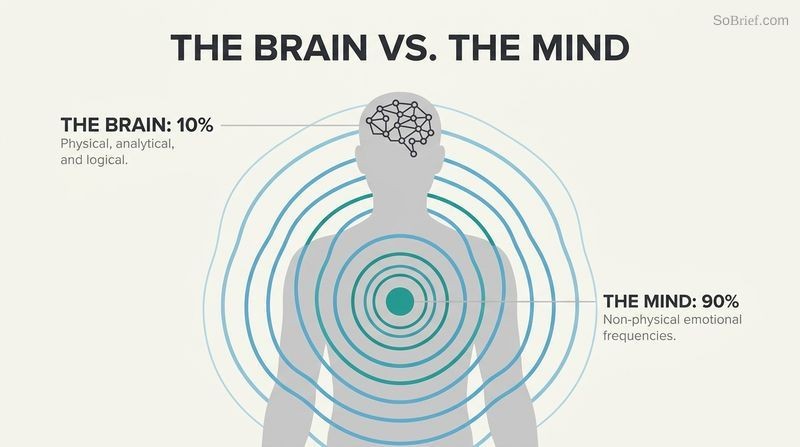
The book's core claim, narrated by the mind itself: brain and mind are two distinct systems that keep trespassing into each other's territory. The brain is physical, roughly three pounds of neurons, expert at thinking, memorizing, analyzing, and planning. The mind has no physical location (Trivedi places it at the navel), no memory, and works purely through emotions and frequencies. His arresting figure: the brain shapes only about 10% of your life, the mind the rest.
Because the mind is invisible, science studies chemicals and DNA instead, treating the brain as the control center. Trivedi counters that no blood test measures anxiety, no pill deletes sorrow, no scan predicts your future worries. The mind sends the emotion; the brain merely reacts. Master the mind and it becomes a power center; let it master you and it wreaks havoc.
The brain/mind split is a rhetorical device more than neuroscience, and readers should hold the 90/10 figure loosely. Yet the underlying intuition rhymes with real dual-process research: Kahneman's fast, emotional System 1 versus slow, deliberate System 2, and Antonio Damasio's finding that patients with damaged emotional centers make catastrophic decisions despite intact reasoning. Trivedi's point that you cannot reason your way out of a feeling anticipates modern therapy's shift from pure cognition toward somatic and emotion-focused work. Where he overreaches is treating the mind as an entity independent of the body; the gut-brain axis and neurochemistry suggest emotion is embodied, not floating at the navel.
Children are born geniuses; upbringing demolishes their Super Conscious Mind
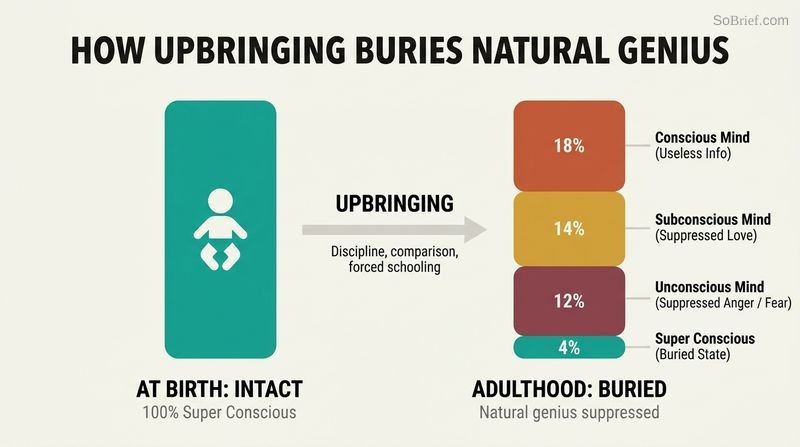
Every child arrives in the Super Conscious Mind, Trivedi's name for the mind's natural power state, brimming with concentration, enthusiasm, and self-confidence. A toddler can outlast four adults, forgets a fight in minutes, plays with total absorption, and knows exactly what he wants. These are the very traits every success guru sells to adults.
Then the demolition begins. Parents and schools flood the child with useless information (forming the Conscious Mind), suppress his love until he turns overly sentimental (the Subconscious Mind), and suppress his anger until it curdles into fear, jealousy, and anxiety (the Unconscious Mind). Discipline, comparison, and forced schooling do the damage. Trivedi notes science's own finding that about 80% of a child's brain develops by age four or five, arguing the real question is whether the Super Conscious state survived intact.
The romantic view of the child as an unspoiled genius echoes Rousseau and later Ken Robinson's famous argument that schools kill creativity. There is empirical support: George Land's divergent-thinking study found 98% of five-year-olds scored at genius level, a figure that collapsed as they aged. But Trivedi's framing risks a one-sided nostalgia. Developmental psychology (Vygotsky, Piaget) shows structure and social scaffolding also build capacities children cannot reach alone. The honest synthesis is not zero discipline but preserving intrinsic motivation and curiosity while guiding. His warning against comparison and forced conformity is the durable, actionable core.
Suppressed anger doesn't vanish; it ferments and detonates on the innocent

Anger is proof of energy, Trivedi insists, not a vice. You get angry when reality contradicts your desire, which means anger defends your will. Society and religion brand it evil so people stay compliant. But an emotion born in the mind cannot be deleted by the brain, only postponed. Suppress it today and it resurfaces tomorrow, often mutated into anxiety, jealousy, or fear stored in the Unconscious Mind.
His vivid chain: a boss fights his wife, swallows it, then scolds his manager, who scolds the accountant, who scolds the assistant, who beats his wife, who beats the children, who brawl with neighbors. The original spat completes itself through five innocent victims. His radical prescription is a family or group that lets each person vent freely, understanding the outburst as spending a mental bank balance, not a personal attack.
This is the book's most provocative and most double-edged claim. It resurrects the catharsis hypothesis, the idea that expressing anger drains it. Modern psychology largely rejects the crude version: Brad Bushman's experiments show venting (hitting pillows, aggressive outbursts) tends to increase later aggression, not reduce it. What survives scrutiny is the danger of chronic suppression, linked to hypertension and displaced hostility, exactly Trivedi's chain reaction. The evidence-based middle path is neither bottling nor exploding but assertive expression: naming the feeling and its cause calmly. Trivedi's freedom-of-expression family, where grievances surface early, aligns well with that research even if his celebration of raw venting does not.
Anchor every worry to a one-year horizon, then shrink it to today
Sorrow lives in the past, worry in the future, and life can only be lived in the present moment. Trivedi's practice is concrete: each morning, refuse to think about anything more than a year away. Master that, then narrow the window to a month, then to just today. Live as if today were your last day and complete only what fits inside it.
Two parables carry the lesson. An exhausted woodcutter begs Death to take him, but when Death actually appears, he instantly rediscovers that simply being alive is enough. A condemned magician buys a year by promising the king a flying horse, reasoning that in a year the king might die, the horse might die, anything might happen. Both do die, and he goes free. The future is built from thousands of unpredictable events, so most of what you dread never arrives.
The present-moment teaching is the book's most universal and best-corroborated. It converges with Stoicism (Seneca on borrowed time), Buddhist mindfulness, and Kahneman-style research showing humans are terrible affective forecasters who systematically overestimate how bad feared outcomes will feel. Studies of chronic worriers find the vast majority of predicted catastrophes never materialize, echoing Trivedi's woodcutter. The graduated technique, from one year to one month to one day, is genuinely useful and rare among present-focus books that offer only the abstract instruction to be here now. The limit: some future planning is adaptive, and pathological anxiety needs more than a mental time-horizon rule.
Stop being a machine whose buttons other people can press
Most people react rather than act. Trivedi's diagnosis of a weak inner personality: your moods depend entirely on how others treat you. A retired bank director skips his daughter's wedding meeting because an old acquaintance failed to return his greeting. He handed a stranger the button to ruin his day. Flattery, insult, comparison, praise, every belief you cling to becomes a lever others pull.
The cure is spontaneity and self-ownership. Stop building rigid lists of permanent likes, dislikes, principles, and ideologies, because each one becomes a button. Decide fresh in the moment. When a man spat on the Buddha and returned the next day begging forgiveness, the Buddha was unmoved both times, explaining that the man's anger and his repentance were both the man's problems, not his. That untouchable self-possession is what an inner personality feels like.
The button metaphor is a memorable reframing of what Stephen Covey called the space between stimulus and response, and what Viktor Frankl located as the last human freedom. Trivedi's twist, that fixed identities and ideologies are themselves the vulnerabilities, is sharper and more unusual. It resonates with Buddhist non-attachment to views and with modern work on cognitive flexibility. One caution: some stable commitments (integrity, core values) are not buttons but ballast, and a self with no fixed principles can drift into expedience. The strongest reading is not valuelessness but refusing to outsource your emotional state to other people's reactions.
Superiority complex is a myth; every strut hides an inferiority
Only one complex actually exists: inferiority. What looks like a superiority complex is simply a costume worn over a wound. Complex means refusing to accept yourself as you are, and it is manufactured entirely by comparison. Nature never compares: no gravel envies a diamond, no ordinary flower wilts beside a rose. But parents and teachers relentlessly measure children against each other, and self-rejection takes root.
When someone loudly and repeatedly insists on something, expect the opposite underneath. A man who keeps announcing he is still young is not young; elderly parents who keep praising their neglectful children are usually starved of care. Trivedi's fable: a bullied lion cub, told he is weak, overcompensates by roaring at every animal until an elephant flings him aside. His diagnostic gift to the reader is learning to read the concealed pain behind every display of grandiosity.
Trivedi borrows and radicalizes Alfred Adler, who coined both terms and argued the superiority complex is a compensation for inferiority feelings, though Adler did allow it as a genuine (if unhealthy) posture. Collapsing it entirely into hidden inferiority is a bold simplification that modern research complicates: narcissism appears to have both vulnerable (fragile, compensatory) and grandiose (genuinely self-satisfied) variants. Still, as a practical lens it is potent. It defuses arrogance by inviting compassion rather than counterattack, and it targets the true engine, social comparison, which Leon Festinger formalized and which correlates strongly with anxiety and depression, especially in the age of curated social media.
What you call love for family is usually possessive involvement
Trivedi draws a scalpel-fine line. Love wishes the best for someone while claiming no ownership. Involvement is a sense of possession, treating another person as part of you, and it is the hidden root of most suffering. The test: a stranger bleeds on the street and you move on; your relative bleeds and you drown in grief for weeks. Same blood, same pain. The difference is involvement, not love.
Involvement multiplies your problems by the number of people you claim, drains your energy, and paradoxically makes you useless in a crisis (the overwhelmed relative who ends up in the hospital bed beside the patient). King Janaka bathes calmly while his palace burns because he owns nothing inwardly; his visiting student panics over one set of clothes inside. A monk carries a stranded woman across a river and forgets her; his companions, who refused to touch her, carry her in their minds for miles.
The love-versus-attachment distinction is central to Buddhist psychology, where non-attachment (not detachment or coldness) allows fuller, less grasping care. It also maps onto attachment theory's insight that anxious, enmeshed bonds produce worse outcomes than secure ones. Trivedi's claim that the less sensitive people prove most useful in emergencies finds real support: emotional regulation, not emotional flooding, predicts effective helping under stress, which is why first responders train to stay calm. The provocative edge is calling family love mostly involvement. Critics would note that deep bonds and some vulnerability to a loved one's pain are features of a meaningful life, not bugs to be engineered away.
Choose intelligence over brilliance: hoard time and energy, not facts
Brilliance is acquired information; intelligence is knowing what to ignore. Brilliance pertains to the brain and loves to impress by collecting every detail. Intelligence pertains to the mind and guards your only two scarce resources: time and energy. An intelligent person learns from one or two experiences, grabs the big opportunity, and treats anything that does not serve the moment as worthless.
Trivedi's stories skewer wasted brilliance. A sanyasi spends 20 years learning to walk on water; Ramakrishna crosses the same river by boat for two paise and asks whether the feat was worth two decades. Three sorcerers brilliantly resurrect a lion skeleton and are promptly eaten, while the illiterate but intelligent charioteer flees and survives. He calls the faculty that instantly spots and burns away the inessential the Third Eye. Dayanand seeing rats eat temple offerings, Steve Jobs quitting church over suffering, Edison quitting school: one experience, decision made forever.
This maps neatly onto Nassim Taleb's distinction between fragile knowledge and street-smart survival, and onto Gerd Gigerenzer's research showing that simple heuristics often beat information-heavy analysis. Herbert Simon's satisficing and the modern via negativa (improving by removing) both echo Trivedi's burn-the-inessential principle. The time-and-energy framing is a useful corrective to a culture that equates knowing more with being smarter. The nuance he underplays: some fields genuinely reward deep, accumulated expertise (surgery, physics), and Edison himself devoured technical books. The reconcilable reading is to hoard depth in your one chosen domain and ruthlessly prune everywhere else, rather than to disdain learning wholesale.
You can't imitate your way to greatness; only originals get remembered
Creativity is Nature's supreme art, and every person carries a latent point of creativity waiting to erupt in one particular field. History remembers only firsts: Edison's first bulb, not its improvers; the artist who painted a new style, not the copyists. Buddha defied Hindu tradition, Jesus defied Jewish tradition; imitators of either merely learn to dress and chant like them and die as followers.
Trivedi's rule: draw inspiration from everyone, but let no one influence you so heavily that your own thinking stops. Galileo revered no convention and found the earth circles the sun. Find your field by noticing where work never tires you, then protect that talent with unusual courage. Edison sold fruit and papers as a boy to fund a home lab, was thrown off a train when it caught fire, and kept going. Van Gogh painted purely for joy, unrecognized until after death.
The innovate-do-not-imitate creed is bracing, but the first-mover mythology needs tempering. History often rewards the best executor, not the literal first: Edison did not invent the incandescent bulb so much as engineer a commercially viable one, and countless pioneers are forgotten while refiners win. Research on creativity (Dean Keith Simonton) shows originality typically grows out of deep immersion in prior work, so absorbing tradition and transcending it are not opposites but a sequence. Trivedi's deeper, sounder point is psychological: creativity flows from intrinsic joy and cannot be forced or scheduled, which aligns with Csikszentmihalyi's flow and Teresa Amabile's finding that intrinsic motivation, not external pressure, drives creative output.
Concentration can't be increased; empty your bag and it appears
Concentration is not a muscle to strengthen but a natural state to uncover. Every child has total concentration; it fragments only as we stuff the mind with a thousand attachments. Trivedi's image: concentration is a shopping bag. Fill it with useless purchases and you cannot pour out just the apple juice without everything spilling. Carry only apple juice and only apple juice comes out. So the instruction to try harder to focus is nonsense; you focus by dropping everything else.
Edison entered his lab carrying no worries about wife, time, or news, and once ate a colleague's already-eaten lunch, then remarked he had eaten too much. He tested over 6,000 filaments across a year without his focus breaking. Trivedi links concentration to energy and aura: the more condensed your mental energy, the more magnetic and effective you become. Guard energy through daily exercise, dawn-aligned sleep, small regular meals, and periodic rest.
The claim that focus comes from subtraction, not addition, is unusually clear-eyed. It matches attention research showing willpower-based focus fails while removing distractions succeeds, the logic behind Cal Newport's Deep Work and digital minimalism. The bag metaphor captures why open loops (Zeigarnik effect: unfinished tasks nag the mind) shatter attention. Trivedi's energy management, treating rest and play as fuel rather than indulgence, prefigures Tony Schwartz's work on energy over time. The aura discussion drifts toward the paranormal (a girl moving clock hands by thought) and should be read metaphorically; there is no evidence for psychokinesis. The practical marrow, protect energy and eliminate the inessential, needs no mysticism to stand.
Lower your ambitions; obsess over the task, not the trophy
Big ambition is a trap, not a fuel. The instant you fixate on an outcome, your focus splits away from the work in front of you, and results come from quality of work, not intensity of wanting. A student who dreams of topping the class studies badly because half his mind rehearses the applause and the other half fears failure. A student who simply enjoys studying tops it without trying.
Worse, ambitions are usually planted by others (a mother wants a doctor, a father a businessman) and yank you off the field your mind actually chose for you. Trivedi argues you succeed only where genuine interest lives, so the useful move is to identify the work that absorbs and satisfies you, then focus purely on doing it well. A thousand miles are crossed one deliberate step at a time; the one who stops to calculate at every step arrives late or never.
This is a classic process-over-outcome argument, well supported in performance psychology: athletes and performers who fixate on results (choking under pressure) underperform those absorbed in execution. It echoes the Bhagavad Gita's teaching to act without attachment to fruits, and Carol Dweck's finding that process praise beats outcome praise. Deliberate practice research (Anders Ericsson) confirms that improvement comes from focused engagement with the task, not from wanting the medal. The tension worth naming: ambition and vision do motivate effort and direction, and goal-setting research (Locke and Latham) shows specific goals can boost performance. The reconciliation is to set a direction, then drop it and immerse in the work.
Real self-confidence is faith in your talent, never a borrowed crutch
Confidence cannot be purchased. Trivedi mocks the market of borrowed confidence: degrees, lucky charms, auspicious timings, rituals, gurus. People chase these because they entered a field their mind never chose, then need external reassurance to survive there. The peddlers grow rich; the seeker loses both money and the little confidence he had.
Genuine self-confidence rests only on your own abilities and intentions, and it appears automatically in the field where your talent lives. A moneylender needs contracts and still suffers bad debts; an underworld don lends without paper and never loses, because his faith rests on himself. A hermit owning two blankets lets a thief take one, calls him back to take everything, then out-generouses him into becoming a lifelong servant. Buddha's dying words, become a lamp unto yourself, capture it: to want light, be the lamp, not a borrower of someone else's flame.
The insight that misplaced confidence-seeking signals you are in the wrong field is genuinely useful and underappreciated. It aligns with self-efficacy theory (Albert Bandura), which shows confidence is domain-specific and built primarily through mastery experiences, not pep talks or talismans. Trivedi's disdain for external crutches parallels the locus-of-control research linking an internal locus to resilience and achievement. The romantic don and hermit stories overstate the case (contracts and institutions exist precisely because self-belief alone does not enforce repayment, and survivorship bias hides the confident who failed). But the core prescription, build confidence through real competence in work that fits you rather than importing it, is sound and empowering.
Analysis
Deep Trivedi's conceit is audacious: he lets the mind narrate its own manual, addressing the reader as a mostly ignorant custodian of the very faculty that governs him. This device, drawn from what Trivedi calls spiritual psychodynamics, is the book's chief strength and its chief liability. It makes abstract psychology intimate and confrontational, but it also lets sweeping claims (the 90/10 mind-brain split, the total denial of a superiority complex, the invisibility of the mind at the navel) pass as pronouncements rather than arguments. Readers should treat the framework as a heuristic map, not a verified model.
Structurally the book is a two-part therapy: first dissolve sorrow (present-moment living, killing complexes, involvement, and expectations), then build success (intelligence over brilliance, creativity, concentration, curbed ambition, self-confidence, contentment). Both halves converge on a single striking thesis: the healthy adult is a recovered child. Everything Trivedi prescribes, concentration, enthusiasm, spontaneity, non-comparison, present-focus, is what he says every toddler already possesses before schooling and family suppress it. This gives the book a coherent spine that most self-help anthologies lack.
Its intellectual lineage is a syncretic blend: Buddhist non-attachment, the Gita's action without attachment to fruits, Adlerian complexes, Pavlovian conditioning, and Eastern energy metaphysics. Trivedi rarely cites, which flattens the borrowing, yet his repackaging is vivid and memorable through parable (Janaka's burning palace, Ramakrishna's two-paise crossing, the anger relay from boss to child).
The weakest links are the anti-suppression catharsis argument, which contradicts modern aggression research, and the flirtation with paranormal energy and aura claims. The strongest and most transferable are the graduated present-moment discipline, the subtraction theory of concentration, and the diagnosis that seeking external confidence reveals you are in the wrong field. Read critically, discarding the mysticism and keeping the psychology, it offers a genuinely useful reorientation: stop optimizing the anxious, comparing, accumulating brain, and recover the absorbed, fearless attention you were born with.
Review Summary
Reviews of "I am The Mind" are highly polarized. Some praise it as insightful and thought-provoking, appreciating its unique perspective and simple explanations of complex concepts. Others criticize it harshly, calling it pseudoscientific, repetitive, and condescending. Positive reviews highlight the book's exploration of mind-brain distinctions and personal growth potential. Negative reviews cite lack of scientific backing, authoritative tone, and questionable logic. The book's writing style and content are controversial, with readers either finding it transformative or a complete waste of time.
People Also Read










Glossary
The Mind (versus the Brain)
Invisible emotional core, not brainTrivedi's redefinition: the mind is a non-physical play of frequencies located (metaphorically) at the navel, the source of all emotions and of powers he claims are far stronger than the brain's. The brain is the physical, thinking, memorizing, analyzing organ. He argues the two have separate systems and that confusing them, or letting the brain suppress the mind, causes most human suffering.
Super Conscious Mind
The child's natural power stateThe mind's foundational power center, the state every child is born into, suffused with love and anger and therefore overflowing with energy, concentration, enthusiasm, and self-confidence. Trivedi says all happy and successful people have kept or regained it. Upbringing, comparison, and forced discipline push a child down into weaker states, and recovering this state is the book's central goal.
Conscious, Subconscious, and Unconscious Mind
Three tempestuous weakened statesTrivedi's three destructive mind-states created by bad upbringing. The Conscious Mind forms from useless accumulated information and feels chronic fear. The Subconscious Mind forms when a child's love is suppressed, breeding excess sentimentality. The Unconscious Mind forms when anger is suppressed, storing anxiety, fear, and jealousy that later erupt without cause.
Collective Conscious Mind
Reads the crowd's shared moodsA power center that, when active, connects a person to the shared likes and dislikes of humanity, enabling one to sense the public pulse, resist manipulation, and (Trivedi claims) even influence others' thoughts. Weak in most people, which he says leaves them easily exploited by religion, advertising, and politics.
Spontaneous Mind
Instant intuitive decision-makingA power center where decisions arise instantly from intuition rather than deliberation, and where the point of creativity fires. Trivedi says the best decisions are spontaneous and never regretted, and that great businessmen and artists rely on this state rather than exhaustive analysis.
Ultimate Mind
The witnessing screen of existenceThe highest and subtlest state, the screen on which the drama of your life plays. Trivedi equates it with prana (life force) and pure awareness, the unchanging witness untouched by life's ups and downs. Reaching it, he says, requires first activating the other power centers.
Point of creativity
Latent creative eruption withinA dormant fount of creativity Trivedi says exists in every person within one particular field. It cannot be forced or scheduled; it erupts on its own when a person immerses in genuine passion. What artists call being in the mood is really this point sending impulses; all original masterpieces flow from it.
Third Eye (of intelligence)
Instant detector of the inessentialTrivedi's metaphor for awakened intelligence: a faculty that, through one or two experiences, instantly recognizes and permanently eliminates what is inessential in your life, freeing time and energy for what matters. He illustrates it with figures who made irreversible decisions from a single experience, such as Edison quitting school.
Brilliance versus Intelligence
Hoarding facts versus saving energyTrivedi's key distinction. Brilliance is brain-based, acquired knowledge that seeks to know everything and impress others, wasting the two scarce resources of time and energy. Intelligence is mind-based and innate, focused only on what is essential and on transforming oneself through experience. He argues a person cannot be both at once.
Involvement
Possessive attachment disguised as loveA perverse form of love: a sense of ownership or possession over people and things, so that any harm to them wounds you. Trivedi identifies it as a primary root of sorrow, distinct from true love, which wishes another well while claiming no ownership. It is strengthened by partiality and by making possessive choices.
FAQ
1. What is "I am The Mind" by Deep Trivedi about?
- Exploration of the Mind: The book delves into the nature, existence, and functioning of the mind, distinguishing it from the brain and emphasizing its role in governing emotions, thoughts, and life experiences.
- Mind vs. Brain: Deep Trivedi clarifies that the mind and brain are separate entities, with the mind influencing the majority of human life and the brain handling only a small fraction.
- Purpose of Mastery: The central aim is to help readers understand and master their mind to achieve happiness, success, and peace.
- Root of Human Sorrows: The author argues that ignorance about the mind is the primary cause of human suffering and failure.
2. Why should I read "I am The Mind" by Deep Trivedi?
- Unique Spiritual-Psychological Approach: The book presents deep psychological concepts in simple, accessible language, blending spirituality and psychology.
- Practical Transformation: It offers actionable insights and remedies for immediate and lasting change in mental and emotional well-being.
- Comprehensive Coverage: Readers gain a holistic understanding of the mind’s composition, power centers, and the causes of sorrow and worry.
- Empowerment: The book equips readers to take control of their emotions, thoughts, and ultimately, their life outcomes.
3. What are the key takeaways from "I am The Mind" by Deep Trivedi?
- Mind’s Dominance: The mind, not the brain, is the true driver of human experience, creativity, and emotion.
- States of the Mind: Understanding and mastering the seven states of the mind is crucial for personal growth and happiness.
- Complexes and Suffering: Complexes, involvement, and expectations are major sources of human sorrow, and the book provides ways to overcome them.
- Keys to Success: Qualities like intelligence, creativity, concentration, self-confidence, and contentment all stem from the mind’s proper functioning.
4. What are the best quotes from "I am The Mind" by Deep Trivedi and what do they mean?
- "There is no such thing as Superiority Complex." This means that what appears as superiority is often a mask for hidden inferiority and pain.
- "Become a lamp unto yourself." The author urges readers to find and follow their own path rather than imitating others.
- "The greater the ambitions one harbours, greater are the failures in life." Excessive ambition fragments focus and leads to restlessness and failure.
- "Contentment is the supreme wealth." True happiness and success come from inner contentment, not external achievements.
5. How does Deep Trivedi in "I am The Mind" differentiate between the mind and the brain?
- Physical vs. Invisible: The brain is a tangible organ, while the mind is an invisible mechanism of frequencies with no physical form.
- Function and Influence: The brain handles thinking, planning, and memory, focusing on external needs, while the mind governs emotions, creativity, and life’s deeper experiences.
- Control and Laws: The brain can suppress weaker mind frequencies but cannot control intense emotions; the mind operates under its own set of laws.
- Source of Creativity: All emotions and creativity originate from the mind, not the brain.
6. What are the seven states of the mind described in "I am The Mind" by Deep Trivedi?
- Three Tempestuous States: Conscious Mind, Subconscious Mind, and Unconscious Mind, which are often sources of negative emotions and complexes.
- Four Power Centers: Super Conscious Mind, Collective Conscious Mind, Spontaneous Mind, and Ultimate Mind, which are associated with creativity, intuition, and mastery.
- Determinants of Life: The state in which a person predominantly resides shapes their behavior, attitude, and life outcomes.
- Path to Mastery: Mastering these states is key to achieving supreme consciousness and control over one’s life.
7. How does "I am The Mind" by Deep Trivedi define and address the concept of Complexes?
- Origin in Comparison: Complexes arise from comparing oneself to others, usually to prove inferiority, leading to pain and hidden weaknesses.
- Superiority as a Mask: What is often called a superiority complex is actually a cover for deep-seated inferiority.
- Illustrative Stories: The book uses stories to show how complexes manifest and cause ridicule or failure.
- Remedy: Avoiding comparisons and focusing on self-acceptance helps prevent and weaken complexes.
8. What does Deep Trivedi’s "I am The Mind" say about involvement and its impact on happiness?
- Involvement vs. Love: Involvement is about ownership and attachment, while love is universal and unbiased.
- Source of Sorrow: Excessive involvement ties happiness to others’ conditions, multiplying problems and emotional exhaustion.
- Broader Attachments: Involvement extends to possessions, religion, and patriotism, increasing attachments and sorrows.
- Solution: Embrace universal love and reduce involvement to conserve energy and maintain peace.
9. How does "I am The Mind" by Deep Trivedi explain the role of expectations in human suffering?
- Expectations Fuel Sorrow: Expectations arise from the desire for change and intensify involvement, leading to disappointment and bitterness.
- Self-Improvement Focus: The book advises focusing on changing oneself rather than others or circumstances.
- Acceptance as a Cure: Accepting oneself, others, and unchangeable situations reduces expectations and associated sorrows.
- Weakening Complexes: Self-acceptance also helps in weakening personal complexes.
10. What are the key differences between intelligence and brilliance in "I am The Mind" by Deep Trivedi?
- Innate vs. Acquired: Intelligence is an inherent quality of the mind, while brilliance is acquired knowledge and skills of the brain.
- Energy Efficiency: Intelligence helps filter essentials and saves energy, whereas brilliance can lead to overthinking and exhaustion.
- Success Factor: True success depends on intelligence, not brilliance, as illustrated by stories of inventors and thinkers.
- Activation: Intelligence becomes active when the conscious, subconscious, and unconscious minds are weak.
11. How does Deep Trivedi in "I am The Mind" describe the importance of creativity, concentration, and self-confidence?
- Creativity: Every person has unique creative potential, and success requires nurturing originality rather than imitation.
- Concentration: Concentration is a natural quality of the mind but gets divided by distractions; unifying it leads to energy and success.
- Self-Confidence: True confidence is intrinsic and comes from trusting one’s own abilities, not from external validation.
- Interconnected Qualities: High concentration fosters confidence and enthusiasm, while creativity flourishes with passion and courage.
12. What remedies and practical advice does "I am The Mind" by Deep Trivedi offer for overcoming sorrows and achieving contentment?
- Living in the Present: Focus on the present moment to avoid being trapped by past regrets or future anxieties.
- Weakening Memory: Reduce fixation on past events and limit worries about the future to conserve mental energy.
- Building Inner Personality: Act spontaneously and avoid being controlled by fixed beliefs or external opinions for emotional freedom.
- Contentment as Wealth: Cultivate contentment to eliminate sorrows, enhance decision-making, and enjoy a balanced, joyful life.
Download PDF
Download EPUB
.epub digital book format is ideal for reading ebooks on phones, tablets, and e-readers.








































