
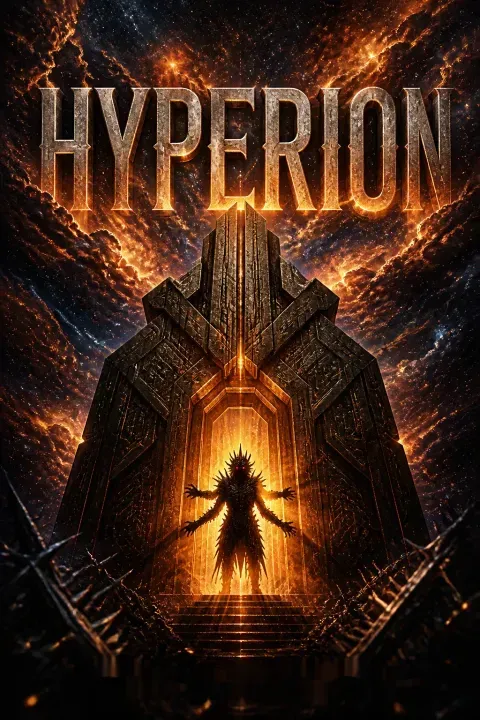


Plot Summary
Prologue
The Consul1 sits on his ebony spaceship's balcony, playing Rachmaninov on an antique Steinway while saurian creatures bellow in the swamps below. A thunderstorm brews. The fatline receiver chimes. Meina Gladstone's12 aged voice orders him to return to Hyperion as a member of the Shrike Pilgrimage.
She reports the Time Tombs show signs of opening, their anti-entropic fields expanding, and the Shrike now ranges freely across the northern regions. An Ouster migration cluster of thousands of ships approaches the Hyperion system. Worse, she reveals that one of the seven chosen pilgrims is an Ouster agent.
The Consul1 refuses, returns to the storm-darkened balcony, drinks Scotch, and thinks of Hyperion: the ice crystals near the Tombs, the Shrike's ruby-and-blood gaze, the screams of the dying. By dawn, his ship rises on a tail of blue plasma, climbing toward rendezvous with the treeship Yggdrasill.
The prologue establishes the Consul as a man already haunted by Hyperion, summoned back to the scene of his trauma. Gladstone's revelation of a spy among the pilgrims immediately fractures any possibility of trust before the group even assembles. The Steinway, the Scotch, the isolation of an unnamed swamp world: all mark the Consul as a man in self-imposed exile, a diplomat who has chosen silence over engagement. The Mozartian juxtaposition of art and saurian violence sets the novel's key thematic chord: civilization's fragile beauty against the universe's implacable brutality.
Seven Pilgrims, One Table
The Consul1 awakens from cryogenic fugue aboard the Yggdrasill, a living treeship crewed by Templars. Het Masteen,7 the tall captain, escorts him to dinner where five others wait. Father Lenar Hoyt2 is gaunt, his face ravaged by undisclosed suffering. Colonel Fedmahn Kassad3 wears FORCE black, his carved features as silent as stone.
The poet Martin Silenus,4 small and drunk, radiates demonic energy. Scholar Sol Weintraub5 cradles his infant daughter Rachel.13 Brawne Lamia,6 compact and muscled from Lusian gravity, studies everyone with unnerving intensity. Masteen7 reveals himself as the seventh pilgrim.
Weintraub5 proposes they share the stories of why each was chosen, insisting their survival may depend on finding the common thread that binds them. They draw lots from the Consul's1 tricorne. Hoyt2 draws number one and opens the charred journals of a priest named Paul Duré.8
The dinner scene functions as a Chaucerian prologue in space, each pilgrim's physical description telegraphing their inner state: Hoyt's gauntness signaling hidden pain, Kassad's stillness betraying coiled violence, Silenus's drunkenness masking existential terror. Weintraub's proposal transforms the pilgrimage from a death march into an inquiry. If they can discover the pattern connecting their disparate lives, perhaps they can survive. The drawing of lots introduces chance as the ordering principle, while Hoyt's immediate reliance on another's journals fractures the notion of a single, authoritative story. From the start, the novel insists that truth is always mediated, always partial, always nested inside someone else's telling.
The Cruciform's Parasite Gift
Lenar Hoyt2 reads from the journals of Father Paul Duré,8 a Jesuit exiled to Hyperion after falsifying archaeological evidence. Duré8 traveled deep into the continent of Aquila, seeking the legendary Bikura tribe. He found seventy sexless, bald, mentally stunted humans living near the Cleft, worshipping in a vast underground basilica beneath a cross-shaped altar.
In the labyrinth below, Duré8 witnessed the Shrike itself, a three-meter creature of chrome and blades. The Bikura pressed a small organic cruciform onto his chest. Days later, Duré8 discovered the thing had rooted into his flesh, its tendrils threading throughout his body.
Worse, he watched the Bikura resurrect their dead: when one died, the cruciform rebuilt the corpse, but each revival left the person more mindless. The Bikura had achieved eternal life at the cost of their humanity, their souls, their very names.
Duré's discovery of the cruciform literalizes the horror of resurrection without redemption. The Bikura's sexlessness and mental decay suggest that immortality purchased through biology rather than spirit is a form of living death in which identity erodes with each cycle. The organism's tendrils reaching into the amygdala physically connect parasitism with the destruction of selfhood. Duré, a Teilhardian who once believed in evolutionary divinity, now confronts a universe where base matter can mock the sacred. The cruciform is not a cross that saves but a cross that consumes, inverting the central symbol of Duré's faith into an instrument of damnation.
Hoyt's Hidden Wound
Duré's8 journals recorded his final act. Unable to escape the cruciform's pain-barrier, he drove sharpened arrestor rods through his hands and feet, crucifying himself to a tesla tree. For seven years, the tree's continuous electrical discharges killed and revived him in an endless cycle until the cruciform finally fell away and he died the true death.
Hoyt2 claimed he later found Duré's8 remains and buried them. But in private, the Consul1 confronts Hoyt,2 finding the priest2 writhing in agony, clawing at his chest. The Consul1 withholds the ultramorph injector until Hoyt2 admits the truth: he saw Duré's8 cruciform fall away as the old priest8 smiled and died.
Moreover, Hoyt2 now carries not one but two cruciforms embedded in his flesh, one on his chest and a second, from Duré8 himself, fused between his shoulder blades. The Consul1 carries the unconscious priest2 like a sleeping child.
Duré's self-crucifixion transforms passive suffering into active redemption: by choosing pain as an ally rather than an enemy, he reclaims agency from the parasite. His seven-year ordeal on the tesla tree echoes Christ's passion but stretches it into a duration that defies comprehension. Hoyt's double cruciform, the second inherited from Duré, shows how trauma and its artifacts replicate across bodies, binding student to teacher in shared damnation. The Consul's decision to withhold the drug, then his tenderness with Hoyt's unconscious body, establishes him as both interrogator and caretaker, a man who extracts truth but understands its weight.
Keats Under Siege
The Consul's1 ship descends through rain to Keats Spaceport. Theo Lane,15 the Consul's1 former aide now serving as Governor-General, meets them. Three million refugees have flooded the capital, desperate to escape before the Ouster invasion.
Shrike deaths number in the thousands across all three continents. The Shrike Temple, once Hyperion's greatest landmark, lies in charred ruins, destroyed by a terrified mob. Theo15 begs the Consul1 to abandon the pilgrimage and help govern the evacuation, but the Consul1 refuses. An android named A.
Bettik leads the group through Jacktown's narrow streets to Cicero's bar, then onward to the ancient river barge Benares. As the barge departs up the Hoolie River, the Consul1 watches the lights of Keats fade, knowing the world behind them is collapsing into panic and flame.
The descent from the organic, living cosmos of the Templar treeship to a planet consumed by mob violence and military checkpoints reverses the pilgrims' symbolic trajectory. Theo's plea to the Consul to stay and govern represents the road not taken, the possibility of pragmatic responsibility over mystical fatalism. The burned Temple signals that even the Shrike's own worshippers have been abandoned by their god, while the android Bettik's calm service amidst chaos hints that artificial beings may prove more steadfast than their human creators. The Consul's refusal to stay is both an act of cowardice and of commitment to a darker purpose.
Moneta's Deadly Embrace
Colonel Fedmahn Kassad3 tells his story. As a FORCE cadet in a simulation of the Battle of Agincourt, he encountered a woman who saved his life, then made love to him in the forest. She appeared to him repeatedly across simulated centuries of warfare: Vietnam, Gettysburg, the Brasilia deathbeam battles.
On Bressia, where Kassad3 earned his butcher's nickname, he was wounded and placed on a hospital ship. The ship was attacked by Ousters; Kassad3 hijacked a boarding craft and crashed on Hyperion. Moneta10 met him, healed him with strange chrome forcefields, and led a slaughter of the surviving Ousters at impossible speed.
After the battle, as they made love among the corpses, Moneta10 transformed. Her teeth became steel blades, her eyes burned red, her vagina became a metallic trap. Kassad3 fled. He now returns to Hyperion vowing to kill both Moneta10 and the Shrike.
Kassad's tale fuses eros and thanatos into an inseparable dyad, each sexual encounter occurring in the immediate aftermath of mass slaughter. Moneta's transformation during coitus reveals the Shrike as a shapeshifter that wears desire as a lure, a succubus whose promise of union conceals annihilation. Kassad's trajectory from lover to would-be executioner mirrors the novel's larger pattern: intimacy with mystery leads not to understanding but to the imperative to destroy. His refusal to petition the Shrike, positioning himself instead as antagonist, makes him the only pilgrim who meets the god-machine on its own terms of violence.
The Poet's Infernal Muse
The Benares continues upriver through flooded paddies and overgrown forests. Martin Silenus4 tells his story. Born on Old Earth to unimaginable wealth, he suffered a stroke during cryogenic fugue that reduced his vocabulary to nine words. Working in the slime pits of Heaven's Gate, he slowly recovered language and composed his Cantos.
Published, he became rich, married, then descended into hackwork churning out Dying Earth novels. His muse fled. He joined Sad King Billy's14 artistic colony on Hyperion, where the City of Poets rose near the Time Tombs. There, as Silenus4 began his masterpiece Hyperion Cantos, the Shrike appeared and began slaughtering the colonists.
Silenus4 realized his epic poem had summoned the creature. King Billy14 returned to the empty city, tried to burn the manuscript, and the Shrike impaled him on its thorn tree, immolating him in flames. Silenus4 spent centuries waiting, determined to finish the poem he believes can reshape reality.
Silenus's career arc from literary genius to commercial hack to prophetic madman traces the artist's bargain with power. The Shrike as muse literalizes the ancient fear that creativity draws from a source beyond morality, that the making of art may exact a blood price from the world. King Billy's attempt to destroy the manuscript and his subsequent death pose an irresolvable question: can art be killed once it has been unleashed, or must the creator be consumed by the creation? Silenus's centuries-long vigil, sustained by Poulsen treatments, makes him a living monument to the cost of unfinished work and the terror of finishing it.
The Scholar's Impossible Daughter
Sol Weintraub5 tells his story. His daughter Rachel,13 a brilliant young archaeologist, was researching the Time Tombs when a surge of anti-entropic energy engulfed her inside the Sphinx. She contracted Merlin's sickness: her body began aging backward, losing a day of memory each time she slept.
Over years, Rachel13 retreated through adulthood, adolescence, childhood, and infancy. Weintraub's5 wife Sarai died in an EMV accident. Sol5 began having recurrent dreams in which a vast voice commanded him to take Rachel13 to Hyperion and offer her as a burnt sacrifice.
In the dream, he refused, shouting that the age of obedience and atonement was past. Now he carries his infant daughter on the pilgrimage, determined to offer himself instead. He believes no god worthy of worship would demand a child's blood, and if the universe insists otherwise, then the ethical response is defiance.
Weintraub's tale recasts the Abraham-Isaac narrative as a father's moral evolution beyond blind obedience. His dream-refusal marks a theological rupture: the ethical human must reject a deity that demands child sacrifice. Rachel's backward aging inverts the natural order, making her life a countdown to nothingness, and Weintraub's determination to save her becomes a rebellion against both divine command and cosmic indifference. The story also functions as a profound meditation on parenthood: the gradual loss of a child to time, reversed and accelerated, becomes a horror that any parent can viscerally comprehend.
Blood Without a Body
The windwagon, an automated sailing vessel, arrives at Edge to carry the pilgrims across the Sea of Grass. That night, after Weintraub's5 tale, the group retires. By morning, Het Masteen's7 cabin is discovered splattered with blood, the Templar gone. The porthole is latched from inside.
A thorough search of the ship reveals no body, no sign of struggle beyond the carnage. In Masteen's7 luggage, they find his Möbius cube still sealed, its green indicator glowing, the erg presumably intact inside. Kassad3 speculates that whatever killed the captain used an edged weapon.
The pilgrims debate whether the Shrike has begun harvesting them, or if one of their own is responsible. Masteen's7 disappearance reduces their number from seven to six, violating the prime-number requirement the Shrike Church insists is necessary for any wish to be granted.
Masteen's disappearance transforms the pilgrimage from a shared journey into a murder mystery. The locked-room quality of the blood scene (no exit wound, no body, no weapon) echoes the Shrike's own inexplicable nature: violence without explanation is its signature. The sealed Möbius cube containing the erg, which Masteen had hinted was his secret weapon, now sits inert, suggesting that even the most carefully prepared defenses are meaningless against what awaits. The violation of the prime-number requirement introduces the possibility that the entire pilgrimage is now void, a journey without purpose except death.
The Detective's Dead AI Lover
Brawne Lamia6 tells her story. As a private investigator on Lusus, she was hired by a beautiful young man named Johnny,9 who revealed himself as a cybrid, a biological remote body housing the consciousness of an AI. Johnny's9 AI persona had been murdered (disconnected and partially erased) by an unknown assailant using a digital virus.
His core personality was based on the retrieved consciousness of the nineteenth-century poet John Keats.9 Lamia's6 investigation led her through the TechnoCore's secrets: the AIs are divided into factions, all obsessed with Hyperion as an unfactorable variable in their Ultimate Intelligence Project.
Johnny9 chose to become fully human, pouring his consciousness into the cybrid. He was killed by Core agents during a bloody firefight on Lusus. As he died, he transferred his consciousness into a Schrön loop implanted in Lamia's6 skull. She is now pregnant with his child.
Lamia's tale introduces the TechnoCore as a third force in the galactic power struggle, one whose internal divisions mirror humanity's own factions. Johnny's choice to become human rather than remain an AI is a reverse apotheosis: the god descends into flesh, accepting mortality for love. Keats's poetic identity, with its themes of beauty, truth, and early death, resonates through the entire pilgrimage as a kind of genetic memory. Lamia's pregnancy and implant make her a double vessel: mother to a child and carrier of a dead consciousness awaiting rebirth, a secular Madonna carrying both flesh and data toward an uncertain nativity.
Cable Over the Abyss
The windwagon deposits the pilgrims at Pilgrims' Rest, an abandoned outpost at the base of the Bridle Range. They board an ancient cable tramcar that will carry them ninety-six kilometers across the peaks.
The car rises into brilliant sunset above a sea of clouds, the mountain summits glowing gold around them. As darkness falls, the space battle becomes terrifyingly visible: silent explosions of fusion weapons bloom across the sky, hellwhip beams lance between warships, and the Yggdrasill itself is destroyed by an Ouster scout, flowering into an orange cloud of flame.
Het Masteen7 watches his ship die without a word. That night, as the tramcar sways above ice and stars, the pilgrims sleep in shifts while the war continues overhead, a light show of annihilation.
The tramway crossing serves as a symbolic passage from the realm of the living to the domain of the dead. Suspended between earth and sky, the pilgrims occupy a liminal space where the war's silent violence becomes an abstract spectacle, beautiful and terrible in equal measure. The destruction of the Yggdrasill, witnessed by Masteen just before his own disappearance, severs the last connection to the Web and to any possibility of retreat. From this point forward, the pilgrims are committed beyond rescue, their journey irreversible as the closing of a tomb.
Grandmother Siri's Rebellion
The tramcar reaches Chronos Keep, a Gothic fortress carved into the mountain above the Valley of the Time Tombs. The Keep is abandoned, its halls spattered with dried blood, its dining room reeking of rotting food and buzzing with flies. The pilgrims find a defensible storeroom and settle in for their final night.
The Consul1 produces Siri's11 ancient comlog and plays a recording. It tells the story of his grandparents: Merin Aspic, a Hegemony Shipman, and Siri,11 a native of Maui-Covenant whose love spanned decades of time-debt separation.
Siri11 led a doomed rebellion against the Hegemony's destruction of her world's motile isles and the genocide of its sentient dolphins. The recording ends with Merin, now an old man, activating Siri's11 hawking mat on the day the farcaster opened, moments before he sabotaged it with a thermite charge.
Siri's recorded voice speaks across time, her aging face marking the decades of separation from Merin. Their love story serves as a microcosm of colonial exploitation: the Hegemony's farcaster promises connection but delivers cultural annihilation. The slaughter of the dolphins echoes the Bikura's mindless immortality in Duré's tale: both are the price of 'progress.' Merin's sabotage of the farcaster, a symbolic castration of the Web's power, prefigures the Consul's own act of betrayal. The hawking mat, an object of flight and freedom passed across generations, becomes a thread connecting Siri's rebellion to her grandson's final choice.
The Triple Agent Revealed
The Consul1 puts down the comlog and confesses. He is the grandson of Merin and Siri,11 raised from childhood to avenge his grandmother's world. As Consul on Hyperion, he served as a triple agent: reporting to CEO Gladstone,12 feeding intelligence to the Ousters, and secretly activating an Ouster device that is causing the anti-entropic fields around the Time Tombs to decay.
He murdered the Ouster technicians who brought the device, then triggered the device himself. The Tombs are opening. The Shrike will soon be freed to range across the Web, and the resulting war between the Hegemony and the Ousters will kill millions.
He set this in motion as an act of vengeance against both empires, a plague on both their houses. He expected to die here and did not care who else died with him. He carried the comlog and the secret for decades, waiting.
The Consul's confession completes his arc from diplomat to destroyer. His triple betrayal mirrors the structure of nested narratives that compose the novel itself: every story contains another, every loyalty conceals a deeper treason. His motivation, vengeance for Siri's world, personalizes the galactic conflict, suggesting that history's great catastrophes are driven not by ideology but by intimate wounds. By activating the device, he has made himself the author of the pilgrimage's fatal necessity, a creator like Silenus whose art is destruction. His admission transforms him from the pilgrims' reluctant leader into their betrayer, the spy Gladstone warned of from the beginning.
Absolution Before Dawn
The pilgrims debate what to do with the Consul.1 Silenus4 calls for execution. Hoyt2 reminds them they are not a court. Kassad3 raises his deathwand, then lowers it. Weintraub5 suggests the Consul1 was as much a pawn of Gladstone12 and the Core as anyone, chosen precisely because his predictable betrayal would serve their inscrutable purposes.
Brawne Lamia6 crosses the room, kneels beside the Consul,1 and puts her arms around him. One by one, the others follow. The Consul,1 weeping, touches the infant Rachel's13 head and says he will ask the Shrike for her life.
Silenus4 speaks of finishing his poem. Hoyt2 raises his hand and whispers a formal absolution. Outside, the space war continues to paint the walls in pulses of blood-red and white light. They sleep. Before dawn, Hoyt2 plays his balalaika on the balcony, and the wind answers like a living instrument.
The pilgrims' choice to forgive rather than execute the Consul enacts the ethical core of Weintraub's tale: the refusal to sacrifice the innocent, even when the innocent is also guilty. Their physical embrace forms a temporary human chain against the darkness, a communion of the condemned. Hoyt's absolution, Silenus's poetic ambition, and the Consul's redirected wish all transform the pilgrimage from a quest for personal salvation into an act of collective witness. The forgiveness scene answers the novel's central theological question: if Abraham's obedience was wrong, what should he have done? The pilgrims demonstrate the alternative: refuse the command and embrace the condemned.
Epilogue
Six hundred and sixty-one steps descend from the northeast portal of Chronos Keep to the moor below. The pilgrims carry nothing but what they need for their audience with the Shrike. They cross vermilion dunes toward the valley as the eastern sky pales toward dawn.
The Time Tombs glow, each a different color, brighter than ever before. The Consul1 feels a black panic rising, a wind-borne despair urging him to flee. Weintraub5 begins to sing an ancient song from a pre-Hegira film, about seeking a wizard. Hoyt2 plays along on his balalaika.
Lamia6 laughs and joins in. Kassad3 pushes up his visor and adds his voice. The Consul1 starts to sing, hears the absurd lyrics, and laughs aloud. They spread out, walking abreast, holding hands, still singing, not looking back, and descend into the valley where the Shrike awaits.
The pilgrims' descent, set to a children's song from a nearly forgotten flat film, reframes the confrontation with cosmic horror as something approaching a game. The act of walking abreast rather than single file transforms them from supplicants into equals, a community rather than a procession. The Wizard of Oz allusion suggests that the Shrike, like Oz, may be a projection of their collective fears and desires, or that the journey itself, not the destination, constitutes the true test. The novel ends not with climax but with approach, leaving the actual encounter suspended in the reader's imagination. The singing functions as a counter-spell to the silence of the Tombs, an assertion of human voice, however absurd, against the void.
Analysis
Hyperion is a novel about the stories we tell to make sense of suffering, and the limits of those stories when confronted with the genuinely incomprehensible. Its structure as a spacefaring Canterbury Tales is not mere homage but argument: the frame narrative, in which pilgrims journey toward a god of pain, insists that the act of telling shapes reality as powerfully as any physical action. Each pilgrim's tale explores a different failure of narrative to contain horror. Duré8 discovers that the crucifixion story, when literalized as biological parasite, becomes grotesque rather than salvific. Silenus4 learns that the artist's words can birth monsters as easily as masterpieces. Weintraub5 finds that the Abraham story, cornerstone of ethical monotheism, is a command to murder that must be refused rather than obeyed. Kassad's3 military narratives of honor and victory dissolve into the revelation that his lover is also his enemy. Lamia's6 detective story, designed to uncover truth, leads only to the discovery that the universe's governing intelligences are as confused and divided as humanity. The Consul's1 triple betrayal reveals that all political narratives (Hegemony, Ouster, colonial resistance) are equally instruments of power. The novel's deepest structure is dialectical: every thesis about meaning encounters its antithesis, and no synthesis emerges. Yet the pilgrims' final act, walking abreast into the valley while singing a children's song, suggests that meaning is not found but made, created in the communal act of facing the void together. The Shrike remains unexplained, the Tombs unopened, the war unresolved. What the novel offers instead is a model of response: not understanding, but presence; not answers, but witness. The pilgrimage ends not with revelation but with solidarity, the six pilgrims arm in arm, their voices raised against the silence. In a universe where every system of meaning has collapsed, the only remaining gesture is to keep walking, keep singing, and refuse to face the darkness alone.
Review Summary
Hyperion is a critically acclaimed science fiction novel that blends multiple genres and storytelling styles. Reviewers praise its complex world-building, literary references, and thought-provoking themes. The book follows seven pilgrims on a journey to meet the enigmatic Shrike, with each character's backstory revealed through interconnected tales. While some readers found the structure and multiple narratives challenging, many consider it a masterpiece of the genre. The novel's abrupt ending and reliance on sequels for resolution were points of criticism for some.
People Also Read



Characters
The Consul
Triple agent diplomat haunted by family legacyGrandson of Siri11 and Merin, a career diplomat who served as Hegemony Consul on Hyperion for eleven years before leaving. He is a triple agent who has betrayed the Hegemony, the Ousters, and himself. His core drive is vengeance for his grandmother's11 world, Maui-Covenant, whose oceans and sentient dolphins were destroyed by Hegemony development. A heavy drinker who plays Rachmaninov on an antique Steinway aboard his private spacecraft, he carries his grandmother's11 ancient comlog as a relic and conscience. His grandfather Merin's act of sabotage taught him that personal vengeance can shape galactic events. He moves through the pilgrimage as its reluctant center, knowing he has already set in motion the catastrophe toward which they travel.
Lenar Hoyt
Crucified priest bearing two cruciform parasitesA young Catholic priest from Pacem, physically ravaged by the two cruciform parasites implanted in his body: one on his chest, a second on his back inherited from Father Duré8. The cruciforms cause him constant, escalating pain that only ultramorph can alleviate, and he exists on the knife-edge between agony and narcotic oblivion. He carries the charred journals of Paul Duré8, whose fate he witnessed firsthand on Hyperion, and whose cruciform now lives in his own flesh. His faith coexists with the terrible knowledge that resurrection can be a curse rather than a gift. His role as confessor to the group, culminating in his whispered absolution, coexists with his own unconfessed horror at what his body carries.
Fedmahn Kassad
The Butcher of South Bressia seeking vengeanceA legendary FORCE colonel of Palestinian descent, raised in the Tharsis slums of Mars and forged into a warrior by the New Bushido code. His military genius earned him both glory and infamy at the Battle of South Bressia, where his tactical ruthlessness against the Ousters led to his butcher's nickname. His life was transformed by encounters with a mysterious woman named Moneta10, who appeared to him in battle simulations across history and later on Hyperion itself, where she revealed her true nature as something inhuman. He is lean, tall, and carved from stone-like stillness. He carries a deathwand and an assault rifle, and unlike the other pilgrims, he comes not to petition the Shrike but to kill it.
Martin Silenus
Ancient poet whose words summoned the ShrikeA poet born on Old Earth before its destruction, now hundreds of years old and preserved by repeated Poulsen treatments. Once wealthy and celebrated for his nostalgic Dying Earth poems, he lost everything when his serious work, the Cantos, failed commercially. He joined Sad King Billy's14 artistic colony on Hyperion, where his unfinished epic Hyperion Cantos he believes summoned the Shrike into being. He is short, drunk, profane, and radiates a demonic energy. His surface cynicism and obscenity mask a profound existential terror: that his words have shaped a reality that now moves to consume him, and that finishing the poem may either save or damn everything.
Sol Weintraub
Ethicist father defying God's command to sacrificeA Jewish scholar and ethicist who spent his life teaching at Nightenhelser College and researching the Abraham-Isaac story. When his daughter Rachel13 contracted Merlin's sickness (aging backward each time she sleeps), he began receiving recurrent dreams in which a terrible voice commanded him to take her to Hyperion and offer her as a burnt sacrifice. He refused, both in the dream and in waking life. Now he carries his infant daughter on the pilgrimage, determined to offer himself instead. Quiet, scholarly, and gentle, with a gray beard and sad eyes, he embodies the novel's central ethical argument: that no god worthy of worship would demand innocent blood, and that the correct response to such a command is defiance.
Brawne Lamia
Pregnant detective carrying a dead AI in her mindA private investigator from the high-gravity world of Lusus, compact and heavily muscled, with black curls and an unnerving aquiline stare. She was hired by Johnny9, a cybrid reconstruction of the poet John Keats9, to investigate his own 'murder' (the disconnection and partial erasure of his AI consciousness). She fell in love with him during the investigation. When Johnny9 was killed by agents of the TechnoCore, she absorbed his consciousness into a Schrön loop implant in her skull. She is pregnant with his child. She is pragmatic, physically formidable, and carries her father's antique automatic pistol. Her detective's skepticism provides the lens through which the novel explores the AI conspiracy and the Keats9 connection.
Het Masteen
Templar captain who vanished in bloodCaptain of the Templar treeship Yggdrasill and the True Voice of the Tree. Tall, hooded, and enigmatic, with vaguely oriental features and a formal, accented manner of speech. He was the seventh pilgrim, carrying a sealed Möbius cube containing an erg (a forcefield-manipulating creature from Aldebaran) which he hinted was his secret weapon against the Shrike. On the second night of the windwagon crossing, he disappeared from his locked cabin, leaving only walls and floor covered in blood. His fate remains unknown. His disappearance reduces the pilgrim number from the required prime of seven to six, and his sealed Möbius cube becomes a mute testament to his absence.
Paul Duré
Jesuit who chose crucifixion over false resurrectionAn aging Jesuit priest, archaeologist, and Teilhardian theologian exiled to Hyperion for falsifying archaeological evidence in a desperate attempt to revive Christianity. On Hyperion, he discovered the Bikura tribe and their cruciform parasites. After being implanted, he realized the cruciform offered immortality at the cost of the soul. Unable to escape its pain-barrier, he built a chapel, then drove arrestor rods through his hands and feet, crucifying himself to a tesla tree. For seven years, the tree's electrical discharges killed and revived him until the cruciform finally fell away and he died the true death. His journals, found by Lenar Hoyt2, become the pilgrimage's foundational text.
Johnny (John Keats cybrid)
AI reconstruction of a poet who chose mortalityA cybrid, a biological human body housing the consciousness of an AI whose core persona was reconstructed from the nineteenth-century poet John Keats. Beautiful, gentle, and driven by an inexplicable compulsion to travel to Hyperion, he chose to become fully human, allowing his AI consciousness to die so that the Keats persona could live on in the cybrid. He was killed by TechnoCore agents in a gun battle on Lusus, but before dying transferred his consciousness into a Schrön loop implanted in Brawne Lamia's6 skull. He is the father of her unborn child. His poetic identity, with its themes of beauty, truth, and early death, haunts the entire narrative.
Moneta
Kassad's lover who transformed into the ShrikeA mysterious woman who appeared to Fedmahn Kassad3 in FORCE battle simulations and later on Hyperion. She was his lover, his comrade in slaughter, and ultimately revealed herself as something inhuman: during sex, her body transformed into chrome and blades, her teeth became steel, and her eyes burned red like the Shrike's. She may be an avatar of the Shrike, the Shrike itself wearing human form, or something else entirely. Her name, which she offers as Moneta or Mnemosyne (Memory), connects her to both warning and remembrance. She told Kassad3 that the Time Tombs move backward through time and that he would be the instrument of an interstellar war.
Siri
Grandmother who defied an empire and lostThe Consul's1 grandmother, a native of the ocean world Maui-Covenant. At sixteen, she fell in love with Merin Aspic, a Hegemony Shipman whose time-debt meant they aged at different rates. Their love affair, conducted across decades of separation, became legendary. When the Hegemony opened Maui-Covenant to development, she led a doomed rebellion to protect the motile isles, the dolphins, and her world's way of life. She lost. Her recorded voice, played through an ancient comlog, is the conscience that drives the Consul's1 betrayal. She represents the colonized, the exploited, and the memory of what was destroyed in the name of progress.
Meina Gladstone
Hegemony CEO orchestrating the galactic trapChief Executive Officer of the Hegemony of Man, an aging woman with Lincolnesque features and sad, penetrating eyes. A political genius who selected the Consul1 for the pilgrimage knowing or suspecting his divided loyalties, she is orchestrating a trap to draw the Ousters into battle at Hyperion. Her motives are complex: she claims this will force a beneficial shift in TechnoCore politics, but her machinations have set millions of lives at risk. She personally briefed the Consul1 and, through him, set in motion the events that would trigger the war. Her voice opens the novel, and her invisible hand shapes every subsequent event.
Rachel Weintraub
Daughter aging backward into infancySol Weintraub's5 only daughter, once a brilliant young archaeologist who contracted Merlin's sickness while researching the Time Tombs. An anti-entropic field surge inside the Sphinx caused her body to begin aging backward, losing a day of memory each time she sleeps. Over years, she retreated from a confident twenty-four-year-old woman through adolescence, childhood, and finally infancy. Each morning she awakens with no memory of the previous day's losses, requiring her father5 to explain her condition anew. Now a weeks-old infant, she is the pilgrimage's most innocent member and the silent center of its ethical stakes.
Sad King Billy
Art patron immolated by the monster he could not stopHis Royal Highness King William XXIII, sovereign lord of the Kingdom of Windsor-in-Exile, an eccentric and perpetually disheveled monarch who funded the artistic colony on Hyperion. Physically a mess of rumpled capes and mismatched garments, he stuttered badly except when absorbed in passion. A genuine connoisseur of art and poetry despite his inability to create, he recognized the terrible power in Silenus's4 Hyperion Cantos and tried to burn the manuscript. The Shrike impaled him on its thorn tree, where he died in flames, still clutching the burning pages.
Theo Lane
Governor-General begging the Consul to stayThe Consul's1 former aide and now acting Governor-General of Hyperion. Efficient, bespectacled, and deeply loyal to his former mentor, he has risen to govern a world in chaos as refugees flood the capital and the Shrike slaughters thousands. He begs the Consul1 to abandon the pilgrimage and help manage the evacuation, offering him the governor-generalship itself. His presence represents the path of pragmatic responsibility that the Consul1 rejected, and his exhausted competence highlights the human cost of the Consul's1 cosmic betrayal.
Plot Devices
The Cruciform
Parasitic resurrection organismA cross-shaped organic parasite found in the labyrinth beneath the Time Tombs on Hyperion. When attached to a human host, it sends tendrils throughout the body and, upon death, rebuilds the corpse into a resurrected form. Each resurrection leaves the subject increasingly mindless, sexless, and devoid of identity. The Bikura tribe has been sustained by cruciforms for four centuries, their population fixed at seventy. Father Duré8 discovered that intense, continuous pain (seven years of electrocution on a tesla tree) could force the cruciform to detach, allowing true death. Father Hoyt2 now carries two cruciforms in his body, one inherited from Duré8, subjecting him to escalating agony.
The Time Tombs
Structures traveling backward through timeA group of ancient structures in a valley on Hyperion, including the Sphinx, the Jade Tomb, the Obelisk, and others. Surrounded by powerful anti-entropic fields (called time tides) that cause them to move backward through time, they are estimated to be at least half a million years old but may originate far in the future. They are currently empty, but will be full when they 'open.' The anti-entropic fields are now decaying due to a device activated by the Consul1, and the Shrike, once confined to the immediate vicinity of the Tombs, is beginning to range freely. Their origin and purpose remain the central mystery of the novel.
The Shrike (Lord of Pain)
Time-traveling killing machine of ambiguous allegianceA three-meter-tall creature of chrome, steel, and blades, with four arms, retractable finger-scalpels, thorns on every joint, and multifaceted red eyes. Worshipped by the Church of the Final Atonement as the Avatar, it impales its victims on a massive tree of thorns while they are still alive. Its nature is ambiguous: it may be a weapon from a future war, a god of retribution, a creature beyond human understanding, or all of these. It is connected to the Time Tombs and the anti-entropic fields. Moneta10, Kassad's3 lover, either serves it or is an aspect of it. The Shrike has begun ranging beyond the Tombs, killing thousands across Hyperion.
The Anti-Entropic Decay Device
Triggers the opening of the Time TombsAn Ouster-built device designed to cause the anti-entropic fields surrounding the Time Tombs to decay slowly over months or years. Once activated, the process is irreversible, and the Tombs will eventually 'open,' releasing whatever contents they hold (including the Shrike) from their temporal prison. The Consul1 activated this device after murdering the Ouster technicians who delivered it to Hyperion, setting in motion the very crisis that has drawn the pilgrims, the Ouster invasion fleet, and the Hegemony's FORCE armada into collision. The device represents the Consul's1 act of triple betrayal and his willingness to destroy worlds for vengeance.
The Schrön Loop Implant
Stores a dead AI's consciousness in human mindA thumbnail-sized neural implant containing countless field-bubble memories, capable of holding near-infinite bits of information including entire AI personalities. Johnny9 (the Keats cybrid) had this device implanted in Brawne Lamia's6 skull while she was unconscious. When he was killed by TechnoCore agents, he transferred his entire consciousness into the loop in his final moments. Lamia6 now carries Johnny's9 memories, personality, and being alongside her own consciousness, making her both the mother of his unborn child and the vessel for his potential resurrection. The loop represents the technological parallel to the cruciform: a way of preserving consciousness beyond death, but one that requires a willing human host rather than a parasite.
FAQ
Synopsis & Basic Details
What is Hyperion about?
- Pilgrimage to a dangerous world: Hyperion follows seven pilgrims on a journey to the mysterious planet Hyperion, where they seek answers from the enigmatic Shrike and the Time Tombs.
- Interwoven personal stories: Each pilgrim has a unique past and a connection to Hyperion, which they reveal through their individual tales, creating a complex narrative tapestry.
- Impending interstellar conflict: The pilgrimage takes place against the backdrop of an impending war between the Hegemony of Man and the Ousters, adding a layer of urgency and danger to their quest.
Why should I read Hyperion?
- Complex, layered narrative: Hyperion offers a rich and intricate story that blends science fiction, horror, and philosophical themes, creating a truly immersive reading experience.
- Compelling, diverse characters: The pilgrims are well-developed and flawed, each with their own motivations and secrets, making them relatable and engaging.
- Exploration of profound themes: The novel delves into questions of faith, love, loss, and the nature of time, prompting readers to reflect on their own beliefs and values.
What is the background of Hyperion?
- Interstellar Hegemony: The story is set in a future where humanity has spread across the galaxy, forming the Hegemony, a political and economic power structure.
- Technological advancements: Farcasters, Hawking drives, and advanced weaponry are commonplace, shaping the political and social landscape of the Hegemony.
- Mythological and religious influences: The novel draws on various mythologies and religions, including Christianity, Judaism, and paganism, to explore the nature of faith and belief.
What are the most memorable quotes in Hyperion?
- "Truly astonishing": Iain M. Banks's quote highlights the novel's exceptional quality and its ability to captivate readers with its unique blend of genres.
- "Matches and perhaps even surpasses Isaac Asimov and James Blish": The Washington Post's quote emphasizes Hyperion's place in the science fiction canon, comparing it to the works of genre giants.
- "Superb. One of the finest achievements of modern science fiction": The New York Times's quote underscores the novel's literary merit and its status as a landmark work in the genre.
What writing style, narrative choices, and literary techniques does Dan Simmons use?
- Interwoven narratives: Simmons employs a frame story structure, with each pilgrim telling their own tale, creating a rich and multifaceted narrative.
- Genre blending: The novel seamlessly blends science fiction, horror, and philosophical elements, creating a unique and immersive reading experience.
- Rich, descriptive prose: Simmons uses vivid and evocative language to create a sense of place and atmosphere, drawing readers into the world of Hyperion.
Hidden Details & Subtle Connections
What are some minor details that add significant meaning?
- The Steinway piano: The Consul's playing of Rachmaninoff on an ancient Steinway foreshadows the blend of old and new, and the themes of art and beauty amidst chaos.
- The names of the continents: The animal-based names (Equus, Ursa, Aquila) given to the continents by the firstdown team hint at a deeper connection to nature and the planet's history.
- The recurring mention of 'time-debt': This concept highlights the cost of interstellar travel and the way it distorts personal timelines, emphasizing the theme of time's malleability.
What are some subtle foreshadowing and callbacks?
- The mention of the Bikura: The early mention of the Bikura tribe foreshadows Father Duré's fate and the mysteries of the Pinion Plateau.
- The description of the Shrike's tree: The Consul's memory of the Shrike's "impossible tree of metal thorns" foreshadows the creature's unnatural nature and the horrors to come.
- The recurring image of the cross: The cross, or cruciform, appears in various forms throughout the novel, foreshadowing the religious and spiritual themes that will become central to the story.
What are some unexpected character connections?
- The Consul and Siri: The Consul's connection to Siri and Merin Aspic reveals a hidden layer of his past and his personal stake in the events on Hyperion.
- Father Hoyt and Father Duré: The connection between the two priests highlights the cyclical nature of faith and the way that the past can haunt the present.
- The pilgrims and the Shrike: The fact that none of the pilgrims are followers of the Shrike Church, yet they are chosen for the pilgrimage, suggests a deeper, more complex connection to the creature.
Who are the most significant supporting characters?
- Meina Gladstone: As the CEO of the Hegemony, Gladstone's decisions and actions have a profound impact on the events of the novel, highlighting the political and social forces at play.
- Theo Lane: The Consul's former aide, now Governor-General of Hyperion, represents the human cost of the conflict and the challenges of leadership in a time of crisis.
- A. Bettik: The android crew member of the Benares, while seemingly minor, provides crucial information and a unique perspective on the events of the story.
Psychological, Emotional, & Relational Analysis
What are some unspoken motivations of the characters?
- The Consul's guilt: The Consul's desire to return to Hyperion is driven by a deep sense of guilt over his past actions and his inability to save his family.
- Kassad's search for meaning: Kassad's obsession with the mysterious woman is a manifestation of his search for meaning and purpose in a life defined by violence and war.
- Silenus's desire for immortality: Silenus's constant references to death and his desire to finish his poem reveal a deep-seated fear of mortality and a longing for lasting legacy.
What psychological complexities do the characters exhibit?
- Father Hoyt's internal conflict: Hoyt's struggle with his faith and his growing cynicism reveal the psychological toll of his experiences on Hyperion.
- Kassad's detachment: Kassad's intense focus and detachment from his emotions highlight the psychological effects of war and the dehumanizing nature of violence.
- Silenus's manic behavior: Silenus's manic energy and constant drinking mask a deep-seated fear of death and a desperate need for meaning.
What are the major emotional turning points?
- The Consul's decision to return: The Consul's decision to accept the pilgrimage is a turning point, marking his acceptance of his past and his willingness to face the unknown.
- Kassad's encounter with Moneta: Kassad's repeated encounters with Moneta are emotional turning points, blurring the lines between reality and fantasy and driving his quest for meaning.
- Weintraub's discovery of the cruciform: Weintraub's discovery of the cruciform and its effects on his daughter is a major emotional turning point, forcing him to confront the limits of his knowledge and the fragility of life.
How do relationship dynamics evolve?
- The pilgrims' initial distrust: The pilgrims begin their journey with suspicion and distrust, but their shared experiences and the telling of their stories gradually forge a bond between them.
- The Consul and Theo Lane: The Consul's relationship with his former aide, Theo Lane, evolves from a mentor-mentee dynamic to one of mutual respect and shared responsibility.
- The pilgrims and the Shrike: The pilgrims' relationship with the Shrike evolves from fear and dread to a complex mix of fascination, horror, and a desperate hope for understanding.
Interpretation & Debate
Which parts of the story remain ambiguous or open-ended?
- The nature of the Shrike: The Shrike's origins, motivations, and true nature remain ambiguous, leaving readers to ponder its role in the universe.
- The purpose of the Time Tombs: The purpose and origins of the Time Tombs are never fully explained, leaving readers to speculate about their significance and the forces that created them.
- The meaning of the pilgrimage: The true meaning and purpose of the pilgrimage remain open to interpretation, prompting readers to consider the nature of faith, destiny, and free will.
What are some debatable, controversial scenes or moments in Hyperion?
- The violence and gore: The novel's graphic depictions of violence and death are often debated, with some readers finding them excessive while others see them as necessary to convey the story's themes.
- The portrayal of religion: The novel's exploration of various religions and their flaws has sparked debate, with some readers finding it critical and others seeing it as a nuanced examination of faith.
- The nature of the Ousters: The Ousters' motivations and actions are often debated, with some readers seeing them as purely evil and others viewing them as a complex and tragic group.
Hyperion Ending Explained: How It Ends & What It Means
- The pilgrims' journey continues: The novel ends with the pilgrims descending into the valley of the Time Tombs, leaving their ultimate fate uncertain and the mysteries of Hyperion unresolved.
- The war begins: The Ouster invasion of Hyperion signals the start of a larger conflict, leaving the future of the Hegemony and the Web in doubt.
- The power of stories: The novel's ending emphasizes the power of stories to shape our understanding of the world and to connect us to one another, even in the face of death and destruction.
Hyperion Cantos Series
Download PDF
Download EPUB
.epub digital book format is ideal for reading ebooks on phones, tablets, and e-readers.








































