
Key Takeaways
1. The World's Reluctant Slide into War
“It had only been a second, but one that showed me how easily people anywhere could be aroused in a time of a crisis, despite all attempts at understanding.”
Escalating Tensions. The period leading up to World War II was marked by a gradual, almost imperceptible, escalation of tensions, despite a widespread desire for peace. Stefan Zweig's observation in 1914, witnessing a French audience's visceral reaction to an image of Wilhelm II, highlighted how quickly public sentiment could turn hostile, even among "good-natured people" with limited political knowledge. This underlying volatility made populations susceptible to manipulation.
Failed Deterrence. Alfred Nobel's 1892 prediction that the sheer destructive power of modern explosives would deter war proved tragically wrong. Instead, the development of increasingly lethal weaponry, from mustard gas to advanced bombers, only made conflict more terrifying, yet did not prevent its onset. The belief that mutual annihilation would force nations to "recoil with horror" did not materialize as leaders continued to pursue military solutions.
Apathy and Normalization. Despite the horrors of World War I, a sense of apathy and normalization of violence set in during the interwar years. Stefan Zweig noted the "witch's sabbath of inflation" and the rise of authoritarian movements in Germany, where people "aligned themselves in readiness for any slogan that promised order." This societal breakdown, coupled with a collective short memory of past suffering, allowed the seeds of future conflict to take root.
2. Leaders' Ideologies and Actions Fueled Conflict
“I like things to happen,” he had said, “and if they don’t happen I like to make them happen.”
Churchill's Belligerence. Winston Churchill, a prominent figure throughout this period, consistently advocated for military strength and often displayed a combative, even ruthless, approach to international relations. From instituting a naval blockade of Germany in 1914 to calling for the "complete annihilation of Germany" in 1918, and later expressing admiration for Mussolini's fascism, Churchill's actions and rhetoric frequently pushed for confrontation. His belief that "safety will only come through a combination of pacific nations armed with overwhelming power" underscored his conviction in military might.
Hitler's Fanaticism. Adolf Hitler, driven by extreme nationalism and anti-Semitism, systematically dismantled peace efforts and prepared Germany for war. His speeches, characterized by "fanaticism" and a desire to "crush his opponent with his teeth," rallied a populace suffering from economic misery and national humiliation. He viewed war as inevitable and necessary for Germany's survival, dismissing any resistance as "nonsense" and promising ruthless action against opposition.
Roosevelt's Strategic Ambiguity. President Franklin D. Roosevelt, while publicly advocating for peace and neutrality, subtly steered the United States towards intervention. His actions, such as building thirty-two warships, placing Wake Island under naval administration, and conducting large-scale war games in the Pacific, were perceived by Japan as provocative. Despite his public pledges to keep America out of war, his private conversations and strategic decisions indicated a readiness to engage, waiting for an "incident" to justify intervention.
3. Propaganda and Censorship Manipulated Public Opinion
“The British Press is an iron curtain hiding the real opinions and feelings of the British people,” the paper said, using a phrase that Churchill would later immortalize.
Controlling Narratives. Governments on all sides actively controlled information and used propaganda to shape public opinion, often distorting facts and demonizing the enemy. In Germany, Joseph Goebbels orchestrated book burnings and anti-Semitic campaigns, portraying critics as "Jewish" and "filth." He successfully used events like the Reichstag fire and Ernst vom Rath's assassination to "crystallize German anti-Semitism," demonstrating the power of manufactured outrage.
Suppressing Dissent. Censorship was a key tool in maintaining national unity and war fervor. In Britain, the government suppressed newspapers like the Daily Worker for "weakening the will of our people" and suggesting that the war was "selfish." Even American reporters faced "heavy censorship" from British authorities, preventing them from fully reporting on the devastation of cities like Coventry. This control ensured that the public received a curated version of events, reinforcing official narratives.
Deception and Misinformation. Leaders frequently engaged in deception to justify their actions or to provoke reactions. The forged Zinoviev letter, used by Churchill and other conservatives to unseat Prime Minister MacDonald, is an early example. Later, Roosevelt's use of a forged "secret map" to convince the American public of Nazi designs on the Americas, despite it being a British forgery, highlights the extent to which misinformation was employed to rally support for war.
4. The Unfolding Holocaust and Failed Refugee Efforts
“The calculated violence of Hitler may even result in a general massacre of the Jews by way of his first answer to the declaration of such hostilities,” Gandhi wrote.
Escalating Persecution. The persecution of Jews in Germany and occupied territories escalated from discrimination and violence to systematic extermination. Early measures included boycotts, public humiliation, and the withdrawal of citizenship. Kristallnacht, triggered by the assassination of Ernst vom Rath, marked a brutal turning point, with widespread destruction of Jewish property and mass arrests, leading to the first large-scale incarcerations in concentration camps.
International Indifference. Despite clear warnings and pleas for help, international efforts to provide refuge for Jews largely failed. The Evian Conference in 1938, convened to address the refugee crisis, ended in failure, with most nations, including the U.S. and Britain, refusing to open their doors. This inaction was noted by a German newspaper: "Jews For Sale—Who Wants Them? No One."
The "Final Solution" Takes Shape. As the war progressed, Nazi policy shifted from forced emigration to systematic annihilation. Heinrich Himmler's memo in May 1940, approved by Hitler, outlined plans for the "emigration of all Jews" to a colony in Africa, rejecting "physical extermination... as un-German and impossible." However, by July 1941, Heydrich was tasked with preparing for the "final solution of the Jewish question," leading to the establishment of extermination camps like Belzec and the use of Zyklon B for mass killings.
5. Aerial Bombing as a New and Brutal Weapon
“The city, the whole city, would burn to the ground, from one single well planned and well executed attack.”
The Vision of Total Destruction. The concept of strategic air bombing, particularly the idea of incinerating entire cities, was articulated years before the war. Hans Rumpf, a German fire engineer, envisioned "one hundred thousand fires simultaneously" leading to a "roaring conflagration" that would reduce a city to ashes. This vision of total destruction became a grim reality as the war progressed.
Early Implementation and Escalation. Both sides quickly adopted and escalated aerial bombing. Britain, under Churchill, initiated bombing raids on German cities, even before significant German attacks on British soil. These early raids, though often inaccurate, were intended to "cut Germany at its tap root" and "destroy the morale of the civil population." The German response, the Blitz, brought similar devastation to London, with both sides increasingly targeting civilian areas.
Technological Advancement and Moral Compromise. The development of new aircraft and bomb technologies, such as the American-built Flying Fortresses and British four-thousand-pound bombs, promised unprecedented destructive power. While initially aimed at military targets, the inherent inaccuracy of early night bombing led to widespread civilian casualties. This led to a pragmatic shift in policy, with the British Air Ministry concluding that "blitz bombing of large working class and industrial areas in the towns" was the only way to achieve "satisfactory results."
6. The Moral Erosion of Total War
“Civilization dies anyhow of blood poisoning the moment it takes up its enemies’ weapons and exchanges crime for crime.”
Justifying Atrocities. As the conflict intensified, the moral boundaries of warfare eroded, with leaders and populations increasingly justifying brutal tactics. Churchill, for instance, dismissed concerns about using mustard gas against "uncivilised tribes" and later expressed a desire to "kill Huns" with "soft-nose bullets," despite their illegality in war. This shift reflected a growing acceptance of extreme violence against the enemy.
The Cycle of Retribution. The principle of "an eye for an eye" quickly became a driving force in the air war. After German bombings, British public opinion, as measured by Mass Observation, showed a strong desire for "similar treatment of the Germans." This cycle of retribution, where each side sought to outdo the other in destruction, led to a "mass murder" that intensified the "lust for blood," as noted by The New York Times.
Dehumanization and Indifference. The constant exposure to violence and propaganda led to a dehumanization of the enemy, making atrocities easier to commit and accept. Cyril Joad observed that some British citizens advocated for a "Carthaginian peace," suggesting the extermination of Germans. This moral decay was also evident in the T-4 euthanasia program, where "useless eaters" were killed, and in the casual brutality of SS units in occupied territories, where "blood lust" became normalized.
7. The Blockade as a Weapon of Starvation
“The British blockade,” Churchill later wrote, “treated the whole of Germany as if it were a beleaguered fortress, and avowedly sought to starve the whole population—men, women, and children, old and young, wounded and sound—into submission.”
A Legacy of World War I. The British naval blockade, a devastating weapon in World War I, was quickly reinstated at the outset of World War II. Churchill, as First Lord of the Admiralty, explicitly aimed to starve the entire German population into submission, a tactic he later acknowledged as "repugnant" but "necessary." This policy extended to occupied territories, leading to widespread food shortages across Europe.
Deliberate Famine. The blockade deliberately created famine conditions in German-occupied countries, including Belgium, Holland, Poland, and Norway. Herbert Hoover, who had led relief efforts after World War I, vehemently opposed this policy, arguing that "incidental starvation of women and children was justified if it contributed to the earlier ending of the war by victory." Churchill, however, maintained that "fats make bombs, and potatoes make synthetic fuel," justifying the denial of food aid.
Moral Dilemmas and Public Outcry. The use of starvation as a weapon sparked moral outrage and calls for humanitarian intervention. Organizations like the American Friends Service Committee and Herbert Hoover's Committee for the Feeding of the Little Democracies sought to send food ships to Europe, but were largely thwarted by the British government. This policy forced a stark choice between military strategy and humanitarian concerns, with the former often prevailing, leading to "mass starvation, death and disease."
8. Pacifist Voices Were Marginalized and Suppressed
“I want to stand by my country,” Rankin said. “But I cannot vote for war. I vote no.”
Isolated Dissent. Despite widespread initial anti-war sentiment, pacifist voices were increasingly marginalized and suppressed as nations geared up for conflict. Jeannette Rankin, the first woman elected to the House of Representatives, famously voted against declaring war on Germany in 1917 and remained a staunch pacifist, facing public scorn and accusations of being a "dupe of the Kaiser." Her lone "no" vote against war with Japan in 1941 underscored the isolation of principled dissent.
Suppression of Anti-War Movements. Governments actively worked to silence anti-war movements. In the U.S., the Selective Training and Service Act criminalized those who "knowingly counsels, aids, or abets another to evade registration or service." Pacifist leaders like Reverend Harry Fosdick and Norman Thomas, who argued that "military conscription is not freedom but serfdom," faced public condemnation and saw their followers imprisoned. In Britain, the Peace Pledge Union faced "pernicious propaganda" accusations and arrests for their anti-war posters.
The Futility of Non-Violence. Mohandas Gandhi, a global advocate for non-violent resistance, offered his philosophy as an alternative to war, even suggesting that the British should allow themselves to be "slaughtered" rather than fight. However, his proposals were politely rejected by the British government, and his followers in India were imprisoned for civil disobedience. The prevailing belief was that non-violence was ineffective against totalitarian regimes, a view that even some former pacifists like W. H. Auden came to adopt, stating, "The truth is, I want to kill people."
9. The United States' Gradual Shift Towards Intervention
“Sooner or later they would make a mistake and we would enter the war.”
Pledges of Neutrality. President Roosevelt repeatedly assured the American public that he would keep the United States out of foreign wars, even as he took steps to bolster military preparedness. His 1940 campaign pledge, "Your President and your Secretary of State are following the road to peace. We are arming ourselves not for any foreign war," reflected a strong isolationist sentiment among the populace.
Strategic Provocations. Despite these pledges, Roosevelt pursued policies that were increasingly provocative, particularly towards Japan. He ordered the U.S. fleet to Pearl Harbor, a move that Admiral Richardson warned "would be a grave mistake to become involved in the west." The U.S. also froze Japanese assets and imposed an oil embargo, actions that Japan viewed as "slow death" and a direct challenge, leading to warnings of "national hara-kiri."
Waiting for an Incident. Roosevelt, aware of the public's reluctance for war, privately acknowledged the need for an "incident" to justify intervention. He told Admiral Richardson that if Japan attacked certain areas, the U.S. might not enter the war, but "Sooner or later they would make a mistake and we would enter the war." The leak of the "Victory Program," outlining a massive military buildup and offensive war plans against Japan, further fueled tensions, culminating in the attack on Pearl Harbor, which many saw as the "break" Churchill and others had been waiting for.
10. The Dehumanizing Language of Conflict
“There are less than seventy million malignant Huns—some of whom are curable and others killable.”
Rhetoric of Contempt. Leaders on all sides employed dehumanizing language to demonize their enemies, fostering hatred and justifying violence. Churchill frequently referred to Germans as "Huns" and "malignant Huns," and described Hitler as a "bloodthirsty guttersnipe." This rhetoric, while rallying his own people, also contributed to a climate where extreme measures against the enemy were more easily accepted.
Racial Slurs and Stereotypes. Racial and ethnic slurs were common, even among Allied leaders. Churchill's description of "yellow Japanese lice" and his earlier characterization of international Jewry as a "sinister confederacy" illustrate how prejudice was woven into the fabric of wartime discourse. Similarly, the Life magazine article on "How to Tell Japs from the Chinese" used derogatory stereotypes, reinforcing racial biases.
Justifying Extermination. The dehumanization of the enemy paved the way for the most horrific atrocities. Hitler's repeated threats of the "annihilation of the Jewish race in Europe" were rooted in his portrayal of Jews as "poisonous bacilli" and "parasites." This language, echoed by figures like Hans Frank who spoke of "annihilation" of Jews in Poland, created a moral vacuum where mass murder could be conceived and executed.
11. The Dawn of Unimaginable Weapons
“Although personally I am quite content with the existing explosives,” he said, “I feel we must not stand in the path of improvement.”
The Pursuit of Superweapons. The war spurred an intense race to develop new, more destructive weapons, pushing the boundaries of scientific and moral limits. James Conant, a key figure in American chemical warfare, actively sought to perfect "new ways to stun, frighten, blind, sicken, or kill people." Churchill, despite his initial contentment with existing explosives, recognized the imperative to "not stand in the path of improvement," signaling an open door for radical new weaponry.
Atomic Ambitions. The Maud Report in 1941 provided a "brief, lucid, and enthusiastic description of the possibility of a bomb made from enriched uranium." This report, detailing a bomb with the force of 1,800 tons of TNT and capable of rendering areas "dangerous to human life for a long period," quickly gained the attention of Roosevelt and Churchill, leading to the coordinated "Manhattan Project." The potential for "concentrated destruction" and "large moral effect" was a primary driver.
Biological Warfare Development. Beyond atomic weapons, the development of biological warfare also gained traction. Lord Hankey, chairman of the Microbiological Warfare Committee, initiated a full-fledged program to "retaliate if such abominable methods should be used against us." This included investigating the use of Colorado beetles against German potato crops and, most chillingly, Operation Vegetarian, which involved creating "millions of diseased cakes" infected with anthrax to kill cattle, awaiting the prime minister's command.
Review Summary
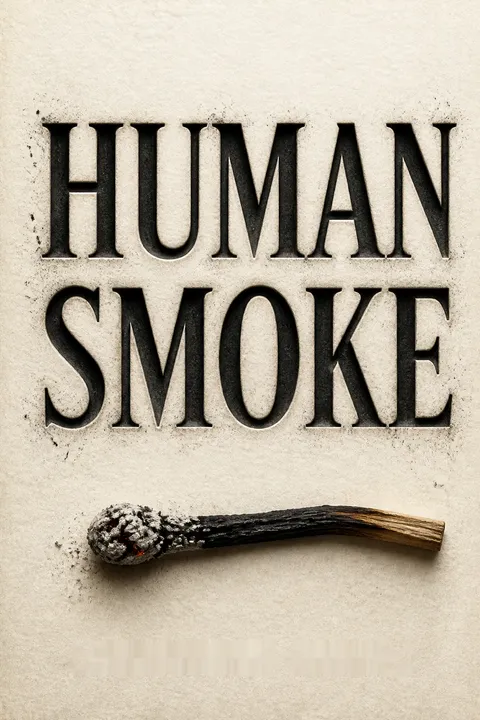
Human Smoke provokes strong reactions, earning an overall 4.06 rating. Many readers praise Baker's unique vignette-style approach, drawn from contemporaneous sources, which reframes WWII's moral narrative by highlighting pacifists and questioning Allied leaders' motivations. Churchill and Roosevelt are portrayed critically, while overlooked peace advocates receive attention. Detractors argue the book is selectively curated, historically incomplete, and potentially misleading for readers unfamiliar with the period. Despite debate over its pacifist conclusions, most agree it is a compelling, thought-provoking read that challenges conventional "good war" mythology.
People Also Read


Download PDF
Download EPUB
.epub digital book format is ideal for reading ebooks on phones, tablets, and e-readers.








































