
Key Takeaways
1. Thinking is a Social Art, Not a Solitary Science
Thinking independently, solitarily, “for ourselves,” is not an option.
Thinking is collaborative. We often believe that good thinking means isolating ourselves to form independent conclusions, but this is a misconception. True thinking is inherently social, a continuous response to the thoughts and words of others. When we commend someone for "thinking for herself," we often mean they've adopted views we approve of, not that they've achieved pure intellectual autonomy.
Beyond mere decisions. Thinking encompasses the entire process of consideration and assessment, not just the final decision. It involves:
- Testing personal responses
- Weighing available evidence
- Grasping "what is" with all senses
- Speculating carefully about "what might be"
- Knowing when to seek help from others
An art, not a science. Unlike a scientific experiment with predictable outcomes, thinking is an art due to the inherent uncertainties of predicting the future and our own reactions. While science can aid the process, the nuanced interplay of factors makes it more akin to an art form, requiring adaptability and a willingness to engage with diverse perspectives.
2. Emotions and Intuitions Drive Our Reasoning
The madman is not the man who has lost his reason. The madman is the man who has lost everything except his reason.
Intuitions come first. Psychologist Daniel Kahneman describes System 1 as fast, intuitive thinking, and System 2 as slow, conscious reflection. Jonathan Haidt uses the metaphor of an elephant (intuition) and its rider (conscious decision-making), highlighting the immense power of our intuitive responses. These immediate intuitions often precede and drive our later, more strategic reasoning.
Feelings are vital. John Stuart Mill's personal crisis revealed that pure analytical power, without the cultivation of feelings, can lead to a profound loss of purpose and energy. Neuroscientist Antonio Damasio later confirmed that emotional responses are crucial for effective decision-making; individuals lacking these responses struggle with even simple choices. Our "biases" are often useful heuristics that reduce cognitive load, allowing us to navigate life without constant conscious deliberation.
Rationality's true scope. Assuming that rationality means suppressing all feelings is a pervasive misconception. As G.K. Chesterton observed, a mind stripped of "sane affections" can become dangerously logical, but also devoid of good judgment, humor, or charity. True thinking requires the engagement of the whole person, integrating both analytical faculties and cultivated feelings to perceive the world accurately and act responsibly.
3. The Allure of the Inner Ring Shapes Our Beliefs
Of all passions the passion for the Inner Ring is most skillful in making a man who is not yet a very bad man do very bad things.
Desire for belonging. C.S. Lewis's concept of the "Inner Ring" describes the powerful, often unconscious, human desire to belong to an exclusive group. This desire, and the terror of being excluded, can subtly compel individuals to adopt certain attitudes or behaviors, even those they might otherwise find questionable. The Inner Ring's influence is insidious because it rarely announces itself as evil, often appearing as trivial social interactions.
Binding and blinding. Jonathan Haidt explains that our moral intuitions bind us into "political teams" that share specific moral narratives, simultaneously blinding us to alternative perspectives. This "hypertrophic instinct for consensus" (Marilynne Robinson) makes us eager to disparage without knowledge, simply for the pleasure of sharing a socially approved attitude. Such consensus effectively closes off subjects from genuine inquiry.
Healthy vs. unhealthy affiliation. While the Inner Ring fosters conformity and discourages uncomfortable questions, genuine "membership" (Lewis) offers a healthier alternative. This involves belonging to a diverse community where individuals are valued for their distinct contributions, not their homogeneity. Such communities are open to thinking and questioning from people of goodwill, fostering true loyalty and intellectual growth, unlike the suspicion-laden conformity of mass movements.
4. Repulsion Towards the "Outgroup" Blinds Us
Despite lingering negative attitudes toward African Americans, social norms appear to suppress racial discrimination, but there is no such reluctance to discriminate based on partisan affiliation.
The "Outgroup" next door. Scott Alexander's observation, "I Can Tolerate Anything Except the Outgroup," highlights a disturbing trend: our deepest animosity is often reserved not for distant enemies, but for those who are ideologically opposed to us, even if they are our neighbors. Research by Iyengar and Westwood confirms this, showing a stronger desire to punish the political outgroup than to support the ingroup.
Bulverism in action. C.S. Lewis coined "Bulverism" to describe the argumentative strategy of assuming an opponent is wrong, then explaining why they are wrong (e.g., they're "fearful" or "angry"), rather than engaging with whether they are wrong. This ad hominem fallacy allows us to avoid challenging questions about our own beliefs and dismiss others as pathological, rather than simply mistaken.
Beyond "the Other." The "online disinhibition effect" and the nature of digital communication can exacerbate this tendency, allowing us to "scream at" those who are not truly our neighbors, fostering a sense of "Repugnant Cultural Otherness" (RCO). To overcome this, we must adopt a "negotiating posture" (Roger Scruton), striving to see opponents as fellow humans, even if we disagree with their views. This doesn't mean accepting their ideas, but recognizing their humanity, as Megan Phelps-Roper did when she began to see her online interlocutors as "human."
5. Words, Metaphors, and Myths Can Impede Genuine Thought
For words are wise men’s counters—they do but reckon by them; but they are the money of fools.
Words as currency. Thomas Hobbes warned that words, which should be "wise men's counters" for reckoning, become "the money of fools" when treated as absolute knowledge. Literacy and language can amplify both wisdom and foolishness. We become captive to words, especially new or fashionable ones, using them to signal group affiliation and dismiss outsiders.
Terministic screens. Kenneth Burke's concept of "terministic screens" illustrates how any vocabulary—political, aesthetic, religious—directs our attention to certain aspects of reality while inadvertently hiding others. Keywords and hashtags function as quick classifications, signaling group identity and often reducing complex ideas to simplistic, emotionally charged labels. George Orwell's "tired hack" exemplifies how such phrases can lead to a "reduced state of consciousness," where the brain is disengaged, fostering conformity.
Metaphors and myths. Lakoff and Johnson's "Metaphors We Live By" shows how deeply embedded metaphors, like "argument as war," shape our understanding and responses, often without our conscious awareness. Mary Midgley's "Myths We Live By" extends this to larger imaginative patterns, like viewing the brain as a computer or animals as "automata." When these metaphors cease to be recognized as such, they become dangerous, permanently implanting "screens" that prevent us from seeing reality in its full complexity.
6. Beware the "Age of Lumping": Individuality Over Categorization
What is repugnant to every human being is to be reckoned always as a member of a class and not as an individual person.
The necessity of taxonomy. We are all "lumpers" and "splitters," constantly classifying people and ideas to manage information overload. This "triage" is often necessary for practical functioning, whether in college admissions or hospital care. However, these classifications, like the acronym "FLK" (Funny-Looking Kid), can reduce individuals to categories, ignoring their unique distinctiveness.
Lumping for solidarity. Categories like "LGBTQIA" demonstrate lumping for solidarity, uniting diverse groups under a common banner to address shared experiences of marginalization. Yet, such unity is often fragile, prone to internal divisions and questions about the validity of the alliance once external pressures shift. As Orwell's Animal Farm illustrates, initial solidarity can devolve into new hierarchies, where "some are more equal than others."
The value of splitting. Dorothy Sayers argued that being "reckoned always as a member of a class" is repugnant. The "eccentric individual" who defies categorization, like her desire to study Aristotle regardless of her gender, embodies a "blessed selfishness" that pushes against reductive labels. Terence's maxim, "Homo sum, humani nihil a me alienum puto" ("I am human, and nothing human is alien to me"), encourages us to recognize the shared humanity in others, even when their beliefs or experiences seem vastly different, moving beyond simplistic "lumpings" to appreciate individual complexity.
7. True Open-Mindedness Means Knowing When to "Shut It"
The object of opening the mind, as of opening the mouth, is to shut it again on something solid.
Beyond "open-mindedness." The popular ideal of being "open-minded" is often misleading. As G.K. Chesterton noted, the purpose of opening the mind is not to keep it perpetually open, but to "shut it again on something solid"—to form settled convictions. We don't want to be open-minded about kidnapping or the alleviation of poverty; some issues require firm, ethical stances. The challenge lies in discerning which convictions should be settled and which remain open to re-evaluation.
The trap of sunk costs. Most of us are prone to intellectual rigidity, especially when we've invested significant time and energy in a particular belief or position. This "sunk cost" fallacy makes us reluctant to abandon a course of action, even when evidence suggests it's a lost cause. Examples range from poker players who can't fold a bad hand to cult followers who escalate their commitment when prophecies fail, as seen in the Marian Keech case.
Falsifiability and fanaticism. Eric Hoffer's "True Believer" describes individuals whose beliefs are unfalsifiable—no matter what happens, it proves their point. This fanaticism, driven by a determination to avoid alternatives, prevents genuine thinking. To counteract this, we must cultivate the ability to imagine circumstances that would cause us to change our minds. Megan Phelps-Roper's story demonstrates how exposure to dissonant voices, even through social media, can break the hold of an echo chamber and allow for intellectual growth.
8. Cultivate the Democratic Spirit: Rigor, Humility, and Forbearance
A Democratic Spirit is one that combines rigor and humility, i.e., passionate conviction plus a sedulous respect for the convictions of others.
The Democratic Spirit. David Foster Wallace, in his review of Bryan Garner's usage dictionary, identified a "Democratic Spirit" as the ability to persuade without dictating, combining passionate conviction with a "sedulous respect for the convictions of others." This spirit demands "100 percent intellectual integrity," requiring honest self-reflection on our motives for belief. It's about finding a way to assert authority without triggering the "you're not the boss of me" reflex.
The art of code-switching. Wallace argued that navigating a democratic society, much like a "SNOOTlet" learning to fit in, requires the ethical skill of "code-switching"—the ability to move between different dialects and contexts. This means inquiring into someone else's moral dialect, even if it feels "impure," and suppressing our "gag reflex" when encountering the Repugnant Cultural Other.
Forbearance and empathy. Cultivating this forbearance is crucial for mending the social fabric. It involves risking the humanization of our opponents, realizing they are simply people who, through different circumstances, arrived at different conclusions. This imaginative act of placing ourselves within another's "plausibility structures" destabilizes our own sense of inevitability, fostering empathy and "love" (as Robin Sloan describes in the Long Now debates). While challenging, this process of "method acting" or "dual booting" into another's perspective is essential for genuine thinking and building a more understanding society.
Review Summary
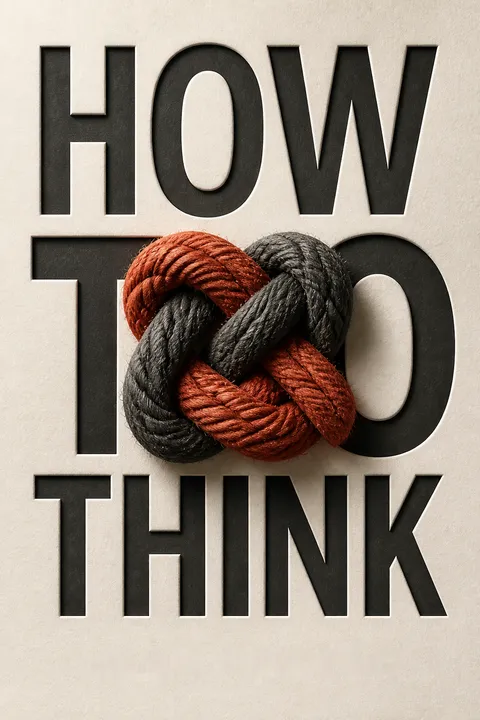
How to Think by Alan Jacobs receives strong praise from readers, averaging 3.95 out of 5 stars. Reviewers consistently highlight its timely relevance in addressing tribalism, social media's influence on discourse, and the importance of empathy in intellectual engagement. Many appreciate Jacobs' conversational yet substantive writing style, his concept of the "Repugnant Cultural Other," and the practical "Thinking Person's Checklist." Some critics note the book feels incomplete or occasionally unfocused, but most recommend it as an accessible, thought-provoking read for anyone seeking more charitable and reasoned engagement with others.
People Also Read







About the Author

Download PDF
Download EPUB
.epub digital book format is ideal for reading ebooks on phones, tablets, and e-readers.








































