

Key Takeaways
A divorce lawyer saw 1,000+ marriages die — here's what killed them
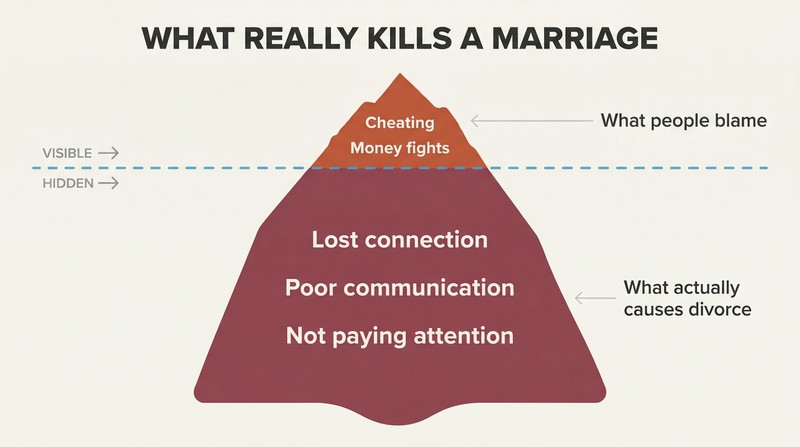
This book reverse-engineers love. James Sexton has facilitated the demise of over a thousand marriages. He's not a therapist, but he has more access to the raw truth than one — clients tell him what they tell their therapist, accountant, best friend, financial advisor, and parole officer combined. His central argument: cheating and money fights are never the real reasons for divorce. They're symptoms. The actual causes are lack of meaningful connection, poor communication, and failure to pay attention.
The remarriage rate proves we crave partnership. Over 53% of marriages end in divorce, yet over 80% of divorced people remarry within five years. We don't stop believing in love — we just keep doing it badly. Sexton wrote this book so people in decent marriages never end up in his conference room, box of tissues and bowl of candy within reach.
Text your partner the small irritation now, before it calcifies
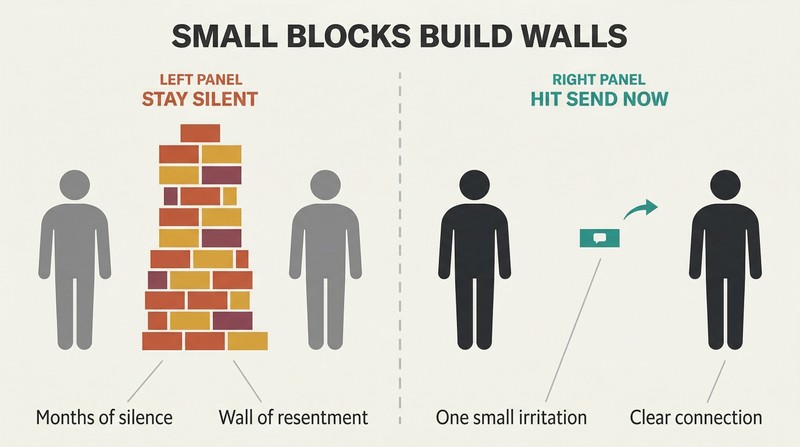
Hit Send Now is Sexton's radical honesty practice. When your partner does something that bothers you even a little, write them an email or text about it within hours. Don't censor, don't overthink, don't bury it. Use the subject line "Hit Send Now" so they know it's one of those messages requiring reflection. The goal: keep your "I prefer gazpacho without cilantro" from fermenting into "You don't know or care to know what I like."
Sexton estimates 90% of what divorcing couples argue about isn't what they're actually arguing about. A fight about bacon crispiness is really about feeling incompetent. A dispute over Tuesday-night pickups is really about stolen youth. Hit Send Now forces couples to argue about what they're actually arguing about — in real time, before the small blocks build a wall.
Stop assuming your spouse knows how you feel — ask and tell
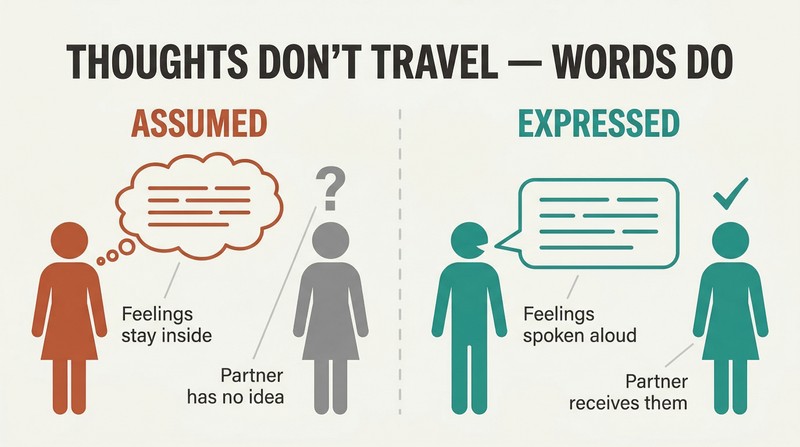
Elizabeth asked for a divorce over breakfast. Her husband Douglas expected to hear "poached eggs" and got "a divorce" instead — she'd even prepared a spreadsheet of assets and recorded the conversation. Douglas claimed total blindsidence. Elizabeth was stunned by his cluelessness: "He should have known." But she'd never actually told him she was unhappy. She assumed her discontent was radiating through her pores.
Two-thirds of divorces Sexton handles involve mutual disbelief. Both parties are shocked it's over. He finds this somewhere between poignant and tragic — spouses spending years certain their partner can hear what they aren't saying, including the nuances behind those unspoken gripes. No one is good at mind reading. There is no such thing. Check in early and often, even at the risk of an uncomfortable answer.
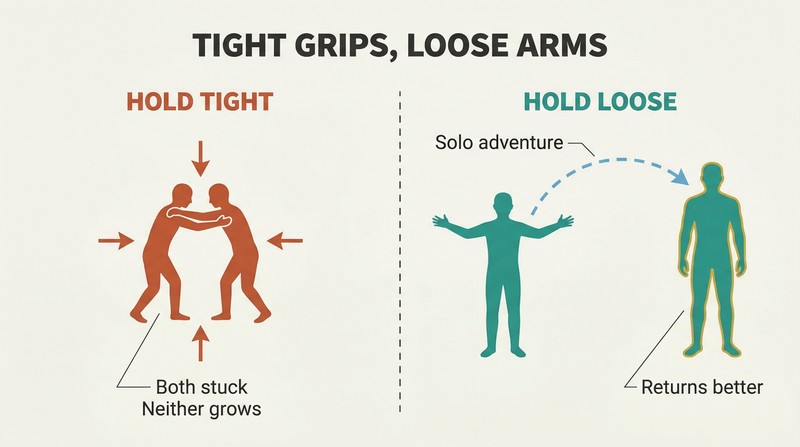
Encourage your spouse's solo adventures — what returns is better
Sexton learned this from Brazilian Jiu-Jitsu. As a beginner, he gripped opponents tightly, assuming that meant control. He learned the opposite: holding tight just locks you to them, sacrificing your own mobility. His instructor's principle — "tight grips and loose arms" — became his best relationship advice. Control the essentials loosely; allow movement.
Possessiveness backfires every time. Sexton's seen GPS trackers on wives' cars, spyware on husbands' phones, bans on girls' night out. None of it works. If your spouse wants to cheat, restricting access won't stop them — they'll do it in a broom closet at the school with the janitor (not hypothetical; Sexton cross-examined the janitor). Encourage golf, gym, weekends away. The marriage vows ask you to forsake all others — not all the things that make you interesting.
Voice your sexual needs or face the only two bleak alternatives
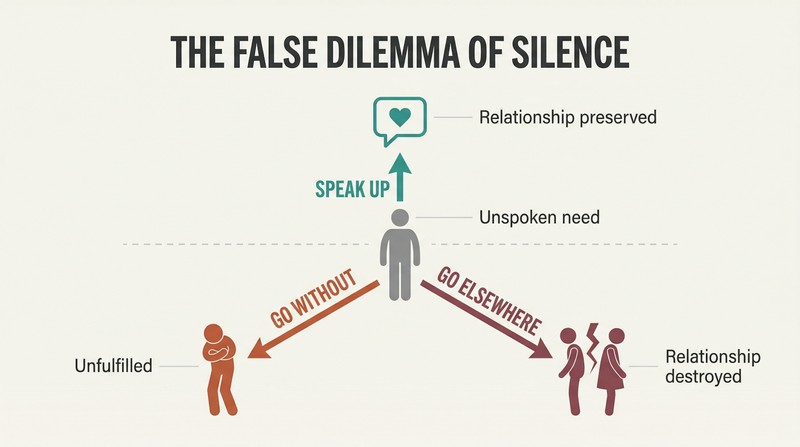
Randy liked wearing women's panties. He never told his wife Kristen during nine years together — not because she was conservative in bed (she wasn't), but because he was embarrassed. He started cheating instead. Later, crying in Sexton's conference room, he admitted Kristen was "actually really fun and open." His primary mistake wasn't the affair — it was forcing himself into an unnecessary choice between going unfulfilled or going elsewhere.
Sexton calls this the Go Without or Go Elsewhere dilemma. In a monogamous contract, if you don't express your desires, those are your only two options — and neither preserves the relationship. His advice: start slow, don't spring it mid-coitus, consider putting it in writing so your partner can digest it. And remember — sometimes "good enough" is absolutely worth keeping.
Praise the specific behavior you want to see more of
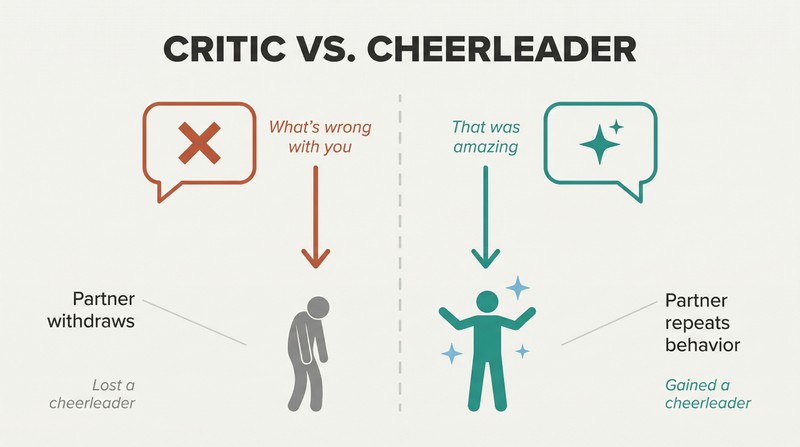
Constructive criticism is just criticism. Sexton argues the "praise sandwich" (positive-negative-positive) is offensive and useless. We fell in love partly because our partner's acceptance helped us accept ourselves. When they become our critic, that's gone. Instead of telling your partner what's wrong, find a tiny nugget of desired behavior and praise it out of proportion: "When we went to that new restaurant instead of our usual place? That was so sexy. It reminds me of when we were first dating."
Vacation Jen proves the principle. One client's wife was sexually adventurous and carefree on trips. Rather than asking her to be that way at home, the husband — who previously hated travel — started enthusiastically planning vacations. She got to be herself; he changed to be with that version of her. What's true for lab rats is true for men.
In love, choose resolution over the ego rush of being right
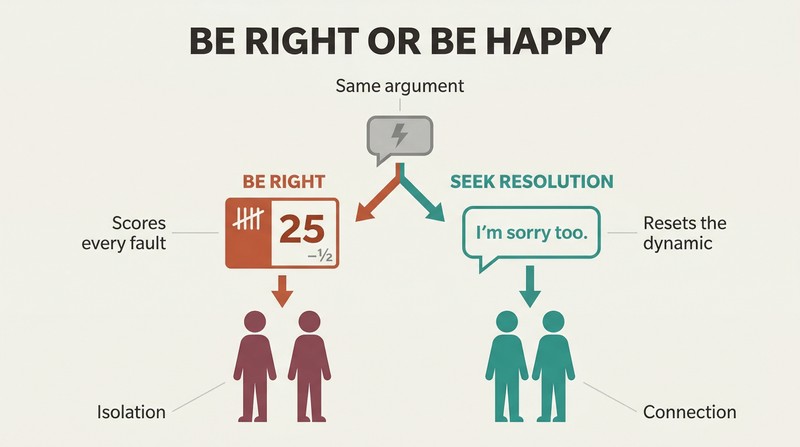
Divorcing couples score every negative at 25 points, every positive at half. Confirmation bias creeps in when you're primed to see your partner as the problem. Sexton has never heard a judge say, "I grant full custody to Mr. Jones. Keep this sock-dropping monster away from these children." Yet couples treat minor annoyances as capital offenses while discounting loyalty, monogamy, and reliability.
Try "I'm sorry too" as a disarming response. When your partner apologizes for something genuinely stupid, instead of cataloging how stupid it was, say: "I'm sorry for the way I handled it. I'm sorry I didn't see you were in a bad place." Nine times out of ten, this completely resets the dynamic. It creates balance — of fault, virtue, and investment in the relationship. Shoot for resolution, not full satisfaction.
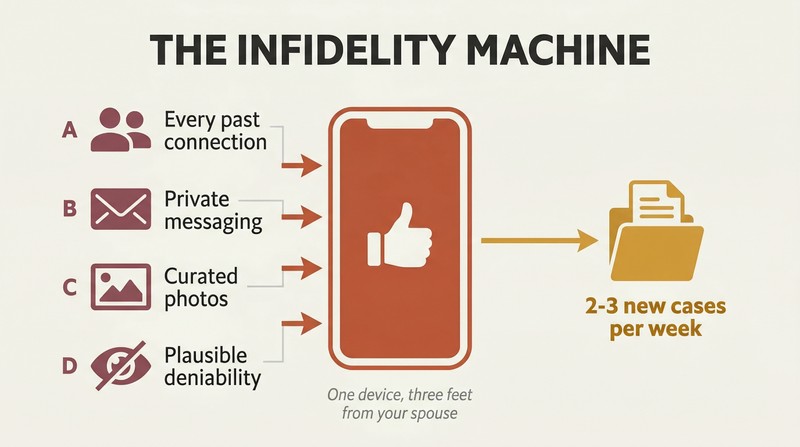
Quit Facebook — it's the most efficient infidelity machine ever built
Sexton gets two to three new infidelity cases per week that started on Facebook. He breaks down why with surgical precision: the platform combines every person you've ever wanted to sleep with, private messaging, curated flattering photos, and built-in plausible deniability ("I was reading pool-cleaning reviews!"). You can flirt through micro-interactions — liking bikini photos, commenting on posts — while sitting three feet from your spouse on the couch.
The typical Facebook family vacation post is "Grand Kabuki Theater." Sexton sees zero correlation between how happy clients look in their photos and when they show up at his office. Among his clients, the platform accelerates affairs by making the past feel more romantic than it was and the present more depressing than it is. As they say in AA: sit in a barbershop long enough and you'll get a haircut.
Split money into three pools to prevent financial ignorance and war
Anastasia thought she married a wealthy anesthesiologist. Fancy cars (leased), two homes (mortgaged to the hilt), luxury vacations (funded by credit lines). Two months into divorce, Sexton had to tell her she was broke. Her husband had leveraged everything on failed real estate without her knowledge. This story repeats constantly in Sexton's practice.
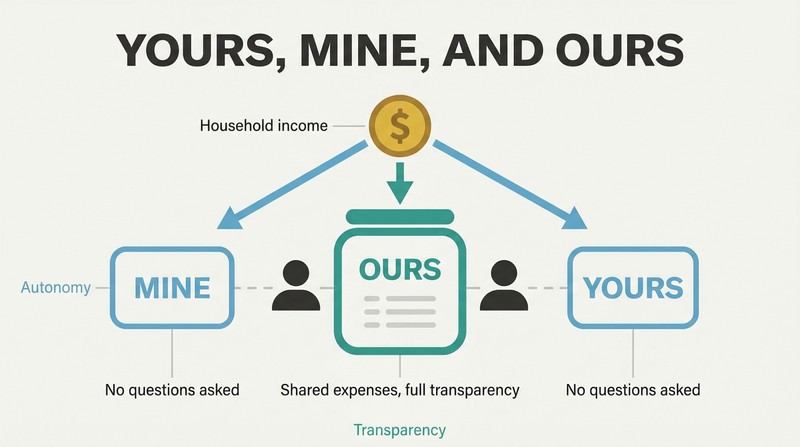
The Yours, Mine, and Ours Financial System prevents this. Create three bank accounts:
1. "Ours" — for shared expenses, with agreed notification thresholds
2. "Mine" — your autonomous money, no questions asked
3. "Yours" — your partner's autonomous money
This maximizes transparency on joint obligations while preserving individual freedom. Want a boat your spouse thinks is stupid? Buy it from "Mine." The system prevents ignorance, reduces resentment, and gives both partners a clear financial picture — something most couples achieve only during divorce discovery.
The secret to staying married is embarrassingly simple: pay attention
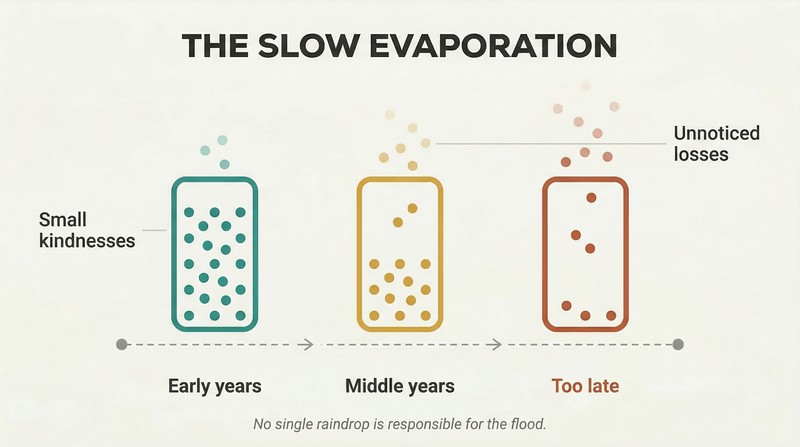
Laura knew her marriage was ending when Fred stopped buying her granola. It was a specific flax brand carried by only certain stores. For years, Fred would notice when they ran out and replace it without being asked — a tiny gesture proving he was paying attention to her small, silly preferences. When the granola stopped appearing, Laura left the empty box at the front of the cabinet. He went shopping and came back without it. "I think this might be ending," she thought. When Sexton asked what she'd stopped doing for Fred, she answered without hesitation: "Blowjobs."
Flax granola and blowjobs. That's what it takes. The biggest danger in long-term relationships is slippage — not betrayal, not fights, but the slow evaporation of small kindnesses. Eye contact, physical touch, a response that shows you're listening. Marriage isn't hard work. It's just attention.
Analysis
Sexton's book inverts the relationship advice genre through a form of via negativa — defining what sustains love by cataloging, in forensic detail, what destroys it. Where most guides prescribe steps toward an idealized partnership, Sexton conducts autopsies. An oncologist who has never cured cancer still possesses invaluable knowledge about the disease's mechanisms; similarly, a divorce lawyer's 20-year catalog of relational pathologies constitutes genuine negative wisdom.
The book's most philosophically provocative claim — that the traits required to repair a broken marriage are identical to those that would have prevented the break — has implications beyond relationships. It suggests most interventions in complex human systems arrive too late not because of timing but because of capacity. The couple who can authentically forgive, communicate transparently, and sustain empathy through crisis didn't need the crisis to develop those muscles. This creates a paradox: the book's advice is most useful to those who least need it.
Structurally, Sexton deploys courtroom storytelling — character setup, rising tension, devastating cross-examination — to make relationship advice visceral rather than clinical. His Elizabeth narrative (the executive whose husband expected 'poached eggs' and got 'a divorce') and Laura's granola parable function as case law for the heart. The specificity of detail — 877 texts between a wife and her trainer, $1.4 million in combined legal fees for one couple, a five-inch penis under cross-examination — creates documentary authority few relationship advisors can match.
The tension between Sexton's self-professed romanticism and professional cynicism gives the book its distinctive register. He tears up at weddings while mentally calculating the statistical likelihood of seeing those couples in his office. This duality reflects an authentic epistemic position: believing deeply in an institution's value precisely because you've witnessed the devastation of its failure. The book's limitation is acknowledged sample bias — Sexton sees only marriages that failed. But for couples willing to treat his observations as diagnostic rather than prescriptive, the cold cartography of how love disappears, one raindrop at a time, may be the most honest relationship guide available.
Review Summary
"If You're In My Office, It's Already Too Late" offers a unique perspective on marriage from a divorce lawyer's viewpoint. Readers appreciate Sexton's candid advice, entertaining anecdotes, and insights into common relationship pitfalls. The book is praised for its humor, practical tips, and thought-provoking content. While some find the advice obvious, many consider it a must-read for couples at any stage. Critics note the heteronormative focus and occasional pessimism, but overall, readers find the book refreshing and valuable for understanding what can go wrong in marriages.
People Also Read

Glossary
Hit Send Now
Immediate honesty with your partnerA communication practice Sexton recommends for couples: when something your partner does bothers you even slightly, write them an email or text about it within hours—uncensored and unsoftened—then send it immediately. The subject line 'Hit Send Now' signals the recipient that this message requires reflection. Designed to prevent small grievances from compounding into resentment over time.
The Ocho
Baby conceived to save marriageSexton's office nickname for a child born as a last-ditch attempt to fix a failing marriage. Named after the 8% increase in child support (from 17% to 25% of gross income) when a couple goes from one child to two. Sexton uses the term to illustrate how lack of honesty about marital problems leads couples to seek false solutions rather than confronting underlying issues.
The Nanny Fascination
Husbands cheating with the nannySexton's term for the recurring pattern in which husbands have affairs with the family's nanny or babysitter. He attributes it not primarily to youth or attractiveness but to the nanny representing a simpler, less complicated version of the wife—someone with a life outside the home, who is easily impressed, and whose expectations are straightforward and transactional rather than emotionally complex.
Tight Grips and Loose Arms
Control essentials, allow freedomA relationship principle borrowed from Sexton's Brazilian Jiu-Jitsu instructor Paul Schreiner. In grappling, you maintain firm control over key contact points ('tight grips') while keeping your arms relaxed enough to adjust to movement ('loose arms'). Applied to relationships: hold firmly to what matters most in the partnership while giving your spouse freedom and flexibility to move, grow, and maintain their individual identity.
Go Without or Go Elsewhere
The binary of unmet needsSexton's framing of the stark choice faced by anyone in a monogamous relationship whose sexual or emotional needs are not being communicated or met: either live with the deprivation (go without) or seek fulfillment outside the relationship (go elsewhere). He argues that neither option is acceptable, making honest communication about needs—however uncomfortable—the only viable path.
Yours, Mine, and Ours Financial System
Three-pool money management for couplesSexton's recommended financial structure for married couples: create three separate bank accounts—'Mine' (one spouse's autonomous funds), 'Yours' (the other's autonomous funds), and 'Ours' (joint funds for shared expenses). Joint expenses above an agreed threshold require notification or preapproval. Individual accounts provide privacy and autonomy. Designed to maximize financial transparency while preventing resentment and ignorance about the couple's overall financial picture.
SIDS (Sudden Income Deficiency Syndrome)
Income mysteriously drops before divorceSexton's satirical term for the phenomenon in which a divorcing spouse's reported income drops inexplicably just before or during divorce proceedings. By his estimation, it 'strikes' 99 percent of divorcing men who own their own business. Used to highlight how frequently spouses manipulate financial disclosures to minimize support obligations during divorce.
Custodial Rotation
Alternating parenting weekends while marriedSexton's suggestion that married couples adopt a practice common among divorced parents: designating specific weekends where one parent has primary responsibility for the children while the other gets explicit, guilt-free time for themselves. Based on his observation that divorced parents often develop healthier parenting rhythms than married ones, who take constant access to their children for granted and never fully recharge as individuals.
FAQ
What's If You're In My Office, It's Already Too Late about?
- Divorce Lawyer's Insights: Written by James J. Sexton, a seasoned divorce lawyer, the book offers insights into maintaining healthy relationships and avoiding divorce.
- Focus on Connection: Sexton emphasizes the importance of staying connected to oneself and one’s partner, providing practical advice on nurturing romantic connections.
- Understanding Relationship Breakdown: The book reverse engineers common mistakes leading to relationship breakdowns, offering a unique perspective on what not to do in marriages.
Why should I read If You're In My Office, It's Already Too Late?
- Expert Insights: Sexton draws from two decades of experience, providing real-life examples and lessons learned from observing countless relationships.
- Preventative Approach: It’s not just for those on the brink of divorce; it offers strategies to strengthen relationships proactively.
- Humorous and Candid: Sexton’s engaging and often humorous writing style makes the serious subject matter more approachable.
What are the key takeaways of If You're In My Office, It's Already Too Late?
- Communication is Crucial: Open and honest communication is essential to avoid misunderstandings and resentment.
- Stay Connected: Maintaining a connection to oneself and one’s partner is vital for a fulfilling relationship.
- Recognize Change: Couples must adapt to changes over time, regularly assessing and evolving their relationship.
What specific advice does James Sexton offer for maintaining a relationship?
- "Hit Send Now" Method: Communicate feelings and concerns immediately to prevent small issues from escalating.
- Pretend You’re Divorced: Occasionally act as if divorced to allow personal time, helping individuals reconnect with themselves.
- Change Yourself, Not Your Partner: Focus on changing your own behavior and responses to encourage a positive dynamic.
What are the best quotes from If You're In My Office, It's Already Too Late and what do they mean?
- “Love is loaned. It isn’t permanently gifted.”: Love requires ongoing effort and nurturing; it’s not something to be taken for granted.
- “You can be right or you can be happy.”: Prioritizing happiness and connection over being right can lead to a more fulfilling relationship.
- “Your partner can’t hear what you don’t say.”: Communication is necessary to prevent misunderstandings and resentment.
How does If You're In My Office, It's Already Too Late address infidelity?
- Five Types of Infidelity: Sexton categorizes infidelity to help readers understand motivations and emotional dynamics.
- Communication Breakdown: Many affairs stem from a lack of communication about needs and desires.
- Consequences of Infidelity: Infidelity often leads to the end of a marriage but can also be a wake-up call for reassessment.
What methods does James Sexton suggest for improving communication in relationships?
- Radical Honesty: Share feelings and concerns without fear of judgment to build trust and understanding.
- Regular Check-Ins: Discuss the relationship and any issues regularly to prevent misunderstandings.
- Use of Technology: Communicate feelings through texting or emailing to express oneself without face-to-face pressure.
How does If You're In My Office, It's Already Too Late define a successful marriage?
- Mutual Respect and Understanding: Appreciate each other’s individuality while working together as a team.
- Adaptability to Change: Be willing to grow together and reassess the relationship regularly.
- Commitment to Connection: Maintain emotional and physical connection through ongoing effort and communication.
What role does self-awareness play in maintaining a relationship according to If You're In My Office, It's Already Too Late?
- Understanding Personal Needs: Self-awareness helps individuals understand their needs and communicate effectively.
- Recognizing Patterns: Awareness of behavior patterns can lead to necessary changes for improved connection.
- Personal Growth: Self-awareness fosters personal growth, positively impacting the relationship.
How can couples apply the lessons from If You're In My Office, It's Already Too Late to their daily lives?
- Implementing "Hit Send Now": Communicate feelings immediately to prevent misunderstandings and build a stronger connection.
- Scheduling Personal Time: Create space for personal time to recharge and enhance overall satisfaction.
- Regular Relationship Assessments: Discuss what is working and what needs improvement to maintain a healthy partnership.
What are the common mistakes couples make that lead to divorce, as outlined in If You're In My Office, It's Already Too Late?
- Lack of Communication: Failing to communicate openly about feelings and needs leads to misunderstandings.
- Neglecting the Relationship: Complacency can result in emotional distance and dissatisfaction.
- Avoiding Difficult Conversations: Avoiding conflict can lead to bigger issues, making it essential to address problems as they arise.
How does If You're In My Office, It's Already Too Late approach the topic of financial transparency in marriage?
- Yours, Mine, and Ours System: Promotes transparency by maintaining separate and joint accounts.
- Preventing Financial Secrets: Warns against keeping financial secrets to avoid distrust and resentment.
- Shared Financial Goals: Encourages setting financial goals and budgets together to foster teamwork.
Download PDF
Download EPUB
.epub digital book format is ideal for reading ebooks on phones, tablets, and e-readers.








































