
Key Takeaways
1. Ancient Cultures Saw Divinity as a Spectrum, Not a Binary
For them, the human realm was not an absolute category separated from the divine realm by an enormous and unbridgeable crevasse.
Continuum of divinity. Unlike modern Western thought, ancient Greek, Roman, and even Jewish cultures perceived divinity as a fluid spectrum, not a strict, unbridgeable chasm between God and humanity. This allowed for various levels of divine beings and the possibility of overlap.
- Pagan examples: Apollonius of Tyana (divine human), Romulus (exalted to godhood), Julius Caesar (deified after death), Caesar Augustus (son of god, revered while alive).
- Divine pyramid: This concept illustrates a hierarchy from a supreme deity down to lesser gods, daimones, and eventually, divine humans.
- Gods becoming human: Myths frequently depicted gods temporarily taking human form, as seen with Jupiter and Mercury in Ovid's Metamorphoses.
Jewish parallels. Even within monotheistic Judaism, a similar continuum existed, albeit with different terminology. While there was one supreme God, other superhuman beings like angels, cherubim, and seraphim were recognized as lower-level divinities.
- Angel of the Lord: This figure in the Hebrew Bible sometimes appears as human and is identified as God himself, blurring the lines between divine and human.
- Divine hypostases: Concepts like Wisdom and the Logos (Word) were seen as aspects of God that could take on distinct, divine existence, acting as co-creators or mediators.
- Humans as divine: The king of Israel was called "Son of God" and even "God" in some scriptures (e.g., Psalm 45:6), and figures like Moses and Enoch were believed to have been exalted to angelic or divine status.
Context for Jesus. This ancient worldview is crucial for understanding how Jesus's followers could eventually consider him divine without abandoning their monotheism. The idea of a human becoming divine, or a divine being becoming human, was not unique to Christianity but was a familiar concept in the broader cultural and religious landscape.
2. The Historical Jesus Was an Apocalyptic Prophet, Not a Self-Proclaimed God
He did not declare himself to be God.
Apocalyptic message. The historical Jesus, as reconstructed by critical scholarship, was primarily an apocalyptic prophet from rural Galilee. His core message centered on the imminent arrival of God's kingdom, a cataclysmic event that would overthrow evil and establish a utopian world.
- Dualism: Present age controlled by evil, future age by God.
- Pessimism: No human effort could improve the current evil age.
- Judgment: God would intervene, resurrect the dead, and judge all.
- Imminence: The end was coming "very soon," within his generation.
Messianic self-understanding. Jesus likely believed he would be the king in this coming kingdom, the Messiah. This belief, shared by his disciples, explains why "Christ" (Messiah) became his most common title, despite his non-messianic actions.
- Disciples' expectation: They saw him as a potential Messiah, a future king.
- Judas's betrayal: Likely revealed Jesus's private messianic claims to authorities.
- Crucifixion charge: Jesus was executed for claiming to be "King of the Jews," a political threat to Rome.
No divine claims. Crucially, Jesus did not claim to be divine during his ministry. The explicit divine self-claims (e.g., "I and the Father are one," "before Abraham was, I am") are found only in the Gospel of John, the latest and most theologically developed of the Gospels.
- Gospel discrepancies: Earlier Gospels (Mark, Q, M, L) lack these divine claims.
- Dissimilarity criterion: Such claims would have been invented by later Christians, not by Jesus himself, as they align perfectly with later theological developments.
- Contextual credibility: No evidence of any first-century Palestinian Jew making such divine claims about themselves.
3. Disciples' Visions, Not an Empty Tomb, Fueled Resurrection Belief
The visions led followers of Jesus to believe he had been raised from the dead.
Catalyst for faith. The belief in Jesus's resurrection was the single most important factor in the birth of Christianity, distinguishing Jesus from other failed prophets. This belief stemmed directly from the disciples' visionary experiences of Jesus after his death.
- Paul's testimony: The earliest Christian witness, Paul, explicitly states his belief was based on a vision (Gal. 1:15-16; 1 Cor. 15:8).
- Early creed: The pre-Pauline creed in 1 Corinthians 15:3-5 mentions appearances, not an empty tomb, as the basis for belief.
- Gospel narratives: Mark, Luke, and John show that an empty tomb alone did not produce faith; disciples only believed after seeing Jesus.
Doubt and non-recognition. The Gospels consistently portray disciples doubting the resurrection, even after seeing Jesus, or failing to recognize him initially. This suggests that the initial experiences were not universally convincing or immediately clear.
- Matthew 28:17: "some doubted" even when Jesus appeared.
- Luke 24:11: Women's empty tomb report dismissed as "idle tale."
- Luke 24:37-43: Jesus had to prove he wasn't a spirit by showing flesh and bones, and eating.
- John 20:24-28: Doubting Thomas required physical proof of wounds.
Nature of visions. Research on visions shows they are common, often deeply convincing to the experiencer, and can be triggered by intense emotional states like grief or stress. Whether veridical (real) or nonveridical (hallucinations), their impact on belief is profound.
- Bereavement visions: Common experiences of seeing deceased loved ones, often bringing comfort and a sense of continued presence.
- Religious visions: Documented instances of individuals and groups experiencing visions of revered figures like the Virgin Mary or Jesus, leading to strong conviction.
- Apocalyptic context: For Jesus's apocalyptic Jewish followers, a vision of him alive would naturally be interpreted as a bodily resurrection, as that was their understanding of the afterlife.
4. Earliest Christology: Jesus Exalted to Divine Status at Resurrection
He was elevated to an impossibly exalted state.
Exaltation Christology. The earliest Christian understanding of Jesus, emerging immediately after the belief in his resurrection, was that he was a human being whom God had exalted to a divine status. This is often called a "low" or "adoptionist" Christology, but it was profoundly significant.
- Romans 1:3-4: A pre-Pauline creed states Jesus was "appointed Son of God in power... by his resurrection from the dead."
- Acts 2:36: "God has made him both Lord and Christ, this Jesus whom you crucified."
- Acts 5:31: God "exalted to his right hand as Leader and Savior."
Divine status and titles. This exaltation meant Jesus received immense power, prestige, and authority, far beyond any human. He was now understood to be:
- Son of God: Not merely by birth, but by divine adoption and inheritance of God's power, akin to Roman adopted sons who gained higher status than natural-born sons.
- Lord: Elevated from a human teacher to the divine sovereign, fulfilling Psalm 110:1 ("The LORD says to my Lord, 'Sit at my right hand'").
- Messiah: Confirmed as the promised king, but now a heavenly one who would return to reign.
- Son of Man: Identified with the cosmic judge from Daniel 7, coming from heaven.
Worship and monotheism. This early Christology led to the worship of Jesus alongside God the Father, creating a "binitarian" devotion within a monotheistic framework. Christians believed God himself had commanded this veneration by exalting Jesus.
- Divine pyramid: Jesus moved up the divine hierarchy, becoming a divine being worthy of worship, without necessarily being the one Almighty God.
- Competition with emperor cult: This exaltation of Jesus directly challenged the Roman practice of deifying emperors, positioning Jesus as the true divine Son and Lord.
5. Evolving Christology: Jesus as a Preexistent Divine Being Incarnate
Jesus was not only the Son of God, the Lord, the Son of Man, the coming messiah; he was the one who mediates God’s will on earth as a heavenly, angelic being.
Incarnation Christology. Very early in Christianity, exaltation Christologies evolved into incarnation Christologies, where Jesus was understood as a preexistent divine being who became human. This shift likely stemmed from identifying Jesus with the "Angel of the Lord" or divine hypostases like Wisdom or the Logos.
- Paul's view: Paul identifies Christ as an angel (Gal. 4:14), the "rock" that followed Israelites in the wilderness (1 Cor. 10:4), and the one "from heaven" (1 Cor. 15:47).
- Philippians 2:6-11: This pre-Pauline poem describes Christ as "in the form of God" who "emptied himself" to take "the form of a slave," becoming human and obedient unto death.
- Exaltation within incarnation: The poem shows Christ, initially a divine being (angel-like, not equal to God), was "highly exalted" by God after his obedience, receiving "the name that is above every name" and becoming the object of universal worship, fulfilling Isaiah 45:23.
John's Logos Christology. The Gospel of John presents the most developed incarnation Christology in the New Testament, identifying Jesus with the preexistent Logos (Word) of God.
- Prologue (John 1:1-18): "In the beginning was the Word, and the Word was with God, and the Word was God... And the Word became flesh and dwelt among us."
- Creator and revealer: The Logos, through whom all things were made, became human in Jesus, revealing God fully.
- Divine self-claims: Jesus in John makes explicit claims of preexistence and equality with God (e.g., "I and the Father are one," "before Abraham was, I am").
Beyond Paul and John. Other New Testament writings, like Colossians and Hebrews, also reflect advanced incarnation Christologies, portraying Christ as the "image of the invisible God," the "firstborn of all creation," and the agent through whom God created the world. These texts often blend incarnational and exaltation elements, emphasizing Christ's superiority to angels and his role as God's ultimate revelation.
6. Early Heresies: Denying Jesus's Full Humanity or Divinity
All three of these views ended up being theological “dead ends.”
Theological battleground. As Christology developed, various interpretations emerged, leading to intense debates and the eventual labeling of certain views as "heresies" by the dominant "orthodox" stream of Christianity. These debates were crucial in defining what it meant to be a Christian.
Denying divinity (Adoptionism). Some groups maintained that Jesus was purely human, adopted by God at a specific point in his life, rather than being divine by nature.
- Ebionites: Jewish Christians who believed Jesus was a righteous man, justified by fulfilling the law, and adopted as God's son at his baptism. They emphasized adherence to Jewish law.
- Theodotians (Roman Adoptionists): Believed Jesus was born of a virgin but was a "mere man" who received the Spirit's power at baptism, becoming divine only after his resurrection. Opponents accused them of altering scriptures to support their views.
Denying humanity (Docetism). Conversely, other groups argued that Christ was so divine that he could not have been truly human, only appearing to have a body and suffer.
- 1 John's "Antichrists": Opposed those who denied "Jesus Christ has come in the flesh," insisting on Christ's tangible, bodily existence.
- Ignatius of Antioch: Vehemently argued against docetists, emphasizing Christ's true birth, suffering, and death as essential for salvation, and as a model for his own impending martyrdom.
- Marcionites: Believed the God of Jesus (loving) was different from the God of the Old Testament (just). Christ, from the loving God, could not be tied to the material world created by the just God, thus appearing as a phantom who only seemed to suffer and die.
7. Other Heretical Paths: Dividing Christ or Conflating God's Persons
But in fact the one God had made the world, which is a place of suffering not because it was created evil, but because it has fallen as a result of sin.
Denying unity (Separationism/Gnosticism). Many Gnostic Christians believed that the material world was evil, created by an inferior deity. For them, the divine Christ temporarily inhabited the human Jesus, separating before the crucifixion.
- Gnostic worldview: Salvation through secret "knowledge" (gnosis) to escape material entrapment.
- Apocalypse of Peter: Describes the "living Jesus" (divine spirit) laughing above the cross while the "physical part" (human Jesus) is crucified, emphasizing the separation.
- Orthodox counter-argument: Insisted on one God, one Christ (fully human and divine), and a good creation corrupted by sin, not inherently evil.
Conflating persons (Modalism/Patripassianism). This view, popular in the early 3rd century, sought to preserve monotheism by asserting that Father, Son, and Spirit were not distinct persons but different "modes" or manifestations of the one God.
- Core belief: Christ is God, and God the Father is God, because they are the same person, appearing in different roles (like one person being a son, brother, and father).
- "Patripassianism": Opponents derisively called modalists this, meaning "Father-sufferers," because if Christ was the Father, then the Father suffered on the cross.
- Scriptural support: Appealed to verses like Isaiah 44:6 ("I am the first and the last; and beside me there is no other") to argue for absolute oneness.
Orthodox counter-arguments. Theologians like Hippolytus and Tertullian vehemently opposed modalism, arguing that scripture clearly portrays Father and Son as distinct.
- Tertullian's analogy: Used human relationships (husband/wife, father/son) to show that one cannot be both simultaneously.
- Divine economy: Proposed that God exists as three distinct "persons" (Father, Son, Spirit) who are unified in will and purpose, but distinct in "degree," "form," or "aspect."
- Trinity concept: Tertullian was the first to use the term "Trinity" (Latin: trinitas) to describe this three-in-one God, laying groundwork for later doctrine.
8. The Arian Controversy: Debating Christ's Equality with God
For Alexander, if Christ came into existence at some point of time and was inferior to God the Father, then in both those respects he was like humans and not like God.
Theological flashpoint. By the early 4th century, the question of Christ's relationship to God the Father became the central theological debate, culminating in the Arian controversy. This dispute was not about whether Christ was divine, but in what sense he was divine.
Arius's position. Arius, a priest from Alexandria, argued that Christ (the Son/Logos) was begotten by God the Father before creation, meaning there was a time "when he was not."
- Subordinate deity: Christ was a perfect creature of God, but still a creature, and thus subordinate and inferior to the unbegotten, eternal Father.
- Infinite glory gap: Arius believed an "infinity of glories" separated the Father from the Son.
- Monotheistic concern: This view aimed to preserve the absolute uniqueness and unbegotten nature of God the Father.
Alexander's opposition. Bishop Alexander of Alexandria vehemently opposed Arius, insisting that the Son was coeternal and coequal with the Father.
- Immutable God: God cannot change; therefore, he must always have been the Father and always had a Son.
- Creator of ages: If Christ created the ages (Hebrews 1:2), he could not have come into existence within time.
- Image of God: If Christ is God's image, God must always have had his image.
Constantine's intervention. Emperor Constantine, a recent convert, sought to unify the Christian church for the stability of his empire. He initially viewed the Arian dispute as trivial but recognized its divisive potential.
- Imperial concern: A unified church could be a unifying force for the empire.
- Divine favor: Disunity in worship could displease God and harm the state.
- Call for council: Constantine convened the Council of Nicea in 325 CE to resolve the escalating conflict.
9. The Council of Nicea: Affirming Christ as "One Substance with the Father"
Christ was coeternal with God the Father. He had always existed. And he was “of the same substance” as God the Father, himself truly God, from back into eternity.
Defining orthodoxy. The Council of Nicea (325 CE) was the first ecumenical council, convened by Emperor Constantine to establish a unified Christian doctrine, particularly regarding Christ's nature. The resulting Nicene Creed directly refuted Arianism.
Key affirmations of the Nicene Creed:
- "Begotten, not made": Directly countered Arius's claim that Christ was a creature.
- "Of one substance with the Father" (homoousios): Declared Christ to be absolutely equal in essence and divinity with God the Father, not subordinate.
- "True God from true God, Light from Light": Emphasized Christ's full deity.
- Anathemas: Explicitly condemned Arian statements like "There was when he was not" and "He came into existence out of nothing."
Theological ortho-paradox. The Nicene Creed established a complex, paradoxical understanding of God:
- Christological paradox: Christ is fully God and fully human, yet one being.
- Trinitarian paradox: There is one God, yet three distinct persons (Father, Son, Holy Spirit), all equally God and coeternal, but not three Gods. This affirmed both the oneness of God and the full divinity of Christ.
Outcome and impact. The council, though not without dissent, largely achieved Constantine's goal of a unified theological statement. Arius and his immediate supporters were exiled.
- Not the end: Nicea was a beginning, not an end, to theological debates. Arianism persisted for decades, and new controversies arose over the precise meaning of the Nicene formulations.
- Foundation for future doctrine: The Nicene Creed became the bedrock of orthodox Christian Christology and Trinitarian theology, shaping centuries of Christian thought.
10. The Aftermath: Recontextualizing Jesus and Intensifying Conflicts
Most Christians today do not realize that they have recontextualized Jesus. But in fact they have.
Constantine's legacy. The emperor's conversion fundamentally altered Christianity's position in the Roman Empire. From a persecuted minority, it became a favored religion, eventually leading to its establishment as the official state religion.
- Emperor as servant: Constantine reversed the imperial cult, depicting himself as a worshiper of Christ, not a rival god.
- Christianization of the empire: This shift led to rapid growth, legal privileges for Christians, and eventually, the outlawing of pagan practices.
Impact on Jewish-Christian relations. The belief that Jesus was God, combined with the accusation that Jews were responsible for his death, fueled intense anti-Judaism.
- Deicide charge: Christians like Melito of Sardis accused Jews of "murdering God," a charge with horrific historical consequences.
- Legal marginalization: Under Christian emperors, Jews faced increasing legal restrictions, economic disadvantages, and tacitly condoned violence.
- Ambrose's defiance: Bishop Ambrose of Milan successfully challenged Emperor Theodosius's order to rebuild a synagogue destroyed by Christians, demonstrating the growing power of the church over the state.
Continued internal Christian disputes. Even after Nicea, and the eventual suppression of Arianism at the Council of Constantinople (381 CE), theological debates intensified, becoming more nuanced and complex.
- Marcellus of Ancyra: Argued for one hypostasis (person) in God, with Christ and Spirit emerging from and returning to the Father, a view later condemned for sounding too modalist.
- Apollinaris: Believed the divine Logos replaced Christ's human "upper soul," making him not fully human, a view condemned for undermining Christ's example and full redemptive capacity.
- Nestorius: Objected to calling Mary "Theotokos" (Mother of God), arguing Christ was two distinct persons (divine and human) in unity, a view condemned for dividing Christ.
Enduring paradoxes. These ongoing debates illustrate that the declaration of Jesus as God at Nicea was not a final solution but a new starting point for theological inquiry. The resulting orthodox doctrines, while highly sophisticated, remained deeply paradoxical, affirming seemingly contradictory truths about Christ and the Trinity. This continuous recontextualization and refinement of Jesus's identity has been a hallmark of Christian thought from its earliest days to the present.
Review Summary
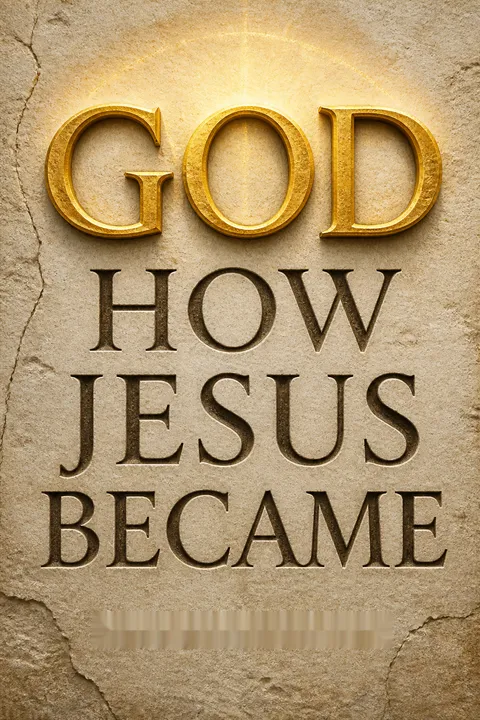
How Jesus Became God examines the historical development of early Christian beliefs about Jesus' divinity. Ehrman argues Jesus was initially seen as a human preacher and only later deified by followers. The book traces evolving interpretations from the gospels through early church debates. While some readers found it insightful and well-researched, others criticized Ehrman's selective use of sources and perceived bias. Many praised his accessible writing style, though some felt certain sections were overly detailed. The book provoked both appreciation and controversy among readers interested in early Christianity.
People Also Read

About the Author
Other books by Bart D. Ehrman

Download PDF
Download EPUB
.epub digital book format is ideal for reading ebooks on phones, tablets, and e-readers.








































