
Key Takeaways
1. The "Dark Age" label for the post-Collapse era is a misnomer.
Few probably would nowadays subscribe to quite such a dramatic, millennial vision of the onset of a dark age.… Each region of increasingly specialized archaeological endeavor now has its own version of what happened in this period, some distinctly less ‘dark’ than others.
Challenging perceptions. The traditional view of the centuries following the Late Bronze Age Collapse (c. 1200 BCE) as a "Dark Age" is increasingly outdated. While the term implies total collapse and degeneration, modern scholarship reveals a more nuanced reality of transition, adaptation, and even innovation across the Aegean and Eastern Mediterranean. This period, now often referred to as the Iron Age, saw significant changes but not universal desolation.
Defining "Dark Age." A "dark age" is typically defined by a decline in civilization, marked by the collapse of central administration, disappearance of elites, breakdown of centralized economies, settlement shifts, population decline, loss of writing, and cessation of monumental architecture. While some regions experienced these symptoms, others maintained or quickly regained aspects of complex society, making the blanket "Dark Age" label inaccurate. For instance:
- Writing was lost in Greece but continued in Mesopotamia.
- Monumental building ceased in some areas but resumed in others.
- Economic systems fragmented but new trade networks emerged.
Scholarly consensus. Many academics now prefer "Iron Age" to describe this period, reflecting a shift in dominant material culture rather than a judgment of societal decline. This change in terminology acknowledges the diverse experiences of different regions and highlights the dynamic processes of reorganization and rebirth that characterized the era. The Greeks themselves, who later lamented living in an "Age of Iron," did not conceive of their past as a "Dark Age."
2. Societies responded to the Late Bronze Age Collapse with diverse outcomes.
Everybody in this region was trying to recover from the same Collapse, but then each society followed its own individual route to recovery, or not.
Varied trajectories. The Late Bronze Age Collapse was not a uniform event with a single outcome for all affected societies. Instead, each region experienced unique challenges and exhibited different capacities for survival, adaptation, or complete disappearance. This diversity underscores the complexity of societal change and the interplay of local conditions with broader systemic shocks.
Spectrum of responses. Responses ranged from complete societal collapse to flourishing transformation. Some societies, like the Hittites, largely vanished, while others, like the Egyptians, merely coped at a diminished capacity. In contrast, the Phoenicians and Cypriots not only survived but thrived, demonstrating remarkable innovation and seizing new opportunities in the post-collapse environment. This highlights that collapse is not always an end, but often a catalyst for new beginnings.
Panarchy in action. The concept of "panarchy" helps explain these varied outcomes, recognizing that individual societies within a larger interconnected system operate on their own adaptive cycles. When the overarching globalized Mediterranean network collapsed, each "cog" (society) reacted differently, affecting both its own trajectory and the broader regional reintegration that eventually followed.
3. Egypt endured, but its resilience was diminished by internal strife.
Although Egyptian culture and society did not completely collapse, and Egyptians did not vanish from the face of the earth, neither was their transformation to the new world order particularly successful after the Bronze Age Collapse.
A shadow of its former self. Egypt, once a "Great Power," survived the Late Bronze Age Collapse but at a significantly reduced capacity. The assassination of Ramses III in 1155 BCE, amidst a sordid harem conspiracy, set a tone of intrigue and instability for centuries. This internal turmoil, coupled with external pressures, prevented Egypt from regaining its previous international prominence.
Internal and external pressures. The megadrought, a primary stressor of the Collapse, severely impacted Egypt by reducing the Nile's flow for two centuries, leading to food crises, famine, and economic problems like worker strikes. Politically, the country fragmented, with rival rulers and high priests vying for control, leading to periods of civil war and multiple pharaohs ruling simultaneously. This era, known as the Third Intermediate Period, saw a cycle of decline and occasional, temporary resurgence.
Coping, not transforming. While Egyptians managed to cope and maintain their cultural identity, administrative structures, and religious practices, they largely failed to adapt or transform effectively to the new world order. Their resilience was primarily about survival and maintaining the status quo, rather than innovating or reorganizing for sustained growth. This meant a diminished international role and a struggle to overcome internal divisions, eventually leading to foreign rule by Kushite kings.
4. Assyria and Babylonia demonstrated enduring resilience, maintaining core structures.
Overall, the Assyrians and the Babylonians proved to be among the most resilient and successful of the affected societies to weather the aftermath of the Collapse.
Unscathed survival. Unlike many of their contemporaries, Assyria and Babylonia largely retained their fundamental societal structures, including centralized government, economy, and writing systems, through the initial chaos of the Late Bronze Age Collapse. While they faced challenges, their core institutions remained intact, allowing for a more stable foundation for recovery. This contrasts sharply with the complete systemic breakdowns seen elsewhere.
Delayed impact and resurgence. Despite their initial resilience, both Mesopotamian powers were eventually impacted by drought, famine, and plague in the eleventh century BCE. This led to a period of downturn, marked by a lack of royal records in Assyria for nearly fifty years. However, they demonstrated remarkable adaptive capacity, with Assyria regrouping by the late tenth and early ninth centuries BCE, coinciding with a wetter climate, to establish the Neo-Assyrian Empire.
Strategic advantages. Their ability to persevere stemmed from several factors:
- Geographic location: Situated on the Tigris and Euphrates rivers, they were less immediately vulnerable to coastal raids and had more dependable water resources.
- Strong leadership: Figures like Tiglath-Pileser I and Nebuchadnezzar I provided stability and military prowess.
- Military strength: Capable armies fought off new adversaries like the Aramaeans and Urartians, securing resources through conquest and tribute.
- Institutional continuity: They never lost their royal dynasties, centralized administrations, or cuneiform writing system, allowing for a quicker re-establishment of dominance.
5. Phoenicia and Cyprus emerged as "anti-fragile" innovators, thriving in chaos.
In the case of the Phoenicians, they seem to have actively taken advantage of the chaos and, most important, of the destruction of Ugarit in northern Syria, to take over the maritime trade routes to the west, across the Aegean to Greece and thence further to Italy, Sicily, and Sardinia.
Thriving in disorder. The central Canaanite city-states, which evolved into the Phoenicians, and the inhabitants of Cyprus, proved to be "anti-fragile" – not just resilient, but gaining from the disorder of the Collapse. They seized opportunities created by the power vacuum and the demise of major trading hubs like Ugarit, transforming their roles in the Mediterranean. This allowed them to expand their influence and wealth significantly.
Maritime dominance and innovation. The Phoenicians became the dominant maritime traders, establishing extensive networks across the Mediterranean, from the Levant to Spain. They were instrumental in:
- Standardizing the alphabet: Spreading their consonantal script, which later influenced the Greek and Latin alphabets, increasing literacy.
- Purple dye production: Perfecting and trading this highly prized commodity.
- Overseas colonization: Founding new settlements like Carthage, extending their commercial reach.
Cypriot ingenuity. Cypriots also demonstrated remarkable resilience and innovation, particularly in metallurgy. They were at the forefront of the transition from bronze to iron, developing and disseminating ironworking technology across the region. Their metalworkers maintained bronze production while pioneering iron tools and weapons, ensuring their continued relevance in international trade. This dual focus on traditional and new technologies allowed them to adapt and flourish.
6. Neo-Hittite states preserved cultural continuity in northern Syria.
It would appear then that, from the early twelfth through the late eighth century BC, Carchemish continued to have a complex government hierarchy, rule over an outlying area with an unbroken string of kings, possess writing, and build monumental structures.
Successors to an empire. While the Hittite Empire in central Anatolia largely collapsed, successor states, known as Neo-Hittites, emerged in northern Syria and southeastern Anatolia. These smaller city-states, like Carchemish and Tell Tayinat, maintained significant cultural continuity, including the use of Hieroglyphic Luwian for inscriptions and monumental art. They filled the power vacuum left by the larger empires, demonstrating a localized form of resilience.
Enduring complexity. Cities like Carchemish, despite being impacted by the broader collapse, continued to exhibit characteristics of complex societies. They maintained:
- Government hierarchies: With rulers holding titles like "Great King" or "Country Lord."
- Monumental construction: Building and decorating structures like the "Water Gate" and "Long Wall of Sculpture."
- Literacy: Hieroglyphic Luwian inscriptions documented their history and rulers.
- Economic activity: Engaging in trade and managing resources, even under Assyrian pressure.
Persistent challenges. These Neo-Hittite states faced constant aggression from the resurgent Assyrian Empire, often forced to pay tribute or endure military campaigns. Despite these pressures, they managed to preserve their distinct cultural identity and political structures for centuries, until their eventual annexation by Assyria in the eighth century BCE. Their story is one of adaptation and persistence in a turbulent geopolitical landscape.
7. Mainland Greece and Crete underwent profound societal transformations.
The glory days of the Minoan civilization during the mid-second millennium BC may have disappeared forever, but Crete itself and its surviving inhabitants carried on during the Iron Age, adapting to the new normal.
Mycenaean demise. Mainland Greece experienced a profound societal collapse, with the Mycenaean palatial system vanishing by around 1050 BCE. Centralized administration, complex economies, and writing were lost, leading to a period of depopulation and simpler living. This was a true "omega" phase, where the old system disintegrated, leaving survivors to rebuild almost from scratch.
Cretan adaptation. Crete, while also losing its distinct Minoan identity (possibly even earlier due to Mycenaean influence), demonstrated a more successful adaptation. Settlements shifted to defensible mountain locations, but urban life continued at sites like Knossos, which even grew significantly in size. Cretans maintained cultural continuity in areas like religious cults and burial practices, laying the groundwork for Archaic Crete.
Slow rebirth in the Aegean. For both mainland Greece and Crete, the centuries after the collapse were a long, hard haul towards recovery. It wasn't until the eighth century BCE that a new Greek culture began to flourish, marked by:
- Reintroduction of writing: The Phoenician alphabet was adopted and adapted.
- Emergence of the polis: The Greek city-state became the dominant political unit.
- Technological innovation: Widespread use of iron tools and weapons.
- Renewed international contacts: Trade and cultural exchange with the Near East resumed.
This period, though challenging, was ultimately a time of regeneration and the genesis of what would become Classical Greek civilization.
8. Climate shifts played a significant, though varied, role in recovery.
I also cannot help but wonder just how much role climate change played in the recovery, for we can see several breaks in the weather that may be directly or indirectly related to developments in the various areas.
Drought's lingering shadow. The megadrought that contributed to the Late Bronze Age Collapse continued to impact various regions for centuries, exacerbating societal vulnerabilities. However, localized and regional shifts in climate patterns also played a crucial role in enabling recovery and shaping the trajectories of different societies. These climatic changes were not uniform across the entire Eastern Mediterranean.
Regional climatic reprieves:
- Southern Levant (c. 1150-950 BCE): A period of slightly wetter conditions facilitated "intense olive and cereal cultivation," providing a window for the emergence of kingdoms like Israel and Judah.
- Mesopotamia (c. 925 BCE onwards): A shift to a much wetter era, including an "Assyrian megapluvial" (850-740 BCE), coincided with the resurgence and imperial expansion of the Neo-Assyrians.
- Eastern Mediterranean (c. 850 BCE onwards): A general change to warmer and wetter conditions across the region, including Cyprus and Greece, likely aided overall societal rejuvenation and renewed interconnections.
Impact on resources. These climatic fluctuations directly affected agricultural output, water availability, and even the navigability of harbors (e.g., silting up in Cyprus). Societies that could adapt their agricultural practices, secure alternative resources, or benefit from favorable weather shifts were better positioned for recovery. The end of prolonged arid conditions often marked a turning point for many regions.
9. Resilience theory provides a framework for understanding diverse societal responses.
Resilience theory may help us to further achieve a more nuanced view of this period, allowing us to better decide “what exactly [the] ‘collapse’ entailed and for whom.”
Beyond simple collapse. Applying modern resilience theory, particularly concepts from the IPCC reports, offers a valuable lens through which to analyze the diverse outcomes of the Late Bronze Age Collapse. This framework moves beyond a monolithic view of "collapse" to distinguish between societies that merely "coped," those that "adapted," and those that truly "transformed" or were "anti-fragile."
Key concepts in action:
- Coping: Societies like Egypt absorbed shocks and maintained the status quo, but struggled with long-term recovery.
- Adapting: Societies adjusted to new realities, implementing changes to better prepare for future events, as seen in some Neo-Hittite states.
- Transforming: Societies reorganized fundamentally, embracing innovation and new opportunities, exemplified by the Phoenicians and Cypriots.
- Vulnerability/Fragility: Mycenaean and Hittite societies, with internal weaknesses and dependencies, proved highly vulnerable to the "perfect storm" of calamities.
Learning from the past. The adaptive cycle, with its phases of growth, conservation, collapse (omega), and reorganization (alpha), helps conceptualize these historical processes. The "alpha" phase, in particular, highlights how periods of chaos can be fertile ground for innovation and the emergence of new systems. This theoretical approach allows for a more nuanced understanding of how ancient societies navigated extreme events.
10. Lessons from ancient collapses offer crucial insights for modern challenges.
The main takeaway from all of this is that clearly such a collapse is survivable, provided that we are resilient enough and able to cope, adapt, or transform as necessary.
Survival is possible. The overarching lesson from the Late Bronze Age Collapse is that societal collapse, while devastating, is survivable. Cultures can continue, even if at a simpler level or in new iterations, and periods of regeneration often follow the worst of times. This offers a hopeful perspective for contemporary global challenges like climate change, resource shortages, and geopolitical instability.
Strategies for resilience: To navigate potential future collapses, modern societies can learn from ancient responses:
- Redundancy: Implement multiple contingency plans for critical systems (administration, trade, food production).
- Self-sufficiency: Reduce over-reliance on external supply chains and foster local capabilities.
- Innovation: Embrace technological and social innovations to adapt and transform, rather than merely coping.
- Strength: Maintain robust defenses against external threats, even during internal stress.
The choice is ours. The question for today is whether we will be like the vulnerable Mycenaeans or the anti-fragile Phoenicians. Our ability to prepare, adapt, and transform will determine our trajectory. As the ancient world demonstrated, foresight and flexible responses are paramount in the face of systemic shocks.
Review Summary
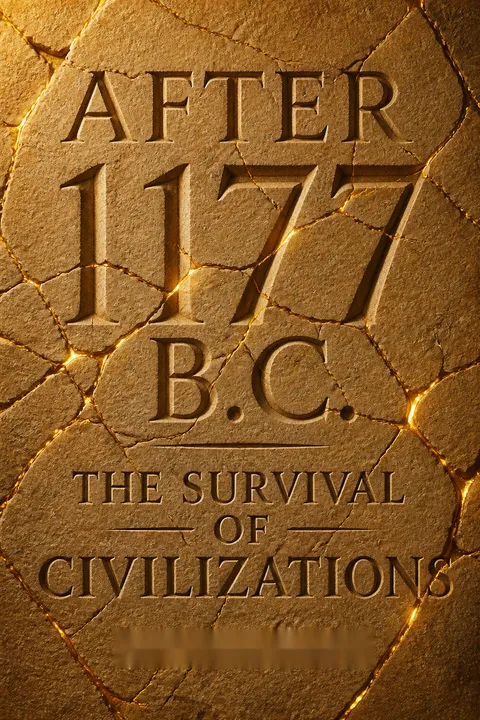
After 1177 B.C. examines how different civilizations in the Eastern Mediterranean and Near East responded to the Bronze Age collapse. Reviews are mixed, averaging 3.77/5 stars. While readers appreciate Cline's comprehensive research and region-by-region analysis, many criticize the book as overly dense, academic, and detail-heavy compared to its predecessor. Common complaints include excessive archaeological minutiae, genealogical listings, and tangential information that obscures narrative flow. Some praise the nuanced discussion of resilience across civilizations—from thriving Phoenicians to vanishing Hittites—while others find the conclusions weak and question the omission of DNA evidence and broader geographic scope.
People Also Read


About the Author
Other books by Eric H. Cline

Download PDF
Download EPUB
.epub digital book format is ideal for reading ebooks on phones, tablets, and e-readers.








































