
Key Takeaways
1. Jesus's Divinity: An Eternal Reality, Not an Evolutionary Process
I have my own view as to “when” Jesus became God. It was not by virtue of the evolution of belief, nor as the result of any ecumenical committee; rather, I think I can articulate the answer by way of a quotation from John the Evangelist: “In the beginning was the Word, and the Word was with God, and the Word was God” (John 1:1).
Challenging Ehrman's thesis. Bart Ehrman posits that belief in Jesus's divinity emerged gradually, a human process of exaltation from a mere preacher to a divine being. This evolutionary view suggests Jesus was not originally considered God in any sense, but became divine over centuries.
An eternal divine nature. In contrast, the book argues that Jesus's deity is eternal, existing before his human incarnation. He never "became" God; rather, he, as the preexistent Word, "became human." This perspective aligns with the Johannine prologue, asserting Jesus's inherent divine nature from eternity past.
Theological implications. This fundamental disagreement shapes the entire debate. If Jesus was always God, then the development of Christology is about understanding and articulating this inherent divinity, not about a human figure being elevated to a status he didn't originally possess.
2. Early Christian Devotion: A "Big Bang" of High Christology
The time between the death of Jesus and the fully developed Christology which we find in the earliest Christian documents, the letters of Paul, is so short that the development which takes place within it can only be called amazing.
Rapid emergence of high Christology. Contrary to Ehrman's gradual evolution, scholars like Martin Hengel, Richard Bauckham, and Larry Hurtado (the "Early High Christology Club") argue for a "big bang" approach. They contend that a fully divine Christology, identifying Jesus with the God of Israel, emerged surprisingly early, within the first few decades after Jesus's death.
Evidence from early sources. Paul's letters, written in the 50s CE, already contain highly elevated claims about Jesus, including his preexistence, divine nature, and role in creation and salvation. This suggests that such beliefs were not late developments but were foundational to the earliest Christian communities, both Aramaic and Greek-speaking.
Devotion and identity. Larry Hurtado highlights early Christian devotional practices, such as prayer and worship directed at Jesus, as clear indicators of his divine status. Richard Bauckham emphasizes that Jesus was included "precisely and unambiguously, within the unique identity of the one God of Israel" from the earliest post-Easter beginnings.
3. Jewish Monotheism: Strict and Exclusive, Not a Flexible Continuum
I am convinced by the study of several scholars that Jewish monotheism was, generally, strict.
Ehrman's flawed premise. Ehrman suggests ancient monotheism was not particularly strict, allowing for a continuum between human and divine realms, where Jesus could be "god" like deified kings or angels. This "inclusive monotheism" is a cornerstone of his argument.
A robust, exclusive monotheism. However, Jewish monotheism was generally strict, centered on one Creator God, whose unique identity was bound to YHWH and demanded exclusive worship (monolatry). This is evident in the Shema (Deut 6:4), Maccabean literature, and Philo.
Intermediary figures are not gods. While Jewish thought acknowledged angels and exalted figures like Metatron or Enoch, these were consistently understood as created, subordinate beings, not objects of worship equal to God. They served God but did not share his rule or receive his worship, a crucial distinction Jesus uniquely crossed.
4. Jesus's Self-Understanding: Embodying God's Return to Zion
When I say that Jesus knew himself to be God, I mean that he was conscious that in him the God of Israel was finally returning to Zion (i.e., Jerusalem) to renew the covenant and to fulfill the promises God had made to the nation about a new exodus.
Beyond a mere prophet. Ehrman claims Jesus saw himself as an apocalyptic prophet, not divine, looking to a future "Son of Man" (not himself) to bring the kingdom. This book argues Jesus understood himself as a divine agent, embodying God's sovereignty.
Divine prerogatives and actions. Jesus's actions, such as forgiving sins (Mark 2:1-12), reconfiguring divine commandments, claiming authority over the Sabbath, and defeating Satan, were seen as divine prerogatives. These were not merely superhuman abilities but claims to embody God's reign and activity in the world.
The Son of Man and enthronement. Jesus's use of "Son of Man" (Aramaic bar enash) was a self-reference, often alluding to Daniel 7:13-14. His trial confession (Mark 14:61-64) implied enthronement with God, a claim so astounding it was deemed blasphemous, placing him within the orbit of divine sovereignty.
5. The Burial and Empty Tomb: Historical Realities, Not Later Fictions
The New Testament narrative of a dissenting member of council is entirely realistic.
Challenging Ehrman's skepticism. Ehrman doubts Jesus's burial in a known tomb, suggesting it's a late fiction and that the empty tomb played no role in early Christian belief. This challenges the historical reliability of the Gospel accounts.
Roman and Jewish customs. Roman law and custom, particularly in Roman Palestine, often permitted the burial of executed criminals, especially when requested and to respect local customs like the Jewish law (Deut 21:22-23) requiring burial before sunset. Joseph of Arimathea, a council member, arranging Jesus's burial aligns with the Jewish Council's responsibility for executed persons.
Archaeological corroboration. Archaeological finds, such as the ossuary of Yehohanan (a crucified man buried with a nail in his heel) and other crucifixion nails in tombs, provide concrete evidence that crucified individuals were indeed buried. The women discovering the empty tomb is a strong historical detail, unlikely to be invented given the cultural context.
6. Synoptic Gospels: Preexistence and Divine Identity from the Outset
I am not for a moment suggesting that Jesus is viewed as an angel in the Gospels, but rather that he is seen as having come from somewhere to carry out his life’s work, namely, from heaven.
Preexistence in the Synoptics. Ehrman claims Matthew and Luke do not portray a preexistent Jesus, and Mark sees Jesus becoming Son of God at baptism. However, Jesus's "I have come" sayings in all three Synoptics imply a heavenly origin, akin to angelic missions, not prophetic declarations.
Divine prerogatives in action. The Synoptics depict Jesus performing actions uniquely reserved for God:
- Forgiving sins (Mark 2:1-10)
- Electing the twelve disciples (Mark 3:13)
- Choosing who knows the Father (Matt 11:27/Luke 10:22)
- Exercising authority over angels (Matt 13:41)
- Performing sea miracles and demonstrating supernatural knowledge.
Worship and blasphemy. Responses to Jesus in the Synoptics include accusations of blasphemy (Mark 2:7, 14:63-64) for claiming divine prerogatives, and acts of worship (Luke 24:52) that exceed mere human reverence. This reflects a strict God/creation divide in the Jewish milieu, placing Jesus firmly on the Creator's side.
7. Paul's Christology: Fully Divine, Not Angelic or Merely Transitional
The way Second Temple Judaism understood God as unique, through the God-relation pattern, was used, by Paul, to express the pattern of data concerning the Christ-relation.
Refuting "angel Christology." Ehrman argues Paul understood Christ as an angel who became human, representing a transition from exaltation to incarnation Christology. This interpretation, however, ignores the vast majority of Paul's Christological language.
Relational monotheism. Paul's Christology is rooted in a relational understanding of Jewish monotheism, where God's "transcendent uniqueness" is defined by the unique pattern of relationship between YHWH and Israel. Paul applies this same pattern to the relationship between Christ and Christ-followers.
Christ included in divine identity. Passages like 1 Corinthians 8:6 (reworking the Shema), 1 Corinthians 10:9 (testing Christ), and 1 Thessalonians 3:11-13 (praying to Jesus) demonstrate that Paul describes the Christ-relation using themes and language traditionally reserved for YHWH. This unambiguously includes Jesus on the divine side of the monotheistic line.
8. Orthodoxy's Paradoxes: Biblical Truths, Not Contradictory Inventions
For when you say that this Christ existed as God before the ages, then that He submitted to be born and become man, yet that He is not man of man, this [assertion] appears to me to be not merely paradoxical, but also foolish.
Paradoxes are inherent. Ehrman introduces "ortho-paradoxes" to suggest that orthodox Christians were forced to "settle" for contradictions (e.g., Jesus as human and divine, Trinity) due to conflicting scriptural passages. However, these paradoxes are deeply embedded in the New Testament itself, particularly in John and Paul.
Johannine and Pauline integration. The Gospel of John seamlessly integrates Jesus's preexistence as God ("the Word was God," John 1:1) with his incarnation as man ("the Word became flesh," John 1:14). Similarly, Paul's letters (e.g., Colossians, Philippians) combine Christ's preexistence and exaltation without perceiving contradiction.
Celebrated, not hidden. Early Christian authors did not view these as "brutal facts" or "seeming contradictions" to be covered up. Instead, they celebrated these truths as amazing and awe-inspiring aspects of God's revelation in Christ, forming the foundation of their faith.
9. Heresy and Orthodoxy: A Consistent Pursuit of Scriptural Truth
Whatever things, then, the Holy Scriptures declare, at these let us look; and whatsoever things they teach, these let us learn; and as the Father wills our belief to be, let us believe; and as He wills the Son to be glorified, let us glorify Him; and as He wills the Holy Spirit to be bestowed, let us receive Him.
Beyond "heresy hunters." Ehrman portrays early orthodox theologians as "heresy hunters" who "rewrote history" by rejecting views that were once acceptable. This characterization overlooks their sincere commitment to scriptural fidelity and the spiritual well-being of their communities.
Retrospective orientation to Scripture. Orthodox theological development, while evolving in precision, maintained a fundamental retrospective orientation toward the biblical texts. Early theologians like Hippolytus emphasized deriving knowledge of God solely from the Holy Scriptures, rejecting interpretations that were one-sided or nonsensical in light of the full biblical witness.
Challenging "adoptionist" claims. Ehrman's assertion that Ebionites and Theodotians held the "earliest" Christian views (Jesus adopted at baptism/resurrection) is not supported by early sources. Irenaeus, Tertullian, and Hippolytus describe Ebionites as believing Jesus was a mere man, never elevated to divine status, contradicting Ehrman's "hard-and-fast irony."
10. The "How Jesus Became God" Narrative: A Flawed Chronological Presupposition
To use the older terminology, in early Christianity the views of Christ got “higher and higher” with the passing of time, as he became increasingly identified as divine.
Predetermined chronological grid. Ehrman's central argument relies on a predetermined chronological grid: Christology must have developed from "lower" (exaltation) to "higher" (incarnation). This is presented as a conclusion of historical study but functions as an unproven presupposition.
Abbreviation vs. development. The presence of "exaltation Christologies" in early texts (e.g., Rom 1:3-4, 1 Cor 15:3-5) does not automatically mean they are chronologically earlier or represent a "lower" Christology. They could simply be abbreviations of a fuller, already existing incarnational Christology, emphasizing specific aspects of Jesus's life or mission.
Ignoring contradictory evidence. Ehrman selectively focuses on texts that fit his scheme while ignoring equally early and significant passages (e.g., Phil 2:6-11, 1 Cor 8:6) that clearly attest to Christ's preexistence and divine nature. This methodological flaw undermines his entire historical reconstruction.
11. Christian Anti-Judaism: A Tragic History, Unlinked to Christ's Deity
The far-reaching, and rather horrific, implications of this view,” Ehrman promises us, “will be the subject of a later discussion in the epilogue.
A problematic causal link. Ehrman attempts to link the orthodox belief in Christ's deity directly to later Christian anti-Judaism, arguing that if Jesus is God, then Jews rejecting him are rejecting God, and "these were the people who had killed God."
Historical context and complexity. While Christian anti-Judaism is a shameful part of history, its causes are complex and cannot be solely attributed to belief in Christ's deity. Jewish "second-class citizenry" in Roman society predated Christian emperors, and even Christian emperors sometimes protected synagogues.
Lack of direct motivation. The charge of deicide (first recorded by Melito of Sardis in the 2nd century) is rarely cited as a direct motivation for later discrimination or violence against Jews in historical records. Other factors, such as political power shifts and social tensions, played significant roles.
Review Summary
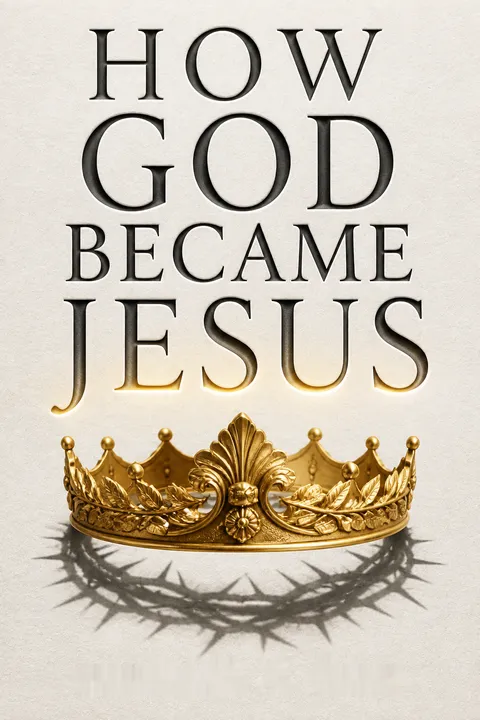
How God Became Jesus is a scholarly rebuttal to Bart Ehrman's "How Jesus Became God." The book, written by Michael Bird and other scholars, challenges Ehrman's claims about the development of Jesus' divinity in early Christianity. Reviewers found the arguments generally solid, praising the historical and biblical scholarship. However, some criticized Bird's writing style and humor as inappropriate. Overall, the book is seen as a valuable resource for those interested in early Christology, though its effectiveness may depend on the reader's existing beliefs.
People Also Read









Download PDF
Download EPUB
.epub digital book format is ideal for reading ebooks on phones, tablets, and e-readers.








































