
Plot Summary
The Invitation to Hell
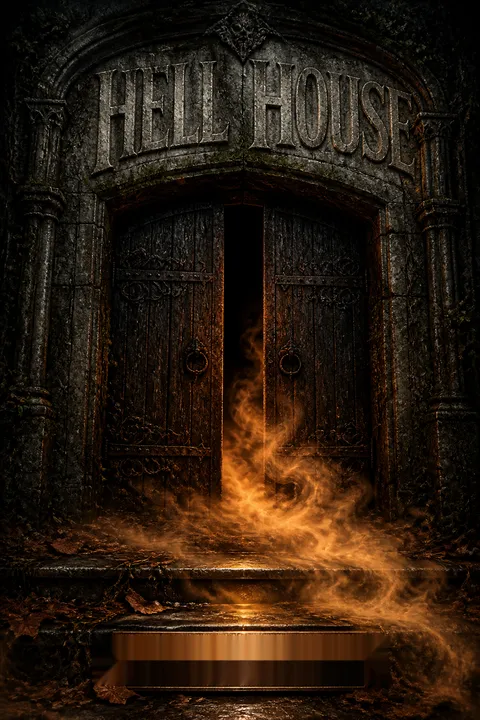
Rolf Deutsch, a terminally ill media tycoon, summons Dr. Lionel Barrett, a physicist and parapsychologist, to his deathbed. Deutsch offers Barrett a fortune to answer the ultimate question: is there life after death? The answer must be definitive, and the proof must be found in the infamous Belasco House—Hell House—reputedly the most haunted house in the world. Barrett, motivated by financial need and scientific curiosity, accepts, despite warnings and the house's deadly reputation. He will not go alone: two others, the spiritualist medium Florence Tanner and Benjamin Fischer, the only survivor of a previous investigation, will join him. The stage is set for a confrontation between science, faith, and the unknown.
Gathering of the Chosen
Barrett, his supportive but anxious wife Edith, Florence Tanner, and the withdrawn, traumatized Fischer converge, each with their own motives and beliefs. Florence seeks to cleanse the house with love and faith, Fischer is haunted by his past trauma, and Barrett is determined to prove his theory that hauntings are electromagnetic phenomena, not spirits. Tensions simmer as the group's psychological vulnerabilities and conflicting worldviews are exposed. The house, with its history of madness and death, looms as both a physical and psychological adversary.
Arrival in the Mist
The group's journey to Hell House is shrouded in literal and metaphorical fog. The house is isolated, decaying, and exudes a palpable sense of dread. As they cross the tarn and approach the windowless mansion, each is gripped by foreboding. The house's oppressive atmosphere immediately begins to affect them, amplifying their fears and insecurities. The first steps inside are marked by unease, malfunctioning equipment, and a sense that the house is aware of their presence.
The House That Waits
The team tours the house, discovering its grotesque architecture, profane chapel, and evidence of past debauchery and violence. The house's history is recounted: Emeric Belasco, a charismatic and monstrous figure, created a haven for depravity, cruelty, and occult experimentation. The house's previous investigators were driven mad, killed, or destroyed. The group's initial scientific detachment is eroded by the house's overwhelming psychic residue and the first subtle manifestations of supernatural phenomena.
Unveiling the Past
Fischer recounts the life of Emeric Belasco, whose sadism, manipulation, and willpower shaped the house's evil. The group debates the nature of haunting: is it the work of surviving spirits, or a residue of human emotion and energy? Florence becomes convinced that Belasco's tormented son, Daniel, is a trapped spirit needing release. Barrett remains skeptical, focusing on his scientific instruments and the construction of his "Reversor" machine, designed to neutralize the house's energy.
Science Versus Spirit
Florence conducts séances, channeling spirits and producing disturbing physical phenomena. Barrett insists these are products of psychic energy, not ghosts. Edith, caught between fear and loyalty, is increasingly affected by the house's atmosphere. Fischer remains aloof, refusing to open himself psychically, haunted by memories of his own near-destruction. The group's unity frays as the house exploits their divisions, and the debate between science and faith becomes personal and dangerous.
The First Night's Terror
The first night brings escalating phenomena: cold spots, moving objects, and a séance that devolves into violence. Florence is attacked by unseen forces, Edith is nearly lured to her death in her sleep, and Barrett's scientific explanations begin to falter. The house's power is not just external; it invades dreams, memories, and desires, turning the group's own minds against them. The boundaries between reality and hallucination blur.
The Medium's Descent
Florence becomes the house's primary target, suffering attacks, possession, and sexual violation by what she believes is Daniel's spirit. Her faith is tested as she is manipulated into believing she can save Daniel through self-sacrifice. The house twists her compassion and guilt, leading her into a spiral of self-doubt, pain, and ultimately, martyrdom. Her attempts to contact and release Daniel only deepen her entanglement with the house's evil.
Poltergeist and Possession
The house unleashes a poltergeist attack during dinner, injuring Barrett and nearly killing the group. Accusations fly: is Florence unconsciously causing the phenomena, or is she being used by the house? Edith's repressed fears and desires are exploited, leading to episodes of sexual aggression and shame. Fischer, still refusing to open himself, is paralyzed by guilt and impotence. The group's psychological defenses crumble as the house isolates and manipulates them.
The Machine of Salvation
Barrett completes his electromagnetic machine, convinced it will "drain" the house of its psychic energy. Florence, desperate to save Daniel, tries to destroy the machine but is stopped. The house retaliates with a final, devastating assault: Florence is possessed and driven to suicide, Barrett is killed by a supernatural force, and Edith is nearly destroyed by hallucinations and attacks. The Reversor's apparent success is revealed as a cruel illusion.
The House Strikes Back
With Barrett and Florence dead, Edith and Fischer are left to confront the house's true nature. Fischer, finally opening himself psychically, is nearly driven to suicide by the house's manipulations. Edith saves him, and together they piece together the clues left by Florence and the house's history. The realization dawns: the haunting is not a multitude of spirits, but the work of one will—Emeric Belasco's.
Madness and Betrayal
Fischer and Edith return to the house, determined to confront Belasco's spirit. They discover that Belasco, obsessed with his own image and power, engineered the house's reputation and the suffering of its victims. His physical deformity and psychological wounds fueled his need to dominate and deceive. The house's phenomena are revealed as extensions of his will, sustained by his ego and the lead-lined secret chamber where his body remains.
The Final Sacrifice
Fischer deciphers Florence's dying message and the clues she left behind. The answer lies not in science or faith alone, but in understanding and confronting Belasco's ego. Fischer, drawing on his own psychic strength and the support of Edith, challenges Belasco directly, stripping away his illusions and exposing his weakness. The confrontation is both psychic and psychological, a battle of wills that shatters the house's power.
The Reversor's Triumph
Barrett's machine appears to clear the house, but the victory is hollow. The house's phenomena return, more violent than before, revealing that the true source of evil was never neutralized. Barrett's scientific certainty is exposed as hubris, and he is destroyed by the very forces he sought to control. The lesson is clear: technology and rationality alone cannot conquer the darkness within.
The Return of the Dead
Fischer and Edith discover Belasco's mummified body in a hidden, lead-lined chamber. The truth is revealed: Belasco's physical and psychological deformities, his need for control, and his manipulation of others' beliefs created the house's legacy of horror. The haunting is not supernatural, but the product of a monstrous human will, amplified by the suffering of others and the credulity of his victims.
The True Haunter Revealed
Fischer confronts Belasco's spirit, using ridicule and pity to strip away his power. By exposing Belasco's true nature—a small, broken man hiding behind a mask of grandeur—Fischer breaks the spell that has held the house for decades. The phenomena cease, and the house is finally freed from its tormentor. The victory is bittersweet, marked by loss, trauma, and the recognition of human frailty.
The Last Confrontation
Fischer and Edith, the only survivors, leave Hell House changed and scarred. They reflect on the lessons learned: the dangers of pride, the limits of science and faith, and the enduring power of human will—for good or evil. The house, stripped of its power, stands as a monument to the darkness that can reside in the human soul.
Dawn Beyond Hell House
As Christmas dawns, Fischer and Edith depart, carrying with them the memories of those lost and the hope of healing. The house is silent at last, its secrets laid bare. The survivors face an uncertain future, but with the knowledge that evil, once understood and confronted, can be overcome—not by force alone, but by courage, compassion, and the willingness to see the truth.
Analysis
Hell House endures as a masterwork of psychological and supernatural horror, not merely for its chilling set pieces, but for its profound exploration of the human mind's capacity for self-deception, pride, and suffering. Matheson's narrative is a relentless dissection of the limits of science, faith, and willpower when confronted with evil that is both external and internal. The house is a crucible that exposes and exploits the investigators' deepest wounds, showing that true horror lies not in ghosts, but in the unchecked ego, the need for control, and the refusal to see the truth. The novel's ultimate lesson is that evil cannot be conquered by technology or belief alone; it must be understood, exposed, and, paradoxically, pitied. Only then can the cycle of suffering be broken. In a modern context, Hell House warns against the dangers of certainty, the seduction of easy answers, and the necessity of confronting the darkness within ourselves as much as the world around us
Review Summary
Hell House receives mixed reviews, with some praising its intense horror and others criticizing its explicit content. Many consider it a classic haunted house story, noting its influence on the genre. Readers appreciate Matheson's suspenseful writing and vivid descriptions but find the sexual elements and violence controversial. Some view it as dated and misogynistic, while others see it as groundbreaking for its time. The book's ending is often described as anticlimactic. Overall, opinions are divided, with some loving its unrelenting terror and others finding it excessive or poorly executed.
People Also Read









Characters
Dr. Lionel Barrett
Barrett is a physicist and parapsychologist, driven by a need for recognition and financial security. He is a man of science, determined to prove that hauntings are the result of electromagnetic phenomena, not spirits. His relationship with his wife Edith is loving but strained by his emotional distance and physical limitations. Barrett's pride and certainty blind him to the house's true nature, and his reliance on technology becomes his undoing. His arc is a cautionary tale about the limits of rationality and the dangers of intellectual arrogance.
Edith Barrett
Edith is Lionel's devoted but insecure wife, haunted by fears of abandonment and her own repressed desires. She is the emotional heart of the group, sensitive to the house's influence and the suffering of others. Edith's psychological struggles—her fear of loneliness, sexual repression, and guilt—make her especially susceptible to the house's manipulations. Her survival is a testament to resilience, but she is left deeply scarred by the experience.
Florence Tanner
Florence is a spiritualist minister and mental medium, driven by compassion and a desire to heal. She believes in the power of love to redeem even the most tormented souls. Florence's faith and openness make her both a source of hope and a target for the house's evil. Her journey is one of increasing torment, as her beliefs are twisted and her body violated. Ultimately, her willingness to sacrifice herself becomes both her downfall and the key to unraveling the house's secret.
Benjamin Fischer
Fischer is a once-powerful physical medium, traumatized by his previous encounter with Hell House. He is withdrawn, cynical, and determined to protect himself by remaining "closed off" psychically. Fischer's journey is one of guilt, self-doubt, and eventual courage. He is forced to confront his own fears and limitations, and in the end, it is his willingness to face Belasco directly that breaks the house's power. Fischer's arc is one of redemption and the reclaiming of lost strength.
Emeric Belasco
Belasco is the unseen antagonist, a man whose will and ego are so powerful that they survive death. His life was marked by cruelty, manipulation, and a need to dominate others. Belasco's physical deformity and psychological wounds drive him to create a house that is both a fortress and a prison. His haunting is not the work of a ghost, but the extension of his monstrous personality, sustained by the suffering of others and the illusions he creates.
Rolf Deutsch
Deutsch is the wealthy patron who sets the events in motion. His fear of death and desire for certainty drive him to commission the investigation. Though he never enters the house, his presence looms over the story as a symbol of humanity's quest for answers and the dangers of seeking truth at any cost.
William Reinhardt Deutsch
The son of Rolf Deutsch, he is dismissive of the supernatural and opposes the investigation, representing the voice of materialism and denial. His actions after his father's death leave the investigators stranded, underscoring the indifference of the outside world to the horrors within.
The House (Hell House)
The house itself is a character, shaped by Belasco's will and the accumulated suffering of its victims. It is both a physical structure and a psychic entity, capable of manipulating reality, exploiting weaknesses, and amplifying fear. The house's power lies in its ability to turn the investigators' own minds against them, making it the ultimate antagonist.
Daniel Belasco
Believed by Florence to be a trapped spirit, Daniel is a construct of Belasco's manipulations and Florence's own guilt. His presence is a diversion, a means for Belasco to ensnare and destroy the investigators by exploiting their compassion and need for meaning.
The Barretts' and Belasco's Past Victims
The ghosts, apparitions, and psychic phenomena that plague the house are the residue of Belasco's cruelty and the credulity of his victims. They serve as warnings and as tools for the house's ongoing manipulation, illustrating the destructive power of unchecked evil and belief.
Plot Devices
Haunted House as Psychological Mirror
Hell House is not just a setting but a psychological crucible. Its phenomena are tailored to the vulnerabilities of its occupants, turning their own minds and emotions into weapons against them. The house's power is less about external ghosts and more about the internalization of trauma, guilt, and desire.
Science Versus Spiritualism
The central tension between Barrett's scientific rationalism and Florence's spiritual faith is both thematic and practical. Their competing methods and beliefs create division, making them more susceptible to the house's manipulations. The ultimate revelation is that neither approach alone is sufficient; understanding evil requires both reason and empathy.
The Red Herring of Daniel Belasco
The belief in Daniel's haunting is a deliberate misdirection by Belasco, exploiting Florence's compassion and the group's need for a solvable mystery. This device keeps the investigators—and the reader—focused on the wrong target, allowing the true source of evil to remain hidden until the climax.
The Reversor and the Illusion of Control
Barrett's machine represents the hope that evil can be neutralized by science. Its apparent success is a cruel trick, exposing the limits of rationality and the dangers of hubris. The house's resurgence after the Reversor's use underscores the need for humility and the recognition of evil's complexity.
Psychological Possession and Manipulation
The house's most effective weapon is its ability to possess, manipulate, and turn the investigators' own minds against them. Sexual repression, guilt, pride, and fear are all used to devastating effect, blurring the line between supernatural and psychological horror.
The Secret Chamber and the Lead-Lined Room
The discovery of Belasco's mummified body in a lead-lined chamber is both a literal and symbolic revelation. The lead blocks psychic energy, allowing Belasco's will to persist undetected. The chamber represents the hidden, festering core of evil that must be exposed and confronted for healing to occur.
The Power of Ego and Exposure
The final confrontation is not a battle of strength, but of revelation. By exposing Belasco's true nature—his physical deformity, psychological wounds, and need for control—Fischer strips him of power. The victory comes not from destruction, but from understanding and pity, breaking the cycle of fear and domination.
FAQ
Synopsis & Basic Details
What is Hell House about?
- A Dying Man's Quest: Terminally ill media mogul Rolf Deutsch hires Dr. Lionel Barrett, a physicist specializing in parapsychology, to definitively prove or disprove life after death within one week. The chosen location is the infamous Belasco House, known as Hell House, reputedly the most haunted place on Earth.
- A Team of Opposing Beliefs: Barrett is joined by Florence Tanner, an empathetic spiritualist medium, and Benjamin Fischer, a powerful physical medium and the sole survivor of a previous, disastrous investigation into Hell House. Each brings their own methods, beliefs, and deep-seated vulnerabilities to the terrifying challenge.
- Confronting a Legacy of Evil: The team enters Hell House, a decaying mansion steeped in a history of depravity, violence, and occult experimentation orchestrated by its former owner, Emeric Belasco. As they attempt to unravel its secrets, the house's malevolent influence systematically exploits their psychological weaknesses, turning their own fears and desires against them in a relentless onslaught of supernatural and psychological horror.
Why should I read Hell House?
- Masterclass in Psychological Horror: Richard Matheson's Hell House transcends typical ghost stories by delving deep into the psychological vulnerabilities of its characters, making their internal struggles as terrifying as the external phenomena. It's a relentless exploration of fear, repression, and the human mind's capacity for self-destruction.
- Intense, Unflinching Dread: The novel maintains a suffocating atmosphere of dread and escalating tension from the moment the characters enter the house. Matheson's vivid, visceral descriptions of the house's history and its attacks create a truly immersive and unsettling reading experience that lingers long after the final page.
- A Unique Take on Hauntings: Hell House offers a compelling and often disturbing reinterpretation of what constitutes a haunting, blending scientific rationalism with spiritual belief to explore the nature of evil, ego, and the enduring impact of human will. It challenges readers to question their own understanding of the supernatural.
What is the background of Hell House?
- Belasco's Depraved Legacy: Hell House was built in 1919 by Emeric Belasco, an illegitimate, physically deformed, and immensely wealthy man who transformed his mansion into a "Sinposium" – a haven for extreme debauchery, sadism, and occult practices, culminating in cannibalism and murder. This history of concentrated evil forms the psychic residue that permeates the house.
- Previous Disastrous Investigations: The house earned its fearsome reputation from two prior attempts at investigation in 1931 and 1940, both ending in tragedy. Eight people were killed, committed suicide, or went insane, with Benjamin Fischer being the sole, traumatized survivor of the 1940 expedition.
- A Scientific and Spiritual Battleground: The current investigation is funded by Rolf Deutsch, a dying media tycoon, who seeks definitive proof of an afterlife. This sets the stage for a clash between Dr. Barrett's scientific, electromagnetic theory of hauntings and Florence Tanner's spiritualist belief in earthbound spirits, all against the backdrop of Belasco's enduring malevolence.
What are the most memorable quotes in Hell House?
- "Welcome to my house. I'm delighted you could come.": Spoken by Emeric Belasco's recorded voice, this chilling greeting sets the tone for the house's insidious hospitality, foreshadowing his manipulative presence and the trap awaiting the investigators. It's a pivotal quote in Hell House that defines the antagonist.
- "There is one thing in this house, and one thing only—mindless, directionless power.": Dr. Barrett's confident assertion encapsulates his scientific theory of electromagnetic radiation (EMR) as the source of the haunting, highlighting his intellectual hubris and his fundamental misunderstanding of Belasco's true nature. This quote is central to the Hell House analysis of science vs. spirit.
- "Perfect love casteth out fear.": Whispered by Florence Tanner's voice in Fischer's mind, this biblical quote (1 John 4:18) represents her core belief and the spiritualist approach to confronting evil, contrasting sharply with Barrett's scientific method and ultimately guiding Fischer to the true nature of Belasco's weakness.
What writing style, narrative choices, and literary techniques does Richard Matheson use?
- Visceral Sensory Detail: Matheson employs rich, often disturbing sensory descriptions, particularly of smells ("fetid odor of the mist," "reek of the dead"), sounds (rappings, screams, gurgling), and tactile sensations (icy coldness, hot slime), to immerse the reader in the oppressive atmosphere of Hell House. This creates a palpable sense of dread and psychological realism.
- Shifting Points of View & Internal Monologue: The narrative frequently shifts between the perspectives of Barrett, Edith, Florence, and Fischer, often delving into their internal monologues. This technique allows Matheson to expose each character's deepest fears, repressed desires, and psychological vulnerabilities, making the house's manipulations deeply personal and terrifying.
- Escalating Tension & Psychological Erosion: Matheson masterfully builds tension through a relentless escalation of phenomena, from subtle breezes and rocking chairs to violent poltergeist attacks and full-blown possessions. This gradual erosion of the characters' sanity and defenses highlights the psychological toll of confronting such pervasive evil, a key theme in Hell House.
Hidden Details & Subtle Connections
What are some minor details that add significant meaning?
- Barrett's Physical Vulnerability: His polio-induced limp, reliance on daily swims and steam baths, and later his injured thumb, are constant reminders of his physical fragility. This contrasts sharply with his intellectual arrogance, subtly foreshadowing his ultimate physical defeat by the house, which targets his body as much as his mind.
- The Cat as a Psychic Barometer: The cat, initially a source of comfort for Florence, becomes a sensitive indicator of the house's escalating malevolence. Its sudden terror, cowering, and later violent, possessed attack on Florence (Document 1, 8:31 A.M.) underscore the pervasive, insidious nature of Belasco's influence, even over animals.
- The Tarn's Symbolic Odor: The "fetid odor" of the tarn, described as smelling like "gangrenous wounds" (Document 1, 6:11 P.M.), is more than just a physical detail. It symbolizes the deep-seated moral and spiritual decay of Hell House, a constant, visceral reminder of Belasco's depravities and the house's role as a "Bastard Bog" for his victims.
What are some subtle foreshadowing and callbacks?
- Belasco's Recorded "Welcome": His voice on the phonograph stating, "I shall be with you in spirit" and "Each to his own device" (Document 1, 12:19 P.M.), subtly foreshadows his omnipresent, manipulative control over the house and its inhabitants, and his strategy of exploiting individual weaknesses and desires. This is a key piece of Hell House symbolism.
- Fischer's "Bastard Bog" Comment: Early in the novel, Fischer's unexplained naming of the tarn as "Bastard Bog" (Document 1, 11:47 A.M.) is a direct callback to Belasco's illegitimate birth and his later use of the tarn for disposing of unwanted pregnancies, hinting at the profound, personal nature of the house's evil.
- Edith's Rocking Chair Observation: Her initial thought that the rocking chair moves "as though someone were sitting in it" (Document 1, 9:49 P.M.) subtly foreshadows the later revelation that Belasco's spirit is indeed a conscious, malevolent presence, actively manipulating phenomena, rather than just "residual energy" as Barrett believes.
What are some unexpected character connections?
- Florence's Brother and Daniel Belasco: Belasco exploits Florence's deep, unresolved grief over her brother David's death (Document 1, 11:16 A.M.). He crafts the "Daniel Belasco" persona to mirror her lost brother, creating a powerful, manipulative emotional connection that leads her to self-sacrifice, a crucial element in Florence Tanner's motivations.
- Edith's Father and Belasco's Influence: Edith's repressed sexuality and fear of men, stemming from her father's attempted rape (Document 1, 2:46 P.M.), are directly targeted and amplified by Belasco. This hidden trauma makes her vulnerable to the house's sexual manipulations, revealing a profound psychological connection between her past and the house's present torment.
- Fischer's Past and Present Self: Fischer's return to Hell House forces a confrontation with his younger, naive self, who was nearly destroyed in 1940. His initial self-imposed psychic block and cynicism are a direct result of this past trauma, highlighting the cyclical nature of the house's influence and his journey toward reclaiming his power.
Who are the most significant supporting characters?
- Rolf Deutsch, the Catalyst: The dying millionaire who commissions the investigation, Deutsch's fear of death and desire for certainty are the initial driving forces behind the entire expedition. His wealth and desperation set the stage for the clash of science and spirit, making him a crucial, albeit physically absent, character in Richard Matheson's Hell House.
- William Reinhardt Deutsch, the Obstacle: Rolf's son, William, represents the cynical, materialistic world outside Hell House. His attempts to sabotage the investigation and his eventual refusal to honor his father's financial commitment leave the survivors stranded, underscoring the indifference of the mundane world to the supernatural horrors they face.
- The Caribou Falls Couple, the Unseen Witnesses: The couple who deliver meals, though never seen, serve as a constant reminder of the outside world's fear and the house's isolation. Their refusal to sleep in the house (Document 1, 3:50 P.M.) subtly reinforces the pervasive dread and the house's reputation, acting as a silent chorus to the unfolding terror.
Psychological, Emotional, & Relational Analysis
What are some unspoken motivations of the characters?
- Barrett's Legacy and Validation: Beyond proving his EMR theory, Dr. Lionel Barrett is driven by a profound, unspoken need for scientific validation and a lasting legacy, especially given his physical disability and the marginalization of parapsychology. This deep-seated pride makes him dangerously resistant to any evidence that contradicts his worldview, even at the cost of his life.
- Edith's Escape from Loneliness: Edith's unwavering insistence on accompanying Lionel, despite her terror, stems from a deep-seated fear of abandonment and loneliness, exacerbated by a past mental breakdown during his absence. Her desire to be with him, even in Hell House, is a desperate attempt to avoid the psychological torment of solitude.
- **Florence'


Download PDF
Download EPUB
.epub digital book format is ideal for reading ebooks on phones, tablets, and e-readers.








































