

Key Takeaways
A Christian doctor claims witches used demons to kill her patients
The book's launching premise is literal warfare. Rebecca Brown presents herself as an internal medicine physician at "Memorial Hospital" who senses a brooding darkness the day she arrives. She describes a respected night nurse, Helen, who allegedly whispered to dying patients about easy reincarnation, laid hands on them, chanted, and summoned "higher powers" to usher them into death. Brown blames unexplained cardiac arrests and a surge of "ICU psychosis" (patients hallucinating demons) on organized witchcraft rather than medicine.
Her own body becomes a battleground. As she prays against the darkness, her neuromuscular disease worsens until she is dying, until roughly 200 church members fast and pray around the clock and she recovers. This sets the stakes: Christians and Satanists fighting over literal lives.
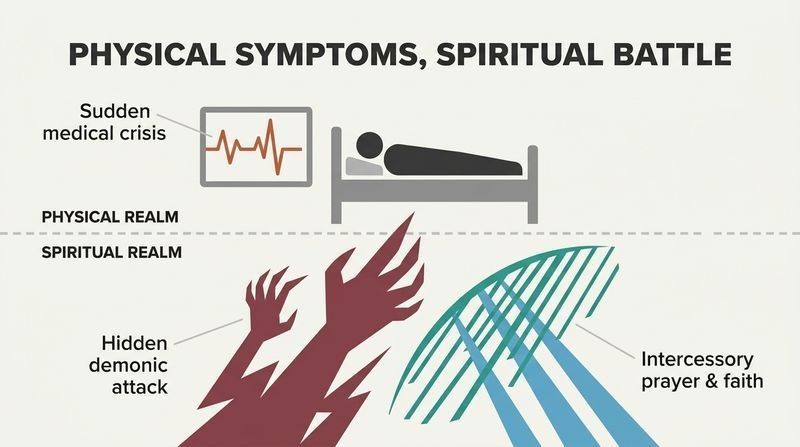
What's striking is how the book converts ordinary hospital phenomena into supernatural combat. ICU delirium is a genuine, heavily studied condition driven by sedatives, sleep deprivation, and windowless sensory monotony, exactly the setting Brown describes, yet it is reframed as demons. The account is unfalsifiable by design: the opening warning insists Satan will make readers sleepy and confused to stop them reading, so skepticism itself becomes evidence of attack. Published in 1986, the book became a foundational text of the American "Satanic Panic," a documented moral panic that produced wrongful convictions later overturned. Brown's own medical license was subsequently revoked.
Predatory cults recruit by targeting the lonely and disfigured
Elaine's story is a grooming narrative. Born with a severe cleft palate and rejected by peers through sixteen years of surgeries, she grows lonely, angry, and hungry for power after discovering she can dominate others. A popular classmate named Sandy, secretly a cult "recruiter," befriends her, tells her God clearly does not care (or she would not have been born deformed), and lures her to a summer "church camp."
Acceptance is the bait, coercion the hook. The camp flatters her supposed gifts, then traps her: guards, sleep deprivation, threats against her family, and a staged demonic manifestation force her to sign a blood contract. The book insists the cult had watched her since infancy, when a nurse allegedly bought her blood.
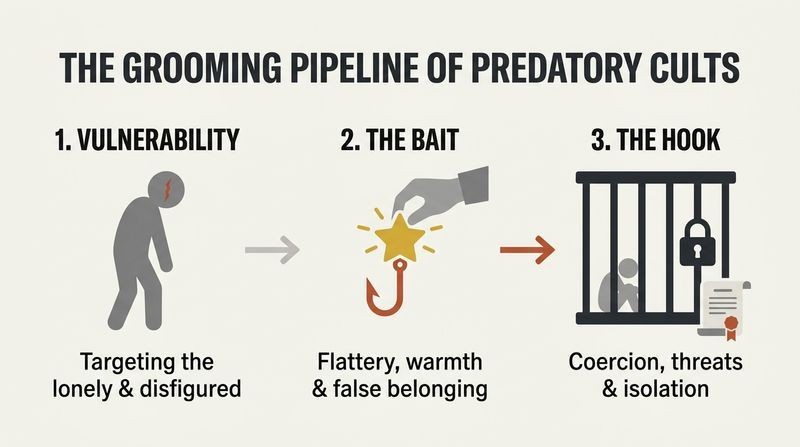
Stripped of the supernatural claims, this is an accurate portrait of how coercive groups actually operate. Cult researchers like Robert Cialdini and Steven Hassan describe the same machinery: love-bombing a wounded outsider, incremental commitment, isolation from family, sleep and food deprivation, and manufactured awe. The pattern maps onto documented recruitment by high-control groups from the Moonies to modern extremist networks. The insight worth keeping is that belonging, not doctrine, is the entry drug. Where the narrative strains credibility is scale and secrecy: a nationwide blood-sacrifice conspiracy leaving no bodies, records, or prosecutions, which is precisely the claim investigators later found no evidence for.
Satan's promised love is a con built on fear and lies
The cult's emotional engine is betrayal. Elaine rises to "high priestess" and even "Bride of Satan," believing herself uniquely loved. Satan appears as her ideal handsome man, marries her in a rented church, and promises power and devotion. Then the mask drops: four demons shred her flesh for a trivial offense while Satan laughs and offers no help. She realizes he despises her and only used her.
Deception runs top to bottom. The book claims every servant is told they are the greatest and most powerful, that all contracts are lies, that Satan cannot be everywhere at once (unlike God), and that the whole system runs on competition and terror rather than loyalty. Demons abandon the weak instantly for the stronger master.
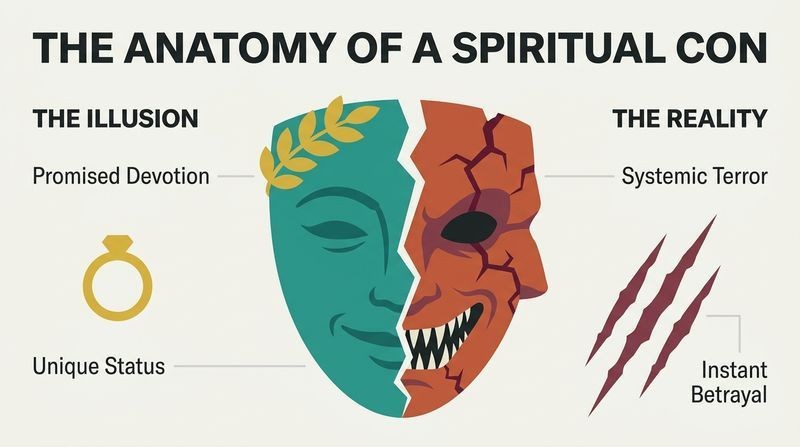
The theological argument here is sharper than the sensationalism suggests: evil is framed as fundamentally parasitic and self-defeating, offering counterfeit versions of everything genuine, love, purity, worship. That contrast, a kingdom of competition versus a kingdom of mutual service, echoes Augustine's view of evil as privation rather than a rival creative force. As psychology, the "you are secretly the chosen one" flattery describes real manipulation tactics used by abusers and pyramid schemes alike. The narrative's weakness is that it grants Satan an elaborate, almost bureaucratic organization (councils, private jets, competitions) that undercuts the very theology of chaos and lies it wants to preach.
Any occult dabbling opens a "doorway" that lets demons in
"Doorways" is the book's central mechanism. Brown teaches that any contact with the occult, however casual, gives Satan legal ground to infest a person, Christian or not. Her list is sweeping:
1. Fortune tellers, horoscopes, ouija boards, tarot, seances.
2. Yoga, Transcendental Meditation, martial arts, acupuncture, hypnosis.
3. Drugs, drunkenness, sexual sin (demons pass through "one flesh").
4. Dungeons and Dragons-style fantasy games, rock music, occult toys and cartoons.
5. Inherited sin from ancestors involved in the occult.
Closing a door requires confession and Jesus's blood. She frames imagination itself as a bridge to the spirit world, so a blanked mind (in meditation or biofeedback) is an open invitation. Salvation alone does not evict demons already invited in; the person must actively command them out.
This is the book's most culturally consequential idea and its most sweeping. By classifying yoga, acupuncture, meditation, role-playing games, and rock records as spiritual hazards, it helped fuel 1980s campaigns against Dungeons and Dragons and "backmasking," claims that collapsed under scrutiny. The underlying logic is a closed epistemic loop: illness, doubt, and depression all become proof of demonic doorways, immune to disconfirmation. Anthropologically, though, the doorway concept captures something real about how ritual and symbol shape identity. The danger is clinical: reframing depression, trauma, or sexual assault as demonic infestation can delay genuine psychiatric and medical care, a concern the deliverance-ministry field still wrestles with.
Cast demons out by area, not one stubborn spirit at a time
Deliverance has an architecture. After Elaine's conversion, Brown describes an eight-week ordeal of near-sleepless nights fighting demons that keep re-entering through unclosed doors. She learns to stop chasing individual demons and instead clear a person by regions, evicting each area's ruling demon with its subordinates at once. Her ordering:
1. Satan's own doorway (held by a "son of Satan").
2. The human spirit (a "guiding spirit" plus conscience, intuition, worship).
3. The soul (will, mind, emotions, plus three levels controlling the spirit).
4. The body (a "death demon," the brain, the sexual doorway).
Method matters more than intensity. She uses spoken commands in Jesus's name, scripture (demons especially hate Revelation), praise music, and anointing oil to seal rooms and homes against re-entry.
Read as ritual technology, this is a coherent system: it gives practitioners a checklist, a sense of control, and a way to interpret setbacks (a missed doorway) rather than abandon the framework. That structure is part of why deliverance ministries persist. The tripartite anatomy of body, soul, and spirit draws directly on Watchman Nee, whom Brown cites heavily. From a clinical angle, the described phenomena, altered voices, thrashing, choking, amnesia, overlap with dissociative and conversion disorders documented in trauma survivors like Elaine. The ethical hazard is real: treating a traumatized, possibly dissociative person through hours of confrontational "battle" can retraumatize rather than heal.
Humans are three parts, and witchcraft hijacks the spirit body
The "soul-controlled spirit" explains occult power. Borrowing from Watchman Nee's "latent power of the soul," Brown argues humans have body, soul (mind, will, emotions), and spirit, and that each has a corresponding "spirit body." Adam once consciously controlled his spirit body and walked with God directly; the Fall severed that awareness. Witches, she claims, use "power demons" as glue to reconnect soul and spirit, regaining conscious control so they can astral-project, see the spirit realm, and attack others while their physical body sits still.
God wants that control surrendered, not reclaimed. Brown insists Christians must ask God to sever soul from spirit (citing Hebrews 4:12) so that supernatural experience comes only when God initiates it, never on demand. Self-generated "spiritual experiences," she warns, are likely demonic.
This is the book's most interesting theological move: it reframes paranormal claims (astral projection, telepathy, remote harm) not as fake but as real spiritual-body activity that God forbids believers to control. It lets Brown affirm the supernatural while condemning its self-directed use, a neat way to make charismatic Christianity police its own mystical edges. The practical rule, that experiences you can summon at will are suspect while those God sends are trusted, is unfalsifiable but internally consistent. It also generates a sharp critique of certain charismatic practices (mind-blanking, forced tongues, on-demand prophecy) that many mainstream Pentecostal theologians would actually share.
Real salvation is a total sale of yourself, not easy grace
Brown attacks the "comfortable gospel." She argues that being saved is not saying a prayer and carrying on; it is a binding contract in which you sell yourself to Christ as completely as a Satanist sells himself to Satan. You keep no rights, no possessions, no guarantee of safety. "Taking up your cross" means literal, ongoing dying: expecting to lose family, career, health, and reputation as Satan petitions God for them, as he did with Job.
Suffering is the proof, not the failure. She insists the servant is not above the master, so anyone genuinely following Christ will be persecuted, often from inside the church. This directly targets the "health and wealth" doctrine, which she brands a teaching of demons designed to keep Christians soft and unwilling to suffer for others.
Detached from the demonology, this is a bracing and defensible piece of Christian ethics, closer to Bonhoeffer's "cost of discipleship" than to the prosperity preaching that dominated 1980s televangelism. Brown's polemic against health-and-wealth theology anticipates critiques later leveled by many evangelical scholars. The shadow side is that a theology equating suffering with faithfulness can become spiritually coercive: it can discourage people from leaving abusive churches, seeking medical help, or questioning leaders, since hardship gets reinterpreted as evidence of doing something right. The same logic that steels a martyr can trap a victim, which is the recurring double edge of this entire book.
Satanists destroy churches by killing the prayer meeting first
Elaine claims an eight-point infiltration playbook. Satanists join a church, fake conversion (they can even speak in tongues, since demons speak languages), build credibility with money and volunteering, then dismantle it from within. The linchpin is destroying corporate prayer. Brown recounts a wealthy infiltrator, "Roy," who grew a thriving 300-member church's Wednesday prayer meeting, then split it into small "discipleship groups" and scheduled choir over prayer night. Within a year the prayer base collapsed and the church fell apart.
The other tactics support the first: spreading rumors, changing doctrine (especially making prayer complicated and preaching health-and-wealth), breaking up families through age-segregated programming, and forbidding any teaching about Satan so he can work unseen.
The sociological observation buried here is genuinely shrewd: institutions die not by frontal attack but by hollowing out their core practices while everyone celebrates growth. Whether or not one believes in infiltrating Satanists, the mechanics, replacing shared ritual with fragmented convenience, mistaking size for health, losing the intimacy that binds members, describe how many organizations decline. The claim that questioning talk about Satan proves you might be a Satanist is, however, a textbook thought-terminating cliche that shields the theory from challenge and can license witch-hunts inside congregations. The warning against age-segregating families also reflects a real ongoing debate in church-growth circles.
Not every illness is demonic, and hurry sabotages healing
Brown carves out a middle position on sickness. Against those who call all disease demonic and those who deny demons touch Christians, she uses Luke's Gospel to argue that Jesus healed some conditions by rebuking spirits and others by rebuking the illness itself. Most depression, she says, is not a demon but a failure of "mind control," letting Satan-injected thoughts run unchallenged; the fix is disciplined thought-capture, scripture, and praise, not exorcism.
Love and time are the missing ingredients. She rebukes deliverance and healing ministers for being selfish with their hours, rushing altar-call exorcisms in five minutes before TV cameras. Deep deliverance, she insists, can take hours or days of patient, private, protective work, and healing may require literally sharing another's burden and pain.
This is the most clinically responsible chapter, and its restraint is notable given the book's overall tenor. The refusal to label all suffering demonic, the emphasis on cognitive discipline over supernatural blame, and the insistence on privacy and patience for the vulnerable reflect real pastoral wisdom. The "mind control" teaching is essentially a spiritualized cognitive behavioral therapy: identify intrusive thoughts, refuse to accept them, replace them, a technique with strong evidence for depression and anxiety. The tension is that Brown still leaves the door open to attribute treatment-resistant cases to demons, which in practice can override medical judgment, exactly the risk her own more cautious instincts here try to limit.
Leaving the occult is all-or-nothing and rarely painless
Brown's exit counsel is uncompromising. You cannot leave Satanism gradually; you must break completely and at once, or, she warns, you may be killed and lose the chance forever. The convert must surrender every occult power, including the ability to sense the spirit world, and ask God to sever soul from spirit so the power cannot be reclaimed even in a moment of rebellion. Familiar objects (occult items, rock records, game manuals) must be destroyed, and ties to still-practicing friends and family cut.
The cost can be brutal. She tells of a converted couple, the "Blacks," whose two children were murdered by the cult after they refused to renounce Christ, framing their endurance as faithfulness rather than tragedy avoided.
The practical core, a clean and total break with a controlling group and its symbols, matches what exit counselors genuinely recommend for people leaving cults, gangs, and abusive relationships. Ambiguous half-departures do leave people vulnerable to being pulled back. But the "Blacks" story exposes the framework's darkest failure mode: when catastrophic loss becomes proof of correct faith, the theology can no longer protect anyone, only console them after the fact. A belief system that interprets the murder of a convert's children as a spiritual victory has quietly removed every ground on which its own promises of protection could ever be tested or falsified.
Analysis
"He Came to Set the Captives Free" (1986) is best understood as two books braided together: a lurid conversion memoir and a practical manual of spiritual warfare. Rebecca Brown, presenting herself as a physician, tells the story of Elaine, a former "high priestess" and "Bride of Satan" in a nationwide cult called The Brotherhood, then generalizes from that story into a system of doorways, deliverance, and combat theology drawn heavily from Watchman Nee.
Historically, the book matters far more than its prose. It is a keystone document of the American Satanic Panic, the moral panic that, alongside "Michelle Remembers," Mike Warnke's "The Satan Seller" (which Brown cites), and recovered-memory therapy, convinced significant segments of the public that a hidden network of Satanists was sacrificing infants and infiltrating institutions. That belief helped drive real harms: the McMartin and other day-care abuse prosecutions, wrongful convictions, and campaigns against Dungeons and Dragons and rock music. No physical evidence for the alleged sacrifice networks was ever found; the FBI's 1992 Lanning report concluded so explicitly. Brown herself (born Ruth Bailey) had her Indiana medical license revoked in 1984, with the board describing diagnoses of demonic causation and other serious concerns.
Read critically, the book is a masterclass in an unfalsifiable closed system. Doubt, fatigue, illness, and skepticism are all pre-coded as evidence of demonic attack, so nothing can count against the thesis. Yet dismissing it entirely misses why it persists. Beneath the sensationalism sit durable observations: coercive groups recruit the lonely with belonging; evil often works parasitically; institutions rot from the core practice outward; cheap grace and prosperity gospel deserve challenge; leaving a high-control group demands a clean break. The tragedy is that these humane insights are welded to a demonology that can pathologize trauma, delay medical care, and, in its bleakest moments, reframe devastating loss as spiritual triumph.
Review Summary
He Came to Set the Captives Free receives polarized reviews on Goodreads, averaging 4.16 stars. Supporters praise its insights into spiritual warfare and deliverance, calling it enlightening and biblically grounded. Critics cite serious concerns: misquoted scripture, contradictions, sensational claims about werewolves and vampires, and fear-mongering. Many question the book's authenticity after learning about the author's revoked medical license and mental health diagnosis. Some found it entertaining as fiction but reject its non-fiction classification. Several reviewers warn against taking scripture out of context and note the book's authoritarian tone.
People Also Read




Glossary
The Brotherhood
Alleged secret Satan-worshiping cultThe name Brown and Elaine give to a supposedly vast, wealthy, highly organized Satan-worshiping cult with covens across the United States, led by high priests and priestesses, practicing human and animal sacrifice, and infiltrating churches, government, police, and business. Presented as real and dangerous, though no corroborating evidence exists and investigators found no such networks.
Doorways
Sins that admit demons legallyBrown's central concept: any act, however minor, that supposedly gives Satan legal ground to infest a person with demons. Her list includes fortune telling, ouija boards, horoscopes, yoga, meditation, martial arts, acupuncture, hypnosis, drugs, sexual sin, fantasy role-playing games, rock music, and inherited ancestral occult involvement. Doorways must be closed through confession and appeal to Jesus's blood.
Standing in the gap
Spiritual combat on another's behalfDrawn from Ezekiel 22:30, Brown's term for asking God to place your spirit body into spiritual battle to shield another person from demonic attack or free them to hear the gospel. The one "in the gap" may suffer real physical fatigue, pain, or illness as a consequence, functioning as a form of intercessory self-sacrifice.
Guiding spirit
Chief demon indwelling a witchA powerful demon a witch invites to live inside them to grant occult skills, increased power, and communication with other demons. In Elaine's account her guiding spirit, named Mann-Chan, controlled her eating, sleep, speech, and abilities, appearing first as a beautiful man before revealing a hideous true form. It ruled her life and later, on Satan's orders, sought to kill her.
Soul-power (latent power of the soul)
Spirit body controlled by soulBorrowed from Watchman Nee, the idea that occult ability comes from the human soul regaining conscious control of its "spirit body," a capacity lost at the Fall. Witches supposedly use "power demons" to reconnect soul and spirit, enabling astral projection and remote attacks. Brown teaches Christians must ask God to sever soul from spirit so such power cannot be self-directed.
Familiar objects and familiar spirits
Cursed items and spying demonsFamiliar objects are items used in Satan's service (occult tools, rock records, game manuals, even certain religious artifacts) that demons cling to and that must be destroyed. Familiar spirits are demons a witch communicates closely with, often placed into an animal for spying so the witch sees and hears through it. Brown claims witches prefer white cats over black.
Bride of Satan
Highest female rank in cultIn Elaine's account, the most exalted position a woman can reach in Satanism, with only five to ten existing in the United States at once and seats on a national council. Elaine claims she was chosen, "married" to Satan in a rented church with a blood contract, and rose to top bride, only to discover his professed love was a manipulative lie.

Download PDF
Download EPUB
.epub digital book format is ideal for reading ebooks on phones, tablets, and e-readers.








































