

Key Takeaways
Kennedy's core charge: the drug regulator became the drug industry's servant
The book's engine is "regulatory capture." Kennedy argues that the agencies meant to protect Americans became captured by the companies they regulate. His figures: the CDC owns 57 vaccine patents and spends nearly half its budget buying and distributing vaccines, NIH holds hundreds of patents, and FDA draws roughly 45% of its budget from pharmaceutical "user fees."
Fauci is cast as the architect. As NIAID director for nearly four decades with a discretionary budget in the billions, Kennedy portrays him as controlling grants, careers, journals, and the "independent" panels that approve drugs. The book's recurring accusation is that Fauci consistently chose patented, profitable products over cheaper remedies, nutrition, and prevention, and that his 50-year tenure coincided with an explosion of childhood chronic disease.
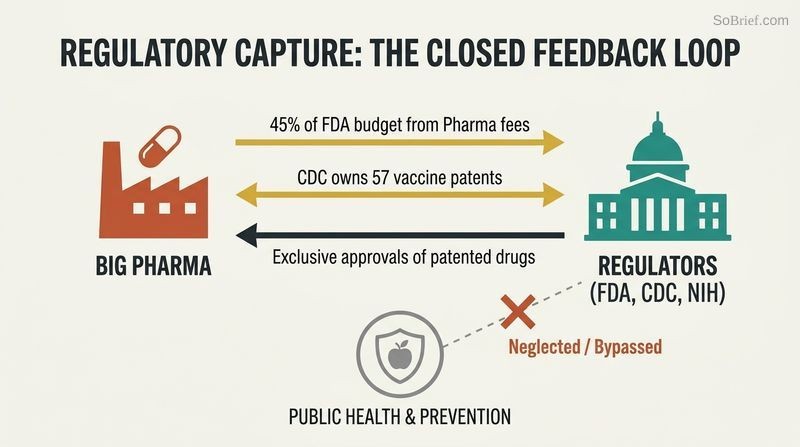
Regulatory capture is a real and well-documented phenomenon in economics, named by Nobel laureate George Stigler, and pharma's influence over the FDA and medical journals draws legitimate criticism from figures like former NEJM editors Marcia Angell and Richard Horton, whom Kennedy quotes. That gives the book a genuine kernel. What is contested is causation: Kennedy attributes chronic-disease trends, agency decisions, and pandemic outcomes to deliberate corruption by one man, a monocausal narrative that skips confounders like improved diagnosis, aging demographics, and genuine scientific uncertainty. The strongest version of his case is structural (misaligned incentives corrupt institutions); the weakest is personal (a single villain engineering catastrophe).
The book's loudest claim: cheap COVID drugs were buried to protect vaccines
A legal trigger drives the plot. Under FDA rules, an Emergency Use Authorization cannot be granted if an adequate approved treatment already exists. Kennedy argues this gave Fauci and vaccine makers a financial motive to discredit hydroxychloroquine and ivermectin, because their success would legally block the multi-billion-dollar vaccine rollout and remdesivir.
His witnesses are frontline doctors. Peter McCullough, Pierre Kory, Harvey Risch, and others claim early outpatient treatment could have prevented up to 80% of COVID deaths. Kennedy alleges the pivotal studies condemning hydroxychloroquine used near-lethal doses (2,400 mg day one), omitted zinc and azithromycin, and dosed patients too late, and that the Lancet/NEJM "Surgisphere" studies relied on a fabricated database and were retracted.
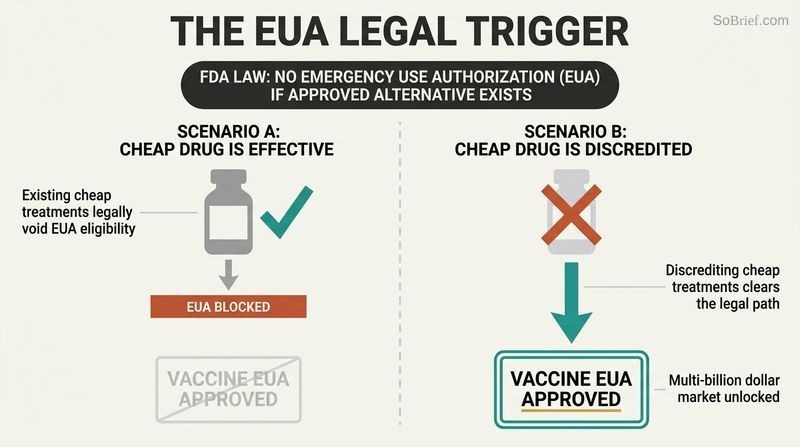
The Surgisphere retraction was real and genuinely scandalous, a legitimate black eye for elite journals. But the broader claim collapses under later evidence: large randomized controlled trials (RECOVERY, WHO Solidarity, the TOGETHER trial, and the NIH ACTIV-6 ivermectin study) found neither hydroxychloroquine nor ivermectin reduced COVID mortality at standard doses in properly designed studies. Kennedy's cited death estimates come largely from observational data and interested clinicians, not controlled trials. The EUA-motive argument is clever and legally accurate, yet a suppressed-cure conspiracy would require silencing thousands of independent international researchers. The lesson worth keeping is narrower: rushed, conflicted, or fraudulent studies (in both directions) corrode trust precisely when it matters most.
Fauci's AZT approval became a reusable playbook for rushing risky drugs
The 1987 AZT saga is the book's Rosetta Stone. Kennedy recounts how azidothymidine, a shelved 1960s cancer drug too toxic to patent, was revived as the first AIDS treatment at up to $10,000 a year. He alleges the trial was halted early, unblinded, riddled with data tampering (patients kept alive only by transfusions logged as "no adverse reactions"), yet declared 95% effective.
From this, Kennedy extracts a template. He argues Fauci repeated the same moves for decades: hype a pathogen, sideline off-patent remedies, stack approval panels with pharma-funded "principal investigators," truncate trials to hide toxicity, and declare victory by press release. The book presents this pattern as the connective tissue linking AIDS, remdesivir, and COVID vaccines.
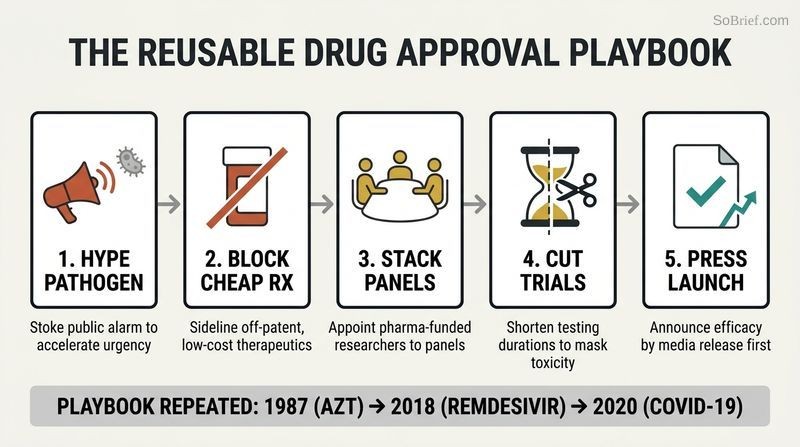
AZT's early high doses were indeed toxic, and the drug's price sparked justified fury from ACT UP, historical facts the book renders vividly. But the framing omits crucial context: AZT at lower doses, and especially in the combination antiretroviral therapy that followed, helped turn HIV from a death sentence into a manageable condition, saving millions. Kennedy's "playbook" is a compelling narrative device, and pattern-recognition is a legitimate analytic tool, but it also risks confirmation bias, forcing every episode into a predetermined mold. The AIDS activist critique of Fauci was real; the claim that antiretrovirals were net killers is not supported by decades of survival data.
Government scientists can legally pocket royalties on drugs they approve
Follow the money to the individual level. Kennedy documents that under a longstanding HHS policy, NIH scientists including Fauci could personally collect up to $150,000 a year in royalties on products they helped develop. He highlights the case of interleukin-2 (Proleukin), on which Fauci held patents while his division spent millions testing it.
The whistleblower who paid the price. Dr. Jonathan Fishbein, hired to enforce ethics in Fauci's AIDS division, discovered these conflicts and the cover-up of a botched Nevirapine trial in Uganda. Kennedy describes how Fishbein was isolated, discredited, and pushed out, becoming radioactive across public health for five years. The episode illustrates the book's claim that dissent inside the agency is systematically crushed.
This is among the book's better-sourced sections because it rests on Associated Press reporting and congressional findings, not just interpretation. Government royalty arrangements under the Bayh-Dole Act and the Federal Technology Transfer Act are real and have drawn bipartisan ethics concern; the AP's 2005 investigation genuinely found NIH scientists collecting undisclosed royalties. The structural point (that inventors evaluating their own inventions face a conflict) is sound and worth institutional reform. Where readers should stay skeptical is the leap from "conflict of interest exists" to "every scientific judgment was therefore corrupt." Conflicts bias judgment probabilistically; they do not automatically falsify every result, and disclosure plus independent replication are the usual remedies.
The book platforms AIDS denialism, science's most thoroughly refuted heresy
Kennedy devotes chapters to questioning whether HIV causes AIDS. He claims to "take no position" while amplifying Peter Duesberg, the Berkeley virologist who argued HIV is a harmless "passenger virus" and that recreational drugs, poppers, and AZT itself caused AIDS. He notes Duesberg's NIH funding vanished after he dissented, framing it as suppression rather than scientific rejection.
The argument leans on Koch's postulates. Kennedy argues no one satisfied the classical criteria proving HIV alone causes AIDS, cites cases of "AIDS without HIV," and invokes Nobel laureate Kary Mullis's skepticism. The chapters function less as science than as a case study in how the author believes orthodoxy silences debate.
This is where the book departs decisively from defensible ground. That HIV causes AIDS is among the most rigorously established facts in modern medicine, confirmed by molecular epidemiology, antiretroviral therapy reversing immune collapse, and the near-elimination of mother-to-child transmission through treatment. Duesberg's hypothesis was tested and failed; its real-world cost was staggering, since South Africa's flirtation with AIDS denialism under Thabo Mbeki is estimated to have caused over 330,000 preventable deaths. Invoking "debate" and Galileo to relitigate settled science is a rhetorical move, not an epistemic one. Genuine science does update, but updating requires evidence Duesberg never produced. This chapter should be read as ideology, not medicine.
His gravest allegations: drug experiments on foster children and Africans
The book's darkest chapters concern the vulnerable. Kennedy details how NIAID-funded trials tested toxic HIV drugs on hundreds of Black and Hispanic foster children at New York's Incarnation Children's Center and facilities in seven states, often without independent advocates as law required. A Vera Institute investigation confirmed 80 children died while in foster care during the studies.
Abroad, he chronicles the Nevirapine trials. In Uganda, a NIAID study of the anti-HIV drug allegedly buried thousands of adverse events and at least 14 deaths, applying looser standards to African subjects. Kennedy frames this within a longer history of medical racism, from Tuskegee to CDC measles experiments, arguing Africa and poor communities became low-cost laboratories for pharma.
These sections draw on genuine journalism (the AP's John Solomon, the BBC's Guinea Pig Kids, the Vera Institute report) and touch a real and shameful history: Tuskegee, Willowbrook, and offshore trials with weak consent are documented ethical disasters. The foster-care trials did happen and did lack required protections, a legitimate scandal. Where care is needed: the Vera Institute found children died while enrolled but could not attribute those deaths to the drugs, since these were often terminally ill kids in the pre-effective-treatment era. Kennedy's framing implies causation the underlying reports did not establish. The ethical failure (inadequate consent and oversight) is real and damning without the added causal claim.
Kennedy reframes Gates's vaccine philanthropy as profit-seeking neocolonialism
"Philanthrocapitalism" is the coined target. Kennedy argues Bill Gates donates strategically to control the WHO (his organizations are among its largest funders), directing global health toward patented vaccines and away from the sanitation, nutrition, and clean water that historically drove down infectious-disease mortality.
His case studies indict specific programs. He cites a Danish-funded study finding the DTP vaccine associated with tenfold higher mortality in African girls, vaccine-strain polio outbreaks from Gates-backed oral polio campaigns in India, HPV trials in India where girls died and consent was forged, and Depo-Provera contraception targeted at Black women. He revives the century-old "germ theory versus miasma" debate to argue Western medicine fixates on pathogens while ignoring the terrain of poverty.
The historical claim has real support: the McKinlays' influential research and CDC data show most 20th-century mortality decline preceded vaccines and antibiotics, driven by sanitation, refrigeration, and nutrition. Critics of Gates-era global health (Linsey McGoey, Global Justice Now) legitimately question the democratic accountability of a private foundation steering the WHO. That said, Kennedy cherry-picks: the Mogensen DTP study was observational and its authors urged more research rather than abandoning vaccination, and smallpox eradication and measles mortality reductions are real vaccine triumphs he underplays. The valuable takeaway is that top-down, technology-first aid can crowd out cheaper structural interventions, a critique development economists like William Easterly make without denying vaccines work.
Pandemic war games rehearsed censorship and control, not treatment
Follow the simulations. Kennedy catalogs over a dozen tabletop exercises (Dark Winter 2001, Atlantic Storm, MARS, SPARS, Clade X, and Gates-funded Event 201 weeks before COVID) that repeatedly gamed the same responses: quarantines, mandatory masking, coerced vaccination, propaganda, and censorship of "misinformation."
His pointed observation: none of these drills focused on boosting immunity, stockpiling therapeutics, or protecting civil liberties. He notes many Event 201 participants (from the CIA's In-Q-Tel, CDC, Johns Hopkins) moved into real pandemic-management roles months later, and documents deep military and intelligence involvement in Operation Warp Speed. The chapters argue biosecurity replaced terrorism as the pretext for expanding a surveillance state and dismantling constitutional rights.
The simulations existed, Event 201 is real and viewable, and the observation that preparedness planning skewed toward control over care is a fair critique that some public-health ethicists share. Scenario planning does shape institutional reflexes, a point RAND strategists have long made. But "rehearsal" is not "blueprint," and predictive accuracy is expected when experts model known threats; foreshadowing is what preparedness is for. The intelligence-agency involvement in biodefense is documented and worth public scrutiny. The interpretive leap Kennedy makes, from coordinated planning to intentional coup against democracy, converts prudent (if illiberal) contingency work into premeditated conspiracy, a jump the evidence of overlapping personnel and shared assumptions does not compel.
Every pandemic since 1976 was hyped for budgets and vaccine sales, he argues
A recurring "cry wolf" pattern anchors the book. Kennedy walks through the 1976 swine flu (one death, but a vaccine that caused hundreds of Guillain-Barre cases), the 2005 bird flu (millions predicted, roughly 100 died), the 2009 swine flu (WHO allegedly redefined "pandemic" to trigger $18 billion in sleeper vaccine contracts), Zika, and dengue.
The dengue case is the deadliest. Sanofi's Gates-and-Fauci-backed Dengvaxia vaccine triggered "pathogenic priming," making children sicker on later infection. After roughly 800,000 Filipino children were vaccinated, hundreds died, and prosecutors filed homicide charges. Kennedy uses these to argue exaggerated fear reliably converts into agency funding and pharmaceutical profit, with modeler Neil Ferguson's serially inflated forecasts as the fear machine.
The strongest material here is factual: the 1976 swine flu program was a genuine fiasco, the 2009 WHO conflict-of-interest findings were reported by the BMJ, and Dengvaxia's antibody-dependent enhancement disaster is real and tragic, a legitimate cautionary tale about rushing vaccines without screening for prior infection. Ferguson's models have indeed missed badly before. But selection bias cuts both ways: cataloging overhyped scares while COVID killed millions risks the gambler's fallacy that because past alarms fizzled, all alarms are false. The honest synthesis is that uncertainty forces officials to act on worst-case models, and both crying wolf and dismissing wolves carry body counts.
Censoring dissent is a religious instinct, not a scientific one
The book's meta-argument is about epistemics. Kennedy contends that "trust the experts" and "scientific consensus" are appeals to authority that belong to religion, not science, which he says advances through skepticism, replication, and open debate. He quotes Fauci's line that attacks on him are "attacks on science" as the tell of a man conflating himself with an institution.
He documents a censorship apparatus. Kennedy describes how his own vaccine articles were scrubbed from Salon, Rolling Stone, and HuffPost, how social media deplatformed dissenters in coordination with government, and how pharma advertising dollars (roughly $9.6 billion a year) buy media silence. The through-line: suppressing questions, however wrong, corrodes both democracy and the self-correcting mechanism of science.
The philosophy-of-science point is legitimate and Popperian: consensus is not proof, and science does progress by falsification and dissent. Heavy-handed pandemic-era content moderation did sometimes suppress claims (like the lab-leak hypothesis) that later gained mainstream traction, vindicating worries about premature censorship. Yet the argument proves too much. "Science thrives on dissent" does not mean all dissent is equally valid; expertise and consensus, while fallible, remain rational defaults under uncertainty. The tension the book never resolves: a functioning society needs both open inquiry and some mechanism to distinguish signal from noise in real time. Kennedy champions the first while treating the second as inherently tyrannical.
He suggests the pandemic's manager may have helped fund its cause
The book closes on gain-of-function. Kennedy documents how funding for research that enhances pathogens' transmissibility, banned under a 2014 Obama moratorium, was routed through Peter Daszak's EcoHealth Alliance to the Wuhan Institute of Virology, with money from NIAID, the Pentagon's DARPA, and BARDA.
The irony he draws is stark. If COVID-19 leaked from experiments Fauci helped fund, then the man two presidents entrusted to manage the pandemic may have helped spawn it. Kennedy details Fauci's late-night January 2020 emails after scientists flagged the virus's unusual "furin cleavage site" as unlikely to be natural, and the subsequent Nature and Lancet letters (privately shaped by Fauci and allies) that branded the lab-leak idea a conspiracy theory, freezing debate for a year.
This chapter has aged better than most of the book. The lab-leak hypothesis, dismissed as fringe in 2020, is now treated as plausible by several intelligence agencies and mainstream scientists, and the Fauci emails and the orchestrated Lancet statement (organized by the conflicted Daszak) are documented. US funding flowing to EcoHealth and Wuhan is established fact, though whether it met the technical definition of gain-of-function, and whether COVID actually originated there, remain genuinely unresolved. The reasonable position sits between Kennedy's certainty and the early reflexive dismissal: the origin is unknown, the funding-and-cover-up questions are legitimate, and the premature branding of inquiry as conspiracy was itself a failure of scientific openness.
Analysis
This is a polemical, prosecutorial history disguised as biography, and it must be read as an argument rather than a neutral account. Kennedy, a veteran environmental litigator, structures the book like a closing statement: marshal every damaging fact, connect them into a pattern of intent, and cast Anthony Fauci as the through-line of a 50-year criminal enterprise. Its power comes from real material (regulatory capture, pharma's grip on journals and media, government royalty conflicts, offshore trial abuses, the Dengvaxia and 2009 swine flu scandals, and the Wuhan funding cover-up) woven with sworn-sounding certainty. Its danger comes from mixing that documented material with thoroughly refuted claims, above all HIV/AIDS denialism, presented under the guise of open debate. The book's fatal methodological flaw is monocausality: it treats correlation as conspiracy, interprets every ambiguity as malice, and forces four decades of complex science and institutional behavior into a single villain's playbook. Confirmation bias is the operating system. Readers should separate three layers. First, legitimate structural critique of misaligned incentives in biomedicine, which mainstream figures like Marcia Angell and Richard Horton share and which deserves reform. Second, contested empirical claims (early COVID treatments, vaccine risk-benefit) where Kennedy relies on observational data and interested clinicians against the weight of randomized trials. Third, pseudoscience (AIDS denialism, vaccine-autism links) that has been tested and failed, sometimes lethally. The book's real value for a critical reader is not its conclusions but its uncomfortable questions: who audits the auditors, how conflicts of interest distort research, why censorship backfired on the lab-leak question, and whether preparedness planning drifted toward control at the expense of care and liberty. Those questions survive even when Kennedy's answers do not. Approached as a flawed but provocative adversarial brief, not as settled fact, it sharpens scrutiny of institutions that genuinely earned some of it.
Review Summary
The Real Anthony Fauci has polarized readers, with many praising its detailed research and exposé of alleged corruption in the medical industry, while others dismiss it as dangerous misinformation. Supporters view it as a crucial revelation of government and pharmaceutical misconduct, particularly regarding COVID-19 policies. Critics argue the book misrepresents facts and promotes conspiracy theories. Some readers found the extensive references compelling, while others claim these sources are often mischaracterized. The book's controversial nature has sparked intense debate about public health policies, vaccine efficacy, and institutional trust.
People Also Read
Glossary
Regulatory capture
Regulators serving industry, not publicAn economic and political phenomenon in which an agency created to regulate an industry comes to advance that industry's commercial interests instead of the public's. Kennedy applies it aggressively to the FDA, CDC, and NIH, arguing pharmaceutical funding (user fees, patents, royalties) and personnel ties transformed America's health regulators into what he calls subsidiaries of Big Pharma.
Principal Investigators (PIs)
Grant-funded academic drug researchersIn Kennedy's usage, the network of a few hundred academic and hospital scientists who conduct drug and vaccine clinical trials on grants and contracts from NIAID and pharmaceutical companies. He argues they function as an industry-loyal army that populates the FDA and CDC approval panels, controls journals and medical boards, and enforces orthodoxy while rooting out dissent.
Pathogenic priming
Vaccine worsens later real infectionAlso called antibody-dependent enhancement (ADE). A phenomenon where a vaccine or prior exposure primes the immune system so that a subsequent encounter with the wild virus produces more severe disease rather than protection. Kennedy cites it as the mechanism behind deaths in the Dengvaxia dengue vaccine program in the Philippines and as a recurring hazard in coronavirus vaccine development.
Philanthrocapitalism
Charity that generates profit and controlThe term Kennedy uses for Bill Gates's model of strategic giving, in which tax-deductible donations are directed to gain control over global health institutions like the WHO while the foundation's investments in pharmaceutical and other companies profit from the policies it promotes. Kennedy argues it privatizes public health policy and prioritizes patented vaccines over sanitation and nutrition.
Gain-of-function research
Lab-enhancing a pathogen's dangerExperiments that intentionally modify a pathogen to increase its transmissibility, virulence, or host range, ostensibly to anticipate future threats. Subject to a 2014 US moratorium, this research was, per Kennedy, funded via EcoHealth Alliance at the Wuhan Institute of Virology using NIAID, DARPA, and BARDA money, raising the possibility that COVID-19 originated from work Fauci helped fund.
Event 201
Gates-funded 2019 pandemic simulationA tabletop coronavirus pandemic exercise co-hosted by the Gates Foundation, Johns Hopkins, and the World Economic Forum in October 2019, weeks before COVID-19 emerged. Kennedy presents it, alongside exercises like Dark Winter and Crimson Contagion, as a rehearsal for censorship, propaganda, and coerced vaccination rather than for treatment or protecting civil liberties.
Fauxcebo
Fake placebo hiding drug harmsKennedy's term for a reactogenic or active substance used in place of an inert placebo in a clinical trial. By causing side effects in the comparison group, it masks injuries in the group receiving the drug or vaccine being tested. He alleges its use in trials for remdesivir and vaccines to make dangerous products appear safe.
FAQ
1. What is The Real Anthony Fauci by Robert F. Kennedy Jr. about?
- Critical examination of Fauci: The book investigates Dr. Anthony Fauci’s decades-long career, focusing on his influence over U.S. and global public health policy, especially during the AIDS and COVID-19 crises.
- Allegations of corruption: It alleges that Fauci prioritized pharmaceutical profits over public health, manipulated data, and suppressed dissenting voices and alternative treatments.
- Broader systemic critique: The narrative extends to Fauci’s alliances with Bill Gates, Big Pharma, media, and government agencies, suggesting a coordinated effort to control health policy and public perception.
- Historical and global context: The book situates these actions within a larger history of medical imperialism, regulatory capture, and the rise of the biosecurity state.
2. Why should I read The Real Anthony Fauci by Robert F. Kennedy Jr.?
- Unveils hidden conflicts: The book claims to expose conflicts of interest and corruption within public health leadership, offering a perspective often absent from mainstream media.
- Challenges mainstream narratives: It encourages readers to question official accounts of pandemic management, vaccine safety, and the suppression of alternative treatments.
- Comprehensive research: The author provides extensive references, testimonies, and historical context to support his arguments, fostering critical thinking.
- Call to civic engagement: Kennedy urges readers to defend democratic freedoms and demand transparency in public health policy.
3. What are the key takeaways from The Real Anthony Fauci by Robert F. Kennedy Jr.?
- Pattern of regulatory capture: The book argues that Fauci transformed NIAID into a subsidiary of Big Pharma, prioritizing patented drugs and vaccines over public health.
- Suppression of dissent: It details how scientific debate and alternative treatments were stifled through media manipulation, censorship, and intimidation of whistleblowers.
- Pandemic mismanagement: The author claims that policies like lockdowns, mask mandates, and vaccine rollouts caused unnecessary harm and economic devastation.
- Global health power dynamics: The book highlights the influence of philanthrocapitalism, especially through Bill Gates, in shaping global health agendas for profit.
4. How does The Real Anthony Fauci by Robert F. Kennedy Jr. describe Dr. Fauci’s relationship with the pharmaceutical industry?
- Financial entanglements: Fauci is portrayed as deeply intertwined with pharmaceutical companies, controlling billions in research grants and personally receiving royalties from products developed under his oversight.
- Regulatory capture: The book alleges that Fauci influenced agencies like the FDA and CDC to fast-track Pharma-favored products and suppress competitors.
- Control over scientific narrative: Fauci is said to reward loyal scientists and punish dissenters, shaping research, publications, and public health policies to align with pharmaceutical interests.
- Systemic corruption: The author likens Fauci’s influence to a “vendetta system” that undermines genuine scientific inquiry.
5. What are the main criticisms of Dr. Fauci’s pandemic management in The Real Anthony Fauci?
- Science-free mandates: The book claims that policies on masking, social distancing, and lockdowns lacked solid scientific backing and caused more harm than good.
- Suppression of early treatments: Fauci allegedly suppressed effective, inexpensive treatments like hydroxychloroquine and ivermectin to promote vaccines and patented drugs.
- Data manipulation and censorship: The author accuses Fauci and agencies under his influence of manipulating COVID data, inflating death counts, and collaborating with media and tech companies to censor dissenting opinions.
- Economic and social fallout: The book argues that these policies led to excess deaths, mental health crises, and the largest upward wealth transfer in history.
6. How does The Real Anthony Fauci by Robert F. Kennedy Jr. address the controversies around hydroxychloroquine (HCQ) and ivermectin?
- Proven safety and efficacy: The book describes HCQ and ivermectin as safe, effective, and well-studied drugs that were deliberately discredited during the pandemic.
- Coordinated suppression: Fauci, Bill Gates, WHO, and pharmaceutical interests are accused of orchestrating campaigns to discredit these drugs through fraudulent studies, regulatory barriers, and media censorship.
- Financial motives: The suppression is linked to protecting vaccine and patented drug profits, with alternative treatments seen as threats to pharmaceutical revenue.
- Impact on public health: The author argues that sidelining these treatments prolonged the pandemic and increased deaths.
7. What does The Real Anthony Fauci by Robert F. Kennedy Jr. claim about COVID-19 vaccines and their approval process?
- Leaky vaccines and ADE risk: The book asserts that COVID-19 vaccines do not provide sterilizing immunity and may increase the risk of antibody-dependent enhancement (ADE).
- Shortened trials and data suppression: It alleges that vaccine trials were cut short, adverse event reporting was suppressed, and information about vaccine injuries and deaths was censored.
- Regulatory capture and conflicts: Fauci’s influence over FDA and CDC committees, many with financial ties to Pharma, is said to have facilitated rapid vaccine approvals despite safety concerns.
- Mandates based on false premises: The book highlights official admissions that vaccines do not prevent transmission, questioning the rationale for mandates.
8. How does The Real Anthony Fauci by Robert F. Kennedy Jr. critique the handling of the HIV/AIDS crisis and related drug trials?
- Questioning HIV as sole cause: The book presents dissenting scientists who argue that HIV alone does not cause AIDS and that other factors like drug use and environmental exposures are significant.
- AZT toxicity and harm: Fauci is accused of promoting highly toxic drugs like AZT, which allegedly caused more harm than AIDS itself.
- Suppression of alternative hypotheses: Dissenting voices and alternative treatments were allegedly silenced through control of research funding and media narratives.
- Unethical drug trials: The book exposes experiments on foster children and African populations, highlighting lack of consent and high rates of harm.
9. What does The Real Anthony Fauci by Robert F. Kennedy Jr. reveal about the partnership between Bill Gates, Dr. Fauci, and global health agencies?
- Strategic alliance: Gates and Fauci are depicted as partners who direct billions into vaccine programs and drug trials, especially in Africa and Asia.
- Philanthrocapitalism critique: Gates’s philanthropy is portrayed as a business model that expands corporate profits and control over global health policies.
- Influence over WHO: Gates’s financial contributions are said to give him outsized influence over WHO’s budget and priorities, shaping international health agendas.
- Ethical concerns: The book accuses global health agencies of coercing vulnerable populations into accepting experimental vaccines without informed consent.
10. How does The Real Anthony Fauci by Robert F. Kennedy Jr. describe the rise of the “Biosecurity State” and pandemic simulations?
- Biosecurity as control: The book argues that the biosecurity state emerged as a new justification for government spending and control, replacing Cold War threats with infectious diseases and bioterrorism.
- Integration of intelligence and health agencies: Agencies like the CIA, Pentagon, and HHS are said to collaborate with pharmaceutical firms to develop bioweapons and pandemic preparedness plans.
- Pandemic simulations as rehearsals: Exercises like Dark Winter and Event 201 are portrayed as blueprints for imposing authoritarian measures, including censorship and forced vaccination.
- Erosion of civil liberties: The author links the biosecurity agenda to the dismantling of constitutional rights and the rise of centralized global governance.
11. What are the book’s claims about vaccine safety, adverse events, and the ethics of vaccinating children in The Real Anthony Fauci by Robert F. Kennedy Jr.?
- Underreporting of injuries: The book claims that systems like VAERS significantly undercount vaccine injuries and deaths, with regulatory agencies admitting their limitations.
- Spike in reported deaths: It highlights a dramatic increase in deaths and serious injuries reported after COVID-19 vaccines, especially among youth.
- No benefit to children: The author argues that healthy children have near-zero risk from COVID-19 and that vaccines offer them no meaningful benefit, making mandates unethical.
- Ethical condemnation: Vaccinating children is described as “highly unethical,” with mandates likened to medical malpractice.
12. What are the best quotes from The Real Anthony Fauci by Robert F. Kennedy Jr. and what do they mean?
- On liberty and safety: “Those who would give up essential liberty, to purchase a little temporary safety, deserve neither liberty nor safety.” —Benjamin Franklin. This underscores the book’s warning against sacrificing freedoms for pandemic measures.
- On scientific consensus: “Consensus is the business of politics. Science, on the contrary, requires only one investigator who happens to be right... If it’s consensus, it isn’t science.” —Michael Crichton. This highlights the book’s critique of enforced orthodoxy in science.
- On Fauci’s power: “Dealing with Tony Fauci is like dealing with organized crime.” —Dr. Fishbein. This metaphor illustrates the alleged control and suppression of dissent within public health institutions.
- On medical colonialism: “They are here to save the world, as long as the world yields to their interests.” —Linsey McGoey. This critiques the Gates/Fauci approach as prioritizing Western and corporate interests over local autonomy.
- On the new normal: “Many of us are pondering when things will return to normal. The short response is: never.” —Klaus Schwab. This reflects the book’s warning about permanent shifts toward authoritarian governance.
About the Author
Other books by Robert F. Kennedy Jr.
Download PDF
Download EPUB
.epub digital book format is ideal for reading ebooks on phones, tablets, and e-readers.








































