
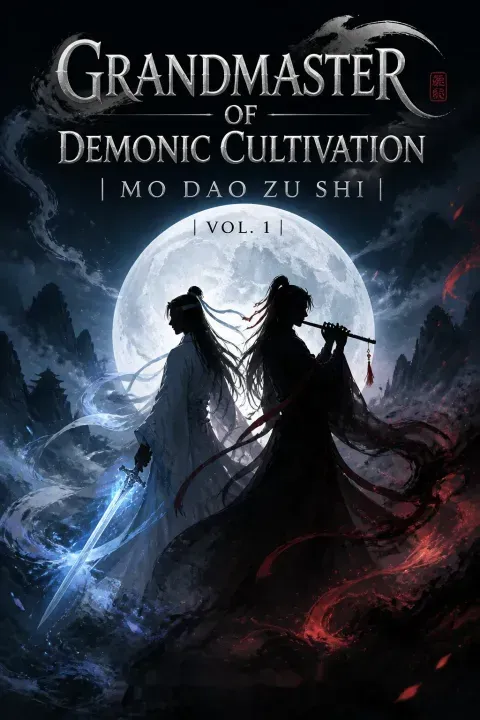


Plot Summary
Reunion with Flesh
Wei Wuxian1 opens his eyes to a boot in his ribs and a stranger screaming about stolen goods. The body he inhabits belongs to Mo Xuanyu, whose face is caked in sloppy white makeup and rouge.
Scattered writings reveal the truth: Mo Xuanyu, an illegitimate son of the late Jin Guangshan, was expelled from the Jin Clan for harassing his peers and returned home mentally shattered. His aunt Madam Mo and her son Mo Ziyuan have tormented him ever since, stealing his remaining cultivation tools. The blood-drawn array beneath him is a Sacrificial Ritual.
Mo Xuanyu offered his own soul to summon a vengeful spirit for revenge. Wei Wuxian1 inspects his new wrists, slashed with wounds that will not heal unless he fulfills the caster's dying wish. The problem: Mo Xuanyu's incomplete ritual never specified exactly what that wish entails.
The resurrection establishes the volume's central tension between free will and forced obligation. Wei Wuxian, once the most feared cultivator alive, now inhabits a body that was literally discarded. The sacrificial ritual functions as a narrative trap: he cannot escape until he satisfies a dead man's unknown desire, forcing him to engage with a world that reviled him. The smeared makeup becomes a visual metaphor for mistaken identity, while the unhealed wrist wounds externalize unfinished business. Mo Xuanyu's tragedy (illegitimate birth, rejection, mental collapse, abuse) mirrors Wei Wuxian's own history of demonization, creating an uncomfortable kinship between summoner and summoned.
Whispers from a Severed Arm
That night, chaos erupts. Mo Ziyuan is found dead, his body drained and aged, his left arm torn away. Madam Mo accuses Wei Wuxian,1 but a stolen spirit-attraction flag hidden in the corpse's robes tells the true story: Mo Ziyuan swiped one of the Lan disciples' flags, attracting an entity far more vicious than the walking corpses they were hunting.
Madam Mo's husband dies next, his left arm also ripped off. Then the servant A-Tong strangles himself with his own left hand before the horrified crowd. Wei Wuxian1 realizes the culprit is a severed left arm that possesses hosts through their own left limbs, draining their life force before moving on.
When Madam Mo herself is taken, Wei Wuxian1 raises her, her husband, and Mo Ziyuan as fierce corpses to fight the arm. They are losing when two guqin notes ring out from the distance. Lan Wangji2 has arrived. Wei Wuxian1 flees into the night, stealing a spotted donkey named Little Apple.
This section introduces the volume's central mystery object: the dismembered corpse whose body parts possess and kill. The left arm operates with a chilling logic (replacing hosts' left limbs, draining vitality) that suggests both cruelty and purpose. Wei Wuxian's instinctive use of fierce corpses to fight the arm reveals his expertise has survived death, even as his new body lacks power. His flight at Lan Wangji's approach establishes the central relationship conflict: Wei Wuxian assumes Lan Wangji will be his enemy, not knowing what has changed in thirteen years. The donkey becomes an unlikely companion that grounds the horror in comic relief.
The Dancing Stone Goddess
At Mount Dafan, seven locals have lost their souls, beginning with a deadbeat who suddenly grew rich, married, and died on his wedding night. The accepted explanation blames a soul-eating fiend from disturbed graves.
Wei Wuxian1 pieces together the truth: the culprit is the Shrine of the Heavenly Maiden, a natural rock formation resembling a dancing woman that centuries of worship transformed into a minor god. It grants wishes in exchange for souls. The deadbeat wished for wealth on the night of the landslide; the statue exposed grave goods for him, then collected his soul.
A young woman named A-Yan wished for her fiancé's eternal love; the statue killed him the next day. When A-Yan's father begged for her recovery, the statue took his soul instead, returning hers damaged. Wei Wuxian1's insight: the creature is not a monster that spiritual weapons can harm, but a corrupted deity operating on divine contract logic.
The Heavenly Maiden case functions as a microcosm of the volume's larger themes: the danger of unanswered prayers, the corruption inherent in worship, and the way desperate people bargain with forces they do not understand. Wei Wuxian's deductive process (noticing that dead souls remained uneaten, reversing the assumed timeline of landslide and soul-loss) demonstrates his defining trait: he sees patterns others miss by questioning consensus. The statue itself is a brilliant antagonist, a god created by human faith that now feeds on human souls, immune to tools designed for fighting demons. It is a commentary on how institutions become predatory while retaining their sacred veneer.
The Ghost General Returns
As the Heavenly Maiden chases the junior cultivators, Wei Wuxian1 carves a crude bamboo flute and plays. From the dark forest, Wen Ning5 emerges, chains dragging, eyes pupilless white. The Ghost General,5 thought destroyed thirteen years ago, tears the stone goddess apart with his bare hands.
But the cultivators' terror shifts from the statue to Wen Ning;5 they surround him. Wei Wuxian1 plays a calming melody to control Wen Ning5's aggression. Lan Wangji2 arrives and grips Wei Wuxian1's wrist, stopping the flute. Wen Ning5 retreats. Then Jiang Cheng3 storms in, demanding to know who summoned Wen Ning.5
He strikes Wei Wuxian1 with Zidian, the purple lightning whip that expels possessing souls. Nothing happens. Wei Wuxian1 was offered the body, not possessing it. Frustrated, Jiang Cheng3 still tries to seize him. Wei Wuxian,1 desperate, claims he is attracted to Hanguang-jun2's type. Lan Wangji2 calmly announces he will take this man to the Cloud Recesses.
This turning point crystallizes the complex web of past relationships. Wen Ning's appearance confirms that the remnants of Wei Wuxian's former life are returning, whether he wants them or not. Jiang Cheng's use of Zidian and its subsequent failure to expose Wei Wuxian becomes a cruel irony: Jiang Cheng is right about Wei Wuxian's identity but his tool of proof fails him. Lan Wangji's claim over Wei Wuxian (the man who just publicly flirted with him) is the first overt sign that Lan Wangji already knows exactly who this is. The scene operates on dramatic irony: the audience understands what the characters are just missing.
Scars Beneath the Cold Spring
Wei Wuxian1 is dragged into the Cloud Recesses, the Lan Clan's mountain home, wailing about the four thousand rules carved on the Wall of Discipline. Lan Xichen,10 the gentle clan leader, seems amused his brother brought a guest.
Left alone in the Tranquility Room, Lan Wangji2's private quarters, Wei Wuxian1 discovers a hidden floorboard concealing jars of Emperor's Smile, the very liquor Lan Wangji2 once punished him for drinking. He helps himself. Later, seeking a jade travel token to escape, he sneaks to the cold spring. There he sees Lan Wangji2 bathing: his back is covered with over thirty discipline whip scars, and below his collarbone is a branding mark identical to one Wei Wuxian1 once bore.
These are scars of grievous punishment and unexplained suffering. That night, Wei Wuxian1 climbs into Lan Wangji2's bed to provoke him, but Lan Wangji2 simply paralyzes him and arranges him into a proper sleeping position until morning.
The Cloud Recesses becomes a prison that is also a sanctuary. Wei Wuxian's discovery of the hidden Emperor's Smile, kept for thirteen years and untouched, and the scars on Lan Wangji's body undermines his assumption that Lan Wangji is still the rigid, disapproving figure from his youth. The whip scars suggest Lan Wangji committed some grave transgression, while the brand mark creates a physical connection between them that Wei Wuxian cannot explain. The bed scene establishes the new dynamic: Wei Wuxian's old tricks (teasing, physical provocation) no longer rattle Lan Wangji. Instead, Lan Wangji has learned to endure and quietly reciprocate, leaving Wei Wuxian disoriented.
Emperor's Smile on the Wall
Fifteen years earlier, Wei Wuxian,1 Jiang Cheng,3 and other young masters arrive at the Cloud Recesses as visiting students. On his very first night, Wei Wuxian1 sneaks out to buy Emperor's Smile liquor from Gusu City. Climbing back over the wall, he encounters Lan Wangji,2 a pristine white-clad boy his own age with a frozen expression and a sword.
Lan Wangji2 demands to know what he is carrying. Wei Wuxian1 offers to share the liquor if Lan Wangji2 pretends he saw nothing. Instead, Lan Wangji2 attacks. They fight briefly on the rooftop; a jug of Emperor's Smile is destroyed.
Wei Wuxian,1 undeterred, sits on the wall and drinks the remaining jug in front of Lan Wangji,2 asking if drinking outside the wall still counts as rule-breaking. He then tells Lan Wangji2 he will share a jug next time too. Lan Wangji2 is left sputtering in outrage at this flagrant disregard for the Cloud Recesses' three thousand rules.
This first meeting establishes the fundamental dynamic between the two characters: Wei Wuxian as chaos agent who treats rules as negotiable social conventions, Lan Wangji as order incarnate who experiences rule-breaking as personal violation. But Wei Wuxian's offer to share the liquor is not pure provocation; it is a genuine attempt at connection through his own terms of friendship (shared pleasure, shared transgression). Lan Wangji's refusal and retaliation come from a worldview where such offers are inherently corrupting. The destroyed jug of Emperor's Smile becomes a symbolic debt that Wei Wuxian will remember for the rest of his life, and Lan Wangji will secretly repay.
Frivolity in the Library
Lan Qiren,11 the strict teacher, assigns Wei Wuxian1 to copy the Lan family precepts in the Library Pavilion under Lan Wangji2's supervision. Wei Wuxian1 quickly discovers his new favorite pastime: provoking reactions from the impassive boy. He calls Lan Wangji2 by his birth name, Lan Zhan.
When silenced by the Lan silencing spell, he writes notes. He draws a remarkably accurate portrait of Lan Wangji,2 then adds a flower behind the ear and gifts it to him. His crowning achievement: swapping Lan Wangji2's Buddhist sutra with an erotic picture book disguised with the same cover.
Lan Wangji2 opens it to find naked figures entangled, hurls the book away, draws his sword, and shouts at Wei Wuxian1 to get lost. It is the first time anyone has ever heard Lan Wangji2 tell someone to leave. Wei Wuxian1 exits through the window, laughing uncontrollably, declaring victory over the famed self-restraint of the Lan Clan.
The Library Pavilion sequence transforms discipline into intimacy. Wei Wuxian's relentless teasing is not mere mischief; it is a systematic campaign to locate the human inside the jade statue. Each escalation (the name, the portrait, the erotica) tests a boundary, and each time Lan Wangji's composure cracks a little more. The erotica prank is particularly revealing: Wei Wuxian frames it as sharing something he enjoys, an extension of his earlier offer of Emperor's Smile. His philosophy of friendship involves mutual participation in forbidden pleasures. Lan Wangji's explosive reaction is fascinating because it is not just anger; it is embarrassment, betrayal of his own curiosity, and the shattering of his carefully maintained detachment.
The Waterborne Abyss Hunt
Lan Xichen10 invites Wei Wuxian1 and Jiang Cheng3 to join a night hunt at Caiyi Town, where water ghosts have been drowning travelers. On the river, Wei Wuxian1 proves his expertise by noticing that Lan Wangji2's boat is riding too low: water ghosts cling to its bottom. He splashes Lan Wangji2 to distract the ghosts, then flips the boat to expose them.
When a Waterborne Abyss (a sentient, predatory current) threatens to swallow the group, Lan Wangji2 saves Wei Wuxian1 by grabbing his collar and lifting all three of them (Wei Wuxian,1 himself, and the disciple Su She) into the air on his sword.
Afterward, Lan Xichen10 reveals the Abyss was driven there by the Wen Clan of Qishan. On the return trip, Wei Wuxian1 flirts with women selling loquats along the canals, gets free fruit, and teases Lan Wangji2 about not receiving any. Lan Wangji2 refuses to participate, but Lan Xichen10 gently asks if he would like to buy some loquats.
This section demonstrates Wei Wuxian's competence in a way that earns respect even from the rigid Lan Clan. His water ghost detection method is practical experience over theoretical knowledge, a recurring contrast. The Waterborne Abyss serves as the first glimpse of the Wen Clan's predatory politics, foreshadowing the coming war. Lan Wangji's rescue (grabbing by the collar because he does not touch others) is both heroic and revealingly awkward. The loquat scene crystallizes the romantic subtext: Wei Wuxian is showered with gifts for his charm, while Lan Wangji stands apart, refusing to participate in such frivolity yet clearly affected. Lan Xichen's quiet question to his brother suggests he already perceives what Lan Wangji cannot acknowledge.
Rabbits and Broken Betrothals
Wei Wuxian1 brings Lan Wangji2 two wild rabbits as a peace offering. Lan Wangji2 initially refuses until Wei Wuxian1 threatens to have them butchered for food. The rabbits stay in the Cloud Recesses, multiplying over the years. But Wei Wuxian1's time at Gusu ends badly.
During a discussion about ideal partners, Jin Zixuan,14 the arrogant Jin heir engaged to Jiang Yanli,13 dismisses his fiancée with contempt. Wei Wuxian1 punches him. The resulting disciplinary meeting brings their fathers, Jiang Fengmian and Jin Guangshan. Jiang Fengmian proposes canceling the engagement, and Jin Guangshan agrees.
Wei Wuxian,1 who instigated the fight out of protective fury for his beloved shijie,13 has accidentally cost her the marriage alliance. He is sent back to Yunmeng in disgrace, yet characteristically refuses to show remorse for defending Jiang Yanli13's honor. His friendship with Lan Wangji2 has been established, fragile but real.
The rabbits become the volume's most enduring emotional symbol: Lan Wangji keeps and protects them for thirteen years after Wei Wuxian's death, a silent, constant memorial to their relationship. The engagement cancellation showcases the collateral damage of Wei Wuxian's impulsiveness. His love for Jiang Yanli is fierce and pure, but his method of expressing it (violence, public confrontation) has consequences he cannot control. Jiang Fengmian's swift move to cancel the engagement hints at existing tensions and perhaps relief at escaping a politically awkward alliance. Wei Wuxian's departure from Cloud Recesses closes the first chapter of his relationship with Lan Wangji on an unresolved note.
Duet in the Nether Room
Back in the present, alarm bells shriek from the Cloud Recesses' Nether Room. The ghost arm, brought from the Mo Estate, has overpowered the soul-summoning ritual. Lan Qiren11 and other Lan elders lie unconscious, bleeding from their facial apertures. Wei Wuxian1 kicks open the sealed doors and enters.
Only Lan Wangji2 remains upright, his guqin strings vibrating with protective energy. Wei Wuxian1 takes position opposite him and joins his bamboo flute to Lan Wangji2's guqin. They play 'Evocation' together, attempting to summon the arm's original soul, but nothing answers. The soul has been split along with the body.
They switch to 'Rest' to pacify the arm. Wei Wuxian1 plays deliberately off-key, poorly enough that the unconscious Lan Qiren11 bolts upright yelling at him to stop before collapsing again. When the arm finally quiets, its index finger points northwest, showing them where to search next.
The duet in the Nether Room is the volume's central metaphor for Wei Wuxian and Lan Wangji's relationship: two opposing forces creating harmony together. 'Evocation' fails because the soul itself is fragmented, suggesting the dismemberment was not just physical but spiritual violence. 'Rest' succeeds because it does not demand answers; it offers peace. Wei Wuxian's deliberately bad playing (to maintain his cover) is a comic beat with deeper resonance: even his worst effort, combined with Lan Wangji's mastery, achieves results. The pointing arm transforms their quest from containment to pursuit; they are no longer suppressing the body parts but actively seeking them out, committing to the investigation together.
Buried Alive in Qinghe
Following the arm's direction, Wei Wuxian1 and Lan Wangji2 arrive at Xinglu Ridge in Qinghe, where rumors tell of a Man-Eating Fortress. Jin Ling4 has already broken into the stone bunkers there. Inside, they find coffins containing sabers, not bodies, and walls that whisper with countless voices. Using 'Inquiry' on his guqin, Lan Wangji2 learns Jin Ling4 is 'right here.'
They tear down a wall and dig the suffocating boy out of packed black dirt. The walls are filled with corpses. After carrying Jin Ling4 to safety in Qinghe town, Wei Wuxian1 strips him to check for injuries and discovers a black curse mark spreading up his leg.
Before he can treat it, Jiang Cheng3 captures Wei Wuxian1 using Jin Ling4's spirit dog, exploiting Wei Wuxian1's lifelong terror of canines. In a locked inn room, Jiang Cheng3 interrogates him with venomous familiarity. Jin Ling4 intervenes with a lie about spotting Wen Ning,5 giving Wei Wuxian1 an opening to escape. Before fleeing, Wei Wuxian1 transfers the curse mark to his own leg.
The wall-burial scene literalizes what the volume explores metaphorically: people entombed by secrets, trapped within structures built to contain dangerous truths. Jin Ling's near-death creates the volume's most intense rescue sequence while also drawing Jiang Cheng into direct confrontation with Wei Wuxian. Jiang Cheng's interrogation is the emotional core of the book: thirteen years of grief and rage compressed into a single conversation, his intimate knowledge of Wei Wuxian (the dog fear, the mannerisms) weaponized against the person he once loved most. Wei Wuxian's apology to Jin Ling and his silent transfer of the curse mark demonstrate his guilt over Jiang Yanli's death transforming into protective, painful care for her son.
The Head-Shaker Confesses
Lan Wangji2 catches the spy who fled Xinglu Ridge: Nie Huaisang,7 the current head of the Nie Clan, nicknamed the Head-Shaker7 for his habit of crying ignorance when pressed. Under pressure in an inn room, Nie Huaisang7 confesses the Nie Clan's darkest secret. The stone bunkers are the Saber Offerings Hall, an ancestral tomb where the clan's cursed sabers are pacified by burying them alongside corpses.
The Nie sabers, wielded by generations of clan leaders, accumulate such intense killing intent that they drive their masters to fatal qi deviation, as happened to Nie Huaisang7's brother, Nie Mingjue.12 To prevent the sabers from rampaging after their masters' deaths, corpses on the verge of becoming fierce are sealed in the walls as sacrificial offerings.
The Man-Eating rumor was spread deliberately to keep people away. Examining the wall corpses, Wei Wuxian1 discovers one whose legs have been stitched onto a different torso: these are the legs of their dismembered victim, hidden here by someone who knew the Nie Clan's burial customs.
The Saber Offerings Hall revelation transforms the volume's horror from supernatural to systemic. The Nie Clan's solution (burying the dead to pacify the weapons of the dead) is a metaphor for how trauma and violence perpetuate across generations. Nie Huaisang's Head-Shaker persona, dismissed by the cultivation world as pathetic incompetence, may conceal a more calculating awareness of his clan's impossible situation. The stitched legs confirm that the dismemberment was not random but carefully planned by someone with intimate knowledge of multiple clans' secret practices, suggesting a conspiracy that reaches into the highest levels of cultivation society.
The Chang Clan's Screaming Coffins
In Yueyang, Wei Wuxian1 learns of the Chang Clan massacre: an entire family of cultivators was found dead after a night of pounding on their own sealed doors. The lone survivor, Chang Ping, later died by lingchi (death by a thousand cuts), his eyes gouged out. Lan Wangji2 reveals the full history.
The murderer was Xue Yang,9 a teenage delinquent with an uncanny talent for demonic cultivation. When Xiao Xingchen8 (a righteous wandering cultivator and Wei Wuxian1's martial uncle through their shared master Baoshan-sanren) captured Xue Yang9 and presented evidence at Golden Carp Tower, the Jin Clan protected Xue Yang9 because he was restoring the Yin Tiger Tally, Wei Wuxian1's most dangerous creation.
Nie Mingjue12 eventually forced a death sentence, but the Jin Clan secretly kept Xue Yang9 alive. After his release, Xue Yang9 massacred Xiao Xingchen8's friend Song Lan's temple and blinded him. Xiao Xingchen8 gave Song Lan his own eyes and vanished. Years later, Chang Ping was killed with Xiao Xingchen8's sword.
The Chang Clan case functions as the volume's moral center, exposing the cultivation world's systemic corruption. The Jin Clan's protection of Xue Yang because of the Yin Tiger Tally implicates Wei Wuxian's own legacy in the tragedy, even though he never intended such consequences. Xiao Xingchen represents the idealism Wei Wuxian might have embraced under different circumstances: a lone cultivator seeking justice outside clan politics. His fate (giving his eyes to his friend, then vanishing) is sacrificial in a way that mirrors and contrasts with Wei Wuxian's own path. The unsettled question of who killed Chang Ping with Xiao Xingchen's sword creates lingering unease; justice remains incomplete.
Drunk Confessions by Moonlight
That night at the Chang cemetery, a gravedigger attempts to excavate a corpse. Wei Wuxian1 and Lan Wangji2 intervene, fighting the masked figure whose sword techniques mirror the Lan Clan's style. The gravedigger escapes via a transportation talisman but drops the prize: the torso of their dismembered victim, fitted with fake cotton limbs.
With three major body parts now collected, they return to the inn. Wei Wuxian1 convinces Lan Wangji2 to drink a single bowl of liquor. Lan Wangji2 falls asleep instantly, then wakes up drunk: outwardly composed but with his boots on the wrong feet.
Drunk Lan Wangji2 slaps Wen Ning5 (whom Wei Wuxian1 secretly summoned), refuses to let Wei Wuxian1 play the flute for anyone else, and when Wei Wuxian1 points at himself asking what this one is, Lan Wangji2 responds with fierce sincerity: 'Mine.' Wei Wuxian1 assumes Lan Wangji2 means the sword Bichen. Drunk Lan Wangji2 then paralyzes Wei Wuxian1 at hai time and arranges them both to sleep properly.
The drunk scene is the volume's most emotionally transparent moment. Lan Wangji's inhibitions, maintained with iron discipline while sober, dissolve with a single bowl of liquor. His possessiveness over Wei Wuxian, his jealousy toward Wen Ning, and his childlike insistence on routine all emerge with startling clarity. Wei Wuxian's misinterpretation of 'Mine' (assuming it refers to the sword) is the crucial dramatic irony: the reader understands what Wei Wuxian refuses to see. Lan Wangji's devotion, which has survived thirteen years of absence and grief, is so absolute that even his drunken self maintains it with perfect consistency. The scene is both comic and devastating.
Toward the Ghost City
Wei Wuxian1 stages a prank the next morning: he strips their clothing to make Lan Wangji2 believe something happened between them while drunk. Lan Wangji2's visible horror is worth the effort, but Wei Wuxian1 quickly reveals the joke.
After they subdue the morning's agitated limbs with another 'Rest' duet, Wei Wuxian1 goes outside and finds children playing a game that reenacts the Sunshot Campaign. A child playing Lan Wangji2 stands silent, accurately capturing the man's reticence. Watching them, Wei Wuxian1 feels an unexpected happiness.
When Lan Wangji2 joins him, they discuss the case: the dismemberment was a malicious subduing spell, the gravedigger is someone connected to both the Lan and Nie Clans, and the conspiracy is tightening. They still need the right arm and the head. The severed arm points southwest. Their next destination is Shudong, a fog-shrouded ghost city that locals avoid at all cost.
The children's game functions as a mirror reflecting how the cultivation world's history has become mythology, with roles simplified into heroes and villains. Wei Wuxian's reaction to seeing himself played as a boastful villain reveals his hard-won detachment from his own reputation; the tiny sting is immediately soothed by the sight of the silent child playing Lan Wangji. The volume ends on a note of unresolved pursuit, typical of serialized storytelling, but the emotional arc has shifted: Wei Wuxian and Lan Wangji are now investigative partners, their trust tentatively rebuilt after thirteen years. The ghost city of Shudong promises the next stage of a mystery that has already exposed corruption at the heart of the cultivation world.
Analysis
The first volume of Grandmaster of Demonic Cultivation establishes a dual structure that mirrors its protagonist's fractured existence: present-day investigation intertwined with formative memory. Wei Wuxian1's resurrection into Mo Xuanyu's abused body literalizes the theme of borrowed identity. He is both the feared Yiling Patriarch1 and a helpless victim, forced to navigate a world that has mythologized his villainy while he searches for the truth behind a dismembered corpse.
The dismemberment mystery serves as the volume's narrative engine, but its deeper function is to expose the cultivation world's hidden corruption. Each body part is found in a location that reveals a clan's dark secret: the Mo Estate's family cruelty, the Nie Clan's cursed sabers and sacrificial tombs, the Chang Clan massacre that implicates the Jin Clan's protection of a murderer. The investigation peels back layers of respectable society to expose the rot beneath, suggesting that the world which destroyed Wei Wuxian1 was never as righteous as it claimed.
The flashbacks to Cloud Recesses accomplish what exposition alone cannot: they make the reader fall in love with the young Wei Wuxian.1 His irrepressible mischief, his genuine brilliance, his relentless campaign to make the stone-faced Lan Wangji2 react: these scenes create an emotional investment that complicates everything we know about his later fall. We see the seeds of his demonic cultivation philosophy in his classroom debate with Lan Qiren,11 but we also see his loyalty, his humor, and his desperate desire for connection.
The volume's treatment of memory and grief is particularly sophisticated. Jiang Cheng3's inability to move past his sister's13 death has calcified into obsessive hatred. Lan Wangji2's response to the same loss has been to preserve: the rabbits, the Emperor's Smile, the discipline whip scars that suggest he paid a terrible price for some act of defiance. Their contrasting responses to Wei Wuxian1's return (one seeking to destroy him again, one seeking to hold him close) dramatize how the same wound can heal into radically different shapes. The volume ends on a note of pursuit toward the ghost city of Shudong, but the true journey is toward reconciliation: with the past, with each other, and with the parts of themselves they thought were lost.
Review Summary
Grandmaster of Demonic Cultivation receives overwhelmingly positive reviews, praised for its engaging plot, complex characters, and unique blend of fantasy and romance. Readers appreciate the intricate world-building, humor, and emotional depth. Many fans have read the novel multiple times and eagerly anticipate the official English translation. Some criticize the translation quality and pricing, but most agree the story's charm outweighs these issues. The book's popularity extends beyond the novel, with adaptations like "The Untamed" drawing in new fans and enhancing the reading experience.
People Also Read
Characters
Wei Wuxian
Resurrected Yiling PatriarchThe Yiling Patriarch, resurrected thirteen years after his death into the body of Mo Xuanyu. In his former life, he was a brilliant, mischievous cultivator who pioneered demonic cultivation (controlling corpses and ghosts) and was reviled as a monster before being destroyed. Reborn into a weak, abused body, he retains his sharp intellect, irreverent humor, and deep knowledge of the dark arts. He is fiercely loyal to those he loves (especially his shijie Jiang Yanli13 and her son Jin Ling4) but carries profound guilt over the deaths his creations and actions caused. His relationship with Lan Wangji2, once defined by teasing antagonism, has shifted in ways he does not fully understand. He fears dogs due to childhood trauma on the streets.
Lan Wangji
Peerless Righteous CultivatorHanguang-jun, the younger of the Twin Jades of Lan. A peerless cultivator known for appearing wherever chaos needs quelling, wielding the sword Bichen and the guqin Wangji. Outwardly cold, principled to the point of rigidity, and famously reticent. Beneath his flawless composure lies a history of secret suffering: discipline whip scars across his back, a mysterious brand mark on his chest, and hidden jars of Emperor's Smile liquor kept for over a decade. His feelings for Wei Wuxian1, once expressed as disapproval, have deepened into something unshakeable and possessive. He recognized Wei Wuxian1 immediately upon his return and has quietly maneuvered to keep him close.
Jiang Cheng
Vengeful Jiang Clan LeaderSandu Shengshou, leader of the Jiang Clan of Yunmeng and Jin Ling4's maternal uncle. Wei Wuxian1's former martial brother and closest friend, now his most bitter enemy. Stern, proud, and quick to anger, he wields the spiritual whip Zidian and the sword Sandu. His obsession with capturing anyone suspected of being Wei Wuxian1 reincarnated stems from unresolved grief over his sister Jiang Yanli13's death and his own complex, jealousy-tinged history with Wei Wuxian1.
Jin Ling
Orphaned Jin Clan HeirThe young heir to the Jin Clan, son of the deceased Jin Zixuan14 and Jiang Yanli13. Orphaned as an infant, he was raised by Jiang Cheng3 and carries both his uncle's pride and his own desperate need to prove himself. Arrogant, brash, and quick to violence, he is also deeply lonely and sensitive about his lack of parents. His spirit dog Fairy is his constant companion. Despite initial hostility, he shows surprising capacity for loyalty, as when he frees Wei Wuxian1 from Jiang Cheng3.
Wen Ning
The Ghost GeneralThe Ghost General, once Wei Wuxian1's most powerful fierce corpse and right hand. Gentle and melancholic in temperament despite his terrifying undead strength. Thought destroyed thirteen years ago, he reappears on Mount Dafan in a mindless state, controlled by black nails driven into his skull. His loyalty to Wei Wuxian1 persists even through his degradation. Wei Wuxian1 begins the process of restoring his consciousness by removing the nails.
Lan Sizhui
Kind Lan Junior LeaderA junior disciple of the Lan Clan, poised and warm-hearted beyond his years. He serves as a natural leader among his peers during investigations. Unlike most, he perceives that Mo Xuanyu is more than he appears and treats him with consistent respect and curiosity. His gentle demeanor and sharp observational skills mark him as exceptional within the rigid Lan tradition.
Nie Huaisang
Incompetent Nie Clan HeadThe current head of the Nie Clan of Qinghe, nicknamed the Head-Shaker for his habit of crying ignorance when asked difficult questions. A former classmate of Wei Wuxian1's at Cloud Recesses, he was always a dilettante who preferred painting fans to cultivation. His older brother Nie Mingjue12's death forced him into a leadership role he is manifestly unsuited for. Beneath his helpless act, he may know more about his clan's secrets than he lets on.
Xiao Xingchen
Idealistic Wandering CultivatorA wandering cultivator who emerged from Baoshan-sanren's mountain, the same master who taught Wei Wuxian1's mother. Known for his gentle righteousness and refusal to join any clan. He captured the mass murderer Xue Yang9 and sought justice, only to be thwarted by Jin Clan corruption. When Xue Yang9 retaliated by blinding his friend Song Lan, Xiao Xingchen gave Song Lan his own eyes and vanished. His sword Shuanghua was later used to kill the last survivor of the Chang Clan.
Xue Yang
Sadistic Demonic ProdigyA sadistic young cultivator with a sweet smile and vicious methods. Discovered to have annihilated the Chang Clan of Yueyang, possibly testing the restored Yin Tiger Tally. Protected by the Jin Clan for his expertise in demonic cultivation. After his release, he massacred Song Lan's temple and blinded him, demonstrating his talent for targeting the loved ones of his enemies. His current whereabouts are unknown.
Lan Xichen
Gentle Lan Clan LeaderZewu-jun, the elder Twin Jade and leader of the Lan Clan. Gentle where his brother Lan Wangji2 is stern, he seems to understand Lan Wangji2's feelings intuitively and subtly encourages his connection with Wei Wuxian1.
Lan Qiren
Strict Lan Clan TeacherThe strict teacher of the Lan Clan, uncle to Lan Xichen10 and Lan Wangji2. Famous for producing exemplary students through rigid discipline. He detested Wei Wuxian1 as a student and considers him a corrupting influence, even thirteen years later.
Nie Mingjue
Fierce Former Nie LeaderChifeng-zun, the former Nie Clan leader and Nie Huaisang7's older brother. Fierce, righteous, and intolerant of corruption, he forced the Jin Clan to agree to execute Xue Yang9. Died young from qi deviation caused by his clan's cursed saber.
Jiang Yanli
Wei Wuxian's Beloved ShijieWei Wuxian1's beloved shijie (senior martial sister) and Jiang Cheng3's older sister. Kind, gentle, and unconditionally supportive of Wei Wuxian1. Her engagement to Jin Zixuan14 was cancelled after Wei Wuxian1 fought him. Her death is a wound Wei Wuxian1 still carries.
Jin Zixuan
Arrogant Jin Clan HeirThe arrogant Jin heir, Jin Ling4's father. Proud of his looks and status, he disparaged his engagement to Jiang Yanli13, prompting Wei Wuxian1 to punch him. His death is tied to Wei Wuxian1's history.
Lan Jingyi
Blunt Lan Junior DiscipleA blunt, loud junior Lan disciple. Unlike most Lans, he is easily worked up and speaks his mind freely. He initially dismisses Wei Wuxian1 as a lunatic but gradually revises his opinion.
Plot Devices
The Sacrificial Ritual
Binds Wei Wuxian to revengeThe forbidden magic that resurrected Wei Wuxian1. The caster offers their body and soul to summon a vengeful spirit, binding the spirit to fulfill a wish. Mo Xuanyu's incomplete version summoned Wei Wuxian1 without specifying the wish clearly. The wounds on the host's body heal as the wish is fulfilled, providing a physical countdown. If the wish is not fulfilled, the summoned spirit is destroyed. The ritual creates the initial plot engine that forces Wei Wuxian1 into action despite his desire to simply escape his past.
The Dismembered Corpse
Mysterious guiding antagonistA severed left arm that possesses living hosts through their own left limbs, draining their vitality and moving from body to body. It is part of a larger dismembered corpse whose body parts have been scattered across the cultivation world as a malicious subduing spell, each part buried in a different haunted location to contain its immense resentment. The arm points toward its other body parts, functioning as both a deadly threat and an involuntary guide. The identity of the victim and the reason for the dismemberment form the central mystery of the investigation.
The Yin Tiger Tally
Wei Wuxian's most dangerous creationA spiritual weapon Wei Wuxian1 forged from a rare iron spirit found in a yao beast's stomach. It can command corpses and ghosts without the user's own spiritual power and does not recognize any single master: anyone who possesses it can wield its power. Wei Wuxian1 destroyed half before his death to limit its threat, but the remaining half was sought by the Jin Clan, who employed Xue Yang9 to attempt its restoration. The tally's existence implicates Wei Wuxian1's legacy in later tragedies, including the Chang Clan massacre, and serves as a symbol of how his inventions escaped his control.
Zidian
Fails to expose Wei WuxianJiang Cheng3's spiritual whip, a Jiang family heirloom that manifests as purple lightning. Its primary power is to expel possessing souls from bodies. When Jiang Cheng3 strikes Wei Wuxian1 with Zidian on Mount Dafan, nothing happens because Wei Wuxian1 was offered the body through a Sacrificial Ritual rather than forcibly possessing it. This technical distinction creates the crucial irony of the volume: Jiang Cheng3 is absolutely certain of Wei Wuxian1's identity, but his most reliable tool of proof fails him, leaving him unable to convince others or even fully confirm his own suspicions.
The Saber Offerings Hall
Hides body parts in ancestral tombThe Nie Clan's ancestral tomb on Xinglu Ridge, disguised by rumors as a Man-Eating Fortress. The Nie sabers accumulate killing intent over generations, driving their masters to fatal qi deviation. After a master's death, the saber would rampage unless pacified by burying it alongside corpses on the verge of becoming fierce. The corpses are sealed inside the walls. This practice, known to few outside the Nie Clan, provided the perfect hiding place for the dismembered legs of the murder victim, sewn onto a different torso and concealed among the legitimate offerings. The perpetrator's knowledge of this secret indicates a connection to the Nie Clan's inner circle.
FAQ
Synopsis & Basic Details
What is Grandmaster of Demonic Cultivation: Mo Dao Zu Shi (Novel) Vol. 1 about?
- Rebirth and Vengeance Quest: The story begins with the death of Wei Wuxian, the infamous Yiling Patriarch, and his subsequent resurrection thirteen years later into the body of Mo Xuanyu, a rejected disciple seeking revenge.
- Demonic Cultivation's Price: Wei Wuxian must fulfill the sacrificial ritual's terms by avenging Mo Xuanyu, navigating a world that still fears and despises his demonic cultivation.
- Unraveling Mysteries and Confronting the Past: As Wei Wuxian investigates the mysteries surrounding his rebirth and the vengeful acts he must commit, he encounters familiar faces and confronts the consequences of his past actions, setting the stage for a journey of redemption and self-discovery.
Why should I read Grandmaster of Demonic Cultivation: Mo Dao Zu Shi (Novel) Vol. 1?
- Intriguing Blend of Genres: The novel seamlessly blends elements of xianxia, mystery, and romance, offering a unique and captivating reading experience.
- Complex Characters and Relationships: The characters are richly developed with intricate motivations and relationships, particularly the evolving dynamic between Wei Wuxian and Lan Wangji.
- Exploration of Morality and Redemption: The story delves into complex themes of morality, justice, and the possibility of redemption, challenging readers to question their own perceptions of good and evil.
What is the background of Grandmaster of Demonic Cultivation: Mo Dao Zu Shi (Novel) Vol. 1?
- Cultivation World Hierarchy: The story is set in a world dominated by cultivation clans, each with its own unique practices, territories, and power dynamics, reflecting a hierarchical society.
- Historical and Mythological Influences: The novel draws inspiration from Chinese history, mythology, and folklore, incorporating elements of Daoism, Buddhism, and traditional martial arts.
- Political Intrigue and Power Struggles: The cultivation world is rife with political intrigue, power struggles, and ancient grudges, creating a complex and dangerous environment for the characters.
What are the most memorable quotes in Grandmaster of Demonic Cultivation: Mo Dao Zu Shi (Novel) Vol. 1?
- "Rejoice, Wei Wuxian is dead!": This opening line immediately establishes Wei Wuxian's notoriety and the relief felt by the cultivation world at his demise, highlighting his controversial legacy.
- "It's obvious from this case that the path of cultivation must always follow the righteous way. The demonic path is only glorious for the moment. You think it looks so glamorous? Heh, look where that got him.": This quote encapsulates the prevailing societal view of demonic cultivation and foreshadows the challenges Wei Wuxian faces in his new life.
- "Finders keepers! I want this! Mine!": This childish outburst, uttered by Wei Wuxian after snatching a spirit-attraction flag, reveals his playful nature and disregard for societal norms, contrasting with the seriousness of the situation.
What writing style, narrative choices, and literary techniques does Mò Xiāng Tóng Xiù use?
- Dual Timeline Narrative: The story unfolds through a dual timeline, interweaving Wei Wuxian's present-day experiences with flashbacks to his past, gradually revealing the events that led to his downfall.
- Humorous and Sarcastic Tone: The narrative voice is often humorous and sarcastic, particularly through Wei Wuxian's internal monologues and dialogues, providing a lighthearted counterpoint to the darker themes of the story.
- Detailed World-Building: Mò Xiāng Tóng Xiù meticulously crafts a rich and immersive world with its own history, culture, and mythology, drawing readers into the intricate details of the cultivation world.
Hidden Details & Subtle Connections
What are some minor details that add significant meaning?
- The Significance of Rabbits: Lan Wangji's fondness for rabbits, initially presented as a quirky detail, later symbolizes his hidden tenderness and the potential for warmth beneath his stoic exterior. The rabbits become a recurring motif, representing comfort and a connection to Wei Wuxian.
- The Imperfect Spirit-Attraction Flags: The fact that the spirit-attraction flags used by the Lan disciples are flawed, only attracting evil within a limited radius, highlights the limitations of even the most respected cultivation clans and their reliance on Wei Wuxian's innovations.
- The Mismatched Boots: Lan Wangji's mismatched boots while drunk, a seemingly minor detail, underscores the extent to which he is out of character and reveals a vulnerability hidden beneath his composed facade.
What are some subtle foreshadowing and callbacks?
- The Recurring Sound of Chains: The clinking of chains associated with Wen Ning foreshadows his eventual appearance and serves as a constant reminder of his tragic past and the burden he carries.
- Wei Wuxian's Fear of Dogs: Wei Wuxian's fear of dogs, initially presented as a comedic quirk, hints at a traumatic past and adds depth to his character, making him more than just a powerful cultivator.
- The Significance of "Rest": The guqin melody "Rest," used to pacify the ghost arm, foreshadows the ultimate goal of the story: to bring peace and closure to restless spirits and unresolved conflicts.
What are some unexpected character connections?
- Mo Xuanyu and Jin Guangyao's Shared Lineage: The revelation that Mo Xuanyu is an illegitimate son of Jin Guangshan creates a complex web of family ties and adds a layer of intrigue to Wei Wuxian's possession of his body.
- Xiao Xingchen and Wei Wuxian's Mother: The connection between Xiao Xingchen and Wei Wuxian's mother through Baoshan-sanren highlights the interconnectedness of the cultivation world and the lasting impact of past events on the present.
- Lan Wangji and Wen Ning's Shared History: The fact that Lan Wangji was involved in the events that led to Wen Ning's death and transformation creates a sense of shared responsibility and adds complexity to their interactions.
Who are the most significant supporting characters?
- Lan Xichen: The Peacemaker: As Lan Wangji's brother and the leader of the Lan Clan, Lan Xichen plays a crucial role in mediating conflicts and offering guidance, often providing a more compassionate perspective than his stoic brother.
- Jiang Cheng: The Rival: Jiang Cheng's complex relationship with Wei Wuxian, marked by both loyalty and resentment, drives much of the plot and serves as a constant reminder of the consequences of Wei Wuxian's choices.
- Jin Ling: The Heir: As the heir to the Jin Clan and the nephew of both Jiang Cheng and Wei Wuxian's deceased sister, Jin Ling represents the future of the cultivation world and the potential for change.
Psychological, Emotional, & Relational Analysis
What are some unspoken motivations of the characters?
- Lan Wangji's Hidden Longing: Lan Wangji's actions, such as bringing Wei Wuxian back to Cloud Recesses and enduring his antics, suggest a deep-seated longing for connection and a desire to protect Wei Wuxian, even if he cannot openly express it.
- Jiang Cheng's Yearning for Recognition: Jiang Cheng's constant need to prove himself and his resentment towards Wei Wuxian stem from a deep-seated desire for recognition and a fear of being overshadowed.
- Mo Xuanyu's Desperation for Validation: Mo Xuanyu's willingness to sacrifice his soul reveals a profound desperation for validation and a desire to escape his life of humiliation and abuse.
What psychological complexities do the characters exhibit?
- Wei Wuxian's Self-Destructive Tendencies: Despite his intelligence and charm, Wei Wuxian exhibits self-destructive tendencies, often pushing boundaries and making choices that lead to his own downfall, driven by a desire to challenge authority and a fear of conformity.
- Lan Wangji's Emotional Repression: Lan Wangji's strict adherence to rules and emotional repression mask a deep well of emotions, making his moments of vulnerability all the more impactful.
- Jiang Cheng's Insecurity and Inferiority Complex: Jiang Cheng's constant need to assert his dominance and his resentment towards Wei Wuxian stem from a deep-seated insecurity and an inferiority complex, fueled by his perceived lack of talent and his fear of being abandoned.
What are the major emotional turning points?
- Lan Wangji's Decision to Protect Wei Wuxian: Lan Wangji's decision to protect Wei Wuxian, despite his past actions and the disapproval of the cultivation world, marks a significant turning point in their relationship, signaling a shift from suspicion to a deeper connection.
- Wei Wuxian's Realization of Jin Ling's Suffering: Wei Wuxian's realization of Jin Ling's loneliness and the impact of his parents' death evokes a sense of guilt and responsibility, prompting him to reflect on the consequences of his past actions.
- The Revelation of Xiao Xingchen's Tragedy: The tragic story of Xiao Xingchen and Song Lan evokes a sense of despair and highlights the devastating consequences of hatred and revenge, prompting Wei Wuxian to question the nature of justice and the possibility of redemption.
How do relationship dynamics evolve?
- Wei Wuxian and Lan Wangji's Evolving Bond: Their relationship evolves from initial animosity and suspicion to a complex bond of respect, understanding, and unspoken affection, driven by shared experiences and a growing awareness of each other's true character.
- Wei Wuxian and Jiang Cheng's Fractured Brotherhood: Their relationship, once defined by loyalty and camaraderie, is now strained by resentment and unresolved conflicts, highlighting the enduring impact of past betrayals and the challenges of reconciliation.
- Wei Wuxian and Jin Ling's Tentative Connection: Their relationship begins with animosity and distrust but gradually evolves into a tentative connection, as Wei Wuxian recognizes Jin Ling's vulnerability and seeks to protect him from the consequences of his own past actions.
Interpretation & Debate
Which parts of the story remain ambiguous or open-ended?
- The True Nature of Mo Xuanyu's Wish: The exact nature of Mo Xuanyu's wish remains ambiguous, leaving room for interpretation regarding the extent of vengeance Wei Wuxian is obligated to carry out.
- The Full Extent of Lan Wangji's Feelings: While Lan Wangji's actions suggest a deep affection for Wei Wuxian, the exact nature and intensity of his feelings remain open to interpretation, adding to the mystery and allure of their relationship.
- The Motives of the Gravedigger: The identity and motives of the gravedigger remain unclear, leaving room for speculation regarding their connection to the larger conspiracy and their ultimate goals.
What are some debatable, controversial scenes or moments in Grandmaster of Demonic Cultivation: Mo Dao Zu Shi (Novel) Vol. 1?
- Wei Wuxian's Treatment of Jin Ling: Wei Wuxian's teasing and taunting of Jin Ling, despite knowing his tragic past, can be seen as insensitive and raises questions about his own emotional maturity.
- Lan Wangji's Decision to Protect Wei Wuxian: Lan Wangji's decision to protect Wei Wuxian, despite his past actions and the disapproval of the cultivation world, can be seen as both admirable and reckless, raising questions about the limits of loyalty and the consequences of defying societal norms.
- The Justification of Demonic Cultivation: The novel's exploration of demonic cultivation and its potential for good raises questions about the nature of morality and whether the ends can justify the means.
Grandmaster of Demonic Cultivation: Mo Dao Zu Shi (Novel) Vol. 1 Ending Explained: How It Ends & What It Means
- The Lingering Threat of the Ghost Arm: The volume concludes with the discovery of the dismembered corpse's torso, indicating that the threat is far from over and that the search for the remaining body parts will continue.
- The Unresolved Mystery of the Past: The revelation of the Chang Clan's extermination and its connection to Wei Wuxian's past adds a layer of complexity to the story, suggesting that the consequences of past actions will continue to haunt the present.
- The Promise of Future Conflict and Revelation: The volume ends on a cliffhanger, leaving readers eager to learn more about the identity of the gravedigger, the nature of the curse mark, and the ultimate fate of Wei Wuxian and Lan Wangji.
About the Author
Other books by Mò Xiāng Tóng Xiù


Download PDF
Download EPUB
.epub digital book format is ideal for reading ebooks on phones, tablets, and e-readers.








































