
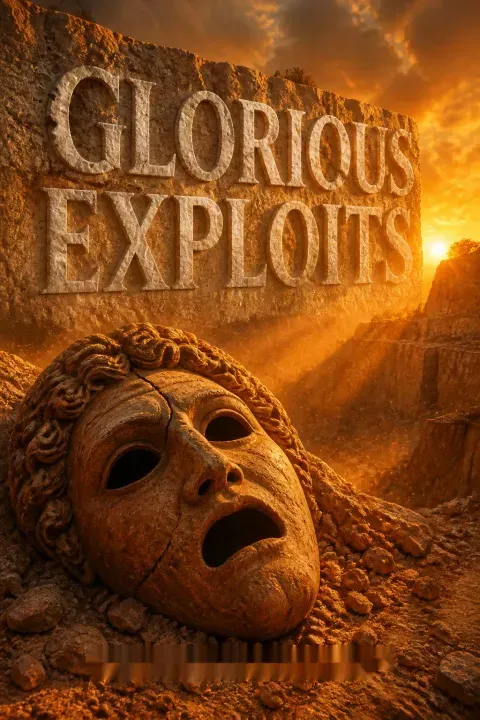


Plot Summary
Food for Euripides
Lampo1 and his handsome, melancholy friend Gelon2 walk to the Laurium quarry outside Syracuse, carrying wine, water, cheese, and olives. The year is 412 BC. Seven thousand Athenian prisoners of war are starving there after their failed invasion of Sicily.
Gelon,2 obsessed with the playwright Euripides, kneels beside a pink-skinned Athenian and asks if he knows any lines. The man croaks a fragment from a play. Gelon2 offers water for recitations and olives for Medea. As the day wears on, prisoners stumble forward with broken memories, competing for mouthfuls.
Lampo1 wanders the pit and witnesses a hulking Syracusan named Biton6 beating an Athenian with green eyes. Lampo1 trades a wineskin of wine to save the man, claiming he is needed for a theatrical role. He christens the prisoner Paches3 and declares him perfect for the part of Jason.
The quarry functions as a moral abyss where suffering becomes entertainment. Lampo and Gelon's feeding of prisoners enacts a perverse economy: culture traded for survival. That Gelon values Euripides more than bread reveals how art can become a lifeline, not merely ornament. The prisoners' fractured recitations mirror their broken bodies, yet something persists through the fragments. When Lampo rescues Paches with a lie about Jason's green eyes, he unwittingly begins transforming from passive spectator into active participant in others' fates. The scene establishes the central tension between cruelty and creation that will define the entire novel.
We Become Directors
At Dismas's tavern, Lampo1 and Gelon2 drink heavily with young aristocrats. Hermocrates' son, a pretty boy with long-lashed grey eyes, buys them perfumed wine and calls Lampo1 a hero for his limp, which Lampo1 dishonestly claims is a war wound. Outside later, drunk beneath stars, Gelon2 begins singing Medea's chorus and announces his proposition: they will become directors.
Not merely trading scraps for lines but staging a full production with chorus, masks, and costumes, performed by the starving Athenians in the quarry itself. He wants to do it properly, like the festivals in Athens. Lampo1 throws a stone into the dark pit and shouts the news to the invisible prisoners below, declaring rehearsals begin the next morning.
The director fantasy serves multiple psychological functions. For Gelon, still grieving his dead son Helios and abandoned by his wife Desma, artistic creation fills a void that nothing else can reach. The quarry production becomes a surrogate child, a monument against despair. For Lampo, the scheme offers identity when his trade is gone and his disability marks him as marginal. Their drunken vow echoes the mad ambition of the Athenian invasion itself: a grandiose project doomed to end in ruin. Yet the beauty of the moment lies in its sincerity. Two nobodies dare to believe they can make something that matters.
The Collector's Ship
Needing money for costumes, Lampo1 and Gelon2 scavenge Athenian armor from a battlefield. Konin the blacksmith sends them to Tuireann,5 a merchant on a battered ship with an Athenian battering ram. Tuireann5 prefers his relics unwashed, so Gelon2 cuts his own arm to freshen the bloodstains. The merchant's crew is menacing, but Tuireann5 himself is cultured and strange.
Over wine in his cabin, he speaks of voyages to India and claims to have followed Dionysus's path. He asks if they believe in gods, then reveals a crate of murky water. Gelon2 stares into it, transfixed, and later tells Lampo1 he saw a god inside. More importantly, Tuireann5 offers them gold to produce the play. He will be their patron.
Tuireann embodies the uncanny intrusion of the wider world into provincial Syracuse. His fascination with suffering as artifact, his desire to possess pain (the beggar's rope, the bloody armor), makes him a dark mirror of the audience the play will attract. The 'god' in the crate remains ambiguous: divine presence or shared hallucination? What matters is Gelon believes. His vision of his dead wife and son in the water transforms the encounter from transaction to revelation. The gold that funds art comes from a source that traffics in human misery, a paradox the novel never resolves but keeps visible.
Lyra Sings
Lampo1 first notices Lyra4 serving wine at Dismas's, her skin like beaten copper, a broken tooth giving her smile a wolfish quality. When young aristocrats grope her, Lampo1 smashes a jug into one's face, making dangerous enemies.
Later, flush with Tuireann's gold, he returns dressed in a lightning-blue chiton and crocodile boots, his hair oiled. Lyra4 sings a Lydian song she translated into Greek: a tale of a shepherd who pretends to be the moon to seduce a girl, then abandons her, becoming eternally lost in his own deception.
The song's melancholy strikes Lampo1 deeply. He begins visiting her at dawn, bringing gifts. She teaches him to write his name in wet sand. He promises to buy her freedom for three hundred drachmae, a sum Dismas names with mockery.
Lyra's song about the shepherd who becomes the moon is the novel's thematic key. It is a parable about self-deception, about becoming so entangled in a role that the original self vanishes. Lampo, playing the rich merchant in borrowed clothes, risks the same fate. Yet his love for Lyra, however improbable, is genuine. She represents something he has never had: a reason to strive beyond survival. The difference in their status (free poor man, enslaved educated woman) creates a complex power dynamic where each holds something the other needs. Her literacy and his freedom become the currency of their impossible hope.
Children Join the Chorus
Gelon2 recruits six street children as production assistants, led by the serious, strategist-minded Dares8 and tiny Strabo,10 whose brother was killed by Athenians. The children distribute food and join the humming that substitutes for music.
At Alekto7's shop, three aging Libyan slaves carve masks; one tells Lampo1 how they were orphaned crossing a desert, their mothers taken by bandits, sold so young they forgot who they were. Gelon2 chooses a little boy's mask, whispering his dead son's name. Rehearsals begin in earnest. Numa,9 a professional actor, transforms into Medea with frightening intensity.
The silver-haired Antikles leads the chained chorus. Even Paches3 improves as Jason, drawing on memories of his aristocratic Athenian youth. Gelon2 reveals they will stage two plays: Medea and Euripides' newest, Trojan Women, never seen in Sicily.
The children's involvement transforms the project from adult folly into something more redemptive. Dares and Strabo, whose families were destroyed by Athenians, must reconcile their grief with the humanity of the prisoners they now feed. This is not simple forgiveness but a more complex recognition: that art can hold both hatred and compassion simultaneously. The Libyan slaves' story of lost identity parallels the Athenians' erasure and foreshadows the destruction to come. Gelon's choice of the boy's mask makes explicit what has been implicit: the play is his mourning ritual, an attempt to give his son's death meaning through creation rather than Biton's path of revenge.
Gelon's Confession
Standing on the wheelbarrow, Gelon2 addresses the assembled cast. He tells them of seeing Oedipus Rex at age seven, how he wept at the doomed king's fate yet felt less alone. How the play showed him that dignity could exist even in the worst that can happen under the sky.
He confesses he loves Athens because it gave him that gift, and though they came as invaders, he cannot hate them. The Athenians straighten their backs. Something like pride flickers in their starving faces. Gelon2 then introduces Alcar, an old man with an aulos, as their musician.
The children hum accompaniment. Rehearsal resumes with new intensity until Biton6 appears again, threatening to kill them all. Dares8 places himself between the men, reminding Biton6 that his father and Biton6's dead son were friends. Biton6 retreats, promising to return.
Gelon's speech is the novel's moral center. It articulates a radical proposition: that art transcends politics, that the Athenian plays matter more than the Athenian invasion. This is not naive pacifism but a conscious choice to value creation over destruction, even when destruction seems justified. The prisoners' response, that spark of pride, confirms that identity persists beyond physical degradation. Biton's counterargument, the raw claim of grief and vengeance, is not dismissed as evil but understood as equally human. The scene sets up the irreconcilable conflict between those who believe suffering must be avenged and those who believe it must be transformed.
The Quarry Performance
Against all odds, hundreds of Syracusans descend into the quarry. Fishermen, potters, aristocrats, and even the remaining Athenian prisoners gather as audience. The performance of Medea begins shakily: chorus members trip, masks fall, the crowd jeers.
Then Numa9 as Medea snarls his opening lines about the misery of women, and silence falls. Paches3 transforms into a cocksure Jason. The set changes to burning Troy. Trojan Women unfolds with unbearable power: Linar's manic Cassandra, Paches3 in glittering robes as Helen dancing for her life.
Gelon2's innovation stuns everyone: tiny Strabo10 appears as Astyanax, is led up a boulder by a guard, and pushed, his shriek of terror cutting through the dusk. The audience weeps, Syracusans and Athenians united in grief. Then Biton6 and his mob strike, clubbing Numa9's head to pulp, killing Linar, Alcar, and most of the chorus.
The performance is both triumph and catastrophe, and the novel insists they are inseparable. Art that genuinely moves people, that pierces through the protections of irony and distance, must risk real danger. Strabo's fall, the actual child thrown from an actual height, collapses the boundary between representation and reality. The audience's tears are real because the danger is real. Biton's massacre is not the interruption of the play but its logical conclusion: the same violence that the tragedy depicts cannot be safely contained by the stage. The quarry walls that made an amphitheater also made a killing floor. Beauty and horror share the same space, the same moment.
The Decree of Starvation
Lampo1 recovers from his beating to learn the city has decreed that Athenian rations be cut entirely. The quarries will be emptied for stonework within weeks. The prisoners will simply be left to die. Paches3 survived the massacre by playing dead, but without food he is fading.
Lampo1 visits Gelon,2 who is broken physically and spiritually, his right arm hanging useless. When Lampo1 asks for help rescuing Paches,3 Gelon2 refuses. He says it is over, that everything he touches dies. Lampo,1 enraged, curses him: every death was Gelon2's fault, his selfishness, his impossible dreams.
He storms out. Alone, he goes to Tuireann5's ship and begs for passage for the Athenians. Tuireann5 refuses to take them from Syracuse but reveals his ship will be at Hyccara, a ruined town on Sicily's far coast, in two days' time. If Lampo1 can get them there, they sail.
The decree transforms the novel's stakes from artistic to existential. The production's failure now threatens to accelerate genocide: the spectacle drew attention back to the prisoners, and the city's response is to erase them entirely. Lampo's split with Gelon marks his transition from follower to protagonist. His curse, though cruel, contains truth: Gelon's aesthetic passion, however beautiful, never fully accounted for consequences. Lampo's love for Paches, a specific friendship with a specific man, proves more reliable than Gelon's love for Art. The personal relationship demands action where the abstract ideal collapses into despair.
Hyccara or Death
Lampo1 secures Alekto7's wagon and horses. Gelon,2 despite their fight, appears to help, his face still crusted with bruises. At the quarry fence, they loop ropes around a stake and use the horses to wrench it loose, creating a gap. Lampo1 plays Alcar's aulos as a signal.
Athenian hands reach through the darkness. Paches3 is too weak to climb; another prisoner ties a rope around his waist and they haul him up. A wagonload of skeletal men flee into the night. At a border checkpoint, a patrolman recognizes Gelon2 from the play.
He pauses, sword in hand, then waves them through, muttering it is a bad night for traveling. The journey across Sicily takes two brutal days. Lampo1 nurses Paches3 with wine-soaked bread. They pass forests, wheat fields, temples on cliffs, and Etna's black, roaring slopes.
The rescue sequence functions as a secular resurrection. Paches is pulled from the pit like a soul from Hades, and the journey across Sicily becomes a pilgrimage toward life. The patrolman's choice to let them pass represents the novel's cautious optimism: individuals can choose mercy even within brutal systems. The landscape Lampo describes, seeing his island for the first time, mirrors his internal transformation. He is no longer performing a role but acting with genuine agency. Gelon's return, despite their rupture, demonstrates that friendship persists through betrayal. They do not need to forgive each other to save each other.
Sailing from the Ashes
The wagon reaches Hyccara: a blackened ruin the Athenians themselves sacked two years earlier. A victory trophy still stands at the gate, inscribed with boasts about liberating Sicily. Tuireann5's ship waits at the tiny harbor. The crew hauls the Athenians aboard with ropes, their chains clinking.
Tuireann5 offers Lampo1 employment and the world: Carthage, Egypt, Babylon, Athens. Lampo1 declines. He asks instead for three hundred drachmae. Tuireann5 tosses him the pouches, then vanishes belowdecks. Paches,3 wrapped in a wool cloak, kisses Lampo1 on both cheeks in the Athenian fashion.
Lampo1 and Gelon2 stand on the icy planks as the ship glides into the dark sea. One Athenian waves, chains jingling. Lampo1 weeps. Walking back through the ruins, Gelon2 finally reveals what he saw in Tuireann5's crate: Desma and Helios, waiting for him. He will meet them again someday.
Hyccara, the town Athens destroyed, becomes the site of salvation. The irony is deliberate and layered: the Athenians' own war crime provides the cover for their countrymen's escape. Tuireann's job offer tempts Lampo with everything he once dreamed of (travel, escape from Syracuse), but his refusal signals genuine growth. He no longer needs to pretend to be something he is not. The money he asks for is for Lyra, the relationship that grounds his identity. Gelon's revelation about seeing his dead family reframes the entire supernatural strand: the 'god' was always grief made visible, hope made bearable. His certainty about reunion is either faith or delusion, but the novel honors it either way.
Lyra Is Gone
Weeks of walking bring Lampo1 and Gelon2 back to Syracuse. Lampo,1 his crocodile boots worn to nothing, clutches the three hundred drachmae and goes straight to Dismas's tavern. The place has been renovated into an aristo establishment. Dismas is in an upstairs room, reading.
When Lampo1 throws the money pouches at him, Dismas flinches and confesses: he sold Lyra.4 A foreigner from the tin islands, the same one who came every night to hear her sing,5 paid seven hundred drachmae. The man said she would be a sensation.
Dismas babbles about debts, offers Lampo1 a replacement girl at a discount. Lampo1 collapses to the floor. The sound that comes from him is not quite human. He leaves the tavern without touching the three hundred drachmae still lying on Dismas's floorboards.
The novel's cruelest irony: Lampo's heroic journey to save Paches cost him the person he most wanted to save. Tuireann, the enabler of art and rescue, is also the purchaser of human beings. His collecting extends to people, and Lyra's singing made her valuable. The symmetry is devastating: Lampo asked for exactly three hundred, the price for Lyra. Tuireann gave it without hesitation. The money could have bought her freedom if Lampo had stayed. Instead, his choice to save Paches (the friend he made through Gelon's dream) meant losing Lyra (the future he imagined for himself). The novel refuses to resolve which choice was right. It simply holds both outcomes before us.
Gold into the Abyss
Lampo1 sits on the hill above the now-empty quarry. The fence stakes have been pulled up. No Athenians remain below: some escaped through the gap, most simply starved. Even the rats have moved on. Lampo1 drinks wine and hurls the three hundred drachmae into the pit, one coin at a time, listening to the clink of each landing.
He imagines three hundred different men finding them over the years, three hundred mysteries. When both jug and pouches are empty, he walks home. In his room, he finds a stylus and wax tablet, the last gift he meant to give Lyra.4 He scratches his name into the wax: Lampo.1
He wishes he had learned to write hers.4 The narrative voice shifts: an old man now speaks, blind and besieged in Syracuse years later. The Carthaginians are coming. He never learned to read, despite trying. He visits Gelon2's grave and plays Alcar's aulos, decently now.
Scattering the money is an act of renunciation that contains both despair and liberation. The coins become votive offerings, a material sacrifice that acknowledges the emptiness of material solutions. Lampo's attempt to write his name, the same word Lyra traced in sand, connects him to her across the uncrossable distance. The framing device reveals that Lampo survived into old age, that he told his story to Strabo (now a man), and that he tends Gelon's grave. Persistence is its own kind of victory. The aulos, Alcar's instrument that Lampo now plays, becomes the symbol of everything that was saved: not lives, not love, but memory and the act of making beauty from loss.
The Wrecked Man Arrives
Athens, 408 BC. Euripides, old and stooped, prepares to leave for Macedonia. At his farewell dinner, prominent citizens sit on packing crates eating cold soup, served by his loyal servant Amphitryon. A storm rages outside. A knock comes.
A stranger enters, sopping wet: a man of middle height with tangled black hair, wrinkles like scars, and vivid green eyes. His voice is incongruously young. He wears fine clothes but looks ruined. He kneels before Euripides and presses a rare Heraclitus manuscript into his hands, saying he owes his life to the playwright.
Then he tells the story: the quarries of Syracuse, two unemployed potters1 staging Medea and Trojan Women, prisoners fed for Euripides' words, the massacre, the escape. Euripides weeps silently, takes the stranger's3 head in his hands, and spends the rest of the night speaking only to him, ignoring his important guests entirely.
The epilogue completes the novel's arc by showing the story's destination: the words return to their source. Euripides, who wrote about suffering he imagined, learns his writing actually fed starving men. The scene reverses the quarry dynamic: now it is the Athenian who kneels and the artist who weeps. Paches' ruined face and youthful voice embody the central paradox: trauma preserves and destroys simultaneously. Euripides' choice to ignore his powerful guests and attend only to the broken stranger is his final artistic statement. The story, not the storyteller, matters. Lampo's voice, filtered through memory and loss, has traveled across years and seas to reach the one person who most needed to hear it.
Analysis
Ferdia Lennon's novel operates as a profound meditation on the relationship between art and suffering, asking whether beauty can ever justify the pain that produces it or the violence that surrounds it. The quarry is the book's central metaphor: a place of death that becomes a theater, where Euripides' words literally feed the starving. The novel refuses easy answers. The production is both magnificent and fatal. The attention it draws leads directly to the massacre and the decree of starvation. Yet without it, Paches3 and his companions would have died anonymously, and the story would have been lost entirely. The novel insists that art matters even when, perhaps especially when, it cannot save anyone. Lampo1's voice, telling this story decades later to Strabo,10 is itself the proof. The telling is the surviving. The book is also a subtle exploration of male friendship and love. The bond between Lampo1 and Gelon,2 tested by betrayal and grief, endures. Lampo1's love for Lyra,4 cut short by forces beyond his control, transforms him without being consummated. His friendship with Paches,3 a man who was his enemy, becomes the most fully realized relationship in the book. These connections cross lines of class, nationality, and circumstance, suggesting that what survives catastrophe is not ideology or nation but the particular, stubborn affection of one person for another. Historically, the novel engages with Thucydides' account of the Sicilian Expedition, the great Athenian disaster that helped lose the Peloponnesian War. But Lennon's focus is not on generals or battles. He turns the lens on those left in the wreckage: prisoners, slaves, unemployed workers, orphaned children. Their story, told in Lampo1's irrepressible, colloquial voice, is a kind of historical reparation, giving language and dignity to those the official record forgets. The epilogue, in which Paches3 brings the story back to Euripides himself, closes the circle: the artist learns, at the end of his life, that his words mattered in ways he could never have imagined.
Review Summary
Reviews for Glorious Exploits are largely enthusiastic, averaging 4.13/5. Fans praise its unique premise — two Irish-voiced Syracusan potters staging Euripides with Athenian prisoners of war — celebrating its balance of dark humor, emotional depth, and themes of friendship, art, and war. Many highlight narrator Lampo as a standout character and commend the modern Irish vernacular as surprisingly effective. Critics, however, found the humor misplaced, the tone jarring, and the protagonist insufferable. Pacing issues in the first third are occasionally noted, though most readers found the latter half compelling and emotionally rewarding.
People Also Read




Characters
Lampo
Narrator, unemployed potter turned directorThe first-person narrator: a thirty-year-old Syracusan with a clubfoot and a gift for self-deception. Lampo is funny, impulsive, and fiercely loyal, masking deep insecurity with bravado. He has never left Syracuse, cannot read, and lives with his mother. His father abandoned the family when he was two. Despite his limitations, he possesses a surprising emotional intelligence and an instinct for the right gesture at the right moment, even when he does not fully understand why. His arc moves from passive spectator to active moral agent, driven first by friendship with Gelon2, then by love for Lyra4, and finally by a genuine bond with Paches3. His greatest flaw is a tendency to sabotage his own happiness through impatience and pride. His greatest strength is an almost irrational persistence in the face of impossible odds.
Gelon
Co-director, grieving father, Euripides devoteeLampo1's best friend since childhood. Tall, hauntingly handsome, with eyes like shallow sea water. Gelon is a former potter whose life collapsed when his young son Helios died of illness and his wife Desma subsequently abandoned him. He now sees Desma's face in cracks in pottery, in painted walls, in stretches of sky. His obsession with Euripides is a lifeline: tragedy gives form to grief that would otherwise consume him. He possesses a photographic memory for poetry, a beautiful singing voice, and a quiet authority that compels respect even from those who would oppose him. His vision of his dead family in Tuireann5's ship grants him a kind of peace. He is prone to melancholy but capable of sudden, galvanizing conviction.
Paches
Athenian prisoner, aristocrat, actorAn Athenian soldier with striking green eyes, captured and imprisoned in the quarry. Paches was wealthy before the war: his father funded the very ship he sailed to Sicily on. In the quarry, he survived by digging tunnels with his friend Philo, who was killed by Biton6 on the day Lampo1 first encountered him. Initially weak and nearly dead, he becomes Lampo1's friend and confidant, playing Jason and Helen in the productions. His aristocratic background gives him surprising reserves of dignity and performance skill. He is gentle, loyal, and carries profound grief for Philo, whom he loved.
Lyra
Lydian slave, singer, Lampo's loveA strikingly beautiful slave from Sardis in Lydia, sold to the tavern-keeper Dismas. Her skin is copper-colored, her front tooth is broken, and she bears a brand on her arm. Unlike most slaves Lampo1 knows, Lyra is highly educated: her father taught her to read Greek and Persian, and she understands astronomy well enough to explain eclipses. She sings haunting Lydian songs she translates herself. She is proud, realistic about her circumstances, and initially distrustful of Lampo1's attention, having learned that promises from free men rarely deliver. Her gradual opening to him reveals both vulnerability and immense inner strength.
Tuireann
Mysterious merchant and producerA wealthy collector from the tin islands far to the north. Pale-skinned with gleaming white teeth that seem almost animal. He travels the Mediterranean collecting objects of suffering: battle-scarred armor, a beggar's rope, and finally people. He sees himself as a follower of Dionysus, the god of tragedy and transformation. His ship carries strange cargo, including something in a crate that Gelon2 perceives as divine. He speaks in riddles, offers cryptic wisdom, and genuinely loves art. His generosity enables the quarry production and the Athenians' escape, yet he is also the man who buys Lyra4, making him simultaneously savior and destroyer in Lampo1's life.
Biton
Grieving father turned avengerA massive Syracusan whose son was captured and tortured to death by Athenians. Biton visits the quarries to kill prisoners, driven by grief that has curdled into murderous rage. He is not a simple villain: his pain is genuine, his love for his son was real, and his violence is the dark mirror of Gelon2's creative mourning. He drinks heavily, and his eyes hold an absence that suggests someone who has passed beyond the reach of reason or mercy. His massacre of the cast during the performance is the inevitable collision between two incompatible ways of processing loss.
Alekto
Theatrical costumer, old family friendAn elderly woman who runs Syracuse's only theatrical supply shop. Her husband disappeared decades ago; rumors say she killed him and used his skin for props. She kept the business and drove all competitors out. Sharp-tongued, unsentimental, but ultimately generous, she provides costumes and masks on credit and later volunteers her wagon for the rescue.
Dares
Child leader of production assistantsA serious, precocious boy who commands a gang of street children. His father died in the war. He becomes Gelon2's devoted assistant, managing the other children and asking endless questions about theater. He dreams of being a general and studies strategy. When Biton6 threatens violence, Dares places himself between the men, demonstrating courage beyond his years.
Numa
Athenian professional actor, lead performerA veteran actor from the rural theaters of Attica. In the quarry, he is discovered hiding under rocks, his skin white from limestone dust. When he performs, he transforms completely: his posture, voice, and even breathing change. He plays Medea and Hecuba with devastating power, mentoring the less experienced cast members with patient professionalism.
Strabo
Youngest production assistantThe tiniest of the children, six or seven years old, with a cracked voice that barely rises above a whisper. His brother was killed by Athenians during the war. He carries a clumsily carved toy horse his brother made. He speaks a prayer for his brother at an Athenian funeral pyre and later plays Astyanax, the murdered child, in Trojan Women. In old age, he becomes the scribe to whom Lampo1 tells his story.
Plot Devices
Euripides' Plays
Catalyst for art and survivalThe tragedies of Euripides, specifically Medea and Trojan Women, function as the engine of the entire plot. The prisoners' ability to recite fragments of these plays earns them food and, eventually, roles in a full production. The plays' themes of betrayal, infanticide, and the suffering of women after war mirror the quarry's reality. Trojan Women, set after the sack of Troy, depicts exactly what the Athenians themselves did to Hyccara. The blurring between theatrical suffering and real suffering becomes the novel's central dramatic tension. Gelon2's belief that preserving these words matters more than punishing their authors drives the ethical argument of the book. The plays are both text and subtext, plot device and thematic framework.
Tuireann's Gold
Enables production and escapeThe Persian gold coins Tuireann5 provides fund the costumes, masks, food, and bribes that make the production possible. The same gold later becomes the 300 drachmae Lampo1 asks for to buy Lyra4's freedom. The money's source, a merchant who collects human suffering as commodity, taints everything it touches, yet without it nothing would have been possible. The gold circulates through the story as a symbol of the uncomfortable truth that beauty and goodness often depend on wealth accumulated through exploitation. When Lampo1 throws the coins into the empty quarry, he rejects the transactional logic that governed both his love for Lyra4 and the production itself.
Alcar's Aulos
Musical instrument and memento moriThe double-reed pipe played by the old musician Alcar provides the musical accompaniment for the quarry production. After Alcar is killed trying to protect Lampo1 during the massacre, Lampo1 takes the instrument and keeps it for decades. In old age, he learns to play it decently and brings it to Gelon2's grave. The aulos represents the persistence of art beyond the death of artists. It is the physical object that connects Lampo1 to the quarry, to Alcar's sacrifice, to the music that held the fragile production together. Its sound, frail against the rats, becomes the novel's central metaphor for human creation in the face of chaos.
The Quarry (Laurium)
Prison, theater, mass graveThe limestone quarry where seven thousand Athenian prisoners are held after their failed invasion. Named Laurium after the silver mines of Attica, the quarry is both literal setting and symbolic landscape. Its crescent shape and high walls create a natural amphitheater, making the theatrical production possible. The prisoners build makeshift graves from stones, creating a city of the dead within the city of the dying. The quarry's porous limestone, its tunnels, its rats, and its stench permeate every aspect of the story. When Syracuse decrees that the Athenians will no longer be fed so the quarry can be reopened for stonework, the literal building of the city requires the erasure of the prisoners. The quarry thus embodies the violence that underlies civilization.
The Wax Tablet
Symbol of literacy and lost loveThe stylus and wax tablet Lampo1 bought as a gift for Lyra4 but never gave her. He intended it as a tool for her to teach him to read and write. After losing Lyra4, he finds the tablet among his possessions and uses it to scratch out his own name, the one word she had shown him how to write in wet sand. He wishes he had learned to write her name, to join their names into one word. The tablet represents both what Lyra4 offered him (access to the world of letters she inhabited) and his failure to fully receive it. In the novel's final pages, old Lampo1 confesses he never did learn to read, but the tablet and the effort it symbolizes remain as testimony to the attempt.
Download PDF
Download EPUB
.epub digital book format is ideal for reading ebooks on phones, tablets, and e-readers.








































