

Key Takeaways
Your brain is for having ideas, not storing them
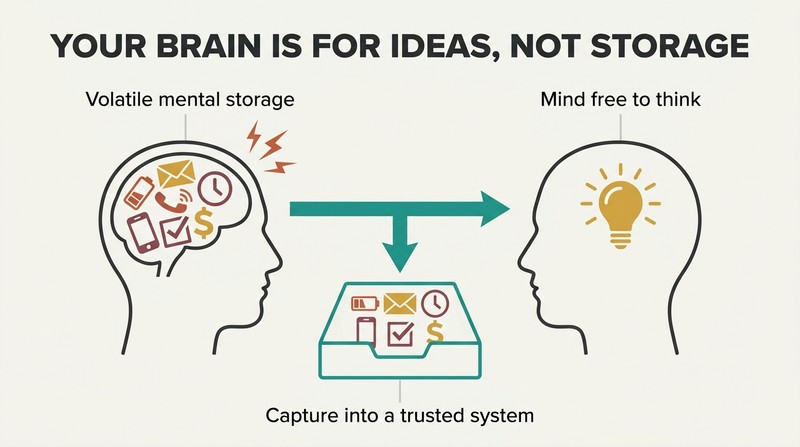
The mind is a terrible office. David Allen's core insight is that the part of your mind holding your to-dos works like a computer's RAM: small, volatile, and incapable of prioritizing. It nags you about buying batteries when you notice the dead ones, not when you pass live ones at the store. It has no sense of past or future, so every uncompleted commitment feels like it should be done right now, all at once.
This is why you feel scattered. The moment you store two tasks only in your head, you have created low-grade failure, because you cannot do both simultaneously. Allen's remedy: capture every open loop into a trusted external system so your mind can stop rehearsing and start thinking. The payoff is a state he calls "mind like water," responding to inputs proportionately, then returning to calm.
What's striking is how neatly this anticipates later cognitive science. Roy Baumeister's research on the Zeigarnik effect shows unfinished tasks intrude on attention until a concrete plan is made, not until they are completed. Allen reached the same conclusion through coaching, not the lab. The claim that the mind is "stupid" is rhetorically sharp but slightly overstated: the brain is superb at pattern recognition and creativity, which is precisely why it should be liberated from clerical retention. The deeper move here is reframing stress as a storage problem, not a workload problem.
Stress comes from broken promises to yourself, not overwork
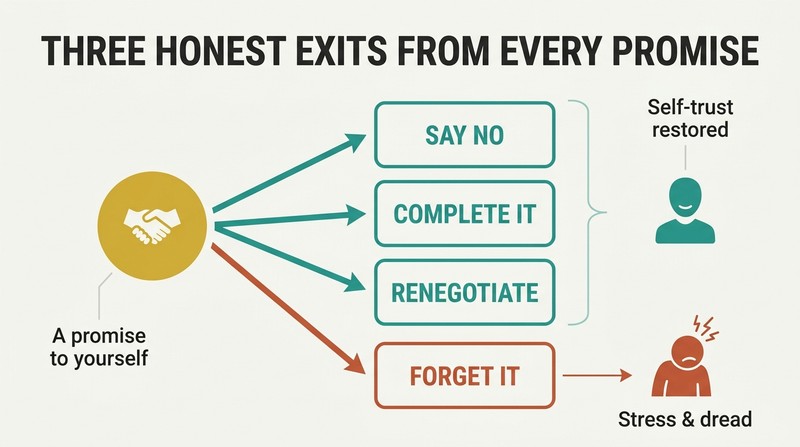
Anxiety is an integrity problem. Allen argues the dread you feel toward your pile of stuff is not caused by having too much to do (there is always too much). It comes from making agreements with yourself and then failing to keep, complete, or renegotiate them. A neglected garage you vowed to clean six years ago whispers at you every time you walk past, because some part of you believes it should be cleaning that garage around the clock.
You have three honest exits from any commitment:
1. Don't make the agreement (say no upfront).
2. Complete the agreement (do it).
3. Renegotiate the agreement (consciously decide "not now").
The catch: you cannot renegotiate a promise you cannot remember making. That is why capturing everything externally is not mere tidiness, it is what restores self-trust.
This reframe is quietly radical. It relocates the source of overwhelm from external volume to internal accounting, which means relief is available without doing more work, just by clarifying. It dovetails with cognitive behavioral therapy, where naming a vague worry and converting it into a concrete plan reduces its emotional charge. One caveat: some commitments are imposed by hierarchy or economic necessity, and "just say no" is a privilege not equally distributed. Still, the framework's emotional logic is sound. Self-trust, like institutional trust, erodes through unacknowledged broken agreements.
Decide the next physical action, not the vague project
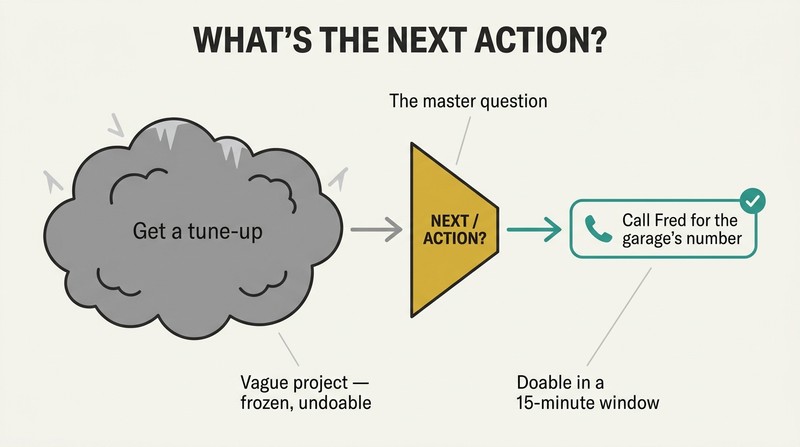
"What's the next action?" is the master question. Allen's most powerful tool is deceptively small. Most stuck items are stuck because no one decided the very next visible, physical behavior required. "Get a tune-up" is not actionable. Trace it back: you need to call the garage, but you lack the number, so the real next action is "Call Fred for the garage's number." That tiny decision is what most people never make until a crisis forces it.
Things rarely get stuck for lack of time. They stick because the doing has not been defined. When you have already determined the next action, you can exploit a fifteen-minute window with low energy to knock out a phone call instead of staring at an amorphous "project" and freezing. Deciding actions when things appear, rather than when they explode, is the efficiency revolution at the heart of the method.
This is implementation intention research in plain clothes. Psychologist Peter Gollwitzer found that specifying "when X, I will do Y" roughly doubles follow-through versus holding only a goal. Allen independently operationalized this for knowledge work. He also offers a fascinating theory of procrastination: the smartest, most imaginative people stall most, because they vividly simulate everything that could go wrong. The next-action question "dumbs down" the task into something the nervous system reads as doable. The visualization claim (picturing a lemon makes you salivate) is a charming proxy for the broader point that mental imagery drives physiological and motivational response.
Master five stages: capture, clarify, organize, reflect, engage
Workflow is a chain only as strong as its weakest link. Allen breaks knowledge work into five distinct stages most people blur together:
1. Collect everything that has your attention into trusted in-baskets.
2. Process what each item means and whether it is actionable.
3. Organize results into the right "buckets" (lists, calendar, files).
4. Review the whole system regularly so you trust it.
5. Do, by making confident in-the-moment choices.
Most people fail at collection (leaks everywhere) or review (the system goes stale). The crucial discipline is keeping these stages separate. When you sit down to "get organized," you usually try to do all five at once, which is why list-making feels futile. You cannot organize an incoming pile, you can only capture it, then process it item by item, deciding and dispatching each before moving on, never returning anything to the in-basket.
The genius is the separation of decision-modes. Cognitive load theory supports this: switching between capturing, deciding, and executing taxes working memory, so batching each mode preserves mental bandwidth. The model also resembles a manufacturing pipeline, applying assembly-line logic to ambiguous mental work, which is fitting given Allen's framing of work shifting from factory to knowledge labor. The vulnerability is the review stage, which depends on a fragile weekly habit. Many adopters capture beautifully then abandon the loop, and the whole structure collapses, which Allen himself identifies as the make-or-break behavior.
If an action takes under two minutes, do it now
The efficiency cutoff rule. When processing your inbox, if the next action will take two minutes or less, handle it immediately. The logic is purely economic: storing and tracking a tiny task costs more time and energy than just finishing it. Below roughly two minutes, deferral is wasteful overhead.
Allen recounts a software executive drowning in 300 emails a day who worked entire weekends to catch up. After clearing his 800-item backlog (much of it deletable, much of it two-minute replies), he never let his inbox exceed a screenful again. His staff joked he was "made of Teflon" because his response time collapsed. The rule scales with your window: with a long open block, stretch the cutoff to five or ten minutes; in a time crunch, shrink it to thirty seconds. The point is to stop re-handling trivial things repeatedly.
This is the most-cited and most-abused piece of the system. The danger, which Allen flags, is that two-minute tasks can become an avoidance ritual, a way to feel busy while dodging the proposal that actually matters. Behavioral economists would note it exploits the "completion bias," our craving to close small loops, which can crowd out high-value deep work. Used inside the discipline of full processing it is a turbocharger; used as a standalone hack it can fragment a day into a hundred shallow wins. The rule's brilliance is also its trap.
Organize actions by context, never by a daily to-do list
Match tasks to where you actually are. Allen rejects the traditional daily to-do list as demoralizing, because shifting priorities and constant new inputs make a pre-written daily plan obsolete by mid-morning, forcing endless rewriting. Instead, sort next actions by the tool, place, or person each one requires: "Calls," "At Computer," "Errands," "Agenda for boss," "At Home."
Why context first? Because it is the first real constraint on what you can do. Stuck in traffic, you can only pull up your "Calls" list. The calendar becomes sacred and minimal: only time-specific commitments, day-specific commitments, and day-specific information go there, nothing else. Everything written on the calendar must happen that day or not at all. This protects the calendar's trustworthiness and frees the rest into "as soon as I can" context lists you scan when the right window and energy appear.
Decades on, this insight quietly powers most productivity software, from tags to smart filters. It treats attention as situational rather than rational, acknowledging that willpower and intent matter less than environmental fit, a theme echoed in habit research. The four-criteria model for choosing in the moment (context, time available, energy available, priority) is refreshingly humble about priority: it lands last, not first, because the first three are hard constraints. Critics argue context lists fragment a sense of overall priority, which is why the weekly review and higher-altitude reviews exist as the counterweight. The calendar-as-sacred-territory rule remains underused and underrated.
The weekly review is the keystone habit that sustains everything
Get clean, clear, current, and complete every week. Allen calls this the critical success factor, the practice that separates people who thrive on the system from those who let it rot. Once a week, block roughly two hours (he favors Friday afternoon) to gather loose papers, process all notes, empty your head, review every project for a defined next action, and scan your waiting-for and someday lists.
He offers a vivid analogy: most people feel best about work the week before vacation, not because of the trip but because they clean up, close loops, and renegotiate every agreement. The weekly review simply does this every seven days instead of once a year. Without it, your lists fall behind reality, your brain stops trusting the system, and it resumes the exhausting job of remembering. Trust is geometric: the more complete the system, the more you rely on it, the more motivated you are to keep it complete.
This is where most GTD adopters fail, and Allen knows it. The weekly review is a high-friction, low-immediate-reward ritual competing against urgent fires, exactly the kind of important-but-not-urgent task humans chronically defer. Behavioral science suggests anchoring it to an existing routine and a fixed environment, which Allen intuitively recommends. There is a deeper point: trust in a system is not a feeling but a track record. Like a relationship or a brand, it is built through reliability and destroyed by a single unprocessed pile that proves the system cannot be relied upon. The keystone metaphor is apt.
Plan projects the way your brain naturally already does
Five phases mirror how you decide dinner. Allen observes that your mind plans effortlessly all day and reverse-engineers that into a model. Choosing a restaurant, you move through: purpose (hunger, celebration), principles (your standards for food and cost), vision (imagining the pleasant evening), brainstorming (what time, is it open, who comes), organizing (sequencing the steps), and next action (call to book).
He contrasts this with "unnatural planning," the meeting that opens with "So who's got a good idea?" before anyone has clarified why they are there. That question only works when you are about 80% through your thinking. And he blames "reactive planning," the crisis cycle where people work harder, then get organized, then brainstorm, then finally hire a consultant who asks the obvious: what are you actually trying to do? The reactive cycle is just the natural model run backwards under pressure.
The natural planning model is Allen's most underappreciated contribution, overshadowed by his action lists. Its insight is that clarity of purpose unlocks both better decisions and, paradoxically, wider creative options, an effect supported by goal-setting theory and by neuroscience of the reticular activating system, which filters perception toward what you focus on (the reason you suddenly see your car model everywhere after buying it). The weakness: Allen concedes 80% of projects need no formal planning at all, just an outcome and a next action. So the elaborate five-phase model is a specialist tool for the stuck or complex 20%, not a universal ritual.
Build a filing system fast and fun enough you'll actually use it
If filing takes over a minute, you'll stack instead. Allen is unusually fierce about reference filing because he found it to be the single biggest bottleneck in most people's systems. The principle: any single piece of paper must be fileable in under sixty seconds, or you will pile it and go numb to the pile. His prescriptions are concrete and slightly obsessive:
1. Keep files within arm's reach, not across the room.
2. Use one simple A-Z alphabetical system, not categories.
3. Own a label maker and keep it on your desk.
4. Keep drawers under three-quarters full and stocked with empty folders.
5. Purge once a year.
The deeper logic is friction. Reference material has no action attached, so it should add zero psychic weight, just a neat-edged library. But the slightest inconvenience converts good intentions into chaotic stacks, which then blur the line between actionable and non-actionable items and numb the whole system.
This chapter dates the book (label makers, hanging folders) yet the friction principle is timeless and now governs digital life: if saving and retrieving a file is slow, people dump everything in a downloads folder and search instead. Allen's insistence on a single alphabetical system over elaborate categories anticipates the search-over-hierarchy logic of modern tools. The cognitive point is sharp: organizational friction is paid not once but every single time you hesitate, and those micro-hesitations compound into avoidance. His near-evangelical tone about a label maker seems quaint until you realize he is really talking about removing every excuse the lazy part of your brain can find.
Review your life at six altitudes, from runway to 50,000 feet
Priorities live at different heights. Allen maps work onto an aviation metaphor with six horizons:
1. Runway: current actions.
2. 10,000 feet: current projects.
3. 20,000 feet: areas of responsibility (your "hats").
4. 30,000 feet: one-to-two-year goals.
5. 40,000 feet: three-to-five-year vision.
6. 50,000+ feet: life purpose.
Logically, priorities should flow top-down: your purpose should govern your projects. But Allen makes a contrarian practical case for working bottom-up. When you are buried in unprocessed runway-level chaos, you cannot think clearly about vision, and top-down planning just raises your standards and adds more to an already overwhelming list. Get control of the mundane first, clear the psychic decks, and the elevated thinking emerges naturally. He notes executives who spend a day clearing their desks often spend that evening having visions about their company's future.
This is GTD's answer to Covey's "begin with the end in mind," and the disagreement is instructive. Covey starts at the summit; Allen starts on the tarmac. Both are right for different people in different states. Someone in crisis cannot meaningfully contemplate life purpose, and forcing it produces guilt, not direction. Yet a purely bottom-up life risks efficiently climbing the wrong ladder, becoming superbly organized in service of goals you never chose. Allen acknowledges this tension and resolves it pragmatically: handle altitudes in balance, but earn the right to lofty thinking by first proving you can manage the runway.
"What's the next action?" can transform an entire organization's culture
One question forces clarity, accountability, and momentum. Allen learned this technique from his mentor Dean Acheson (no relation to the statesman), who would pick up each paper on an executive's desk and demand the very next physical action. Applied across a team, the question becomes a cultural standard with outsized effects.
He argues meetings routinely end with a vague sense that something should happen and a quiet hope it is not your job. He forces the question twenty minutes before any meeting ends, and finds it usually takes those full twenty minutes to answer honestly. The query does four things: it creates clarity (forcing real decisions), accountability (whose ball is it?), productivity (resources allocated upfront, not in crisis), and empowerment (it undercuts the victim mentality, since complaining about something means you believe it could be changed, and the action question calls that bluff).
Allen elevates a personal trick into organizational design, and the move holds up. The dark side he names, that "collaborative" cultures develop an allergy to assigning individual ownership, is well documented in research on diffusion of responsibility and social loafing. The next-action question is a low-cost intervention against both. There is also something quietly Stoic in the empowerment claim: distinguishing what you can act on from what belongs to the immutable landscape echoes Epictetus. The limitation is that a question alone cannot fix a culture that punishes people for owning balls; clarity without psychological safety just creates clearer scapegoats.
Analysis
Getting Things Done occupies a strange and durable place in the productivity canon: it is simultaneously a tactical manual obsessed with label makers and a quasi-philosophical argument about the architecture of attention. Published in 2001, it arrived precisely as email and the dissolution of clear work boundaries were overwhelming a workforce trained for assembly-line clarity. Allen's central diagnosis, that work had become "edgeless" and that our tools and habits had not caught up, was prescient and has only intensified in the smartphone era.
The book's deepest contribution is conceptual, not procedural. By relocating stress from workload to the mind's failure to externalize and renegotiate commitments, Allen reframes productivity as a psychological and even ethical matter of self-trust. This anticipates findings in cognitive science (the Zeigarnik effect, implementation intentions, cognitive load theory) that Allen reached through two decades of coaching rather than research. His "mind like water" ideal borrows from martial arts but describes something real: proportionate, non-rehearsing responsiveness.
The method's weaknesses are well known. It is front-loaded with setup cost, demands a fragile weekly review habit that most adopters abandon, and its context-list architecture can fragment any sense of overarching priority. The two-minute rule, divorced from full processing, becomes a busywork generator exploiting completion bias. And the bottom-up emphasis, while pragmatically wise for the overwhelmed, risks optimizing a life without ever questioning its direction, a critique Covey-style purpose-first thinkers fairly raise.
What ultimately distinguishes the book is its refusal to choose between the mundane and the meaningful. Allen insists the same thinking, outcome plus next action, scales from buying tires to designing a life. That claim, that high-level vision and grocery lists obey identical mechanics, is both the book's boldest assertion and its most useful. It is a systems theory of personal agency disguised as office advice.
Review Summary
Getting Things Done receives mostly positive reviews for its practical productivity system. Many readers find it life-changing, praising its methods for organizing tasks, clearing mental clutter, and reducing stress. The book's emphasis on capturing ideas, processing inboxes, and identifying next actions resonates with many. Some criticize its corporate focus and outdated elements, while others find it unnecessarily long and repetitive. Overall, readers appreciate the actionable advice and report increased efficiency and mental clarity after implementing the GTD system.
People Also Read



FAQ
What's "Getting Things Done: The Art of Stress-Free Productivity" about?
- Overview: "Getting Things Done" by David Allen is a guide to organizing tasks and commitments to achieve stress-free productivity. It introduces a system to manage work and life efficiently.
- Main Focus: The book emphasizes capturing all tasks and commitments in a trusted system outside the mind, clarifying actions, and organizing them for review and execution.
- Purpose: It aims to help individuals clear their minds of clutter and focus on completing tasks effectively, providing a structured approach to managing tasks, projects, and responsibilities.
- Target Audience: Ideal for anyone feeling overwhelmed by their workload, from executives to homemakers, offering practical advice to regain control and clarity.
Why should I read "Getting Things Done"?
- Improved Productivity: The book offers practical techniques to enhance productivity by organizing tasks and reducing stress, helping readers focus on what truly matters.
- Stress Reduction: By capturing tasks in a trusted system, it alleviates the mental burden of remembering tasks, leading to a calmer, more focused mind.
- Universal Applicability: The principles can be applied to both personal and professional life, making it a versatile resource for improving organizational skills.
What are the key takeaways of "Getting Things Done"?
- Capture Everything: Collect all tasks, ideas, and commitments in a reliable system to prevent mental clutter and allow for better focus.
- Clarify Actions: Define the next physical action required for each task to prevent procrastination and ensure steady progress.
- Regular Review: Consistent review of tasks and projects is crucial to maintaining control and focus, with a recommended weekly review to update and organize commitments.
How does the GTD system work?
- Five Stages: The GTD system consists of five stages: capture, clarify, organize, reflect, and engage, each designed to help manage tasks efficiently.
- Capture Everything: Collect all tasks, ideas, and commitments in a trusted system outside your head to free up mental space.
- Clarify and Organize: Determine the next action for each task and organize them into appropriate categories for review and execution.
What is the "mind like water" concept in "Getting Things Done"?
- Definition: "Mind like water" is a state of relaxed control where you respond appropriately to any situation without overreacting or underreacting.
- Achieving the State: By capturing, clarifying, and organizing tasks, you can achieve this state, allowing you to focus on the present moment and make better decisions.
- Benefits: This state leads to increased productivity, reduced stress, and a greater sense of well-being, as you are no longer burdened by mental clutter and unfinished tasks.
What is the "Natural Planning Model" in "Getting Things Done"?
- Five Phases: The Natural Planning Model consists of defining purpose and principles, outcome visioning, brainstorming, organizing, and identifying next actions.
- Purpose and Vision: Start by defining the purpose and envisioning the successful outcome of a project, providing direction and motivation.
- Brainstorming and Organizing: Generate ideas and organize them into a coherent plan, identifying the next actions required to move the project forward.
How can "Getting Things Done" help with procrastination?
- Next-Action Clarity: The book emphasizes defining the next physical action required for each task, reducing hesitation and encouraging progress.
- Breaking Tasks into Steps: Allen's method involves breaking down projects into manageable steps, making them less daunting and building momentum.
- Regular Review and Organization: Regular reviews help keep priorities clear and manageable, avoiding the last-minute rush that often results from procrastination.
How does the "two-minute rule" work in "Getting Things Done"?
- Definition of the Rule: If a task can be completed in two minutes or less, it should be done immediately to prevent small tasks from accumulating.
- Application in Daily Life: The rule can be applied to tasks like responding to emails or making quick phone calls, encouraging prompt action.
- Benefits of the Rule: It leads to a significant reduction in clutter and an increase in productivity by quickly clearing minor tasks.
What are some of the best quotes from "Getting Things Done" and what do they mean?
- "Your mind is for having ideas, not holding them." Emphasizes freeing the mind from remembering tasks to enhance creativity and problem-solving.
- "The art of resting the mind..." Highlights the value of achieving a clear mind, free from stress and mental clutter, to enhance productivity and well-being.
- "You can do anything, but not everything." Reminds to prioritize tasks and focus on what truly matters, rather than trying to do everything at once.
How can I implement the GTD system in my daily life?
- Start with Capturing: Begin by collecting all tasks, ideas, and commitments in a trusted system outside your head using tools like notebooks or digital apps.
- Clarify and Organize: Determine the next action for each task and organize them into appropriate categories for review and execution.
- Regular Review: Set aside time each week to review and update your system, ensuring it remains functional and up-to-date.
What tools and systems does "Getting Things Done" recommend for organization?
- In-Baskets and Filing Systems: Use physical or digital in-baskets to capture all incoming tasks and information, and maintain a well-organized filing system.
- Action Lists and Calendars: Maintain action lists categorized by context and use a calendar for time-specific tasks and appointments.
- Digital Tools: Apply GTD principles using modern digital tools like task management apps and digital calendars, integrating them into a cohesive system.
How can "Getting Things Done" be applied in a team or organizational setting?
- Shared Language and Practices: Adopt a shared language and practices for task management, improving communication and collaboration.
- Accountability and Clarity: Define next actions and outcomes clearly to enhance accountability and avoid misunderstandings within a team.
- Cultural Shift: Promote a focus on productivity and efficiency, reducing stress and improving task management for better results and a positive work environment.
About the Author


Download PDF
Download EPUB
.epub digital book format is ideal for reading ebooks on phones, tablets, and e-readers.








































