
Plot Summary
The New Priest's Communion
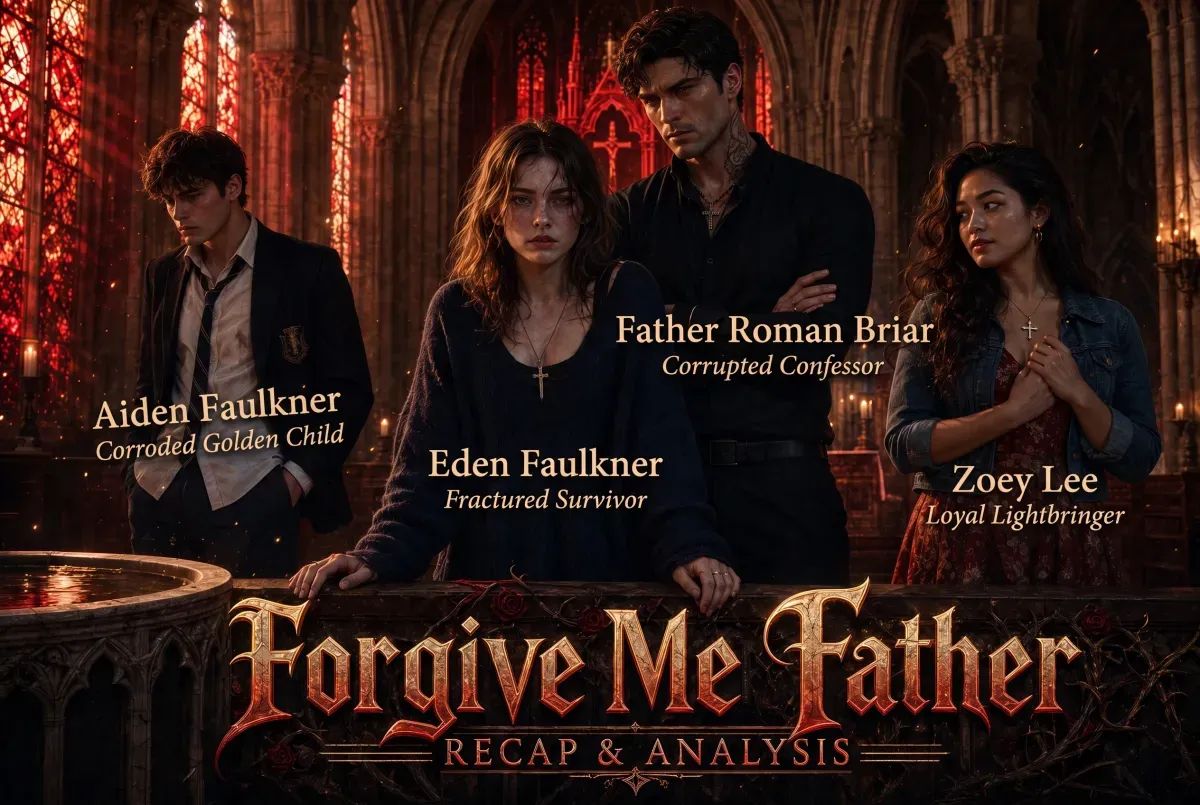
Home indefinitely after fleeing college, Eden Faulkner1 performs the family ritual of Sunday faith while privately despising her cheating father,3 sedated mother,10 and tormenting brother Aiden.4
Expecting to lie her way through confession with frail Father Kevin,9 she instead finds Roman Briar,2 the young, tattooed priest stepping into Kevin's9 role. Their first exchange crackles: she mocks the altar servers, he tells her to learn when to keep her mouth shut.
At Communion, Roman2 pries her jaw open with his thumb and feeds her the host, praising her for submitting. Eden1 flees to her car, shaken by how easily he commands her. Unknown to her, her father3 has secretly enrolled her as an altar server, and Roman2 quietly assigns her the maximum service hours.
The opening weaponizes Catholic ritual as erotic theater, establishing the book's central transgression: sacred authority repurposed as dominance. Eden's compulsive lying in confession signals a girl who has weaponized performance to survive a home built on hypocrisy. Roman reads through her instantly, which both threatens and seduces her, because being seen is precisely what her family withholds. The thumb-on-lip communion fuses obedience and arousal, framing submission as relief rather than degradation. Crucially, the chapter plants the engine of plot: David's covert enrollment hands Roman institutional access to his daughter, and Roman's choice to maximize her hours reveals obsession masked as discipline before either character admits desire.
Stripped at The Overlook
Coerced into driving Aiden4 and his friends to a lookout to smoke, Eden1 lets Zack,8 who once asked her to prom, lure her into conversation. It is a setup: Zack8 rips off her oversized sweater to win a bet, exposing the self-harm scars she has hidden all summer, then the boys steal her car and abandon her in a downpour.
Soaked and humiliated, she flags down a black 4Runner and finds Roman2 behind the wheel. He sees the cuts and the older nail marks on her ribs, demands names, and refuses pity. When she begs for an alternative to the blade, he reclines her seat and guides her hand, making her recite a Hail Mary as she finds release instead of pain.
The Overlook humiliation externalizes Eden's hidden wounds, forcing her concealed self-harm into the open through cruelty rather than confession. Zack's bet reframes her body as a wager, echoing the commodification that will later define the trafficking plot. Roman's intervention inverts the dynamic: where the boys exposed her to shame her, he exposes her to understand her. His substitution of pleasure for self-injury is morally vertiginous, a predator's tenderness, yet it speaks to her actual psychology, that she craves not punishment but oblivion from feeling. The scene establishes their toxic covenant: he will be the one who makes her bleed and the one who stops her bleeding.
Behind the Picket Fence
Walking Eden1 home, Roman2 confronts David Faulkner3 and watches the man strike Aiden4 for the lookout fiasco. During an improvised porch confession, Aiden4 admits their father3's punishments for him were never the belt, hinting at something darker, and that David3 left Eden1 alone only because Aiden4 absorbed his rage.
Roman,2 posing as an ally, bargains to take charge of Eden1's discipline. David,3 mistaking Roman2 for a kindred zealot, references a mysterious roster and inventory Roman2 knows nothing about.
That night David3 binds Eden1's wrists and spanks her raw when she takes the blame to spare Aiden.4 Roman,2 parked outside, orders her to lock her door, then later talks her through release over the phone, where she ends by sending him a defiant nude photo.
This sequence reveals the rot beneath the Faulkners' performative piety: abuse laundered through weekly absolution. Aiden's confession reframes sibling rivalry as trauma economics, where one child's suffering purchases the other's safety. David's casual mention of a list seeds the conspiracy without explaining it, generating dread through Roman's ignorance. Eden's choice to take Aiden's punishment marks her latent capacity for sacrificial love, the same impulse that will later endanger her. The phone encounter shows the lovers building intimacy through transgression even as violence saturates the house, suggesting Eden can only metabolize affection when it borrows the grammar of sin she was raised inside.
The Catalog of Children
Suspicious of David3's hints, Roman2 breaks into the church office, cracks Father Kevin9's computer using a password hidden in a Latin Bible, and finds bank statements co-signed by David3 alongside an absurdly overpriced furniture inventory.
The horror crystallizes when David3 personally hands Roman2 a leather portfolio, welcoming him into the inner brotherhood. Each listed sofa and futon corresponds to a child, photographed, named, priced, and marked virgin or sold. The final entry has no face and the highest price: a non-virgin woman ideal for breeding.
Roman2 realizes Saint Michael's launders a child-trafficking ring through its remodel, that local police are complicit, and that David3 now believes him a fellow predator. Sickened, war memories surfacing, Roman2 resolves to dismantle it from within.
The grotesque metaphor of children catalogued as furniture exposes commodification at its most literal, religion as a front for an economy of bodies. Roman's military past, glimpsed in his triggered flashbacks, recasts him from rogue priest to a man whose violence might finally serve a purpose. The complicity of police and clergy collapses every institution meant to protect, leaving private vengeance as the only justice available, which is the genre's moral engine. The faceless final listing functions as a ticking clock the reader half-recognizes, foreshadowing Eden's commodification. Roman's accidental admission into the brotherhood traps him in a deadly performance where exposure means death.
Drowned in Holy Water
When Zack8 arrives at the church to wash a robe, Roman2 snaps. He forces the boy's head into the holy water font, splits his scalp on the stone rim, and extracts a vow that Zack8 will never touch Eden1 again. Eden1 walks in mid-violence, sees the blood, and silently blesses herself, unsettling Roman2 with her composure rather than fear.
Refusing to discuss what she witnessed, she demands a power exchange on the altar itself. Roman2 gives in: he removes his ring at her insistence, then uses a marble crucifix anointed with holy water to bring her to a bloody, overwhelming climax beneath the looming cross. Afterward, terrified by intimacy, Eden1 flings the ring back at him and storms out, convinced he is just another of her father's monsters.3
Roman's brutalization of Zack reveals the war-trained killer beneath the collar, his protectiveness indistinguishable from rage. Eden's refusal to flee, her blessing herself in the carnage, signals her own attraction to darkness, a survivor who finds safety in someone more dangerous than her abusers. The desecration of the crucifix dramatizes the novel's thesis that her body has been claimed by religion against her will, so reclaiming it requires profaning the very symbols used to cage her. The ring, his vow to God, becomes the contested object: she demands he choose her over heaven, then panics when he might, exposing her terror of being chosen and then discarded.
The Girl on the Bench
As Eden1 tries to retreat behind walls, Roman2 discloses the secret that reframes everything: six weeks before he ever fed her communion, he found her alone in the town park, sobbing on the phone, dragging a blade toward her wrist. He had pressed himself against her back, seized the knife at the cost of his own cut hand, and shown her his old vertical scar to prove he understood.
She confessed then that she had been raped at college, beaten, recorded, and disbelieved, and that she fled home to a different hell. He sent her toward the church promising a guardian angel, then looked up her name. Eden1 understands that their meeting was never chance, that he chose her before she knew he existed.
The reveal retroactively rewrites the romance as a rescue narrative rooted in mirrored damage, his suicide scar answering hers. It complicates Roman's obsession into something closer to recognition: two people who tried to die meeting at the threshold. The disclosure also explains his disproportionate fury at her tormentors, he has been guarding her since before consent existed between them, which is both devotion and surveillance. Eden's trauma backstory, the campus rape and institutional betrayal, contextualizes her self-harm and her hunger for control through submission. That a priest stalking a parishioner reads as salvation rather than menace is the dark romance contract operating at full intensity.
Jealousy at the Reservoir
Dragged to a bonfire and swim by Zoey,5 Eden1 meets Luca Thorn,6 a kind, age-appropriate hockey player who flirts and offers her something normal. Drinking for the first time since her assault, she breaks down and tells the group the truth about her rape and her scars, then kisses Luca6 defiantly.
Roman,2 tracking her after a bar brawl that left him bruised, arrives at the reservoir and finds Eden1 with her head in Luca6's lap. He hauls Luca6 from the truck and chokes him until Eden1 screams that she will leave with him if he stops. Luca6 drives off wounded, telling Eden1 the rumors about her must be true, and she climbs into Roman2's car, furious yet unable to refuse him.
Luca embodies the road not taken: gentleness, daylight, a love that would not require her to bleed. Eden's drunken confession to near-strangers is a desperate bid for witness, the validation her family and college denied her. Roman's violent possessiveness exposes the central danger of their bond, that his love and his control share a single muscle. The triangle is less about choosing between men than between versions of herself: the woman who could heal in the light, or the one who feels most alive in the dark. Luca's parting cruelty shows how quickly even kindness curdles when wounded pride enters, isolating Eden further into Roman's orbit.
The Binder Under the Bed
Recovering at Roman2's house the morning after a drunken night, Eden1 snoops and discovers the trafficking catalog beneath his bed just as David3 arrives unannounced. To preserve his cover as David3's enforcer, Roman2 strikes Eden1 across the face in front of her father,3 who beams with approval.
Once David3 leaves, the truth pours out: Roman2 confesses he accepted the role of disciplining Eden1 only to shield her from David3's worse intentions, that Zoey5 is slated for the auction, and that the police are bought. Eden,1 betrayed and horrified that the slap mirrored her father's violence,3 screams that having anything to do with David3 makes Roman2 just as guilty. He insists every move has been to keep her and the children alive.
The staged slap is the novel's cruelest test of trust, asking whether protective deception can survive looking exactly like abuse. For Eden, whose body keeps the score of every hand raised against her, the blow shatters the distinction Roman insists upon between performance and harm. The scene interrogates the ethics of undercover love: Roman must become the monster to fight the monsters, and the cost is the very intimacy he is protecting. Zoey's inclusion in the catalog personalizes the conspiracy, raising the stakes from abstract horror to a friend's imminent sale. Eden's accusation lands because it is partly true, complicity and resistance have become indistinguishable inside David's machine.
Infiltrating the Brotherhood
Building evidence, Roman2 corners Seth,12 Zoey5's father, at a cult meeting, plants a letter opener beneath his ribs as a threat, and conscripts him as an informant by promising to clear his name in exchange for a paper trail. He secretly records the gathering of wealthy parishioners who drink Communion wine while reviewing the catalog.
To shield Eden,1 Roman2 wagers David3 that he can prove she remains a virgin and submissive, which would disqualify her from bidding. David,3 suspecting Roman2 has fallen for her, accepts the bet with a chilling promise to make Roman2 watch if he is lying. Back at the church office, Roman2 uses the crucifix again, slips his ring onto Eden1's finger, and chooses her over his vow.
Roman's espionage tightens the thriller machinery: leverage, recordings, an informant, a deadline. The virginity wager is grotesque precisely because it forces Roman to traffic in the same currency he means to destroy, bargaining over Eden's body to save it. David's suspicion reframes him as a worthy adversary who smells the heretic, raising the danger that love itself is the tell that exposes the mole. The transfer of the ring from Roman's finger to Eden's is the romance's covenant inversion: his commitment migrates from God to her, sanctifying their union by the very symbol of his abandoned vows. Sacred and profane fuse into a single act of devotion.
Devil's Night Confession
At a Halloween party, Eden1 plays girlfriend to Luca6 as cover, but a drunk Luca6 turns rough, gripping her throat and biting her until she calls Roman2 in tears. Aiden4 confronts Luca,6 Eden1 slaps him publicly, keys his truck, and walks to Roman2's house. There she finds Roman2 torturing the informant Seth12 on a tarp for information about David3 and Luca.6
Rather than recoil, Eden1 drives her stiletto into Seth12's hand and slashes his thigh, discovering her own appetite for vengeance. After Seth12 is released, the lovers consummate their relationship fully for the first time, and the next morning Eden1 sees a photo of Roman2's late mother and learns of his abusive father and military past.
Luca's transformation from refuge to threat completes his arc as the false safe harbor, proving that ordinary men can be predators too. Eden crossing the line to torture Seth marks her psychological turn: the victim becomes an agent of violence, reclaiming power through the same brutality once used against her. Their first full union, framed as both worship and bloodletting, consecrates a love built on shared darkness rather than its absence. The morning revelation of Roman's mother and abusive father humanizes him, locating his rage and his faith in a son's grief, his vow to God an attempt to reach her in heaven. Tenderness and monstrosity finally share one bed.
The Rapist Returns
David3 escalates by summoning Eric,7 Eden1's college rapist, back to Idlewood under the guise of reuniting them. When Eric7 appears at the cafe, Eden1 collapses in terror, hitting her head. Roman2 shields her, lies that she fainted from dehydration, and learns David3 means to hand Eden1's discipline to Eric.7
Refusing to leave her exposed, Roman2 secretly leases an apartment and engineers a confrontation that gets Eden1 and Aiden4 thrown out of the Faulkner house, spiriting them to safety with Zoey5's help. That same night Roman2 lures Eric7 to his home, confronts him over his self-justifying view of Eden1 as a temptation needing punishment, and kills him, then coerces the jailed-bound Seth12 into taking the fall.
Eric's return collapses Eden's two hells into one, proving Idlewood and the campus were always the same machine of male impunity dressed in faith. His ideology, that Eden's existence justifies her violation, articulates the theology of control underwriting the entire conspiracy, women and children as objects to be disciplined. Roman's murder of Eric is the romance's darkest wish-fulfillment, the avenger killing the unpunished rapist that institutions protected. Yet it also binds Roman deeper into the cycle of blood he claims to oppose. Extracting Eden and Aiden physically severs them from David's house for the first time, converting emotional rebellion into literal escape and accelerating the war toward open conflict.
The Father's Counterstrike
Reviewing footage from the fall festival, where Roman2 and Aiden4 beat three men who had harassed Eden1 and Zoey,5 David3 and his lieutenant see Roman2 cradle Eden1's face with unmistakable tenderness. David3 realizes the new priest is the mole and that his relationship with Eden1 is real, not discipline. Father Kevin9 reports Roman2 has contacted the Vatican about leaving the priesthood.
Rather than simply expose him, David3 devises a crueler strategy: he replaces Zoey5's photo with Eden1's in the auction catalog, making his own daughter1 bid number thirty. He reasons that love clouds judgment, that dangling Roman2's prize will drive him to reckless exposure, and that removing Eden1 will force Aiden4 home and restore his control.
This rare antagonist POV chapter exposes David as a strategist of intimacy, understanding that the surest weapon against Roman is the thing he loves. Listing his own daughter for sale obliterates any remaining ambiguity about his monstrosity, paternal love entirely supplanted by ownership and profit. The decision reframes the climax to come as a trap rather than a transaction: the auction is bait. David's logic, that love is a vulnerability to be exploited, sets the thematic stakes, the novel must prove whether devotion is a weakness or, ultimately, a force capable of burning his empire down. Cold calculation meets the chaos of feeling he cannot comprehend.
Bid Number Thirty
At what is meant to be his final meeting before leaving Idlewood, Roman2 opens the updated catalog and finds Eden1 listed as lot thirty. David3 confirms the threat: pay up or leave town without her. Enraged, Roman2 pistol-whips and shoots David3 in the leg and hand before fleeing, blowing his cover entirely.
He races Eden1 and Aiden4 toward safety and phones Echo, an old army brother named Elijah11 now working for Homeland Security, calling in a long-owed favor. Echo11 agrees to fly in with a team but insists they need recorded evidence and must wait for the auction itself, when the children can be recovered and the buyers caught. Roman2 seethes against patience while Eden1 begs simply to be safe.
Discovering Eden as merchandise transforms Roman's slow infiltration into open war, the controlled mole replaced by a man with nothing left to lose. Shooting David is catharsis and catastrophe, satisfying yet detonating the cover that protected everyone. Echo's introduction supplies the mechanism by which private vengeance can become public justice, the one uncorrupted authority outside Idlewood's incestuous power structure. The tension between Roman's bloodlust and Echo's procedural patience dramatizes the book's recurring question: whether the children are best saved by righteous slaughter or disciplined evidence. Eden's simple plea for safety cuts through the men's strategy, a reminder that she is the person, not the prize, at the center.
A Mother's Last Call
At three in the morning Eden1's mother Morgan10 calls, weeping, begging Eden1 to take Aiden4 and flee Idlewood forever and confessing she failed her children by staying. David3 discovers the call, and Eden1 hears through the muffled phone as he beats and strangles Morgan10 to death, taunting the unseen listener he assumes is the mole.
Desperate to confirm Aiden4 is safe and unwilling to wake Roman2 into danger, Eden1 takes Roman2's gun and slips out alone to the family house. She finds her mother's caved-in body,10 is overpowered by David3 and an accomplice, and is knocked unconscious. She wakes in a dog cage in the church basement among twenty drugged trafficked children, stripped and prepped for the auction.
Morgan's final act, a warning that costs her life, redeems a mother who spent the novel anesthetized and complicit, dying in the one moment she chooses her children. Her murder is the conspiracy's logical endpoint: a woman David once purchased, discarded the instant she defies him. Eden's solitary return, driven by love for Aiden and refusal to endanger Roman, is both her noblest and most catastrophic choice, the sacrificial instinct seeded early now nearly fatal. The basement reveal collapses metaphor into flesh: the catalog's faceless lot is a real cage, the children real bodies. Eden's commodification, long foreshadowed, becomes literal, dragging her from rescuer to merchandise.
The Bidding Raid
Roman2 attends the auction with Echo11 posing as a buyer, his hidden wire feeding DHS outside. He watches Eden,1 drugged and bruised, dragged onto the altar as the first lot and sold to Luca,6 revealed as a buyer all along. As bidding proceeds, Roman2 quietly shoots David3 and his lieutenant, then storms the altar.
Echo11's team breaches the church shouting their arrival; in the chaos Eden1 seizes the dropped pistol and kills Luca6 to save Roman.2 Every trafficked child, including a girl named Hannah,13 is freed. As Roman2 holds Eden,1 a not-yet-dead David3 fires, striking her, before agents kill him. Eden1 survives surgery. Echo11's raid ends the ring, and Roman,2 having killed Father Kevin9 earlier, chooses Eden1 over the priesthood entirely.
The climax stages salvation inside the very sanctuary built for sale, the altar that auctioned children becoming the killing floor of their liberation. Eden killing Luca completes her arc from passive victim to active avenger, seizing agency in the place designed to erase it. David's final bullet, fired even in death's throes, insists that patriarchal control would rather destroy than relinquish, while his elimination by lawful force finally marries vengeance to justice. Hannah's rescue concretizes the stakes that had risked becoming abstract. Roman's abandonment of the collar resolves the novel's spiritual tension: he does not lose faith so much as relocate it, from an institution that trafficked souls to the woman who returned his.
Epilogue
Six years later, Eden1 and Roman2 are married and free, living far from Idlewood near Aiden4 and Zoey,5 who escaped with them. Eden1 teaches photography; Roman,2 encouraged by Echo,11 has left the priesthood for work that protects the vulnerable. On a Scottish hillside, Eden1 surprises Roman2 with a removed IUD and a positive pregnancy test.
He weeps with joy, kissing her belly, vowing endless love. The same tenderness and hunger that defined them remains, but now turned toward building a family rather than surviving a nightmare. Eden1 reflects that, for once, her prayers were answered, and that the answer was Roman Briar.2
The epilogue grants the dark romance its redemptive coda, relocating the lovers from cathedral basement to open Scottish hills, from cages to freedom. Pregnancy, the catalog's grotesque breeding language now reclaimed as chosen creation, completes the reversal of commodification: a body once listed for sale becomes the source of wanted life. Roman's tears, last shed at his mother's death, signal that grief has finally been answered by love. The persistence of their erotic intensity, even softened toward domesticity, refuses to sanitize them into ordinariness. Eden's closing reflection reframes the entire ordeal as a perverse theodicy, her suffering answered not by the church that betrayed her but by the man it sent.
Analysis
Forgive Me Father operates as a dark romance that smuggles a trafficking thriller inside its forbidden love story, using the cathedral as both altar and abattoir. Its provocations are deliberate: the sexualization of Catholic ritual is not gratuitous decoration but the novel's central argument, that an institution which weaponized purity to cage Eden1 must be desecrated for her to reclaim selfhood. Religion functions throughout as a mechanism of control, the Ten Commandments framed above a breakfast table where every commandment is broken, faith as the alibi under which David3 traffics children and beats his family. Against this hypocrisy, the book stages an inversion: the priest who has actually lost faith2 in the institution becomes the only moral agent, and transgression becomes the path to liberation. The romance itself interrogates the line between protection and possession, tenderness and control. Roman2 loves Eden1 by stalking, lying, slapping, and killing, and the novel does not fully resolve whether his devotion redeems or merely repackages the domination she has always known, though it insists, through the safe word and negotiated consent, on a distinction between chosen surrender and inflicted abuse. Eden1's arc traces a survivor's reclamation of agency: from rehearsing her own death to wielding the blade against her abusers, she transforms commodity into combatant. The trauma plot, campus rape disbelieved, police complicit, family colluding, indicts the institutions meant to protect the vulnerable, leaving private vengeance as the only justice until an outside authority finally intervenes. The recurring scripture verses closing each chapter create grim irony, sacred text annotating sin. Ultimately the book offers a perverse theodicy: Eden1's prayers go unanswered by God and church alike, answered instead by a broken man2 sent, as she frames it, to be her guardian, suggesting salvation lives not in institutions but in being truly seen.
Review Summary
Forgive Me Father received mixed reviews, with many readers disappointed by the lack of tension and character development. Critics cited issues with pacing, excessive trauma, and unrealistic plot elements. Some found the writing poor and suspected AI involvement. Positive reviews praised the dark romance and spicy content. Common complaints included instalust, problematic scenes, and insufficient exploration of religious themes. While some readers enjoyed the book's intensity, others felt it fell short of expectations, particularly compared to similar works in the genre.
People Also Read









Characters
Eden Faulkner
Defiant traumatized dropoutA college dropout returned to her suffocating Catholic hometown, Eden hides self-harm scars beneath oversized clothing and dulls her pain through provocation and concealed blades. Survivor of a campus rape that no one believed and a childhood of paternal violence, she trusts no one and weaponizes wit as armor. Beneath the defiance lives a girl starving to be seen rather than corrected. Her psychology pairs a hunger for control with a craving for surrender, which is why submission to someone who truly perceives her feels like relief rather than defeat. Aspiring photographer, fiercely protective of her brother Aiden4, Eden gradually transforms from a girl rehearsing her own death into a woman willing to fight, and to kill, for the people she loves.
Roman Briar
Priest with a violent pastThe startlingly young new priest at Saint Michael's, Roman is tattooed, hardened, and haunted, a war veteran who took vows hoping to reach his late mother in heaven and to quiet the violence in his blood. He wears a gold ring symbolizing his commitment to God, a vow he treats as both shield and shackle. Cynical about the institution he serves, he views Catholicism as a tool for peace rather than literal truth. His protectiveness toward Eden1 quickly curdles into obsession, and his capacity for tenderness is matched only by his capacity for brutality. Driven by grief, guilt, and a soldier's instinct to guard the vulnerable, Roman is a man perpetually negotiating between damnation and devotion, faith and the woman who unmakes it.
David Faulkner
Pious tyrant fatherEden1 and Aiden4's father, a successful lawyer and pillar of the congregation whose public devotion masks domestic abuse and far worse. David rules his family through the belt, the Bible, and fear, justifying every cruelty as discipline ordained by God. Controlling, narcissistic, and incapable of empathy, he treats wives and children alike as possessions to be managed, corrected, or discarded. He is the architect of the conspiracy threaded through the church, a man who experiences love only as ownership. His chilling composure makes him more terrifying than any rage, the embodiment of evil that prays before breakfast and sins by nightfall.
Aiden Faulkner
Tormented golden boyEden1's younger brother, the family's celebrated athlete and youth coordinator, whose popularity conceals years of private suffering at their father3's hands. Initially cruel to Eden1, weaponizing her secrets out of resentment and self-preservation, he gradually reveals the abuse he absorbed to keep their father3's attention off her. His arc moves from bitter rivalry toward genuine fraternal loyalty as the siblings unite against the household that broke them both.
Zoey
Eden's loyal best friendEden1's warm, open-minded childhood friend, a barista whose apron pins and cross necklace announce a faith she practices on her own terms. Daughter of an estranged, embittered bartender mother14, Zoey provides Eden1 levity, acceptance, and unconditional support. Beneath her bubbly exterior she carries her own family's dark secrets, and she proves braver and more endangered than her cheerfulness suggests.
Luca Thorn
Charming hockey playerA handsome, easygoing hockey player and outdoor-gear clerk who pursues Eden1 at the cafe, offering her a glimpse of normal, age-appropriate romance. Kind on the surface and seemingly safe, Luca represents the life Eden1 might have chosen in the light. But his patience frays under rejection and alcohol, revealing that gentleness and entitlement can share a face.
Eric
Eden's college rapistEden1's devout former boyfriend from college who drugged, assaulted, and recorded her, then escaped accountability when his fraternity destroyed the evidence. He embodies the ideology that frames women as temptations deserving punishment, the campus mirror of the hometown conspiracy. His return to Idlewood resurrects Eden1's deepest trauma and forces the conflict toward open war.
Zack
Cruel hometown bullyA washed-up former classmate turned drug dealer who runs with Aiden4's crowd. Petty and vindictive over an old prom rejection, Zack engineers Eden1's public humiliation at the lookout and informs on Roman2, making himself a recurring instrument of the cruelty Eden1 faces.
Father Kevin
Retiring corrupt priestThe elderly priest Roman2 replaces, beloved by the congregation and outwardly frail. He cultivates a reputation for gossip and sanctimony, but his retirement and his cryptic handover to Roman2 conceal a far deeper entanglement with the church's hidden machinery.
Morgan Faulkner
Sedated complicit motherEden1 and Aiden4's mother, who anesthetizes herself with wine and Xanax to endure a loveless marriage to David3. Passive and self-deceiving, she performs neighborhood respectability while ignoring the abuse around her. Her buried maternal love surfaces only at great cost, complicating her legacy of failure.
Echo (Elijah)
Roman's DHS army brotherRoman2's old military comrade, now a Homeland Security operative scarred but irrepressibly wry. Echo is the one incorruptible authority outside Idlewood's web, providing the procedural muscle and moral counterweight to Roman2's vengeance. He insists on evidence and patience even as he understands Roman2's rage.
Seth
Coerced informant fatherZoey5's estranged father, a member of the church's inner circle whose name is tied to the trafficking transport. Roman2 threatens and conscripts him as a reluctant informant against David3.
Hannah
Captive girl Eden protectsA young trafficked girl held in the church basement who befriends Eden1 during their captivity. Her survival and reunion with her parents concretize the human stakes of the conspiracy.
Renee
Embittered bartender motherZoey5's mother, a hardened bartender pushed out of the congregation after glimpsing David3's operation. She warns Roman2 of the Faulkners' true nature and points him toward the reservoir.
Plot Devices
The gold ring
Vow versus desire tokenRoman2's gold band, initially mistaken for a wedding ring, symbolizes his vow to God and his struggle against temptation. Its presence or absence tracks his internal war throughout the novel: he insists on wearing it during intimacy as a reminder of judgment, removes it when he surrenders to Eden1, and ultimately transfers it onto her finger as a covenant that relocates his devotion from heaven to her. Eden1 repeatedly demands he choose by taking it off, making the ring the physical scoreboard of their forbidden love. By the time he wears it on a chain rather than his hand, the object has migrated from a barrier into a promise, charting his abandonment of the priesthood for her.
The trafficking catalog
Conspiracy made literalA leather binder presenting children as furniture, each photographed, named, priced, and marked virgin or sold, with a hidden inventory laundering the sales through the church remodel. It is the central engine of the thriller plot, the document that converts David3's vague mentions of a list into concrete horror. Roman2 first decodes it through bank statements and an emailed inventory, then receives the full catalog when David3 mistakes him for an ally. Its faceless, highest-priced final entry foreshadows Eden1's own commodification. The binder reappears under Roman2's bed, recurs at the cult meetings, and structures the climactic auction, functioning as both evidence to be gathered and prophecy to be averted.
Holy water and crucifix
Sacred objects profanedReligious instruments repurposed for violence and desire run through the book as its signature transgression. The holy water font becomes a weapon when Roman2 drowns and bloodies a tormentor in it; a marble crucifix anointed with holy water becomes an instrument of Eden1's pleasure on the altar. Communion wine fuels the cult's gatherings, and the altar itself hosts both worship and auction. This systematic desecration dramatizes the novel's thesis that the institution which caged Eden1 in piety must be profaned for her to reclaim her body and her agency. The collision of the sacred and the carnal is not mere shock but the story's coherent moral grammar.
The safe word Repent
Trust within transgressionEden1 chooses Repent as her safe word during her bdsm dynamic with Roman2, a darkly comic and thematically loaded choice that fuses confession with consent. The word converts the language of religious contrition into a tool of bodily autonomy, letting Eden1 hold ultimate control even while surrendering. It signals that their relationship, however extreme, operates on negotiated trust rather than the unilateral domination she suffered from her father3 and rapist7. The device distinguishes Roman2's dominance, which she invites and can halt, from the abuse done to her without consent, clarifying the book's contested boundary between violation and chosen power exchange.
Self-harm blade
Pain as coping ritualEden1's hidden cloth-wrapped razor and the scars covering her arms, thighs, and ribs externalize her trauma and her need to convert emotional agony into something physical and controllable. The blade introduces her psychology, drives the lookout humiliation when her scars are exposed, and motivates Roman2's substitution of pleasure for pain. It is the thread connecting her to Roman2, whose own suicide scar mirrors hers, and the object whose abandonment marks her gradual healing as she finds other outlets for release. The recurring temptation of the blade measures Eden1's fluctuating despair throughout the narrative.
The Shadows of Darkness Universe Series

Download PDF
Download EPUB
.epub digital book format is ideal for reading ebooks on phones, tablets, and e-readers.








































