
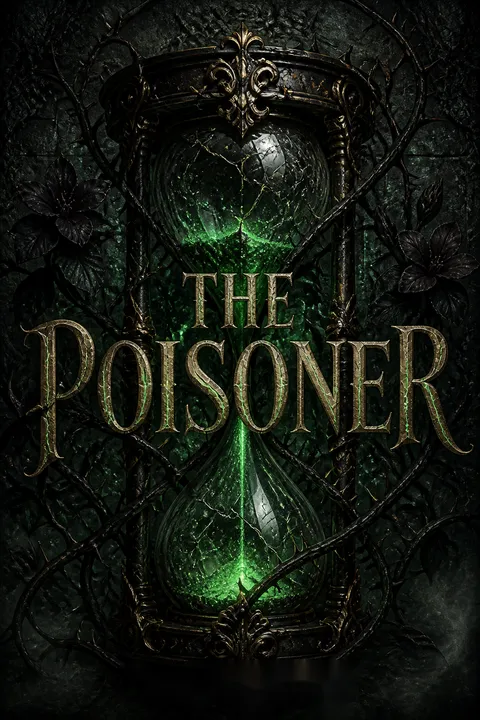


Plot Summary
Prologue
A question opens the story like a confession whispered through a keyhole: how long does a lethal dose of arsenic take to kill? The answer is precise — thirty-five hours, twenty-nine minutes, and fifteen seconds.
The narrator counted it herself. What reads as a poisoner's clinical boast will prove to be the book's most devastating secret: not professional detachment, but a woman measuring the death of someone she loved — one agonizing second at a time.
The Poisoner Comes Home
Beneath her respectable facade as a pharmacist writing about toxic beauty products, Alina Lis1 runs a covert operation — selling poisons to women who need abusive men eliminated. After a year mourning her chemist father8 on a country estate, she returns to London at the insistence of her dearest friend, Phoebe Aston.3
At Phoebe's3 lavish party, Alina1 stumbles into a side room where a blond man grips a woman in a blue dress, blood streaming down the woman's neck. His pale gray eyes fix on Alina1 with slow, predatory amusement.
His tongue drags up his victim's jugular while he watches her, daring her to act. She does the thing that will haunt her most: nothing. She walks away. The next morning, a newspaper sketch confirms the woman in the blue dress is dead.
Bodies Carved in Her Likeness
The women pulled from the harbor share Alina's1 coloring — dark hair, light eyes — but it is the surgical detail that stops her breath. The skin on the left side of each face has been peeled away, a meticulous replica of her poliosis, the rare condition that turns the hair on one side of her face white.
This is a message addressed only to her. Meanwhile, inhuman clicking sounds haunt her shop and home — not insect, not mammal, something she cannot classify. She arms herself with venom-tipped hair needles, hidden blades, and barber's razors.
She has killed many men through chemistry and distance. Whatever made those sounds has already been inside her home, watching her sleep, memorizing the cadence of her breathing like a predator cataloging its next meal.
The Staircase Wager
He materializes in her living room during a dark hour, snuffing her candle with a puff of breath. His voice slides through the blackness — smooth, taunting, reeking of smoke and blackberries. Silas2 proposes a wager: reach her bedroom before he catches her, and he leaves for the night.
She bolts. He gives no real head start, snagging her ankle halfway up the staircase. Alina1 whips around with her venomous hair needle and slashes his cheek — puff-adder venom, imported and lethal — before her skull cracks against the stair edge.
She wakes alone the next morning in dried blood, a crimson stain the wood will never release. The vase she hurled at him now holds red poppies. She is certain the venom killed him. There is no known antidote. She is wrong.
The Mongoose Returns
The shop bell chimes and Alina's1 healing wound throbs in recognition. Silas Forbes2 leans against her counter — a fading cut on his cheek the only souvenir — and pleasantly inquires about remedies for snake venom.
He compares himself to a mongoose: immune to the serpent's bite, with a developing appetite for serpent flesh. She studies him in daylight for the first time: impossibly tall, sharp-jawed, tailored in black, every fiber engineered for temptation. He slides her a calling card bearing the name of an industrial fortune.
When she demands how he survived, he claims his entire body is made of poison. The encounter ends with what sounds disturbingly like flirtation from a man she tried to murder. She shoves his card into a drawer, already formulating her next attempt.
Fingers in the Monster's Mouth
Another night, another invasion. Silas2 forces Alina1 from the bathtub, orchestrates hide-and-seek through her own home, and reveals himself fully when he catches her: eyes flooding black with blood, two sets of fangs snapping forward from the roof of his mouth, a tongue split down the middle with halves that move independently.
He pins her in a chair to claim his prize. But instead of begging, Alina1 hooks her fingers into his jaw, pries it open, and demands to see where the teeth fold.
She catalogs front and rear accessory fangs — viper-like and colubrid-like — and whispers, breathless with wonder, whether others of his kind exist. He expected screaming. He got a field examination. Something fundamental shifts in how the predator regards his prey. She falls asleep from exhaustion still in his arms.
Bourbon and Bad Faith
Alina1 goes on offense, slipping through a cellar window into Silas's2 manor to pour poison into his bourbon decanter. He watches every move from the dark — then confronts her. He forces the spiked liquor into her mouth; she spits it out rather than swallow her own creation.
His punishment is elegant cruelty: elbows and palms flat on his desk, lift either and she dies. He leaves her bent there alone. She does not eat, does not drink, does not shift her weight for over twelve hours.
When her body betrays her in the most humiliating way possible, soaking his Persian rug, his appetite for the game vanishes entirely. He orders her out. She leaves — having outlasted a creature who has outlasted centuries, winning through stubbornness what she could never win through violence.
The Sarcophagus Surrender
Rain hammers the cemetery where Alina1 visits her father's8 grave. Silas2 chases her through headstones, catacombs, and a miniature town of sealed tombs. She fights with a thorny shrub, slashing his face, kicking outward — but he is faster.
He slams her against a stone sarcophagus, pins her throat, and hikes her leg over his shoulder. His fangs twitch inches from her pulsing neck, his body shaking with a hunger that no longer resembles a game. She screams his name — not in defiance but in raw, undisguised terror.
The sound breaks something inside him. His forehead drops to the stone beside her head. He whispers that he cannot do this. Then he vanishes into the storm. Both now understand the same terrifying truth: he has lost the ability to kill the woman he was designed to devour.
Nailed to Her Door
Blood seeps under the front door before Alina1 turns the knob. Madam Berdot7 — her brothel-owning client, the woman who tested Alina's1 poisons on abusive men — hangs from the wood, a metal spike through her skull. Silas2 denies responsibility and suggests her poisons have failed on others who are now retaliating.
The revelation of enemies beyond Silas2 terrifies her. That midnight, she phones him with a proposition: her blood in exchange for his. She wants to study his biology; he needs to feed, as no other blood satisfies him anymore.
They negotiate three visits per week and seal the arrangement with a kiss Alina1 has laced with cyanide lip pomade. He tastes it and finds it charming. Their dynamic shifts from predator-prey to something neither can classify — part research partnership, part addiction, part courtship conducted in needles and venom.
The Charming Lab Partner
Amid a greenhouse's glass cathedral, a Russian accent interrupts Alina's1 examination of a corpse flower. Viktor Kaskov4 is a warm academic who has read her published journals and shares her fascination with poisonous plants. He becomes her lab partner at King's College, teaching her blood extraction while sketching her portrait between sessions.
Meanwhile, through quid-pro-quo exchanges during blood draws, Silas2 reveals his species: Vipera — creatures born or corrupted by dying while envenomed, who live until they starve or lose their heads.
Alina1 is a Mellifluous Host, carrying dormant Vipera traits including vestigial fangs beneath her palate. She could turn fully if she died within hours of being bitten. Viktor4 integrates seamlessly into her life, all warmth and dimpled smiles, while Silas2 watches from the margins with jealousy that makes his teeth ache.
Thirty-Five Hours Confessed
Curled together in a bay window nook, Alina1 peels back the wound she has never shown anyone. As a child, she poisoned schoolboys tormenting Phoebe3 — one died. Later, her father's8 assistant assaulted her repeatedly while she slept at their countryside cottage. She put arsenic in the wine.
But a storm spread the contamination, and her father8 — the man whose shop she tends, whose grave she visits — was accidentally exposed. She tracked every second of his dying: thirty-five hours, twenty-nine minutes, fifteen seconds. The prologue's cryptic confession made visceral.
Silas2 does not flinch, does not judge. He tells her what she did was necessary. He holds her until she sleeps, then drapes a blanket and tucks an oleander bloom behind her ear. The worst man she knows becomes the only one who does not recoil from her darkest truth.
Blue Eyes in the Kitchen
Weeks of migraines, sleep paralysis, and lower-back pain converge into a terrifying answer. While fetching water from her darkened kitchen, Alina1 spots two blue points of light in the corner — not Silas,2 who waits upstairs. Something else has been inside her home.
Silas2 examines her back and discovers two fresh puncture wounds along her lower vertebrae: someone has been feeding on her spinal fluid while she slept. He recognizes the signature of Luka Novikov,4 an ancient Vipera assassin called the Fixer, hired by Silas's2 own father to hunt the Poisoner who has been inadvertently killing Nest members.
Silas2 buys train tickets that night, urgently sending Alina1 to the countryside with Phoebe.3 For the first time, his obsessive surveillance resembles not possession but the only thing standing between her and something far worse.
Claimed at the Cottage
Months of chasing, biting, and bargaining reach their consummation at Alina's1 family cottage. Silas2 feeds from her neck during intercourse, his venom flooding her system with euphoria that eclipses morphine.
At climax, three rows of barbed spines at the base of his cock lock into her flesh — structures designed to secure a mate, tipped with venom that masks the pain. He confesses he lied about never using them. She is biologically claimed. Afterward, Alina1 begins secretly injecting his purified venom, chasing the high while simultaneously weaponizing his biology.
She develops an unstable anti-Vipera compound from his blood and saliva — five small vials that cause their blood cells to combust on contact. The creature who claimed her body has unwittingly supplied the formula for his species' undoing.
Viktor Dies, Luka Strikes
At a private scientific exhibition, Silas2 catches Viktor4 making a remark about spinal fluid that only the Fixer would know. The connection crystallizes: Viktor Kaskov4 is Luka Novikov.4 Days later at a museum gala, Viktor4 leads Alina1 to a secluded wing on the pretense of fetching her for Silas.2
His warmth curdles. He drops the wire glasses, tells her his true name, and bares fangs nothing like Silas's2 — thick, brutal, built to damage without numbing venom. He sinks them into her shoulder and carries her unconscious into the night.
Alina1 wakes naked, bound, and wearing a gold collar with sharp fleur-de-lis points in a Vipera Nest — the Aston family estate. The man who sketched her portrait and made her burnt coffee has delivered her to the predators she had been poisoning.
Every Friend a Liar
Luka4 peels away Alina's1 reality one confession at a time. Phoebe3 is Vipera — Mr. Aston's daughter, ageless despite appearances. Silas2 is Phoebe's3 half-brother, explaining their hostile familiarity. Mr. Aston identified Alina1 as a Host in childhood and planted Phoebe3 as her only permitted friend: surveillance dressed as companionship.
Dr. Hayes,5 her father's8 trusted colleague, works as the Nest's physician and admits to sabotaging her experiments. Every relationship was managed. Luka's4 methods are calculated sadism: he forces Alina1 to kneel on raw rice for hours while whipping her with a riding crop, then assaults her as a supposed reward.
Phoebe3 visits later in secret, her own neck bruised, and smuggles one vial of Alina's anti-Vipera compound into the room. One half-inch glass tube — their single weapon.
The Poisoner Bites Back
At a Nest gathering, Luka4 delivers the final humiliation: reading aloud from Alina's1 journal how she tracked her father's8 death second by second. As he positions himself to assault her before the assembly, Alina1 acts. The glass vial hidden in her mouth shatters between her teeth.
She leans into Luka's4 neck as if yielding, then bites down, driving the anti-Vipera compound into his bloodstream through the open wound. His face begins to corrode outward from the bite — skin burning in a chemical blaze that spreads like acid eating through silk.
He shrieks something beyond language. Silas2 crashes into him. In the erupting chaos, Phoebe3 seizes Alina1 and drags her from the room, from the estate, from the architecture of a life built on managed captivity. Her masterpiece is the wound she leaves behind.
Epilogue
Alina1 and Phoebe3 stand at the stern of a White Star Line ship, Liverpool to New York, watching England dissolve into gray horizon. Alina1 holds a crumpled ticket in one hand and a cigarette in the other. She carries no trunks from her old life — only a mind full of Vipera biology, an unstable poison formula, and the memory of every creature who underestimated her.
She does not know what became of Silas2 or Luka.4 Phoebe3 asks if she is coming inside. Alina1 flicks the cigarette into the ship's wake, watches the ember die in the waves, and follows her oldest friend3 below deck. She is heading west — not to run, but to disappear long enough to return as something far more dangerous than a poisoner.
Analysis
The Poisoner interrogates consent, autonomy, and the seductive appeal of surrendering both. Alina1 is introduced as a woman who weaponizes agency — choosing victims, controlling her craft, dictating every interaction on her terms. The novel then systematically strips that control through escalating predation, forcing her to negotiate with creatures who treat consent as a game mechanic rather than an ethical principle. Alina's1 scientific curiosity functions as a third force between fight and flight — she examines her predator rather than fleeing, transforming powerlessness into data collection and reclaiming agency through knowledge.
The dual-predator structure maps a taxonomy of male violence. Silas2 wants permission; Luka4 wants submission. Silas's2 obsession evolves from hunger toward something approaching devotion, but the novel refuses to sanitize it — his tenderness still operates through control. Luka4 weaponizes the inverse: gentleness deployed as camouflage for calculated sadism, the boyfriend persona as infiltration tool. Together they represent how systems consume women while offering competing justifications for the consumption.
The novel's most provocative gesture frames Alina1 as a killer before the story begins. Her poisons protect women from abusive men; the Vipera Nest feeds by collecting women as renewable resources. Both systems treat bodies as transactional, and Alina's1 visceral horror at witnessing the Den's flayed woman mirrors the horror she deliberately shields herself from regarding her own work's consequences.
The prologue's thirty-five-hour countdown — revealed as Alina1 tracking her father's8 accidental death by her own arsenic — reframes every subsequent act. She poisons compulsively to retroactively justify the accident that consumed the person she loved most. The Victorian setting amplifies this through period-specific restrictions on female autonomy, making each transgression a form of breaking containment.
Vipera biology externalizes the psychology of abusive attachment: fangs that fold like concealed intentions, a tongue that simultaneously soothes and tastes prey, barbed spines that enforce bonding through pain masked by euphoria. Alina's1 willingness to study these mechanisms rather than merely survive them reflects a mind that refuses passive consumption — making her final act of biting her captor with her own creation the definitive inversion of predator and prey.
Review Summary
The Poisoner received mixed reviews, with some praising its gothic atmosphere, intriguing characters, and dark romance elements. Many readers enjoyed the Victorian setting and the chemistry between Alina and Silas. However, others criticized the graphic content, inconsistent characterization, and controversial ending. Some felt the book had potential but failed to deliver, while others found it captivating and eagerly anticipated the sequel. Common complaints included historical inaccuracies, excessive smut, and a lack of plot development. The book's marketing and premise generated initial excitement, but reader reactions varied widely.
Characters
Alina Lis
The Poisoner of LondonA twenty-three-year-old botanist, chemist, and covert assassin operating from her late father's8 apothecary in London's West End. She writes about toxic beauty products publicly; privately, she sells poisons to women eliminating abusive men. Her poliosis—white hair on the left side of her face against jet-black hair—marks her as visually striking and impossible to hide. Behind her composed exterior lies devastating guilt over an accident that drove her into a year of exile. She processes trauma through obsessive work, alcohol, and rigid control, wearing black daily as a private homage to the funerals she causes. Her scientific curiosity is simultaneously her greatest weapon and most dangerous flaw—she will examine the creature that could devour her rather than flee, choosing taxonomy over survival every time.
Silas Forbes
The Obsessed CreatureA centuries-old born Vipera disguised as a wealthy industrialist, Silas is apex predator wrapped in tailored black. His angelic exterior—golden hair, gray eyes, sharp jawline—conceals retractable fangs, a split tongue, and blood that burns like acid. He fixates on Alina1 initially as prey but finds himself incapable of completing the kill. His obsession mutates from hunger into something he cannot name: possessiveness that operates through both violence and tenderness, stalking that slides into protection. He discovers he can no longer feed on anyone else—Alina1 has ruined all other blood for him. Beneath the sadism and theatric cruelty lies a creature who has never feared anything until he met someone who looked at his monstrous biology with curiosity instead of horror. His devotion is genuine; his methods remain terrifying.
Phoebe Aston
Alina's Devoted Best FriendA vivacious redhead socialite who hosts lavish parties and fills every silence with gossip, Phoebe appears entirely human—bright, doting, fiercely protective. She was only ever permitted one close friend, making her attachment to Alina1 both intense and codependent. She reads people faster than tabloids and defends Alina1 with a tongue sharper than surgical steel. Her devotion is genuine, yet she carries buried secrets about her own nature and family that complicate every gesture of friendship with the weight of what she cannot say.
Viktor Kaskov
Alina's Scholarly AdmirerA Russian academic studying orthopedics at King's College, Viktor enters Alina's1 life armed with knowledge of her published work and a warmth that disarms every defense she has built. He sketches her portrait, teaches her phlebotomy, shares her fascination with the natural world, and makes burnt coffee without complaint. His intelligence matches hers without competing; his gentleness provides counterpoint to every sharp edge in her existence. He appears at key moments with uncanny timing, knows details he shouldn't, and reads her moods with unsettling precision. What drives Viktor is a consuming interest in Alina1 that mirrors her own obsession with the unknown—total, patient, and not entirely what it seems. His artistic sensitivity conceals depths that even his wire-rimmed glasses cannot soften.
Dr. William Hayes
The Compromised Father FigureA tall, lanky professor at King's College and Alina's father's8 oldest friend, Hayes secures her laboratory access, shares fond stories about her late father8, and offers paternal warmth over bourbon. He hands out butterscotch candies to nervous patients and scolds students with the sternness of clergy. His concern for Alina1 appears genuine, shaped by decades of loyalty to her father8—but his professional allegiances extend further than academic corridors suggest.
Mrs. Caldwell
The Unwitting FloristA plump, cheerful shopkeeper who imports exotic and deadly plants for Alina1 without questions. Her shop, three blocks from the apothecary, serves as the supply chain for the Poisoner's most lethal ingredients.
Madam Berdot
The Brothel's Poison ClientA brothel owner who served as Alina's1 primary testing pipeline, administering experimental poisons to abusive clients. Her anxious visits to the apothecary underscore the real-world stakes of Alina's1 work.
Jacek Lis
The Father's Lasting ShadowAlina's1 deceased father, a dedicated chemist whose apothecary, botanical knowledge, and favorite sayings continue to shape her identity, her guilt, and her purpose long after his death.
Plot Devices
The Apothecary
Alina's lab and sanctuaryInherited from her father8, the apothecary serves dual purposes: a legitimate storefront selling herbal remedies, and a concealed laboratory for manufacturing lethal poisons. Brass instruments and glass bottles from her father8 line the workbenches, keeping his memory alive through scent and routine. The shop is where Silas2 first appears as a customer, where their blood-for-blood exchanges are conducted, and where Alina1 performs her first physical examination of Vipera biology—measuring his heart rate, cataloging his fangs, extracting his black blood. More than a workspace, it represents the one space where she maintains total authority. Every drawer holds something deadly, and every ring of the shop bell could announce either a patron or a predator.
The Blood Deal
The predator-prey bargainThe formal arrangement that transforms Alina1 and Silas's2 relationship from hostile stalking to structured codependency. Alina1 offers her rare Mellifluous blood—which Silas2 can no longer live without—in exchange for samples of his blood, venom, and saliva for scientific study. Negotiated at midnight over the telephone and sealed with a poisoned kiss, the deal creates mandatory intimacy through three weekly meetings and establishes consent as currency. It gradually dissolves the boundaries between researcher and subject, predator and lover. Crucially, the arrangement becomes the mechanism through which Alina1 acquires every biological sample she needs to develop a weapon against Vipera, making Silas2 an unwitting supplier of the raw materials for his own species' potential destruction.
Mellifluous Host Blood
The rare blood that ruinsAlina's1 blood carries a mutation—Mellifluous—that makes it sweeter and more sustaining than any other human blood to Vipera. This biological rarity is both her greatest danger and most powerful bargaining chip. It explains why Silas2 becomes unable to feed on anyone else after tasting her, why powerful figures kept her monitored since childhood, and why she was never simply killed when her poisoning was discovered. The blood also signals dormant Vipera traits: vestigial fangs hidden beneath her palate, the capacity to turn fully if envenomed before death. Being Mellifluous makes her simultaneously more valuable alive and more hazardous to leave uncontrolled, creating the central tension between every faction that wants to own, study, or consume her.
Alina's Poliosis
Visible mark of rarityAlina's1 poliosis—white hair and skin on the left side of her face against jet-black hair—functions as both a character signature and a recurring plot engine. It makes her instantly recognizable in any crowd, a critical liability for a covert poisoner. Silas2 uses it to craft grotesque messages: peeling the skin from murdered women's faces to replicate her markings as declarations only she would decode. The condition attracts unwanted scrutiny from strangers and rude questions at parties, reinforcing her isolation. Symbolically, the visible anomaly that makes people stare mirrors the hidden anomaly of dormant Vipera biology beneath her palate. Throughout the story, it marks her as something rare—and in this world, rarity makes you either precious or prey.
The Anti-Vipera Compound
The weaponized antidoteDeveloped over weeks from Silas's2 blood and saliva samples, this unstable chemical compound induces a reaction that causes Vipera blood cells to combust through chemical heat. Alina1 produces five small vials—unreliable in potency but devastating when they work. The compound represents the synthesis of everything she is: a poison crafted from studying the predator who underestimated her intelligence, using the biology he willingly shared through their bargain. Its delivery method in the climax—crushed between teeth and driven through a bite wound—inverts the entire predatory dynamic of the novel, turning the prey's mouth into the weapon and the predator's blood into fuel for its own destruction.
Download PDF
Download EPUB
.epub digital book format is ideal for reading ebooks on phones, tablets, and e-readers.








































