


Key Takeaways
Your wedding day closed the deal for you, never for her
The relationship is never permanently settled in her mind. Feldhahn's central discovery is that even happily married women carry a latent insecurity about whether their man still loves them. Saying "I do" felt like a done deal to him, but to her it means an ongoing "Do you still?" Seven in ten women reported that how their man feels about them is on their minds regularly, and roughly four in five admitted feeling insecure about his love at times, rising to over 90% among women under 45.
Confusing behaviors are warning lights. When she asks "Do you love me?" after he just said it, or turns critical for no clear reason, these are signals of a triggered insecurity, not random moodiness. He should read them as a dashboard light meaning "reassure me," not "attack."
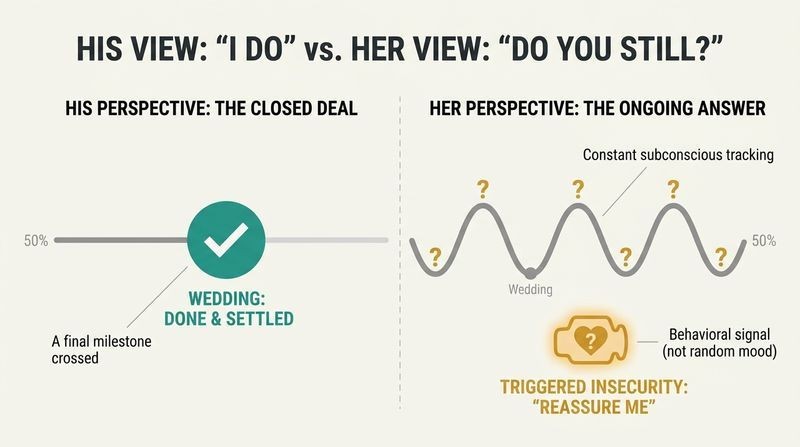
What's striking is how this reframes maddening behavior as a decodable signal rather than caprice, echoing attachment theory's "protest behavior," where an anxiously attached partner escalates precisely because they fear abandonment. The book's swamp-versus-map metaphor is apt: men treat women as unpredictable terrain when the terrain is actually consistent. A fair caveat: the survey draws from a largely religious, married American sample circa 2006, so generalizing to all women overreaches. Attachment style, not gender alone, likely drives much of this. Still, the practical reframe (see distress as a request for reassurance) holds up across relationship science regardless of who carries the insecurity.
Reassure her mid-conflict: "I'm angry, but we're okay"
The magic sentence during a fight. Feldhahn's most actionable finding: when a man reassures his partner of his enduring love during conflict, separate from his anger, it defuses her turmoil. A remarkable 95% of women said this single step would diminish or eliminate their emotional distress, and 86% said it would make them better able to grant him the space he wants.
Space plus a return, not silent withdrawal. Men retreat into what the book calls "cave time" to process, but her wiring reads silence as "something is wrong with us." The fix is to name the need without blaming her: "I need time alone, it's not about you." Then, crucially, come back and address the issue without making her raise it. As one woman put it, the fact that he returns matters more than the original argument.
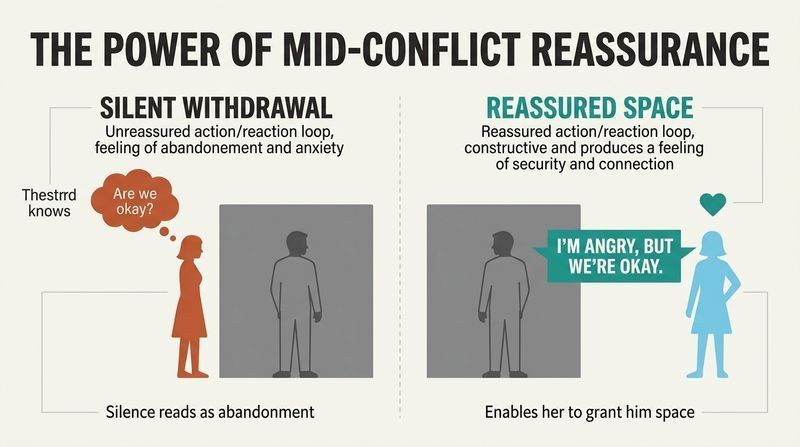
This is behaviorally shrewd. The reassurance decouples two signals men accidentally fuse: "I am upset" and "I am withdrawing love." Gottman's research on "repair attempts" during conflict aligns closely, finding that a partner's ability to de-escalate mid-fight predicts marital survival better than the absence of conflict itself. The instruction to return and reopen the issue counters the male "stonewalling" pattern Gottman flagged as corrosive. One nuance worth adding: the phrase only works if it is genuine. Repeated as a manipulation tactic to buy escape, it curdles into a formula she will detect. Sincerity, not scripting, is the active ingredient.
The chase doesn't end at the altar; keep pursuing her daily
Pursuit prevents insecurity before it starts. Beyond reassurance, Feldhahn argues persistent pursuit is the deeper tool. Men treat wooing as a dating-phase activity that ends once the relationship is secured. Women experience it as a permanent need. Several women equated their hunger to be pursued with a man's need to feel sexually desired.
Do what made you irresistible. The prescription is simple: repeat the small courtship behaviors, such as flirty midday texts, holding hands, silly nicknames, sharing dreams. The book cites a woman wooed for years with flowers and notes who fell into depression when her new husband stopped the moment they married. He insisted "of course I love you" while quitting every gesture that proved it. Using a scene from The Parent Trap, Feldhahn notes she wanted him to come after her, and telling him to would have robbed the act of meaning.
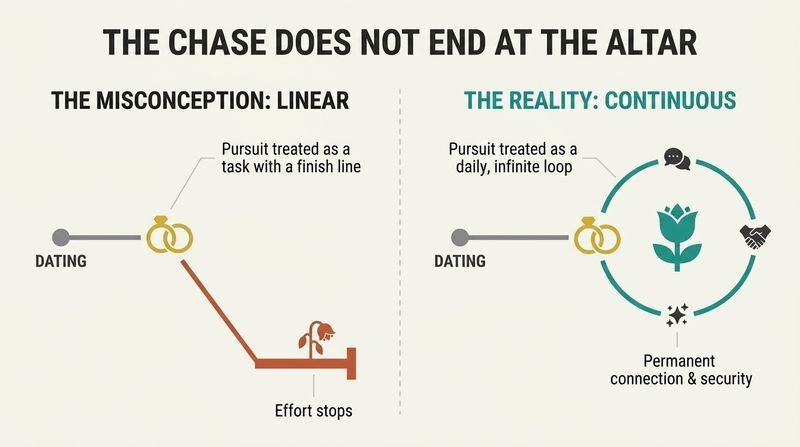
The economics here are counterintuitive but sound: courtship behaviors are cheap yet high-signal precisely because they are voluntary and unrequested. Behavioral economists call this costly signaling, where the value lies in demonstrating effort no one demanded. The Parent Trap point about not being able to ask is subtle and psychologically real: self-initiated action signals genuine preference, while requested action is contaminated by obligation. A useful extension: this maps onto the "hedonic adaptation" trap, where partners stop investing once a reward feels guaranteed. The antidote is treating the relationship as an ongoing practice, not an achieved state. The gendered framing may understate that men crave pursued-feeling too.
Her brain runs dozens of open windows she cannot close
The female mental multitasking model. Feldhahn compares a woman's mind to a computer running many windows at once, some weeks old, with unwanted "pop-ups" (intrusive thoughts and emotions) surfacing involuntarily. Nearly 80% of women described experiencing thoughts and feelings simultaneously rather than one at a time. About half get hit by pop-up emotions from the past multiple times weekly.
The close button is broken. Over four in five women said dismissing unwanted thoughts required real effort or was impossible; those thoughts return until the underlying issue is resolved. Where a man can put a worry on a mental timer and forget it, she cannot. The fire-starter story illustrates it: a friend's wife couldn't relax at dinner until she physically moved a lighter away from her kids, even after being assured they couldn't use it.
The computer metaphor is memorable, though the neuroscience is softer than the book implies. Research on gender differences in multitasking is genuinely mixed, and the more robust finding is about rumination: women, on average, report more repetitive negative thinking, a tendency Susan Nolen-Hoeksema documented as a driver of higher female depression rates. That reframes the "can't close the window" claim as rumination rather than superior parallel processing. The actionable core survives either interpretation: telling a ruminating person to "just stop thinking about it" backfires, while helping them resolve or externalize the concern (moving the lighter) actually closes the loop. Behavioral, not verbal, resolution is the underrated lever.
She'll trade money for closeness: emotional security beats financial
Security means the relationship, not the bank account. Feldhahn's biggest personal miss: he worked 80-hour weeks in a Manhattan law firm to buy a doorman building he thought his wife needed, when she wanted more of him, not more square footage. When forced to choose, 70% of married women preferred enduring financial struggle over distance in the relationship. Women struggling financially were even more likely to choose closeness.
What emotional security actually looks like. It is built from five things: feeling close to you, seeing you prioritize time together, feeling your commitment, seeing you active in home life, and seeing you make an effort to provide. Crucially, the little gestures (a hand on her back in a parking lot) build it more than grand romantic dinners. Men measure love in income because numbers are easy; she measures it in attention.
This inverts a deep cultural script that equates male provision with male love, a script with real evolutionary and historical roots. The book's data suggests the script has overshot: men over-index on the legible metric (money) because effort and presence resist quantification, a classic case of optimizing what is measurable over what matters. The "happy dad versus grumpy dad" story lands the point emotionally. A steelman for the provider instinct: financial stress is a genuine relationship killer, and the 70% figure reflects a choice between two bad options, not proof money is unimportant. The wisdom is balance, not abandoning ambition, as the women who rejected an "unhappy husband" job confirm.
When she shares a problem, her feelings are the problem
Fix the right thing by not fixing. The cliche "she doesn't want you to fix it, she wants you to listen" is true but useless without translation. Feldhahn decodes it: she doesn't need your solution (yet), she needs you to understand her feelings, and this applies only to emotional problems, not the car making a noise. Just 5% of women said a reasonable solution would actually solve their problem, and 60% found an offered fix to be a negative when it preempted listening.
Run the listening bases. His baseball framework: first base is full physical attention (face her, kill distractions), second is full mental attention (listening genuinely tires men, so admit your limit), third is listening for her feelings not the facts, and home plate is acknowledging and affirming those feelings, even feelings you think are irrational.
The counterintuitive gem is affirming a feeling you disagree with: "It's okay you felt disappointed." This aligns with Marshall Rosenberg's nonviolent communication and with therapeutic validation, where acknowledging an emotion is prerequisite to any productive problem-solving. Neurologically, naming and validating affect ("affect labeling") measurably reduces amygdala activation, so listening literally calms the nervous system before logic can land. The book's honesty about male listening fatigue as a near-physical limit is refreshing and probably underappreciated. One tension: the framework risks implying men should suppress problem-solving entirely, when the data shows two-thirds of women found the suggestions helpful once offered after validation. Sequence, not suppression, is the lesson.
Her lower sex drive is biology, not a verdict on you
"It's not you" is literally true. Among women who wanted less sex than their husbands, 75% said it had nothing to do with his desirability, and under 4% cited him being unattractive. Feldhahn attributes the gap partly to hormones: men have more testosterone-driven "assertive" desire, women more estrogen-linked "receptive" desire, meaning available and willing but without the drive to initiate. Over 80% of these wives said they'd boost their own drive if they magically could.
Sex starts in her heart, hours earlier. Her body doesn't respond to his physique alone the way his responds to hers; her arousal is tied to how she feels emotionally in the moment, which is shaped by how he treated her that day. Practical levers: warm-up and anticipation time, closeness outside the bedroom, helping around the house (Gottman found chore-sharing men have better sex lives), and never taking "not tonight" as rejection.
The "assertive versus receptive desire" distinction, drawn from sex researchers, has since been developed further by Emily Nagoski's responsive-desire model, which argues many women don't feel spontaneous craving but respond readily once pleasurable context is created. That validates the book's warm-up prescription while updating its hormonal determinism, which oversimplifies a picture involving stress, relationship quality, and medication. The chore-and-sex link from Gottman is real and delightfully unromantic. A worthwhile caution: framing the whole chapter around the husband wanting "more" centers male desire, and the book acknowledges one in four couples reverse the pattern. The deeper, gender-neutral truth is that desire discrepancy is normal and rarely a referendum on attractiveness.
You are her mirror: tell her she's beautiful, specifically and now
The little girl still asks "am I pretty?" Feldhahn's image: inside a competent grown woman lives the girl who twirled for her father asking if she's beautiful, only now she asks her husband, and only his answer counts. Over three-quarters of women under 45 have a deep need to know their man finds them beautiful; nearly 90% said hearing it made their day. He argues the husband is her one true mirror in a culture that otherwise humiliates women about their bodies.
How to say it right. Be specific (not "you look fine," which reads as "you don't rock my world"), be sincere, and say it immediately (she has a thirty-second rule). Take reluctance as a sign she needs it more, not less. The hammer that shatters the mirror is looking at or lusting after other women: two-thirds are bothered by a lingering glance, three-quarters are hurt if his thoughts linger.
The mirror metaphor is powerful because it assigns the man a role he rarely realizes he holds: the primary corrective to a distorted self-image bombarded by media. This anticipates research on social comparison and body image, where a partner's specific, credible affirmation buffers against idealized cultural standards. The "fine" critique is linguistically astute; vague praise signals low engagement. The chapter's treatment of wandering eyes as covenant-breaking reflects its evangelical frame and may strike secular readers as strict, yet the underlying finding stands independent of theology: perceived comparison wounds. A gentle challenge: outsourcing a woman's entire sense of beauty to her husband is fragile design. Healthiest is affirmation that supplements, not substitutes for, self-worth.
You don't have to wait for her to change first
One person can shift the whole system. Feldhahn closes by insisting a man needn't wait for his wife to understand him before acting on these insights. Women who read the companion book For Women Only often bristled at "why do I have to do all the work?" then discovered that changing their own behavior transformed the relationship. The same power belongs to the man who moves first.
The biggest surprise: you are her hero. Asked in the survey's open field what they most wished their husband knew, women overwhelmingly said, in effect, "you are my hero." Over 90% affirmed they deeply need, respect, and desire their husband even when they don't show it well. The average guy who leaves the toilet seat up is, to the woman who loves him, the knight she hoped for as a girl.
The "change unilaterally" principle is quietly radical and matches systems theory: relationships are feedback loops, so one partner altering their input reliably shifts the other's output without requiring negotiation or agreement. Therapists exploit this when only one spouse will attend counseling. It also sidesteps the fairness deadlock that stalls so many couples ("I'll change when you do"). The closing revelation, that women's unspoken verdict is admiration, is a genuinely hopeful counterweight to a genre that often catalogs male failures. The caveat: unilateral effort is a catalyst, not a doormat mandate. If sustained one-sidedness meets contempt rather than reciprocity, the issue is compatibility, not technique.
Analysis
For Men Only is a thesis-driven relationship manual built on an unusual engine: a nationally representative survey of 400 women (designed by a former US Census sampling chief) plus thousands of interviews, narrated by Jeff Feldhahn as the self-deprecating "embedded male" translating findings for fellow confused husbands. Its rhetorical genius is the swamp-to-map reframe: women are not random but knowable terrain, and most male frustration stems from pulling the wrong lever rather than facing genuine unpredictability.
The book's enduring value lies in a handful of high-leverage, low-cost behavioral scripts: reassure during conflict, keep pursuing after marriage, validate feelings before fixing, invest presence over provision, and affirm beauty specifically. These are testable, memorable, and largely consistent with mainstream relationship science, particularly Gottman's work on repair attempts and chore-sharing, and affect-labeling research on validation.
Its limitations are equally clear. The 2006 sample skews toward married, religious, heterosexual American women, and the book candidly frames itself as a Christian, complementarian text assuming husbands should love as Christ loves the church. Its gender essentialism (women as multitasking, receptive, emotionally-driven; men as sequential, assertive, logical) is presented as biological fact when contemporary research treats many of these as distributions with massive overlap, better explained by attachment style, socialization, and individual variation than by sex alone. The "female brain as multitasking computer" claim is the weakest scientifically; rumination research fits the data better.
Yet the book hedges honestly, repeatedly noting exceptions and that one in four couples reverse the sexual-desire pattern. Read charitably, it is less a rigid theory of gender than a practical decoder for a specific, common relational dynamic. Strip the essentialist packaging and the operational advice generalizes: perceive distress as a bid for reassurance, validate before solving, invest in the unmeasurable, and move first. Those principles outlast the survey that inspired them.
Review Summary
For Men Only offers insights into women's thoughts and behaviors, based on surveys and research. Reviews are mixed, with some praising its helpfulness in understanding relationships, while others criticize its stereotypical portrayals and oversimplifications. Many readers found valuable insights, but some felt the advice was obvious or poorly presented. The book's Christian perspective and casual writing style were noted. Overall, it's seen as potentially beneficial for some couples, though not without flaws.
People Also Read








FAQ
1. What’s "For Men Only: A Straightforward Guide to the Inner Lives of Women" by Shaunti Feldhahn about?
- Purpose of the Book: "For Men Only" is a research-based guide designed to help men understand the inner emotional and relational lives of women, especially in the context of marriage or committed relationships.
- Focus on Practical Insights: The book translates complex female behaviors and feelings into straightforward, actionable advice for men, aiming to reduce confusion and frustration in relationships.
- Research-Driven Content: The authors conducted national surveys, focus groups, and interviews with thousands of women to uncover common patterns and needs that men often overlook.
- Christian Worldview: While the book is accessible to all, it is written from a biblical perspective, emphasizing love, service, and mutual understanding in relationships.
2. Why should I read "For Men Only" by Shaunti Feldhahn?
- Clarity on Female Behavior: The book demystifies behaviors and emotional responses in women that often perplex men, offering clear explanations and solutions.
- Improved Relationships: By understanding what women truly need, men can foster deeper intimacy, reduce conflict, and create more harmonious partnerships.
- Actionable Advice: The book provides simple, practical steps that men can implement immediately, making it easier to connect with and support their partners.
- Research-Backed Confidence: Knowing the advice is based on extensive research gives men confidence that these insights are widely applicable and not just anecdotal.
3. What are the key takeaways from "For Men Only" by Shaunti Feldhahn?
- Women’s Insecurity About Love: Even in good relationships, women often need ongoing reassurance of their partner’s love and commitment.
- Emotional Multitasking: Women process multiple thoughts and emotions simultaneously, making it hard for them to "just let things go" or compartmentalize issues.
- Emotional Security Over Financial Security: Most women prioritize emotional closeness and security over financial stability, even willing to endure financial hardship for a closer relationship.
- Listening Over Fixing: When women share problems, they usually want empathy and understanding, not immediate solutions or advice.
- Sexual Differences: Women’s desire for sex is often less frequent and less visually triggered than men’s, and is more connected to emotional intimacy.
- Desire to Feel Beautiful: Women have a deep need to feel beautiful and desired by their partner, and men’s words and actions powerfully influence this.
- Men Are Heroes: Most women deeply respect and appreciate their husbands, even if they don’t always express it well.
4. How does "For Men Only" by Shaunti Feldhahn explain women’s need for ongoing reassurance of love?
- Not a Closed Deal: Women don’t feel permanently loved after marriage; they need regular affirmation that their partner still loves and values them.
- Triggers of Insecurity: Conflict, withdrawal, silence, absence, or unresolved issues can trigger doubts about love, even if unintentional.
- Simple Solutions: Regular verbal and physical reassurance, especially during or after conflict, can quickly restore a woman’s sense of security.
- Persistent Pursuit: Continuing to pursue and woo a wife after marriage is essential; women want to feel chosen and cherished every day.
5. What does "For Men Only" by Shaunti Feldhahn reveal about how women think and process emotions?
- Multiple Open Windows: Women’s minds are like computers with many windows open—thoughts, feelings, and concerns from past and present run simultaneously.
- Difficulty Closing Issues: Unlike men, women often can’t simply "close" or ignore unresolved issues; these thoughts persist until addressed.
- Pop-Ups from the Past: Old hurts or unresolved conflicts can resurface unexpectedly, affecting current moods and interactions.
- How Men Can Help: Encouraging women to talk through issues, listening without judgment, and helping resolve concerns can help women "close windows" and feel at peace.
6. How does "For Men Only" by Shaunti Feldhahn define "security" for women, and what should men do about it?
- Emotional Over Financial Security: Most women value emotional closeness, commitment, and time together far more than financial comfort or material things.
- Feeling Like a Priority: Women feel secure when they know they and the family come before work or outside interests in their partner’s life.
- Active Participation: Being involved in home life and parenting, not just providing financially, is crucial for a woman’s sense of security.
- Support for Men: The book encourages men to balance their provider instincts with efforts to be present, attentive, and emotionally available.
7. What advice does "For Men Only" by Shaunti Feldhahn give men about listening to women?
- Listening vs. Fixing: Women usually want their feelings heard and validated, not immediate solutions to their problems.
- Four Steps to Listening: Give full physical and mental attention, listen for feelings (not just facts), acknowledge and affirm those feelings, and avoid being defensive.
- Emotional Problems vs. Technical Problems: The "just listen" rule applies to emotional issues; practical problems (like a broken car) can be solved directly.
- Power of Good Listening: Effective listening makes women feel loved, valued, and understood, and often leads to quicker resolution of issues.
8. How does "For Men Only" by Shaunti Feldhahn address differences in sexual desire between men and women?
- Lower Sex Drive is Normal: Most women have a lower, less assertive sex drive than men, due to physiological and hormonal differences.
- Not About Desirability: A woman’s lower interest in sex is rarely about her husband’s attractiveness or her love for him.
- Emotional Connection Matters: For women, sexual desire is closely linked to emotional intimacy and feeling cherished.
- Practical Tips: Men are encouraged to build emotional closeness, help with daily stresses, initiate romance outside the bedroom, and communicate openly about needs and preferences.
9. What does "For Men Only" by Shaunti Feldhahn say about women’s need to feel beautiful and desired?
- Deep-Seated Need: Most women, regardless of age or self-confidence, have a strong desire to feel beautiful in their partner’s eyes.
- Men as Mirrors: A husband’s words and actions are the most important "mirror" for a woman’s self-image; regular, sincere compliments are vital.
- Impact of Comparison: When men look at or linger on other women, it can deeply wound their partner’s sense of being special and beautiful.
- Practical Affirmation: Men should give specific, heartfelt compliments, avoid dismissive responses, and consistently reassure their partner of her unique beauty.
10. What are the most common misunderstandings men have about women, according to "For Men Only" by Shaunti Feldhahn?
- Assuming Simplicity: Men often think women’s needs are simple or the same as men’s, leading to missed emotional cues.
- Misreading Emotional Signals: Behaviors like criticism, withdrawal, or repeated questions are often signs of insecurity, not attacks or nagging.
- Overvaluing Financial Provision: Men may believe providing financially is the main way to show love, while women prioritize emotional presence.
- Taking Rejection Personally: Men may interpret a lack of sexual interest or emotional withdrawal as personal rejection, when it’s usually about other factors.
11. What practical steps does "For Men Only" by Shaunti Feldhahn recommend for men to improve their relationships?
- Regular Reassurance: Frequently affirm your love, especially during or after conflict, and continue to pursue your partner romantically.
- Active Listening: Practice attentive, empathetic listening without jumping to solutions or becoming defensive.
- Prioritize Time Together: Make your partner and family a clear priority over work and outside interests.
- Support Her Self-Image: Give sincere, specific compliments about her appearance and character, and avoid behaviors that make her feel compared to others.
- Help with Daily Life: Share household responsibilities and parenting, reducing her stress and increasing emotional closeness.
12. What are the best quotes from "For Men Only" by Shaunti Feldhahn and what do they mean?
- "Even if your relationship is great, your mate likely has a fundamental insecurity about your love—and when that insecurity is triggered, she may respond in ways that confuse or dismay you until she feels reassured."
This highlights the ongoing need for reassurance in relationships, even when things seem fine. - "Their thought lives are almost like busy computers with multiple windows open and running all at once."
This metaphor explains why women may seem preoccupied or unable to "let things go" until issues are resolved. - "For women, the currency that counts is a strong sense of closeness or intimacy with their man."
Emotional connection is more valuable to most women than financial security or material comfort. - "Listening to her so she actually feels listened to will pay immediate dividends in a deeper, stronger, more rewarding relationship."
Empathetic listening is a powerful tool for building intimacy and trust. - "A woman needs to feel sexy to her man. But many men do not spend the time or effort in affirming their spouse sexually outside of the bedroom."
Affirmation and pursuit outside the bedroom are essential for a fulfilling sexual relationship. - "You’re not just the guy who shares her space. You’re her most important mirror—the man who can reflect back to her how lovely you think she is."
A man’s opinion and affirmation are central to a woman’s self-image and confidence.
About the Author



Download PDF
Download EPUB
.epub digital book format is ideal for reading ebooks on phones, tablets, and e-readers.








































