

Key Takeaways
Commitment, not conquest, is the aphrodisiac that actually delivers pleasure
Gregoire's central argument inverts the cultural script. The magazine fantasy says bad girls have wilder, better sex, but the data she cites tells the opposite story. A Family Research Council study of 1,100 couples found the most sexually satisfied woman is often the long-married, imperfect, twenty-five-pounds-heavier wife who has been devoted to one man for decades.
Her own surveys of roughly 1,000 women each reinforce this. Women who saved sex for marriage rated their current sex lives a full point higher (7.5 versus 6.5 on a 10-point scale) than those with multiple prior partners. Her thesis: sex was engineered for a committed, exclusive relationship, so ripping it out of that context strips it of depth. The security of permanence, not novelty or physical perfection, is what unlocks abandon.

The claim aligns with broader relationship research. Studies from the National Health and Social Life Survey have repeatedly found married and religiously committed people reporting high sexual satisfaction, plausibly because trust lowers the vigilance that inhibits arousal. Attachment theory offers a mechanism: felt security frees the nervous system to surrender. One caveat worth flagging is selection bias. People predisposed to stability may both marry and report satisfaction, so causation is murky. Gregoire's own sample skews heavily toward devout Christian women, which she acknowledges. Still, the counterintuitive core, that safety fuels rather than dampens eroticism, is a genuinely useful corrective to novelty-obsessed culture.
Great sex joins body, soul, and mind, not just genitals
Gregoire insists sex was designed to unite three dimensions at once, echoing Thomas Aquinas's three goods of marriage: offspring (physical), fidelity (relational), and sacrament (spiritual). She reframes the Hebrew word for sex in Genesis, to know, noting the same root describes deeply knowing God. Sex, in her view, is a longing for total union that mirrors the human hunger for the divine.
Her survey numbers make the point concretely. Of women who always reached orgasm, 29 percent still rated their sex lives merely 6 to 8, not a 9 or 10. Meanwhile, 17 percent of women who never orgasmed rated their sex lives a 9 or 10. Physical climax alone does not guarantee a satisfying sex life. As one author she quotes puts it, the real goal is oneness, not orgasm.
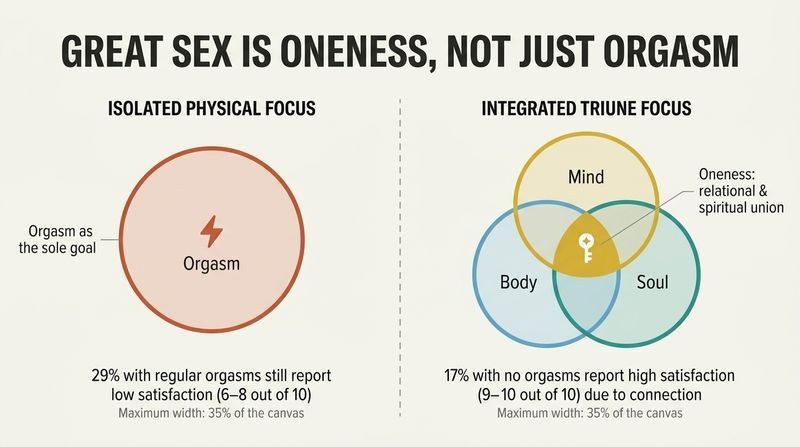
This holistic framing resonates beyond religion. Secular sex therapists like Esther Perel argue that eroticism thrives on emotional connection and meaning, not mechanics alone. The finding that orgasm and satisfaction only loosely correlate is striking and echoes clinical data showing relationship quality predicts sexual contentment better than orgasm frequency. Gregoire's triune model gives readers a useful diagnostic: when sex disappoints, ask which dimension is starved rather than reaching for new techniques. The framework's limitation is that it can inadvertently shame couples for whom the spiritual language does not resonate, but the underlying insight, that connection outperforms performance, is broadly supportable.
Men make love to feel loved; women feel loved to make love
Gregoire frames the sexes as built with complementary, mismatched wiring. Men's desire is body-driven and near-instant, closer to a physical pressure that demands release, while women's arousal is relationship-driven and lives largely in the head. Her memorable image: men are like balloons that build unbearable pressure, women are like teeter-totters who enjoy the ride without needing to climax.
The practical payoff is understanding rather than resentment. A woman can lose all arousal because a stray thought about buying milk wanders in. A man feels genuinely rejected, not just frustrated, when refused, because sex is his primary love language and route to intimacy. She argues the mismatch is intentional design: each partner must focus on the other's need to get their own deepest need met, which itself becomes a bonding exercise.
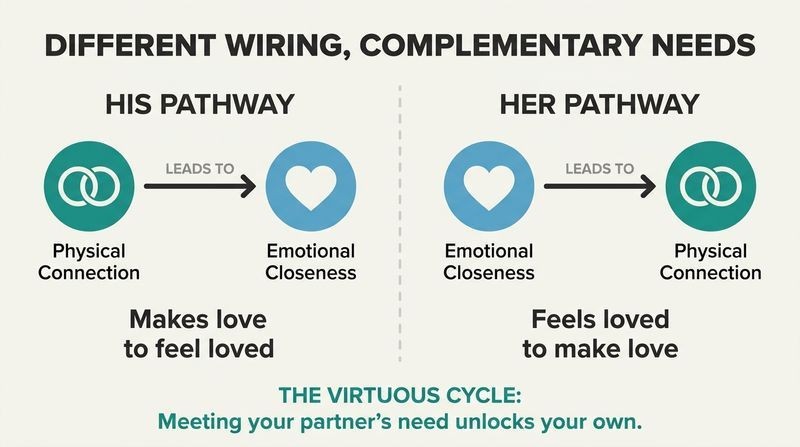
The gendered generalizations are the book's most debatable feature. Sex research supports meaningful average differences in spontaneous desire, but the variation within each sex is large, and Gregoire herself documents many higher-drive wives. Rosemary Basson's model, which Gregoire cites, actually complicates the binary: many people of both sexes experience responsive rather than spontaneous desire. The risk of essentialism is real. Yet the core coaching insight, that partners often misread each other's rejection and arousal cues, holds up well. Framing difference as complementary design rather than defect is emotionally generous and likely reduces the blame spirals that erode intimacy.
Relax about the wedding night; only 16 percent of virgins orgasm
Gregoire attacks the high-pressure Christian narrative that the wedding night must be perfect. Her survey found only 16 percent of women who were virgins reached orgasm through intercourse that night, and 70 percent did not orgasm at all. Yet years later, 57 percent of those same women usually or always climax. Skill compounds with time and safety, not with a flawless debut.
She reframes the night around the marriage itself, not a performance milestone. Practical advice fills the chapter: schedule an early ceremony to avoid exhaustion (the top wedding-night regret), skip the alcohol (10 percent of couples did not have sex because the husband was too drunk), bring lubricant, urinate afterward to dodge UTIs, and treat the first time as the opening of a decades-long learning curve rather than a test to pass.
The demystification here is quietly radical within its genre, replacing a shame-laden mythology with normalizing data. Sex educators broadly agree that performance anxiety is self-defeating, since the sympathetic nervous system's fight-or-flight state actively blocks arousal and lubrication. Gregoire's insistence that competence is learned rather than innate mirrors deliberate-practice research: expertise in any embodied skill comes from repetition, feedback, and low-stakes experimentation. The practical logistics (hydration, sleep, sobriety) are unglamorous but evidence-aligned, since fatigue and alcohol both blunt physiological response. The chapter's strength is treating sex as a craft couples develop together rather than a talent one either has or lacks.
For women, arousal is a mental switch you consciously flip
Because female desire lives in the head, Gregoire argues women have more control than they think, and more responsibility to engage. She recommends a concrete self-training method for women who struggle to orgasm: have your husband stimulate you while you rate your arousal on a 1-to-10 scale, learning to recognize the difference between a 7 and a 9. Once you know what a 9 feels like, begin intercourse there.
She also normalizes taking charge of one's own pleasure. Orgasm requires surrender and letting go of control, which is hard for orderly personalities. Distraction, tension, and self-monitoring are the enemies. Her fix is presence: talk during sex, keep your eyes open, ask yourself what you want him to do next. She reframes messiness and loss of control as features God designed into sex, not embarrassments.
The arousal-scaling exercise is essentially sensate-focus therapy, a legitimate clinical technique developed by Masters and Johnson to reduce performance anxiety and rebuild body awareness. Gregoire's emphasis on presence over spectatoring is well supported: research on sexual mindfulness shows that attending to physical sensation rather than self-evaluating (what Masters and Johnson called spectatoring) improves arousal and satisfaction. Framing a woman as an active agent in her own pleasure, rather than a passive recipient, is empowering and corrects the passive scripts many absorb. The one tension is that placing responsibility on women could shade into self-blame when the real issue is a partner's inattention, which Gregoire elsewhere acknowledges.
Pornography rewires the brain to crave images over your spouse
Gregoire treats porn as a genuine addiction that hijacks arousal circuitry, and increasingly not just a male problem: 25 percent of the women she surveyed reported struggling with it, while 66 percent of men admitted seeking it out. The mechanism she describes is desensitization, the same escalation an alcoholic experiences, where the brain learns to fire for a picture rather than a person, eventually wrecking libido for real relationships.
She cites counselor Ian Kerner's coined term SADD (Sexual Attention Deficit Disorder) to describe men so accustomed to endless novel stimulation that real sex cannot hold their focus. Her recovery blueprint: confront it as sin and addiction, install filters, find an accountability partner (never the spouse), expect relapses, and rebuild through non-demanding physical closeness rather than trying to out-compete porn with kinkier sex, which only deepens the dependence on fantasy.
The neurological account tracks emerging research on how supernormal stimuli can dysregulate the dopamine reward system, though the science on porn-induced dysfunction remains contested and politically charged. Gregoire's counterintuitive advice, that a wife should not try to become porn to save her marriage, is psychologically shrewd: it refuses to let the addict externalize responsibility and avoids reinforcing the fantasy-arousal pathway. Her insistence that the spouse not serve as accountability partner mirrors standard addiction-recovery practice, which separates intimate relationships from monitoring roles. The framing is compassionate rather than merely condemnatory, locating blame partly in a saturating culture, which likely makes recovery conversations less defensive.
Friendship and sex form a self-reinforcing circle, each fueling the other
Gregoire's relational thesis is that sex is not the foundation of marriage but the culmination of a friendship. Couples who stop doing things together (Tanya and Mike, who eventually divorced, ate separately and shared nothing but sex and kids) lose the connection that makes desire possible. Her prescription: build common hobbies, share your thoughts before bed (for women, talking is often the real foreplay that clears the mental clutter), and perform small daily acts of kindness.
But the circle runs both directions. Better sex also builds friendship. She cites the couple Sarah and Colin, who committed to daily sex for a month and found themselves flirting, cuddling, cooking for each other, and fighting less. Because oxytocin (the bonding hormone) surges most in men during sex, meeting a husband's sexual need often unlocks the emotional attentiveness a wife craves.
The bidirectional model is the book's most sophisticated relational idea and it aligns with Gottman's decades of marriage research, which identifies friendship and fondness as the foundation of lasting partnership. The oxytocin explanation, while popularly oversimplified, points to a real dynamic: physical affection and sexual activity are associated with pair-bonding neurochemistry. Gregoire's reframe of a woman's bedtime venting as foreplay rather than rejection is a genuinely useful decoding of a common conflict. The insight that couples should not wait to feel connected before having sex, because sex itself generates connection, breaks a stalemate many partners are stuck in, each waiting for the other to move first.
Desire often follows sex rather than preceding it, so jump in
Gregoire's most practical libido advice challenges the assumption that you must feel in the mood before making love. She invokes University of British Columbia researcher Rosemary Basson, who found many women begin sexual encounters feeling sexually neutral and only experience desire once arousal builds. Desire is the result of lovemaking, not its prerequisite.
Her analogy: standing shivering on the pool steps, dreading the cold water, wastes the whole swim. Dive in and your body adjusts. She distinguishes this sharply from faking anything, and from having sex under coercion, an affair, or active porn use. In healthy marriages, though, she urges women to initiate and engage even when not initially aroused, because the mind leads and the body follows. She also notes that initiating lets a woman set the pace and angle, making the encounter more likely to satisfy her too.
Basson's responsive-desire model is one of the most important developments in modern sex science and Gregoire deploys it accurately and usefully. It reframes low spontaneous desire as normal rather than dysfunctional, relieving enormous anxiety. The pool analogy captures the activation-energy problem behavioral economists know well: the hardest part of many rewarding activities is starting, and anticipation systematically overweights discomfort. The ethical guardrails Gregoire places around this advice matter, since responsive desire can be misused to pressure reluctant partners. Her framing keeps agency with the woman by pairing willingness with initiation and control. The advice is strongest when both partners understand it, preventing it from becoming one-sided obligation.
Freedom in the marriage bed has three simple boundaries
On the perennial questions (oral sex, toys, role-play, lingerie), Gregoire offers a permissive framework grounded in three tests rather than a list of rules. An act is acceptable if:
1. You are married, so freedom is the default.
2. It is mutual and never degrading, coerced, or fear-based.
3. It involves no lust for anyone outside the marriage.
Applying these, she finds no biblical prohibition on oral sex, lingerie, or most role-play, while urging real caution around anal sex (physically riskier) and certain toys or vibrators that do something a husband cannot replicate, potentially making it harder to respond to him. Her deeper warning is that chasing ever-more-adventurous acts, driven by a pornified culture, can turn sex into an idol and crowd out the quiet intimacy, especially early in marriage, that actually builds oneness.
Gregoire threads a difficult needle for a conservative audience, rejecting both prudishness and anything-goes libertinism with a coherent principle-based ethic. Her three tests function like a values filter, letting couples reason about novel situations rather than memorizing prohibitions, which is pedagogically superior to rule lists. The caution about vibrators creating a response gap has some physiological basis, since intense mechanical stimulation can recalibrate what triggers climax, though framing this as a reason for restraint is debatable and many therapists recommend toys precisely to help women learn orgasm. The strongest thread is her worry that boundary-pushing can become its own idol, substituting escalation for intimacy, a critique that applies well beyond religious contexts.
Treat your bedroom like a five-star restaurant, not a truck stop
Gregoire's closing metaphor contrasts two ways of eating: the diner, where you refuel to make hunger go away, versus the resort, where each course is savored and hunger is deliberately awakened. Utilitarian sex (just satisfying his need so everyone can move on) diminishes it. The alternative is to cultivate anticipation.
She turns restaurant rituals into sexual practices: a dedication (pray or read Scripture together first), the setting (keep the bedroom uncluttered, candlelit, work-free, and reserved for the two of you, not laundry or kids), the presentation (dress attractively for the spouse, not just for strangers at work or church), appetizers (flirt and send suggestive texts during the day to prime desire), and spicing the menu (vary positions, times, and locations to escape ruts). The aim is sex that stirs hunger rather than merely relieving it.
The restaurant framework is an effective mnemonic that repackages sound behavioral principles: anticipation amplifies pleasure (a well-documented finding in hedonic psychology, where looking forward to an experience delivers measurable enjoyment on its own), environment shapes behavior, and novelty combats habituation. The daytime-priming advice dovetails with the responsive-desire model from earlier: seeding sexual thoughts hours ahead gives desire runway to build. The appearance advice may strike some readers as placing disproportionate grooming burden on wives, and Gregoire does aim it primarily at women. Yet the underlying claim, that intentionality and ritual elevate sex from transactional to meaningful, is a fitting capstone that ties the book's physical, relational, and spiritual threads together.
Analysis
This is a Christian marriage self-help book aimed squarely at devout, largely evangelical women, many navigating shame, inexperience, or mismatched desire. Its structure is thematic, moving through four discoveries (physical fireworks, spiritual bliss, relational laughter, and integration), each blended with survey data, reader testimonials, theology, and candid personal disclosure. What makes it distinctive within its genre is Gregoire's willingness to be anatomically explicit while remaining doctrinally conservative, and her reliance on original survey research (three surveys totaling roughly 2,400 respondents) rather than pure exhortation.
The book's intellectual spine is a synthesis of Thomas Aquinas's three goods of marriage with modern sex science, particularly Rosemary Basson's responsive-desire model. This pairing is genuinely useful: it lets Gregoire argue that low spontaneous desire is normal, not sinful or broken, while grounding sex in covenant meaning. Her strongest contribution is demystification, replacing a high-pressure purity culture that treats the wedding night as a pass-fail exam with data showing skill compounds over decades.
The book's vulnerabilities are twofold. First, the sample is self-selected and overwhelmingly religious (84 percent report a close relationship with God), so satisfaction correlations with virginity or faith are confounded by selection effects Gregoire only partly acknowledges. Correlation-causation slippage recurs. Second, the gender essentialism, while softened by counterexamples, occasionally hardens generalizations that within-group variance undermines.
Where the book transcends its niche is its relational model: the friendship-sex circle, the decoding of rejection cues, and the responsive-desire reframe are transferable insights validated by mainstream research from Gottman to Masters and Johnson. Stripped of its theological packaging, much of the practical advice would sit comfortably in a secular therapist's office. The book's enduring value lies less in its doctrine than in its compassionate, evidence-informed permission for women to see sex as designed for their pleasure and connection, not merely their husband's need.
Review Summary
The Good Girl's Guide to Great Sex receives mostly positive reviews, praised for its Christian perspective on marital intimacy. Readers appreciate its honest, humorous approach and practical advice. Many found it helpful for newlyweds and long-married couples alike. The book emphasizes mutual pleasure, emotional connection, and spiritual aspects of sex. Some criticize it for outdated gender stereotypes or judgmental tone. The updated edition addresses previous shortcomings and includes more inclusive content. Overall, most readers recommend it as a valuable resource for Christian women seeking to improve their sex lives within marriage.
People Also Read








FAQ
What is The Good Girl's Guide to Great Sex by Sheila Wray Gregoire about?
- Comprehensive Christian marriage guide: The book explores how to create a marriage that is both "holy and hot," focusing on sexual intimacy as a God-designed, beautiful part of marriage.
- Physical, emotional, and spiritual focus: It addresses sex from physical, emotional, and spiritual perspectives, helping couples deepen their connection on all levels.
- Myth-busting and encouragement: Sheila challenges cultural myths about sex, especially the idea that only "bad girls" have fun, and encourages women to embrace God’s design for sex within marriage.
Why should I read The Good Girl's Guide to Great Sex by Sheila Wray Gregoire?
- Addresses real struggles: The book offers hope and practical solutions for common issues like fear, pain, past baggage, mismatched libidos, and lack of desire.
- Faith-based perspective: It provides a biblical foundation for sexuality, showing that sex is a sacred gift meant to be enjoyed within marriage, not a source of shame.
- Empowerment and transformation: Readers are encouraged to become more confident lovers, deepen intimacy, and experience a thriving marriage emotionally, physically, and spiritually.
What are the key takeaways from The Good Girl's Guide to Great Sex by Sheila Wray Gregoire?
- Sex is relational, not just physical: True intimacy involves emotional, spiritual, and physical connection, not just the act itself.
- Communication and mutual respect: Open dialogue and shared responsibility are essential for a satisfying sex life.
- Growth over time: Sexual satisfaction and intimacy deepen as trust, friendship, and transparency grow within marriage.
What are the main differences between how men and women view sex according to Sheila Wray Gregoire?
- Different motivations: Men’s desire is often more physical and immediate, while women’s is more relational and emotional, needing to feel loved and safe.
- Sex is in the head: Women’s arousal depends heavily on mental and emotional connection, while men tend to become aroused more quickly and physically.
- Mutual responsibility: Both spouses should seek to please and cherish each other, making sex a shared journey rather than a duty.
How does Sheila Wray Gregoire define the purpose and nature of sex in marriage?
- Threefold purpose: Drawing on Thomas Aquinas, sex’s purposes are offspring (procreation), fidelity (commitment), and sacrament (spiritual union), with spiritual union as the highest.
- Sex as a gift: Sex is designed by God to be pleasurable and bonding, releasing hormones that deepen intimacy.
- Covenant promise: Sex is a covenant act that unites husband and wife as "one flesh" on every level.
What are the most common sexual challenges discussed in The Good Girl's Guide to Great Sex by Sheila Wray Gregoire?
- Mismatched libidos: Differences in sexual desire between spouses can cause frustration and feelings of rejection.
- Dissociation and past trauma: Many women struggle with being mentally present during sex due to past abuse, guilt, or reliance on fantasy.
- Pornography and addiction: Porn use by either spouse can damage sexual desire, connection, and trust within marriage.
How does The Good Girl's Guide to Great Sex by Sheila Wray Gregoire address women’s physical challenges with sex?
- Difficulty reaching orgasm: Over half of women struggle with this; the book suggests relaxation, communication, and clitoral stimulation.
- Pain during intercourse: Issues like vaginismus or tension can be addressed with relaxation exercises, pelvic floor training, and emotional healing.
- Low lubrication and libido: Hormonal changes, stress, or medication can reduce desire; using lubricants, more foreplay, and medical consultation are recommended.
What advice does Sheila Wray Gregoire give for men’s sexual challenges in The Good Girl's Guide to Great Sex?
- Erectile dysfunction (ED): Often linked to physical health issues; medical consultation, lifestyle changes, and emotional support are encouraged.
- Psychological causes: Stress, insecurity, and relationship issues can worsen ED; building trust and reducing performance pressure are key.
- Low libido: Causes include low testosterone, weight issues, pornography, and lack of friendship; solutions involve medical help, lifestyle changes, and improving the marital relationship.
How does The Good Girl's Guide to Great Sex by Sheila Wray Gregoire recommend couples prepare for the wedding night and honeymoon?
- Relax and enjoy discovery: The wedding night is the start of a journey, not a performance; most women do not orgasm on their wedding night, and that’s normal.
- Practical preparation: Plan birth control, medical checkups, and choose a comfortable setting; bring lingerie and lubricant for comfort and confidence.
- Communication and patience: Talk openly about likes, dislikes, and fears; take time to explore each other without pressure.
What practical tips does Sheila Wray Gregoire offer for enhancing physical intimacy and pleasure in marriage?
- Explore erogenous zones: Detailed guidance on sensitive areas for both spouses, encouraging experimentation with touch, kissing, and massage.
- Foreplay importance: Ample time on foreplay increases lubrication and emotional connection, especially for women.
- Variety in positions: Trying different sexual positions can improve comfort and pleasure, with specific suggestions for stimulating key areas.
How does The Good Girl's Guide to Great Sex by Sheila Wray Gregoire address the role of communication and mutual respect in sexual intimacy?
- Open communication: Regularly discuss desires, boundaries, and problems to help both partners learn and enjoy sex more.
- Mutual respect: Respecting each other’s bodies, feelings, and needs creates a safe environment for vulnerability and intimacy.
- Shared responsibility: Both spouses should actively participate in creating a satisfying sexual relationship, not just fulfilling one partner’s needs.
What are the best quotes from The Good Girl's Guide to Great Sex by Sheila Wray Gregoire and what do they mean?
- “Sex is better and more fulfilling as the years go by because trust builds, friendship grows, and transparency happens to allow for greater intimacy.” This highlights that sexual satisfaction deepens with emotional closeness over time.
- “Men make love to feel loved, whereas women need to feel loved to make love.” This explains the fundamental difference in how men and women experience desire and intimacy.
- “The Lord never, and I mean never, tells me what’s wrong with the other person when I have a disagreement.” This reminds readers that God focuses on our own hearts and attitudes, encouraging self-reflection in marriage conflicts.
About the Author

Download PDF
Download EPUB
.epub digital book format is ideal for reading ebooks on phones, tablets, and e-readers.








































