

Key Takeaways
Guard your time like it's the only currency that never returns
Time is the one nonrenewable resource. Foroux opens with a confession: he lost thirty minutes falling down a Wikipedia rabbit hole starting with Bitcoin and ending with the history of money. Nothing was learned, nothing gained, and the time was gone forever. He argues that we squander time as if it were infinite, browsing an ex's social media, watching shows we do not enjoy, refreshing news that only fuels dread.
Start the circle small. Rather than agonizing over wars, recessions, or a stranger's tweet, improve your own life first, then your family's, then friends. Foroux borrows Seneca's framing that if you value happiness highly, everything else must be valued less. The Stoic path begins with ruthlessly sorting what you control from what you do not.
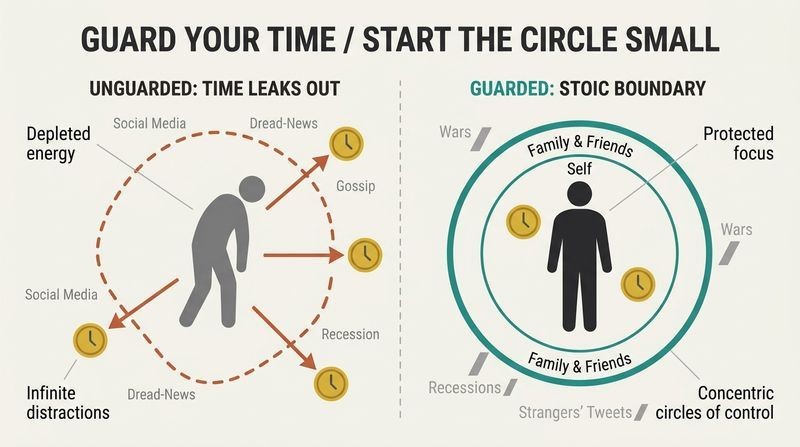
What's striking is how Foroux updates Seneca's ancient warning for the attention economy. Behavioral economists call this the opportunity cost of attention, and platforms are engineered to exploit it through variable reward schedules identical to slot machines. The concentric circle model echoes Confucian ethics, where cultivating the self precedes ordering the family and the state. One tension worth noting: Foroux's dismissal of caring about world events can shade into quietism. Civic engagement and time-wasting are not identical, and Stoicism historically produced dutiful public servants, not hermits. The useful distinction is between anxious rumination and deliberate action, not between the personal and the political.
Show sympathy outwardly, but never let another's grief infect your judgment
Moods are contagious, so inoculate yourself. Foroux describes waking up joyful, then meeting a downcast friend and instantly absorbing their gloom, answering a cheerful question with a flat "same old." When two moods collide, negativity usually wins because it is the more forceful energy. His fix comes from Epictetus: comfort the grieving, use kind words, even mirror their sadness outwardly, but do not inwardly grieve with them.
Protect your mood without becoming cold. Wanting only positivity is as unrealistic as wanting fitness without exercise. The Stoic prizes his own sanity above feeling another's pain, yet respects that others have every right to their emotions. The job is not to preach your values or fix people, which comes across as patronizing, but to execute your values quietly in your own mind.
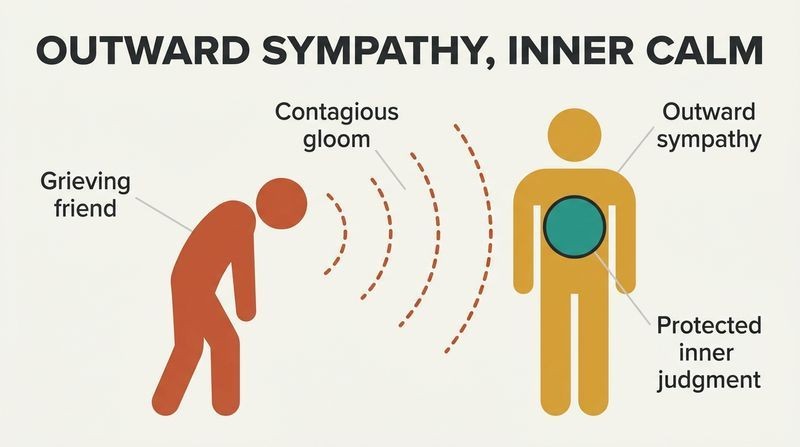
This maps neatly onto what psychologists call emotional contagion, the automatic mimicry of others' affective states, and onto the clinical concept of differentiation of self from family systems therapy, staying connected without fusing. Foroux threads a genuinely difficult needle: compassion without absorption. The risk is that "do not inwardly grieve" curdles into emotional detachment or superiority. Research on empathy distinguishes empathic distress, which burns out caregivers, from compassion, which sustains them. Foroux is essentially advocating the latter. The line about not preaching your values is wise; unsolicited philosophical advice rarely lands and often signals the giver's need to feel wise more than the receiver's need to hear it.
Trade hoping for wondering, because hope and fear are twins
Hope secretly manufactures fear. Seneca told his friend Lucilius that ceasing to hope means ceasing to fear, because both keep the mind suspended in an anxious future rather than anchored in the present. When you hope a tiger will not eat you, you are also afraid. Modern hopes (that she likes you, that you get hired, that Covid does not surge) work the same way.
Swap the verb. Foroux borrows a reframe from Susan Jeffers, author of Feel The Fear And Do It Anyway: instead of "I hope I get a new job," say "I wonder what my new job will be." Wondering treats life as an unpredictable journey rather than an outcome you can will into existence. He keeps a vague, abstract faith in the future but refuses specific hopes, because specificity is what breeds disappointment and dread.
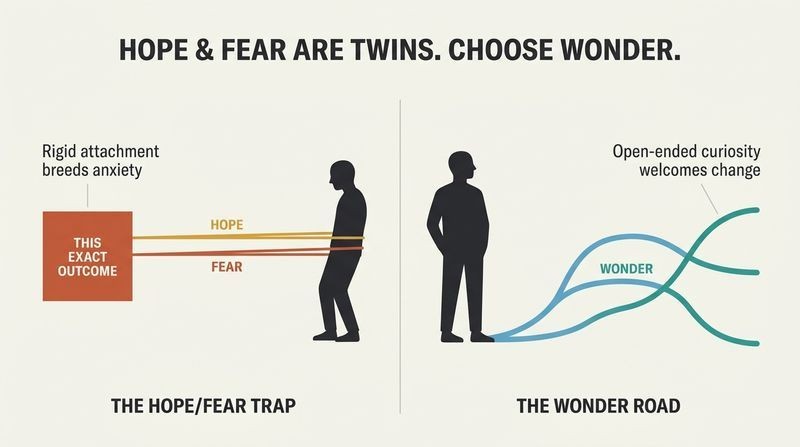
The insight that anticipatory emotion is a single mechanism pointing in two directions is philosophically sharp and has empirical support. Neuroscience shows anticipation of reward and threat both activate future-oriented simulation in the prefrontal cortex. Acceptance and Commitment Therapy makes a parallel move, teaching people to hold outcomes loosely while committing to values-driven action. Yet the claim deserves pushback. Hope theory research by C.R. Snyder links hope to resilience, goal persistence, and better health outcomes. The reconciliation is that Snyder's hope is agency plus pathways, effort you control, whereas Foroux targets passive wishing about things you do not control. The wording matters less than the locus of control.
Change your attitude, not your zip code, when life feels stale
Novelty fades wherever you flee. Bored in his own apartment, seeing the same view and neighbors, Foroux felt the universal itch to escape. Seneca had already diagnosed it two thousand years earlier when Lucilius complained that travel had not cured his sadness: you should change your mind, not your surroundings. Humans habituate to any environment, no matter how beautiful, then blame the scenery for an internal problem.
Control does not obligate action. Foroux notes a subtlety many miss about "focus on what you control." You may control your ability to move cities or quit a job, but controlling something does not mean you must exercise that control. The Stoic operates from equanimity first, making decisions from a calm baseline rather than from restless dissatisfaction. He would happily visit the Caribbean, but he needs nothing external to feel at peace where he already is.
This is the hedonic treadmill in plain clothes, the well-documented tendency to return to a baseline of satisfaction after both gains and losses. Foroux's contribution is practical sequencing: fix the interpreter before rearranging the furniture. The caveat, which he half-concedes, is that some environments genuinely are toxic, and "change your mindset" can become a trap that keeps people in bad jobs or relationships. The mature reading is diagnostic: if you have fled three cities and stayed miserable, the common denominator is you; but if a specific situation reliably harms you, mindset work is not a substitute for leaving. Stoicism at its best is discernment, not passive endurance.
Welcome what happens as if you had chosen it yourself
Acceptance with disdain is not acceptance. Most people tolerate rain, loss, and pandemics grudgingly because they see no alternative. Marcus Aurelius pushed further, urging acceptance without disdain, treating whatever arrives as though you wanted it. Foroux admits this is a mind trick, essentially fooling yourself, but insists it works, dissolving the exhausting stream of "why did this happen to me" questions.
Own nothing, and you cannot lose. A companion practice: treat everything, possessions, jobs, even people, as borrowed rather than owned. Epictetus reframed death as returning what was on loan. When Foroux sold his first car at twenty, he was so attached he made his father handle the sale; years later, selling a car felt like nothing, because he had internalized that he never truly owned it. Nothing is yours; you are a temporary guest.
The "as if you wanted it" move is the Stoic concept of amor fati, love of fate, later championed by Nietzsche as the formula for human greatness. It resembles radical acceptance in Dialectical Behavior Therapy, which reduces suffering by ending the war against reality. The borrowed-not-owned frame parallels Buddhist non-attachment and Epictetus's dichotomy of control. A fair critique: telling a grieving person their spouse was merely "returned" risks sounding callous, and Foroux is careful to say Stoics still mourn. The psychological value is not suppressing grief but preempting the secondary suffering of entitlement, the belief that reality owes us permanence it never promised.
Become your own witness so you stop performing for an audience
Approval-seeking is childhood conditioning that outstays its welcome. Foroux confesses that for most of his life he chose jobs, books, clothes, and social-media photos to be liked. As kids we are trained to earn "good job" from teachers and parents, and the conditioning quietly persists into adulthood. Working from home during the pandemic exposed how much of our effort depends on being watched.
Your actions when unobserved define you. In high school he showed up to basketball practice at 3:59 for a 4:00 start and never trained on off days. At his corporate job he worked hard only when the boss was around. Epictetus counsels that you compromise your integrity when you chase outside approval; be your own witness and you need no other. Do the work because it matters to you, not because someone is keeping score.
This resonates with the psychological distinction between intrinsic and extrinsic motivation, where research by Deci and Ryan shows externally driven behavior is less durable and less satisfying than behavior anchored in personal meaning. It also echoes the ancient concept of integrity as wholeness, being the same person in public and private. Sports psychology confirms the point: athletes who train hardest unsupervised outperform those who peak only under a coach's gaze. A nuance worth adding is that humans are irreducibly social, and some accountability to others genuinely helps. The goal is not to eliminate all external feedback but to make the internal witness the final judge.
You pay a hidden price for every game you choose to play
Every reward has an invoice. The career game promises status and money, but the fee is your morals, time with family, and sometimes your personality, hidden behind a game face at the boss's birthday party. Foroux's rule, drawn from Epictetus: do not complain about the price. If you flatter a host to get invited, pay gladly; if you refuse to flatter and stay uninvited, enjoy the intact integrity you kept instead.
Choose an inner scorecard. At his first bank job, Foroux joined the lunchtime gossip, then caught himself dissecting the same colleagues who had just seemed like friends. When he stepped away and stopped laughing at the jokes, the invitations dried up, which he calls the best thing that happened to him. Stoics can pursue wealth, but the moment the price is your values, the math never works.
The inner-versus-outer scorecard framing is borrowed from Warren Buffett, who asks whether you would rather be the world's best lover known as the worst, or the reverse. Foroux applies it to the everyday economics of belonging. Sociologists would recognize the gossip trap as the cost of in-group cohesion, which bonds members precisely by uniting them against absent others. The Stoic escape is not moral superiority but a clear-eyed cost-benefit accounting most people never run consciously. The strongest version of this insight is that exclusion from trivial circles is often a filter, not a loss, quietly redirecting time toward pursuits with a better return.
Freedom means being enslaved to no object, chance, or craving
Liberty is the real prize, not pleasure. Seneca warned that yielding to pleasure means also yielding to pain, toil, and poverty, because appetite makes you its servant. True freedom is owing nothing to fortune. Foroux points to Rubin "Hurricane" Carter, the boxer wrongly imprisoned for nearly twenty years, who kept his mind free of anger and revenge and never saw himself as a captive, a story Bob Dylan set to music and Denzel Washington filmed.
Flip adversity into fuel. He pairs this with Jocko Willink's one-word philosophy: whatever the setback, injury, illness, lack of time, the response is "good," then do what you can. Since fortune assigns our birth and circumstances, Stoic freedom is the refusal to hand fortune power over our inner state. When you already need nothing, everything else in life becomes a bonus.
The Carter example is the strongest possible case study for the claim that freedom is internal, echoing Viktor Frankl's observation from the concentration camps that the last human freedom is choosing one's attitude. Willink's "good" is cognitive reappraisal in military dialect, the emotion-regulation strategy most consistently linked in research to resilience and lower stress reactivity. There is a limit worth naming: framing every external constraint as irrelevant to freedom can slide toward victim-blaming or excusing injustice. Carter, notably, never stopped fighting to prove his innocence; his inner freedom coexisted with relentless external struggle. The lesson is dual: master your response while still working to change what can be changed.
Chase actions you control, then turn your back on outcomes
Bad goals are outcome goals. Foroux used to set targets like "make $100K a year" or "gain five pounds of muscle," then quit when reality diverged. The Stoic redesign: set goals inside your control and measure actions, not results. Instead of a target weight, he commits to three great strength workouts a week; instead of an income figure, he commits to creating something every single day.
Round numbers are cultural hypnosis. He notes society's obsession with figures starting with one and six or seven zeros, admitting he had no idea where his own 100K fixation came from. A wealthy family friend worth 100 million told him being rich is not that great, because he is perpetually managing lawsuits, rogue employees, and relatives who want something. As Seneca put it, success is greedy; when nothing is ever enough for you, you are never enough for others. Focus on the process and the outcomes tend to follow.
This is a Stoic anticipation of what modern productivity writers call systems over goals, and it aligns with self-determination theory's finding that process focus sustains motivation better than outcome fixation. The counterintuitive kicker, that obsessing less over results makes them arrive faster, has support in flow research: performance improves when attention is on the task, not the scoreboard. The wealthy-friend anecdote is a useful antidote to the affective forecasting error, our systematic tendency to overestimate how much money and status will improve our happiness. The limitation is that pure process focus can drift into effort without direction; the best practice keeps an outcome as a compass while grading yourself only on daily inputs.
Grow stronger by celebrating others' wins as if they were yours
Envy is optional, not inevitable. When Seneca saw his friend Lucilius advancing, he reported growing stronger and shedding his old age, drawing energy from another's success rather than resenting it. Foroux contrasts two former colleagues: Sander, a knowledgeable mentor who turned on him and tried to sabotage him once Foroux outshone him, and Andre, a generous veteran who shared everything and, precisely because everyone liked him, became more successful himself.
Rig the game so everyone wins. Foroux argues this is Stoicism's most underrated move: since humans mostly care about themselves, deciding to benefit from others' success converts a universal poison into rocket fuel. Every time envy appears, treat it as a signal to check your priorities and return your focus to what you control. Don't be fooled by curated social-media highlight reels; prestige and power do not reliably make anyone happier.
The reframe from envy to inspiration has a name in positive psychology: benign envy, which research distinguishes from malicious envy and links to increased motivation and performance rather than hostility. Foroux's Sander-versus-Andre contrast is essentially a lesson in the long-run payoff of generosity, echoing Adam Grant's finding in Give and Take that givers, though they populate the bottom of success distributions, also dominate the top. The mechanism is reputational and relational compounding. One honest tension: deciding to feel joy at a rival's success is easier said than done, since envy is a fast, automatic social-comparison response. The practice is not suppressing the pang but redirecting it before it hardens into resentment.
Rest before you're tired, but don't let rest become sloth
Recovery is preventive, not remedial. Borrowing from Dale Carnegie's line to rest before you are tired, Foroux compares it to hydrating before thirst rather than after. He watches for warning signals, frequent headaches, heavy eyes, broken sleep, irritability, and takes a break before collapse. Work matters, but being energized matters more.
Distinguish earned rest from avoidance. He recalls a period of dreading each workday, counting down to the weekend by Wednesday, and realizes that was not fatigue but a job he did not enjoy. Seneca observed that rest itself can become restless, and that real calm arrives only when a good state of mind unfolds, not merely when activity stops. If chronic stress is the problem, the cure is to change or accept the source, not to nap. Genuine rest recharges; escapist rest breeds the sloth Seneca warned cannot bear itself.
The rest-before-tired principle prefigures modern research on proactive recovery and the concept of strategic breaks, where periodic detachment prevents the cortisol accumulation and cognitive depletion that lead to burnout. Foroux's sharper insight is diagnostic: the urge to rest constantly is often a symptom of misaligned work, not overwork. Occupational psychology supports this; disengagement and the counting-down-to-Friday pattern correlate more with low job meaning than with high workload. The distinction between restorative rest and avoidant escape maps onto the difference between recovery and rumination-driven withdrawal. One addition: true recovery requires psychological detachment, actually disconnecting, whereas scrolling while anxious about work provides neither rest nor engagement.
Treat yourself as gently as you treat a chronically late friend
We reserve our harshest voice for ourselves. Foroux notices a strange inversion: we are polite to strangers, warm to friends, and most critical toward those closest to us, with ourselves at the bottom of the ladder, subjected to aggression we would never aim at anyone else. Forget to close a window and the inner monologue turns savage. Seneca marked his own progress with a single line: he had begun to be a friend to himself.
Self-friendship radiates outward. Foroux found that as he grew less critical of himself, he grew more relaxed with everyone else. We forgive a friend who always shows up late, even turn it into an affectionate joke, yet refuse ourselves the same slack over trivial mistakes. Seneca added that whoever is a friend to himself is a friend to all mankind. Allow yourself to fall, then simply stand up again.
This is self-compassion, which researcher Kristin Neff has shown outperforms self-esteem for resilience, because it does not depend on constant success or favorable comparison. Studies link self-compassion to lower anxiety, greater motivation, and faster recovery from failure, directly countering the folk belief that self-criticism drives performance. Foroux's ladder of graduated harshness is a shrewd observation about how proximity licenses cruelty, a dynamic family therapists see constantly. The claim that befriending yourself improves your treatment of others has empirical backing: self-compassionate people report more caring, connected relationships. The one caveat is calibration; self-friendship is accountability plus warmth, not indulgence that excuses genuinely harmful patterns.
Analysis
Focus on What Matters is not a systematic treatise but an epistolary self-help collection, seventy short letters modeled explicitly on Seneca's correspondence with Lucilius. That structure is both its charm and its challenge for a summarizer: the book advances by accretion and repetition rather than argument, circling a few core Stoic ideas (the dichotomy of control, amor fati, non-attachment, virtue over externals) from dozens of angles. Foroux's real innovation is not philosophical but rhetorical. He translates Seneca, Epictetus, Marcus Aurelius, and the lesser-known Musonius Rufus into the vocabulary of a millennial entrepreneur, splicing ancient texts with references to Jay-Z, David Goggins, Warren Buffett, Morgan Housel, and the GameStop short squeeze. This makes Stoicism feel native to the smartphone era, where the enemy is no longer a saber-toothed tiger but the infinite scroll.
The book's center of gravity is the distinction between the inner world (mastering your mind) and the outer world (functioning in society), a division that resists the common caricature of Stoicism as withdrawal. Foroux repeatedly insists Stoics can pursue wealth, ambition, and deep friendship, so long as their peace does not depend on outcomes. This is the healthiest reading of the tradition and a useful corrective to the bro-Stoicism that treats it as a productivity hack.
The limitations are real. The letters lean personal and anecdotal, occasionally substituting the author's biography for evidence. The recurring advice to ignore news and world events, while defensible as attention hygiene, can tip into a privileged quietism that ignores how Stoic sages were also engaged public servants. And the sheer redundancy means the marginal letter adds little. Yet the cumulative effect is genuinely useful: a portable, unpretentious operating manual for equanimity. Its deepest value lies less in novelty than in repetition as training, which is precisely the point Musonius made, that philosophy without daily practice is inert.
Review Summary
Focus on What Matters receives positive reviews for its accessible introduction to Stoic philosophy. Readers appreciate its concise format, practical advice, and application of ancient wisdom to modern life. Many find it helpful for personal growth, stress management, and prioritizing what's important. The book is praised for its simple language and focus on self-improvement. Some readers note it's particularly beneficial for those new to Stoicism. While a few felt it lacked depth, most found it a valuable guide for living intentionally and developing resilience.
People Also Read





FAQ
What's "Focus on What Matters" about?
- Stoic Philosophy: The book is a collection of letters inspired by Stoic philosophy, focusing on how to live a well-balanced life by mastering both the inner and outer worlds.
- Practical Advice: It offers practical advice on managing emotions, thoughts, and making better decisions, all rooted in Stoic principles.
- Personal Growth: The letters aim to guide readers in personal growth, helping them to focus on what truly matters in life.
- Modern Application: The author, Darius Foroux, adapts ancient Stoic wisdom to address contemporary challenges and personal development.
Why should I read "Focus on What Matters"?
- Timeless Wisdom: The book provides timeless wisdom from Stoic philosophers like Seneca, Marcus Aurelius, and Epictetus, making it relevant for today's challenges.
- Practical Tools: It offers practical tools and strategies for improving mental resilience and emotional well-being.
- Personal Development: Readers can gain insights into personal development, helping them to live a more fulfilled and balanced life.
- Actionable Insights: The letters are designed to be actionable, encouraging readers to apply Stoic principles in their daily lives.
What are the key takeaways of "Focus on What Matters"?
- Control and Acceptance: Focus on what you can control and accept what you cannot, a core Stoic principle.
- Inner Peace: Achieving inner peace is essential for a fulfilled life, and it starts with mastering your thoughts and emotions.
- Balance: Balance between personal success and inner tranquility is crucial for a meaningful life.
- Continuous Improvement: Personal growth is a lifelong journey, and small, consistent efforts lead to significant improvements.
How does Darius Foroux apply Stoic principles in "Focus on What Matters"?
- Modern Context: Foroux adapts Stoic principles to modern life, addressing issues like anxiety, decision-making, and personal growth.
- Practical Examples: He uses practical examples and personal anecdotes to illustrate how Stoic wisdom can be applied today.
- Actionable Advice: Each letter provides actionable advice, encouraging readers to implement Stoic strategies in their daily routines.
- Focus on Control: Emphasizes focusing on what is within one's control and letting go of external concerns.
What are the best quotes from "Focus on What Matters" and what do they mean?
- "Focus on what you control": This quote emphasizes the Stoic principle of directing energy towards things within one's control, reducing stress and anxiety.
- "Liberty is the prize": Reflects the idea that true freedom comes from not being enslaved to desires or external circumstances.
- "Be your own witness": Encourages self-reliance and self-approval, rather than seeking validation from others.
- "Do less, better": Suggests that focusing on fewer tasks with greater attention leads to more meaningful accomplishments.
How does "Focus on What Matters" address managing emotions?
- Emotional Awareness: The book emphasizes the importance of being aware of one's emotions and understanding their origins.
- Stoic Techniques: It offers Stoic techniques for managing emotions, such as detachment and rational thinking.
- Practical Strategies: Provides practical strategies for dealing with common emotional challenges like anxiety and disappointment.
- Balance and Control: Encourages finding a balance between emotional expression and control to maintain inner peace.
What advice does "Focus on What Matters" give on making better decisions?
- Rational Thinking: Encourages using rational thinking and Stoic principles to make informed decisions.
- Focus on Values: Advises aligning decisions with personal values and long-term goals for greater satisfaction.
- Acceptance of Outcomes: Emphasizes accepting the outcomes of decisions, whether positive or negative, as part of life's journey.
- Preparation and Flexibility: Suggests being prepared for unexpected changes and remaining flexible in decision-making.
How does "Focus on What Matters" suggest dealing with hard times?
- Resilience Building: The book emphasizes building mental resilience through Stoic practices to better handle life's challenges.
- Perspective Shift: Encourages shifting perspective to see challenges as opportunities for growth and learning.
- Acceptance and Action: Advises accepting difficult situations while taking proactive steps to improve them.
- Support Systems: Highlights the importance of having a support system and sharing burdens with trusted individuals.
What does "Focus on What Matters" say about living a fulfilled life?
- Inner Peace and Success: Suggests that true fulfillment comes from balancing inner peace with personal and professional success.
- Meaningful Relationships: Emphasizes the importance of nurturing meaningful relationships and sharing joy with others.
- Purpose and Passion: Encourages pursuing passions and finding purpose in daily activities for a more fulfilling life.
- Gratitude and Contentment: Advises practicing gratitude and contentment with what one has, rather than constantly seeking more.
How does "Focus on What Matters" approach the concept of wealth?
- Wealth as a Tool: Views wealth as a tool for living well, not as an end goal, aligning with Stoic values.
- Integrity Over Wealth: Emphasizes maintaining integrity and values over the pursuit of wealth.
- Moderation and Balance: Advocates for a balanced approach to wealth, avoiding excess and focusing on what truly matters.
- Freedom from Attachment: Encourages freedom from attachment to wealth, reducing anxiety and stress related to financial matters.
What role does self-awareness play in "Focus on What Matters"?
- Self-Reflection: The book encourages regular self-reflection to understand one's thoughts, emotions, and actions.
- Personal Growth: Self-awareness is seen as a key component of personal growth and development.
- Alignment with Values: Advises aligning actions with personal values through increased self-awareness.
- Mindful Living: Promotes mindful living by being present and aware of one's impact on the world and others.
How can "Focus on What Matters" help with personal growth?
- Continuous Improvement: Encourages continuous self-improvement through small, consistent efforts.
- Learning from Mistakes: Advises learning from mistakes and using them as opportunities for growth.
- Setting Goals: Provides guidance on setting meaningful goals that align with personal values and aspirations.
- Building Resilience: Focuses on building mental and emotional resilience to navigate life's challenges effectively.
About the Author


Download PDF
Download EPUB
.epub digital book format is ideal for reading ebooks on phones, tablets, and e-readers.








































