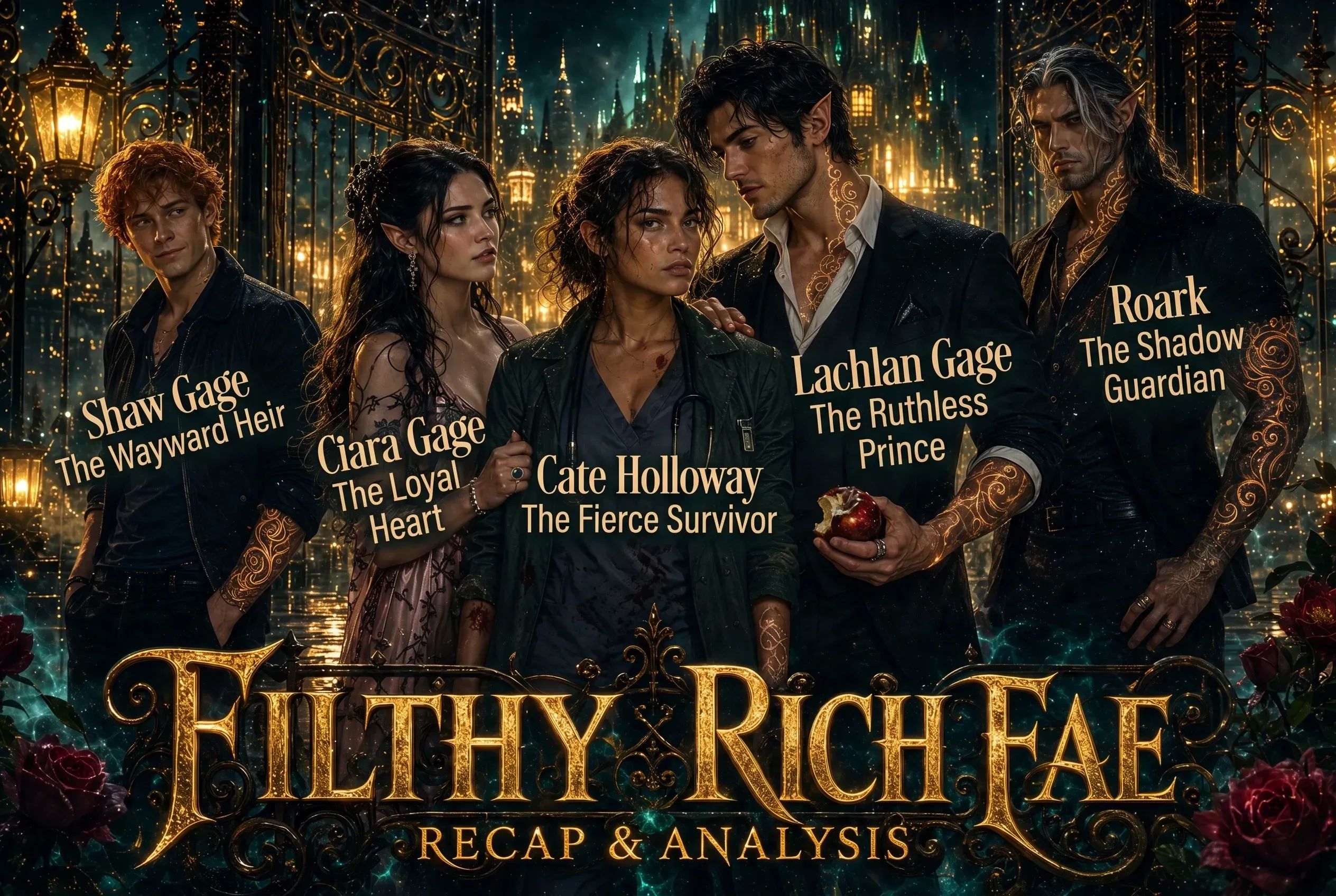


Plot Summary
The Brother on the Gurney
Cate Holloway1 works the night shift at Gage Memorial when two gunshot victims arrive from Waverly Avenue. One dies; the other is her nineteen-year-old foster brother, Channing,3 hit by a custom Gage bullet during a botched job. He confesses he owes the criminal Gage family a debt he can repay only with his life.
Refusing to lose the closest thing she has to family, Cate1 does the unthinkable: she phones the police and reports the unregistered firearm, ensuring Channing3 lands in protective custody. Her supervisor suspends her for breaking the hospital's deal with its dangerous benefactor. Suspended, terrified, and armed only with her dead mother's emerald ring, Cate1 resolves to find Lachlan Gage2 and bargain for her brother's3 freedom.
The opening fuses medical realism with looming dread, establishing Cate as a woman whose entire identity is built on saving others while needing no one. Her decision to report Channing is both protective and self-sabotaging, revealing the orphan's logic that danger contained is danger survived. New Orleans functions as a character: a city where institutions are bought and silence is currency. Lee plants the central psychological wound early, that Cate equates love with sacrifice. The emerald ring, introduced as her sole inheritance and her grandmother's symbol of survival, quietly becomes the story's most loaded object, foreshadowing that her body and history will be the true stakes.
The Man With the Apple
At the gleaming Avalon hotel, Cate1 meets a tattooed, gun-strapped man2 polishing a red apple who claims to be merely an escort to Lachlan Gage.2 He warns her not to eat or drink anything, teases that his trade is desire, and leads her down to a smoke-filled subterranean club of dancers, cages, and armed guards. Behind a heavy oak door, she expects to plead her case.
Instead she watches a sneering aristocrat named MacAlister10 sever a man's hand as punishment for breaking a rule, while the others look on. Horrified, Cate1 drops to the floor and improvises a tourniquet from her purse strap. Only then does she realize the apple-eating stranger who escorted her is Lachlan Gage2 himself.
This sequence weaponizes glamour in both senses: the seductive surface and the literal fae magic disguising monsters as men. Cate's misreading of Lachlan as a lackey mirrors her broader misreading of the world she thought she understood. The mutilation scene establishes the brutal moral economy of this universe, where custom outranks mercy, yet Cate's instinct to heal rather than flee marks her as constitutionally different. Her competence under horror, the tourniquet, signals that her nursing is not just a job but a compulsion toward repair. The apple is pure fairy-tale grammar, the forbidden bite telegraphing that consumption equals consent and consequence.
A Soul for a Soul
Lachlan,2 amused and unmoved, informs Cate1 that Channing3 owes not money but his life for stealing food. When she offers her worthless-seeming emerald ring, he scornfully refuses it. Pressed three times whether she would trade her own life, her soul, for her brother's,3 Cate1 furiously swears she would give anything. He tosses her an apple and tells her to eat.
Famished and reckless, she bites into it. A hook sensation burrows into the back of her neck. Lachlan2 calmly explains she has sealed a fae bargain: her soul for Channing's3 freedom, and now she belongs to him. He snaps his fingers, and a tapestry of rainbow and gold light swallows the room, ripping her out of New Orleans entirely.
The bargain crystallizes the book's thesis that desperation is a currency predators accept. Lachlan's triple questioning echoes folkloric rule-of-three magic, and his refusal of the ring is the story's cleverest sleight of hand, ensuring Cate keeps the one object that secretly matters most. Cate's consent is coerced yet technically freely given, dramatizing the dubious-consent tension the book foregrounds. Psychologically, she trades herself precisely because self-sacrifice is the only love language she trusts. The apple bite literalizes the Eden motif promised by the book's epigraph, framing knowledge, appetite, and damnation as inseparable, and converting a working-class woman's loyalty into a supernatural contract.
Prince of the Nether Court
Cate1 lands in a wild, Edenic garden before a black-stone palace. Lachlan2 transforms before her: taller, more beautiful, ears sloping into points, tattoos rippling across his skin. He is fae, prince of the Nether Court, and this is the Otherworld. He informs her the bargain is nearly impossible to break and that her old human life, soon to be jobless and brotherless, no longer holds her.
Trapped in a warded mansion she cannot escape, Cate1 refuses to cower. She demands her freedom, insults him, and braces for assault when he leads her to a luxurious bedroom. To her shock, he tells her sex is not part of the arrangement and that she is not his type.
The reveal recodes the gangster as ancient predator, expanding the threat from criminal to cosmic. Lee plays with reader expectation by having Lachlan explicitly decline the seduction Cate assumes is inevitable, subverting the captor-conquest trope and unsettling Cate's defensive script. His catalog of her isolation, orphan, friendless, unmissed, is psychological warfare, but it also accidentally names his own loneliness. The opulent prison externalizes the gilded-cage motif: comfort as control. Cate's refusal to show fear, learned from a brutal childhood, becomes her armor and her appeal. The dynamic establishes the enemies-to-lovers engine, two damaged people circling, each mistaking armor for indifference.
Pulling the Trigger
Convinced killing Lachlan2 is the only way to free herself and protect Channing,3 Cate1 seduces him to steal a gun, then aims it at his heart. He calmly presses the barrel to his chest and dares her to fire. She pulls the trigger, and nothing happens. He had emptied the chamber and left the safety on.
Rather than punish her, he is impressed she tried. He then offers the rules of escape: she has a month and a day to figure out what he stands to gain from the bargain and prove he will never get it from her. Until then she must come to him each night, wear an enchanted pendant that summons him, and stop trying to kill him.
The failed assassination inverts the captivity narrative into a courtship of mutual testing. Lachlan's admiration for Cate's willingness to kill reveals his attraction to agency rather than submission, and quietly foreshadows that her capacity for violence is precisely what he needs. The riddle structure of the escape clause transforms the rest of the novel into an investigation, with the answer hidden in plain sight. Psychologically, the scene reframes survival, Cate has faced monsters before, suggesting trauma has armed her. The pendant introduces a leash dressed as courtesy, extending the theme that every gift in this world carries strings, every freedom a hidden cost.
Her Car, Her Heart, Aflame
Back home, Cate1 finds Channing3 handcuffed and bitter, blaming her for jailing him. Her ancient Volvo then bursts into flames in the hospital lot. Lachlan2 appears, summoned by her panic, and lets the car burn before extinguishing it. Their argument detonates into a kiss against the wreck, after which she insists she felt nothing.
To remove the obstacle of her job, Lachlan2 phones the chief of medicine and installs Cate1 as his private nurse, simultaneously ordering the understaffed hospital to double salaries. The gesture is controlling and oddly thoughtful. Soon he reveals he does not even live in the Otherworld; the family stays at the Avalon, which straddles both worlds. He moves her into the hotel's top floor.
The literal conflagration mirrors the combustible attraction neither will name. Lachlan's refusal to save the car, then his casual rescue, encapsulates his maddening hot-cold pattern, control masquerading as care. His commandeering of her career strips her last anchor of independence while genuinely improving the hospital, dramatizing how his power can heal and harm in a single gesture. Cate's denial of the kiss, her insistence on sexy magic as scapegoat, is the addict's bargaining: anything to avoid owning desire for a man she should hate. The move to the Avalon collapses the boundary between her two lives, making escape geographically and emotionally harder.
The Sister Sold for Alliance
Lachlan2 explains he is brokering his beloved sister Ciara's4 marriage to Bain,7 the cold prince of the Infernal Court, to secure an alliance and solve the trinity drug crisis poisoning New Orleans.
He asks Cate1 to befriend and distract Ciara4 during the three weeks of fae nuptial ritual leading to the marriage banns. Cate,1 recognizing her own powerlessness in Ciara,4 chooses to genuinely befriend her rather than merely use her. She also bonds with Shaw,6 Lachlan's2 overlooked younger brother, and Roark,5 his loyal penumbra and shadow-twin.
Through them she learns the fae are centuries old, that other courts are arriving, and that Lachlan2 rules through emotionless calculation. Trinity, she learns, is corrupted clover, a drug whose magic has gone lethally wrong.
The arranged-marriage subplot mirrors Cate's own contractual bondage, two women bartered for the greater good, and lets her extend her caretaker instinct to a found family. Lee uses the ensemble to humanize Lachlan obliquely: his guilt over Ciara, his neglect of Shaw, his reliance on Roark sketch a man imprisoned by responsibility. The clover crisis grounds the fantasy in a recognizable opioid epidemic, with the fae as both dealers and reluctant would-be saviors. Cate's choice to befriend rather than manipulate marks her moral divergence from the transactional fae, and seeds the alliance that will later crack the central mystery wide open.
The Midnight Feast
At the Midnight Feast preceding Ciara's4 banns, Cate1 discovers the fae ritual is essentially a sanctioned orgy, with gold-painted offerings and uninhibited coupling. Lachlan2 insists no one may touch her without consent on pain of dismemberment, and promises she is safe to let loose.
Overserved on the intoxicating ambrosia, Cate1 dances provocatively, hides with the gentle light-court prince Oberon,8 and unwittingly narrates filthy thoughts about Lachlan2 aloud. He carries her off rather than bed her drunk, refusing to take advantage.
The next morning he leaves a hangover cure with a curt note. Their charged restraint, his repeated insistence she is not his type colliding with obvious wanting, reaches a fever pitch that neither can much longer deny.
The bacchanal stages desire as both communal sacrament and individual danger, testing Cate's relationship to her own body, which earlier trauma taught her to guard. Lachlan's consent doctrine, threaded through a debauched setting, is a deliberate counterweight to the dub-con bargain, signaling that bodily autonomy is the one boundary he reverences. His refusal to bed an intoxicated Cate is the clearest evidence yet that his cruelty has limits and his attraction is more than appetite. Ambrosia functions as truth serum, externalizing the longing she suppresses. The introduction of Oberon as kind and safe plants a quiet seed that the narrative will later, devastatingly, uproot.
Redcaps in the Alley
After saving an overdose victim at a nightclub, Cate1 slips away into a dead-end alley and is ambushed by two redcaps, murderous fae who try to skin and devour her. As one slices her collarbone, she manages to touch the pendant and call for Lachlan.2 He arrives like a storm, shoots one, and methodically breaks every bone in the other's hand, promising slow death for daring to make her bleed.
He sends her home with Roark,5 then returns drenched in their blood. Instead of recoiling, Cate1 quietly cleans him, confessing she feels avenged rather than horrified. Their tension finally ignites into near-sex against a bathroom counter before Roark5 interrupts with an emergency, and Lachlan2 vanishes into the night.
The attack escalates the external threat while accelerating the internal romance, fear and desire braided into a single adrenal current. Cate's response, tending the blood-soaked killer rather than fleeing, marks a profound psychological turn: she stops measuring Lachlan against an absolute moral binary and begins accepting the gray. Her admission of feeling avenged is a confession about her own buried capacity for vengeance, tied to wounds not yet disclosed. Lachlan's rage is possessive but rooted in protection rather than ownership. The interrupted consummation sustains erotic momentum, but more importantly it dramatizes intimacy as mutual witnessing, each seeing the other's darkness without looking away.
The Lesson in the Bayou
Lachlan2 drives Cate1 deep into the Louisiana swamp, past Goemon,15 a member of the Wild Hunt who guards the bayou, and teaches her to fire a pistol. Standing behind her, he turns the lesson sensual and insists she must be able to protect herself. Mid-lesson, Cate1 seizes on a theory: he wants her to kill one of the visiting heirs, because if he kills another royal he will be branded by the Wild Hunt.
She declares the bargain broken and refuses. He denies needing her as an assassin, insisting the lessons are about ensuring she is never again a victim. He also reveals he has quietly dropped Channing's3 charges and found him honest work, protecting her brother without telling either of them.
The bayou sequence braids eroticism, agency, and dread, with the gun as a symbol of self-possession rather than murder. Cate's incorrect guess is a productive red herring, sharpening the reader's hunt for Lachlan's true motive while revealing how she still expects to be used. His insistence that she learn self-defense reframes power as something he wants to give her, not take, directly answering her trauma of helplessness. The introduction of the Wild Hunt and Goemon installs the machinery for the climax's stakes. His secret rescue of Channing is the quiet proof that he has begun loving in her language, sacrifice rendered invisible, expecting no credit.
The Tainted Clover Conspiracy
Determined to free Ciara4 from the marriage and fix the drug crisis herself, Cate1 secretly recruits Sirius,9 the young alchemist prince of the Astral Court, to analyze clover samples in the hospital's private lab.
Posing as ordinary shopping trips, the three friends smuggle Sirius9 in to test old clover, lethal trinity, and ambrosia. Meanwhile Lachlan,2 after the overdose, orders all clover destroyed and recalled, provoking Bain7 to publicly accuse the Nether Court of poisoning and demand the engagement be called off, then negotiate a handfasting instead.
On the morning of the handfasting, Sirius9 delivers his verdict: the trinity strain carries Infernal Court magic. Bain7 himself tampered with the clover, hiding his sabotage in plain sight to engineer the alliance.
Cate's scientific conspiracy transforms her from pawn into prime mover, applying her healer's investigative discipline to a magical mystery the immortal royals overlooked. The plot rewards her defining choice to trust rather than exploit, the Astral alliance born from genuine friendship. Lee modernizes the fae as pharmaceutical cartels, and the revelation that Bain manufactured the crisis to force a marriage exposes the predatory logic beneath courtly ritual. The handfasting's escape clause, a magical trial-marriage dissolvable for just cause, is carefully seeded so the later confrontation pays off legally. Cate's agency here directly buys Ciara's freedom, making her the catalyst the calcified fae system could not produce internally.
Ruin Me, Then
At Ciara's4 handfasting ceremony, Cate,1 dressed in Nether green, finds a haunted Lachlan2 and leads him away. On a moonlit balcony he finally opens up: his parents were handfasted mates, his father heir of the Nether Court and mother heir of the destroyed Terra Court, both killed in World War Two, forcing him onto a throne he rules without emotion.
He admits he made the bargain partly because she made him feel, and that he wants to break it rather than keep her by force. Cate1 refuses to let him, choosing him over freedom. They sleep together at last, and she confides the childhood assault she has never told anyone. He vows no one will touch her again without answering for it.
The long-deferred consummation is staged as mutual unveiling, sex inseparable from confession. Lachlan's backstory recodes the gangster-prince as a war orphan crushed by inherited duty, his emotionless governance a trauma response mirroring Cate's self-isolation. The lost Terra Court and the dead-but-secret mating magic plant the novel's final twist. Cate's disclosure of her rape, withheld from even Channing, is the ultimate act of trust, completing her arc from armored solitude to chosen vulnerability. Crucially she rejects the freedom she once killed for, the romance's central reversal: the cage becomes home only when she elects it. Love here is defined as the willingness to be ruined.
MacAlister's Final Bargain
After the courts confront Bain7 and dissolve the handfasting, Lachlan2 banishes the Infernal Court by nightfall. Alone in his Otherworld quarters, Cate1 is cornered by MacAlister,10 Bain's7 penumbra, sent to murder her and break Lachlan.2 She lunges for the pistol hidden beneath the pillow and shoots him. Lachlan2 appears, summoned by the wraiths.
Knowing the dying penumbra's signet will mark his killer for the Wild Hunt, he tricks Cate1 into swearing she will never give him her emerald ring, instantly breaking their bargain and freeing her. Then he fires the final kill shot himself, taking the Wild Hunt's death sentence to spare her. He sends her fleeing through a prepared escape garage, sacrificing his throne, his family, and his life.
The climax fuses every planted device: the pillow gun from the bayou lessons, the ring whose worthlessness was a lie, the Wild Hunt established in the swamp. Lachlan's sacrifice is the purest expression of his arc, the man who calculates suffering finally choosing to absorb all of it himself. The ring trick retroactively reveals his deepest motive: not to use Cate, but to protect her, the bargain's true answer hidden in plain sight all along. Cate's killing of MacAlister completes her weaponization, but as self-defense, not the assassination she feared. Love is dramatized as inversion of self-interest, he forfeits eternity so her heart keeps beating.
Epilogue
In a brief shift to Lachlan's2 perspective, he dumps MacAlister's10 body in the bayou, is spared by Goemon,15 and flees to his estranged sister Fiona's14 home, only to learn Cate1 never made the safe-house call. Channing,3 dying, confesses he made a bargain with someone who promised to take Cate1 away, then was shot for his trouble.
A new gold tattoo blooms across Lachlan's2 hand: a true mating bond, the long-dead magic, sealed with Cate.1 He sends Roark5 to guard Ciara4 and vows to walk into hell for her. Cate1 wakes in an idyllic palace to find her gracious host is Oberon,8 the light-court prince she trusted, who reveals he orchestrated everything. His purpose, like any king's: war.
The dual ending detonates two reversals at once. Oberon, coded throughout as the safe, gentle alternative, is unmasked as the true architect, indicting Cate's, and the reader's, instinct to equate light with goodness. The fae moral spectrum, repeatedly described as light and shadow rather than good and evil, pays off as thematic payload. Channing's betrayal, born of the same protective desperation that started the novel, tragically mirrors Cate's opening choice, closing a loop of love-as-sabotage. The mating bond reveals Lachlan's freeing of Cate was not loss but the deepest claim, transforming sacrifice into permanence. The cliffhanger reframes the entire romance as the opening move of a coming war.
Analysis
Filthy Rich Fae transplants fairy-tale grammar into a noir New Orleans, recasting the Eden apple, the soul bargain, and the captive bride through the lens of addiction, trauma, and class. Its central intelligence lies in misdirection: nearly every reveal, that the escort is the prince, that the worthless ring is the master key, that the safe light-court ally is the true villain,8 trains readers to distrust surfaces, which is also the fae's defining magic of glamour. The novel's repeated insistence that fae morality runs along light and shadow rather than good and evil becomes both worldbuilding and thesis, dismantling the reflex to equate radiance with virtue. Psychologically, the romance pairs two orphans of catastrophe whose survival strategies, Cate's1 compulsive self-sufficiency and Lachlan's2 anesthetized rule-by-calculation, are mirror defenses against loss. Their arc reframes love not as rescue but as the willingness to be ruined, to depend, to be witnessed in one's darkness. Cate's1 defining reversal, rejecting the freedom she once tried to kill for, complicates the captivity premise: the cage becomes home only when chosen, a risky move the book partly redeems by granting her genuine agency through her nursing, her investigation, and her refusal to cower. The drug crisis lends contemporary moral weight, framing the immortal aristocracy as cartels whose rituals sanctify exploitation, and lets a working-class human outthink them. Consent is the novel's anxious preoccupation, the dub-con bargain set against Lachlan's2 fierce no-touch doctrine, an attempt to hold seduction and autonomy in uneasy balance. The dual climax converts sacrifice into permanence through the mating bond, suggesting that the deepest claim and the deepest freedom can be the same act. Ending on betrayal and the promise of war, the book leaves its lovers' victory provisional, its real subject the cost of loving in a world that prices everything.
Review Summary
Filthy Rich Fae received mixed reviews, with an average rating of 4.01 out of 5. Many readers enjoyed the romantic tension, banter, and fae world-building, comparing it favorably to ACOTAR. The slow-burn romance and cliffhanger ending were widely discussed. Some praised the characters and plot twists, while others found the writing cringy or lacking depth. Criticisms included inconsistent character behavior, weak world-building, and a slow middle section. Despite flaws, many readers expressed eagerness for the sequel.
People Also Read


Characters
Cate Holloway
Defiant ER nurse heroineA twenty-four-year-old emergency nurse forged by a brutal foster childhood, Cate measures love in sacrifice and trusts no one to protect her. Fiercely independent, sharp-tongued, and allergic to gifts because gifts always carried strings, she channels survival instinct into healing strangers. Her dead mother's emerald ring, gift of the grandmother who finally gave her safety, anchors her sense of self. Cate's defining wound is a buried sexual assault that taught her to guard her body and her trust. Over the story she moves from armored solitude toward chosen vulnerability, learning that depending on someone need not mean being weaponized against. Reckless, loyal, and morally serious, she refuses to cower before monsters, fae or human, and insists on her own agency even inside a magical contract.
Lachlan Gage
Brooding fae crime princeKnown to New Orleans as its cruelest crime lord, Lachlan is secretly the centuries-old prince of the shadowy Nether Court, his shifting tattoos betraying a restless mind. Orphaned by war and thrust onto a throne, he rules through deliberate emotionlessness, calculating who must suffer so others survive. Arrogant, possessive, and maddeningly hot-cold, he hides genuine tenderness beneath swagger and bourbon. He carries iron-cored bullets and a guilt-heavy sense of duty toward siblings he keeps at a protective distance. Cate1 cracks his armor by caring openly, something he had forgotten how to do. His core motif is sacrifice rendered invisible: he helps without claiming credit, protects without permission, and would rather absorb every consequence himself than risk losing one more person he loves.
Channing
Cate's troubled foster brotherNineteen, fair-haired, and perpetually success-challenged, Channing is the foster brother Cate1 raised and the reason she gambles her soul. Charming, reckless, and desperate to escape New Orleans' inescapable Gage economy, he tangles with forces beyond him. His love for Cate1 runs as deep and self-destructive as hers for him, driving choices that mirror, and complicate, her own protective sacrifices.
Ciara
Lachlan's warm-hearted sisterThe vivacious, shopping-obsessed princess of the Nether Court, Ciara is over two hundred years old yet emotionally generous in a way her brother2 is not. Bartered into a political marriage with Bain7, she masks dread with sparkle. She becomes Cate's1 first true friend, isolated in her own gilded way, and proves braver and more capable, gun in her purse, than her bubbly surface suggests.
Roark
Loyal shadow-twin penumbraSilver-haired, lip-ringed, and perpetually glued to his phone, Roark is Lachlan's2 penumbra, a companion raised since birth to be his right hand and second self. Calm where Lachlan2 is volatile, he helps the prince balance light and shadow, deliberately chaperones the smoldering couple, and offers Cate1 steady, wry counsel about loving a man who calculates everything through loss.
Shaw
Overlooked youngest brotherThe youngest Gage sibling, copper-haired and good-natured, Shaw was raised mostly away at school and is casually dismissed by Lachlan2. His static tattoos move only when he worries, which he tries not to do. Warm and funny like Ciara4, he befriends Cate1 easily and embodies the family neglect Lachlan2 inflicts in the name of protection.
Bain
Cold Infernal Court princeThe platinum-haired, ice-featured crown prince of the molten Infernal Court, Bain negotiates a marriage to Ciara4 while pursuing a hidden agenda. Arrogant, vengeful, and adept at hiding sabotage in plain sight, he posing as a desirable ally while engineering the very crisis he offers to solve. He becomes the Nether Court's declared enemy.
Oberon
Charming light-court princeAncient twin ruler of the radiant Hallow Court, Oberon glows with light-court magic and presents as warm, self-deprecating, and gently flirtatious toward Cate1. He plays mediator among the squabbling royals and seems the safe, kind alternative to the shadow princes. His easy charm conceals depths the surface never suggests.
Sirius
Young alchemist Astral princeThe nerdy, brown-skinned prince of the Astral Court in Prague, Sirius studies alchemy, the science of magic. Orphaned and raised by his sister Aurora12, he is shy, eager, and brilliant. His willingness to help Cate1 analyze clover, born of genuine friendship, cracks the central mystery the immortal royals failed to solve.
MacAlister
Bain's cruel penumbraBain's7 sadistic penumbra, introduced severing a man's hand for sport. Hungry to prove himself and escape the broken magic that binds the courts, he relishes cruelty and serves his prince's darkest errands, making him a recurring threat that finally turns lethal toward Cate1.
Haley
Cate's overworked nurse friendThe exhausted charge nurse at Gage Memorial and Cate's1 closest human confidante, Haley dispenses weary wisdom about gray morality and pushes Cate1 to admit her feelings while quietly covering for her risky schemes.
Aurora
Composed Astral crown princessSirius's9 elder sister and the elegant crown princess of the Astral Court, who raised him after their parents died in the war. Warm toward Lachlan2, level-headed, and a reluctant mediator among the courts.
Titania
Flirtatious Hallow twinOberon's8 beautiful, drama-stirring twin and co-ruler of the Hallow Court. Coquettish toward Lachlan2 and openly disdainful of Cate1 as a mere human, she embodies light-court superiority.
Fiona
Estranged eldest sisterThe oldest Gage sister, cold and blizzard-tempered, who left court life because she carried too much of their lost mother's Terra heritage. She glamours Cate1 before the Equinox and later harbors a safe haven.
Goemon
Bayou Wild Hunt enforcerA pierced, leather-clad fae of the Wild Hunt who guards the Louisiana bayou outside any court. Bound to hunt those marked for breaking ancient law, he is both threat and reluctant well-wisher to Lachlan2.
Plot Devices
The Fae Bargain
Binds two souls magicallySealed when Cate1 bites Lachlan's2 apple after swearing three times to trade her life for Channing's3, the bargain magically tethers her soul to the prince and compels her to spend every night at his court. Fae bargains cannot be broken unless both parties truly agree the terms can never be met, making it nearly inescapable. Lachlan2 offers Cate1 a riddle: discover what he gains from the deal and prove he will never get it, and she goes free. The bargain drives the entire plot, framing the romance as a contest of wills, an investigation into hidden motive, and a meditation on coerced versus chosen consent. Its true answer, hidden in plain sight, reframes everything.
The Emerald Ring
Hidden key to freedomCate's1 sole inheritance from her dead mother, an emerald ring her grandmother told her never to remove as proof she survived. When Cate1 first offers it to settle Channing's3 debt, Lachlan2 dismisses it as worthless, a deliberate move ensuring she will never offer it again and will always keep it on. The ring recurs as a symbol of survival, loss, and identity. Its true significance is concealed by glamour until the climax, when swearing never to give it to Lachlan2 becomes the precise mechanism that dissolves their bargain. The object embodies the book's sleight-of-hand storytelling: the most casually scorned thing turns out to be the linchpin of the entire contract and the lovers' fate.
Clover and Trinity
Drug-crisis mystery engineClover is New Orleans' once-harmless fae street drug, a bought moment of happiness, now mutated into lethal trinity that overdoses half the city. The crisis motivates Lachlan's2 marriage alliance, fills hospital beds, and gives Cate1, a nurse, both moral stakes and a problem to solve. Her secret alchemical investigation with Sirius9, testing old clover, trinity, and ambrosia, becomes the mechanism that exposes the conspiracy behind the corrupted supply. The drug grounds the fantasy in a recognizable opioid epidemic and reframes the immortal courts as competing cartels, while letting the human heroine outthink centuries-old royals. Its tainted magic is the thread that unravels who truly benefits from the city's suffering.
The Wild Hunt
Death sentence for royal-killersThe Wild Hunt are court-less mercenaries who hunt down any soul magically marked for breaking the fae's most ancient laws, especially the killing of an heir or penumbra. When a royal dies, the victim's signet brands the killer, summoning the tireless Hunt; there is no escape. Introduced through Goemon15 in the bayou and explained alongside Lachlan's2 revelation that he cannot personally kill another royal without being marked, the Hunt installs the precise stakes the climax detonates. It converts the question of who pulls a trigger into a life-or-death calculus, and makes Lachlan's2 final choice, who takes the kill shot, the ultimate measure of sacrifice and love.
The Abismine Pendant
Magical summons and leashA black abismine-stone necklace Lachlan2 gives Cate1, spelled so that touching it summons him and lets him hear her thoughts, and originally to return her home at sunrise. Presented as a courtesy, it is functionally a leash binding her to the bargain and to him. It enables key rescues, he comes when she calls during the redcap attack, and fuels charged comedy and intimacy when she forgets he can hear her. The pendant externalizes the theme that every fae gift carries hidden control, and its presence or absence repeatedly determines whether Cate1 is reachable, protected, or dangerously alone, making it a recurring barometer of her tether to the prince.
FAQ
Synopsis & Basic Details
What is Filthy Rich Fae about?
- A Desperate Bargain: Filthy Rich Fae introduces Cate Holloway, an overworked New Orleans nurse whose life is upended when her foster brother, Channing, is entangled with the city's most powerful and dangerous family, the Gages. In a desperate bid to save him from a death sentence, Cate confronts Lachlan Gage, the enigmatic and ruthless prince of the fae, unknowingly striking a magical bargain that binds her soul to him.
- Worlds Collide: Whisked away to the opulent yet perilous fae Otherworld, Cate discovers the Gages are not just a crime syndicate but ancient fae royalty. Her initial captivity transforms into a complex dance of defiance and reluctant attraction with Lachlan, as she navigates a world of ancient magic, court intrigue, and hidden dangers, all while trying to unravel the terms of her binding agreement.
- Survival and Sacrifice: The narrative explores themes of survival, family, and the blurred lines between good and evil. Cate's journey forces her to confront her own capacity for violence and vulnerability, as she uncovers deeper conspiracies within the fae courts and grapples with her undeniable connection to Lachlan, a man who is both her captor and her unexpected protector.
Why should I read Filthy Rich Fae?
- Intense Emotional Depth: Readers seeking a dark urban fantasy with profound psychological and emotional stakes will find Filthy Rich Fae compelling. The story delves into the characters' past traumas and vulnerabilities, particularly Cate's history in foster care and Lachlan's burdens of leadership and loss, creating a raw and resonant emotional core.
- Complex Fae Lore & World-building: Beyond typical fae tropes, Geneva Lee crafts a unique fae society deeply intertwined with human history and urban settings. The intricate court politics, distinct magical abilities (like nipping and glamours), and the nuanced morality of light vs. shadow fae offer a fresh, immersive experience for fans of rich fantasy world-building.
- Sizzling Chemistry & Power Dynamics: The dynamic between Cate and Lachlan is a central draw, evolving from intense antagonism and forced proximity to undeniable passion and mutual respect. Their constant push-and-pull, intellectual sparring, and the exploration of consent and control within a magically binding relationship provide a captivating and steamy romance.
What is the background of Filthy Rich Fae?
- New Orleans Underbelly: The story is set against the gritty, atmospheric backdrop of New Orleans, a city secretly controlled by the fae Gage family. This urban fantasy setting grounds the magical elements in a familiar, yet corrupted, reality, where human institutions like hospitals are bankrolled by fae crime, and a deadly drug, trinity, plagues the streets.
- Ancient Fae Society: The fae society is structured around powerful "courts" (Nether, Infernal, Astral, Hallow), each with distinct magical affinities (shadow, molten, celestial, air) and political agendas. Their history includes ancient wars, such as World War II, where fae participated alongside humans, leading to significant losses and shaping current court dynamics and rivalries.
- Magical Laws & Customs: Fae society operates under strict, ancient laws, particularly concerning "bargains" and "mating bonds." These magical contracts are unbreakable, and their violation can lead to severe consequences, including being marked by the Wild Hunt. Customs like "handfasting" (a trial marriage) and the "Midnight Feast" (a ritualistic orgy) reveal the fae's complex and often brutal traditions.
What are the most memorable quotes in Filthy Rich Fae?
- "Death was business as usual, and tonight, business was…good? No, not good. More like unrelenting." (Chapter 1): This opening line immediately establishes Cate's cynical, world-weary perspective as a nurse in a city plagued by violence and death. It sets the grim, realistic tone of the human world before the fae elements are introduced, highlighting the pervasive darkness that Cate navigates daily.
- "You belong in the Otherworld, princess, because I will never have my fill of you." (Chapter 33): Spoken by Lachlan after a moment of intense intimacy, this quote encapsulates his possessive desire for Cate and the inescapable nature of their connection. It blurs the lines between his magical claim over her soul and his personal longing, hinting at the depth of his attraction and the permanence he envisions for their relationship.
- "Protecting what matters comes at a price, princess. And no price is too great. Even personal happiness." (Chapter 30): Lachlan's confession reveals the core of his character and the heavy burden of his leadership. This quote highlights the theme of sacrifice, showing that his ruthless decisions are often driven by a profound, albeit hidden, desire to protect his family and court, even at the cost of his own desires.
What writing style, narrative choices, and literary techniques does Geneva Lee use?
- First-Person, Present Tense Immersion: The novel is primarily told from Cate's first-person, present-tense perspective, creating an immediate and immersive experience. This choice allows readers to directly access Cate's raw emotions, quick wit, and internal struggles, making her journey of discovery and vulnerability deeply personal and impactful.
- Sensory-Rich and Visceral Prose: Lee employs vivid, sensory descriptions that bring both the gritty streets of New Orleans and the opulent Otherworld to life. The prose is often visceral, particularly in depicting violence, desire, and Cate's physical reactions, grounding the fantastical elements in a tangible, often uncomfortable, reality.
- Foreshadowing and Narrative Misdirection: The author skillfully uses subtle foreshadowing, such as Lachlan's initial warnings about fae food and his seemingly throwaway lines about his "kind," to build suspense and hint at deeper truths. Narrative misdirection, particularly around Lachlan's true motives and the nature of the fae bargain, keeps readers guessing and adds layers of complexity to the plot.
Hidden Details & Subtle Connections
What are some minor details that add significant meaning?
- Lachlan's Shifting Tattoos: Beyond being aesthetically striking, Lachlan's tattoos are described as "swirling," "shifting," and "fleeing" when he's emotional or thinking. This subtle detail symbolizes his internal turmoil and the constant, untamed nature of his fae magic and emotions, which he struggles to control, unlike the static tattoos of other fae like Shaw. It hints at a deeper connection between his magic and his emotional state, a vulnerability he rarely shows.
- The Emerald Ring's True Purpose: Cate's mother's emerald ring is initially presented as a sentimental heirloom and a potential financial asset. However, Lachlan's later insistence that she "do not take off that ring" and his final act of freeing her from the bargain by linking it to her ring reveals its hidden magical significance. It's not just a symbol of survival, but a powerful fae artifact that can conceal or protect, hinting at Cate's own latent magical connection or destiny.
- The Wraiths as Court Guardians: The "hollow wails" Cate hears in the Nether Court, initially dismissed as ghosts, are later revealed to be "wraiths"—lost souls bound to serve the fae royals. This detail adds a layer of gothic horror and reinforces the fae's power over life and death, even beyond their own kind. It also subtly foreshadows Cate's own potential fate if she were to die in the Otherworld, making her survival even more critical.
What are some subtle foreshadowing and callbacks?
- The Unloaded Gun: Cate's failed attempt to kill Lachlan in Chapter 7 is a crucial piece of foreshadowing. Lachlan reveals the gun was unloaded and that he "took the bullets out," but also that he "left your choice up to you." This subtly hints at his manipulative nature, his testing of Cate, and his deeper plan to teach her to use a weapon, which culminates in her killing MacAlister later. It's a callback to his control and foresight.
- Lachlan's "Not My Type" Remark: Early in their interactions, Lachlan dismisses Cate by saying she's "not my type" when she assumes he wants sex. This seemingly insulting remark is a clever misdirection. It foreshadows his true, non-sexual desire for her (her soul, her ability to calm his magic, her capacity for love) and later becomes a running joke and a point of contention, highlighting the growing sexual tension and his eventual admission that he does desire her physically.
- The "Filthy Rich" Title's Double Meaning: The book's title, Filthy Rich Fae, initially seems to refer to the Gages' immense wealth and criminal activities. However, as the story progresses, it subtly foreshadows the "filthy" nature of fae power, their morally ambiguous actions, and the "rich" complexity of their ancient society, which is steeped in both opulence and corruption. It's a callback to the initial perception of the Gages as mere human criminals, revealing their deeper, more insidious influence.
What are some unexpected character connections?
- Roark as Lachlan's Conscience and Matchmaker: While Roark is explicitly Lachlan's penumbra and loyal protector, his role extends beyond mere duty. He actively "chaperones" and "interrupts" Lachlan and Cate's intimate moments, not just to protect Lachlan's reputation or the court, but because he senses the profound connection between them. His statement, "The way you two look at each other," reveals his deeper understanding and subtle encouragement of their relationship, acting as an unexpected emotional catalyst.
- Fiona's Hidden Vulnerability and Glamour: Fiona, initially presented as cold and disdainful, particularly towards Cate, is revealed to be Lachlan's sister who "suffered through the Equinox" and avoids the court. Her use of glamour to appear as a mere servant, and her later appearance in a domestic setting with Romy, hints at a deeper vulnerability and a desire for a life away from court politics, mirroring Cate's own longing for normalcy and safety.
- Sirius's Role as a Scientific Ally: Sirius, the young Astral Court prince, is unexpectedly crucial due to his scientific and alchemical skills. His "nerd" persona and focus on "the science of magic" provide a unique bridge between the human and fae worlds, allowing Cate to leverage her human ingenuity (nursing, scientific method) within the magical realm. This connection subverts the typical fae-human power dynamic, showing collaboration based on intellect rather than brute force or magic.
Who are the most significant supporting characters?
- Roark, The Unwavering Anchor: Roark, Lachlan's penumbra, is far more than a bodyguard; he's Lachlan's emotional anchor and strategic confidant. His unwavering loyalty, combined with his blunt honesty and subtle manipulations (like interrupting Lachlan and Cate), highlights the immense pressure Lachlan faces and the deep trust he places in his penumbra. Roark's character provides a crucial perspective on Lachlan's complex morality and the burdens of fae leadership.
- Ciara, The Reluctant Pawn with a Heart of Gold: Lachlan's sister, Ciara, initially appears as a frivolous socialite, but her character quickly reveals layers of vulnerability and fierce loyalty. Her arranged marriage and her genuine friendship with Cate underscore the personal sacrifices demanded by fae politics. Ciara's emotional honesty and her willingness to defy her brother (e.g., helping with the clover investigation) make her a vital ally and a symbol of hope for personal freedom within a rigid system.
- Sirius, The Intellectual Bridge: Prince Sirius of the Astral Court is significant not just for his alchemical skills, which are pivotal in exposing Bain's treachery, but also for representing a different facet of fae society. His scientific approach to magic and his genuine curiosity about Cate's human world offer a contrast to the more traditional, power-hungry fae. He embodies the potential for inter-court cooperation and intellectual pursuit, providing a crucial element of hope and ingenuity.
Psychological, Emotional, & Relational Analysis
What are some unspoken motivations of the characters?
- Lachlan's Desire for Peace/Calm: Beyond his stated desire for Cate's "soul" or "desire," Lachlan's deepest unspoken motivation is revealed to be Cate's unique ability to bring him "calm." His tattoos, which normally "writhe" with his emotions, become "peaceful" when she touches him. This suggests a profound, almost primal need for emotional tranquility, a stark contrast to his outwardly ruthless persona, and a motivation far more intimate than power or control.
- Cate's Need for a "Home" and "Family": While Cate explicitly states her motivation is to save Channing, her deeper, unspoken drive is a profound longing for belonging and a stable "home" and "family" after a lifetime in foster care. Her initial resistance to Lachlan and the Nether Court slowly erodes as she finds herself drawn into the Gage family's dynamics, eventually admitting that the court feels like "my own" and that she "came home to this place, to them, to a family, to him."
- Channing's Misguided Protection: Channing's final act of betraying Cate to Oberon, while seemingly selfish, is rooted in a misguided attempt to "fix" his sister's situation and "protect" her from Lachlan. His statement, "He'll protect you now," reveals his belief that he's securing a safer future for Cate, even if it means sacrificing their relationship. This unspoken motivation highlights his deep-seated guilt over getting her involved and his desperate, albeit flawed, love for her.
What psychological complexities do the characters exhibit?
- Lachlan's Burden of Leadership and Loss: Lachlan exhibits the psychological complexity of a leader haunted by past losses and the immense burden of responsibility. His "emotionless decisions" and ruthless exterior are a coping mechanism developed after the destruction of the Terra Court and the death of his parents in WWII. He struggles with vulnerability, believing that caring makes him weak and exposes those he loves, leading to a constant internal conflict between his protective instincts and his desire for emotional distance.
- Cate's Survivor's Guilt and Control Issues: Cate's history of abuse and abandonment in foster care has instilled in her deep-seated control issues and a fierce self-reliance. She struggles with accepting help or vulnerability, viewing it as weakness. Her "survivor's guilt" is evident in her constant need to protect Channing and her initial belief that she must "pay" for her mistakes, even if it means sacrificing herself. This complexity makes her journey towards trust and interdependence with Lachlan particularly challenging and poignant.
- Ciara's Performance of Freedom: Ciara, despite her vivacious exterior and claims of "freedom" in her sex life, exhibits the psychological complexity of a fae princess trapped by duty. Her "lousy drunk" confessions and her frantic energy before the handfasting reveal a deep-seated anxiety about her lack of true autonomy. Her "performance" of being carefree is a coping mechanism for the immense pressure of her arranged marriage, highlighting the emotional cost of political obligations in fae society.
What are the major emotional turning points?
- Cate's Decision to Not Kill Lachlan: The moment Cate pulls the trigger on Lachlan's unloaded gun, and he reveals his foresight, is a major emotional turning point. Instead of fear or anger, Cate feels a complex mix of frustration and a grudging respect. This scene shatters her black-and-white perception of him as a pure "monster" and forces her to acknowledge his strategic mind and perhaps, a hidden protective instinct, opening the door for their relationship to evolve beyond antagonism.
- Lachlan's Confession of His Past: Lachlan's raw confession about his parents' deaths in the war, the destruction of the Terra Court, and his subsequent forced choice of throne is a pivotal emotional turning point. This vulnerability humanizes him, revealing the deep grief and trauma that shaped his ruthless leadership. It allows Cate to see beyond his "monster" facade and understand the immense weight he carries, fostering empathy and deepening their emotional connection.
- The "Ruin Me" Exchange: The heated argument after Channing's confrontation, culminating in Cate's defiant "Then ruin me" and Lachlan's subsequent physical claim, marks a significant emotional shift. This moment signifies Cate's surrender to her feelings for Lachlan, accepting the "ruin" of her carefully constructed emotional walls and isolation. It's a powerful turning point where both characters acknowledge their mutual, undeniable desire and the profound impact they have on each other.
How do relationship dynamics evolve?
- Cate & Lachlan: From Captor to Confidant to Lovers: Their relationship begins as a power struggle between a desperate human and a manipulative fae prince, marked by distrust and antagonism. It evolves through reluctant alliance (the bargain, the investigation into clover), shared vulnerability (revealing past traumas), and undeniable physical attraction. By the end, they become deeply connected lovers and partners, willing to sacrifice everything for each other, demonstrating a profound shift from forced proximity to chosen intimacy.
- Cate & Gage Siblings: From Suspicion to Found Family: Cate's initial interactions with Ciara and Shaw are tinged with suspicion, viewing them as extensions of Lachlan's dangerous world. However, through shared experiences (shopping, parties, the clover investigation), mutual support, and honest conversations, these relationships evolve into genuine friendships. Ciara and Shaw become Cate's allies and a form of "found family," providing emotional support and a sense of belonging that Cate has long craved.
- Lachlan & His Siblings: From Burden to Mutual Support: Lachlan's relationship with Ciara and Shaw is initially characterized by his overprotective, controlling nature, stemming from his past losses. He views them as burdens he must protect, often isolating himself. As Cate challenges his methods and helps expose Bain, Lachlan begins to rely on his siblings more, acknowledging their strengths and allowing for a more balanced, mutually supportive dynamic, particularly with Roark and Ciara.
Interpretation & Debate
Which parts of the story remain ambiguous or open-ended?
- The Nature of Cate's Ring and Its Magic: While Lachlan emphasizes the ring's importance and uses it to break the bargain, its full magical properties and connection to Cate's lineage remain ambiguous. Is it merely a conduit for fae magic, or does it signify a deeper, perhaps latent, magical heritage within Cate herself? The final scene where it "soothed the ragged need" suggests an inherent power beyond just a binding tool, leaving its true potential and origin open to interpretation.
- The Extent of Oberon's True Intentions: Oberon, the Hallow Court king, presents himself as a benevolent, if somewhat detached, figure who offers Cate sanctuary. However, his final declaration of "War" and his willingness to hold Cate as a "guest" (read: pawn) against Lachlan leaves his true motives ambiguous. Is he genuinely concerned for Cate's safety, or is he primarily interested in leveraging her to gain power over the Nether Court, making him a more subtle, yet equally dangerous, antagonist?
- The Future of the Fae Courts and the "New Magic": The story ends with the fae world on the brink of war, and Lachlan marked by a "new magic" that binds him to Cate. The exact implications of this magic, its source, and how it will affect the balance of power among the courts are left open. Will this new bond lead to a different kind of fae society, or will it simply be another weapon in the ongoing power struggles? The long-term consequences for all the courts remain uncertain.
What are some debatable, controversial scenes or moments in Filthy Rich Fae?
- The Hand-Maiming of Martin: The scene where MacAlister, at Lachlan's implicit command, brutally severs Martin's hand for stealing food is highly controversial. Readers might debate the morality of this "justice
Filthy Rich Fae Series
About the Author



Download PDF
Download EPUB
.epub digital book format is ideal for reading ebooks on phones, tablets, and e-readers.








































