

Key Takeaways
Treat prayer as your sharpest weapon, not a spiritual formality
Prayer is combat, not decoration. Shirer opens with a battle metaphor borrowed from The Lord of the Rings: open war is upon you whether you accept it or not. A real, personal enemy schemes against your marriage, children, mind, and future. Most people demote prayer to a duty, an afterthought, or a mix of guilt and wishful manipulation, then wonder why nothing changes.
She reframes prayer as the mechanism God chose to bring heaven's power to earth. It is the fuel Paul lists at the end of the armor of God passage in Ephesians 6, the piece that activates the belt, breastplate, shield, and sword. Physical fixes (working harder, giving someone a piece of your mind, moving across town) cannot touch spiritual roots. Only prayer reaches where the real battle happens.
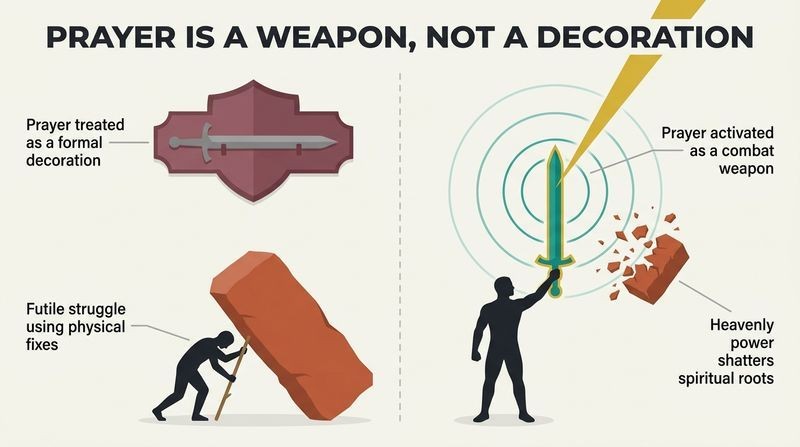
What's striking is how Shirer collapses the sacred and the practical. She refuses the common dichotomy where prayer is peaceful and problem-solving is aggressive. Instead she frames intercession as the most aggressive act available. This echoes a broader theological tradition (from the desert monks to Ignatian spirituality) that treats contemplation as spiritual exertion, not passivity. A skeptic might note that framing everything as demonic warfare risks bypassing ordinary causes like biology, sleep, or genuine relational fault. Shirer does acknowledge natural causes and consequences elsewhere, but readers should hold both lenses: some struggles are spiritual assaults, others are simply human, and wisdom lies in discernment.
Write your prayers down and post them where you'll see them daily
The whole book distills into a grandmother's phrase. Shirer's ninety-five-year-old grandmother, Annie Cannings, kept prayer requests in a cheap spiral notebook. Asked why she wrote them out, she answered simply: so I won't forget. Forget who the real enemy is, who your hope is in, what you truly need, and later, how God answered.
Shirer adopted the practice literally. She writes prayers on full sheets or scraps of paper, dates them, and tapes them above the hooks in her closet so she sees them every time she dresses. The physical act of writing narrows a scattered mind onto what matters most and turns vague longing into a concrete plan. Her instruction: tear out prayers, post them on mirrors, dashboards, and cubicles, then pray them consistently rather than merely reading them.
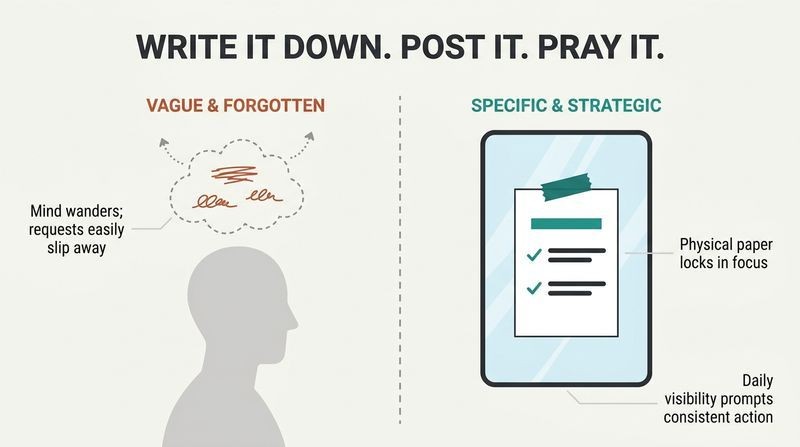
The counsel aligns neatly with cognitive science on externalized memory and intention. Writing a goal by hand improves encoding and follow-through; visible cues in the environment trigger behavior far more reliably than internal resolve, a principle behavioral researchers call implementation intentions. Shirer intuits what habit researchers formalize: repetition plus environmental prompting beats willpower. There is also a longevity dimension. A written prayer becomes a dated record, allowing the pray-er to later trace answers, which builds faith empirically rather than through feeling alone. The one caution: writing can calcify into performance. The grandmother's power lay in her relationship, not her stationery.
Pray with pinpoint specificity, targeting exactly where you're under attack
Scattered prayer wastes ammunition. Shirer argues that flinging words and emotions in every direction without considering how the enemy is specifically targeting you accomplishes little. She observes that your recurring fears and anxieties are not random; they reveal a personalized strategy drawn up by someone who knows where you live, whom you love, and your habitual weak spots.
Her remedy is to fight fire with fire. She polled a large group of women and distilled the enemy's tactics into ten targets: passion, focus, identity, family, confidence, calling, purity, rest, heart, and relationships. Each chapter ends with a personalized, written prayer strategy anchored in Scripture that corresponds to that specific area. Precise prayer, she says, keeps you integrated with reality and consistent with biblical truth, rather than wandering down a spiritual hallway that never connects to where you actually live.
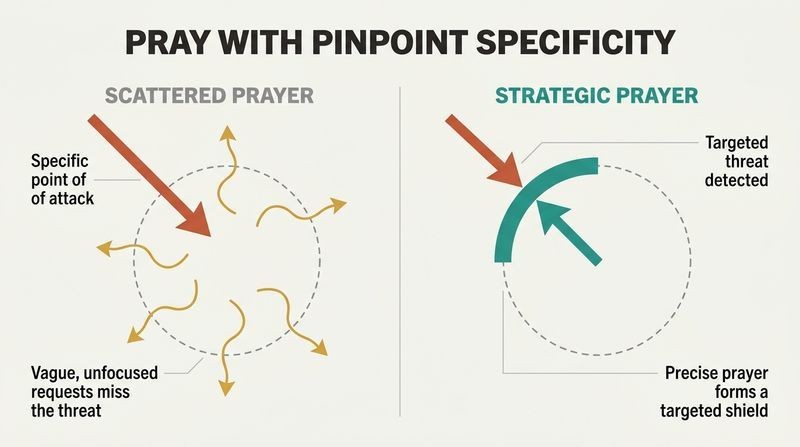
The specificity principle has surprising secular parallels. Vague goals (be healthier) fail where concrete ones (walk 8,000 steps) succeed; therapists use targeted exposure rather than diffuse reassurance. Shirer applies the same logic spiritually: name the enemy's exact move and counter it precisely. The framing that your worst fears are intelligence about where you are being attacked is psychologically shrewd, turning anxiety into diagnostic data rather than shame. A fair challenge: not every fear signals a spiritual assault, and treating personal weakness as external strategy could externalize responsibility. Yet the practical payoff, forcing believers to articulate rather than mumble, is genuinely useful regardless of theology.
Stop firing at people; the real enemy hides behind the curtain
Focus determines who you fight. Shirer's favorite image is a church carnival Whac-A-Mole game built on a truck. A bored five-year-old yanked the curtain off and exposed three adults working the puppets from below. Her point, drawn from Ephesians 6:12, is that your struggle is not against flesh and blood but against unseen spiritual forces manipulating what you can see.
When you attack your husband, teenager, or coworker, you are whacking the visible symptom while the puppeteer works unseen. Satan disguises himself as an angel of light and succeeds when he stirs discord in your home so subtly that no one realizes he was ever in the building. Prayer, she says, functions like 3-D glasses: it pulls back the curtain, exposes the true instigator, and redirects your emotional energy away from the people who are merely his instruments.
This reframe has real relational utility even for non-believers. Marriage researcher John Gottman found that contempt, seeing a partner as the enemy, is the single strongest predictor of divorce. Shirer's insistence that your spouse is not the enemy operationalizes that finding through a spiritual lens, defusing blame before it hardens into contempt. Attribution theory in psychology confirms that reassigning the cause of conflict changes emotional response. The risk, of course, is that blaming an invisible adversary can excuse genuine human wrongdoing or discourage accountability. Shirer partly guards against this by noting that self-examination often follows. The safest reading keeps human responsibility and spiritual awareness in tension.
Satan is a limited illusionist running out of time, not God's rival
Two errors distort spiritual warfare. Shirer warns readers not to overestimate Satan (living in constant fear) nor underestimate him (leaving yourself defenseless and, in her blunt word, stupid). The corrective is proportion: Satan is not God's peer or counterpart. She points to Revelation's climactic battle as, in her framing, the devil dressed for war with nowhere to go, a conflict over before it starts.
She lists four hard boundaries the enemy cannot cross:
1. He cannot be everywhere at once; only God is omnipresent.
2. He cannot read your mind; only God is omniscient.
3. He is an illusionist using trickery; only God works real miracles.
4. He is running out of time; only God is eternal.
Because of these limits, believers pray from victory, not fear. Christ has already disarmed, overruled, and rendered him powerless.
Theologically, this reflects a classic Augustinian move: evil is parasitic, not equal, a corruption of good rather than an independent power. Shirer's insistence that Satan cannot read minds is a meaningful pastoral point, undercutting the anxiety that one's private thoughts are exposed to a hostile intelligence. Psychologically, framing an adversary as fundamentally limited reduces the paralysis that catastrophic threat perception produces. The four-limits list functions almost like a cognitive reframe used in anxiety treatment, shrinking an exaggerated menace back to scale. Critics of spiritual-warfare literature sometimes note it can breed hyper-vigilance; Shirer's emphasis on Satan's defeat is a healthy counterweight, keeping the reader oriented toward confidence rather than dread.
Structure every prayer around Praise, Repentance, Asking, and Yes
A simple scaffold keeps prayer anchored. Shirer offers the acronym PRAY to shape each written strategy:
1. Praise: thread gratitude for who God is throughout, not as a warm-up but because his glory is the point.
2. Repentance: expect prayer to expose where you resist God, and turn.
3. Asking: make requests personal and specific, naming your actual struggles.
4. Yes: accentuate prayers with God's own promises from Scripture, since his promises are answered with a resounding yes.
The Yes element is her distinctive emphasis. She supplies dozens of Scripture passages per chapter so the pray-er is not manufacturing feelings but declaring God's recorded words back to him. Praying Scripture, she insists, is the most powerful form of prayer because the enemy trembles before truth he cannot refute.
The praise-first, ask-later sequence mirrors ancient liturgical patterns and the structure of the Psalms, which typically move from lament through petition to trust. There is also emotional wisdom here: beginning with gratitude before requests parallels findings in positive psychology that gratitude practices measurably shift mood and reduce anxiety before problem-solving begins. The Yes step, praying Scripture verbatim, resembles the memorization and recitation techniques used across contemplative traditions to quiet intrusive thought. One nuance worth flagging: reciting promises can slide into a transactional expectation that God must deliver. Shirer hedges this by anchoring outcomes in God's sovereign will, keeping the framework devotional rather than mechanical.
Lost spiritual passion is on loan from God, and only he can retrieve it
The enemy's first target is your desire to pray at all. Shirer builds this on the floating ax head story in 2 Kings 6. A young prophet chopping wood loses his borrowed iron ax head in the river, and it sinks out of reach. Elisha throws in a stick and the iron floats up, miraculously recovered.
She draws four lessons about your cutting edge, her term for spiritual passion and fervency:
1. God's presence stayed near even when the edge was lost.
2. The man lost it while doing good, productive work, so weariness is not proof of failure.
3. The ax was borrowed; passion is a gift on loan, not something you manufacture.
4. Only God could retrieve it from the deep, so stop blaming yourself and ask him to restore it.
Satan condemns to destroy; God convicts to restore. Guilt-laden despair bears the enemy's fingerprints.
The distinction between condemnation and conviction maps onto clinical work separating shame from guilt. Researcher Brene Brown found guilt (I did something bad) motivates repair while shame (I am bad) predicts depression and disengagement. Shirer's claim that the enemy specializes in self-focused despair while God's correction points outward to grace is a shrewd pastoral application of that distinction. The idea that passion is on loan rather than self-generated also relieves a peculiarly modern burden, the pressure to feel constantly motivated. Reframing motivation as a gift to be requested rather than a resource to be willed removes the self-blame that often deepens spiritual fatigue and accelerates recovery.
Your identity in Christ is a packing list, not a shopping list
A case of mistaken identity is the enemy's aim. Shirer opens with Abby, a college student whose family grieved her death for six days after a fatal crash, only to learn she had been misidentified and was alive. The grief was real but based on a lie. The enemy wants you similarly mourning who you wish you were instead of relishing who you already are.
Paul's list in Ephesians 1 is not a shopping list but a packing list. You already possess these things: chosen before creation, adopted, redeemed, lavished with grace, given an inheritance, sealed by the Spirit. Paul does not pray that believers receive them but that their eyes open to realize they already have them. Shirer ties this to the belt of truth, the foundational undergarment of the armor, worn first so every other piece stays in place. Truth about your identity must precede everything else.
The packing-list versus shopping-list reframe is the chapter's most portable idea and doubles as a psychological insight. Much of insecurity stems not from lacking worth but from failing to perceive worth already present, what cognitive therapists call a perceptual rather than factual deficit. The Abby analogy is emotionally potent precisely because it dramatizes acting on false information, the exact mechanism behind maladaptive core beliefs. The belt-of-truth image, truth as the foundation garment everything else attaches to, resonates with the therapeutic principle that accurate self-appraisal must undergird behavioral change. A subtle risk: identity language can drift toward triumphalism that minimizes real struggle, though Shirer keeps it tethered to grace received rather than merit earned.
Quit trying to fix your husband; your marriage is a gospel billboard
Marriage carries symbolic weight the enemy wants to smear. Shirer argues that marriage's deepest purpose is to display the covenant between Christ and the church, making every Christian home a billboard the enemy is desperate to vandalize. During filming of a faith-based movie about prayer, her own family fractured under stress until she and her husband Jerry chose to stop fighting each other and fight the enemy together in prayer.
Her sharpest practical counsel: stop trying to be the Holy Spirit in your marriage. She spent early years convinced her spiritual gift was changing Jerry, and it took nearly two decades to admit that improving your husband appears nowhere in Scripture's list of spiritual gifts. Your job is to respect him and leave the rest to God. Praying for him, she found, mostly reveals what needs changing in your own heart. She applies the same to children, calling them arrows to be launched.
The advice to stop policing a spouse is corroborated by relationship research showing that attempts to change a partner typically breed defensiveness and resentment, while acceptance paired with self-focused change predicts satisfaction. Shirer's confession that praying for Jerry spotlighted her own faults echoes the therapeutic axiom that the only person one can reliably change is oneself. Framing children as arrows launched into culture is a striking image of parenting as release rather than control, an antidote to helicopter parenting. The billboard metaphor may strain for readers whose marriages have ended, and Shirer's traditional complementarian framing of submission will not land universally, but the core counsel, fight alongside rather than against, is broadly sound.
Obey God anyway when fear whispers you're not ready
Fear is the enemy's paralysis strategy. Shirer's friend Shawna, an accomplished counselor, marathoner, and mother, broke down in a car ride confessing she was too scared to write the books God was clearly leading her toward. Shirer's fierce response: do it anyway. If the only thing stopping you is fear, the enemy is trying to paralyze you and divert you from something valuable.
Scripture treats fear seriously precisely because it is common. Shirer notes God tells people not to be afraid more than three hundred times. At the Red Sea, Moses did not tell Israel not to feel fear (looming death produces that naturally) but not to wallow in it, because doing so would cost them the miracle and the Promised Land beyond it. Since 2 Timothy says God does not give a spirit of fear, paralyzing dread has only one other source, which should make you curious what blessing it is guarding.
The reframe that fear signals a threshold worth crossing inverts the ordinary avoidance response and aligns closely with exposure-based therapy, where approaching rather than fleeing the feared thing extinguishes anxiety. Shirer's distinction between feeling fear and choosing it mirrors the acceptance and commitment therapy principle that emotions need not dictate action; one can feel afraid and act anyway. Her curiosity reframe, wondering what treasure the fear is protecting, is a clever motivational hack that transforms dread into intrigue. The one caution is discernment: not all hesitation is satanic paralysis; some is wise prudence or accurate risk assessment. Shirer guards this by requiring the direction be confirmed through Scripture and godly counsel first.
Refuse forgiveness and you hand the enemy a switch to mute your prayers
Unforgiveness is a strategic design to outwit you. Shirer describes a season when her prayers felt hollow, echoing off an empty cave. A passage in 2 Corinthians 2 convicted her: forgive and comfort the offender so you are not outwitted by Satan, whose designs you must not ignore. She had been quietly resenting a friend whose cold shoulder had wounded her.
Obedience meant more than internal forgiveness. God pressed her to actually comfort the woman, so she brought a homemade meal to her house. There she discovered the offender had been losing sleep and appetite, wrestling with her own insecurity. The ice broke, and Shirer's prayer life flooded back. Her point: the enemy wants you seething, not sobbing, baking in bitterness until your spiritual life turns hard and lifeless. Forgiveness is less a favor to the offender than a release for yourself, spared the exhausting job of being judge and jury.
The link between unforgiveness and blocked spiritual vitality has a measurable secular counterpart. Studies on forgiveness by Everett Worthington and others document that chronic resentment elevates cortisol, blood pressure, and cardiovascular risk, while forgiveness improves immune function and mental health. Shirer's framing that bitterness bakes inside where the heat has no escape is physiologically apt. Her insight that forgiveness relieves you of the burden of enforcing justice parallels the therapeutic reframe that letting go is self-liberation rather than exoneration of the offender. The move from internal pardon to concrete kindness raises the bar, and Shirer wisely notes such gestures are not always required or safe, preserving room for boundaries in abusive situations.
Chronic busyness is slavery in disguise; reclaim Sabbath and say no
Overload is a spiritual attack, not just a scheduling problem. Shirer argues the enemy enslaves you not only to sins but to good things: job, ministry, hobbies, your kids' activities. Constant pressure mimics slavery, where the day's agenda controls you rather than the reverse. When God freed Israel from Egypt, they still thought like slaves and even resisted the command to rest, having never known the concept.
Sabbath (the Hebrew shabbat, to cease or pause) was God's tool to reprogram a slave mentality. Shirer identifies three roots of pressure:
1. Slavery: treating even good activities as merciless taskmasters.
2. Fear and insecurity: believing your worth equals your output.
3. Idolatry: pressure often masks a hidden idol (reputation, self-reliance, achievement, or children).
Every plague-era demand to Pharaoh added a purpose: let my people go so they may worship me. Margin keeps God from being marginalized. A free woman can say no without guilt.
Shirer's diagnosis of busyness as idolatry is unusually incisive for the genre. Her claim that overload masks fear (worth tied to output) anticipates research on achievement-based self-worth, which correlates with anxiety, burnout, and depression. The reframe that saying no is an act of freedom rather than selfishness challenges a productivity culture that treats exhaustion as virtue. The Sabbath-as-deprogramming argument resonates with sociologist Judith Shulevitz's work on the vanishing rhythm of rest and its psychic cost. The most useful move is diagnostic: asking which idol a given pressure serves. A worthy tension remains, since real obligations exist and not all busyness is idolatry, but the invitation to audit motives before capitulating is broadly wise.
Analysis
Fervent belongs to the practical-devotional subgenre of evangelical spiritual-warfare literature, but its structural cleverness sets it apart. Rather than a treatise about prayer, Priscilla Shirer builds a reverse-engineered playbook: she catalogs ten ways a personal enemy attacks women, then supplies a countermeasure for each, culminating in tear-out pages the reader physically posts. The book is action-oriented by design; its stated ambition is that the cover should end up disfigured from use. This makes it resistant to conventional summary because roughly half its value lives in the doing, not the reading.
The intellectual spine is the conviction that reality is bilayered, with a visible physical world manipulated by an invisible spiritual one, and that prayer is the only instrument reaching the lower layer. Shirer's rhetorical gift is concretizing abstraction: the ax head for lost passion, the misidentified crash victim for false identity, the Whac-A-Mole curtain for misdirected blame, Highway 59's exit ramp for a haunting past. These images do heavy pedagogical work and are more memorable than the theology they illustrate.
Three ideas transcend the book's religious frame and connect to secular research: forgiveness as physiological self-liberation, busyness as identity-based insecurity, and specificity as the difference between effective and futile intention. Each has empirical support in psychology and behavioral science, which strengthens Shirer's pastoral instincts.
The book's chief limitation is its interpretive monism. Attributing fatigue, fear, marital friction, and distraction primarily to demonic strategy risks under-weighting biology, circumstance, and personal accountability. Shirer partially inoculates against this by acknowledging natural causes and by keeping Satan firmly subordinate to a sovereign God, praying from victory rather than terror. Her complementarian assumptions about marriage and submission will limit the audience. But as a manual for turning diffuse anxiety into disciplined, written, scripturally-anchored petition, it is unusually practical and psychologically astute for its category.
Review Summary
Fervent receives mostly positive reviews, praised for its practical approach to prayer and spiritual warfare. Readers appreciate Shirer's engaging writing style, personal anecdotes, and Scripture-based strategies. Many find the book life-changing, helping them develop a more intentional prayer life. Some criticisms include oversimplification of spiritual concepts and overemphasis on Satan's influence. The book's organization, prayer cards, and focus on specific life areas are frequently commended. Overall, it's widely recommended for Christians seeking to deepen their prayer practice and combat spiritual challenges.
People Also Read










Glossary
Prayer strategy
Written, targeted battle plan prayerShirer's central practice: a specific, Scripture-anchored prayer composed in writing to counter a particular way the enemy is attacking one area of life. Unlike scattered, emotional prayer, a strategy names the exact struggle, incorporates relevant biblical promises, and is posted somewhere visible to be prayed repeatedly and consistently rather than merely read once.
PRAY
Praise, Repentance, Asking, YesShirer's four-part framework for structuring each written prayer. Praise threads gratitude throughout; Repentance turns from resistance to God; Asking makes personal, specific requests; Yes accentuates the prayer with God's own scriptural promises, since Scripture says God's promises are answered with a resounding yes. The scaffold keeps prayer anchored to biblical truth.
Cutting edge
Spiritual passion and fervencyShirer's metaphor, drawn from the floating ax head in 2 Kings 6, for the passion, faith, and fire that fuel fervent prayer. She argues this edge is borrowed, a gift on loan from God rather than something self-manufactured, so when it goes missing the remedy is to ask God to restore it rather than to blame oneself.
Packing list, not a shopping list
Identity already possessed, not acquiredShirer's reframe of Paul's identity descriptions in Ephesians 1. Believers do not need to acquire spiritual blessings (a shopping list) because they already possess them (a packing list). Paul prays not that they receive these things but that their eyes open to recognize what they already have in Christ.
Friendly fire
Believers wounding fellow believersShirer's borrowed military term for the damage Christians inflict on one another through division, jealousy, gossip, and disunity. She argues such wounds among spouses, friends, and church members are rarely accidental but reflect enemy activity designed to isolate and weaken believers, since unity multiplies their spiritual force against him.
FAQ
What's "Fervent: A Woman's Battle Plan to Serious, Specific and Strategic Prayer" about?
- Purpose of the Book: "Fervent" by Priscilla Shirer is a guide for women to develop a strategic and effective prayer life. It emphasizes the importance of prayer in spiritual warfare.
- Structure: The book is organized into ten strategies, each focusing on a different area of life where prayer can be applied to combat the enemy's tactics.
- Call to Action: Shirer encourages readers to not just read about prayer but to actively engage in it, making it a central part of their daily lives.
Why should I read "Fervent" by Priscilla Shirer?
- Empowerment through Prayer: The book provides practical tools and strategies to empower women to fight spiritual battles through prayer.
- Personal Growth: It encourages personal growth by helping readers identify areas in their lives where they need to focus their prayers.
- Community and Support: Reading "Fervent" can foster a sense of community among women who are seeking to deepen their prayer lives and support each other in spiritual warfare.
What are the key takeaways of "Fervent"?
- Strategic Prayer: Prayer should be specific and strategic, targeting areas where the enemy is most active in your life.
- Awareness of the Enemy: Recognizing the enemy's tactics is crucial to effectively countering them through prayer.
- Power of Unity: The book emphasizes the importance of unity in prayer, both within oneself and with others, to strengthen spiritual defenses.
How does Priscilla Shirer define strategic prayer in "Fervent"?
- Focused and Intentional: Strategic prayer involves being deliberate about what you pray for, focusing on specific areas of need or attack.
- Biblical Foundation: It is grounded in biblical truths and promises, using Scripture as a guide and weapon in prayer.
- Personalized Approach: Shirer encourages readers to tailor their prayers to their unique circumstances and challenges, making them more effective.
What are the ten strategies outlined in "Fervent"?
- Passion: Reignite your passion for prayer and spiritual matters.
- Focus: Direct your focus on the real enemy, not the distractions.
- Identity: Remember and affirm your identity in Christ.
- Family: Pray for the protection and unity of your family.
- Past: Release guilt and shame from past mistakes through prayer.
How does "Fervent" address the concept of spiritual warfare?
- Enemy's Tactics: The book highlights how the enemy uses specific strategies to attack believers, such as fear, distraction, and division.
- Prayer as a Weapon: Shirer presents prayer as a powerful weapon that can dismantle these strategies and protect against spiritual attacks.
- Victory through Prayer: The book assures readers that victory is possible through persistent and strategic prayer.
What role does Scripture play in "Fervent"?
- Foundation for Prayer: Scripture is used as the foundation for crafting effective prayer strategies.
- Source of Truth: It provides the truths and promises that believers can stand on when praying.
- Guidance and Encouragement: Shirer uses Scripture to guide readers in their prayer life and to encourage them in their spiritual battles.
What are some of the best quotes from "Fervent" and what do they mean?
- "This Means War": This quote sets the tone for the book, emphasizing that prayer is a battle against a real enemy.
- "Praying with precision is key": It highlights the importance of being specific and intentional in prayer to effectively counter the enemy's attacks.
- "Prayer is the portal that brings the power of heaven down to earth": This quote underscores the transformative power of prayer in accessing divine strength and intervention.
How does "Fervent" suggest dealing with fear and anxiety?
- Identify the Source: Recognize that fear and anxiety are often tactics used by the enemy to paralyze and distract.
- Scriptural Promises: Use Scripture to combat fear, focusing on God's promises of peace and protection.
- Faith over Fear: Shirer encourages readers to choose faith over fear, trusting in God's plan and presence.
What advice does Priscilla Shirer give for maintaining purity in "Fervent"?
- Recognize Temptation: Be aware of the enemy's attempts to tempt and lead you away from purity.
- Prayer for Strength: Use prayer to seek strength and guidance in resisting temptation.
- Accountability and Support: Surround yourself with a community that supports your commitment to purity.
How does "Fervent" encourage readers to pray for their families?
- Protection and Unity: Pray for the protection and unity of your family against the enemy's attacks.
- Specific Needs: Address specific needs and challenges your family faces through targeted prayer.
- Legacy of Faith: Pray for a legacy of faith to be established and maintained within your family.
What is the significance of the "Amen" section in "Fervent"?
- Conclusion and Encouragement: The "Amen" section serves as a conclusion, encouraging readers to continue their prayer journey with renewed fervor.
- Commitment to Prayer: It reinforces the commitment to making prayer a central part of life.
- Community of Prayer: Shirer emphasizes the importance of joining a community of believers in prayer, strengthening the collective power against spiritual warfare.
Download PDF
Download EPUB
.epub digital book format is ideal for reading ebooks on phones, tablets, and e-readers.








































