
Plot Summary
Riches and Ringlets
Cruella grows up ensconced in luxury in 1920s London, held aloft by the glitter and rules of the De Vil estate. Her world is ordered and gilded with marble, furs, and the love of her distant, glamorous Mama and the genuine warmth of Papa. Yet, for all the sparkling chandeliers and mirrored staircases, Cruella is already taught that the household below belongs to shadows—the "in-betweens" and servants who flit ghostlike around her. Only Anita, her beloved childhood friend, breaches the thresholds between worlds. From her earliest youth, greatness and elegance are sewn into Cruella's every thought, just as loneliness tangles among her perfect ringlets.
Tea For One Hour
One precious hour each day is reserved for Cruella and her Mama in the morning room—a daily ritual of measured affection, sparkling advice, and veiled critique. Mama's love is conditional, sometimes warm, sometimes critical, with constant reminders to distinguish herself and never wear the same dress twice. These moments, gilded in memory, incubate both longing and resentment. Cruella craves her mother's approval, learning early how to perform for affection, to manipulate small gestures into tokens of belonging. Even as she learns the rules of society, there are invisible rules of love and worth forming just beneath her skin.
In-Betweens and Best Friends
Cruella's childhood is structured by strict social barriers: the family, the servants, the ambiguous "in-betweens" like her governess Miss Pricket, and the lower middle class. But Anita, the bookish ward without noble pedigree, becomes her emotional anchor, her truest companion. Their bond is envied by servants and marginalized by Lady De Vil. As Cruella is schooled in how to categorize and contain affection—and in how invisibly affection can disappear—her sense of identity and kinship grows entangled with the fragile, shifting status of those around her. It is a lesson in difference, privilege, and the ache of wanting more.
The Crumbling of Home
The death of Papa shakes the foundation of Cruella's universe. Rendered powerless, she watches as her mother's heart calcifies with grief and anger. The will leaves Cruella, not her Mama, the De Vil fortune—an act that sows a rift impossible to bridge. Her mother blames her, love vanishes, and the home that felt so eternal now flickers with uncertainty. Suddenly, the experience of loss and betrayal replaces the old joy of dancing with Papa and reading tales of adventure. Trust in home and family frays beyond repair, marking Cruella with sorrow and a desperate hunger for connection and control.
Cruella Alone
Sent off to finishing school, Cruella is brutalized by the pettiness, exclusions, and mercenary games among young women of her class. Anita is her only solace, but even their friendship is tested by the cruelty of others and by Lady De Vil's plotting from afar. Lessons in decorum are swiftly shadowed by realities of social warfare, jealousy, and the knowledge that real affection is transactional. Cruella finds herself emotionally adrift, performing the rituals of a young lady, but internally receding, turning cold. Loneliness sharpens her craving to be special—at any cost.
Educating Young Ladies
At Miss Upturn's Academy, Cruella faces relentless hostility for befriending Anita, whose lack of noble birth marks her an outcast. Worse, Cruella's own mother actively sabotages their friendship. Cruella's attempts to defend Anita backfire, alienating them both from their peers and staff. Her reputation becomes that of a haughty rebel, and she finds herself isolated, resentful, and increasingly contemptuous of the very social order she was raised to uphold. She learns the currency of power, manipulation, and the sacrifices made to survive adulthood among the sharks of society.
Society's Favorite Daughter
On returning home, Cruella is forced into the role of marriageable debutante, paraded before eligible bachelors, forced to wear sparkles and furs, the model daughter for Lady De Vil's ambitions. Her own desires are irrelevant; the stage is set to find a man who will either preserve or end her inheritance, depending on whether she keeps her name. Marriage and society balls reveal the distorted rituals of grown-up power and manipulation. Even as Cruella resists, she finds herself thinking in her mother's voice, wanting approval and fearing abandonment. Identity is a costume—and she wears it with mounting desperation.
Christmas Fractures
Christmas brings a brief illusion of unity—until it explodes. Joyful celebrations with Anita and the household staff are met with Lady De Vil's outrage when she returns unexpectedly, horrified by her daughter's violation of social boundaries. The resulting fallout brings harsh words, embitters relationships with her mother and Miss Pricket, and cements Cruella's realization that true affection is conditional, even among those who seemed closest. Furs and jewels cannot compensate for the ache of emotional absence. Cruella learns that in the pursuit of distinction, one may find oneself bitterly, irrevocably alone.
Friendships Lost, Furs Gained
Growing ever colder, Cruella's relationship with Anita disintegrates. Anita chooses her own independence over a life of "adventure" beside Cruella, refusing a role as paid companion. Devastated and betrayed, Cruella turns to fur and fashion, the symbols of status and glamour that once defined maternal love. Surrounded by beautiful things, she is increasingly isolated, envying Anita's ordinary but sincere happiness. Her emotional world shrinks to the echo of her mother's cold ambitions, even as she desperately tries (and fails) to forge new bonds. Her sense of self, and sense of power, curdle into resentment.
Mother's Schemes, Daughter's Defiance
Despite Lady De Vil's manipulations—arranging suitors and managing social standing—Cruella defies her, attempting to maintain her independence and keep her father's name. She is torn between the hope of her mother's approval, her father's memory, and the pull toward bitterness. When she does fall in love—unexpectedly, deeply—with the charming American Jack, it finally seems possible to have love, freedom, and wealth all at once. Yet the shadow of her mother's schemes, and her own habits of emotional self-sabotage, threaten every happiness.
Finding Jack, Losing All
Cruella experiences a fleeting happiness after marrying Jack, building a new life of parties and fulfillment, only for it to be snuffed out by sudden catastrophe: Jack's tragic death in a fire and the loss of all wealth except a decaying estate. The betrayal of her mother, who sells the family home, and the revelation that many around her have only ever protected their own interests, break her final reserves of hope. Grief and anger transform Cruella—physically (her hair turning half white) and emotionally—marking the birth of her infamous, villainous persona.
The White and Black Divide
Sequestered in the ruins of her family's countryside estate, what others call "Hell Hall," Cruella becomes a figure of lore—her pain and rage echoing down empty corridors. The loneliness of her exile cements her transformation. While she attempts to reconnect with Anita and the past, she realizes she has been fully abandoned. All affection and approval, once thought attainable with gifts, has vanished, leaving only cold clarity: her distinction—her so-called uniqueness—is now her curse. The world, once rich and warm, is now nothing but the white and black of grief, envy, and rage.
Hell Hall's Lament
With even her attempts at reconciliation with Anita failing, Cruella becomes consumed by bitterness, plotting the ultimate act of revenge against those who now scorn her. Her longing for love, for a place among family, has twisted into something monstrous—the idea of transforming Anita's beloved Dalmatians into a fur coat, the final symbol of belonging, status, and maternal love. Her infamous plan for the puppies is born not purely from evil but out of the relentless ache of abandonment. Her reputation for wickedness grows as her capacity for empathy is burned away by despair.
The Price of Distinction
Cruella's plot to steal the Dalmatian puppies—helped along disastrously by incompetent henchmen—is the perverse culmination of her lifelong belief that distinction, being special, is earned through grand gestures and spectacle. The coat she intends to make is as much a monument to her lost mother's approval as it is a symptom of her own brokenness. The chaos, betrayal, and eventual failure of her scheme are met not with understanding, but further ridicule and social exile. Cruella's infamy is sealed; her story becomes one of warning, not envy, among the world she once ruled.
Return to Shadows
Public disgrace chases Cruella back to Hell Hall, this time as a prisoner—first by her mother's design, then by her own madness. The only company she has left is the echo of the past, the ghosts of servants, and the sad devotion of Miss Pricket, the sole in-between who never stopped caring. The world outside is a chorus of ridicule. Her identity—once centered on being seen, admired, and envied—has become the shadow of a scandal. Locked away, Cruella's legend is reduced to headlines and horror stories.
A Final Betrayal
Cruella, now narrating her own tale, is haunted by questions: Could things have been different? If her childhood had held more warmth, if Anita had chosen her, if her mother had stayed? The narrative blurs between confession and justification, between candid pain and bitter pride. Whether she is truly evil, truly mad, or simply the inevitable product of neglect and longing is left open. Her identity, once black and white, is shown to be a tangle of grey—envy, sorrow, pride, and the slow acceptance that some wounds never heal.
Plans in the Dark
Even locked away, Cruella plots a new, grander act of revenge; her heartbreak is now inextricably fused with her will to be remembered, to distinguish herself by any means. As whispers circulate of puppies, coats, and evil, she still dreams of the approval she never received, the love she never got. In the darkness, hope and delusion entwine—proof that, for some, the longing for recognition is stronger than regret.
The End in Black and White
The memoir closes with the reflection of the story's amanuensis, who, having heard Cruella's tale, sees her not as simply "evil," but as a wounded soul shaped by loss and neglect. Miss Pricket returns as her caretaker. Whether Cruella will ever find peace, or if the desire for distinction will forever curse her, remains unanswerable. All the world's cruelty, every pain and ambition, is drawn in stark black and white—except, perhaps, in the moment a hand reaches out to offer mercy, and the story ends, unfinished and unresolved.
Analysis
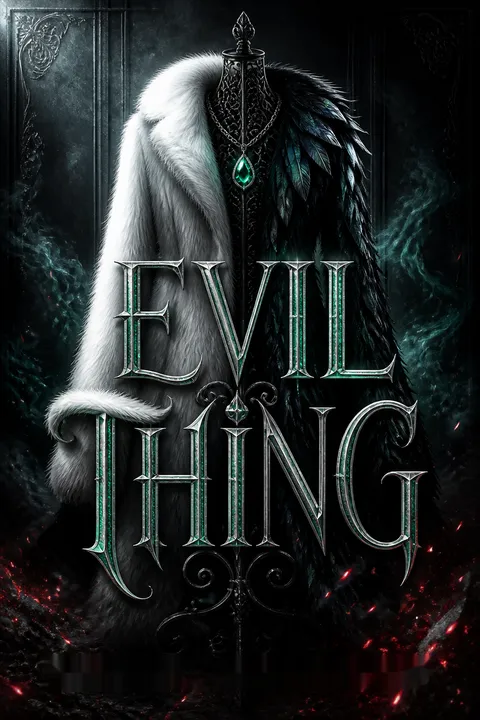
Evil Thing reinvents the Cruella De Vil mythos as a deeply psychological character study, offering a narrative about how privilege, emotional neglect, and social cruelty conspire to produce the monster everyone loves (and loves to hate). By inviting us into Cruella's voice—by turns witty, vulnerable, and vengeful—the book explores the complexities of villainy: the intersection of trauma, ambition, and the desperate need for love. It is a subtle indictment of class, familial expectation, and the social rituals that reward distinction while isolating those who crave belonging. The repeating motif of "distinction" reveals how society's ideals twist into pathology when affection is made transactional. The tale's cyclical losses—every gift laced with conditional love—lead not only to external evil, but to a profound internal exile. Modern readers are invited to find empathy in the monstrous; to recognize how neglect, manipulation, and the denial of sincere connection breed not only sadness, but a need to harm. The story subverts the black-and-white logic of good versus evil, reminding us that what is truly "evil" is more often the product of a world that prizes appearance over affection, spectacle over sincerity.
Review Summary
Evil Thing by Serena Valentino receives mostly positive reviews, averaging 3.97/5. Readers praise the deeply emotional origin story of Cruella De Vil, highlighting her tragic childhood, complex relationship with her mother, and friendship with Anita. Many consider it the best installment in the Villains series, appreciating its memoir-style narrative and standalone accessibility. The audiobook narration also receives high praise. Critical reviews cite repetitive pacing, a rushed ending, and overly simplistic character motivations as weaknesses.
People Also Read


Characters
Cruella De Vil
Cruella grows up surrounded by wealth and expectation, yet emotionally malnourished by her mother's cold, performative love and her father's distracted warmth. Witty, passionate, and desperate to be seen, she chooses dramatic gestures (jewelry, furs, spectacle) as tokens of worth. In her youth she is capable of genuine affection—especially for Anita—but repeated betrayals twist her desire for love into a dangerous need to "distinguish herself" at all costs. Her descent is psychological: each loss sharpens her need until empathy dies and only ambition, envy, and a will to be remembered remain. As narrator, she both confesses and justifies, haunted by what might have been.
Lady De Vil (Cruella's Mother)
Lady De Vil is a paragon of style and social ambition, devoted to appearances and fiercely protective of her own reputation. She expresses love through gifts and criticism, rarely with affection. Her own traumas—loss, disappointment, and class anxiety—pulse through her parenting, fueling both her encouragement and her sabotage of Cruella's attachments (especially Anita). Lady De Vil's love is always transactional: her most defining legacy is the phrase "distinguish yourself," which lingers as both a goad and a curse on her daughter. Caring only for status, she ultimately scapegoats Cruella, locking her away to avoid personal disgrace.
Anita
Anita, lacking noble blood but rich in empathy and intelligence, is both foil and friend to Cruella. She is the only person who provides unconditional support, yet her refusal to be merely a companion or servant exposes the limits of Cruella's affections. Anita's own sense of identity leads her to choose independence and love (with Roger), rather than a life defined by Cruella's needs. Gentle, bookish, and pragmatic, Anita represents the "ordinary" joys that Cruella cannot understand or accept. Their friendship's end is the keystone of Cruella's spiral into bitterness.
Papa (Lord De Vil)
Kind, humorous, and loving, Cruella's father is nonetheless absent, focused on his own passions and social duties. His affection is genuine but inconsistent—he gives gifts with stories and sentiment (the jade earrings), but leaves emotional labor to others. His will, leaving the family fortune to Cruella, unwittingly creates a rift and seeds lifelong resentment between mother and daughter. Papa's death deprives Cruella of her last anchor to uncomplicated affection and is the beginning of her emotional unraveling.
Miss Pricket
As Cruella's governess, Miss Pricket is neither staff nor family—a liminal, tender presence who sees and loves Cruella more than anyone else. Her empathy and steadfastness make her an emotional refuge, yet her station ensures she is never fully trusted or valued. After being dismissed for challenging Lady De Vil and for caring too much, she remains the only figure to return to Cruella in her final isolation, offering the possibility of redemption or, at least, human connection for the forsaken.
Mrs. Baddeley
The family cook, Mrs. Baddeley fusses over Cruella with food and affection ignored by the upper tiers of the house. Her patience and kindness to both girls—especially Anita—are rejected or resented by Cruella, but in truth, she is closer to a traditional mother than Lady De Vil ever was. Ultimately, she becomes Anita's housekeeper, her warmth standing in contrast to Cruella's descent into bitterness and alienation.
Jackson
The De Vil household's butler, Jackson is a steady, dignified presence, offering order when everything else unravels. Though appearing emotionally reserved, he is deeply loyal, watching over Cruella through childhood loss and adult tragedy. His inability to save Jack from the fire becomes a focal point for Cruella's misplaced rage, representing how even the most steadfast bonds can be undone by trauma.
Jack De Vil (Lord Shortbottom)
The American baronet who captures Cruella's heart, Jack is everything the social world is not: open, funny, authentic. He genuinely loves Cruella, supporting her independence and even taking her name. Their marriage is the apex of her hopes for fulfillment and is, predictably, destroyed. His sudden, ambiguous loss to fire is both a personal tragedy and a narrative device—the last foundation swept away, leaving Cruella with nothing but rage and legend.
Mrs. Web ("The Spider")
Introduced as Lady De Vil's instrument for control once Cruella's world collapses, Mrs. Web is an oppressive presence. Cold, silent, and constantly observing, she mirrors and amplifies the loss, suspicion, and gloom suffusing Cruella's later life. As Cruella's keeper in Hell Hall, she embodies the institutionalization of punishment and societal shame.
Sir Huntley
The De Vil family lawyer, Sir Huntley is bumbling but earnest. Tasked with managing the trust and navigating the will's seditious politics, he attempts (unsuccessfully) to protect Cruella's interests. He is often the messenger of bad news but remains the sole professional voice of reason as Cruella's fate slips away from her hands.
Plot Devices
Unreliable Narration and Memoir Framing
Evil Thing employs Cruella's voice as both confessor and manipulator: her memories are colored by self-justification, doubt, humor, and accusation. The story's "truth" lies in the tension between her self-portrayal and the events as described, creating an ambiguous, confessional tone. The final chapter, with its authorial meta-commentary, blurs the line between fiction and oral history, inviting the reader to judge what was madness, what was evil, and what was regret.
"Distinguish Yourself" as Symbol and Foreshadowing
Lady De Vil's constant exhortation that Cruella "distinguish herself" operates as both motivation and doom. What begins as a call to excellence curdles, over the years, into madness and infamy. Every action Cruella takes—her love, rebellion, plots, and even her crimes—are iterations of this refrain, culminating in the attempt to create something (a coat from puppies) truly "unique." From childhood onward, the phrase foreshadows Cruella's tragic flaw: the belief that love must be earned through spectacle.
Costume, Appearance, and Power
The narrative repeatedly ties Cruella's sense of worth, power, and self to objects: fur coats (her mother's love incarnate), jade earrings (her father's memory), black dresses (mourning, glamour, transformation). The act of dressing becomes a catalyst for change, for villainy, for distinction; it is both shield and prison, a way Cruella tries to shape the world's view—and her own—of who she really is.
Social Divisions and In-betweens
The sharp stratification in the De Vil household, embodied by labels like "ghosts" and "in-betweens," is a recurring device representing the emotional and social barriers that ultimately shape Cruella. The narrative structure mimics social exclusion: moments of intimacy are always followed by reminders of status and worth. The cyclical breaking and repairing of bonds—always with a cost—mirrors how class, affection, and ambition are inextricably linked.
Foreshadowing and Cycles of Abandonment
Subtle hints—such as the cursed jade earrings and the continual mentions of abandonment—prime the reader for the descent that follows. Every major shift in Cruella's life is preceded by loss: parent, friend, home, love, reputation. Each absence foreshadows the next betrayal, creating a sense of doom and the tragic inevitability of her transformation into "evil." The final gestures—locked in Hell Hall, plotting anew—suggest the cycle endures.
Villains Series


About the Author
Other books by Serena Valentino
Download PDF
Download EPUB
.epub digital book format is ideal for reading ebooks on phones, tablets, and e-readers.








































