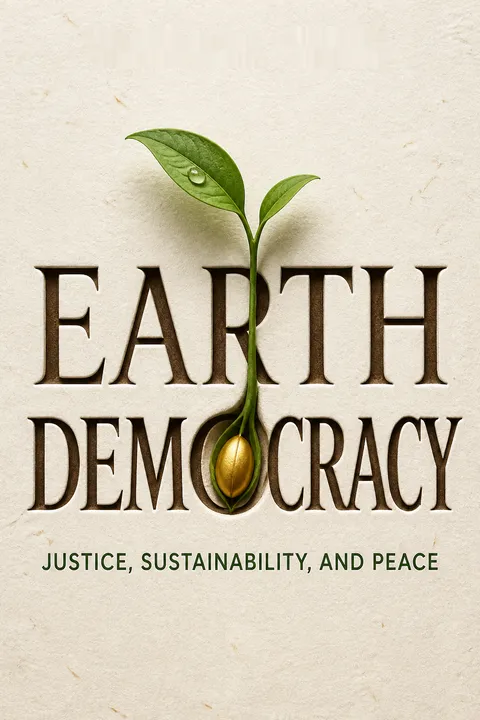

Key Takeaways
1. Earth Democracy: An Ancient Worldview and Emergent Movement
Earth Democracy is both an ancient worldview and an emergent political movement for peace, justice, and sustainability.
Holistic vision. Earth Democracy connects the local to the global, the diverse to the common, and the particular to the universal, embodying the concept of "vasudhaiva kutumbkam" (the earth family). This worldview, shared by indigenous cultures worldwide, recognizes the profound interconnectedness of all beings and generations. It emphasizes that "the earth does not belong to man; man belongs to the earth."
Response to globalization. This movement arises as a direct response to corporate globalization, which views the world solely as private property and the market as driven by profit. Millions are resisting the privatization of vital resources like water, seeds, and biodiversity, asserting that "Our world is not for sale." Earth Democracy champions the planet as a commons, defending biological and cultural diversity against destruction.
Virtuous cycles. Earth Democracy aims to shift from violent, suicidal cultures and economies to virtuous cycles of creative nonviolence. It fosters living cultures, living democracies, and living economies, which are synergistically linked. This project is unfolding through dialogue, diversity, pluralism, and solidarity, addressing global challenges through local actions and self-organizing capacities.
2. The Three Economies: Nature, Sustenance, and Market
In Earth Democracy every being has equal access to the earth’s resources that make life possible; this access is assured by recognizing the importance of the other two economies: nature’s economy and the sustenance economy.
Market's blindness. The dominant globalized free market economy fails to meet societal needs because it myopically focuses on capital exchange, ignoring nature's economy and the sustenance economy. This narrow focus makes vital living processes invisible "externalities," leading to ecological disasters and increased poverty despite "economic growth."
Nature's foundation. Nature's economy is the primary economy, producing essential goods and services like water cycles, soil fertility, and genetic evolution. The market economy, however, separates nature from people and ecology from economy, often destroying these foundational processes through overexploitation for commercial gains. This short-sighted approach risks long-term underdevelopment by eroding the very resource base.
Sustenance for life. The sustenance economy involves people working directly to maintain their lives, often through craft production, peasant agriculture, and women's unpaid labor. It provides for biological survival and societal reproduction, yet it is rendered invisible and depleted by market expansion. Globalization accelerates this depletion through privatization and commoditization, creating new forms of poverty and violence.
3. Corporate Globalization as a New Enclosure of the Commons
Corporate globalization is based on new enclosures of the commons; enclosures which imply exclusions and are based on violence.
Historical precedent. Corporate globalization represents a modern form of "enclosure of the commons," akin to the historical process in England where common lands were privatized, displacing peasants. This transformation of shared resources into private property creates "disposable people" by denying access to essential livelihoods.
Five processes of enclosure:
- Exclusion from common resources.
- Creation of "surplus" people.
- Conversion of common to private property.
- Replacement of diversity with monocultures for market.
- Enclosure of minds, defining privatization as progress.
Double theft. Today, this enclosure extends to biodiversity, seeds, water, knowledge, and public services like health and education. This "double theft" robs people of both economic and cultural security, driving millions towards extremism and fundamentalism as a response to dispossession and economic colonization.
4. The Violence of Industrial Agriculture and Food Fascism
The inexorable processes of agriculture–industrialization and internationalization–are probably responsible for more hungry people than both cruel wars and unusual whims of nature.
Systemic destruction. Industrial agriculture, driven by corporate globalization, is a "global economy of death and destruction" that creates a fourfold crisis: ecological unsustainability, farmer displacement, widespread hunger, and an obesity epidemic. It overexploits resources, destroys biodiversity, and spreads toxic pollution.
Farmer genocide. WTO rules, particularly the Agreement on Agriculture, are designed to promote corporate agriculture by forcing open Southern markets and allowing dumping of subsidized products. This leads to rising production costs and falling prices for small farmers, pushing them into debt and suicide. In India, tens of thousands of farmers have taken their lives, a tragic symptom of this "genocide."
False promises. The promise of "cheap food" from industrial agriculture is a myth, as its true costs are externalized onto the environment, farmers, and public health. It is inefficient in terms of resource use, consuming vast amounts of energy and water. This system also spreads health hazards globally, from pesticide residues to obesity, while undermining food safety and diversity.
5. Living Economies: Local, Diverse, and People-Centered
Living economies are processes and spaces where the earth’s resources are shared equitably to provide for our food and water needs and to create meaningful livelihoods.
Rejuvenating life. Living economies are designed to rejuvenate ecological processes and reactivate people's creativity, solidarity, and interdependence. They are people-centered, decentralized, sustainable, and livelihood-generating, based on co-ownership, co-production, sharing, and participation. These economies are rooted in the consciousness of being part of the earth family.
Ecological imperative. Such economies prioritize ecological limits and localize production to reduce resource waste and displacement. They consider the evolutionary potential of all life, re-embedding human welfare in community and the earth family. Ecological security is the most basic security, and reclaiming democratic control over food and water is essential for freedom.
Practical examples. Movements like India's Navdanya network, with over 200,000 farmers, demonstrate how biodiverse organic farming and fair trade can enrich the earth, increase farmer incomes, and provide quality food. Organizations like Lijjat Papad and Mumbai's Dabbawalas showcase self-organized, decentralized systems that ensure livelihoods and preserve cultural diversity, reversing the logic of corporate globalization.
6. Living Democracies: Reclaiming Power from Corporations and States
Living democracy is the space for reclaiming our fundamental freedoms, defending our basic rights, and exercising our common responsibilities and duties to protect life on earth, defend peace, and promote justice.
Beyond representative democracy. Corporate globalization has rendered representative democracy inadequate, as economic decisions are shifted to undemocratic institutions like the WTO, IMF, and corporate boardrooms. This "economic dictatorship" undermines national sovereignty and grassroots participation, leading to insecurity and the rise of exclusivist cultural nationalism.
Deepening democracy. Living democracy requires reinventing and broadening democratic participation to include all aspects of life and all beings. It involves reclaiming decision-making power from both centralized governments and global corporations, emphasizing self-organization and self-rule (Gandhi's swaraj). This means:
- Reclaiming commons and citizenship.
- Reinventing government to protect people's rights and regulate capital.
- Reinventing global institutions to be accountable and democratic.
Localization as a test. Localization serves as a crucial test for justice and sustainability, ensuring that decisions are made at the level closest to where their impact is felt. This bottom-up approach, from local communities to national and global levels, fosters a creative synergy that can bring about sustainability, justice, and peace, transcending the "either/or" logic of exclusion.
7. Living Cultures: Diversity, Nonviolence, and Interconnectedness
Living cultures are based on nonviolence and compassion, diversity and pluralism, equality and justice, and respect for life in all its diversity.
Beyond "culture of violence." The dominant culture, often imperialistic and driven by corporate globalization, creates "killing cultures" that disintegrate societies and destroy diversity. True "living cultures" (sanskriti) are based on integration, compassion, and respect for universal humanity and diverse identities. They reject the violent imposition of monocultures and false universalisms.
Monoculture of the mind. The reductionist "monoculture of the mind" is blind to diversity, leading to the extinction of biological and cultural richness. This mindset, coupled with the "law of the excluded middle," constructs mutually exclusive categories, denying interconnectedness and justifying ecocide and genocide. Living cultures, conversely, embrace multiplicity and pluralism.
Positive identities. Living cultures foster positive identities rooted in a sense of place, community, and belonging to the earth family. These identities, forged by compassion and shared evolutionary history, are stronger than negative identities based on hate and fear. They inspire actions that nourish life, promote peace, and ensure sustainability, moving beyond consumerism and cultural manipulation.
8. Water Democracy: A Fight Against Privatization and Depletion
Water is life. Without water democracy there can be no living democracy.
Nature's equitable distribution. The planet's hydrological cycle embodies water democracy, distributing water equitably across diverse ecosystems for all species. Nature does not discriminate, ensuring all life forms receive their share. This natural right to water is fundamental for sustenance and survival.
Corporate hijacking. Corporate globalization undermines this natural water democracy through overexploitation of groundwater, diversion of rivers, and privatization of public water supplies. Corporations like Coca-Cola and Suez are commodifying water, turning it from a common good into private property, often facilitated by "corporate states" that centralize power and erode community rights.
Local resistance. Movements for water democracy, like the women of Plachimada who successfully shut down a Coca-Cola plant, are emerging globally. These struggles assert community rights to water, resist privatization, and expose the ecological and social costs of corporate water grabs. They demonstrate that water must remain a public trust, managed for the common good, not private profit.
9. Seed Sovereignty: The Foundation of Food Freedom
Seed is the first link in the food chain. In Sanskrit, bija, the seed, means the source of life. Saving seed is our duty; sharing seed is our culture.
Assault on freedom. Patents on seeds and genetic resources, enforced by WTO's TRIPS agreement, transform seed saving and sharing—traditional farmer freedoms—into intellectual property crimes. This biopiracy, exemplified by cases like RiceTec's basmati patent or Monsanto's wheat patent, allows corporations to monopolize life forms and traditional knowledge, robbing farmers of their heritage and livelihoods.
Diversity for security. Farmers have historically cultivated thousands of diverse seed varieties, adapted to local ecosystems and providing security against pests, diseases, and climate fluctuations. Industrial agriculture, with its push for monocultures and uniform seeds, destroys this genetic diversity, increasing risks of crop failure and dependence on costly corporate inputs.
Bija Satyagraha. In response to these threats, movements like India's Navdanya have launched "bija satyagraha" (seed civil disobedience), pledging non-cooperation with unjust seed and patent laws. This movement, inspired by Gandhi, reclaims seed as a symbol of freedom, diversity, and ecological justice, asserting that farmers' rights and the earth's biodiversity must come before corporate greed.
10. Women as Guardians of Life-Centered Cultures
Despite being subjected to the double burden of religious and capitalist patriarchy, women are emerging as leaders and guardians of life-centered cultures, economies, and policies.
Patriarchy's convergence. Globalization, as a project of capitalist patriarchy, converges with religious patriarchy to deepen violence against women. It devalues women's productive and creative roles, commodifies their bodies (e.g., trafficking), and renders them disposable. This is evident in phenomena like female feticide, where economic insecurity and consumerist dowry demands combine with sex-selective technologies to eliminate girls.
Life-affirming response. Women, traditionally primary producers in the sustenance economy, are leading nonviolent movements to defend life on earth. They challenge the patriarchal myth that capital and machines are the sole sources of creation, asserting that nature and human societies, especially women's work, are the true wellsprings of life.
Redefining humanity. Women are redefining "being human" not through violent, acquisitive, or exploitative traits, but through capacities to care, share, love, and protect. They find strength and security in diversity, rejecting oppressive monocultures. This "irrepressible urge to live and celebrate life" forms the basis of creating living cultures, fostering reverence for all life and promoting interdependence.
11. Localization and Self-Organization as the Path Forward
Earth Democracy allows us to overcome artificial scarcity and manipulated and manufactured insecurities by seeing and experiencing connections.
Small is powerful. In an era of corporate dictatorship, small-scale, self-organized responses become powerful tools for change. Like Gandhi's salt march or spinning wheel, local actions around seeds, water, and food reclaim economic, political, and cultural freedoms. These "small victories" can be replicated by millions, unleashing people's energies to rebuild living cultures and democracies.
Beyond propaganda. Earth Democracy challenges the propaganda that sells corporate globalization and militarism as "security." It encourages a "satyagraha" (struggle for truth) that extends to colonizing instruments of mind and thought. It redefines homeland security in terms of ecological and social well-being, fostering a worldview of peaceful co-creation and co-evolution.
Unleashing potential. By exposing the connections between corporate power, economic wars, and people's poverty, Earth Democracy enables the transformation of "dead democracies" into living ones. It builds solidarities that crack open alliances of the powerful, empowering individuals and communities to participate creatively in building alternatives. This is not the end of history, but a new beginning for liberation and the freedom to stay alive.
Review Summary
Earth Democracy by Vandana Shiva receives mixed reviews (3.97/5). Readers praise her powerful ideas about globalization's harm to environment, biodiversity, and livelihoods, and appreciate her framework of three economies (natural, sustenance, market). Many value her optimistic focus on resistance movements and solutions. However, most criticize the book's repetitive, disorganized structure and idealistic tone. Some find her romanticizing pre-industrial societies and using inflammatory language problematic. Despite structural flaws, reviewers generally agree the content addresses crucial environmental and social justice issues worth reading.
People Also Read







About the Author

Download PDF
Download EPUB
.epub digital book format is ideal for reading ebooks on phones, tablets, and e-readers.








































