


Summary Unavailable
This book is not suitable for a summary (it may be a textbook, workbook, cookbook, reference book, or collection). However, you can still explore the FAQs, about author, and other metadata below!
Key Takeaways
Attraction is a learnable skill, not a fixed trait you're born with
Success with women is like an instrument, not a light switch. DeAngelo, an admittedly average-looking man (5'10", 160 pounds, who once sat in bars for hours too scared to approach), insists his results came from study and practice, not luck or genetics. He frames the whole project as skill acquisition: roughly 2 to 4 years to get good, another 2 to 4 to master, 10-plus to reach genius.
Reframe failure as a missing skill, not a personal defect. When something isn't working, the problem is rarely "something wrong with me." It's an unlearned competency. Can't get dates after collecting numbers? You need the skill of converting numbers to meetings. This reframing replaces shame with a fixable to-do list, which is psychologically liberating for men stuck in self-blame.
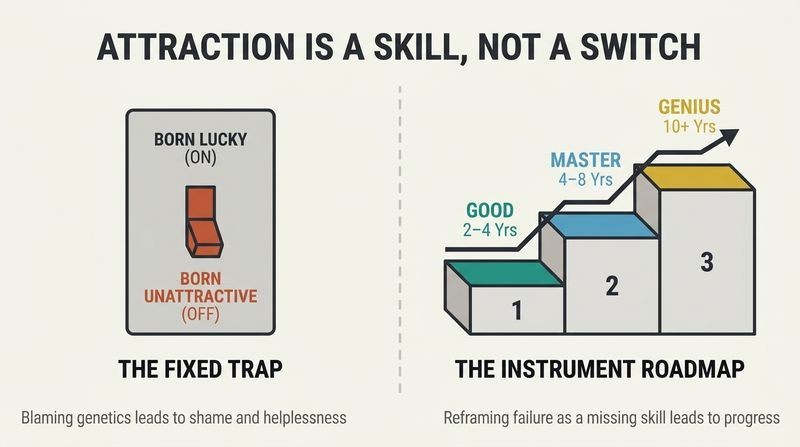
What's striking is how cleanly this maps onto modern growth-mindset research from Carol Dweck: people who view ability as malleable persist longer and improve more than those who see traits as fixed. DeAngelo arrived at the same conclusion intuitively. The skill framing is genuinely empowering. The caveat worth flagging is that treating human connection purely as a trainable technique risks instrumentalizing other people. Skills like cooking or guitar do not have feelings about being practiced on. The framework works best when paired with genuine curiosity about the person rather than reducing courtship to a closed-loop optimization problem.
Women respond to how you make them feel, not your resume
Feelings beat facts. DeAngelo's central claim is that while looks, money, fame, power, and exclusivity grab initial attention, the durable driver of attraction is the emotional state a man generates in a woman. A rich or handsome man "pushes a button" automatically; an average man must learn to "install the button" so that being around him triggers those same feelings.
This is the great equalizer for ordinary men. He invokes the Halo Effect (the cognitive bias, popularized by Robert Cialdini, where attractive or high-status people are assumed to be smarter and more trustworthy) to explain why status grants a head start. But because emotional experience can be manufactured through personality, humor, and presence, the playing field opens up. He suggests acting as if you can make any woman feel wonderful, and asks readers how they would walk, talk, and carry their face if they truly believed it.
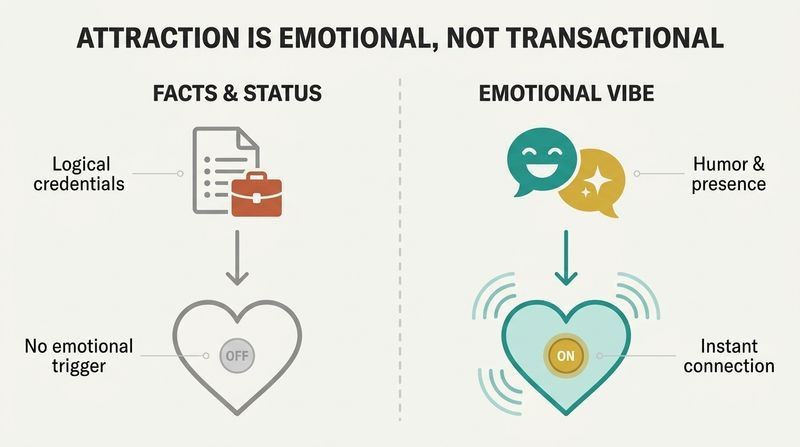
The emphasis on emotional experience over status anticipates findings in affective science: people remember how an interaction felt far more than its content, echoing Daniel Kahneman's peak-end rule. There is real wisdom in shifting focus from possessing traits to generating experiences. The weakness is the sweeping generalization. DeAngelo treats "women" as a near-monolithic category wired identically, which flattens enormous individual variation in what people find compelling. The "fake it till you make it" confidence advice has support in embodied-cognition studies showing posture and behavior can shift internal states, though the effect sizes are more modest than the book's exuberant tone implies.
Neediness is poison; the calm, slightly indifferent man wins
Insecurity and neediness kill attraction instantly. DeAngelo calls them "hemlock and arsenic." A man is needy when he craves approval; insecure when he acts on it. The tells he lists include hanging on a woman physically, badmouthing exes, getting visibly upset over small things, asking her to make every decision, showing off for compliments, and arguing to win.
The antidote is genuine self-sufficiency, projected through behavior. He compares attraction to sales: it's easier to serve a customer who calls you than one you cold-call. So become the kind of man women approach. Lean back instead of leaning in. End conversations and phone calls first, signaling you have a full life. He notes that humans are wired to chase what retreats and flee what pursues, so pursuit itself often repels.
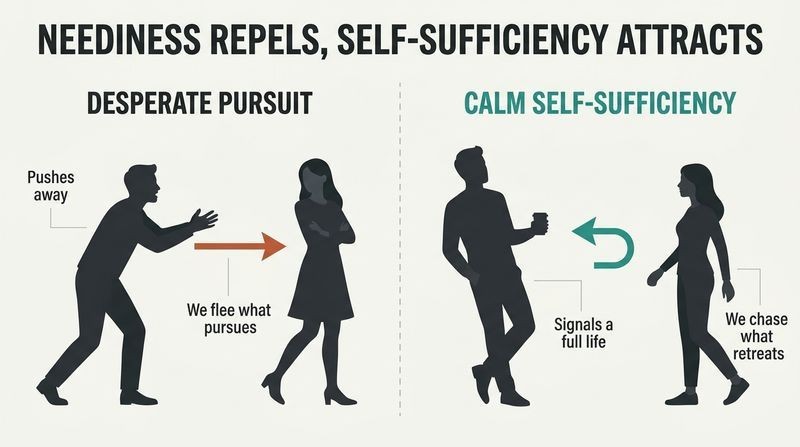
This tracks with attachment theory: anxious, approval-seeking behavior reliably erodes attraction, while secure self-possession signals emotional stability. The "chase what flees" intuition also aligns with scarcity and reactance psychology. The danger is that DeAngelo's prescription can be performed rather than embodied. Manufactured indifference (pretending to be busy, strategically withholding) is mimicry of security, not the real thing, and perceptive partners eventually detect the difference. The deeper, healthier reading is the one he gestures at: build a genuinely full, interesting life so that non-neediness becomes truthful rather than theatrical. Strategy decays; actual self-worth does not.
Cocky plus funny: arrogance is repellent unless it's hilarious
The signature formula. DeAngelo's most famous contribution is "cocky and funny," a blend of mild overconfidence and humor. Pure arrogance is a turn-off; pure niceness is forgettable; but arrogance delivered with a wink becomes magnetic. He cites Pierce Brosnan, Clark Gable, and Top Gun-era Tom Cruise as embodiments of confident charm that never tips into mean.
Character beats jokes. Drawing on Melvin Helitzer's Comedy Writing Secrets, he argues humor lives in the character, not memorized lines. Techniques include playful teasing, misinterpreting her words as flirtation, exaggeration, and keeping a straight face (smiling and laughing at your own joke releases the tension that keeps it funny). The teasing must stay warm: the test is whether she's laughing and having fun. If yes, you can't overdo it.
The cocky-funny construct has real grounding in evolutionary psychology, where humor functions as a "fitness display" signaling intelligence, social calibration, and low anxiety, an idea Geoffrey Miller develops in The Mating Mind. Self-deprecation and busting work because they signal a man unintimidated by a woman's status. The genuine risk, which DeAngelo only lightly acknowledges, is calibration failure: the same line that reads as charming banter from a relaxed man reads as belittling from an anxious one. Negging and teasing weaponized by less self-aware imitators became the cultural baggage of this entire genre. The humor must come from warmth, or it curdles into contempt.
Stop courting early; romance signals "friend," not "lover"
Counterintuitive timing. DeAngelo claims women mentally file men into categories: not interested, friend, long-term relationship, or sexual interest. His provocative argument is that lavish early courtship (expensive dinners, gifts, constant calls, flowers) signals "long-term provider," which paradoxically delays physical involvement. Meanwhile, generating attraction and chemistry early lets the relationship flow naturally in any direction.
Don't buy affection. Spending heavily too soon, he argues, telegraphs that your wallet is all you have to offer, and women may take the gifts while quietly losing respect. The first date should not feel like a job interview full of school-work-family questions. Instead, talk about drama, scandal, comedy, and anything with emotional energy. Lead with personality, not your provider credentials.
The provider-versus-attraction tension echoes parental investment theory, but DeAngelo's hard binary oversimplifies. Real research on relationship initiation suggests warmth and generosity are attractive when they read as abundance rather than anxious purchasing of approval. The actual variable may not be whether you're generous, but whether the generosity comes from neediness or from a secure, give-on-my-terms posture. His "first date isn't an interview" advice is broadly sound and underrated: conventional fact-swapping generates no emotional spark. The dated celebrity-gossip conversation prompts have aged poorly, but the principle (lead with playful, emotionally engaging topics) remains practically useful for anyone who has suffered through a checklist date.
Pass her tests by never rewarding bratty behavior
Testing is a screening mechanism. DeAngelo argues attractive women, accustomed to men capitulating, will challenge a man (complaining, making demands, acting difficult) to discover whether he'll hold his frame. The man who apologizes, gets nervous, or scrambles to please fails the test and confirms he's "one of those guys." His move: turn it up a notch with humor. If she complains about his music, he threatens to play only that from now on, said half-seriously so she can't tell if he's joking.
"You're in my reality now." The mindset he borrows from a friend is that the man owns the frame and the woman is a guest in it. When she deploys a game or excuse, he laughs rather than reacts emotionally, never giving her a button to press repeatedly.
"Frame control" overlaps with what therapists call holding boundaries and not being manipulated by emotional pressure, which is genuinely healthy. The reframe of difficult behavior as a test rather than a personal attack reduces reactivity, a useful emotional-regulation skill. The serious concern is interpretive: labeling all of a partner's displeasure as "testing" to be overridden can shade into dismissing legitimate complaints. A woman who genuinely dislikes something is not always running a compliance probe. Mature relationships require distinguishing manipulation from honest grievance, a distinction the testing frame can blur dangerously if applied without judgment.
Your body and voice say 93% of it before you speak
Words are the smallest channel. Citing the oft-quoted finding that only about 7% of communication is verbal while 93% rides on body language and tone, DeAngelo redirects men obsessed with "the perfect line" toward physical presence. His confidence cues: stand tall, shoulders back, take up space, uncross your limbs, lean back rather than forward.
Slow down everything. His distinctive advice is to deliberately decelerate: your walk, gestures, head turns, even your blink rate. Slowness reads as calm and creates intrigue. Hold eye contact until she looks away, with a slight squint and raised eyebrow. Use deliberate pauses in speech to build suspense and "subtext." He recommends training a deeper, resonant voice you can feel in your chest, citing vocal coaching resources.
The 7/93 statistic is one of the most misused numbers in popular psychology. Albert Mehrabian's original research applied narrowly to communicating feelings and attitudes when words and tone conflict, not to all communication. Taken literally it's false; content obviously matters. That said, the underlying point stands: nonverbal signaling powerfully shapes perceived confidence and attraction, and most anxious men leak nervousness through fidgeting and rushed speech. The "slow down" advice is the book's most quietly practical tip, well supported by observations that high-status individuals move deliberately. Vocal depth and pacing genuinely influence perceived dominance and warmth in social-perception studies.
Speak in code: women want subtext, not blunt declarations
Indirect beats direct. DeAngelo compares women to the Enigma machine, attuned to subtle, shifting signals rather than plain statements. Saying "I really like you" lands flat; teasingly accusing her of liking you lands. Affection works best disguised as a poem left as a surprise, a noticed detail, or the phrase "I was thinking about you," which he claims matters more than any gift because the gift is merely a symbol of being thought about.
Mismatched communication and the friend frame. He advocates sending mixed signals: a serious face while paying a compliment, tenderness paired with a playful bite. He also weaponizes the dreaded "let's be friends" line by deploying it first, which disarms women used to being pursued and reframes him as the selective party doing the choosing.
The preference for indirect, playful signaling has cross-cultural support: flirtation universally relies on plausible deniability, allowing both parties to advance or retreat without losing face, as anthropologists studying courtship have documented. "Mismatched communication" cleverly exploits the brain's tendency to fixate on ambiguity, which sustains attention and emotional arousal. The thoughtful-attention insight (presence over presents) is the most genuinely tender idea here and aligns with research showing perceived responsiveness predicts relationship satisfaction. The shadow side is that strategic ambiguity, taken too far, becomes a manipulation engine that prevents the honest communication healthy intimacy actually requires. Code is great for sparking; clarity sustains.
Polish the controllables: grooming, props, and learnable charm
Remove the disqualifiers. DeAngelo argues that grooming and style won't necessarily attract women, but neglecting them actively repels women in ways men don't notice. Women read details (matching belt and shoes, breath, clean nails) and extrapolate to your whole life. His fix-it list is unglamorous: wash thoroughly, trim stray hair, fresh breath, clean shoes, restrained cologne, and a "casual nice" wardrobe assembled cheaply from clearance racks.
Engineer fascination and prepare for success. He recommends "props" (interesting books, magic tricks, a dog, unusual objects) as built-in conversation starters, plus learnable skills like cold reading, palmistry, and cooking a few good meals. Keep your home clean and bed made: don't sabotage success by being unprepared. Chivalry (opening doors, walking curbside) paired with cocky humor he calls almost magical.
The "removing disqualifiers" frame is sharper than typical grooming advice. It distinguishes hygiene as a threshold gate (failing it eliminates you) from charm as an upside lever, a useful asymmetry. Behavioral economics calls this loss-aversion territory: the downside of bad grooming outweighs the upside of great grooming. The props strategy is essentially environmental design for conversation, lowering the activation energy of interaction. The cold-reading and palmistry recommendations are ethically murkier, edging toward manufactured mystique built on pseudoscience. The cooking advice is underrated and durable: it demonstrates competence, generosity on your own terms, and creates intimacy that restaurant dates structurally cannot.
Surround yourself with men who already succeed with women
Mentorship trumps books. DeAngelo's single strongest piece of advice ("if you do nothing else, do this") is to find and befriend roughly five men who are genuinely successful with women and learn from them in the real world. He credits his own breakthroughs to watching skilled friends in action, not to tapes or seminars, explicitly invoking the "Master Mind" group concept from Napoleon Hill's Think and Grow Rich.
Define your actual outcome. He pushes readers to specify what they want (a one-night encounter, a girlfriend, a wife, or simply confidence), comparing a man with no target to "a ship with no port." Pair clear goals with positive self-talk, mental rehearsal, and managing your internal emotional state, the inner-game foundation he calls the most important part of the book.
The peer-modeling emphasis is the book's most evidence-backed claim. Social learning theory (Albert Bandura) confirms humans acquire complex social behaviors far faster by observing skilled models than through abstract instruction, and modern research on peer effects shows behavior is powerfully shaped by one's immediate social circle. "You become the average of the people around you" has since become self-help orthodoxy. The goal-clarity point reflects basic motivation science: vague intentions produce vague results. The inner-game material (self-talk, visualization, state management) borrows from sports psychology, where mental rehearsal has measurable performance effects. This chapter, stripped of the seduction context, is simply sound advice for learning any difficult skill.
Analysis
Double Your Dating is a 2001 self-published e-book that helped launch the commercial "pickup artist" industry. Structurally it is part field manual, part manifesto, written as a browsable reference rather than a linear argument, organized from mindset (inner game) through communication (outer game) to logistics (where, when, how). Its audience is the shy, ordinary, frustrated heterosexual man, and DeAngelo positions himself as one of them: average looks, formerly terrified to approach, self-taught through obsessive trial and error.
Intellectually, the book is a pop-Darwinian synthesis. It leans on Robert Cialdini's Halo Effect, Matt Ridley's The Red Queen, evolutionary mating theory, and NLP, blending genuine insight with confident overreach. Its durable contributions are three: the reframe of attraction as a trainable skill rather than fixed fate; the "cocky and funny" persona that defined a genre; and the relentless attack on neediness as the cardinal sin. These ideas have aged reasonably well because they overlap with growth mindset, attachment theory, and humor-as-fitness-display research.
The book's serious limitations are equally clear. It treats "women" as a near-monolithic psychological category, indulges in casual misogyny (women as Enigma machines, the "dark side of beauty," the persistent contempt-tinged framing), and its strategic ambiguity and "never give her what she wants" tactics can shade from playful into manipulative. The persistence advice around "no" is genuinely concerning, and DeAngelo's own disclaimers acknowledge the danger without resolving it. Its cultural legacy is double-edged: it empowered anxious men to develop social courage and self-respect, while also seeding a community that some interpreted as license for adversarial gamesmanship.
Read charitably and selectively, the core is sound: build a full life, regulate your inner state, lead with playful confidence, remove self-sabotaging neediness, and learn from skilled peers. Read literally as a manipulation playbook, it points users toward connections built on performance rather than authenticity, which the book itself, in its better moments, quietly warns against.
Last updated:
Report IssueReview Summary
Double Your Dating receives mixed reviews, with some praising its insights into female psychology and confidence-building techniques. Critics argue it's outdated, simplistic, and promotes manipulative behavior. Positive reviews highlight its effectiveness in understanding women and improving dating skills. Negative reviews claim it's basic, lacks substance, and objectifies women. Some readers found it life-changing, while others suggest alternative dating books. Overall, opinions are divided on its usefulness and ethical approach to dating.
People Also Read







FAQ
What's "Double Your Dating" about?
- Author's Goal: "Double Your Dating" by David DeAngelo is a guide for men on how to be more successful with women. It aims to teach men the skills and mindset needed to attract women.
- Encyclopedic Approach: The book is designed as a reference manual rather than a novel, encouraging readers to practice and integrate the techniques into their lives.
- Practice and Mastery: DeAngelo emphasizes that success with women is akin to learning a musical instrument—it requires practice and persistence.
- Comprehensive Coverage: The book covers various aspects of dating, from understanding women's psychology to communication techniques and maintaining long-term relationships.
Why should I read "Double Your Dating"?
- Improving Dating Skills: If you're looking to improve your dating life and understand women better, this book offers practical advice and techniques.
- Unique Perspective: DeAngelo provides insights into the psychological differences between men and women, which can help in navigating relationships.
- Actionable Techniques: The book is filled with specific strategies and exercises that can be applied immediately to see results.
- Long-Term Benefits: Beyond just dating, the skills learned can improve overall confidence and social interactions.
What are the key takeaways of "Double Your Dating"?
- Understand Female Psychology: Recognize that women think and want differently than men, and use this knowledge to your advantage.
- Attraction Over Pursuit: Focus on attracting women rather than chasing them, as attraction is more effective and sustainable.
- Confidence is Key: Develop a confident, slightly cocky personality that is irresistible to women.
- Continuous Improvement: Always work on improving your physical appearance, communication skills, and self-confidence.
How does David DeAngelo suggest men should think about success with women?
- Shift in Thinking: Understand that what women want may not make sense to men, but focus on what works rather than what seems logical.
- Selector Mindset: Adopt the mindset of being the selector, not the selectee, which shifts the power dynamic in your favor.
- Avoid Neediness: Insecurity and neediness are major turn-offs; work on being self-sufficient and confident.
- Practice and Patience: Like learning an instrument, becoming successful with women takes time and practice.
What are the best communication techniques from "Double Your Dating"?
- Cocky and Funny: Use humor mixed with a bit of arrogance to keep women interested and engaged.
- Non-Verbal Cues: Focus on body language and voice tone, as they are more powerful than words in communication.
- Teasing and Testing: Women often test men; respond with humor and confidence to pass these tests.
- Mystery and Curiosity: Be mysterious and hold back some information to keep women curious and engaged.
What are the six things that attract women according to David DeAngelo?
- Means: Wealth and the ability to provide can be attractive, but are not the only factors.
- Power: Influence and leadership are appealing traits.
- Fame: Being well-known can be a draw, but is not necessary.
- Looks: Physical appearance matters, but personality can outweigh it.
- Exclusivity: Being hard to get or having a unique status can be attractive.
- Personality: Humor, creativity, and intelligence are key traits that can attract women.
How does "Double Your Dating" suggest men should approach dating?
- Qualify Them: Approach dating with the mindset that you are qualifying women to see if they meet your standards.
- Avoid the Friend Zone: Don't fall into the trap of being just a friend; make your intentions clear.
- Use E-mail First: Start with e-mail communication to build familiarity before moving to phone calls or meetings.
- Be Direct and Confident: When setting up dates, be straightforward and confident in your approach.
What are some practical tips for meeting women from "Double Your Dating"?
- Go Where Women Are: Frequent places where the type of women you want to meet are likely to be, such as gyms, coffee shops, or dance classes.
- Online Opportunities: Use online platforms like AOL to practice communication and meet women in a low-pressure environment.
- Be Prepared: Always be ready for success by keeping your living space clean and having interesting conversation starters.
- Chivalry and Humor: Combine traditional chivalry with humor to create a powerful attraction.
How does David DeAngelo suggest maintaining a long-term relationship?
- Keep It Interesting: Continue to be fun, unpredictable, and thoughtful to maintain attraction over time.
- Give More Than You Get: Be willing to give more in the relationship to receive more in return.
- Understand Chemical Changes: Be aware that the initial intoxicating feelings will change over time, and adapt to maintain the relationship.
- Focus on Growth: Encourage mutual growth and development to keep the relationship dynamic and fulfilling.
What are the best quotes from "Double Your Dating" and what do they mean?
- "Success with women is more like success with learning to play a musical instrument." This emphasizes the need for practice and patience in becoming successful with women.
- "Be the selector, not the selectee." This quote highlights the importance of taking control in dating situations and not being passive.
- "Women are FAR more interested in the way you make them FEEL rather than looks, money, or fame." It underscores the importance of emotional connection over superficial attributes.
- "If you want to get back more than you give, then play the stock market." This suggests that relationships require giving more than you expect to receive.
What are some common mistakes men make in dating according to "Double Your Dating"?
- Being Too Needy: Showing insecurity and neediness can quickly turn women off.
- Over-Complimenting: Complimenting a woman's looks too much can be counterproductive; focus on other aspects.
- Predictability: Being too predictable can make you uninteresting; keep some mystery and unpredictability.
- Buying Affection: Trying to win a woman over with gifts and favors can be seen as manipulative and lacking confidence.
How does "Double Your Dating" suggest handling rejection?
- Don't Take It Personally: Understand that not every woman will be interested, and that's okay.
- Learn from Experience: Use each interaction as a learning opportunity to improve your skills.
- Stay Positive: Maintain a positive mindset and continue practicing until you achieve success.
- Move On Quickly: If a woman is not interested, move on to the next opportunity without dwelling on it.
About the Author
David DeAngelo, whose real name is Eben W. Pagan, is an American author and dating coach. He gained popularity in the early 2000s with his "Double Your Dating" brand, which includes books, seminars, and online courses. David DeAngelo developed the concept of "cocky and funny" as a dating strategy, though he later admitted to creating it without field testing. Despite controversy surrounding his methods, DeAngelo has maintained a significant presence in the dating advice industry. He has since expanded his business into other self-help areas and entrepreneurship coaching. DeAngelo is now married, which some critics use to question his ongoing relevance in the dating advice field.
Download PDF
Download EPUB
.epub digital book format is ideal for reading ebooks on phones, tablets, and e-readers.








































