
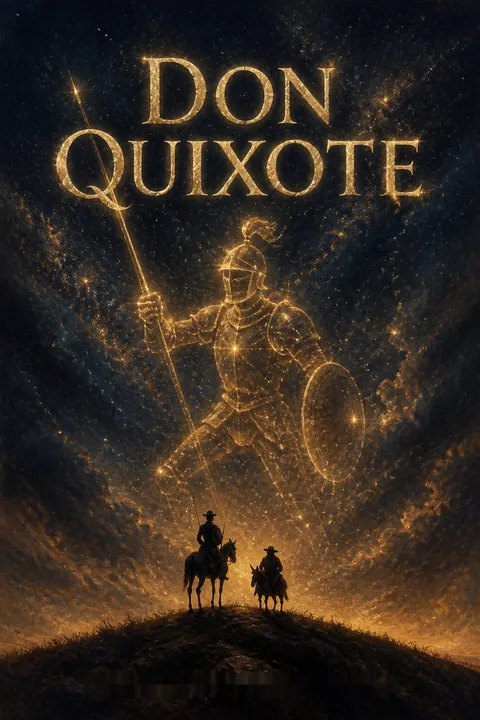


Plot Summary
A Gentleman Reads Himself Mad
In a village of La Mancha whose name the narrator declines to specify, a spare, gaunt gentleman named Alonso Quixano1 reads so many chivalry romances that his brains dry out entirely. He convinces himself the world needs a knight-errant and that he is the man.
He polishes his great-grandfather's rusted armor, fashions a pasteboard visor, renames his bony horse Rocinante, and christens himself Don Quixote of La Mancha.1 For his lady love he chooses a farm girl he once glimpsed — Aldonza Lorenzo — and rebaptizes her Dulcinea del Toboso.3
His first solo sally ends in farce: an amused innkeeper knights him using an account book, and merchants beat him senseless when he demands they proclaim Dulcinea's3 beauty. A neighbor carries him home. His friends the village curate5 and barber12 burn most of his library, walling up the room and blaming an enchanter.
Sancho Takes the Halter
Back on his feet but undeterred, Don Quixote1 recruits his neighbor Sancho Panza2 — a short, round farmer with a wife and children — by promising to make him governor of an island won in battle. Sancho,2 illiterate but shrewd, saddles his donkey Dapple and follows his new master into the night.
This pairing is the engine of everything that follows: the tall, lean idealist on his skeletal horse beside the squat, earthbound pragmatist on his ass. Sancho2 protests, bargains, and complains, yet he cannot resist the dream.
Don Quixote1 speaks in the ornate language of chivalric romance; Sancho2 answers in proverbs and belly-logic. Together they form a single creature, half prayer and half appetite, lurching forward into a Spain that has no use for either of them.
Windmills Become Giants
On the plains of La Mancha, Don Quixote1 spots thirty or forty windmills and announces to Sancho2 that they are monstrous giants he must slay. Sancho2 pleads that they are plainly windmills. Don Quixote1 charges at full gallop, drives his lance into a turning sail, and is catapulted from Rocinante, crashing to the ground with his lance in splinters.
Uninjured but dazed, he blames the enchanter Friston for transforming the giants to rob him of glory. This becomes the rhythm of their odyssey: Don Quixote1 perceives nobility and peril where there is only the ordinary; reality punishes him; he attributes the punishment to sorcery. Sancho2 watches, grumbles, follows. The adventure costs a lance, several bruises, and none of Don Quixote's1 certainty.
The Galley Slaves Go Free
Encountering a chain gang of convicts bound for the king's galleys, Don Quixote1 interrogates each prisoner about his crime. One stole laundry, another confessed under torture, and the most dangerous — a rogue named Gines de Pasamonte11 — boasts of writing his own autobiography.
Don Quixote1 declares it unjust to enslave men against their will and attacks the guards, scattering them. The freed prisoners refuse his only demand: that they present themselves to Dulcinea3 in El Toboso.
When Don Quixote1 insists, Gines11 rallies the convicts, and they pelt knight and squire with stones, strip them of their belongings, and vanish. Don Quixote1 and Sancho2 flee into the Sierra Morena, now fugitives themselves. The episode crystallizes Don Quixote's1 fatal logic: noble intentions generating catastrophic results.
Lovesick Among the Crags
Deep in the Sierra Morena, Don Quixote1 decides to imitate the lovesick penance of his hero Amadis of Gaul. He strips to his shirt, turns somersaults, bangs his head on rocks, and writes verses to the distant Dulcinea.3 He dispatches Sancho2 to deliver a love letter — which Sancho2 promptly loses and must reconstruct from garbled memory.
Along the way, Sancho2 encounters the village curate5 and barber,12 who have come searching for their mad friend. They also meet Cardenio,9 a young gentleman driven half-mad by love, and Dorothea,8 a resourceful woman betrayed by the same nobleman, Don Fernando.10 The curate5 devises a scheme: Dorothea8 will pose as a distressed princess called Micomicona to lure Don Quixote1 from the mountains and toward home.
Four Hearts Collide at the Inn
Dorothea,8 disguised as Princess Micomicona, begs Don Quixote1 to slay the giant who usurped her kingdom. He agrees eagerly. They make for an inn where coincidence draws together all the tangled lovers: Don Fernando10 arrives holding Luscinda captive; Cardenio9 recognizes his stolen beloved; Dorothea8 confronts the man who seduced and abandoned her.
Tears, fainting, and drawn swords give way to repentance — Don Fernando,10 shamed by Dorothea's8 constancy and the curate's5 reasoning, releases Luscinda and accepts Dorothea8 as his rightful wife.
Meanwhile Don Quixote,1 asleep in bed, dreams he battles a giant and slashes wine skins to ribbons, flooding the room with red wine Sancho2 mistakes for the giant's blood. The lovers are reconciled; only the knight's delusions remain unresolved.
Caged and Carried Home
With every stratagem exhausted, the curate5 and barber12 resort to deception. Disguised figures tell Don Quixote1 he has been enchanted — which neatly explains why he cannot move or fight. They lock him in a wooden cage and load it onto an oxcart pulled by plodding oxen.
Don Quixote1 accepts this indignity with the gravity of a martyr, reasoning that enchantments must work differently in modern times. Sancho,2 unconvinced, tries to tell his master the truth, but Don Quixote's1 capacity for belief outweighs all evidence.
The slow procession creaks homeward. His housekeeper and niece receive him with tears and curses against the books that ruined him. Part One ends with Don Quixote1 in bed, bruised and unrepentant, already dreaming of a third sally.
Their Story Already in Print
A month of convalescence has not cured Don Quixote1 — only rested his body. The bachelor Samson Carrasco,4 a sharp-witted young graduate from their village, reports that Don Quixote's1 adventures have been published in a book by one Cide Hamete Benengeli, translated from Arabic.
Thirty thousand copies are in circulation. Don Quixote1 is thrilled but disturbed by inaccuracies; Sancho2 is delighted to learn he is a famous character.
Samson,4 privately conspiring with the curate5 and barber,12 encourages a third sally — planning to ride out in disguise, defeat Don Quixote1 in single combat, and force him home under the terms of chivalric law. Unaware of the trap, Don Quixote1 and Sancho2 slip away at night, heading for El Toboso to seek Dulcinea's3 blessing before new adventures.
Sancho's Greatest Lie
Arriving near El Toboso, Don Quixote1 sends Sancho2 ahead to find Dulcinea's3 palace. Sancho,2 who has never actually seen Dulcinea3 and knows she is merely a peasant named Aldonza Lorenzo, panics.
When three coarse village girls ride toward them on donkeys, Sancho2 seizes his chance: he drops to his knees and declares the plainest of them to be Dulcinea,3 magnificent on her palfrey. Don Quixote1 sees only a squat, garlicky peasant and is devastated. He concludes that wicked enchanters have transformed his peerless lady into this repulsive form to torment him.
The lie is Sancho's2 masterwork and his curse. From this moment, Don Quixote's1 anguish over Dulcinea's enchantment becomes the engine of Part Two, generating the penance subplot and fueling the cruel games ahead.
The Mirror Knight Unmasked
In a nighttime grove, Don Quixote1 encounters a melancholy knight who calls himself the Knight of the Mirrors and claims to have already defeated Don Quixote of La Mancha.1 They agree to single combat at dawn.
Don Quixote1 charges before his opponent's horse can move and sends him crashing from the saddle. Lifting the fallen knight's visor, he discovers the face of Samson Carrasco4 — his own village neighbor. Don Quixote1 refuses to believe it, insisting enchanters have disguised the defeated knight.
In truth, Samson4 had armed himself precisely to beat Don Quixote1 and invoke the chivalric condition that the loser must retire. Instead, Samson4 limps away humiliated, ribs cracked and plan in ruins — already vowing a second attempt with better preparation.
The Lion Turns Away
A cart carrying two African lions for the king passes on the road. Don Quixote1 commands the keeper to open the larger cage. Sancho2 flees. The gentleman Don Diego de Miranda, traveling with them, protests that this is suicide, not valor. Don Quixote1 dismounts, braces his shield, and stands before the open door.
The great lion stretches, yawns enormously, licks its own face, surveys Don Quixote1 with supreme disinterest, turns its hindquarters to him, and lies back down. Don Quixote1 orders the cage closed and declares magnificent victory. He adopts a new title: Knight of the Lions. It is perhaps his finest hour — absurd, suicidal, and genuinely brave, a moment where the membrane between madness and courage dissolves entirely.
The Duke's Grand Theater
A duke6 and duchess,7 avid readers of Don Quixote's1 published history, invite knight and squire to their castle and convert their household into an elaborate stage. Every servant becomes an actor; every meal an occasion for pranks calibrated to Don Quixote's1 delusions.
They stage a procession of enchanters who proclaim that Dulcinea3 can only be disenchanted if Sancho2 whips himself three thousand three hundred times. They construct a wooden horse called Clavileno and convince Don Quixote1 and Sancho2 they are flying through the air — while servants blast bellows and wave torches at the blindfolded pair.
Sancho2 claims he peeked and saw the earth the size of a mustard seed. The Duke6 then promises Sancho2 a real island to govern, turning theatrical play into something dangerously close to reality.
Ten Days as Governor
The Duke6 installs Sancho2 as governor of a village rechristened the island of Barataria. Despite everyone's expectations, Sancho2 governs with startling common sense — resolving a case of hidden gold inside a hollow cane, seeing through a woman's false accusation, and enacting sensible ordinances.
But his doctor, Pedro Recio, refuses to let him eat a morsel, claiming each dish will ruin his health. Sancho2 suffers hunger more keenly than any of his master's beatings.
Then the Duke's6 servants stage a terrifying night attack, trampling Sancho2 between two shields in mock battle. After ten days, exhausted and starving, Sancho2 resigns. He embraces his donkey Dapple and declares he was born to labor, not to rule — returning to Don Quixote1 poorer in pride but richer in self-knowledge.
Defeated on Barcelona Beach
In Barcelona, where Don Quixote1 has been feted by the gentleman Don Antonio Moreno and marveled at the sea and the galleys, a new challenger appears on the beach at dawn: the Knight of the White Moon. He demands Don Quixote1 confess that his own lady surpasses Dulcinea3 — or fight. Don Quixote1 accepts. They charge. The White Moon knight, riding a stronger horse, slams Don Quixote1 and Rocinante into the sand.
Standing over the fallen knight, he demands that Don Quixote1 retire to his village for one year. Don Quixote,1 bruised and broken, yields — refusing only to deny Dulcinea's3 beauty. The White Moon is again Samson Carrasco,4 who has finally accomplished his mission. Don Quixote1 rises from the sand, his calling extinguished.
Shepherds Instead of Knights
The journey home is slow and melancholy. Don Quixote1 proposes that during his forced retirement he and Sancho2 become shepherds, composing poetry and singing elegies under the names Quixotize and Panzino.
Sancho2 humors him but negotiates payment for the lashing penance meant to disenchant Dulcinea — settling on a quarter-real per stroke. At night Sancho2 retreats into the dark and whips tree trunks rather than himself, groaning convincingly while Don Quixote1 counts the blows on his rosary. A herd of pigs stampedes over them in the darkness.
Near their village Don Quixote1 reads omens in everything — a boy's words, a fleeing hare — and despairs of ever seeing Dulcinea3 restored. They arrive home to find the curate5 and Samson4 waiting, and Sancho's wife Teresa13 demanding to know what riches he has brought.
Alonso Quixano Returns
A fever seizes Don Quixote1 and holds him for six days. Samson4 urges him to cheer up and begin their pastoral life. Then Don Quixote1 sleeps deeply — and wakes transformed. He announces he is no longer Don Quixote of La Mancha1 but Alonso Quixano the Good. His reason has returned. He denounces the romances of chivalry that stole his wits and calls for a priest to hear his confession and a notary to draft his will.
Sancho,2 weeping, begs him to get up, to go be shepherds, to find Dulcinea3 behind some bush. But Alonso Quixano is done with enchantments. He confesses, leaves his estate to his niece, forgives Sancho2 their debts, and dies peacefully — surrounded by those who loved him most when he was most absurd.
Epilogue
The fictional historian Cide Hamete Benengeli hangs up his pen and addresses it one last time, warning that no future writer should dare resurrect Don Quixote.1 The knight was born for Cide Hamete alone, and Cide Hamete for him.
Let the weary bones of Don Quixote1 remain where they lie, he insists, and let no pretender from Tordesillas carry him off to new adventures. His purpose fulfilled — to make the world laugh at the absurdities of chivalric romance — the author lays down his instrument. The pen rests. The story is complete.
Analysis
Don Quixote1 is the foundational text of the modern novel, and its deepest insight is that reality and fiction are not opposing categories but codependent ones. Cervantes' gentleman does not simply mistake windmills for giants — he constructs an entire epistemological framework in which the world must conform to his reading. The novel's genius lies in revealing that this is not unique to madmen. The Duke6 and Duchess7 spend vast resources staging fictions. Samson Carrasco4 adopts chivalric identity to fight chivalry. Even Sancho,2 the supposed realist, invents the enchantment of Dulcinea. Everyone in the novel inhabits narratives of their own construction.
The relationship between Don Quixote1 and Sancho2 enacts a dialectic between idealism and materialism that neither side wins outright. Don Quixote's1 visions are preposterous but generate real courage, real generosity, and real beauty. Sancho's2 pragmatism keeps them alive but cannot explain why they persist together. Over hundreds of pages, each absorbs something of the other: Sancho2 begins philosophizing, while Don Quixote1 increasingly acknowledges the physical costs of his calling.
Cervantes also interrogates the ethics of spectacle. The Duke6 and Duchess,7 who consume Don Quixote's1 madness for entertainment, are arguably more morally compromised than the madman himself. Their elaborate pranks — blindfolded flights, fake governorships, staged attacks — raise a question that resonates in any era of exploitative media: when does watching someone's delusion become complicity in their suffering?
The ending delivers the novel's most devastating argument. When Don Quixote1 recovers his sanity, he immediately dies — as though the dream was what sustained him. This implies that human beings require some measure of beautiful illusion to live, and that pure rationality, stripped of imagination, is itself a kind of extinction. The world mourns Don Quixote1 precisely because it needs what he represented: the stubborn, laughable, magnificent possibility that a single person, armed with nothing but conviction, might still reshape the world according to nobler principles.
Review Summary
Don Quixote is widely praised as a groundbreaking, influential work of literature. Readers appreciate its humor, wit, and philosophical depth, though some find it long and repetitive. The novel follows the adventures of the delusional knight-errant and his loyal squire, exploring themes of reality, idealism, and human nature. Many note the innovative narrative techniques and meta-fictional elements, particularly in the second part. While opinions on the two parts vary, most reviewers consider it a masterpiece of Western literature that continues to resonate with readers centuries later.
People Also Read
Characters
Don Quixote / Alonso Quixano
The self-made knight-errantA lean, gaunt gentleman of La Mancha nearing fifty, Alonso Quixano is a voracious reader whose obsession with chivalric romances erodes the boundary between fiction and reality. As Don Quixote, he imposes the architecture of romance onto a prosaic world—seeing castles in inns, giants in windmills, and princesses in farm girls. His madness is highly selective: on any topic outside chivalry, he speaks with striking wisdom and eloquence. Psychologically, he represents the human need to invest life with meaning even at the cost of sanity. His relationship with Sancho2 evolves from master-servant to genuine, interdependent friendship. He is simultaneously the most foolish and most noble figure in the novel—a man who would rather be broken by his ideals than surrender them.
Sancho Panza
The earthy, loyal squireA short, pot-bellied farmer with a wife, two children, and no education, Sancho serves as Don Quixote's1 squire in exchange for the promise of an island governorship. He is the earthy counterpoint to his master's celestial delusions—grounded in appetite, proverbs, and common sense. Yet Sancho is no simple foil. He gradually absorbs his master's language and values, growing wiser and more eloquent as their journey continues. His loyalty persists through blanketings, beatings, and starvation, suggesting a devotion that transcends self-interest. Psychologically, Sancho embodies the tension between materialism and idealism within every person. He wants the island, but he wants his master's companionship more—a truth that grows clearer with each mile they travel together.
Dulcinea del Toboso
The invisible beloved idealThe invisible axis around which the entire narrative turns. Dulcinea is a peasant woman named Aldonza Lorenzo whom Don Quixote1 has elevated to the status of peerless princess, though he has barely seen her. She never appears in her own voice, existing only as projection—an ideal that cannot survive contact with reality yet sustains everything Don Quixote1 does and endures.
Samson Carrasco
The bachelor who hunts himA sharp-witted young bachelor from Don Quixote's1 village who disguises himself as a rival knight to defeat Don Quixote1 in combat and force him to retire. His motives blend genuine concern for his neighbor's welfare with intellectual vanity and competitive pride. He represents the rational world's determined attempt to cure madness on its own terms—through chivalry's own rules.
The Curate (Pero Perez)
The priest who schemes to saveThe village priest, an educated man who serves as Don Quixote's1 literary foil and reluctant rescuer. He participates in burning the library, orchestrates multiple deceptions, and conspires to bring Don Quixote1 home. His compassion for his friend wars constantly with his conviction that the madness must be cured, making him both devoted companion and benevolent jailer.
The Duke
The noble prankster hostA wealthy nobleman who, having read Part One, transforms his entire household into a stage for Don Quixote's1 humiliation. His motivations are pure entertainment—he and his wife7 find the pair endlessly amusing. He represents aristocratic power wielded frivolously, raising uncomfortable questions about who is truly foolish: the madman who believes in honor, or those who exploit his belief for sport.
The Duchess
Co-architect of castle pranksThe Duke's6 wife and chief co-conspirator, clever and perceptive, who takes particular delight in Sancho's2 malapropisms and earthy wisdom. She engineers many of the castle's pranks with theatrical flair. Her treatment of Sancho2 oscillates between genuine affection and casual cruelty, reflecting the deep ambiguity of patronage—generosity that always serves the giver's amusement first.
Dorothea
The resourceful disguised princessA resourceful and intelligent young woman betrayed by Don Fernando10, who seduced her under false promises of marriage. She displays extraordinary composure, improvising the role of Princess Micomicona with convincing skill to lure Don Quixote1 from the mountains. Her courage and quick wit make her one of the novel's most capable figures, and her eventual confrontation with Don Fernando10 restores her honor.
Cardenio
The lovesick mountain exileA young gentleman driven half-mad by his beloved Luscinda's forced marriage to Don Fernando10. His mountain exile mirrors Don Quixote's1 lovesick penance, linking romantic despair to the same madness the knight embodies.
Don Fernando
The repentant noble betrayerA nobleman who betrays both Dorothea8 and his friend Cardenio9 by seducing one and stealing the other's bride. His eventual repentance at the inn, moved by Dorothea's8 constancy, restores the romantic order of Part One.
Gines de Pasamonte
The cunning galley-slave rogueA cunning galley slave freed by Don Quixote1 who repays the favor by stealing Sancho's2 donkey. He later resurfaces disguised as Master Pedro, a puppet showman with a divining ape, whose show Don Quixote1 destroys in a frenzy.
The Barber (Master Nicholas)
The curate's co-conspiratorThe village barber who conspires with the curate5 throughout both parts to cure Don Quixote's1 madness. Amiable and practical, he serves as the curate's5 steadfast partner in every scheme to bring the knight home.
Teresa Panza
Sancho's sharp-tongued wifeSancho's2 sensible, plainspoken wife who doubts the promises of knight-errantry but relishes the gifts that arrive from her husband's adventures. She anchors Sancho2 to domestic reality with blunt affection.
Plot Devices
Chivalry Romances
The catalyst of madnessThe hundreds of books of chivalry that Alonso Quixano1 devours are both the origin of his insanity and the lens through which he interprets reality. They provide the vocabulary, the code of conduct, and the expectations that shape every encounter. When his friends burn the library, they wall up the room—but the stories have already migrated from page to brain. Every windmill, every inn, every peasant girl is filtered through these narratives. The romances function as both disease and sustenance: they rob Don Quixote1 of his reason but give him his purpose, his courage, and his extraordinary eloquence. The novel's final act of sanity is a renunciation of these same books, suggesting they were the thread holding his life together.
Dulcinea del Toboso
The absent, invented belovedDulcinea is not a character but a construct—a peasant woman named Aldonza Lorenzo whom Don Quixote1 has never courted and barely seen, elevated to the status of peerless princess. She never speaks, never appears in her true form, and exists solely as the object of devotion that chivalric code requires. Her power lies in her absence: because she is imaginary, she can never disappoint. In Part Two, Sancho's2 lie that she has been enchanted into peasant form creates a new dynamic—Don Quixote1 must now fight not just for her honor but for her restoration. Dulcinea thus becomes the novel's purest symbol of idealism: beautiful precisely because she is unreachable.
Mambrino's Helmet (Barber's Basin)
Reality versus perception embodiedWhen Don Quixote1 seizes a barber's brass basin from a man riding through the rain and declares it the enchanted helmet of Mambrino, the object becomes a recurring test of perception. To Don Quixote1 it is a priceless relic; to Sancho2 it is plainly a basin; to others it provokes debate. At the Duke's6 castle, bystanders vote on whether it is a basin or a helmet, turning epistemology into farce. The device crystallizes the novel's central question: if a man sincerely believes a basin is a helmet, and acts with genuine courage because of that belief, is he wrong—or simply operating in a different register of truth?
Cide Hamete Benengeli
The metafictional historian frameCervantes invents an Arab historian named Cide Hamete Benengeli as the supposed original author of Don Quixote's1 history, which the narrator claims to have found in a Toledo marketplace and had translated from Arabic. This layered frame—author, translator, Moorish historian—creates deliberate ironic distance and unreliability. It allows Cervantes to comment on his own narrative, question the truth of his tale, and in Part Two, address the existence of the published Part One and even the spurious sequel by Avellaneda. The device anticipates postmodern fiction by four centuries, making the act of storytelling itself a subject of the story.
The Enchantment of Dulcinea
Sancho's lie becomes Part Two's engineWhen Sancho2 tells Don Quixote1 that the peasant girl on a donkey is actually Dulcinea3, enchanted into ugly form by malicious sorcerers, he creates a fiction within the fiction that drives most of Part Two. Don Quixote's1 grief over this enchantment is genuine and deep. The Duke6 and Duchess7 exploit it ruthlessly, declaring that only if Sancho2 whips himself 3,300 times will Dulcinea3 be restored. This demand produces the running comedy of Sancho's2 negotiated, delayed, and largely faked self-flagellation. The device is structurally brilliant: Sancho's2 single lie generates guilt, penance, manipulation, and pathos across hundreds of pages, binding master and squire ever more tightly together.
FAQ
Synopsis & Basic Details
What is Don Quixote about?
- A delusional gentleman's adventures: Don Quixote, an aging gentleman obsessed with chivalric romances, sets out to revive knight-errantry, accompanied by his pragmatic squire, Sancho Panza.
- Clash of idealism and reality: The novel chronicles their misadventures as Don Quixote's idealized vision of the world clashes with the harsh realities of 17th-century Spain.
- A journey of self-discovery: Through a series of comical and often painful experiences, Don Quixote's sanity gradually erodes, leading to moments of profound self-awareness and ultimately, a poignant return to reality.
Why should I read Don Quixote?
- A cornerstone of Western literature: Don Quixote is considered one of the first modern novels and a foundational work of Western literature, influencing countless writers and artists.
- Exploration of universal themes: The novel delves into timeless themes of idealism, reality, sanity, madness, social class, and the power of storytelling, offering profound insights into the human condition.
- Humor and pathos: Cervantes masterfully blends humor and pathos, creating a story that is both laugh-out-loud funny and deeply moving, making it a rewarding and thought-provoking read.
What is the background of Don Quixote?
- Social satire of chivalry romances: Don Quixote emerged during a period when chivalry romances were immensely popular in Spain, and Cervantes used the novel to satirize their unrealistic and often absurd portrayals of knighthood.
- Spain's Golden Age: The novel reflects the cultural and social landscape of Spain's Golden Age, a time of great artistic and literary flourishing but also of economic decline and social inequality.
- Cervantes' personal experiences: Cervantes' own life experiences as a soldier, captive, and struggling writer heavily influenced the novel, lending authenticity and depth to its characters and themes.
What are the most memorable quotes in Don Quixote?
- "Too much sanity may be madness - and maddest of all: to see life as it is, and not as it should be!": This quote encapsulates the central theme of the novel, highlighting the tension between idealism and reality and the potential for both sanity and madness to be destructive.
- "He who has not known adversity has known but half of life.": This quote speaks to the importance of hardship and suffering in shaping character and gaining wisdom, a recurring motif in Don Quixote's journey.
- "I know who I am and who I may be, if I choose.": This quote reflects Don Quixote's unwavering belief in his own potential and his determination to define himself, regardless of societal expectations or limitations.
What writing style, narrative choices, and literary techniques does Miguel de Cervantes Saavedra use?
- Metafiction and unreliable narration: Cervantes employs metafiction by presenting the story as a translation of an Arabic manuscript, blurring the lines between fiction and reality and questioning the authority of the narrator.
- Satire and parody: The novel is a masterful satire of chivalry romances, using parody, irony, and humor to expose the absurdity of their conventions and the dangers of escapism.
- Realism and character development: Cervantes' use of realism, particularly in the portrayal of Sancho Panza, grounds the story in everyday life and allows for complex character development, making the characters relatable and believable despite their eccentricities.
Hidden Details & Subtle Connections
What are some minor details that add significant meaning?
- The burning of Don Quixote's books: Symbolic rejection of fantasy: The curate and barber's burning of Don Quixote's books of chivalry symbolizes an attempt to purge his mind of fantasy and restore him to reality, but it also highlights the destructive potential of censorship and the suppression of imagination.
- Sancho's changing mode of transportation: Shifting social status: Sancho's initial reliance on his ass, Dapple, and his later acquisition of a horse during his governorship reflect his changing social status and aspirations, highlighting the corrupting influence of power and wealth.
- The names of Don Quixote's horses: Reflecting their masters' character: The names Rocinante and Dapple, both humble and somewhat comical, reflect the characters of their respective riders, Don Quixote and Sancho Panza, and their contrasting perspectives on the world.
What are some subtle foreshadowing and callbacks?
- The initial description of Don Quixote's library: Foreshadowing his madness: The detailed description of Don Quixote's library and his obsessive reading habits foreshadows his descent into madness and provides insight into the source of his delusions.
- Sancho's initial reluctance to leave his family: Foreshadowing his eventual return: Sancho's initial reluctance to leave his family and his repeated longing for home foreshadows his eventual disillusionment with knight-errantry and his desire to return to a simpler life.
- The recurring motif of barbers and basins: Highlighting the theme of illusion: The recurring motif of barbers and basins, often mistaken for helmets, underscores the theme of illusion and the subjective nature of reality, challenging the reader to question what is real and what is imagined.
What are some unexpected character connections?
- The shared history of Cardenio and Don Fernando: Illustrating the cyclical nature of betrayal: The shared history of Cardenio and Don Fernando, both betrayed by the same woman, highlights the cyclical nature of betrayal and the destructive power of jealousy.
- The connection between Ricote and Ana Felix: Exploring the complexities of identity: The connection between Ricote, the Morisco, and Ana Felix, the Christian convert, explores the complexities of identity, religious persecution, and the challenges of belonging in a society divided by faith.
- The relationship between Altisidora and Don Quixote: Satirizing courtly love: The relationship between Altisidora and Don Quixote, marked by her feigned love and his unwavering devotion to Dulcinea, satirizes the conventions of courtly love and the absurdity of unrequited passion.
Who are the most significant supporting characters?
- The Curate and Barber: Representing reason and societal norms: The curate and barber, as Don Quixote's friends and neighbors, represent reason and societal norms, constantly attempting to bring him back to reality and cure him of his madness.
- The Duke and Duchess: Embodying aristocratic amusement and cruelty: The duke and duchess, as wealthy and powerful aristocrats, embody the amusement and cruelty of the upper class, using Don Quixote and Sancho as objects of entertainment and exploiting their delusions for their own amusement.
- Cardenio and Luscinda: Illustrating the destructive power of passion: Cardenio and Luscinda, as tragic lovers caught in a web of deceit and betrayal, illustrate the destructive power of passion and the consequences of societal expectations on individual happiness.
Psychological, Emotional, & Relational Analysis
What are some unspoken motivations of the characters?
- Don Quixote's need for validation: Seeking recognition through chivalry: Beyond simply wanting to revive chivalry, Don Quixote is driven by a deep-seated need for validation and recognition, seeking to immortalize himself through heroic deeds and gain the admiration of others.
- Sancho's desire for social mobility: Dreaming of a better life: Sancho's loyalty to Don Quixote is fueled not only by affection but also by a desire for social mobility and economic security, dreaming of becoming a wealthy and respected governor.
- The Duke and Duchess's boredom and amusement: Seeking entertainment through manipulation: The Duke and Duchess, despite their outward politeness, are primarily motivated by boredom and a desire for amusement, manipulating Don Quixote and Sancho for their own entertainment and social gain.
What psychological complexities do the characters exhibit?
- Don Quixote's fluctuating sanity: Alternating between lucidity and delusion: Don Quixote's psychological state is characterized by a constant fluctuation between lucidity and delusion, exhibiting moments of profound wisdom and insight interspersed with periods of complete madness.
- Sancho's internal conflict: Balancing loyalty and self-interest: Sancho's psychological complexity lies in his internal conflict between his loyalty to Don Quixote and his own self-interest, torn between the promise of adventure and the desire for a comfortable life.
- Dorothea's resourcefulness and resilience: Adapting to survive: Dorothea's psychological strength is evident in her resourcefulness and resilience, adapting to difficult circumstances and using her intelligence and charm to navigate a world dominated by men.
What are the major emotional turning points?
- Don Quixote's defeat by the Knight of the White Moon: Forcing a confrontation with reality: Don Quixote's defeat by the Knight of the White Moon is a major emotional turning point, forcing him to confront the reality of his limitations and the futility of his quest.
- Sancho's loss of Dapple: Symbolizing the loss of innocence: Sancho's loss of Dapple, his beloved ass, is an emotional blow that symbolizes the loss of innocence and the harsh realities of the world, prompting him to question his loyalty to Don Quixote.
- The discovery of Luscinda's letter: Triggering Cardenio's madness: The discovery of Luscinda's letter to Cardenio, revealing her forced betrothal to Don Fernando, is an emotional catalyst that triggers Cardenio's madness and sets in motion a chain of tragic events.
How do relationship dynamics evolve?
- Don Quixote and Sancho's codependency: A complex bond of loyalty and exasperation: The relationship between Don Quixote and Sancho evolves from a simple master-servant dynamic to a complex bond of loyalty, affection, and exasperation, with each character influencing and shaping the other's journey.
- Don Quixote and Dulcinea's idealized love: A driving force behind his actions: Don Quixote's idealized love for Dulcinea remains a constant driving force throughout the novel, shaping his actions and influencing his perception of the world, even as her true identity remains elusive.
- The Duke and Duchess's manipulative amusement: Exploiting Don Quixote's delusions: The Duke and Duchess's relationship with Don Quixote is characterized by manipulative amusement, exploiting his delusions for their own entertainment and highlighting the power dynamics between the aristocracy and the lower classes.
Interpretation & Debate
Which parts of the story remain ambiguous or open-ended?
- The true nature of Dulcinea's enchantment: Subjective perception vs. objective reality: Whether Dulcinea is truly enchanted or simply perceived as such by Don Quixote remains ambiguous, leaving the reader to question the nature of reality and the power of perception.
- The identity of Cide Hamete Benengeli: Authorial voice vs. narrative device: The identity of Cide Hamete Benengeli, the supposed author of the manuscript, remains a mystery, blurring the lines between authorial voice and narrative device and prompting questions about the nature of authorship and authenticity.
- The extent of Don Quixote's sanity at the end: A return to reason or a final delusion: Whether Don Quixote's renunciation of chivalry and return to sanity at the end of the novel is a genuine transformation or simply a final delusion is open to interpretation, leaving the reader to ponder the meaning of his life and the nature of truth.
What are some debatable, controversial scenes or moments in Don Quixote?
- Don Quixote's attack on the galley slaves: Debating the ethics of intervention: Don Quixote's decision to free the galley slaves, despite their criminal status, raises ethical questions about the limits of individual action and the justification of interfering with the law.
- The Duke and Duchess's treatment of Don Quixote: Questioning the morality of aristocratic amusement: The Duke and Duchess's elaborate pranks and manipulations of Don Quixote raise questions about the morality of aristocratic amusement and the exploitation of vulnerable individuals for entertainment.
- Sancho's whipping for Dulcinea's disenchantment: Exploring the limits of loyalty and self-sacrifice: Sancho's willingness to whip himself for Dulcinea's disenchantment, despite his aversion to pain, explores the limits of loyalty and self-sacrifice, prompting questions about the value of personal well-being versus the demands of duty.
Don Quixote Ending Explained: How It Ends & What It Means
- Don Quixote renounces chivalry: Accepting reality over fantasy: On his deathbed, Don Quixote renounces his belief in chivalry and acknowledges the folly of his past actions, declaring himself Alonso Quixano once more.
- A return to sanity and societal norms: Embracing conventional life: Don Quixote's final act of rejecting his knightly persona and embracing a conventional life can be interpreted as a return to sanity and acceptance of societal norms, but also as a tragic loss of imagination and individuality.
- A complex legacy of madness and wisdom: The enduring power of idealism: The ending of Don Quixote is bittersweet, leaving the reader to ponder the complex legacy of a man who was both mad and wise, foolish and courageous, and whose story continues to resonate with readers centuries later, reminding us of the enduring power of idealism and the importance of finding meaning in a world that often seems devoid of it.
Download PDF
Download EPUB
.epub digital book format is ideal for reading ebooks on phones, tablets, and e-readers.








































