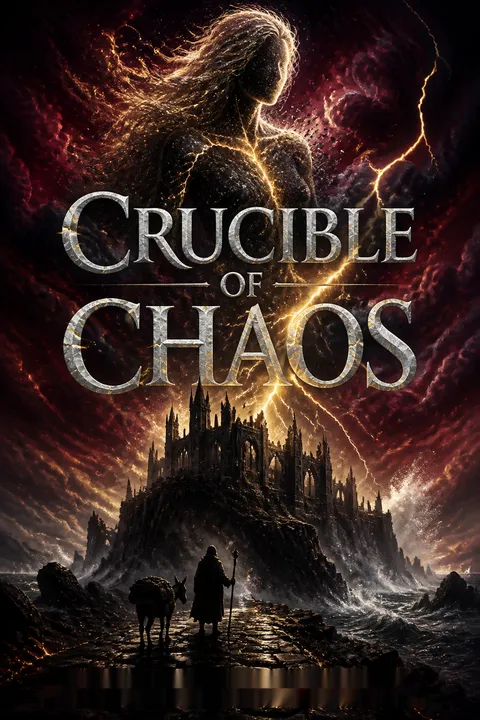

Plot Summary
Summons to Isola Sombra
Magistrate Estevar Borros, known as the King's Crucible, receives a letter from Abbot Venia of Isola Sombra, a remote abbey famed for its spiritual history. Venia's message is urgent: the monks are at war over which gods should replace those murdered two years prior, and the abbey teeters on the brink of chaos. Venia, once a respected leader, is now besieged and powerless, fearing that theological disputes will soon turn to violence. He begs Estevar, a man of law and reason, to arbitrate and restore peace. Despite his own wounds and weariness, Estevar's curiosity and sense of duty compel him to answer the call, setting the stage for a journey into a place where faith, law, and the supernatural collide.
Storms and Old Wounds
Estevar's journey to Isola Sombra is fraught with physical and emotional peril. Battling a festering dueling wound and a relentless storm, he traverses the treacherous causeway with only his stubborn mule, Imperious, for company. Memories of past failures and pride haunt him, especially the duel that left him injured and humiliated. Upon arrival, he is met not with sanctuary but suspicion and threats—from a knight warning him away, to the very elements themselves. The abbey, once a beacon of faith, now looms as a fortress beset by madness, its gates closed to reason. Estevar's resolve is tested by both the physical ordeal and the growing sense that something unnatural festers within the abbey's walls.
The Poisoned Abbey
Inside Isola Sombra, Estevar finds a community fractured into hostile factions: the traditionalist Bone-Rattlers, the militant Trumpeters, and the hedonistic Hounds. The monks, once united by faith, are now driven by paranoia, zealotry, and despair. The abbey's famed wine, a symbol of its prosperity, has been poisoned, driving the brethren to hallucination and violence. Estevar's investigation reveals that the chaos is not merely theological but chemical—someone has deliberately sabotaged the wine to weaken the abbey from within. The margrave's knights, supposedly sent to help, have their own agenda, and the villagers have fled. The abbey is a crucible of suspicion, with Estevar caught between factions, each eager to use or destroy him.
A Dubious Rescue
Estevar's attempts to find allies are met with duplicity and danger. He is rescued from drowning by a mysterious monk, Malezias, and later aided by the sharp-witted Caeda, a woman with a shadowy past and a penchant for mischief. Yet trust is scarce: the inquisitor Agneta, once a Cogneri, tests Estevar's resolve with threats and riddles, while the Trumpeters and Hounds vie for control, each claiming divine sanction. Estevar's mule, Imperious, proves a steadfast companion, saving his life more than once. As Estevar navigates shifting allegiances, he realizes that the abbey's true sickness is deeper than poisoned wine or broken faith—it is a spiritual rot, and he may be the only one left to excise it.
Factions in the Fog
Estevar's investigation brings him face to face with the leaders of the abbey's warring factions. Strigan, the self-styled Wolf-King, rules the Hounds through charisma and occult rituals, his followers marked with forbidden sigils. Mother Leogado, the Trumpeters' general, prepares for war against both internal and external threats, convinced that only a new god can save the abbey. Agneta, the Bone-Rattler inquisitor, clings to tradition but is haunted by her own doubts. Each faction is driven by fear, pride, and the poisoned wine's influence, their actions increasingly erratic. Estevar, aided by Caeda, uncovers the threads of conspiracy and desperation binding them all, but the truth remains elusive, hidden beneath layers of madness and faith.
The Abbot's Last Testament
The murder of Abbot Venia is the mystery at the heart of the chaos. His body, repeatedly exhumed and desecrated, is covered in occult sigils, echoing those on Strigan's followers. Estevar, with Caeda's help, discovers Venia's secret writings—rambling, guilt-ridden confessions scrawled on the walls of a hidden cell. Venia's last days were consumed by a desperate attempt to purify the abbey through an ancient, forbidden ritual: the Sacrificia Purgadis, meant to transfer the community's sins onto a single sacrifice. But the ritual failed, unleashing not redemption but horror. Venia's madness, pride, and misguided faith have set the stage for a catastrophe that threatens to consume everyone.
The Wolf-King's Gambit
Strigan, intoxicated by his own legend, confesses to crimes he did not commit, eager to be seen as the abbey's new sovereign. His followers, marked with sigils, are both victims and perpetrators, their revels masking a deeper corruption. Estevar's duel with Strigan is as much a battle of wits as of blades, exposing the Wolf-King's insecurities and the emptiness of his power. The true danger, however, lies not in Strigan's ambitions but in the forces he has unwittingly unleashed. The sigils, the rituals, and the poisoned faith have opened the abbey to something far worse than human folly—a supernatural reckoning is at hand.
Demons in the Courtyard
The abbey's descent into chaos reaches its nadir as demons—born of the monks' madness and the failed ritual—manifest in the courtyard. These pale, horned creatures, marked with the same sigils as Strigan's followers, revel in carnage, transforming monks into monsters and slaughtering the rest. Estevar, Caeda, and their few allies fight desperately, but mortal weapons are of little use. The demons are not mere hallucinations but the physical embodiment of the abbey's collective sin and despair. As the survivors are driven into hiding, Estevar realizes that the only hope lies in confronting the spiritual sickness at the heart of Isola Sombra.
The Godless Trial
With the abbey in ruins and the survivors cornered, Estevar calls for a trial—not of any one person, but of the entire community. Caeda, revealed to be both victim and judge, presides over the proceedings. The trial is both legal and spiritual, a last attempt to impose order on chaos. Testimonies are given, secrets revealed: Venia's failed experiment, the margrave's conspiracy, the monks' complicity. The verdict is unanimous: all are guilty, not just of individual crimes but of collective failure. The trial becomes a crucible, burning away lies and illusions, leaving only the raw truth of human frailty and the need for redemption.
The Sacrifice and the Song
The failed ritual, the poisoned faith, and the collective guilt of the abbey coalesce in Caeda, who is revealed to be the intended sacrifice of the Sacrificia Purgadis. Her death and resurrection—engineered by Venia and completed by Malezias—make her the vessel for the abbey's sins and hopes. As the trial concludes, Caeda ascends, transformed by the storm's lightning and the faith of those around her. She becomes a new kind of god: not one of vengeance or pride, but of curiosity, justice, and song. Her awakening banishes the demons, but not without cost—the abbey is destroyed, and the survivors must reckon with what remains.
The Birth of Chaos
As Caeda and Venia—now monstrous avatars of chaos and guilt—battle for supremacy, the abbey collapses around them. The survivors, led by Estevar and his mule, Imperious, flee across a causeway miraculously raised by Caeda's newfound power. The old gods are gone, the new ones are born not of faith but of human error and longing. The storm that began as a metaphor for spiritual unrest becomes literal, tearing the island apart. In the end, only those willing to accept the truth and seek justice survive, while the rest are claimed by the chaos they helped create.
The Verdict of the Dead
With the abbey sunk and the survivors scattered, Estevar reflects on the meaning of justice in a world where gods can be made and unmade by human hands. Caeda, now a god in her own right, chooses not vengeance but forgiveness, offering the survivors a chance to begin anew. Estevar, battered but unbroken, recognizes that the true power of law is not in punishment but in the hope of redemption. The story ends not with triumph but with the possibility of healing—a song of justice carried on the wind, and a promise that even in the crucible of chaos, humanity can endure.
The God Who Remains
In the aftermath, Estevar and Imperious stand on the shore, watching the sun rise over a world forever changed. Caeda, now divine yet achingly human, bids him farewell, choosing her own path as a god of curiosity and justice. The margrave's ambitions are thwarted, the abbey is gone, and the survivors must find new meaning in a world without old gods. Estevar, ever the investigator, sets out once more—wounded, wiser, and accompanied by his faithful mule. The crucible of chaos has forged not just a new god, but a new hope: that justice, though fragile, can survive even the death of faith.
Analysis
Crucible of Chaos is a masterful meditation on the intersection of faith, law, and human frailty. Sebastien de Castell crafts a narrative that is both a gripping murder mystery and a profound exploration of the dangers of pride, the seductions of power, and the necessity of justice. The story's structure—built around the phases of a forbidden ritual—mirrors the psychological journey of its characters, each marked by guilt, longing, and the hope for redemption. The abbey's descent into chaos is both literal and metaphorical, a reflection of a society unmoored from its values and vulnerable to manipulation from within and without. Estevar Borros, as investigator and judge, embodies the struggle to impose order on a world where gods can die and be reborn, and where truth is as fragile as memory. The novel's ultimate lesson is that justice is not about punishment, but about the courage to face the truth, accept responsibility, and seek forgiveness. In a world where faith can be poisoned and gods can be made from human error, the only hope lies in the stubborn, imperfect pursuit of justice—a song sung not by the divine, but by those who refuse to kneel before chaos.
Review Summary
People Also Read


Characters
Estevar Borros
Estevar is a King's Magistrate, known as the King's Crucible, whose life is defined by a relentless pursuit of justice and a deep skepticism of both faith and the supernatural. Scarred by past failures and a festering dueling wound, he is driven by pride, curiosity, and a stubborn refusal to yield—even when reason and safety demand it. His relationships are complex: he is both adversary and ally to the abbey's factions, mentor and confidant to Caeda, and a reluctant friend to his mule, Imperious. Psychologically, Estevar is a man at war with himself, torn between the ideals of law and the messy realities of human frailty. His development is marked by humility learned through suffering, and a growing recognition that justice is not about punishment, but about hope and redemption.
Caeda Branwen
Caeda is a young woman of sharp wit and restless spirit, whose outsider status in the abbey masks a deeper connection to its fate. Initially a mischievous ally and investigator's assistant, she is revealed to be the intended sacrifice of the Sacrificia Purgadis—a victim of Venia's failed ritual, whose death and resurrection make her the vessel for the abbey's sins and hopes. Psychologically, Caeda is defined by longing: for belonging, for understanding, for justice. Her journey is one from victimhood to divinity, as she becomes the god born of chaos, curiosity, and song. Her relationship with Estevar is both filial and romantic, a partnership forged in adversity and crowned by her final act of mercy.
Abbot Venia
Venia is the abbot of Isola Sombra, a man of faith and reason whose inability to reconcile the abbey's divisions leads him to madness. His desperate attempt to purify the community through the Sacrificia Purgadis—using Caeda as the sacrifice—unleashes the very chaos he sought to prevent. Venia's psychological arc is one of tragic hubris: convinced of his own righteousness, he becomes the architect of his own downfall, and ultimately the monstrous god of abominations. His relationship with Estevar is one of mutual respect and disappointment, while his connection to Caeda is both paternal and destructive. Venia embodies the dangers of unchecked faith and the perils of seeking redemption through violence.
Imperious
Imperious is Estevar's mule, a creature of remarkable intelligence and will. More than a beast of burden, Imperious is a symbol of resilience and steadfastness, saving Estevar's life on multiple occasions and providing comic relief amid the darkness. Psychologically, Imperious represents the virtues of patience, loyalty, and silent wisdom—qualities often lacking in the humans around him. His relationship with Estevar is one of mutual exasperation and deep, unspoken affection. In the story's darkest moments, Imperious's courage and tenacity become a beacon of hope, reminding the characters—and the reader—that heroism can be found in the most unlikely places.
Brother Agneta
A former Cogneri, Agneta is the abbey's chief quartermaster and a master of both religious law and practical survival. Her skepticism and wit mask a deep sense of duty and a capacity for violence when necessary. Agneta's relationship with Estevar is adversarial but respectful, each recognizing in the other a kindred spirit of stubbornness and principle. Psychologically, she is haunted by the failures of faith and the compromises of power, yet remains committed to the idea that law—however flawed—is the only bulwark against chaos. Her development is marked by grudging acceptance of Estevar's methods and a willingness to fight for justice, even at great personal cost.
Mother Leogado
Leader of the Trumpeters, Leogado is a former military captain who brings martial discipline and tactical acumen to the abbey's spiritual wars. Her faith is pragmatic, her leadership uncompromising. Leogado's relationship with Estevar is one of mutual challenge and respect, each testing the other's convictions. Psychologically, she is driven by a need for order and a fear of the chaos that faith unmoored can unleash. Her arc is one of reluctant humility, as she learns that true leadership requires not just strength, but compassion and the willingness to trust others.
Strigan (Wolf-King)
Strigan is the self-proclaimed Wolf-King of the Hounds, a figure of wild charisma and reckless ambition. His followers, marked with forbidden sigils, are both his strength and his undoing. Strigan's psychological makeup is a blend of insecurity, pride, and a desperate need for validation. His relationship with Estevar is antagonistic, yet he is ultimately a pawn in a larger game. Strigan's arc is one of self-destruction, as his pursuit of power leads to his transformation into a monster—both literally and figuratively. In the end, he is a tragic figure, undone by the very forces he sought to command.
Malezias
Malezias is a towering monk with a soldier's past and a heart divided between duty and love. His loyalty to Caeda is unwavering, even as it leads him to commit terrible acts in the name of redemption. Psychologically, Malezias is torn between the violence of his past and the hope of a better future. His relationship with Estevar is wary but respectful, while his devotion to Caeda is both protective and self-sacrificing. Malezias's arc is one of atonement, as he seeks to make amends for his role in the abbey's tragedy by aiding in its salvation.
Sir Daven Colraig
Sir Daven is the margrave's knight, a master of deception and manipulation. Outwardly affable, he is the architect of the abbey's poisoning and the margrave's plot to seize Isola Sombra. Psychologically, Daven is driven by ambition and a belief in his own superiority, yet is ultimately a tool of greater powers. His relationship with Estevar is a dance of mutual suspicion and reluctant admiration. Daven's arc ends in betrayal and death, a cautionary tale of the dangers of pride and the futility of seeking power through treachery.
The Demons
The demons are not characters in the traditional sense, but embodiments of the abbey's spiritual sickness. Born from the failed ritual and the monks' madness, they are both victims and perpetrators, reveling in chaos and destruction. Psychologically, they represent the shadow side of faith—the capacity for violence, cruelty, and self-destruction that lies within all communities. Their relationship to the other characters is that of judge and executioner, yet they are also the product of the very sins they punish. In the end, they are banished not by force, but by the acceptance of truth and the possibility of redemption.
Plot Devices
The Poisoned Wine
The deliberate poisoning of the abbey's wine is the inciting incident that transforms theological debate into chaos. It serves as both literal and metaphorical poison, driving the monks to hallucination, paranoia, and violence. The wine's effects are not uniform, amplifying each character's deepest fears and desires, and fracturing the community into warring factions. This device is a masterful use of foreshadowing, as the physical symptoms of poisoning mirror the spiritual sickness at the heart of the abbey. The wine's origin—a plot by the margrave to weaken the abbey for conquest—ties the personal to the political, making the abbey's internal strife a microcosm of the nation's larger turmoil.
The Sacrificia Purgadis
The ancient, banned ritual of the Sacrificia Purgadis is the story's central plot device, driving both the murder mystery and the supernatural horror. Intended to purify the community by transferring its sins onto a single sacrifice, the ritual instead unleashes chaos, transforming monks into demons and setting the stage for the birth of a new god. The ritual's sigils, inscribed on flesh, serve as both evidence and curse, linking the physical and spiritual realms. The Purgadis is a brilliant example of narrative structure: each "sigil" marks a new phase in the story, and the ritual's failure becomes the crucible in which the characters' true natures are revealed.
The Judicial Trial
Estevar's insistence on holding a trial—even as the abbey collapses into chaos—is both a plot device and a thematic statement. The trial is not just a means of assigning blame, but a ritual of truth-telling and catharsis, a last stand for reason in the face of supernatural horror. The structure of the trial—testimony, cross-examination, verdict—mirrors the narrative's progression, with each character forced to confront their own guilt and complicity. The trial's outcome is not exoneration or punishment, but the possibility of redemption, embodied in Caeda's transformation and the banishment of the demons. The device is a powerful commentary on the limits and necessity of law in a world where gods can die and be reborn.
The Unreliable Witness
Throughout the story, characters' memories and perceptions are distorted—by poison, trauma, and supernatural influence. Caeda, in particular, is both present and forgotten, her existence slipping from the minds of those around her. This device heightens the sense of uncertainty and dread, forcing both Estevar and the reader to question what is real. The unreliable witness is not just a tool for suspense, but a meditation on the fragility of truth and the dangers of collective denial. The ultimate revelation—that Caeda is both victim and judge, mortal and divine—hinges on the story's manipulation of memory and identity.
The Storm
The recurring storms that batter Isola Sombra are more than atmospheric detail—they are both foreshadowing and active participants in the narrative. The storms mark transitions between phases of the story, signal the arrival of supernatural forces, and ultimately serve as the crucible in which the abbey's fate is decided. Lightning, in particular, is a symbol of divine intervention and transformation, striking at key moments to mark the birth of new gods and the destruction of the old order. The storm is a device that unites the personal, the political, and the cosmic, making the abbey's crisis a matter of fate as well as choice.
About the Author



Download PDF
Download EPUB
.epub digital book format is ideal for reading ebooks on phones, tablets, and e-readers.








































