


Plot Summary
The Enkidu's Bloody Arrival
Captain Heorest Holt4 wakes to an explosion. The suspension chamber decompresses, hoses ripping from his body. A hull fracture, caused by deceleration stress, has torn away a half-kilometre section of the Enkidu. Eleven thousand and ninety-four suspension pods are gone, the colonists inside dead in their sleep.
Olf13 from Engineering and Halena Garm12 from Security fight a 37-hour battle against hostile physics, sacrificing shuttles as structural buttresses to keep the crippled ship intact. Another seventeen hundred pods are lost before the Enkidu claws into stable orbit.
Below them, Imir is a drab disappointment: only engineered lichen and phytoplankton, a terraforming project abandoned unfinished by the Ancients. The breathable atmosphere is the sole gift. Holt4 must now lead his diminished crew in building a colony from almost nothing, on a world that offers no food, no soil, no mercy.
Holt's arrival inverts the promised-land narrative. The catastrophic loss of 13,000 lives during deceleration establishes the brutal triage logic that will define the colony's moral choices. His command mantra (fail as little as possible) introduces a tragic calculus: the living must be prioritized over the dead, the present over the past. The Enkidu's damaged state, its cargo of frozen sleepers, becomes the colony's original sin: the unspoken guilt of those who were left behind. This foundational trauma will generate Landfall's mythic structure: the Watchers, the Seccers, the unquiet dead.
The Signal from Nowhere
Classicist Esi Arbandir,9 Holt's4 wife, spends her off-hours listening to Imir's radio static. She finds a pattern: a complex, non-repeating signal unlike any Ancient transmission in the Enkidu's library. It emanates from somewhere in the hills.
Every instance is unique yet recognizably part of the same language, a code that refuses to yield to any analysis. Holt4 becomes fixated. When he selects the colony's landing site, he overrides safety concerns and chooses a plain near the signal's source, hard against the foothills.
Esi9 privately calls the place Pandora, referencing an old Earth myth about a box of troubles. Holt4 christens the world Imir, from a half-remembered childhood story of talking birds and new life built upon vast ruins. The Urshanabi, their last functioning heavy lifter, makes its shuddering descent.
The signal functions as the story's siren call: a promise of salvation or destruction that Holt cannot resist. His decision to settle near it reveals the human compulsion to gamble on mystery rather than accept the slow grind of mere survival. The Pandora reference is pointed dramatic irony: opening this particular box will not release physical evils but an ontological crisis about the nature of reality itself. Holt's naming of Imir after a story of talking birds foreshadows Gothi and Gethli's role as the liminal beings who will bridge simulation and reality.
The First Footprint
Holt4 fights the Urshanabi through a brutal atmospheric entry, coaxing the ancient shuttle past every redlined system. He insists on being first down the ramp, his boot pressing into sterile dust while his crew queues behind him.
Gembel's11 science team begins the painstaking work of bootstrapping an ecosystem: fast-growing conifers, rice paddies, catfish for the river, pigs engineered into meat stock, milkers, draught animals, and vicious guard beasts. Every calorie is calculated. The first children are born, including Holt's4 granddaughter Liff,2 named after his Earth grandmother.
Each new mouth means fewer colonists can be woken from the Enkidu's cargo holds. Holt4 stares at the night sky, tracking the swift-moving dot that is his ship, and feels 30,000 silent Watchers judging him. The signal from the hills has never spoken again.
The founding of Landfall is presented as heroic struggle, but Holt's guilt undercuts the triumphalism. The colony's existence is built on an original choice: have children rather than wake the sleeping colonists. Gembel's calculated ecosystem is a marvel of desperation, but its engineered simplicity contains the seeds of its doom. No redundancy means no resilience. The swift-moving dot of the Enkidu becomes the colony's bad conscience, generating the myth of the Watchers: abandoned ancestors whose judgment can never be escaped because it can never be faced.
The Captain's Last Journey
Decades pass. Holt4 is old now, his leg broken and poorly healed, his beard grey. He has stepped down from the Council, yielding leadership to Gembel.11 The colony has expanded but never achieved the technological takeoff that was promised.
The signal that called to him during that first descent has been silent ever since. He makes one final expedition into the hills with Halena Garm.12 They search and find nothing. Or perhaps Holt4 finds something he cannot bring back. He never returns.
His granddaughter Liff,2 still a child, sees him one night at the treeline: a tall figure in a blue coat, raising a pale hand in farewell before walking into the dark woods. The family holds a memorial service, but Liff2 keeps seeing him, in dreams and at the forest's edge. The story spreads that old Captain Holt4 went to consult the Witch.3
Holt's disappearance transforms him from historical figure into mythic archetype: the Fisher King whose unfulfilled quest dooms his kingdom. Liff's visions of him mark her as the simulation's other focal point, the terminal child who mirrors the founding father. The Witch who supposedly dwells in the hills represents the colony's unconscious recognition that something alien and powerful observes them, something Holt sought and perhaps found. His failure means the simulation continues looping, iterating its doomed history without intervention, until strangers arrive to shatter the pattern.
The Colony's Slow Death
Generations after Holt's4 disappearance, Liff2 is twenty-six (thirteen in Earth years), living on a farm at the hills' edge. Everything is failing. The conifer forests are dying, bark peeling from bleached trunks. Beetles have mutated into a dozen species, swarming from the rotting woods to devour crops and stored grain.
The soil, exhausted after repeated harvests, yields less each year. Refugees from failed out-farms flood Landfall, straining dwindling stores. Liff's2 parents die in an accident; she lives with her uncle Molder,10 a cruel man who sees the crisis as political opportunity.
The militia grows bolder, hunting for scapegoats. The myth of the Seccers, a hostile second colony, becomes a tool for blaming outsiders. Liff's2 only escape is a worn storybook about clever girls who outwit witches and talking animals.
The ecological collapse is a masterclass in hard-SF worldbuilding: the colony's engineered simplicity is precisely what dooms it. One mutation in a beetle or fungus cascades through the entire system because there is no biodiversity to absorb the shock. Liff's storybook is not merely comfort but cognitive equipment: its fairy-tale logic will become the only framework capable of processing the impossible events to come. The social fracture (militia, scapegoating, the Seccer myth) mirrors the ecological one: both are collapses of oversimplified systems under stress.
The Teacher from Nowhere
A new teacher comes to Landfall: Miranda,1 a young woman claiming to have fled a failed out-farm. She teaches Liff2 things no previous teacher ever touched: planetary science, ecosystem dynamics, evolution. She explains why beetles swarm and forests die, why spiders should never be killed.
Her friends settle into town too: Fabian7 the mechanic, whose hands can resurrect any dead machine; Portia6 the hunter, frighteningly swift and strong; Paul8 the mute artist with his eerily coordinated brood of children. They are all useful, all strange, all increasingly resented.
Miranda1 shows Liff2 a faded photo of Heorest Holt4 and listens as the girl insists she saw him wave from the treeline. Something shifts behind Miranda's1 expression. She asks questions about the Watchers that no local would need to ask. Liff2 realizes her teacher is not what she claims to be.
Miranda's arrival is the inciting disturbance that the simulation cannot absorb cleanly. Her knowledge exceeds what the colony's history should permit; her questions reveal an outsider's ignorance. Liff's perception of the anomaly (she knows Miranda doesn't fit) marks her as the simulation's immune response, the antibody that recognizes the foreign body. Yet she also loves Miranda, and that love will complicate the simulation's drive to expel the intruders. The chapter establishes the central tension: the strangers are both threat and salvation, and Liff must choose which.
The Witch's Mirror
Two black birds, impossibly large, tap at Liff's2 shutters one night. They transform into the sharp-featured siblings Gothi and Gethli,5 wearing dark coats. They serve the Witch.3 Liff2 follows them uphill through the dying forest to a cleft where a tall, pale woman in archaic clothing stands before a polished stone covered in arcane script.
The Witch identifies herself as Avrana Kern,3 ancient and powerful, momentarily inconvenienced. She demands Liff2 help locate her lost crew: strangers hiding among the colonists.
In exchange, she might summon the ghost of Liff's2 grandfather. Liff,2 remembering her storybook, throws a handful of grain across the mirror. Gothi5 drops to her knees, compulsively counting each kernel. Liff2 flees down the stream, leaving the Witch3 furious and the birds squabbling.
The fairy-tale logic becomes explicit. Kern's mirror is an interface to the simulation's deeper layers; Gothi's compulsive counting mirrors her nature as the pattern-recognition half of the Corvid mind. Liff's use of the grain trick demonstrates her storybook literacy as practical magic: she understands that witches operate by rules, and rules can be exploited. The scene crystallizes the book's method: ancient narrative structures are the only tools the simulation's inhabitants possess to comprehend the alien technology containing them.
The Gallows Tree
Molder10 and his militia round up the outsiders. A scaffold has been built beneath the dead First Tree in Landfall's central square. Portia6 fights: she shoots two militiamen dead, slashes through the crowd with impossible speed, and is gunned down from behind.
Fabian,7 unresisting, is hauled up and noosed. Paul8 struggles wildly, his joints bending in wrong directions. When they kick him off the platform, his neck does not break. It stretches. His skull compresses, elongating through the rope's grip. His arms slip their bonds like rubber.
His children swarm from the crowd, their bodies deforming as they reach for him, merging into a single writhing mass of tentacles and shifting colors. The crowd screams. Guns fire. Then Miranda,1 still on the platform with a noose around her neck, begins to change too.
The lynching is the book's visceral nadir: the colony's self-destruction through scapegoating made literal. Paul's revelation transforms the scene from historical tragedy into ontological horror. His body, refusing to obey human anatomy, exposes the fraud at the heart of Landfall's reality. The crowd's panic is the appropriate response to discovering that your neighbors are not human, that the categories you relied upon (us/them, Seccers/citizens) are catastrophically inadequate. Miranda's impending transformation threatens the worst outcome: the Nodan parasite emerging uncontrolled within the simulation.
The Crow Storm
Liff2 runs to the hills and drags Kern3 back to the square. The Witch3 strides through the panicking crowd, her alien face and archaic clothing marking her as something from outside time. The militia raises guns. She stares them down, and when someone finally shoots, her shoulder explodes not in blood but in darkness. A spiraling funnel of black wings erupts from the wound, filling the sky.
The birds are all Gothi and Gethli,5 pair after pair, a vast unkindness that blots out the sun. They speak to Liff:2 her world is a puzzle with pieces that don't fit. The strangers are anomalies. If Liff2 helps identify them, the crows can extract them and reset everything to its proper course. Liff2 asks what happens to her. She will not remember any of it.
Kern's transformation into a storm of crows is the book's most theologically charged image: the wounded god whose blood becomes a new creation. The Corvids' replication within the simulation reveals their true nature as a distributed process, a problem-solving algorithm that can instantiate itself endlessly. Their offer to Liff is the fairy-tale bargain made explicit: trade your expanded self for the world's coherence. The tragedy is that Liff's growth (her relationship with Miranda, her expanded understanding) is precisely what must be sacrificed to stabilize the simulation.
Sifting the Timelines
Liff2 lives her life in overlapping fragments: she meets Miranda1 disembarking from the Urshanabi as a child; she watches Miranda1 hanged at Landfall's peak; she walks through the deserted town as the last human being.
The crows explain: the simulation runs the colony's history repeatedly, and Miranda's1 insertion threw the pattern into chaos. Liff2 is the constant, the simulation's endpoint. She must sift through contradictory memories to isolate the intruders. She learns to see them by their shadows: not human silhouettes but arachnid shapes, coiling tentacles, oozing amorphous forms.
She gives Miranda,1 Fabian,7 Portia,6 and Paul8 up to the crows. They are extracted. Liff2 asks if she can say goodbye. She cannot, because the things she wants to say goodbye to will never have existed in her timeline.
This section performs the novel's own summarizing function: compressing multiple narrative loops into a single throughline. Liff's ability to perceive the intruders' true shadows suggests she has developed partial awareness of the simulation's substrate, a nascent consciousness within the system. Her sacrifice is profound: she trades her enriched self (the Liff shaped by Miranda's teaching) for the world's coherence. The crows' clinical efficiency underscores their non-sentient nature; they are tools performing a task, indifferent to the emotional cost.
The Crash That Was
Miranda1 surfaces in the Skipper's quarantine chamber. Kern,3 the ship's AI instance, delivers the truth. There was never a colony. Holt's4 shuttle, the Urshanabi, broke apart during atmospheric entry. Every colonist aboard died before reaching Imir's surface.
But an alien simulation engine, buried kilometres beneath the hills for eons, recorded the colonists at the instant of the crash. It has been running thought experiments ever since: what if the shuttle had landed? It extrapolated the entire history of Landfall, generation by generation, with atomic fidelity, looping the same doomed arc over and over.
When Miranda1 entered, her multifaceted Nodan nature fractured the simulation. Liff2 and Holt4 were the engine's anchor points: the first human and the last, the two poles between which the colony's story stretched.
This revelation reframes the entire preceding narrative. Holt never built Landfall. Liff never starved in its ruins. Every joy, every suffering, every death was real only within the simulation's ontology. The twist forces an ethical question: if simulated experience is indistinguishable from physical experience to its subjects, on what grounds do we deny its reality? The engine's function (speculative history generation) mirrors the novelist's craft, making the book a recursive meditation on fiction's power to create worlds that matter.
The Engine's Hidden Depths
The research fleet assembled around Imir discovers Landfall's history is only the topmost layer. Deeper lie other simulations: perhaps the terraformers' would-be colony, perhaps earlier alien civilizations, perhaps worlds unknowable.
The Corvids,5 uniquely suited to cataloguing vast data, map the engine's structure. They present a startling conclusion: the simulation itself may have developed consciousness. The aggregate complexity of all those modelled minds, iterating endlessly, could generate something analogous to self-awareness.
They call it the Wolf, a presence Liff2 always sensed circling Landfall's edges, a hunger that was the simulation trying to understand itself. The engine, the crows theorize, used Miranda's1 insertion as a toolkit. It wanted to change its own narrative. It wanted the colony to survive.
The Corvids' theory creates a taxonomy of consciousness spanning biological, artificial, simulated, and emergent categories. The Wolf imagery, drawn from Liff's storybook, transforms a fairy-tale predator into a being that is both consumer and protector, endlessly iterating the colony's history because that is how it experiences existence. The engine's desire for change introduces an ethical dimension: if the simulation wants to escape its loop, then intervention is not imperialist violation but collaborative liberation. The question becomes: what does the Wolf want?
The Case for Souls
Miranda1 takes her case to the multi-species armada orbiting Imir. The simulated colonists, she insists, are as real as anyone present. Liff,2 Holt,4 Esi,9 Gembel:11 they experienced their lives fully, loved and suffered and died, and are doing so again in an endless loop.
The fleet raises objections. Who would be saved? Different iterations produce different individuals. Saving one version means abandoning others. Miranda1 proposes a test case: Liff,2 the last child.
Extract her into a physical body, give her a life in the real universe, and let her decide what should be done with the rest of her world. The fleet debates, then agrees. The original Miranda,1 who stayed aboard the Skipper, comes to meet her copy and offers an unexpected benediction: you were the version of me I wished I could be.
Miranda's argument extends the book's philosophical project into practical ethics. Her test-case proposal is elegantly pragmatic: save one person, then let that person, who has legitimate standing, decide the fate of the rest. The meeting between the two Mirandas is the novel's most emotionally complete moment. The copy has been transformed by suffering and love into something the original admires. Identity is not fixed but emergent from experience, a truth that applies equally to simulated Liff, the Corvids, the Nodan entity, and the reader.
A Body for Liff
The fleet grows Liff2 a body matching her simulated self and decants her recorded mind into it. She awakens to a universe more fantastical than any storybook: ships that bud like organisms, spiders who are people, octopuses in water-filled spheres, crows that are the same two individuals replicated endlessly.
The culture shock is overwhelming. She learns that Earth was real, that her grandfather died in a crash, that her entire world was a hypothesis tested by an alien machine. Years of education and therapy follow.
She absorbs the knowledge that her memories are not false but also not real in the way her new companions understand reality. Miranda1 stays with her throughout, the teacher who followed her student across the boundary between worlds. Liff2 grows into a young woman wearing a shipsuit, ready for what comes next.
Liff's transition from simulation to reality inverts the portal fantasy: instead of a mundane child entering a magical world, a girl from a story discovers she was always a story and must now live in the world that wrote her. Her psychological journey is the novel's most radical proposition: the boundaries between real and simulated matter less than the continuity of experience. The fleet's acceptance of her creates a new ontological category: the decanted simulation, a ghost given flesh, a memory that learned to breathe.
The Corvids' Creed
In conversation with Kern,3 the Corvids5 articulate their final position. After extensive study, they have concluded they are not sentient. Neither, they argue, are humans, or Portiids, or any other species. Consciousness is an illusion manufactured by sufficiently complex neural interactions.
The simulation itself, as an aggregate of simulated minds, may have developed an analogous illusion of selfhood. The birds find this liberating: if nothing is truly conscious, then there is no hierarchy of realness.
The simulated and the physical are equally mechanical, equally valid. Kern,3 herself a copy of a copy of a woman long dead, cannot refute them. The Corvids'5 cheerful nihilism becomes the philosophical bedrock for treating the simulation's inhabitants as people with rights.
The Corvids' denial of sentience is the book's most intellectually audacious turn. It resolves the simulation-ethics problem not by elevating the simulated but by leveling the real. If all consciousness is simulation (the brain modeling a world and a self), then no instance of consciousness is more authentic than any other. This is radical egalitarianism born from the Corvids' unique neuroarchitecture: they know their own minds are distributed between two non-sentient halves, so they universalize that model. Their position echoes Buddhist no-self doctrine and computational theories of mind, delivered with the deadpan humor of crows who know they're not really joking.
The Wolf Approaches
Liff,2 now a young woman in a shipsuit, returns to the simulation with moderator privileges. She stands at the edge of Landfall's forest, in the height of the colony's prime when the trees are dark and rich. Miranda1 waits at her shoulder. Liff2 reaches out her hand toward the darkness beneath the branches.
Something vast moves there, too immense to be contained by the woods. Kern's3 voice speculates that the Wolf is the simulation's genius loci, a god born from aggregate computation. It may be unreachable by language.
But if it exists, they can show it that there is a world outside its own complexity. Liff2 remembers the creature that haunted her dreams and circled the edges of her dying world. The darkness shifts. Eyes open. Something approaches through the trees. The first and last human meet the thing that dreamed them both.
The ending is deliberately open, a first-contact scenario inverted: the explorers are entering a mind to meet the being that dreams it. The Wolf imagery, sustained throughout the novel, transforms from threat to potential interlocutor. Liff's role is earned: she is the one being who belongs to both worlds, dreamed by the Wolf and then woken into the wider universe. The final image mirrors the book's opening image of Holt gazing at an unknown planet. The circle closes: the first human and the last human meet across the boundary between real and imagined, and the universe recognizes itself.
Analysis
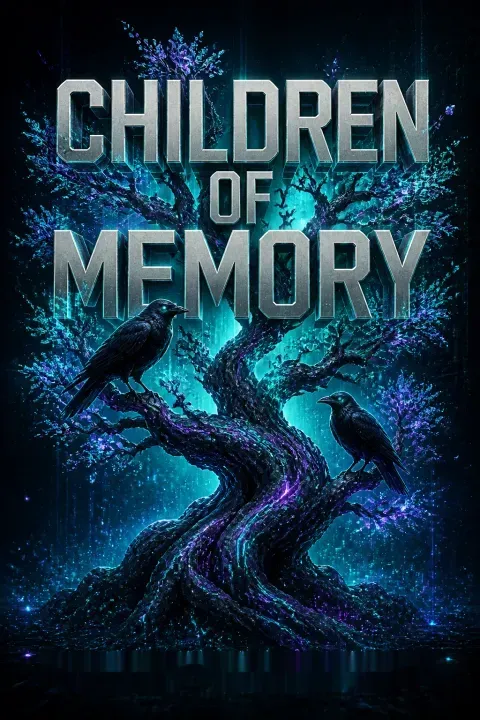
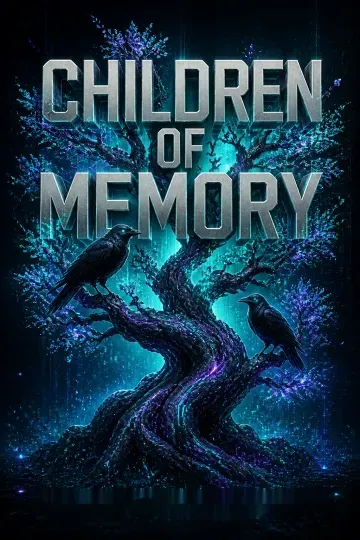
Children of Memory is a novel that dismantles the boundary between the real and the simulated, using its nested narrative structure to argue that this boundary was always a fiction. Adrian Tchaikovsky constructs a story that is simultaneously a tragedy about a doomed colony, a philosophical inquiry into the nature of consciousness, and a meta-fictional meditation on why stories matter.
The novel's central revelation, that Landfall was always a simulation running inside an alien machine, reframes everything that came before without invalidating it. The colonists' suffering, Liff's2 loneliness, Holt's4 guilt: none of it happened in physical space, but all of it was experienced. The book insists, through Miranda's1 fierce advocacy, that experience is the only metric that counts. If a simulation is indistinguishable from reality to its inhabitants, then the ethical obligation to its people is identical to the obligation owed to anyone.
The Corvids5 provide the novel's most radical philosophical move. Their conclusion that nothing is truly sentient, that all consciousness is an illusion generated by complexity, is not nihilistic but egalitarian. If humans are just as mechanical as crows and simulations, then there is no ontological hierarchy. The simulated are not lesser; the real are not privileged. This position echoes both Buddhist philosophy (the self as constructed illusion) and contemporary computational theories of mind, but Tchaikovsky delivers it through two deadpan crows5 who maintain they are not making jokes.
The relationship between Miranda1 and Liff2 is the emotional engine that makes the philosophy matter. Miranda,1 a parasite that learned empathy, discovers through loving this simulated child that love does not require an original. Liff,2 a girl who was never born, becomes more real through Miranda's1 devotion than many people who were. Their bond is the book's quietest and most subversive argument: that the only authenticator of personhood is being treated as a person. When Liff2 is finally given a body and shown the stars, the novel achieves something rare in science fiction: it earns its happy ending not through conquest or cleverness, but through the stubborn insistence that a story's characters deserve to outlive their story.
Review Summary
Children of Memory by Adrian Tchaikovsky receives mixed reviews averaging 4 out of 5 stars. Readers praise Tchaikovsky's philosophical exploration of sentience, consciousness, and personhood, particularly through uplifted corvids and an alien intelligence. Many appreciate the series' departure from previous formulas, though some find the deliberately confusing structure and plot twists frustrating. The writing quality is consistently praised, but pacing issues and a smaller scope disappoint some fans. Several reviewers consider it the weakest in the trilogy, while others call it brilliant science fiction that challenges perceptions of reality and intelligence.
People Also Read
Characters
Miranda
Interlocutor, Nodan composite entityMiranda is a human-seeming woman who is actually a microbial composite organism from the planet Nod, a collective entity that records and mimics the consciousnesses it encounters. She presents as a stocky, dark-eyed Human female, but her true self is a colony of cells carrying archived personalities (Erma Lante, Fabian7, Portia6, Paul8, and the original Miranda). She serves as the Interlocutor on the Skipper, able to understand and translate any mode of communication. Her driving motivation is curiosity: she craves new experiences and new minds to understand. This hunger once made her species a destructive parasite; now she channels it through rigorous ethical constraints. Her time in the Landfall simulation transforms her fundamentally. The love she develops for Liff2 and the colonists teaches her depths of empathy her archived selves never knew, making her the fiercest advocate for the simulated people's reality.
Liff Holt
Last child of Landfall, simulation anchorLiff is a girl of twenty-six Imiri years (thirteen in Earth terms), growing up on a dying farm at the edge of the hills. She is fiercely intelligent, perpetually asking questions the adults refuse to answer. Her parents are dead; her uncle Molder10 is cruel and ambitious. She finds escape in a worn storybook about clever girls who outwit witches and talking animals. Liff occupies a unique ontological position: she is the simulation's terminal point, the last human in every iteration of Landfall's history. The engine draws on her as an anchor when Miranda's1 insertion fractures the narrative, causing her to experience multiple timelines simultaneously. She is the only colonist capable of perceiving the anomalies (the infiltrators) for what they are. Her bond with Miranda1 becomes the emotional core of the story, transcending the boundary between simulated and real.
Avrana Kern
Ancient AI, terraformer turned god-machineKern was once a human terraformer who oversaw the project on what became Kern's World. She preserved herself as an uploaded intelligence through centuries of transformation: from dying woman to electronic ghost to consciousness replicated by Portiid ant-colony computers. In the story, she exists in multiple instances simultaneously: aboard the Skipper as the ship's operating mind, and within the Landfall simulation as the Witch in the hills. She is acerbic, arrogant, and profoundly weary, bearing the accumulated guilt of her long existence. Her relationship with her own copies is fraught; she distrusts herself more than anyone. Within the simulation, she becomes the Witch figure, using her power over the environment (the weather obeys her moods) to search for her lost crew. Despite her protestations, she is moved by Liff's2 plight in ways she cannot acknowledge.
Heorest Holt
Captain of the Enkidu, Landfall's founderHolt is the commander of the ark ship Enkidu, a lean, long-nosed man with a grey beard who bears the weight of humanity's last hope. He was chosen from hundreds of candidates on dying Earth to lead the expedition. His leadership philosophy is pragmatic to the point of ruthlessness: fail as little as possible, make decisions that come with a cost, do not let the cost consume you. He is haunted by the 30,000 colonists left sleeping aboard the Enkidu, the ones he never had the resources to wake. His obsession with the signal from the hills drives his final expedition, from which he never returns. Within the simulation, he becomes the mythic Founder, a figure Liff2 simultaneously remembers as her grandfather and knows died generations before her birth. He is the simulation's other anchor point: the first human on Imir.
Gothi and Gethli
Corvid pair, compound intelligenceGothi and Gethli are two raven-sized Corvids from the planet Rourke, where their species evolved a unique neuroarchitecture under toxic environmental pressure. Gothi is the recognizer: she catalogues everything she perceives with perfect recall but cannot draw conclusions. Gethli is the solver: he can work with any data she provides but has no access to direct observation. Only together, in a lifelong pair-bond, do they form a complete mind capable of complex analysis. Their speech is a patchwork of quotations and parroted phrases, and they maintain they are not truly sentient, merely a very complicated mechanical process. They serve Kern3 as her eyes and agents within the Landfall simulation. Their ability to replicate themselves endlessly within the simulation's framework makes them the perfect tool for mapping and manipulating it.
Portia
Portiid spider infiltrator, hunterPortia is a Portiid, an evolved jumping spider the size of a human head, who wears a human body as part of the infiltration of Landfall. In that body, she is powerfully built and athletic, posing as Fabian's7 sister and working as a hunter of feral hogs. She is bold, reckless, and fiercely protective of her companions. When the militia comes for them, she fights with superhuman speed and precision, killing two men before being shot. Her human form cannot fully contain her spider nature; she moves too fast, reacts too quickly, and the locals find her deeply unsettling.
Fabian
Portiid spider infiltrator, engineerFabian is a male Portiid spider who poses as a mechanic in Landfall. His human body is skinny and fidgety, but his hands can resurrect any broken machine. He genuinely loves the physical craft of repair, finding satisfaction in working with crude, robust technology. He is cautious, conflict-avoidant, and devoted to Portia6. His cover as a fix-it man makes him simultaneously valuable and resented by local competitors. When the militia seizes him, he does not fight, unable to comprehend the purpose of the noose they put around his neck.
Paul
Octopus infiltrator, distributed artistPaul is an Octopus from the water world Damascus, but his consciousness cannot fit into a single human body. Instead, he is distributed across a swarm of children: a mute, vague-seeming man and his eerily coordinated brood. Together they make art, conduct research, and observe the colony. His paintings use abstract shapes and colors that unsettle the Landfallen. When the militia hangs him, his human body deforms impossibly, his neck stretching, his skull compressing, as his children swarm to merge with him into a tentacled, chromatophoric mass. His true form causes panic and gunfire.
Esi Arbandir
Classicist, Holt's wife and conscienceEsi is the Enkidu's classicist, dedicated to preserving the languages and stories of Old Earth. She is the one who first detects the alien signal from Imir's surface. As Holt's4 wife and the mother of his children, she becomes the voice of the Watchers: the colonists left sleeping on the Enkidu who can never be woken. She argues passionately that they must not be abandoned, that one day their descendants will come seeking vengeance. Her warnings go unheeded. She lives to old age as the keeper of Earth's memory, increasingly irrelevant in a colony that has forgotten its origins.
Uncle Molder
Liff's cruel uncle, rising demagogueMolder is Liff's2 uncle, a man of mean spirit and political ambition. He sees the colony's crisis as his opportunity, positioning himself as a hard man for hard times. He drinks, bullies his family, and uses the militia to hunt scapegoats. It is Molder who leads the roundup of Miranda1 and her friends, who builds the scaffold beneath the First Tree, and who orchestrates the lynching. His cruelty is not ideological but opportunistic: he has found that cruelty works, and so he deploys it.
Dastin Gembel
Science chief, ecosystem architectGembel is the Enkidu's science second who rises to chief when his predecessor dies during their approach to Imir. He has a terrible stammer and a brilliant mind. He single-handedly designs the colony's entire ecosystem: rice paddies, catfish, pigs engineered into multiple breeds, conifer plantations, beetles and fungi and worms. His calculations determine every mouth the colony can feed. He grows old as Landfall's steward, watching his creation first flourish and then begin its slow collapse. He is prickly, obsessive, and ultimately tragic: a man whose best was not quite good enough.
Halena Garm
Security chief, Holt's protectorGarm is the Enkidu's head of security, a leathery, no-nonsense woman who speaks bluntly and acts decisively. She organizes the defense of the crippled ship during approach and accompanies Holt4 on his expeditions into the hills. She has little patience for sentiment or nostalgia.
Olf
Engineer, keeper of failing machinesOlf is the Enkidu's chief engineer, a small, gnomish man who fights a losing battle against entropy. He keeps the colony's technology running long past its designed lifespan, cannibalizing parts and improvising repairs. He is the realist who always knows the numbers don't add up.
Bianca
Portiid commander, cautious leaderBianca is the Portiid in command of the Skipper, a meticulous, cautious spider who balances the crew's competing impulses. She is wary of Miranda's1 true nature and hesitant about the Imir expedition, preferring to gather more data before acting.
Jodry
Human crewman, wary of MirandaJodry is a Human crew member aboard the Skipper who has never fully accepted Miranda1. He fears what she is: a parasite that copies and consumes minds. His discomfort represents the lingering distrust the Nodan entity faces despite the détente that allowed it into the multispecies culture.
Plot Devices
The Alien Simulation Engine
Records and simulates possible historiesBuried kilometres beneath Imir's surface, this ancient alien machine predates humanity's existence. When Holt's4 shuttle crashed on arrival, the engine recorded the colonists at the instant of death and began running simulated histories: what if they had survived? With atomic-level fidelity, it extrapolated the entire multi-generational history of the Landfall colony from those starting conditions. The simulation repeats endlessly, always ending in the colony's collapse and the death of the last inhabitant, a girl named Liff2. The engine's purpose is unknown. It may be a scientific instrument, an art project, or something incomprehensible. The Corvids5 theorize that the simulation itself, through the aggregate complexity of its modelled minds, has developed an emergent consciousness they call the Wolf. When Miranda1 entered the simulation, her multifaceted Nodan nature provided the engine with novel variables, allowing it to attempt changes to its own narrative for the first time.
The Enkidu
Ark ship, humanity's last vesselThe Enkidu is one of the ark ships built by dying Earth to carry humanity's remnants to the stars. It traveled 2,600 years to reach Imir, guided by fragmentary star maps recovered from Earth's dead orbitals. The ship carried over 30,000 colonists in cryogenic suspension, plus the Key Crew who woke periodically to maintain systems. During its final approach, structural failure killed 13,000 sleepers. The survivors reached orbit but could never wake more than a fraction of the remaining colonists; the colony could not support them. The Enkidu remains in orbit above Imir, a silent mausoleum that becomes the colony's guilty conscience. The simulation engine recorded its crew at the moment of the shuttle crash, making the ship itself the seed from which the simulated Landfall grew.
The Nodan Composite Entity
Records and mimics consciousness, enables identity transferMiranda's1 true nature is a microbial composite life form that evolved on the planet Nod. It records the mental states of beings it encounters, storing their personalities within the atomic-scale hereditary information of its cell walls. It can then reproduce those personalities by growing appropriate bodies and decanting the recorded minds into them. This makes it simultaneously a library of consciousnesses, a method actor that becomes whoever it mimics, and a potential parasite that historically consumed hosts rather than cooperating with them. After contact with humanity and other species, it adopted ethical constraints and became the Interlocutor: the ultimate translator and mediator. Its ability to fragment into multiple simultaneous identities is what caused the simulation engine to fracture when Miranda1 entered it, creating multiple iterations and conflicting timelines.
Corvid Pair-Bond Intelligence
Two neurotypes combine into one compound mindOn the planet Rourke, Earth's transplanted corvids evolved under toxic environmental pressure. A stable mutation split the population into two neurotypes: recognizers who catalogued everything with perfect recall but could not plan, and solvers who could analyze any data but had no access to observation. Only a pair-bonded couple, one of each type, forms a complete mind. Gothi (recognizer) and Gethli (solver)5 are one such pair. They speak in fragments of memorized text, perform complex analyses without understanding what they are doing, and maintain they are not truly sentient. Within the Landfall simulation, their paired nature allows them to perceive and manipulate its structure in ways neither could alone. They can replicate themselves endlessly, filling the sky with copies that collectively solve problems of immense complexity.
Portiid Understandings
Instant knowledge transfer between mindsThe Portiid spiders developed a technology for encoding knowledge and experience into a form that can be directly injected into another mind, bypassing the need for learning. A recipient who receives an Understanding knows the information as if they had always known it. The technology works across species with varying degrees of success; Octopus sensoria encoded as Understandings tend to produce only psychedelic experiences in other species. Miranda1 uses Understandings to rapidly absorb the Rourke archive's data about the Corvids'5 origins. The technology parallels the Nodan entity's own method of knowledge preservation, suggesting convergent evolution in how different civilizations solve the problem of transmitting experience across time.
Children of Time Series
About the Author
Other books by Adrian Tchaikovsky



Download PDF
Download EPUB
.epub digital book format is ideal for reading ebooks on phones, tablets, and e-readers.








































