

Key Takeaways
You already read minds daily; you just do it clumsily and unconsciously
Mind reading is observation, not magic. Fexeus, a professional mentalist, argues that every thought produces a physical trace. Fear dries your mouth and pumps blood to your legs. A sexual thought triggers obvious bodily reactions. Because René Descartes wrongly split body from soul, most people still treat thinking as separate from the flesh. Neurologist Antonio Damasio proved the opposite: mind and body are one system.
The link runs both ways. Clench your jaw, lower your brows, stare, and make fists for ten seconds, and you begin to feel angry. Your pulse rises ten to fifteen beats per minute. Since the outside reveals the inside, watching someone's face, posture, and voice lets you infer emotions and thoughts. You do this constantly; the book simply sharpens an existing skill.
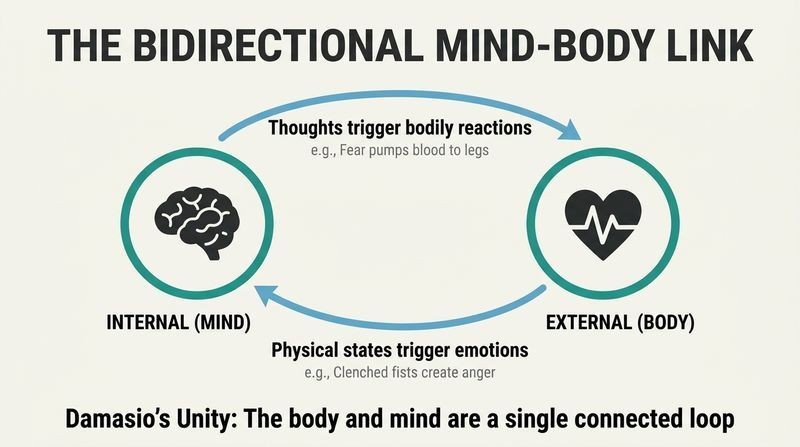
The reframe is smart marketing and largely accurate. The James-Lange theory of emotion, echoed in the jaw-clenching exercise, has real support: facial-feedback studies show that holding a pen between the teeth (forcing a smile) can nudge mood, though the famous 2016 replication failure tempered those claims. Damasio's somatic-marker hypothesis genuinely undermines Cartesian dualism. What's valuable here is the permission structure: framing perception as a trainable skill rather than a mystical gift lowers the reader's resistance and invites practice, which is where any real improvement actually comes from.
Subtly mirror someone's posture and gestures to manufacture instant trust
Rapport means adapting to how others communicate. Fexeus borrows the term from wordless-communication research: a state of mutual trust and openness. The core mechanism is that people like people who resemble themselves. So you echo the other person's posture, head angle, and gestures. Matching means moving the same limb they move (when side by side); mirroring means moving the opposite limb (when facing them).
Discretion is everything. Copy too closely and you look unhinged (see the film Single White Female). Instead, use representative gestures: if they cross their arms, rest your hand on your wrist. Delay your movement twenty to thirty seconds. Match facial expressions, which they cannot see and so cannot catch. Once rapport locks in, you can lead: open your own body language and they follow, lifting their mood with you.
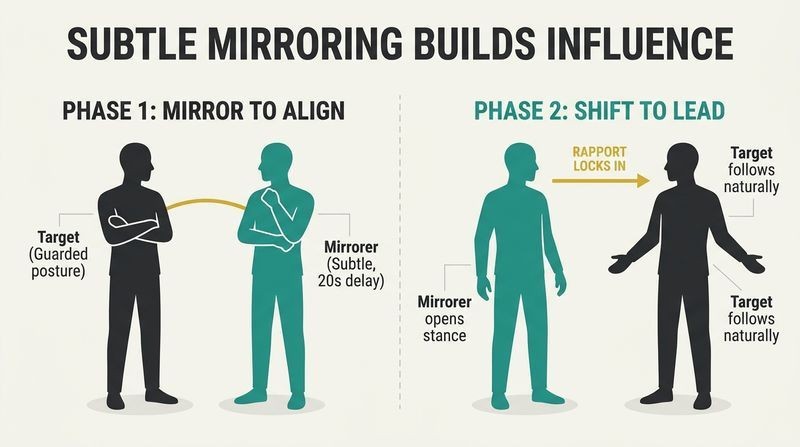
The mirroring effect is one of social psychology's better-documented phenomena. Tanya Chartrand and John Bargh's 1999 "chameleon effect" studies showed people unconsciously mimic each other and rate mimickers as more likable. Waitresses who echo customers' words earn larger tips. The caution against over-mimicry matters, though: research also shows mimicry backfires when detected or when directed at someone with hostile intent. The ethical tension Fexeus glosses is real, since the same tool that builds genuine connection also greases manipulation. His defense, that you influence people constantly anyway so you might as well do it consciously and kindly, is honest if not fully reassuring.
Match a person's speaking speed and one telemarketing team's sales jumped 30%
Tempo is the single most powerful voice lever. We speak at the pace we think, so mismatched speed either bores or overwhelms the listener. Communications expert Elaina Zuker describes a telemarketing experiment: one sales group kept working as usual, the other was told only to pace their speech to each customer's speed. The second group lifted sales by almost 30 percent while the first showed no gain.
Voice has many dials beyond tempo. Tonality (deep or light), fullness (rich or airy), melody (monotone or singsong), and volume all offer something to match. Breathing is even more potent when you can catch it: sync your breath and the connection can feel almost magical, though physical size differences sometimes make it impossible. Notice how your voice unconsciously morphs to sound like whoever you just called.
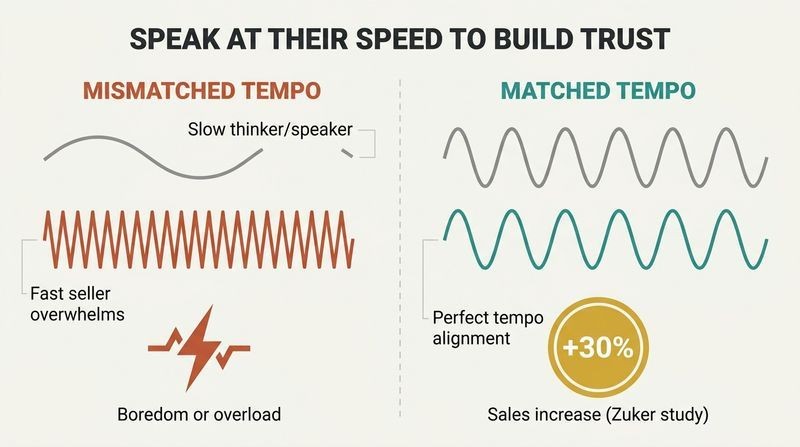
The tempo-matching claim is plausible but the cited 30 percent figure comes secondhand and lacks a traceable controlled source, so treat it as illustrative rather than settled. Still, the underlying principle aligns with communication-accommodation theory, developed by Howard Giles in the 1970s, which shows that people who converge in speech rate, accent, and vocabulary are judged warmer and more competent. Convergence signals belonging; divergence signals distance. The breathing-synchrony point connects to research on physiological linkage between close partners and therapists and clients, where heart rates and respiration measurably align during moments of empathy and rapport.
Never say "but"; agree first, then steer using the word "and"
Opinion aikido: stop resisting, redirect momentum. Confronting someone with "you're wrong" triggers defense mode and a pointless wrestling match. Instead, find something you honestly agree with, or at minimum say, "If I were you, I would feel exactly the same." This is always literally true and lands as proof you understand them. Like the martial art, you stand beside your opponent rather than blocking, using their energy to move you both forward.
Then swap "but" for "and." Compare a politician who says "we want better health care, but lower taxes" (self-contradicting) with "we agree health care matters, and that's why we want lower taxes." The word "and" lends any claim a near-causal quality. Shakespeare's Mark Antony used this at Caesar's funeral: he opened by praising Brutus as honorable, won the crowd's agreement, then reversed them entirely.
The linguistic observation about "and" versus "but" is sharp and underused. "But" functions as a psychological eraser that negates whatever preceded it, a point negotiation researchers echo when they urge replacing it with "and" to keep both truths alive. The aikido framing resonates with Chris Voss's tactical empathy and with motivational interviewing, where clinicians deliberately avoid the "righting reflex" because direct contradiction hardens resistance. One caution: perpetual agreement can slide into sycophancy or dishonesty, and Fexeus rightly insists you never betray your actual values. The Mark Antony example is a reminder this technique is ethically neutral and historically weaponized.
People filter reality through one dominant sense; speak their language
Visual, auditory, kinesthetic, or neutral. Fexeus claims most people favor one channel for thinking. Visual types say "I see your point" and speak fast in a high chest voice. Auditory types say "that rings a bell" and speak melodically. Kinesthetic (touch and emotion) types say "it finally sunk in," move slowly, and need things to feel right. Neutral or digital types reason logically and avoid sensory metaphors entirely. Architects skew visual, music producers auditory, athletes kinesthetic, lawyers neutral.
Adapt your words to their channel. Ask a visual person if they see the advantages, an auditory person to hear the benefits, a kinesthetic person whether it feels right. Fexeus even offers eye-accessing cues (EAC): eyes up for images, sideways for sounds, down-right for feelings. Then he confesses the research largely fails to support stable sensory dominance, suggesting the real benefit is that hunting for patterns makes you a sharper listener.
This is the book's most intellectually honest moment and its shakiest science. The VAK learning-styles model and NLP's eye-accessing cues have been repeatedly debunked; a 2012 study by Richard Wiseman found no link between eye direction and lying, and learning-styles matching shows no benefit in controlled education research. Fexeus's fallback, that the placebo of attentive pattern-hunting improves communication regardless, is quietly profound. It echoes the Hawthorne effect: the act of paying deliberate attention changes outcomes. The practical residue survives the debunking, since tailoring vocabulary to how someone actually talks is just good listening, dressed in dubious neuro-jargon.
Seven emotions flash identically on every face on Earth
Ekman's universal expressions. Studying cultures from Papua New Guinea to America, psychologist Paul Ekman found seven emotions displayed the same way everywhere: surprise, sadness, anger, fear, disgust, contempt, and joy. Each recruits specific muscles. Genuine sadness lifts only the inner eyebrows into a triangle, a movement almost impossible to fake. A real smile engages the orbicularis oculi around the eyes, which only about 10 percent of people can flex on command, so a mouth-only smile reads as false.
Watch for three subtle forms. Slight expressions use the whole face weakly; partial expressions use only one region; microexpressions are complete but last as briefly as a twenty-fifth of a second, betraying a suppressed feeling. Because facial muscles fire faster than conscious awareness, you can spot an emotion arriving before the person feels it. Fexeus notes the newer constructivist view (Lisa Barrett) challenges this whole model.
Ekman's basic-emotions theory dominated affective science for decades and powers everything from airport screening to Pixar's Inside Out. Fexeus deserves credit for airing Barrett's constructivist rebuttal, which argues emotions are culturally assembled predictions rather than hardwired programs with fixed facial signatures. The truth likely sits between: meta-analyses show cross-cultural recognition well above chance yet far from perfect, and context often overrides the face. The Duchenne smile distinction (eyes plus mouth) remains robust and genuinely useful. The takeaway for readers is calibration over certainty: treat a microexpression as a hypothesis to investigate, never a verdict.
A strong emotion hijacks memory to confirm itself; wait before acting
Othello's mistake. Named by Ekman after Shakespeare's tragedy, this is the trap of interpreting evidence through an emotion you are already feeling. Othello, convinced his wife betrayed him, reads her terror not as innocence but as guilt, and kills her. Once an emotion grips you, perception turns selective: you forget everything that contradicts the feeling, distort what you do recall, and suddenly dredge up grievances from years ago that reinforce it.
The practical rule: postpone. Anger in particular narrows vision and pushes you to harm the target. Since the body recovers slower than the mind, your heart keeps racing after the danger passes. Because muscles react before awareness, you can often catch a negative emotion arriving in someone's face and defuse it before it fully ignites, or, in yourself, simply refuse to decide anything until the storm clears.
This maps precisely onto modern affective neuroscience. The "amygdala hijack," Daniel Goleman's term, describes how the fast subcortical route to the amygdala fires before the slower cortical route can appraise the situation, exactly the two-path model Fexeus sketches. Cognitive science calls the memory distortion mood-congruent recall, and confirmation bias explains the selective evidence-gathering. The advice to delay action is the same wisdom behind "sleep on it" and Stoic counsel to let anger cool. Where Fexeus adds value is linking the interpersonal and internal: the same lens that makes you misjudge others makes you misjudge yourself, which is why self-observation is the harder discipline.
Liars leak through the body, so ignore their words and watch the hands
We are best at lying with words, worst with our bodies. Ironically, when we suspect deceit we focus harder on words, exactly backward. What you actually detect is emotional stress, not the lie itself, so look for leakage: contradictory unconscious signals. The autonomic system (sweating, blushing, pupil dilation) cannot be faked but only fires under strong emotion. The most common lying gesture is not scratching the nose (second place) but covering the mouth, as if to trap the lie.
Listen for linguistic tells too. Behavioral psychologist Peter Collett cataloged them: distancing through denial (Nixon's "I am not a crook" instead of "I am honest"), avoiding "me" and "mine," shifting to past tense, sudden formality, and unprompted reservations ("I know this sounds strange, but"). Crucial caveat: any single sign proves nothing. Look for clusters, confirm they are changes from baseline, and if unsure, assume honesty.
Fexeus is more careful than most popular deception writers, and the caution is warranted because the science is humbling. Meta-analyses (Bond and DePaulo, 2006) show humans detect lies at about 54 percent, barely above chance, and no single cue reliably signals deception. The polygraph, as the book's footnote concedes, measures arousal, not truth. The strongest empirically supported approach is not cue-spotting at all but cognitive load: liars struggle more when asked to recount events in reverse or add unexpected detail, which the book gestures at with its "ask for more detail" test. The honest bottom line, assume truth when uncertain, may be the chapter's wisest sentence.
Telling someone "don't worry" plants the very worry you meant to erase
The unconscious cannot process negation. To not do something, you must first picture the thing. Say "don't think of a blue polar bear" and the bear appears. Tell a child not to lean back on his chair and you strengthen the image of leaning back until the chair alone triggers it. Fexeus recounts steering a snow scooter straight into the one tree he was desperately trying to avoid. Athletes who focus on missing hazards hit them.
Suggestions bypass the analytical filter. A statement to the conscious mind gets weighed and judged; a suggestion slips to the unconscious as fact. Related tools: embedded commands (stressing hidden words in a sentence), comparisons with no reference ("new, better recipe", better than what?), and generalizations ("growing criticism", from how many people?). The fix: tell people what you want them to do, not what to avoid. Say "be calm," not "don't panic."
The negation point has solid grounding in cognitive linguistics; George Lakoff built a career on "don't think of an elephant," showing that negating a frame activates it, which is why political denials backfire. Ironic-process theory, Daniel Wegner's research on thought suppression, demonstrates that trying not to think of something increases its intrusion, the classic white-bear experiment. The coaching implication is real: goal framing ("keep the ball low") outperforms error framing ("don't hit it long") in motor-skill studies. Where readers should stay skeptical is the leap to covert "embedded commands" hypnotically installing behavior; that claim rests more on NLP folklore than replicated evidence.
Fire a gesture at someone's emotional peak to trigger that feeling on command
Anchors are Pavlov for feelings. Just as Pavlov's bell made dogs salivate, any distinctive stimulus applied while someone feels a strong emotion becomes wired to that emotion. Repeat the stimulus later and the feeling returns. You carry countless natural anchors already: a song revives the mood of when you first heard it, the Jaws theme spikes your pulse, Proust's madeleine resurrects childhood.
Plant them deliberately. Wait until the emotion is peaking (visible through bright eyes, dilated pupils, flushed skin), then apply a unique touch, word, or gesture, and release before the feeling ebbs. Combine multiple senses for strength. Fexeus warns of a hidden danger: a father who only touches his children when comforting them anchors his hug to sadness, so the embrace eventually saddens even a happy child. He speculates this is why many people dislike being touched at all.
The Pavlovian mechanism is real classical conditioning, and emotional conditioning in humans is well established, from fear-conditioning paradigms to the way retailers pair brands with music and scent. The insight about negative anchoring through comfort-only touch is genuinely thoughtful and echoes attachment research showing that the quality and context of early physical contact shape lifelong comfort with intimacy. The weaker claim is the speed and reliability of deliberately installed anchors, an NLP staple that lacks rigorous controlled support. Conditioning normally requires repetition and salience; one well-timed shoulder tap rarely produces a durable reflex. Treat it as a nudge, not a switch.
The seduction dance runs on autopilot; neither flirt notices doing it
Attraction unleashes an unconscious script. Fexeus describes it: you establish rapport across a room, glance sideways until eye contact, then look away. Women often glance downward, a submission signal rooted in primal mating behavior. Both sexes preen (fixing hair, straightening posture), expose vulnerable wrists and open palms (an ancient "I hold no weapon" gesture, the origin of the handshake), and turn to face each other directly, which exposes the unprotected torso and signals deep trust.
The tells escalate and nobody remembers. Sensual self-touching, putting objects to the lips, loosening clothing. In a Caribbean resort, Fexeus watched a woman lean, push her cleavage forward, stroke her necklace, and rub her bare foot up her leg at a seated man, who tapped his feet and looked away, disinterested. Both later swore it had been a purely businesslike chat. When interest dies, barriers rebuild: glasses go back on, arms cross, eye contact breaks.
Ethologist Desmond Morris, whom Fexeus draws on, catalogued these courtship sequences, and evolutionary psychologists like David Buss and Monica Moore documented female nonverbal solicitation cues that reliably predict male approach. The striking claim is the total lack of conscious awareness, which the resort anecdote dramatizes. That plausibly overstates the case, since much flirtation is quite deliberate, and the framing of female submission as hardwired invites justified pushback that Fexeus half-acknowledges with his #MeToo aside. The durable insight is subtler: a large share of attraction signaling operates below the verbal channel, which is precisely why people so often misread whether interest is mutual.
Analysis
The Art of Reading Minds is a mentalist's field guide dressed as pop psychology, and its central move is demystification: what looks supernatural is really disciplined observation of the body-mind unity that Descartes wrongly severed. Fexeus synthesizes rather than discovers, openly crediting Ekman, Bandler and Grinder, Erickson, Morris, and Damasio. His gift is packaging, translating academic and NLP material into an IKEA-manual of practical drills.
The book's intellectual honesty is unusual for the genre. Twice Fexeus detonates his own chapters: he admits the dominant-senses model lacks empirical support, and he airs Lisa Barrett's constructivist assault on Ekman's universal emotions. This candor is both a virtue and a tell. It signals that much of the content sits on contested or debunked foundations, particularly the NLP-derived eye-accessing cues, embedded commands, and instant anchors. A rigorous reader should sort the material into three tiers: well-supported (mimicry builds liking, communication accommodation, thought suppression backfires, Duchenne smiles, mood-congruent memory), plausible but oversold (tempo-matching sales gains, microexpression detection), and largely unsupported (VAK dominance, covert hypnotic commands, one-shot anchoring).
What rescues the weaker claims is a pragmatic escape hatch Fexeus articulates near the sensory chapter: actively hunting for patterns makes you a more attentive communicator regardless of whether the pattern is real. This is essentially a productive placebo, and it may explain why practitioners report success from techniques the literature cannot validate. The deliberate act of attention, not the specific theory, does the work.
Ethically, the book walks a tightrope. Every rapport and suggestion tool doubles as a manipulation tool, and Fexeus leans on a Spider-Man aphorism and repeated warnings rather than a robust framework. His defense, that influence is unavoidable so conscious kindness beats unconscious harm, is defensible but thin. The lasting value is a reorientation of attention outward: most people broadcast far more than they intend, and most listeners catch far less than they could.
Review Summary
The Art of Reading Minds receives mixed reviews, with an average rating of 3.53/5. Many readers find it informative and practical, offering insights into body language, rapport-building, and non-verbal communication. Some appreciate the accessible writing style and humor. Critics argue it's basic psychology and common sense, lacking depth. The book is praised for its party tricks and practical exercises but criticized for potential manipulation. Overall, readers find it a helpful introduction to understanding and influencing others, though some desire more scientific backing.
People Also Read




FAQ
What's "The Art of Reading Minds" about?
- Understanding Human Behavior: The book explores how to understand and interpret human behavior through nonverbal communication, body language, and psychological cues.
- Mind Reading Concept: It introduces the concept of "mind reading" as a natural ability to understand others' thoughts and emotions by observing their physical reactions.
- Practical Techniques: The author, Henrik Fexeus, provides practical techniques for improving communication and building rapport with others.
- Influence and Persuasion: It also delves into methods of influencing and persuading others subtly and effectively.
Why should I read "The Art of Reading Minds"?
- Improve Communication Skills: The book offers insights into enhancing your communication skills by understanding nonverbal cues.
- Build Better Relationships: By learning to read minds, you can build stronger and more meaningful relationships with others.
- Personal and Professional Growth: The techniques can be applied in both personal and professional settings to improve interactions and outcomes.
- Self-Awareness: It encourages self-awareness by helping you understand your own nonverbal communication and how it affects others.
What are the key takeaways of "The Art of Reading Minds"?
- Rapport Building: Establishing rapport is crucial for effective communication and involves adapting to others' preferred communication styles.
- Nonverbal Communication: Understanding body language and facial expressions can reveal a person's true emotions and thoughts.
- Emotional Influence: You can influence others' emotions and thoughts through subtle suggestions and anchors.
- Mind Reading Techniques: Practical exercises and demonstrations are provided to practice and enhance mind-reading skills.
How does Henrik Fexeus define "mind reading"?
- Natural Ability: Fexeus defines mind reading as a natural ability to understand others' thoughts and emotions through observation.
- Nonverbal Cues: It involves interpreting nonverbal cues such as body language, facial expressions, and tone of voice.
- Psychological Insight: Mind reading is about gaining psychological insight into others' mental processes and emotional states.
- Practical Application: The book emphasizes the practical application of mind reading in everyday interactions.
What is the importance of rapport in "The Art of Reading Minds"?
- Foundation of Communication: Rapport is the foundation of effective communication and involves creating a connection of trust and understanding.
- Adapting Communication Style: Building rapport requires adapting your communication style to match the other person's preferences.
- Mutual Influence: Once rapport is established, it allows for mutual influence and easier acceptance of ideas and suggestions.
- Personal and Professional Benefits: Good rapport can enhance personal relationships and improve professional interactions and negotiations.
How can I use nonverbal communication to read minds?
- Observe Body Language: Pay attention to gestures, posture, and movements to understand a person's emotional state.
- Facial Expressions: Learn to recognize subtle changes in facial expressions that indicate different emotions.
- Eye Movements: Eye movements can reveal whether a person is recalling a memory or constructing a new thought.
- Tone of Voice: Listen to changes in tone, pitch, and tempo to gain insight into a person's feelings and intentions.
What are "anchors" and how do they work in "The Art of Reading Minds"?
- Emotional Triggers: Anchors are stimuli that trigger specific emotional states based on past associations.
- Creating Anchors: You can create anchors by associating a specific action, word, or gesture with a strong emotion.
- Triggering Emotions: Once established, anchors can be used to trigger desired emotions in yourself or others at will.
- Practical Use: Anchors are useful for altering emotional states, enhancing motivation, and improving communication.
How can I detect if someone is lying according to Henrik Fexeus?
- Contradictory Signs: Look for contradictory signs in body language, such as gestures that don't match spoken words.
- Microexpressions: Pay attention to microexpressions, which are brief, involuntary facial expressions that reveal true emotions.
- Voice Changes: Notice changes in voice, such as increased pitch or altered speech patterns, which may indicate lying.
- Contextual Clues: Consider the context and look for multiple signs before concluding that someone is lying.
What role do emotions play in "The Art of Reading Minds"?
- Emotional Expressions: Emotions are expressed through facial expressions and body language, revealing true feelings.
- Influence on Perception: Emotions influence how we perceive and interpret information, affecting communication.
- Emotional Triggers: Understanding emotional triggers can help in managing and influencing others' emotional states.
- Emotional Awareness: Being aware of your own emotions and those of others enhances empathy and communication skills.
How does Henrik Fexeus suggest using suggestions and influence?
- Subtle Proposals: Use subtle suggestions to plant ideas in others' minds without their conscious awareness.
- Embedded Commands: Incorporate embedded commands in your speech to influence others' thoughts and actions.
- Positive Framing: Frame suggestions positively to encourage desired behaviors and outcomes.
- Ethical Use: Emphasize ethical use of influence to improve communication and relationships, not manipulate.
What are some practical exercises from "The Art of Reading Minds"?
- Rapport Exercises: Practice establishing rapport by matching body language, tone, and tempo with others.
- Observation Drills: Improve observation skills by noting subtle changes in facial expressions and body language.
- Anchor Creation: Create personal anchors by associating specific actions with positive emotions for self-motivation.
- Mind Reading Demonstrations: Perform mind-reading demonstrations using techniques like eye movement analysis.
What are the best quotes from "The Art of Reading Minds" and what do they mean?
- "With great power comes great responsibility." This quote emphasizes the ethical use of mind-reading techniques to help and not harm others.
- "If I am the same as you, you will understand and like me." It highlights the importance of rapport and adapting to others' communication styles.
- "Our unconscious mind doesn’t filter and doesn’t make judgments." This underscores the power of suggestions and how they can influence thoughts.
- "Emotions started as automatic mechanisms for starting up the autonomic nervous system." It explains the biological basis of emotions and their role in survival.
Download PDF
Download EPUB
.epub digital book format is ideal for reading ebooks on phones, tablets, and e-readers.








































