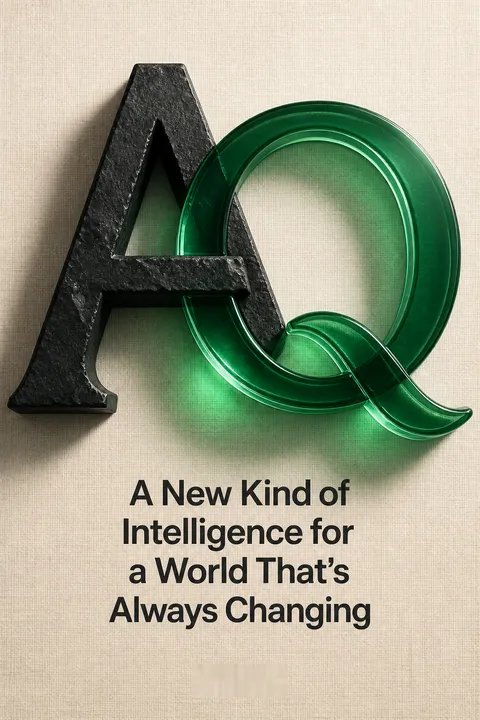

Key Takeaways
1. AQ is the Essential Intelligence for a World Defined by Constant Change
What we really need is a new kind of intelligence that directly addresses our ability to handle today’s ever-fluctuating challenges and opportunities.
Stability is a myth. The world is no longer predictable; it's a dynamic, unstable environment where change is the rule, not the exception. Traditional measures of intelligence like IQ (Intelligence Quotient) and EQ (Emotional Quotient), while valuable in their time, are insufficient for navigating this new reality. We are often trapped by the "End of History Illusion," believing we've stopped growing, and the "status quo bias," which compels us to resist change for perceived safety.
A new intelligence. Agility Quotient (AQ) is defined as "the ability to handle change, uncertainty, and the unknown." It's a crucial aptitude for individuals and organizations alike, as evidenced by the rapid shifts in careers (Gen Z will have 18 jobs across 6 careers) and corporate lifespans (S&P 500 companies averaged 61 years in 1958, now 18). AQ empowers us to not just survive, but thrive, in this turbulent landscape.
Beyond IQ and EQ. IQ, emerging from industrialization, focused on ranking aptitude, while EQ, born from knowledge work, emphasized interpersonal skills. AQ is the next evolution, directly addressing our capacity to adapt to unprecedented technological advancement and constant flux. By naming and defining AQ, we imbue it with the importance it deserves, making it an observable and actionable way of being that impacts every facet of our lives.
2. Understand Your AQ Archetype to Harness Your Innate Agility
Irrespective of your AQ Archetype, you are capable of thriving in the proverbial Sonoran Desert of life, but the first step is to know what Archetype you are at your core.
Four unique styles. The book introduces four AQ Archetypes—Neurosurgeon, Novelist, Firefighter, and Astronaut—each with distinct strengths, challenges, and motivations for handling change. These archetypes are not hierarchical; none is inherently "better" than another. Instead, they offer a thematic lens for self-observation, helping us understand our default reactions to Proactive Change (initiated by us) and Reactive Change (unwanted, unpredictable events).
Archetype breakdown:
- Neurosurgeon: Motivated by excellence, slow at both proactive and reactive change. Strengths: steadfast, determined, expert. Challenges: perfectionism, fear of failure, skepticism.
- Novelist: Motivated by freedom, fast at proactive change, slow at reactive change. Strengths: visionary, future-forward, inspiring. Challenges: avoids difficult situations, overwhelmed by unwanted change.
- Firefighter: Motivated by impact, slow at proactive change, fast at reactive change. Strengths: excels in chaos, energetic, calm. Challenges: neglects planning, tolerates high stress, may create chaos.
- Astronaut: Motivated by passion, fast at both proactive and reactive change. Strengths: quick to evolve, authentic, bold. Challenges: overlooks details, impatience, difficulty rallying others.
Leverage diversity. Understanding your Archetype, and those of others, is crucial for building high-AQ teams and relationships. By recognizing and appreciating diverse approaches to agility, we can learn from one another, augment weaknesses, and divide tasks effectively. For instance, a Neurosurgeon's diligence can balance a Firefighter's spontaneity, creating a more robust collective response to CHURN.
3. Master the Three Stages of AQ to Consistently Embrace Change
Everything changes, and I embrace it—This is the Full AQ Stage, the highest form of agility.
CHURN is constant. Life is a succession of "CHURN"—Change, Hiccups, Uncertainty, Rupture, and Newness—ranging from minor daily disruptions ("little CHURN") to life-altering events ("big CHURN"). Our response to this constant flux determines our agility, and we typically move through three stages: Avoidant, Fighting, and Full AQ. The goal is not perfection, but continuous improvement and mastery of the Full AQ Stage.
The three stages:
- Avoidant Stage: "Everything changes, and I resist it." Characterized by rigidity, withdrawal, and being stuck. We ignore pain, pretend everything is okay, and lack confidence to confront CHURN. Example: Ignoring market shifts in a business, distracting oneself from a partner's potential layoff.
- Fighting Stage: "Everything changes, and I deal with it." Marked by strenuous effort, criticism, negativity, and energy-wasting. We take action but are unhappy, blaming others or lamenting our fate. Example: Working 80-hour weeks to save a company while exhausted and resentful.
- Full AQ Stage: "Everything changes, and I embrace it." The highest form of agility, characterized by a logical, unemotional, and thankful mindset. We stop asking "Why is this happening to me?" and instead ask "How might this be happening for me?", finding silver linings and feeling empowered. Example: Embracing a chaotic writing process, finding gratitude in unexpected challenges.
Shift your mindset. Moving from Avoidant to Fighting requires building confidence, while transitioning to Full AQ demands cultivating a positivity bias. This means accepting unpleasant CHURN as natural, learning from setbacks, and holding both positive and negative emotions simultaneously. Your personal AQ influences everyone around you; by embodying the calm, clear, and grateful mindset of Full AQ, you become a powerful role model.
4. Cultivate Anchors to Ground Yourself Amidst Life's Turbulence
Anchors are what steady us in the turbulence of CHURN.
Stability in flux. Anchors are the people, places, and routines that provide stability and grounding in our lives, especially during periods of intense CHURN. They are comforting, familiar, and essential for maintaining calm in rough seas. The more change and uncertainty we face, the more crucial it becomes to nurture these foundational elements.
Types of anchors:
- People Anchors: Human connections that offer support, clarity, and unconditional care. Examples: close friends, family, mentors, therapists, communities. Research shows communities with stronger social ties recover faster from disasters.
- Place Anchors: Physical spaces that feel safe, secure, and stable. Examples: home, nature, libraries, places of worship, a favorite coffee shop. These provide psychological grounding, as our spirit is intrinsically connected to our shelter.
- Routine Anchors: Activities, habits, and rituals that bring structure and a sense of control. Examples: morning coffee, exercise, reading, meditation, specific daily tasks. Their predictability offers peace and restores energy, making us more effective.
Archetypes as anchors. Each Archetype naturally excels at being an anchor in different ways: Astronauts instill courage, Novelists provide clarity through planning, Firefighters solve problems swiftly, and Neurosurgeons offer unwavering loyalty and effort. Recognizing and appreciating these diverse anchoring styles strengthens relationships and collective resilience. By consciously identifying and investing in our anchors, we build the resilient roots necessary for agility, transforming them into powerful, life-shaping forces.
5. Overcome Ambiguity Aversion by Making Hopeful Bets on Yourself
A bet is an action you take without knowing the outcome.
The bias against the unknown. Ambiguity Aversion is a deep-seated psychological bias that makes us favor known risks over unknown ones, even if the unknown might offer superior outcomes. This evolutionary trait, once vital for survival, now keeps us clinging to the familiar, hindering our AQ and limiting our world. To expand our horizons and increase agility, we must become comfortable with ambiguity by learning to "bet."
Betting for growth. A "bet" is simply trying something new, moving forward without certainty. It's the antidote to Ambiguity Aversion, disrupting entrenched habits and launching us from the stagnation of the Avoidant Stage into the momentum of the Fighting Stage. Bets don't have to be perilous; they can be low-stakes choices like trying a new route to work, expressing feelings, or asking for more responsibility. The key is regularity, which builds comfort with the unknown.
Hopeful vs. hedging. We face a choice with every bet: a hopeful bet (optimistic, expansive, energizing, focusing on what could go right) or a hedging bet (cautious, self-protective, fear-based, focusing on what could go wrong). While hedging protects from disappointment, it also prevents us from achieving what we truly want. To bet well, we must choose hope, as it stretches, shapes, and expands our lives. The more we want to avoid a bet, the more we need to do it, and if an idea persists for 24 hours, act on it within 48.
6. Transform Every Experience into a Classroom for Lifelong Learning
Nothing ever goes away until it has taught us what we need to know.
Life's persistent lessons. This profound insight suggests that challenges ("CHURN") will recur until we extract the necessary lessons. Embracing a "Classroom" mindset means treating every moment, big or small, as an opportunity for learning, thereby increasing our AQ. This shifts our perception from "Why is this happening to me?" to "What can I learn from this?", turning obstacles into teachable moments.
From Know-It-All to Learn-It-All. High AQ requires a cultural shift from being a "Know-It-All" (proud of expertise, avoids failure, wants to be right) to a "Learn-It-All" (excited by learning, embraces setbacks, confident to say "I don't know"). This mindset, championed by leaders like Satya Nadella at Microsoft, recognizes that worth is determined by how much we embrace what we don't know, not by what we already know.
Tools for the eternal student:
- Agility Journal: Handwrite daily observations to process experiences and distill lessons. Record: one way you were rigid, one way you were agile, and something you want to remember.
- A+ Questions: Adopt an inquisitive approach, asking thoughtful questions like "Tell me more..." or "What do you mean by that?" Asking for advice is a sign of strength, not weakness.
- Learning Goal: Set meaningful objectives that align with your curiosity and improve daily life. This provides clarity and purpose, motivating continuous growth.
By adopting these practices, we become perpetual students in the classroom of life, equipped to face, learn from, and adapt to any CHURN that arises.
7. Reframe Discomfort as a Positive Signal of Personal Growth
Discomfort is deviation from normal.
The unexpected delight. Discomfort, often perceived as negative (stress, anxiety, self-doubt), is fundamentally "deviation from normal." It's a signal that you're doing something different, stretching beyond your comfort zone, and actively growing your AQ. Studies show that a life without variation leads to cognitive malfunction, highlighting our innate need for newness and the discomfort it brings.
Embracing the wave. Instead of fearing or resenting discomfort, we can reframe it as a "wave"—a gradual buildup of sensation that crests and then rolls away, predictable and temporary. This linguistic shift transforms a potentially overwhelming experience into a manageable, even meaningful, one. Just as a difficult childbirth can be both terrifying and exhilarating, discomfort can coexist with growth and enjoyment.
Strategies for navigating discomfort:
- Visualize the Crest: When at a low point, focus on the easy, enjoyable part of the experience yet to come. Envision the relief and positive outcome on the other side.
- Celebrate Yourself: Acknowledge your efforts with self-appreciation and joyful activities. Cheer yourself on vigorously, as this shifts focus from annoyance to triumph.
- "I'm Growing My AQ": Adopt this phrase as a default response to any discomfort. It's a powerful salve, reminding you that challenging moments are opportunities to improve your agility.
The connection between bets, classroom, and discomfort creates a self-reinforcing loop: taking bets inherently involves discomfort, and learning in the classroom mindset means embracing deviation from normal. Mastering discomfort is essential for high AQ, turning perceived hardship into a harbinger of positive change.
8. Prioritize Durable Skills for an Invincible and Adaptable Career
Your Durable Skills don’t just help you to hold on; they exponentially expand your options.
Beyond the career ladder. The traditional "career ladder" model is obsolete; professional life is now an "infinite rock-climbing wall" demanding versatility and adaptability. This shift necessitates a focus on "Durable Skills" over "Technical Skills." Technical Skills (e.g., coding, accounting) are specialized, job-specific, and rapidly become obsolete (half-life less than 5 years). Durable Skills, however, are broad human and cognitive abilities that are highly transferable and remain indispensable across roles, industries, and eras.
AI's impact. While AI will increasingly outperform humans in Technical Skills, it is unlikely to surpass us in Durable Skills. These include:
- Agility, clear communication, creative expression
- Confidence, self-advocacy, learning aptitude
- Hard work, resilience, bias toward action
- Empathy, active listening, self-awareness
- Critical thinking, problem-solving, receiving feedback
- Persuasion, influence, relationship building
The Hermès lesson. Émile-Maurice Hermès, seeing the decline of saddle-making (a Technical Skill), pivoted the company by leveraging its Durable Skills of innovation, design quality, and branding, making it a luxury powerhouse. Over-identifying with Technical Skills, like his brother Adolphe, leads to stagnation. Cultivating Durable Skills means prioritizing learning over short-term outcomes, embracing slower, deeper growth, and viewing ourselves as "LLMs" (Large Learning Models) that fill our "training data" with distinctly human experiences.
Archetype-specific durability. Each Archetype can enhance durability by focusing on specific areas: Neurosurgeons need to increase speed and embrace imperfection; Novelists must become more open-minded to others' plans; Firefighters need to cultivate reflection and proactive planning; and Astronauts should prioritize expertise and depth over breadth. By honing Durable Skills, we become context-agnostic, timeless, and invincible in an unpredictable world.
9. Build High-AQ Teams and Lead with Agility to Navigate Workplace CHURN
A single arrow is easily broken, but not ten in a bundle.
Diversity is strength. High-AQ teams thrive on a rich mix of personalities, perspectives, and strengths, much like a well-equipped kitchen needs more than just a spatula. Each Archetype brings unique contributions: Neurosurgeons excel at high-stakes, long-term projects; Novelists are ideal for innovation and new technology; Firefighters lead in urgent, complex situations; and Astronauts bring fearlessness to moonshots and experimental work. Homogeneity leads to rigidity; diversity fosters resilience.
Stages of AQ in teams. Teams, like individuals, operate across the three Stages of AQ:
- Avoidant Stage: Rigid, stuck, resisting change, unable to agree on problems or solutions.
- Fighting Stage: Productive but fraught with strife, criticism, and blame. They "deal with it" but with negative energy.
- Full AQ Stage: Fully activated agility, characterized by collaboration, shared ownership, and a logical, unemotional, thankful mindset. Team members embrace CHURN and shine with respect and trust.
Leading with your AQ. As a manager, your AQ profoundly influences your team. You must be their primary anchor, providing clarity and calm during turbulence, rather than escalating stress. Encourage bets by championing new ideas and taking bold swings. Foster a classroom mindset by making every interaction a learning opportunity and creating space for reflection. Finally, reframe discomfort as a signal of growth, balancing stress with celebration and recognition. Your consistent Full AQ behavior serves as a powerful blueprint, inspiring your team to follow suit.
10. Master Green & Black Thinking for Visionary Yet Pragmatic Decision-Making
The test of a first-rate intelligence is the ability to hold two opposed ideas in the mind at the same time, and still retain the ability to function.
The power of duality. Green & Black Thinking, inspired by Edward de Bono's Six Thinking Hats, is a powerful tool for navigating uncertainty by simultaneously embracing bold dreaming (green hat) and rigorous risk assessment (black hat). It's about being visionary and detail-oriented, self-confident and self-critical, allowing for both possibility and pragmatism.
The Six Thinking Hats:
- White Hat: Facts, figures, objective information (Neurosurgeon).
- Red Hat: Feelings, emotions, intuition (Astronaut).
- Yellow Hat: Optimism, benefits, upsides (Astronaut, Firefighter).
- Black Hat: Risks, limitations, what could go wrong (Neurosurgeon).
- Green Hat: Growth, creative possibility, new ideas (Firefighter, Novelist).
- Blue Hat: Process, organization, strategy (Neurosurgeon, Novelist).
NVIDIA's survival. When NVIDIA faced near-certain failure, CEO Jensen Huang employed Green & Black Thinking. He used the black hat to face the harsh reality of their failing chip and dwindling funds, letting go of 70% of staff. Then, with the green hat, he proposed a radical, unproven solution: design a new chip using an emulator and order 100,000 units without standard testing. This bold gamble, rooted in both clear-eyed assessment and creative leap, saved the company and led to its multi-trillion-dollar success.
A fountain of youth. Irving Kahn, the world's oldest active investor, worked until 108 by balancing his green hat (curiosity, optimism, founding his own fund at 73) with his black hat (scrutinizing data, dismissing hype, navigating depressions). This dual mindset fuels both excitement and discipline, enabling safe yet ambitious leaps. For Archetypes, Firefighters and Novelists need to develop their black hat, while Neurosurgeons and Astronauts need to strengthen their green hat, fostering a fluid mastery of all six hats.
11. Bushwhack Your Own Path to Forge a Unique and Resilient Future
Bushwhacking is what it looks like to reach the Full AQ Stage, and it is a hallmark of those who succeed in uncertain times.
Carving new routes. "Bushwhacking" means forging a path where none exists, a skill exemplified by ancient camels migrating from North America to Africa, or Gentoo penguins abandoning old nests for new ones. It's the ultimate expression of Full AQ, requiring strength, resilience, and imagination to navigate inhospitable, unwelcoming terrain. In a world where traditional career paths are disappearing, we must all become Bushwhackers.
Maggie Lena Walker's legacy. Maggie Lena Walker, born to a formerly enslaved woman in post-Civil War Virginia, defied immense odds to become America's first female bank president. Her extraordinary career is a masterclass in Bushwhacking, driven by:
- Dreaming: A defiant inner voice asking, "Why not me?" She saw possibilities where others saw only limitations, inspired by other fraternal societies to build a youth division, newspaper, emporium, and bank for her community.
- Taking Bets: Despite her organization being on the brink of collapse, Maggie made bold, unprecedented bets—recruiting African American women, overhauling insurance policies, and building relationships with white allies to secure a bank charter.
- Fixing: Bushwhacking isn't just about starting; it's about constant maintenance. Maggie continually fixed and rerouted her paths, closing the emporium when competition became too fierce and merging her bank during the Great Depression, demonstrating adaptability and a willingness to amend original designs.
Antidote to sameness. In an age where AI risks homogenizing our thinking, Bushwhacking is a superpower for originality. It forces us to think for ourselves, forge bespoke paths, and stand out from the crowd. By embracing dreaming, taking courageous bets, and continuously "fixing" what's broken, we cultivate the fortitude to create new trails and thrive in an unpredictable future.
People Also Read






Download PDF
Download EPUB
.epub digital book format is ideal for reading ebooks on phones, tablets, and e-readers.








































