Plot Summary
Crickets and Canon Noise
In the restless, sticky summer of 2010 in Queens, Catalina, an undocumented young woman, tries to drown out the endless cacophony of invading crickets by losing herself in books and dreams of escape. Her grandfather's nostalgia for a life back in Ecuador contrasts with Catalina's own truncated mobility and perpetual outsider status. Isolation and longing take root, shaping her worldview: books become both shield and map. The tension of being ever-watchful—of bugs, of borders, of what isn't said—coexists uneasily with her pursuit of American success stories and mythologies. Throughout, the canon—a white noise of privilege—becomes a cover, a tool, and a persistent ache of exclusion.
Miracle Child, Unseen Wounds
Catalina's status as a miracle survivor overshadows every introduction: orphaned by a car crash in Ecuador, shipped to unknown grandparents in New York, the "miracle baby" who lived when others did not. Yet, survival exacts its own cost. Catalina looks for secret evidence that her parents are alive, for a different answer as to why she was sent away. Her grandparents hope to imbue her with purpose—she must be their American success. Underneath achievement runs invisible pain: intergenerational trauma, questions left unanswered, and a deep suspicion that everything given comes from something lost, from someone left behind.
Queens: Dreams and Debts
Life in Queens is a delicate financial and emotional balancing act. Catalina and her grandparents live in a perpetual state of alert—every action, from boiling cinnamon to hiding passports, is suffused with the anxiety of not belonging. The dream of American success—embodied by Harvard—feels both dazzling and treacherous. Sacrifice is everywhere: grandparents' labor, forfeited opportunities, Catalina's relentless pursuit to justify the cost. Even achievements are weighted by the demand to stand out, to stand in for everyone who could not make the journey. Home is a fortress and a cage, filled with love and simmering resentment.
Harvard and Invisibility Tricks
Arriving at Harvard is a lesson in the performance of belonging and the art of going unseen. Catalina quickly understands that wonder is a giveaway; so is pride. To survive, she cultivates a nuanced invisibility, oscillating between standout student and background presence. The micro-calibrations of class—how to pronounce "Goethe," the etiquette of literary discussions—become a daily gauntlet. She befriends and breaks away from people easily, struggling to transmute outsider-ness into currency. Men, both benevolent and dangerous, offer her new roles and risks. Harvard is a land of unspoken rules and constant surveillance.
Family Math, Survival Calculus
Under the roof her grandparents keep immaculate, Catalina is both treasure and burden. Her grandparents' disappointments and thwarted ambitions saturate the apartment. Grandfather's pride in work turns to bitterness with aging and legal precarity; grandmother's longing for independence collides with resigned housebound existence. Their expectations for Catalina are written in gestures and sacrifices: everything is for her, but everything is also a transaction. The apartment's physical decay mirrors the fragile scaffolding of their lives, where every missed bill, every unspoken truth, threatens to collapse what security they have left.
Camilo, Internships, and Longing
In a prestigious Manhattan internship, Catalina meets Camilo, whose ambiguous background both attracts and unsettles her. Their dynamic is colored by insider-outsider jokes and mutual longing for recognition. The literary world's glamor both beckons and excludes—Catalina's labor is necessary but often invisible. All her ambitions—to be discovered, to become "Art" itself—play out against the mundane reality of navigating adult interactions with adult men. Her grandfather's stories blur with her own desires, making every small encounter a test of fate, luck, and ability to be seen on her own terms.
Muses, Mothers, and Martyrs
Family histories—real and mythologized—bear down on Catalina. Her grandmother, a reluctant caretaker and secret rebel, models what it means to endure disappointment and carve spaces of joy within constraint. Catalina resists becoming a domesticated version of her grandmother, yet recognizes the sacrifices built into her own striving. Hopes for artistic immortality and love as salvation entwine with Catholic iconography, tales of saints, and the blood-wrought narratives of Latin America. The tension between submission and revolt, memory and forgetting, drives her relentless self-invention.
Edges of Belonging
Caught between Catholic and Jehovah's Witness traditions, between legal invisibility and American citizenship, Catalina tiptoes on the edges of every group she enters. She doubts the narrative of being "spared" or "chosen" while resisting the obligations such narratives entail. Laws and religious codes become competing systems of exclusion. The DREAM Act becomes a distant possibility—a legislative promise that never quite arrives. In every heartbreak, burned bridge, or intellectual failure, Catalina is reminded of how conditional every belonging is, and how quickly it can be revoked.
The Politics of Becoming
As her Harvard career develops, the contrast between apparent meritocracy and underlying inequity sharpens. Friendships become strained over politics (the DREAM Act, voting), personal failures accumulate, and the brief safety of academia is revealed as contingent and expensive. The prize-winning moments are hollowed by endless legal and financial precarity. Mentor figures—professors, editors—offer affirmation but also reinforce Catalina's sense of outsider-ness. All the while, national politics churn at the borders of her experience, threatening to upend the fragile order Catalina has built.
Friendships: Love and Friction
Delphine, Catalina's closest friend, mirrors and complicates her sense of identity. Both are "outsiders" navigating Harvard, yet their differences (religion, citizenship, background) generate tension and heartbreak as much as affection. Their relationship is urgent, intimate, and full of sharp edges. Celebrations of shared pain become battlegrounds for loyalty; misunderstandings over voting or family origin mask deeper wounds. The push-pull dynamic—needing each other, failing each other—underscores the difficulty of true belonging for anyone not born inside the club.
Museums, Memory, and Meaning
Catalina's work cataloguing artifacts at the Peabody Museum exposes her to the strange afterlives of plundered objects. She is drawn to the khipu—ancient Andean record-keeping devices—which represent memory, power, and erasure. Handling these artifacts, she grapples with her own longing for origin and the impossibility of recovering what's lost. Museums appear as both sanctuaries and scenes of ongoing colonial violence. The themes of translation, touch, and ownership map seamlessly onto Catalina's evolving self-understanding—she, too, is archive and subject, object and teller.
Flirting with Prestige
Catalina's interactions with men (Nathaniel, Kyle, Camilo, Byron) are filtered through the lens of class, race, self-performance, and ambition. Sexual dynamics at Harvard are transactional, performative, and sometimes genuinely tender, but always inflected with the politics of who gets to possess, to name, to exoticize. Literary and artistic recognition is intoxicating, but fraught with the fear of being reduced to a story, a stereotype, or someone else's project. Catalina's navigation of desire and ambition involves endless recalibration—how much to give, how much to withhold, how to control her own image.
Fatherlands Lost, Fathers Gone
The death of Catalina's uncle—her "second father"—precipitates a crisis in her immediate family and within herself. Her grandfather's despair becomes dangerous, physically and emotionally; her grandmother's resilience turns brittle. The bonds which tether Catalina to family are both lifesaving and suffocating, forcing her to confront the limits of loyalty, love, and self-determination. As old ghosts resurface—bereavement, abandonment, the threat of deportation—the futility of striving for safety or closure comes into painful focus.
Love, Power, and Self-Invention
Relationships begin, sour, break, and sometimes reassemble. The thrill of being wanted, the ache of being misrepresented, and the exhaustion of always performing—Catalina cycles through encounters with lovers and would-be saviors, sometimes taking power, sometimes ceding it, always wrestling with the line between reality and narrative. Her creative work—a would-be documentary, stories crafted for others—mirrors her self-shaping in intimate spaces. Reckless acts and small flourishes of care alike are entangled in her ongoing process of becoming.
Trauma, Truth, and Telling
As her grandfather faces deportation, Catalina becomes both advocate and archivist, compiling documents and seeking help with a doggedness born of love and desperation. Acts of storytelling become acts of survival—the stories she crafts about her grandparents, lovers, self, are polished until they fit the desired frame. But the violence of bureaucracy, history, and heartbreak always threaten to outpace narrative containment. Each attempt to "fix" the past, to arrange the present, exposes the limits of memory, truth, and agency for the undocumented.
Vanishing Acts and Aftermath
The sudden, silent departure of Catalina's grandfather devastates what remains of her family, leaving Catalina and her grandmother to mend the absence as best they can. Every object becomes hypercharged with memory; every act of remembering risks wounding anew. As public and private griefs intertwine—with the broader violence against women, migrants, and the vanished—Catalina resists closure, refusing the tidy endings or easy redemptions others might want for her story.
Heirlooms, Stolen and Kept
Catalina's inheritance arrives as a scrap of khipu and a box of broken, cherished things—part gift, part curse, both priceless and incriminating. The stolen artifact links Catalina's family's fate with the wider narrative of conquest and erasure, complicating any notion of rightful ownership. Legacies are not only blood, but story, risk, and wound. The objects Catalina keeps or discards are weighted with consequence, reminding her that memory itself is contested ground—a treasure, a liability, a truth too knotted to untangle.
Afterlives: Grit and Grace
The story does not resolve with neat justice, nor martyrdom. Catalina, shaped by loss and resilience, honors her scars—the visible ones and those hidden—to carve out a future alongside her grandmother. Friends drift, fragments of love persist, and the perennial tension between hope and realism remains. Teaching, caretaking, and ongoing advocacy are not glamorous, but they are the means by which Catalina and those like her continue: not as saints or victims, but as complex survivors—gritty, wry, and always rewriting what comes next.
Analysis
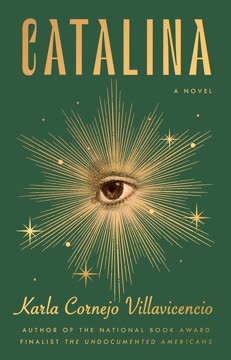
Catalina by Karla Cornejo Villavicencio is a dazzling and wrenching portrait of immigrant girlhood and the American myth of upward mobility, wrapped inside the barbed wire of real-world precarity. It deconstructs the "coming-of-age" novel by showing not simply the cumulative weight of trauma, love, and striving, but how those weigh differently when every achievement is haunted by possible erasure. Through sharp humor, biting self-awareness, and cultural references that oscillate from highbrow to pop, the novel interrogates what it means to inherit trauma, to "owe" your existence to someone else's gamble or loss, and to both belong to and be used by the institutions—family, nation, university—that claim to save you. The khipu—a knotted, unreadable record—becomes a central metaphor for immigrant identity: history cannot be fully recovered, only witnessed and sometimes stolen. Ultimately, Catalina refuses to become a symbol or poster child, rejecting the simplifications of narrative closure. Instead, her story insists on the dignity of the complicated, the unfinished, the temporarily safe. The lesson is not just one of resilience, but of the cost and possibility of surviving—even thriving—on the wrong side of every border, real and imagined.
Review Summary
People Also Read




Characters
Catalina Ituralde
As narrator and protagonist, Catalina's intelligence and humor cut through her story's traumas and ironies. A child survivor of a car crash, orphaned and sent from Ecuador to America, she is raised by grandparents who see her as both a burden and a vessel of hope. Marked by displacement and shaped by undocumented status, Catalina internalizes the expectations of others even as she rebels against them. Her psychological complexity is rooted in a deep skepticism about narrative itself: is she living for herself, for her ancestors, for "America," or for an audience watching from afar? Catalina's strategies—self-invention, biting wit, self-destruction, perfectionism—are as much adaptive as they are self-preserving. Through love, loss, and fleeting triumphs, she contends with the fear that nothing she achieves will ever undo the sense of being unmoored. In the end, her agency lies in embracing the mess: she is valedictorian of the abandoned, a girl with a future only as open as the stories she dares to tell.
Abuela (Fernanda)
Fernanda, Catalina's grandmother, is both caretaker and co-conspirator, ambitious but resigned. Her own youth was marked by neglect and displacement, and though she carves small joys out of relentless hardship, her longings for economic agency and feminine freedom remain unfulfilled. She evinces tenderness in private rituals—helping Catalina get ready, sharing stories—but can also be cold or evasive, refusing to dwell on legal status or lost histories. Her journey is one of making do: denial where survival demands it, flashes of irreverence when the world is not watching. The complicated inheritance she gives Catalina is not just material, but psychological—refusing self-pity, yet unable to fully offer protection or belonging. After her husband's disappearance, Fernanda reinvents herself for survival, confirming her unbreakable, if raw, strength.
Abuelo (Francisco)
Catalina's grandfather embodies the classic arc of an exile whose pride and bitterness are products of both historic injustice and personal thwarted ambition. He vacillates between loving mentorship and controlling patriarchy, sometimes nurturing, sometimes wrathful. Haunted by just-missed opportunities—especially the failed chance at citizenship—he becomes obsessed with stories of Latin American resistance, oratory, and survival, passing them down to Catalina as lessons and as burdens. Wounded masculinity and failed protector fantasies drive him to both outbursts and, ultimately, disappearance; his love is never simple, never entirely safe, but impossibly central. The talismans he leaves behind—chains, stories, even stolen artifacts—are loaded with both meaning and pain.
Delphine Rodriguez
Delphine, Catalina's closest friend at Harvard, is a study in parallel difference: both outcasts who've internalized survival's lessons, yet shaped by divergent paths (race, citizenship, family). Their urgent, possessive friendship is intimate but full of betrayals and silences. Delphine's own trauma—maternal suicide, Black-Latina identity—colors her every interaction. Still, her practicality and fierce loyalty often anchor Catalina. Both competitive and affectionate, their relationship exposes the jagged edges of solidarity and the impossibility of uncomplicated healing for women at the margin.
Nathaniel Wheeler
Nathaniel, the privileged son of a famous filmmaker, becomes Catalina's romantic interest and a mirror for her own longing for authenticity and belonging. His attraction to Catalina is colored by exoticizing tendencies and a kind of "anthropological" curiosity; he embodies the contradictions of well-meaning, progressive upper-class America—genuine affection, unconscious privileges, occasional blindness. Their dynamic is passionate but tinged with miscommunications and the constant threat of disappointment. Nathaniel's efforts to honor Catalina are sincere, but they cannot bridge the chasms of experience and power between them.
Kyle Johnson
Kyle's friendship with Catalina offers one of the few uncomplicated spaces of support and welcome, even as their friendship is not without its limits. As a Black, Jewish, queer Harvard student, he understands the double consciousness Catalina lives with, and their shared outsider status allows for moments of vulnerability and mutual rescue. He is perceptive, funny, and keeps Catalina grounded in both political and personal reality, often helping her navigate institutional codes and class performance.
Camilo Oliveres
Camilo, another intern at the literary magazine and an ambiguous figure (Spaniard by blood, Mexican by birth), offers Catalina a tantalizing blend of insider cultural knowledge and outsider status. Their flirtation is marked by mutual wariness—bonds over language, jokes, music—but cannot escape the gravitational pull of Catalina's self-sabotage and ambition. Camilo is less a fully formed partner than a touchstone for what might have been—another survivor, another possibility.
Professor Ruby Sandoval
The first tenured Latina professor at Harvard, Sandoval begins as a possible ally and role model for Catalina but ultimately functions as a complex, sometimes disappointing guide. Hard, demanding, and not easily impressed, Sandoval pushes Catalina to recognize her own intellectual laziness and internal contradictions. Their relationship stings because it carries the weight of representation and expectation, forcing Catalina to confront the limits of shared identity.
Byron Wheeler
Nathaniel's father, a celebrated filmmaker, becomes both opportunity and threat for Catalina. His interest in documenting Catalina's story (and trauma) embodies the complicated dance between powerful gatekeepers and the people whose pain they commodify or elevate. There are moments of real mentorship and possibility, but the project is always fraught—Catalina is invited in as both subject and object, never fully in control.
Don Luis
Don Luis, the neighborhood notario and quasi-lawyer, is a stand-in for the "old world" modes of survival and negotiation. He serves as connector for Catalina's family in moments of crisis—be it paperwork, deportation, or clandestine difficulties. His presence is a reminder of the parallel institutions that sustain immigrant communities, sharing advice, resources, and sometimes dubious moral logic.
Plot Devices
Shifting Narrative Structures and Narrative Self-Invention
The novel tirelessly foregrounds the act of storytelling—in letters, documentary footage, personal essays, childhood fantasies, and even college applications. Catalina's voice moves from witty detachment to wounded intimacy, from the omniscient self-commentary of the campus novel to raw documentary realism. Metafictional play (the documentary project, essays within the text) blurs the lines between teller and tale, challenging readers to ask whose story is being told and for whose benefit. This patchwork structure mirrors the immigrant experience: memory is fragmented, history is suspect, and identity is endlessly re-edited in the face of systemic erasure.
Object Motifs: Khipu, Artifacts, and Heirlooms
The Andean khipu becomes a central, enigmatic symbol: a device for recording history, but also a site of loss, violence, and resilience. The khipu's unknowability (like the past) stands for everything Catalina can never fully access: her parents' stories, her family's reasons, a "true" account of Latin America. Other objects—crucifixes, letters, museum pieces, gold chains—likewise accrue meaning as records and reminders of what cannot be kept whole.
Foreshadowing and Mirroring
Elements from early in the narrative (the cricket invasion, acts of hiding, stories of saints or martyrs) repeat in different forms, suggesting a world stuck in patterns of disappearance and return. Childhood survival stories foreshadow future crises—family members vanished, legal statuses revoked, relationships cut short. The bunkered secrecy that defined Catalina's childhood is mirrored by clandestine adult actions: stashing documents, hiding love, hiding trauma.
Double Consciousness, Passing, and Performance
The recurring theme of performance—of race, class, gender, and nationality—structures nearly every interaction. Academic life, romance, even family relationships are characterized as auditions or con games, sharpening the awareness of being observed, mistaken, or misread. This self-consciousness is both a shield and a source of fatigue, as Catalina oscillates between desirability, disgust, and invisibility.
Political Stakes and Bureaucratic Clock
The narrative is punctuated by legal deadlines, legislative fights (DREAM Act), and the intrusion of government paperwork. Each document, each hearing, is both a plot device and an existential threat, lending urgency to otherwise everyday actions. Time is always running out—on contracts, on visas, on relationships, on graduations—forcing Catalina and her family into ever more desperate calculations.








































