

Key Takeaways
Some things get stronger when you shake them: name it antifragile
English lacks a word for gaining from disorder. We call the breakable "fragile" and its opposite "robust" or "resilient." But robust just means unharmed. Taleb coins antifragile for the true opposite: things that improve under stress, volatility, and shocks. Three mythological figures map the spectrum: Damocles, whose sword hangs by a hair, is fragile. The Phoenix, reborn identical from ashes, is robust. The Hydra, which grows two heads for each one severed, is antifragile.
The property is everywhere once named. Muscles thicken under load, bones densify under weight, bacterial colonies toughen against antibiotics, and revolutions swell under repression. Deprive these systems of stressors and they atrophy, like a body confined to bed rest. Half of existence had no name because our formal minds ignored it, even as our instincts relied on it.
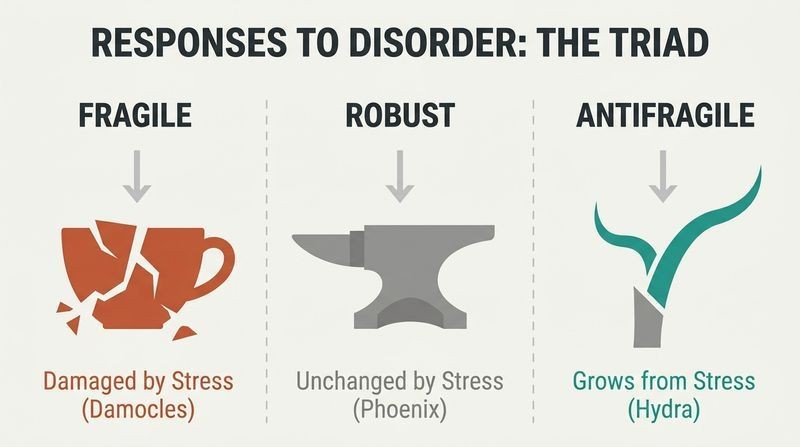
What's striking is how naming a concept expands what we can perceive, echoing the linguistic relativity Taleb invokes with Homer's "wine-dark sea" and cultures lacking a word for blue. The distinction between resilience and antifragility is genuinely useful and often collapsed by careless readers. One nuance worth flagging: antifragility is always bounded and domain-specific. Bones love load until they shatter, colonies toughen until eradication. This mirrors hormesis in toxicology, where small doses stimulate and large ones kill. The concept resembles Stuart Kauffman's "order for free" in complexity science, where systems self-organize at the edge of chaos rather than in dead equilibrium.
Stop forecasting rare events; measure how badly they'd wreck you
Fragility is measurable; risk is not. Taleb's central methodological pivot: predicting when a Black Swan (a rare, high-impact, unforeseen event) will strike is mathematically hopeless, because the rarer the event, the less data exists and the wilder the model error. But you can assess present fragility right now. You can tell your grandmother is more vulnerable to temperature swings than you, that a debt-loaded bank is more fragile than Switzerland, that Chartres Cathedral will outlast a shoddy modern tower.
Use the asymmetry test. Anything with more upside than downside from random shocks is antifragile; the reverse is fragile. This flips risk management on its head. Instead of forecasting the tsunami, build so a tsunami barely dents you. Not seeing the crisis coming is excusable; building something that shatters when it arrives is not.
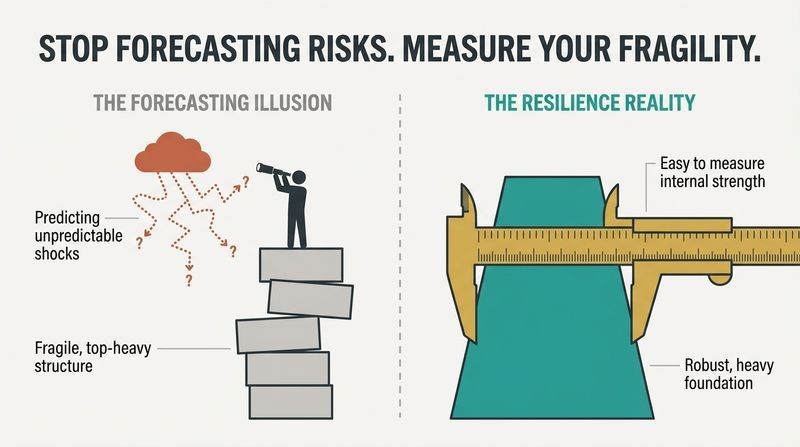
This reframing is the book's most practically potent move, and it aligns with engineering safety philosophy, where designers assume failure and build margins rather than predict exact load conditions. It also anticipates the replication crisis and the general failure of expert forecasting documented by Philip Tetlock, whose research shows pundits barely beat chance on political predictions. A fair challenge: measuring fragility still requires some model of what "shocks" a system faces, and Taleb's confidence that fragility is cleanly detectable can understate cases where the exposure itself is hidden. Still, shifting attention from probability to consequence is a durable, transferable discipline.
Systems thrive on stressors; suppressing volatility breeds hidden catastrophe
Smoothing out small shocks stores up giant ones. Taleb calls the impulse to tame every fluctuation "touristification." A forest denied small fires accumulates flammable brush until it explodes. An economy denied recessions builds silent vulnerabilities until it collapses. James Clerk Maxwell proved mathematically in 1867 that tightly controlling a steam engine's speed causes instability.
Switzerland versus the nation-state illustrates it. Taleb's favorite example: the most stable country on Earth has no strong central government, only bickering cantons producing constant, harmless municipal noise. Contrast Syria's Baath Party, which centralized the chaotic souks into crisp office buildings and sent the trading families fleeing. Suppressed volatility produces the "Great Turkey Problem": a turkey fed daily grows more confident of the butcher's love right up until Thanksgiving. Calm surfaces conceal accumulating risk.
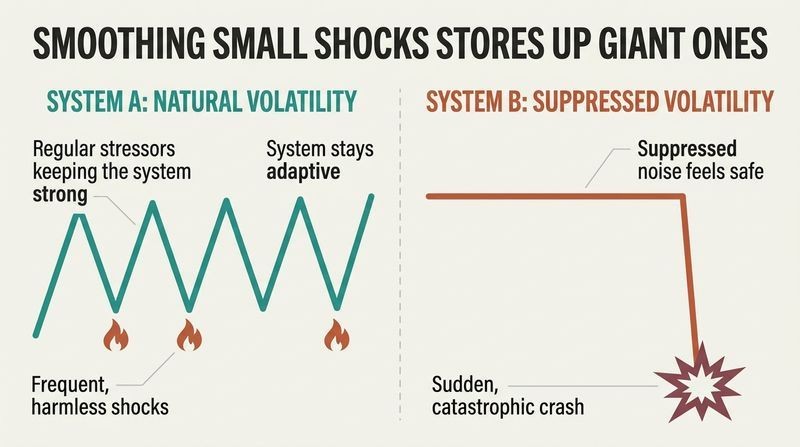
The forest-fire analogy has strong empirical backing in ecology, where fire suppression policy in the American West is now widely blamed for catastrophic megafires. The economic parallel gained credibility after 2008, when the "Great Moderation" of suppressed volatility preceded the crash, exactly as this logic predicts. The insight connects to Hyman Minsky's financial instability hypothesis: stability itself breeds instability by encouraging leverage. A caveat: not all volatility is productive, and distinguishing cleansing small shocks from genuinely destructive ones is harder in practice than the forest metaphor suggests. Deciding which fires to let burn remains a judgment call, not an algorithm.
Build a barbell: pair extreme safety with tiny wild bets
Avoid the mushy middle. The barbell strategy combines two extremes with nothing in between: overwhelmingly conservative on one end, aggressively speculative on the other. In money, put roughly 90% in cash-safe assets and 10% in maximally risky ventures. Your worst case is capped at losing the 10%, while your upside stays unlimited. Someone "medium risk" across the board can be wiped out entirely by a mismeasured tail.
It applies far beyond finance. Writers take a dull, secure day job (Kafka at an insurance firm, Spinoza grinding lenses) so their pen stays free. Certain monogamous birds pair with a stable provider yet occasionally mate with the alpha. In health: be paranoid about ruin (no smoking, no motorcycles) yet aggressive elsewhere. Clip the catastrophic downside first, then let the upside run.
The barbell is essentially a practical expression of convexity, and it rhymes with modern approaches like the Kelly criterion and Nassim's own tail-hedging funds, which lose small amounts for years then profit enormously in crashes. It also resembles venture capital's power-law logic: many bounded losses, a few uncapped wins. The deeper wisdom is treating survival as strictly prior to optimization, a point behaviorally supported by prospect theory's finding that losses loom larger than gains. One tension: rigid barbells can leave value on the table in genuinely stable environments, and the strategy presumes you can actually identify which exposures carry ruin risk.
Optionality lets you win without knowing where you're going
Thales bought the right, not the obligation. The philosopher, mocked for being poor, cheaply reserved every olive press before a bumper harvest, then sublet them at a premium. Aristotle credited superior astronomy; Taleb says the real engine was optionality: a small fixed cost for a large uncertain upside. An option is asymmetry plus rationality (keep what works, discard what doesn't).
Optionality substitutes for intelligence. With capped downside and open-ended upside, you don't need to be right often or predict the future, you just need to recognize a good outcome and grab it. Nature exploits this through tinkering: about half of embryos spontaneously abort rather than being designed perfectly. This is why trial and error beats grand planning, and why the wheeled suitcase took 6,000 years after the wheel, waiting not for genius but for someone to exercise the obvious option.
This is arguably the book's most generative idea for entrepreneurs and researchers, and it dovetails with Steven Johnson's work on innovation emerging from recombination rather than eureka planning. Optionality reframes evolution, science, and business as harvested randomness rather than directed intelligence, echoing François Jacob's "bricolage." The practical directive, invest in people who can pivot six times rather than in fixed business plans, mirrors real venture practice (bet on the jockey, not the horse). A useful challenge: options are not truly free when they carry opportunity costs, cognitive load, or commitment costs, and endlessly keeping options open can itself become a failure to commit, as loyalty in human relationships demands.
Practitioners tinker breakthroughs; academics lecture birds on how to fly
Knowledge flows from doing to theory, not the reverse. The dominant story says academic science yields technology yields growth. Taleb calls this the lecturing-birds-how-to-fly illusion: professors watch birds fly, publish papers, then claim credit for flight. In reality, the steam engine, the jet engine, architecture, and derivatives pricing all came from tinkerers who couldn't explain why their methods worked. Theory arrived afterward to take the credit.
Wealth precedes education, not the reverse. Taiwan had lower literacy and half the income of the Philippines in 1960; today it earns ten times more. Rich countries fund universities, then mistake the correlation for causation, an epiphenomenon. The green lumber fallacy captures the deeper point: a trader made a fortune in "green lumber" believing it was painted green, not freshly cut. Necessary knowledge for doing is not the knowledge that sounds important.
This is Taleb's most contrarian and contestable claim, and historians of science genuinely split on it. His allies include Terence Kealey and the empirical weakness of the "linear model" of innovation. But the counterexamples are formidable: the transistor, nuclear power, GPS, and mRNA vaccines drew heavily on deep theory. The honest synthesis is probably that the theory-to-practice arrow runs both directions, with feedback loops, and Taleb overcorrects a real overstatement in the other direction. Still, the green lumber fallacy is a sharp cognitive tool: expertise in a domain and the ability to articulate that domain are distinct skills, frequently confused by credential-worshipping institutions.
Refuse the free option: demand skin in the game
The gravest modern injustice is asymmetric exposure. Some people harvest the upside while transferring the downside to others, a hidden option at society's expense. Bankers keep bonuses when bets pay off and stick taxpayers with the losses. Robert Rubin earned $120 million from Citibank, then kept it when the bank collapsed and required a bailout. Forecasters and pundits like Thomas Friedman face no penalty for catastrophically wrong advice.
Hammurabi solved this 3,800 years ago. If a builder's house collapses and kills the owner, the builder is put to death. The builder knows more than any inspector about risks hidden in the foundations, so align his fate with the structure's. Taleb's rules: never board a plane if the pilot isn't aboard; never trust a forecast from someone with nothing to lose. Heroism is the inverse: taking the downside for others.
Skin in the game may be the book's most morally resonant and enduring contribution, later expanded into its own volume. It unifies ethics, epistemology, and risk into a single principle and connects to principal-agent theory in economics, though Taleb pushes further by demanding symmetric downside, not just aligned incentives. The Hammurabi example is vivid, but literal life-for-life liability would today deter all risk-taking, so the workable version is calibrated exposure, not draconian punishment. The deeper insight, that filtering opinions by what someone personally risks, is a fast heuristic against charlatans, echoing Charlie Munger's dictum: show me the incentive and I'll show you the outcome.
Fragility is nonlinear: one big rock beats a thousand pebbles
Harm accelerates with intensity. A king vows to crush his son with a stone, then, regretting it, has the stone broken into pebbles to pelt him harmlessly. The difference reveals fragility's signature: a 10-pound stone does more than ten times the damage of a 1-pound stone. Jumping once from 30 feet kills; jumping 30 times from one foot doesn't. This curved, accelerating response is concavity, and it is the mathematical fingerprint of the fragile.
Convexity is the mirror image and it is good. Things that gain disproportionately from variation curve the other way. This yields a detection heuristic: probe a system with small and large shocks. If harm accelerates, it's fragile. It also explains why size kills: doubling a company's size more than doubles its vulnerability to squeezes, why traffic collapses nonlinearly past a threshold, and why megaprojects overrun catastrophically.
Grounding fragility in Jensen's inequality gives the book rare analytical spine, transforming a philosophical intuition into something measurable. The nonlinearity insight explains phenomena across scales: why the Societe Generale fire sale of $70 billion lost billions while ten smaller banks would have lost nearly nothing, and why elephants break limbs from falls that cats survive. The practical payoff is the fragility-detection heuristic Taleb developed with the IMF, which needs no accurate forecasting model, only a probe of second-order response. One limitation: real systems mix convex and concave regions, and identifying the relevant stress range requires domain knowledge that the elegant math alone cannot supply.
Subtract to improve: removing beats adding almost every time
Via negativa is the robust path to knowledge and health. We know what is wrong with far more certainty than what is right. A single black swan disproves "all swans are white," but no number of white swans proves it. So knowledge grows more reliably by subtraction, by removing errors, than by addition. Michelangelo reportedly carved David by removing everything that wasn't David.
In medicine, iatrogenics makes this urgent. Iatrogenics means harm done by the healer. George Washington was likely killed by his doctors' bloodletting. Removing smoking arguably delivered more benefit than every medical advance since World War II combined. Charlatans always sell positive advice (ten steps to riches); the wise subtract. Chess masters win by not losing; people get rich by not going bust. Taleb applies it to diet, removing sugar and modern foods rather than adding pills.
Via negativa is intellectually rigorous, resting on Popper's asymmetry between falsification and confirmation, and it offers a genuinely different heuristic from the addition-obsessed self-help genre. The medical application is well-supported: overdiagnosis and overtreatment are documented harms, and the burden-of-evidence reversal (the unnatural must prove itself, not the natural) is a defensible precautionary stance. The dietary and lifestyle prescriptions are more speculative and lean on ancestral-appeal reasoning that can shade into the naturalistic fallacy, which Taleb acknowledges applies to ethics but claims not to risk management. The core principle, that eliminating downside is more robust than chasing upside, transfers powerfully to decision-making generally.
The old survives for reasons we can't see: respect the Lindy effect
Nonperishable things age in reverse. For a person, each passing year shortens remaining life expectancy. For an idea, a book, or a technology, each year survived predicts a longer future. A book in print 40 years will likely stay in print 40 more; survive another decade and its expectancy grows again. Time is the ruthless, incorruptible tester that our logic and narratives cannot match.
This kills neomania. Neomania is the love of the new for its own sake. Futurists err by adding gadgets to the present; the rigorous forecast subtracts the fragile. Taleb walks to dinner in shoes like a 5,300-year-old mummy's, uses Mesopotamian silverware, drinks millennia-old wine. What has survived long has proven its match to human nature, like Empedocles's dog always sleeping on the same tile. To read the future, mine the past.
The Lindy effect, formalized with Mandelbrot, gives a probabilistic backbone to conservatism about ideas and technologies, and it is empirically testable: Richard Gott used similar reasoning to predict Broadway show runtimes with 95% accuracy. It offers a filtering rule for information overload, favor sources that have already survived decades, that is genuinely useful in an age of hype. The sharpest caveat, which Taleb himself grants, is conditional: the effect describes averages, not individual doomed technologies like landlines. The tricky part is defining the reference category, since a technology can be framed narrowly or broadly, changing its apparent life expectancy considerably.
More data means more noise, more overreaction, more harm
Frequency of observation determines the noise ratio. Look at data yearly and you might get half signal, half noise. Look hourly and it becomes roughly 99.5% noise. The neurotic who reacts to every fluctuation is responding to static; the composed leader reacts only to real information. Modernity floods us with data, transforming calm people into anxious ones and driving compulsive, harmful intervention.
In research, abundance breeds spurious findings. With 200 unrelated variables, high correlations appear by pure chance. This is the tragedy of Big Data: false relationships multiply faster than real ones because noise is convex to the number of variables. Cherry-picking becomes industrialized. The remedy is naturalistic rationing of information and via negativa, using data to debunk rather than confirm. Alan Greenspan tracking vacuum cleaner sales in Cleveland micromanaged the economy into chaos.
This anticipates the reproducibility crisis with uncanny precision: John Ioannidis's landmark finding that most published research findings are false rests on exactly the multiple-comparisons and researcher-degrees-of-freedom problems Taleb describes. The signal-to-noise argument also has behavioral support in the finance literature, where frequent portfolio monitoring correlates with worse returns due to loss-aversion-driven churning. The information-fasting prescription is countercultural but increasingly validated by attention research. A reasonable pushback: some domains genuinely reward high-frequency data (weather, logistics, high-frequency trading itself), so the rule is domain-dependent rather than universal. The deeper point stands, that treating more information as automatically better is a dangerous and widespread modern superstition.
Everything alive gains from volatility; deprive it and it dies
The whole book collapses to one line. When a friend asked Taleb to explain the book standing on one leg, the answer was: fragility is what loses from volatility and uncertainty; antifragility is what gains. The glass on the table is short volatility, it can only break. Living things are long volatility, they need variation to exist. Food has no taste without hunger; joy needs sadness; conviction needs doubt.
Mortality of parts fuels antifragility of the whole. Every restaurant is fragile and many go bankrupt, which is exactly why the restaurant industry delivers reliable quality. Entrepreneurs fail so the economy evolves; they deserve honor like fallen soldiers. Individual organisms die so genes improve. The tragedy of modernity is that it fears volatility and, by suppressing it everywhere, in bodies, economies, and politics, makes the world more fragile and more prone to the very catastrophes it dreads.
The layered structure, where fragile components generate an antifragile system, is the book's most sophisticated systems-thinking contribution, and it resolves an apparent paradox: cruelty at the unit level (bankruptcy, death) produces robustness at the aggregate. This mirrors evolutionary biology's distinction between the disposable soma and the immortal germline, and complexity science's finding that adaptive systems require component turnover. The moral discomfort Taleb voices, that this logic makes individuals expendable, is honest and important, and it tempers the ideology with humanism: shield people from ruin even while letting the system churn. The one-line distillation is a genuine test of the framework's coherence, and it largely passes.
Analysis
Antifragile is the capstone of Taleb's Incerto, a thesis-driven philosophical treatise disguised as a sprawling anthology of maxims, ancient anecdotes, and technical appendices. Its difficulty for a summarizer is precisely its strength: the book is deliberately nonlinear, mixing Fat Tony's Brooklyn wisdom with Seneca, Jensen's inequality, and autobiographical rants. The core, though, is a single, powerful conceptual innovation: naming the third category that our vocabulary omitted. Fragile, robust, antifragile. Everything follows.
The book's most durable intellectual moves are three. First, the epistemological pivot from prediction to exposure: since rare events are incomputable, stop forecasting and start measuring fragility, which is a present property. Second, the mathematization of that intuition through convexity and Jensen's inequality, which turns a philosophical hunch into a detection heuristic that needs no accurate model, only a probe of second-order response. Third, the ethical culmination in skin in the game, which fuses risk, epistemology, and morality into one filter against the modern parasite class of bonus-collecting, downside-transferring "fragilistas."
Where the book overreaches is in its wholesale assault on academic knowledge. The lecturing-birds-how-to-fly thesis contains a real correction to naive linear-model triumphalism, but the transistor, GPS, and mRNA vaccines are stubborn counterexamples to the claim that theory rarely drives practice. Taleb's rhetorical aggression, entertaining as it is, sometimes substitutes for the calibrated argument his own probabilistic sophistication demands.
Yet the practical toolkit is unusually transferable: barbell your exposures, harvest optionality, subtract rather than add (via negativa), respect what has survived (Lindy), ration information, and demand that decision-makers bear their own downside. Read after 2008, the book reads less as provocation than as diagnosis. Its deepest contribution may be temperamental: an invitation to stop fearing disorder and to build a life, a portfolio, and a society that quietly feed on it.
Review Summary
Antifragile receives mixed reviews. Some praise Taleb's innovative concept of systems that benefit from disorder, while others criticize his writing style and perceived arrogance. Supporters find the book thought-provoking and insightful, appreciating Taleb's challenge to conventional wisdom. Critics argue that the ideas are often obvious or poorly explained, and that Taleb's tone is off-putting. The book's exploration of randomness, risk, and resilience in various domains sparks both admiration and frustration among readers, with many acknowledging its importance despite its flaws.
People Also Read
Glossary
Antifragile
Gains from disorder and stressTaleb's coined term for the true opposite of fragile: things that improve, strengthen, or benefit when exposed to volatility, randomness, errors, and stressors, up to a point. Distinct from robust or resilient, which merely resist shocks and stay the same. Examples include muscles under load, evolution, and antibiotic-resistant bacteria.
Fragilista
Harmful confident interventionistSomeone who causes fragility because they believe they understand a complex system they don't. Fragilistas suppress beneficial volatility, mistake organisms for machines, and intervene with actions whose benefits are small and visible but whose side effects are severe and hidden. Often found in suits: policymakers, bankers, and interventionist doctors.
Triad
Fragile, robust, antifragile spectrumTaleb's classifying framework placing anything into one of three categories along its response to disorder: the fragile is harmed by volatility, the robust is indifferent to it, and the antifragile benefits from it. The tool is used to diagnose exposures and find ways to shift items rightward toward antifragility.
Barbell Strategy
Combine extreme safety with speculationA dual approach that pairs two extremes while avoiding the middle: maximally conservative on one end (protecting against ruin) and aggressively speculative on the other (capturing unlimited upside). By capping the downside, it achieves antifragility. Applies to finance, careers, health, and social policy.
Optionality
Right without obligation, capped downsideHaving the right but not the obligation to act, yielding limited downside and large or unlimited upside. Optionality substitutes for knowledge and prediction because you need only recognize and seize good outcomes, not forecast them. Nature exploits it through trial and error; the archetype is Thales's option on olive presses.
Iatrogenics
Harm caused by the healerFrom the Greek for caused by the healer: net harm from treatment or intervention exceeding its benefits, often hidden and delayed. Originating in medicine (George Washington's fatal bloodletting), Taleb extends it to policy, economics, and education, where well-intentioned interventions fragilize systems that could have healed themselves.
Via Negativa
Knowledge and improvement by subtractionImproving through removal rather than addition. Since we know what is wrong more reliably than what is right (a single counterexample disproves a rule), subtracting errors, toxins, or fragile elements is more robust than adding. Applied to diet, medicine, decision-making, and knowledge itself.
Lindy Effect
The old predicts longer futureFor nonperishable things (ideas, books, technologies), life expectancy increases with age: every additional year of survival predicts a longer remaining lifespan, unlike perishable humans. A book in print 40 years is expected to last 40 more. It signals robustness and is Taleb's tool for forecasting what will endure.
Turkey Problem
Confidence peaks before catastropheA turkey fed daily by the butcher grows statistically more confident each day that the butcher loves it, until Thanksgiving. Adapted from Bertrand Russell, it illustrates how suppressed volatility and past data breed false security, and how mistaking absence of evidence for evidence of absence sets up Black Swan disasters.
Skin in the Game
Bearing downside of your decisionsThe principle that anyone who makes decisions affecting others must personally bear the potential downside. Rooted in Hammurabi's code, it removes the agency problem and the free option enjoyed by those who take upside while transferring risk. The captain goes down with the ship; pilots must be aboard the plane.
Green Lumber Fallacy
Confusing necessary knowledge with visible knowledgeNamed for a trader who profited hugely in green lumber while believing it was lumber painted green (it means freshly cut). The fallacy is mistaking the knowledge that appears important from the outside for the knowledge actually needed to succeed. Doers often lack the theory yet perform brilliantly.
Lecturing-Birds-How-to-Fly Effect
Academia falsely credited for practiceThe illusion that reverses the true arrow of knowledge, crediting universities and theory for advances that actually came from tinkerers and practitioners. Like professors lecturing birds, then claiming credit when the bird flies. Taleb applies it to the jet engine, the Industrial Revolution, and the myth that education drives national wealth.
FAQ
What's Antifragile: How to Live in a World We Don't Understand about?
- Core Concept: The book introduces antifragility, a concept where systems benefit from shocks, volatility, and disorder, unlike fragile systems that break under stress.
- Triad Framework: Taleb categorizes systems into fragile, robust, and antifragile, helping readers understand different responses to stressors.
- Real-World Applications: The concept is applied to various domains, including economics, medicine, and personal life, illustrating how embracing uncertainty can lead to better outcomes.
Why should I read Antifragile by Nassim Nicholas Taleb?
- Practical Wisdom: Taleb offers insights that challenge conventional thinking about risk and uncertainty, relevant for navigating a complex world.
- Counterintuitive Ideas: The book encourages rethinking approaches to failure and success, emphasizing that mistakes can lead to growth and innovation.
- Engaging Narrative: Filled with anecdotes, historical references, and philosophical musings, Taleb's writing is both informative and enjoyable.
What are the key takeaways of Antifragile?
- Embrace Randomness: Taleb argues that randomness and uncertainty are not to be feared but embraced, as they can lead to unexpected benefits.
- Avoid Over-Intervention: The book warns against naive interventionism, which can lead to fragility, emphasizing that attempts to eliminate volatility often harm systems.
- Focus on Asymmetry: Understanding the asymmetry between potential gains and losses is crucial for navigating uncertainty effectively.
What is the definition of antifragility in Antifragile?
- Antifragility Defined: Taleb defines antifragility as the property of systems that gain from disorder and stress, thriving and growing when exposed to volatility.
- Beyond Resilience: Antifragility goes beyond resilience or robustness, which only resist shocks; antifragile systems improve and evolve through challenges.
- Real-World Examples: Taleb illustrates antifragility through examples from nature, economics, and personal experiences, showing how systems can thrive under stress.
What is the Triad framework in Antifragile?
- Three Categories: The Triad consists of fragile, robust, and antifragile systems, helping readers categorize and understand different responses to stressors.
- Fragile Systems: These systems break under stress and need protection, seeking tranquility and stability.
- Antifragile Systems: These systems benefit from volatility and uncertainty, thriving in chaotic environments and loving randomness.
How does Antifragile relate to modernity?
- Critique of Modernity: Taleb critiques modernity for suppressing randomness and volatility, leading to fragility, and argues that top-down policies often harm us.
- Need for Volatility: The book emphasizes that systems need a certain level of volatility to thrive, as excessive stability can lead to hidden risks.
- Historical Context: Taleb provides historical examples to illustrate how societies that embraced uncertainty fared better than those that sought to eliminate it.
What is the barbell strategy mentioned in Antifragile?
- Definition of Barbell Strategy: This strategy involves combining extreme risk aversion with high-risk investments, avoiding the middle ground.
- Risk Management: It allows individuals to protect themselves from significant losses while still benefiting from potential high returns.
- Practical Application: Taleb suggests applying the barbell strategy in various aspects of life, from investing to personal decisions, to enhance antifragility.
What is optionality, and why is it important in Antifragile?
- Definition of Optionality: Optionality refers to the ability to take advantage of favorable outcomes while minimizing potential losses.
- Real-World Applications: Taleb illustrates how optionality can be applied in various domains, such as investing, where having multiple options allows for better decision-making.
- Contrast with Traditional Risk Management: Optionality encourages a dynamic approach that leverages unpredictability for positive outcomes, unlike traditional risk management.
How does Antifragile address the concept of iatrogenics?
- Definition of Iatrogenics: Iatrogenics refers to harm caused by medical intervention, highlighting the risks of over-treatment.
- Broader Implications: The concept extends beyond medicine to other fields, where intervention can lead to unintended negative consequences.
- Caution Against Naive Intervention: Taleb warns that well-intentioned actions can often lead to fragility, advocating for a more cautious approach to intervention.
What is the "via negativa" approach mentioned in Antifragile?
- Concept of Via Negativa: This approach focuses on subtracting harmful elements rather than adding new ones, leading to more effective solutions.
- Application in Medicine: Taleb argues that removing harmful substances can have a more significant impact on health than introducing new treatments.
- Broader Implications: The via negativa philosophy encourages eliminating negative influences rather than seeking constant improvement, leading to a more fulfilling life.
What are the best quotes from Antifragile and what do they mean?
- "What does not kill me kills others.": This quote emphasizes that while some individuals may grow stronger from adversity, others may suffer, highlighting the interconnectedness of fragility and antifragility.
- "The fragile wants tranquility; the antifragile loves randomness.": This quote encapsulates the core idea of the book, contrasting the desire for stability with the benefits of embracing uncertainty.
- "Wind extinguishes a candle and energizes fire.": This metaphor illustrates how challenges can either weaken the fragile or strengthen the antifragile, encouraging readers to seek out stressors for growth.
How does Taleb suggest we deal with uncertainty in Antifragile?
- Accept Uncertainty: Taleb emphasizes the importance of accepting uncertainty as a fundamental aspect of life, focusing on building systems that can adapt to unexpected changes.
- Build Redundancy: He advocates for creating redundancy in various aspects of life, such as finances and health, to mitigate risks and provide support during challenging times.
- Focus on Small Bets: Taleb recommends making small, low-risk bets rather than large, high-stakes investments, allowing for experimentation and learning without catastrophic losses.
Incerto Series
About the Author
Other books by Nassim Nicholas Taleb
Download PDF
Download EPUB
.epub digital book format is ideal for reading ebooks on phones, tablets, and e-readers.








































