

Key Takeaways
Every decision is already a bet — start treating it that way
Annie Duke was a professional poker player who won over $4 million in tournament play. Her central insight: poker, unlike chess, involves hidden information and luck — just like real life. John von Neumann modeled game theory on poker for exactly this reason. Every choice we make — accepting a job, ordering dinner, firing an employee — commits resources to an uncertain future. That makes every decision a bet.
Poker player John Hennigan once bet $30,000 that he could live on one street in Des Moines for a month. He lasted two days and paid $15,000 to escape. His analysis — weighing upside, downside, and opportunity costs — was identical to what anyone faces in a relocation decision. The only difference is that poker players make the bet explicit. When we do the same, we become more thoughtful about risk, probability, and what we're actually wagering.
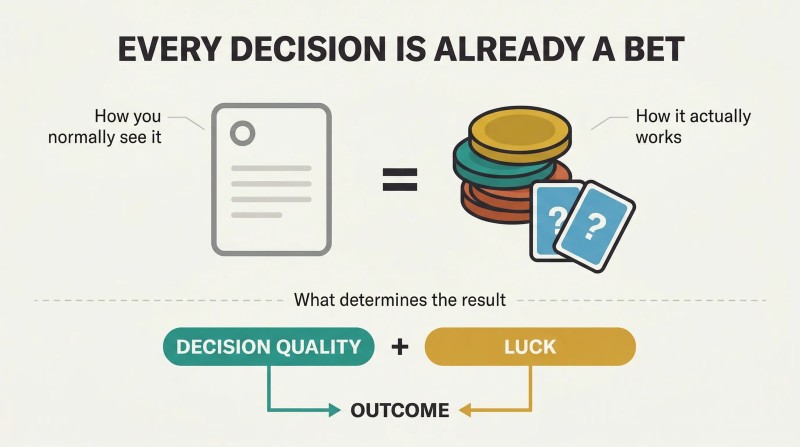
A bad outcome doesn't prove a bad decision was made
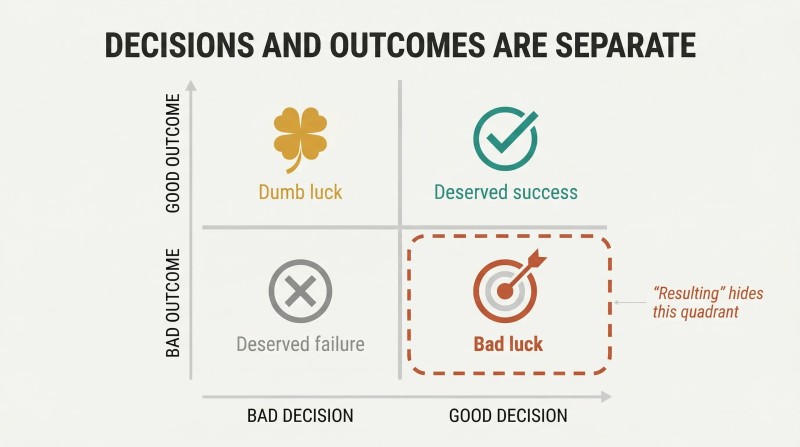
Poker players call this resulting — judging a decision's quality solely by its outcome. When Seahawks coach Pete Carroll called a pass play in the final seconds of Super Bowl XLIX and it was intercepted, headlines screamed "Worst Call in Super Bowl History." But only zero of sixty-six similar passes that season had been intercepted — a roughly 2% chance. Carroll made a sound bet that lost.
A CEO Duke consulted identified firing his company president as his worst decision because results suffered afterward. But when Duke probed the process — competitor analysis, executive coaching, evaluating alternatives — the group agreed the decision had been reasonable. The CEO had confused a bad result with a bad decision, then changed future behavior based on that confusion. Resulting is the silent saboteur of learning.
We believe what we hear first and verify later — if ever
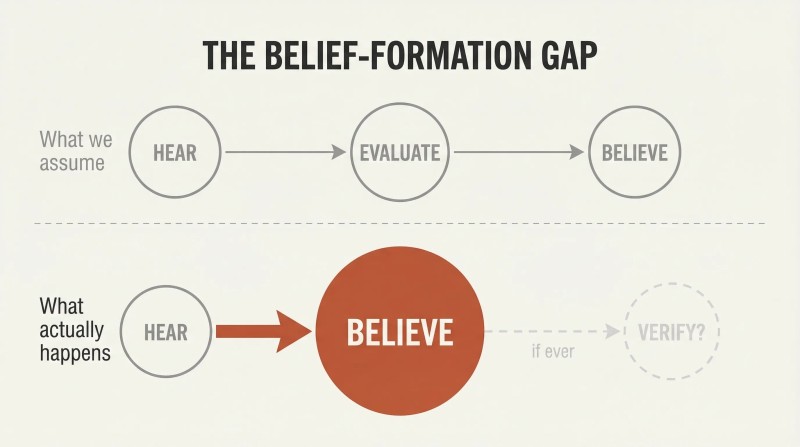
Our belief-formation process is backwards. Harvard psychologist Daniel Gilbert demonstrated that our default is to believe what we hear is true — even when information is explicitly labeled false. Under time pressure, subjects in his experiments presumed all statements were true regardless of labeling. Evolution built us to trust our senses quickly; when language evolved, that same "believe first" wiring carried over to secondhand information.
The consequences are enormous. Most people "know" baldness comes from the maternal grandfather (it doesn't) and that dog years equal seven human years (made up in the thirteenth century). More dangerously, research secretly funded by the sugar industry convinced Americans to replace dietary fat with carbohydrates. Obesity tripled, diabetes surged, and cardiovascular progress stalled — all because a haphazardly formed belief became national policy.
Intelligence amplifies bias rather than correcting it
Smart people are better spin doctors. Psychologists West, Meserve, and Stanovich tested blind-spot bias — our ability to see bias in others but not ourselves — and found that more cognitively sophisticated participants showed larger bias blind spots in six of seven biases tested. Awareness of bias didn't help either.
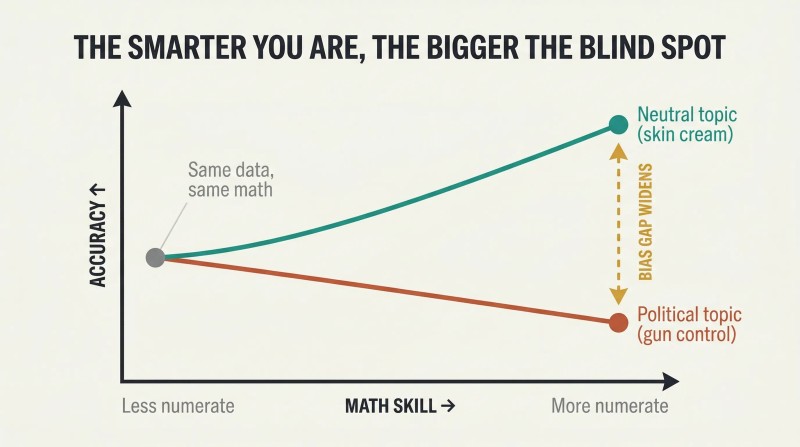
Dan Kahan's research drove this home. When subjects analyzed data about a neutral topic (skin cream), math skill predicted accuracy. But when the same data was relabeled as being about gun control, the more numerate subjects made more errors than less numerate ones, spinning identical numbers to confirm their political beliefs. The polarization didn't shrink among the smartest participants — it grew. This means we can't simply think our way out of bias, no matter how intelligent we are.
Rate your confidence zero to ten instead of right or wrong
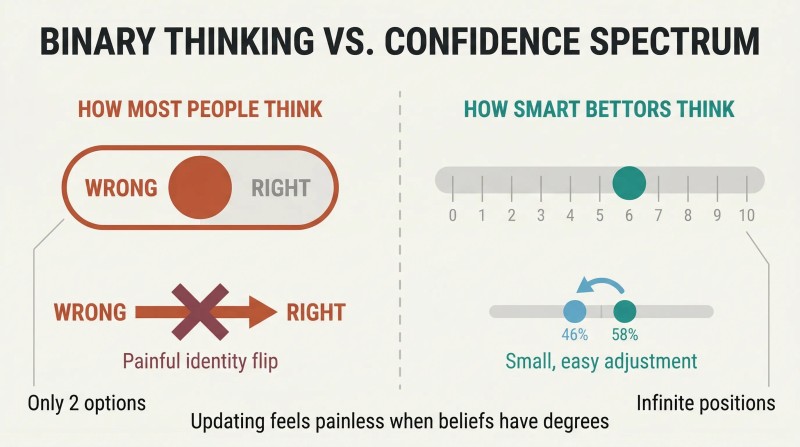
Binary thinking cripples decisions. Imagining you're either 100% right or 100% wrong is like using a medical scale with only two settings: 50 pounds and 500 pounds. Instead, Duke advocates rating confidence on a zero-to-ten scale. "I'm 60% that Citizen Kane won best picture" acknowledges what you know and don't know, making you less defensive when new evidence arrives.
This shift has cascading benefits. Updating from "I was 58% but now I'm 46%" feels far less threatening than admitting "I was right but now I'm wrong." It invites collaboration — people share more freely when you signal uncertainty. It makes you a more credible communicator, because listeners trust someone who quantifies their confidence over someone who claims absolute certainty. Scientists already do this through p-values and confidence intervals; the rest of us should too.
You grab credit for wins and blame luck for losses — reverse it
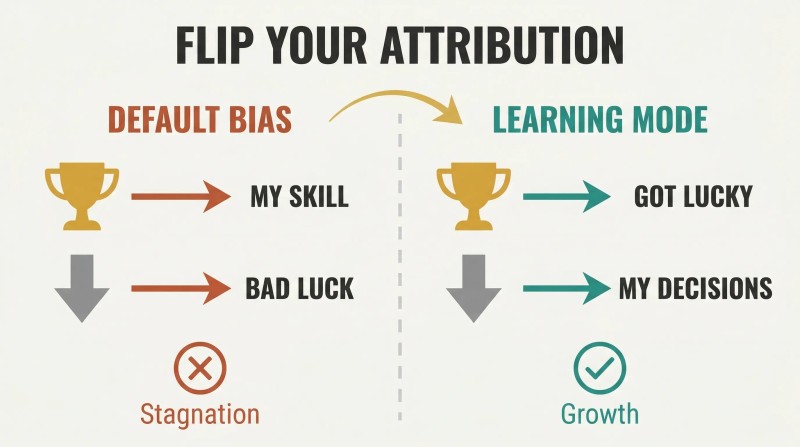
Self-serving bias is universal. Phil Hellmuth, the biggest winner in World Series of Poker history, said on ESPN: "If it weren't for luck, I'd win every one." In auto-accident reports, 37% of single-vehicle drivers still blamed someone else. Chris Christie, in a single debate exchange, deflected blame for Bridgegate while claiming credit for New Jersey's job growth — a textbook pivot.
For others' outcomes, we flip the script: their failures are their fault, their successes are luck. Steve Bartman received death threats from Cubs fans despite dozens of spectators reaching for the same foul ball. Phil Ivey offers the antidote. After winning a half-million-dollar tournament, he spent dinner analyzing his mistakes rather than celebrating. Actively crediting luck in your wins and seeking lessons in your losses is the fastest path to learning.
Use 'wanna bet?' as a mental interrupt for sloppy thinking
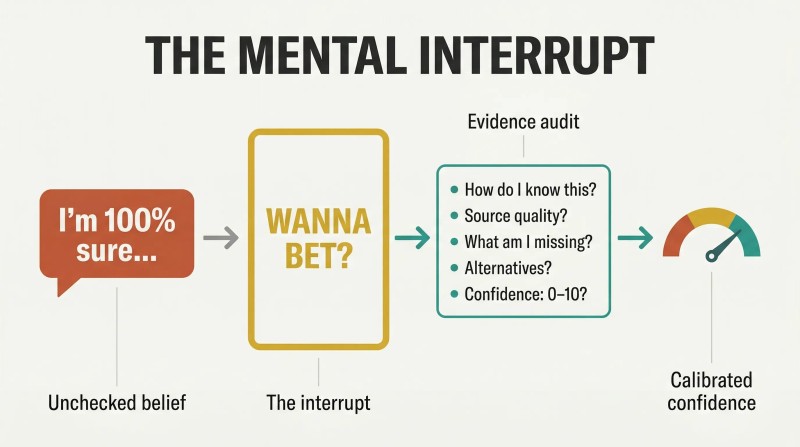
Two words change everything. Imagine confidently declaring "Citizen Kane obviously won best picture" — then hearing "Wanna bet?" Suddenly you're auditing your evidence: Where did I hear that? How reliable is the source? What are the alternatives? The challenge triggers the vetting step we routinely skip in belief formation.
You don't need actual wagers or poker-playing friends. The point is internalizing the frame. When you catch yourself expressing certainty, mentally ask: Would I bet real money on this? The questions that follow are powerful:
1. How do I know this?
2. What is the quality of my sources?
3. What am I missing?
4. What are the plausible alternatives?
5. How confident am I really, on a scale of zero to ten?
This habit alone can interrupt motivated reasoning before it calcifies into false confidence.
Form a truthseeking pod that rewards accuracy over agreement
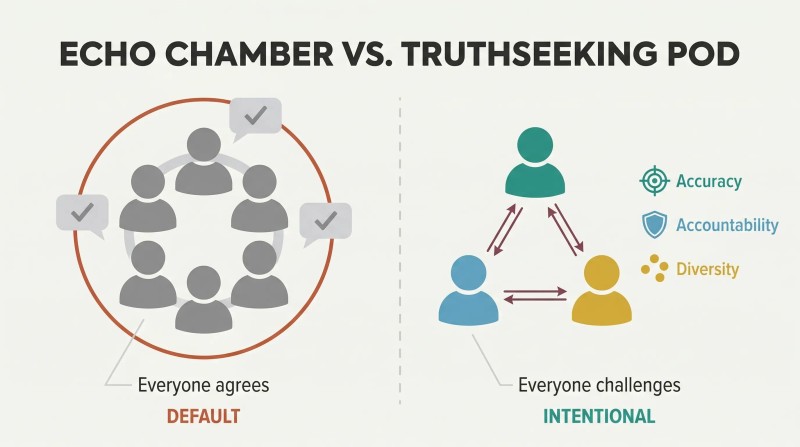
Echo chambers are the default. Without an explicit charter, groups drift toward confirmation — nodding along and swapping hard-luck stories. Duke's poker mentor Erik Seidel set different rules: "I don't want to hear it. If you have a question about a hand, you can ask me about strategy all day long." That three-sentence charter established accuracy as the goal, accountability as the norm, and diverse thinking as the currency.
Research supports this. Cass Sunstein studied 6,000+ federal appeals and found that a single judge from the opposing party had "a large disciplining effect" on panel decisions. Homogeneous panels went to ideological extremes. A truthseeking pod needs just three elements: focus on accuracy, accountability with advance notice, and genuine diversity of viewpoints. Even three members — two to disagree and one to referee — can produce robust reasoning.
Precommit to decisions before emotions hijack your judgment
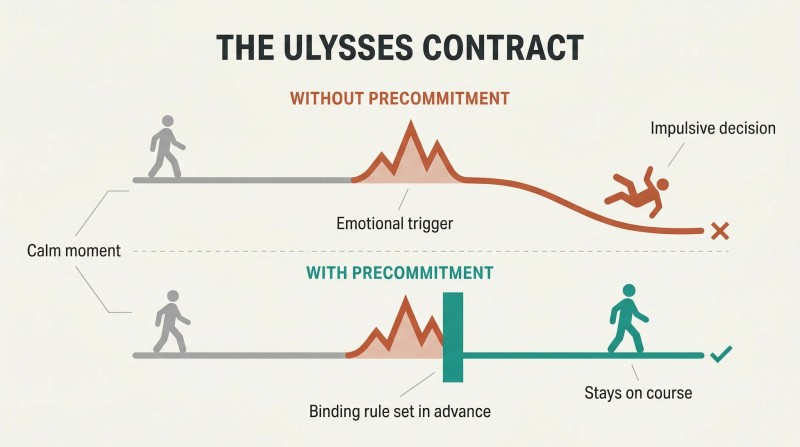
Odysseus tied himself to the mast before hearing the Sirens' song — binding his future self to better behavior. This Ulysses contract strategy applies everywhere. Arrange a ride-share before going to a bar. Set automatic retirement contributions. Agree on a maximum home price before attending the auction. Duke maintained a poker loss limit enforced by her group — if she lost $600, she left the game, knowing her in-the-moment self couldn't be trusted.
The science confirms this. In a Stanford study, subjects who saw an age-progressed image of themselves allocated $178 to retirement versus $74 for those seeing their current face. Temporal discounting — our tendency to massively favor present rewards — can be countered by making our future self vivid and present. Suzy Welch's 10-10-10 technique helps: ask how you'll feel about this decision in ten minutes, ten months, and ten years.
Work backward from imagined failure to prevent real failure
Positive visualization backfires. NYU psychologist Gabriele Oettingen found that women who fantasized most positively about slimming down lost twenty-four fewer pounds than those who pictured obstacles. Dreaming about success actually impeded it across multiple studies — job seekers, students, and surgery patients showed the same pattern.
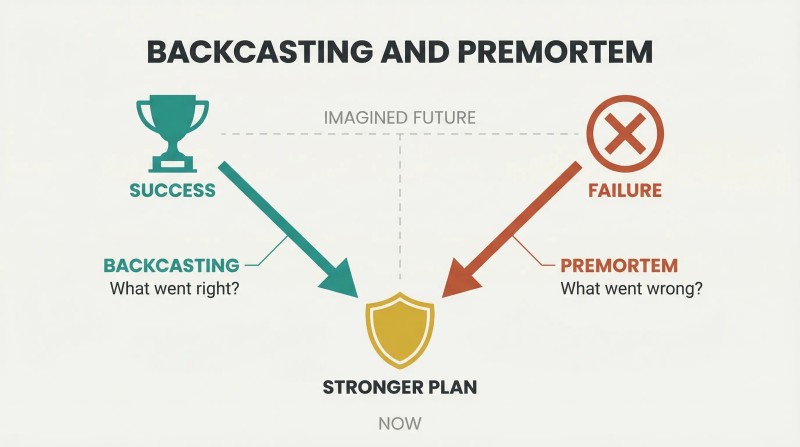
The solution combines two techniques. Backcasting starts from an imagined success ("We doubled market share!") and works backward to identify what went right. A premortem starts from imagined failure ("We missed our goal") and identifies what went wrong. Research shows that prospective hindsight — imagining an event has already occurred — increases the ability to correctly identify reasons for outcomes by 30%. Duke helped the nonprofit After-School All-Stars use this approach for grant planning, transforming their budgeting from guesswork into probability-weighted scenario planning.
Analysis
Duke's contribution to the behavioral economics canon is distinctive not for discovering new cognitive biases but for providing an operational framework to combat them under real-world time pressure. Where Kahneman's Thinking, Fast and Slow is a diagnostic manual and Ariely's Predictably Irrational catalogs our failures with scholarly precision, Duke prescribes a protocol forged in thousands of hours of high-stakes poker — an environment where theoretical understanding had to be converted into executable habits within seconds, with real money on the line.
The book's strongest intellectual move is collapsing the artificial distinction between 'important' decisions and 'routine' ones by reframing all of them as bets. This isn't merely semantic; it activates a different cognitive posture. When we 'decide,' we feel entitled to certainty. When we 'bet,' we instinctively acknowledge risk. That single shift in framing recruits the deliberative system in moments where reflexive processing would otherwise dominate.
The argument that intelligence exacerbates bias — supported by Kahan's numeracy research and West et al.'s blind-spot studies — may be the book's most counterintuitive and consequential claim. It undermines the Enlightenment assumption that knowledge is inherently corrective, suggesting instead that cognitive horsepower without structural safeguards becomes a more powerful engine for self-deception. Duke's solution — social accountability structures rather than individual willpower — aligns with behavioral design thinking (Thaler and Sunstein's 'nudges') but grounds it in poker's natural laboratory.
The book contains an honest tension it never fully resolves: if biases are evolutionarily embedded and resistant even to brilliant minds, how much can 'thinking in bets 'actually deliver? Duke's answer — catching perhaps 10% more learning opportunities, compounding like a one-degree navigation correction over thousands of miles — is admirably modest. It's also, based on her twenty-year career outperforming players who weren't doing this work, empirically persuasive.
Review Summary
Thinking in Bets receives mixed reviews. Many praise its insights on decision-making, emphasizing the role of uncertainty and luck. Readers appreciate Duke's poker-based perspective and practical advice for overcoming cognitive biases. Some find the book repetitive or lacking depth, while others consider it a valuable framework for better decision-making. Critics argue that the content is not entirely original and could have been more concise. Overall, reviewers recommend it for those interested in improving their decision-making skills, especially if unfamiliar with behavioral economics concepts.
People Also Read
Glossary
Resulting
Judging decisions by their outcomesA thinking error, common in poker and life, where we equate the quality of a decision with the quality of its outcome. A good decision can produce a bad result (and vice versa) due to luck and hidden information. Duke uses Pete Carroll's Super Bowl play call as the signature example—a sound decision judged terrible because it didn't work out.
Thinking in bets
Treating decisions as uncertain wagersDuke's central framework for better decision-making. It means recognizing that every decision involves choice among alternatives, incomplete information, risk, and probability—just like placing a bet. By making the betting nature of decisions explicit, we become more calibrated about uncertainty, more open to updating beliefs, and less vulnerable to resulting, self-serving bias, and motivated reasoning.
Self-serving bias
Credit wins, blame losses on luckThe systematic tendency to attribute good outcomes to our own skill and bad outcomes to external factors like luck. For other people's outcomes, the pattern reverses: their successes are luck, their failures are their fault. Duke identifies this as the single most significant obstacle to learning from experience, because it prevents accurate sorting of outcomes into 'skill' and 'luck' buckets.
Motivated reasoning
Processing information to confirm beliefsAn irrational, circular information-processing pattern in which our existing beliefs drive how we interpret new information, which in turn strengthens those beliefs. We seek out confirming evidence, rarely challenge it, and work hard to discredit contradictory information. Duke argues this pattern is so robust that even high intelligence cannot overcome it—in fact, smarter people may be more susceptible.
CUDOS
Merton's norms for truthseeking groupsAn acronym developed by sociologist Robert K. Merton for the normative structure of scientific communities, which Duke adapts as rules of engagement for any decision group. Communism (share all data), Universalism (evaluate ideas regardless of source), Disinterestedness (guard against conflicts of interest), and Organized Skepticism (encourage questioning and dissent). Together they form a blueprint for productive truthseeking.
Tilt
Emotionally compromised decision-makingBorrowed from poker (originally from pinball machines), tilt describes a state where recent bad outcomes trigger emotional reactions that compromise subsequent decision-making, creating a self-reinforcing downward spiral. Verbal signs include exasperated exclamations; physiological signs include flushed cheeks and elevated heart rate. Duke recommends precommitting to walk away when tilt signs appear.
Ulysses contract
Precommitment binding future behaviorA decision strategy named after Odysseus tying himself to the mast to resist the Sirens. It involves past-you making a commitment that prevents or interrupts present-you from acting irrationally—such as setting automatic retirement contributions, establishing poker loss limits, or arranging transportation before drinking. The binding can range from physical prevention to simple precommitment that creates a decision-interrupt.
Backcasting
Planning backward from imagined successA scenario-planning technique where you imagine having already achieved a positive goal, then work backward to identify the decisions, events, and circumstances that led there. Research shows that this 'prospective hindsight' increases the ability to correctly identify reasons for future outcomes by 30% compared to forward-looking planning. Duke pairs backcasting with premortems for complete scenario coverage.
Premortem
Imagining failure before it happensA planning exercise where a team imagines that a project or decision has already failed, then identifies the reasons why. Coined by decision scientist Gary Klein, the premortem gives permission for dissent and surfaces obstacles that optimism-biased forward planning misses. Duke cites Gabriele Oettingen's research showing that people who imagine obstacles are more likely to achieve their goals than those who only visualize success.
FAQ
What's Thinking in Bets about?
- Decision-Making Focus: Thinking in Bets by Annie Duke explores decision-making in uncertain environments, using betting as a framework to analyze choices. It compares life to poker, where outcomes are influenced by both skill and luck.
- Learning from Outcomes: The book emphasizes understanding the difference between luck and skill to improve decision-making. By treating decisions as bets, individuals can better evaluate their choices and learn from results.
- Practical Strategies: Duke provides strategies for separating decision quality from outcome quality, encouraging readers to embrace uncertainty and think probabilistically.
Why should I read Thinking in Bets?
- Enhanced Decision-Making: The book helps improve decision-making skills by teaching readers to recognize and mitigate biases, leading to more rational choices in personal and professional contexts.
- Real-World Applications: Concepts are applicable across various fields, including business and finance, helping readers navigate uncertainty more effectively.
- Engaging Narrative: Duke's experiences as a professional poker player make the book informative and entertaining, illustrating complex concepts in an accessible way.
What are the key takeaways of Thinking in Bets?
- Life as Bets: Every decision is a bet on an uncertain future, encouraging evaluation of risks and rewards associated with choices.
- Avoiding Resulting: Duke stresses not equating decision quality with outcomes, understanding that luck plays a role, which helps in learning from experiences.
- Embracing Uncertainty: The book advocates for accepting uncertainty and encourages saying, “I’m not sure,” leading to better decision-making and belief assessment.
What are the best quotes from Thinking in Bets and what do they mean?
- “Thinking in bets will improve decision-making throughout our lives.”: This quote encapsulates the book's premise that a betting mindset enhances informed choices.
- “We can get better at separating outcome quality from decision quality.”: Highlights the importance of distinguishing between decision results and the decisions themselves for objective learning.
- “I’m not sure” is a vital step to being a better decision-maker.: Emphasizes acknowledging uncertainty, leading to more thoughtful and less reactive decision-making.
How does Annie Duke define a "bet" in Thinking in Bets?
- Broad Definition: A bet is “a choice made by thinking about what will probably happen,” applicable to everyday decisions involving risk assessment.
- Risk and Belief: Involves risking something valuable based on beliefs about future events, encouraging evaluation of outcome likelihoods.
- Decision-Making Framework: Framing decisions as bets allows for better analysis of choices and influencing factors, leading to improved outcomes.
What is the "Buddy System" in Thinking in Bets?
- Collaborative Learning: Involves forming a group committed to truth-seeking and improving decision-making together, holding each other accountable.
- Accountability and Support: Group members provide feedback and challenge beliefs, fostering open-mindedness and reducing biases.
- Diversity of Opinions: A diverse group combats confirmation bias and promotes exploratory thought, essential for accurate and informed decisions.
What is "resulting," and why is it a problem in decision-making?
- Definition of Resulting: Resulting is evaluating decision quality based solely on its outcome, a cognitive bias leading to misjudgments.
- Impact on Learning: Equating outcomes with decision quality can hinder learning from mistakes or overestimating skills, affecting future decisions.
- Example in Sports: Duke uses Pete Carroll’s Super Bowl play call to illustrate resulting, where critics judged the decision based on the negative outcome.
How can I separate luck from skill in my decision-making according to Thinking in Bets?
- Fielding Outcomes: Actively analyze decision outcomes to determine influence by skill or luck, asking critical questions about contributing factors.
- Learning Loop: Create a feedback loop to assess decisions and outcomes, identifying growth areas and refining beliefs.
- Embrace Uncertainty: Accepting luck's role in outcomes allows focus on controllable decision-making processes, fostering resilience and adaptability.
What strategies does Thinking in Bets suggest for improving decision-making?
- Think Probabilistically: Adopt a mindset assessing outcome likelihoods before decisions, clarifying risks and rewards.
- Practice Self-Reflection: Reflect on past decisions and outcomes to identify thinking patterns and biases, improving future choices.
- Engage in Truth-Seeking: Seek diverse perspectives and challenge beliefs for a more accurate world understanding, combating biases.
How does Thinking in Bets address the role of emotions in decision-making?
- Emotional Influence: Emotions significantly impact decision-making, often leading to irrational choices; recognizing this is essential for objectivity.
- Strategies for Managing Emotions: Techniques like stepping back to assess situations rationally help maintain focus on decision-making processes.
- Building Resilience: Understanding and managing emotions builds resilience, allowing better navigation of uncertainty and improved outcomes.
How does Thinking in Bets relate to personal finance and investing?
- Probabilistic Thinking: Encourages applying probabilistic thinking to financial decisions, assessing risks and potential returns for informed choices.
- Long-Term Perspective: Emphasizes maintaining a long-term perspective in investing, focusing on trends and probabilities over short-term fluctuations.
- Learning from Outcomes: Advocates analyzing past investment decisions to refine strategies and improve decision-making.
What role does mental time travel play in Thinking in Bets?
- Future Self-Awareness: Involves envisioning future outcomes and considering current decisions' impact on future selves, enhancing decision quality.
- Regret Anticipation: Anticipating potential regret helps avoid impulsive actions by considering future feelings about decisions.
- Scenario Planning: Encourages imagining possible futures based on current decisions, identifying risks and opportunities for strategic choices.
About the Author
Other books by Annie Duke
Download PDF
Download EPUB
.epub digital book format is ideal for reading ebooks on phones, tablets, and e-readers.








































