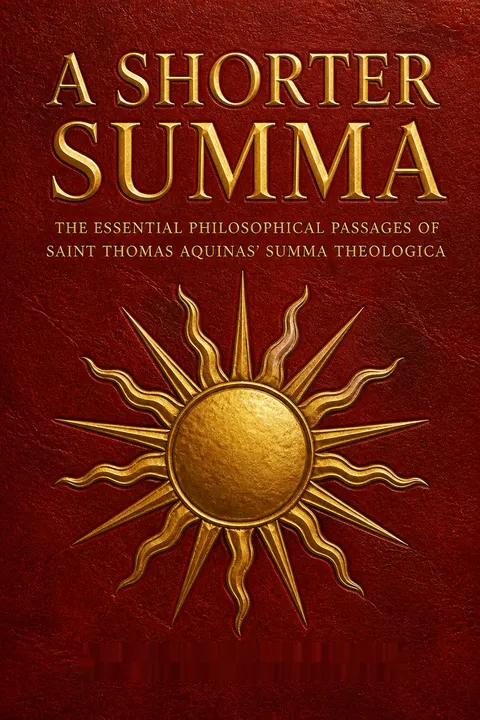

Key Takeaways
1. Theology: A Science of Revealed Truth with Multiple Interpretations
It was necessary for man’s salvation that there should be a knowledge revealed by God, besides philosophical science built up by human reason.
Divine revelation. Beyond what human reason can discover through philosophy, a further, sacred doctrine is required for man's salvation. This is because man's ultimate end—God—surpasses the full grasp of human reason, and this end must be known to direct human thoughts and actions. Even truths about God discoverable by reason are often known by few, after long effort, and with many errors, making divine revelation a more fitting and surer path to salvation.
Sacred science. This revealed knowledge forms a distinct science, differing from philosophy not in its object (God) but in its means of knowing (revelation versus natural reason). While philosophy relies on human intellect, sacred doctrine accepts truths by faith, even those that might be scientifically demonstrable. This distinction ensures that faith and reason, though distinct, are not contradictory, but rather complementary paths to truth.
Scriptural senses. Holy Scripture, as authored by God, can convey meaning not only through words but also through the things signified by those words. This leads to multiple senses of a text:
- Literal/Historical: The primary meaning intended by the author.
- Spiritual: Based on the literal, where things signified by words also have further meaning.
- Allegorical: Old Law signifying New Law (e.g., Moses as Christ).
- Moral: Actions in Christ signifying what we ought to do (e.g., Christ washing feet).
- Anagogical: Signifying eternal glory (e.g., healing blindness as spiritual healing in Heaven).
These spiritual senses are always founded on the literal, preventing arbitrary interpretation and ensuring that nothing necessary for faith is contained solely in a spiritual sense without being elsewhere stated literally.
2. God's Existence: Not Self-Evident, but Demonstrable from Creation
The existence of God can be proved in five ways.
Not self-evident. The proposition "God exists" is self-evident in itself because God's essence is His existence, but it is not self-evident to us because we do not know God's essence. While a general, confused knowledge of God as man's beatitude is naturally implanted, this is not explicit knowledge of God's actual existence. Therefore, God's existence needs to be demonstrated from effects known to us, rather than being immediately obvious.
Demonstrable a posteriori. God's existence can be demonstrated through an a posteriori argument, meaning from effects to their cause. Since God's effects (the created world) are better known to us than God Himself, we can reason backward from these effects to infer the existence of their ultimate cause. This approach avoids begging the question and acknowledges the limits of human knowledge regarding God's essence.
The Five Ways: St. Thomas presents five cosmological arguments, each starting from an observable aspect of the world and concluding with the necessity of a First Cause, which is understood as God:
- Motion: Everything in motion is moved by another; this chain cannot go to infinity, so there must be an Unmoved Mover.
- Efficient Cause: Nothing causes itself; the order of efficient causes cannot regress infinitely, requiring a First Efficient Cause.
- Contingency: Things exist that are possible to be and not to be; if everything were contingent, nothing would exist, so a Necessary Being must exist.
- Degrees of Perfection: There are gradations of goodness, truth, and nobility; these imply a maximum, a source of all perfection.
- Governance of the World: Non-intelligent natural bodies act for an end; this purposeful action requires an intelligent director.
These arguments collectively point to God as the ultimate explanation for the existence and order of the cosmos.
3. The Nature of God: Simple, Immutable, Omnipresent, and the Cause of All Good
God is in all things; not, indeed, as part of their essence, nor as an accident; but as an agent is present to that upon which it works.
Absolute simplicity. God is entirely simple, meaning He is not composed of any parts—neither quantitative parts (as He is not a body), nor matter and form, nor essence and existence, nor genus and difference, nor subject and accident. This absolute simplicity implies that God is the first being, uncaused, and pure act without any potentiality, as composition would imply posteriority, dependence, and a cause.
Immutability and omnipresence. God is altogether immutable, incapable of change, because He is pure act and infinite perfection, unable to acquire anything new or extend Himself beyond what He already is. Despite His transcendence, God is intimately present in all things, not as a part of their essence or an accident, but as the primary agent causing and sustaining their very being. Just as an agent must be joined to what it acts upon, God's immediate action in all things means nothing is distant from Him.
Divine knowledge and will. God necessarily knows all things other than Himself, not as external objects that perfect Him, but by perfectly understanding His own essence, which contains the images and causal power for all created things. God's knowledge is the cause of things, much like an artificer's knowledge is the cause of his creations. His will, though without an external cause, is reasonable in that He wills one thing to be on account of another, ordering effects from definite causes for the universe's perfection. God loves all existing things because their existence and goodness are willed by Him, and He loves them unequally in that He wills greater good for some than for others, reflecting the diverse perfections in creation.
4. Creation: A Freely Willed Act, Not Necessarily Eternal, Known by Faith
By faith alone do we hold, and by no demonstration can it be proved, that the world did not always exist.
World's beginning. Philosophical reason alone cannot definitively prove whether the universe of creatures always existed or had a beginning. Arguments for an eternal world, such as those from the unbegotten nature of matter or continuous motion, are shown to be inconclusive or based on flawed premises. Similarly, arguments attempting to demonstrate the world's temporal beginning, like the impossibility of traversing an infinite past, are also not cogent demonstrations.
God's free will. The world's duration depends entirely on God's will, which is not bound by necessity to create an eternal world. God's will to create is eternal, but the effect of that will (the world) can be temporal. Creation is not a successive change within time, but an instantaneous act that brings both being and time into existence. Therefore, the newness of the world cannot be demonstrated from its own nature or from the nature of God's will, which is not subject to rational investigation regarding His free choices concerning creatures.
Faith and reason. The doctrine that the world began is an article of faith, revealed by God, and not a conclusion demonstrable by natural reason. It is crucial to recognize this distinction to avoid offering weak philosophical arguments that might lead unbelievers to dismiss matters of faith. While reason can prove that the world could have had a beginning, and that God is its efficient cause, it cannot prove that it did have a beginning in time without divine revelation.
5. Human Nature: An Incorruptible Soul United to a Body, Inferior to Angels
The intellectual principle which we call the human soul is incorruptible.
Incorruptible soul. The human soul, as an intellectual principle, is incorruptible. Unlike the souls of brute animals, which are not self-subsistent and perish with their bodies, the human soul is a subsistent form. Corruption occurs when a form separates from matter; since the soul is a form without matter, it cannot be corrupted per se. Furthermore, the intellect apprehends existence absolutely and for all time, leading to a natural desire for perpetual existence, which, being natural, cannot be in vain.
Soul-body union. The intellectual soul is properly united to a corruptible body because its mode of knowing requires it. As the lowest among intellectual substances, the human soul gathers knowledge from individual things through the senses, which necessitate corporeal organs. The body, therefore, serves as a fitting instrument for the soul's sensory and intellectual operations, even if its material nature entails corruptibility.
Distinction from angels. The human soul is of a different species than an angel. Key differences include:
- Mode of knowledge: Angels possess simple, intuitive intelligence, not deriving knowledge from visible things. Human souls, by contrast, acquire knowledge through sensation and abstraction from corporeal phantasms.
- Relation to body: The human soul, by its essence, is naturally ordered to be united with a body, and is incomplete without it. Angels, being purely spiritual, have no such intrinsic relation to a body.
This distinction highlights the unique, intermediate position of humanity in the hierarchy of intellectual beings.
6. Knowledge and Will: Intellect Guides Will, Freedom Rooted in Reason, Ideas as Means to Know Reality
Man has free-will: otherwise counsels, exhortations, commands, prohibitions, rewards and punishments would be in vain.
Intellect's primacy. Absolutely speaking, the intellect is a higher power than the will because its object (the idea of appetible good) is more simple and abstract than the will's object (the appetible good itself existing in things). However, relatively, the will can be considered higher when its object (e.g., God) is nobler than the soul itself, in which the idea understood resides. Thus, the love of God is better than the knowledge of God, but the knowledge of corporeal things is better than the love thereof.
Free will from reason. Man possesses free will because his judgment concerning particular actions is not determined by natural instinct, as in brute animals, but by reason. Reason, in contingent matters, can consider opposite courses of action, allowing man to choose freely. This freedom is essential for moral responsibility, making counsels, commands, and punishments meaningful. God's causality does not negate human free will; rather, He moves voluntary causes according to their nature, making their actions truly voluntary.
Knowledge from senses. Intellectual knowledge is derived from sensible things. The human intellect, occupying a middle place between pure sense and pure angelic intellect, knows forms existing individually in corporeal matter by abstracting them from phantasms (sense images). The intelligible species (ideas) are not what is understood, but that by which the intellect understands real objects. To claim ideas are the primary objects of knowledge would lead to skepticism, as it would imply we only know our own mental impressions, not external reality.
7. True Happiness: Found Only in God, Not in Created Goods
It is impossible for any created good to constitute man’s happiness.
Happiness as ultimate end. Happiness is man's last end, the perfect good that completely satisfies the appetite, leaving nothing further to be desired. It is the state of life made perfect by the aggregate of all good things, desired for its own sake, and is the true reward of virtue.
Limitations of created goods. Man's happiness cannot consist in any created good, whether external or internal to the soul, because all created goods are finite and cannot fully satisfy the human will, which desires the universal good.
- Wealth: A mere means to natural wants or exchange, not an end in itself. Desire for artificial wealth is infinite, but unsatisfying.
- Honors: Signs of excellence already existing, not the cause of excellence or happiness.
- Fame/Glory: Dependent on human knowledge, which is fallible and often deceptive; lacks stability.
- Power: A principle, not an end; can be used for good or evil, thus imperfect.
- Bodily Goods: Subordinate to the soul, as the body is for the soul; cannot be man's ultimate end.
- Pleasure: A proper accident resulting from happiness, not its essence; a sign of good possessed, not the good itself.
- Goods of the Soul (e.g., virtue, knowledge): The soul itself is in potentiality and cannot be its own last end; while happiness is a perfection of the soul, what constitutes happiness is outside the soul.
God as ultimate good. Only God, as the universal and infinite good, can fully satisfy the human will and constitute man's perfect happiness. Every creature possesses goodness only by participation, whereas God is goodness itself. Therefore, man's life of happiness is found in God, as the soul is the life of the body.
8. Ethics: Grounded in Natural Law and Perfected by Virtues
The natural law is nothing else than the rational creature’s participation of the eternal law.
Law and reason. Law is a dictate of practical reason from a ruler governing a community. The entire universe is governed by Divine Reason, making the idea of this governance in God the "eternal law." Rational creatures participate in this eternal law through their natural inclination to proper acts and ends, which is called the "natural law." This natural law is the light of natural reason, enabling us to discern good and evil.
Human and divine law. From the general, indemonstrable precepts of natural law, human reason derives more particular determinations, forming "human laws." However, a "Divine law" is also necessary for four reasons:
- To direct man to his supernatural end of eternal happiness.
- To provide certainty due to the uncertainty of human judgment.
- To judge interior movements, which human law cannot.
- To forbid and punish all evil deeds, which human law cannot fully do.
Virtues and evil. Goodness is rightly divided into the virtuous (desired for its own sake), the useful (desired as a means), and the pleasant (rest in the desired thing). Fault (sin) is a greater evil than pain, because fault makes one evil by a disordered act of the will, opposing the divine will and love, whereas pain is merely the privation of some good. The entire structure of good works is built on four cardinal virtues:
- Prudence: Perfects reason itself in discerning good means to good ends.
- Justice: Orders reason into operations concerning others.
- Temperance: Curbs passions inciting against reason.
- Fortitude: Strengthens against passions withdrawing from reason's dictate.
Additionally, faith, hope, and charity are theological virtues, directing man to supernatural happiness by supernatural principles, surpassing human capacity. The natural law's first principles are unchangeable and cannot be blotted out from the heart, though secondary precepts can be obscured by vicious customs.
Review Summary
Readers generally find A Shorter Summa a valuable but limited introduction to Aquinas, praising Kreeft's helpful footnotes, witty commentary, and thoughtful selection of passages. Many appreciate its accessibility and compact size, though several recommend Kreeft's longer Summa of the Summa as a more worthwhile investment. Some struggle with dense philosophical terminology, particularly in the epistemology section. The book works best as a starting point for newcomers to Aquinas, covering key topics like God's existence, the soul, free will, and ethics.
People Also Read

About the Author
Other books by Peter Kreeft
Download PDF
Download EPUB
.epub digital book format is ideal for reading ebooks on phones, tablets, and e-readers.








































