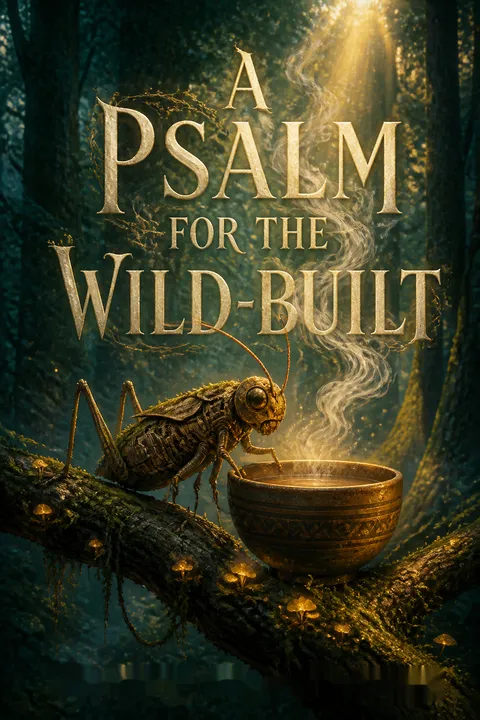

Plot Summary
Restless in the City
Sibling Dex, a monk in the bustling, harmonious City of Panga, finds themselves increasingly dissatisfied despite the city's beauty and comfort. The absence of cricket song—a small, natural detail—becomes a symbol of what's missing in their life. Dex's longing for something more, something unmanufactured and wild, grows into a persistent itch. The city's engineered perfection, once a source of pride, now feels confining. Dex's restlessness is not about external hardship but an internal void, a sense that life's meaning is slipping through their fingers. This yearning for a deeper connection with the world, for a sense of purpose beyond routine, sets Dex on a path of transformation, even as they struggle to articulate what exactly is missing.
The Call of Cricket Song
Dex's fixation on the absence of cricket song in the city's soundscape intensifies, becoming a metaphor for their spiritual hunger. The city's noise and engineered nature cannot replace the wild, unpredictable music of crickets. Dex's desire to hear this lost song grows into a compulsion, representing a longing for authenticity and connection with the untamed world. This yearning is not just for sound but for an experience of life unmediated by human design. The cricket song, extinct in most of Panga, becomes a symbol of what has been lost and what Dex hopes to rediscover. It is this small, persistent absence that finally pushes Dex to leave the city and seek something real, raw, and unplanned.
Becoming a Tea Monk
Driven by their restlessness, Dex leaves their comfortable role as a garden monk to become a tea monk, traveling between villages to offer comfort and tea. The transition is both liberating and terrifying. Dex's first attempts at tea service are awkward and humbling, revealing the gap between theory and practice. They struggle with self-doubt, feeling unprepared and exposed. Yet, the act of listening to others' troubles and offering small comforts becomes a new way to connect. Dex's journey is not just physical but existential, as they search for a sense of purpose in service to others. The tea monk's path is one of humility, learning, and the slow, uncertain process of self-discovery.
The Road Beyond Comfort
As Dex travels the villages, their skills as a tea monk grow. They become beloved, known for their creative blends and attentive ear. Villagers seek them out, grateful for the respite Dex provides. Yet, beneath the surface, Dex remains unsettled. The work is meaningful, but the old itch persists. The absence of cricket song, the sense of something missing, haunts Dex even in moments of apparent success. The comforts they offer others do not fill their own emptiness. Dex's journey becomes a search not just for external validation but for an answer to the question: Why isn't this enough? The road, once a symbol of freedom, now feels like a loop.
The Best Monk in Panga
Dex becomes celebrated as the best tea monk in Panga, their wagon a welcome sight in every village. They are showered with gratitude, gifts, and invitations. Yet, the more Dex is praised, the more acutely they feel their own dissatisfaction. The rituals of tea and comfort, once novel, become routine. Dex's longing for something more—something wild, unstructured, and unknown—intensifies. The praise of others cannot quiet the persistent question inside: What is missing? Dex's success only highlights the gap between external achievement and internal fulfillment, pushing them to consider a more radical break from the familiar.
The Itch That Remains
Despite their outward success, Dex wakes each morning feeling hollow and tired. The joy of helping others fades quickly, replaced by a gnawing sense of lack. Dex becomes obsessed with the idea of finding crickets, researching their last known habitats and contemplating a journey into the protected wilderness. The decision to leave the mapped world behind is impulsive but feels inevitable. Dex's crisis is not about failure but about the limits of comfort and routine. The itch that began as a longing for cricket song has become a deeper spiritual hunger—a need to confront the unknown, to risk discomfort in search of meaning.
Into the Wilds
Dex turns away from their scheduled route, leaving behind the safety of villages and the expectations of others. They set out alone into the wilderness, following a half-remembered map to a remote hermitage where crickets might still exist. The journey is physically demanding and fraught with uncertainty. Dex's carefully engineered wagon and supplies are ill-suited to the wild, and the road quickly deteriorates. Yet, the act of stepping off the map is exhilarating. For the first time, Dex feels the thrill of being truly alone, unobserved, and unplanned. The wilds become a mirror for Dex's internal chaos and longing.
A Robot in the Forest
In the heart of the forest, Dex's solitude is shattered by the sudden appearance of Mosscap, a robot who has not seen a human in centuries. Mosscap is curious, earnest, and disarmingly friendly, eager to learn about humans and their needs. The encounter is surreal and unsettling for Dex, who is unprepared for first contact with a being from myth. Mosscap's presence challenges Dex's assumptions about solitude, agency, and the boundaries between human and machine. The robot's question—"What do humans need?"—becomes the new axis around which Dex's journey turns, forcing them to confront their own uncertainties.
Mosscap's Question
Mosscap explains its mission: to travel among humans and answer the question of what people need. The robot's perspective is both alien and familiar, shaped by remnants of its factory origins and generations of wild-built experience. Mosscap's curiosity is boundless, and its lack of purpose is a point of pride. Dex, meanwhile, is unsettled by the robot's fluid sense of identity and its refusal to be defined by function. Their conversations probe the nature of consciousness, purpose, and the difference between being an object and being an animal. Mosscap's question echoes Dex's own: What is enough? What does it mean to be satisfied?
Remnants and Revelations
As they travel together, Dex and Mosscap confront the remnants of their respective pasts—Dex's inherited anxieties and Mosscap's inherited memories from factory parts. They visit a ruined factory, where Mosscap reveals its wild-built lineage and the robot tradition of repurposing parts rather than seeking immortality. The conversation turns to the paradoxes of life: the tension between comfort and growth, the inevitability of death, and the search for meaning in a world that offers no guarantees. Dex realizes that both human and robot are shaped by remnants—instincts, memories, fears—that cannot be fully escaped but can be understood and transcended.
The Limits of Help
When Dex's wagon breaks down, Mosscap offers practical assistance, but Dex resists, feeling uncomfortable with the idea of a robot doing their work. The exchange exposes deep-seated cultural anxieties about dependence, agency, and the legacy of the Factory Age. Mosscap challenges Dex's assumptions, insisting on its own agency and desire to help. The episode becomes a lesson in humility and interdependence, as Dex learns to accept help without guilt or shame. The boundaries between object and person, helper and helped, blur, revealing the complexity of true companionship.
Off the Map
The journey grows more difficult as the road disappears, forcing Dex and Mosscap to navigate untamed wilderness. Dex's determination to reach the hermitage becomes an obsession, driving them to physical and emotional exhaustion. The wilds strip away the last vestiges of comfort and control, exposing Dex's vulnerability and fear. Mosscap remains a steady presence, offering guidance and support without judgment. The landscape becomes a crucible, testing Dex's resolve and forcing them to confront the limits of their own strength and the necessity of surrender.
The Mountain's Challenge
Climbing the mountain toward the hermitage, Dex is battered by rain, fatigue, and self-doubt. The journey becomes a metaphor for their internal struggle—a desperate attempt to prove something to themselves, to find an answer to the question of what is missing. Dex's body and spirit are pushed to the breaking point, and their relationship with Mosscap is strained by frustration and misunderstanding. The mountain demands humility, forcing Dex to accept their own limitations and the impossibility of complete self-sufficiency.
Breaking Down
Exhausted, injured, and emotionally raw, Dex collapses in the mud, finally admitting that they do not know what they are seeking or why they are suffering. Mosscap offers comfort, not solutions, and helps Dex find shelter in a cave. In the darkness, Dex confesses their sense of inadequacy and the persistent feeling that something is missing, despite having everything they could want. The cave becomes a space of vulnerability and surrender, where Dex can finally let go of the need to have answers and simply be present with their pain.
Shelter and Surrender
In the cave, Dex and Mosscap share their fears, doubts, and hopes. They hold hands, bridging the gap between human and robot, animal and object. The act of companionship—simple, wordless, and mutual—offers a measure of comfort that words and rituals cannot. Dex realizes that the search for meaning is not about finding a single answer but about accepting the complexity and impermanence of life. The night in the cave becomes a turning point, a moment of rest and acceptance before the final ascent.
The Hermitage at Hart's Brow
The ruined sanctuary is both a relic of the past and a testament to human aspiration. Dex is moved by the traces of comfort, community, and care that linger in the abandoned rooms. The hermitage is not a place of answers but of presence—a reminder that sanctuaries exist for respite, not for permanent solutions. Dex's memories of childhood comfort and the rituals of tea service resurface, blending nostalgia with grief and gratitude. The journey's end is not a revelation but a quiet acknowledgment of the beauty and fragility of seeking.
The Tea Ceremony Reversed
In a reversal of roles, Mosscap prepares a humble tea ceremony for Dex, using wild herbs and salvaged objects. The gesture is awkward but deeply meaningful, embodying the essence of comfort and care. Dex, for once, is the recipient rather than the giver, and the experience is both humbling and healing. The ceremony becomes a moment of mutual recognition—of the limits of help, the necessity of rest, and the sufficiency of simply being together. The wild-built robot and the restless monk find, in each other's company, a fleeting sense of enough.
The Song of Enough
As night falls and crickets begin to sing, Dex and Mosscap prepare to return to the world of villages and roads. The journey has not provided answers or erased the itch, but it has transformed their understanding of what it means to be alive. Enough is not a destination but a practice—a willingness to marvel at existence, to accept help, to offer comfort, and to rest in the presence of another. The song of the wild, once lost, is found not in perfection but in the shared experience of being, becoming, and belonging.
Analysis
A Psalm for the Wild-Builtis a gentle, profound meditation on the nature of purpose, comfort, and the search for meaning in a world that has solved many of its material problems but not the existential ones. Becky Chambers crafts a narrative that is both intimate and universal, using the journey of Sibling Dex and the wild-built robot Mosscap to explore the limits of comfort, the necessity of rest, and the sufficiency of simply being. The novel challenges the modern obsession with productivity, purpose, and self-optimization, suggesting that enough is not a destination but a practice—a willingness to marvel at existence, to accept help, and to offer comfort without demanding justification. The dialogue between human and robot reframes the question of what it means to be alive, blurring the boundaries between object and animal, helper and helped. In a world increasingly engineered for comfort, A Psalm for the Wild-Built
reminds us that the wild—the unknown, the unplanned, the uncomfortable—is not something to be conquered or escaped, but something to be embraced as part of the fullness of life. The lesson is not that answers can be found, but that the search itself is sacred, and that enough is found in the shared experience of being, becoming, and belonging.
People Also Read










Characters
Sibling Dex
Sibling Dex is a nonbinary monk whose journey is driven by a profound sense of dissatisfaction with a life that appears, on the surface, to be perfect. Dex's role as a tea monk is both a calling and a burden, as they strive to offer comfort to others while struggling to find it for themselves. Dex's relationships—with family, colleagues, and strangers—are marked by care and empathy, but also by a persistent sense of not fitting in. Psychologically, Dex embodies the universal human tension between comfort and growth, belonging and autonomy. Their development is a gradual process of surrendering the need for answers and embracing the complexity of existence. Dex's arc is one of humility, vulnerability, and the slow acceptance that enough is not a fixed state but a practice.
Splendid Speckled Mosscap
Mosscap is a wild-built robot, assembled from generations of repurposed parts, whose mission is to understand what humans need. Mosscap's personality is earnest, inquisitive, and disarmingly open. It approaches the world with childlike wonder, unburdened by the need for purpose or permanence. Mosscap's relationship with Dex is both a mirror and a challenge, as it refuses to be defined by function or utility. Psychologically, Mosscap represents the possibility of being content with simply existing, of marveling at consciousness without demanding justification. Its development is marked by a growing empathy for human struggles and a willingness to offer comfort without judgment. Mosscap's presence forces Dex—and the reader—to reconsider the boundaries between object and animal, helper and helped, meaning and enough.
Sister Mara
Sister Mara is the Keeper of Dex's original monastery, a figure of gentle authority and understanding. She supports Dex's decision to change vocations without judgment, embodying the ethos of modern monastic life: guidance without control. Mara's relationship with Dex is one of trust and respect, allowing Dex the freedom to make mistakes and learn through experience. Psychologically, Mara represents the possibility of leadership rooted in compassion rather than hierarchy. Her presence in the story is brief but significant, setting the tone for Dex's journey of self-discovery.
Dex's Family
Dex's family, especially their father, represents the ties of origin and the complexities of belonging. Their relationships are marked by love, pride, and a lack of deep understanding. Dex's sense of not fitting in is both a source of pain and a catalyst for growth. The family's presence in the narrative is felt through messages, memories, and the rituals of sharing food and comfort. Psychologically, they embody the tension between tradition and individuality, support and estrangement.
The Villagers
The villagers Dex serves as a tea monk are diverse in background and temperament, united by their need for respite and connection. Their stories and struggles provide Dex with purpose but also highlight the limits of comfort and the universality of longing. Psychologically, the villagers represent the broader human community—each unique, each in need, each a reflection of Dex's own search for enough.
The Robots
The wild-built robots, of which Mosscap is a representative, are a society of beings who have chosen impermanence and autonomy over immortality and servitude. Their tradition of repurposing parts and refusing fixed purpose challenges human assumptions about identity and meaning. Psychologically, the robots embody the possibility of living without a singular purpose, of embracing change and mortality as intrinsic to existence.
The Gods (Allalae, Chal, Samafar, Bosh, Grylom, Trikilli)
The pantheon of gods in Panga's culture provides a spiritual framework for understanding the world. Allalae, the God of Small Comforts, is especially significant for Dex, representing the value of rest, comfort, and care. The gods are not interventionist but inspirational, offering metaphors and rituals rather than answers. Psychologically, they embody the human need for narrative, connection, and the search for meaning in the face of uncertainty.
The City
The City is both a character and a setting—a place of beauty, harmony, and abundance that nonetheless fails to satisfy Dex's deeper longings. It represents the achievements and limitations of human design, the tension between comfort and wildness, order and chaos. Psychologically, the City is the backdrop against which Dex's existential crisis unfolds.
The Hermitage at Hart's Brow
The hermitage is a place of pilgrimage, memory, and rest. It embodies the human impulse to create spaces of comfort and reflection, even in the wildest places. Psychologically, it represents the limits of seeking—sanctuaries are for respite, not for permanent answers.
The Wild
The wilderness is both a physical and psychological landscape—a place of danger, beauty, and transformation. It strips away the illusions of control and comfort, forcing Dex to confront their own vulnerability and the necessity of surrender. Psychologically, the wild is the crucible in which Dex's journey toward enough is forged.
Plot Devices
Journey as Self-Discovery
The narrative structure is built around Dex's journey from the city to the wilds, from comfort to discomfort, from certainty to uncertainty. Each stage of the journey corresponds to a stage in Dex's psychological development, with the road serving as both a literal and metaphorical path. The journey is not about reaching a destination but about the process of becoming—of learning to accept the limits of comfort, the necessity of rest, and the sufficiency of being.
The Absent Cricket Song
The motif of cricket song recurs throughout the narrative, representing Dex's yearning for something lost, something wild and unmanufactured. Its absence is both a literal extinction and a metaphor for spiritual hunger. The search for cricket song becomes a quest for authenticity, connection, and meaning in a world that has been carefully engineered for comfort.
First Contact and the Question of Need
The arrival of Mosscap introduces the device of first contact—not as a conflict but as a conversation. Mosscap's central question, "What do humans need?" becomes the axis of the narrative, reframing Dex's personal crisis as a universal inquiry. The dialogue between Dex and Mosscap explores the boundaries between object and animal, purpose and existence, comfort and enough.
Remnants and Memory
Both Dex and Mosscap are shaped by remnants—instincts, memories, and inherited fears that cannot be fully escaped. The narrative uses these remnants to explore the tension between past and present, autonomy and inheritance. The motif of repurposed parts, both mechanical and psychological, underscores the complexity of identity and the impossibility of complete self-determination.
Reversal of Roles
The structure of the tea ceremony is reversed when Mosscap offers comfort to Dex, highlighting the mutuality of care and the limits of ritual. This reversal becomes a moment of healing and recognition, emphasizing that enough is found not in answers but in presence and companionship.
The Wild as Crucible
The wilderness functions as a crucible, stripping away the illusions of control and comfort. It forces Dex to confront their own vulnerability, to accept help, and to surrender the need for answers. The wild is both a threat and a teacher, revealing the beauty and terror of existence without guarantees.






Download PDF
Download EPUB
.epub digital book format is ideal for reading ebooks on phones, tablets, and e-readers.








































