
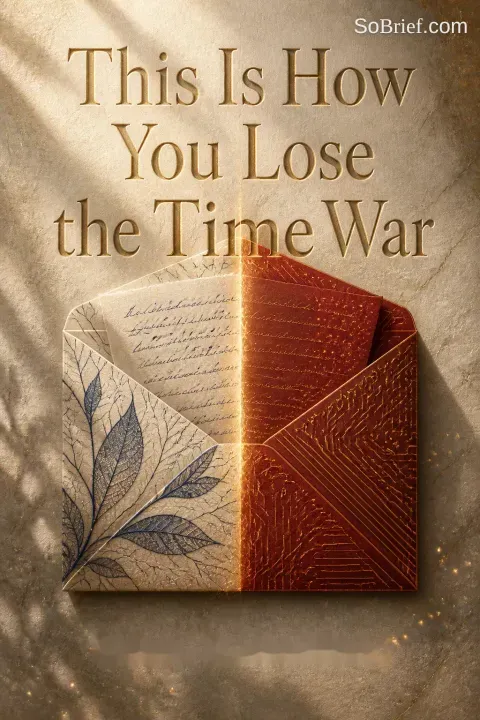


Plot Summary
Burn Before Reading
When Red1 wins the battle, she stands alone among corpses with blood slicking her hair. She senses another presence on the field, someone from the rival faction Garden4 who altered the battle's flow. Searching the wreckage, she finds a cream envelope that reads: Burn before reading.
Despite knowing this letter could expose her as compromised to her Commandant,3 she lights it with a dead soldier's lighter. Flames reveal a message from her enemy, Blue,2 who taunts Red1 for making the war interesting again after years of boredom.
Blue2 thanks Red1 for her tactics and signs off fondly. Red1 leaves the crumbling planet. Then a shadowy Seeker5 emerges, collects the ashes, and uses her own rainbow blood to reconstitute the letter, reading it once more before the world cracks apart.
This opening establishes the central paradox: the letter is simultaneously a weapon and an invitation to intimacy. Blue's first message frames reading itself as surrender. Red's choice to read despite knowing the danger reveals her core trait: curiosity and courage outweighing caution. The Seeker's immediate appearance plants the novel's circular time-loop structure while remaining mysterious. The battlefield setting reminds us these are enemies in a real war, not merely playful correspondents.
READ BY BUBBLING
Blue2's next mission takes her to a twenty-first-century hospital where she was meant to infect a doctor with a new bacterial strain. She finds her opportunity vanished and a jar labeled READ BY BUBBLING left in an MRI machine.
She deciphers Red1's message, which boasts about spoiling the mission by triggering a bomb threat and arranging remote work for the doctor. Red1's letter wonders if Blue2 has bosses, suggests her command chain might be corrupt, and ends with a joke about contact poison on a keyboard.
Blue2 laughs despite her failure. Their pattern is set: each will now leave messages in the wreckage of the other's missions. The chase becomes mutual, and language becomes their shared battlefield. A Seeker5 follows, drinking the water from the jar.
The correspondence shifts from one-time taunt to ongoing dialogue. Red's questions about Blue's command structure probe for vulnerability while revealing her own anxieties about discovery. The joke about poison foreshadows the death-letter to come while establishing that even threats between them carry playfulness. Their relationship is built on the thrill of professional rivalry transmuting into personal connection, each letter a gauntlet and a gift.
A Century in Tree Rings
Red1 spends a decade embedded with Genghis Khan's horde, posing as a man, rising to a position of authority. While inspecting lumber for siege engines, she discovers a message from Blue2 grown into the tree's rings over an entire century. Blue2's words ask Red1 to speak plainly: what does she want from this correspondence?
Blue2 points out that Red1 could have killed her but chose not to, and that Red1 has acted without the Agency's knowledge. She asks Red1 to tell her something true or nothing at all. Red1 memorizes the message, then watches as the logs become engines that shatter a city's walls. She carries Blue2's question forward through the war, unable to forget. The Seeker5 later gathers splinters from the wrecked engines.
This is the demand for honesty that transforms their correspondence from game to genuine connection. Blue's century-long investment in writing a single letter demonstrates commitment beyond any taunt. Her question cuts to the heart of their relationship. Red's choice to use the logs as weapons rather than destroy them to hide the message shows she is already protecting their secret, even from herself.
Hunger Like a Furnace
Red1 writes back answering Blue2's question. She describes her Agency's collective consciousness, where minds swap bodies and privacy barely exists. But at thirteen, inspired by a comic book about Socrates, she left her pod and stood alone on a barren hilltop through the night, refusing all attempts to reach her. She wanted to know herself apart from the collective.
The silence hollowed her into someone real. Blue2's reply reveals Garden4's nature: she has been birds and branches, bees and wolves. But she was severed as a child by an enemy attack, cut off from Garden4's collective, left with a hunger so consuming it defines her. She has never been satisfied, never fit in. Their letters have become a way to be less alone.
This reciprocal vulnerability transforms their relationship. Both are deviants within their factions: Red by choice, Blue by circumstance. The hunger Blue describes becomes the novel's central metaphor for desire itself, something that sharpens the more it is fed. Their shared experience of being apart creates a bond neither expected. The letters become not just a game but a lifeline to someone who understands the particular loneliness of being different from one's own kind.
The Six-Legged Wolf
Blue2 is stationed on a barren planet, guarding a creature bred to devour a specific Agency agent. Then she sees the target: a thirteen-year-old girl standing alone on a hilltop, lost in thought. It is Red.1 Blue2 recognizes her from the story Red1 told. The creature, a voiceless winged lion with pale blue cilia, begins stalking the young Red.1 Blue2 does not hesitate.
She transforms into a six-legged wolf and tears out the creature's throat, killing it and eating the carcass. She is wounded but hides her injuries as she pads past Red,1 who glimpses her for a frozen moment. Blue2 later finds a letter from the older Red1 waiting on a rock, addressed to her wolf form. The letter was left by Red1 from the future, who sensed Blue2's presence.
This is the pivotal moment where their relationship transcends correspondence. Blue's choice to kill her own side's weapon, to betray Garden for a girl she knows only through letters, proves her love before the word is ever spoken. Her wounded, silent passage past young Red is both self-protection and reverence. The letter Red-from-the-future left confirms this moment has always been part of their story, a closed loop in time.
I Love You
Red1's letter arrives after Blue2's wolf-self saved her younger incarnation. She writes without pretense, abandoning their usual game of taunts and pseudonyms. She thanks Blue2 for saving her life and confesses she followed Blue2's footsteps through time to witness the rescue.
She describes how she has been collecting blues everywhere: bismuth flame, cerium, lapis, glacier cracks, Mary's robes in frescoes. She pours Blue2 into things to keep her close. She admits she worried her long letters were a burden, that Blue2 only responded on sufferance.
Then she states it plainly: she loves Blue.2 She is Blue2 's, not Garden4 's, not her mission's. She doesn't know what this means or where it leads. She sends the letter sealed with wax containing perfume she spent years crafting from the memory of Blue2's tea.
The confession strips away all armor. Red's admission that she worried Blue only tolerated her letters reveals an insecurity beneath her confidence. The act of collecting blues, folding the beloved into the physical world, is a way of making love tangible across timelines. The perfume seal, crafted over years, demonstrates that love expresses itself in the time and effort one is willing to invest for the other.
Seeds of Sumac
Blue2 is embedded in an alternate North America, married to a scout, living a slow domestic life as part of Garden4's strategy. She writes Red1 three letters over a year, compressing them into sumac seeds delivered via owl pellet. The first describes needle-felting and the ache of missing Red.1 The second confesses her fierceness: she wants to consume Red,1 not merely love her gently.
The third reveals the true story of her childhood infection and warns that someone may be following Red.1 A goose delivers the seeds to Red1 in the Ohio woods. She eats the first three, each unfolding inside her mind like a letter. The third makes her swoon. When she wakes, the leather pouch is gone, stolen by the shadowy Seeker5 she has been hunting.
The sumac seeds embody the novel's themes of consumption and time. Blue writes across seasons, embedding her words in biology, requiring Red to literally ingest her thoughts. The confession about her childhood infection reveals vulnerability while planting a crucial plot point. The Seeker's theft of the pouch while Red sleeps advances the mystery of who is following them, adding an edge of paranoia.
Commandant's Death-Letter
Blue2 completes a masterstroke: she manipulates a timeline so perfectly that Garden4 strangles the Agency's future. The Agency panics. Commandant3 summons Red1 to a field office and reveals they have mapped Blue2's connection to Red1 through time. They believe Blue2 has been grooming Red1 for recruitment.
Commandant3 orders Red1 to craft a letter that will kill Blue2 using genetic steganography: words hidden within words, proteins turned wrong, a message to unravel Blue2's memory and germ line. Alone in a white lab, Red1 writes three layers: a surface invitation to meet, a hidden poison, and deeper still, a true letter warning Blue2 not to read it. She makes the plant beautiful, with luster and fragrance, because even death must be worthy of Blue.2
This is Red's impossible position: forced to become the instrument of Blue's death or expose them both. The triple-layered letter is her desperate compromise. The beauty she imbues the poison with is both apology and love letter. Commandant's belief that Blue is merely grooming Red reveals the Agency's inability to comprehend genuine love between enemies. Strategy cannot account for this.
The Poison Feast
Blue2 receives the seed and grows it for a year, watching it become beautiful and deadly. She knows it is poison. She recognizes the surface message as a crude Agency forgery. But she also knows that if she refuses to eat it, the Agency will suspect Red1 warned her and destroy Red1 instead.
She waits, hoping for a retraction. None comes. Finally she decides. She eats every berry, crushes some against her palate, rolls others on her tongue. She chews every thorn until her cheeks and throat tear.
She consumes the whole plant down to the root. As the poison twists through her, she writes Red1 a final letter pretending to believe the betrayal, calling it magnificent. She dies composed on her bed, the letter clutched to her chest. Red1 arrives too late and finds her body.
Blue's consumption is simultaneously suicide, murder, and love letter. She reads Red's hidden warning and chooses death anyway to protect Red from Commandant's suspicion. Her final letter is an act of misdirection: by appearing to believe the betrayal, she shields Red. The fairy-tale imagery of thorns, spindles, and poisoned apples frames her death as a dark Sleeping Beauty, waiting for a kiss that may never come.
Chatterton's Dead Boy
Red1 flees with Blue2's final letter, reading it as mushroom clouds bloom on the horizon. Blue2's words seem to accept Red1's betrayal with agonized admiration. Red1 screams at the sky. She wanders through time, broken, until she descends into London's abandoned Underground.
There she finds a mural: a copy of Henry Wallis's painting of the poet Chatterton, dead on a bed, beautiful and young, with red hair. Blue2 mentioned Chatterton in an early letter, discussing forgery and how failing to learn someone's orthography was the undoing of forgers.
Red1 stares at the painting and understands: Blue2 knew the letter was an Agency forgery. Blue2 planted this clue centuries ago. The pomegranate reference in the final letter signals a promise of return. Blue2 planned her own survival.
The Chatterton painting functions as the novel's key hidden message: a work of art left in a dead city, waiting for the one person who would understand its significance. Blue's careful seeding of clues transforms apparent tragedy into strategy. The reference to forgery connects to their earliest letters, rewarding attentive reading. Red's interpretive act of reading the painting as a letter mirrors the reader's own experience of the novel.
The Seeker's True Purpose
Red1 understands what she must do. She performs autosurgery to remove her tracking implants. She follows the trail of letters back through time, collecting traces of Blue:2 blood from the wax seal, tears from the dinosaur swamp, skin cells, the memory of her scent.
Using these, she transforms her body, growing new organs, shedding her skin, becoming partly Blue.2 She enters Garden4's domain as a letter sealed in Blue.2 She navigates its hostile biosphere by thinking of Blue.2 She finds Blue2's childhood crèche and encounters her as a young girl, a creature of thorn and edge.
Red1 kisses her, transferring a virus: an antidote to the future poison, wrapped in Red1's biological signature. This is the childhood infection Blue2 remembered. Red1 flees, crashes in a desert, and is captured by Commandant.3
The time loop is the novel's structural and emotional climax. Red literally becomes the Seeker who has been following them all along. Her transformation into Blue is both physical and spiritual: to save Blue, she must become her. The kiss is simultaneously infection and inoculation, death and life. The closed causal loop means their love has no origin point. Each has always already saved the other.
This Is How We Win
Red1 is imprisoned, tortured, and interrogated by Commandant.3 On the day before her scheduled execution, a guard throws her into her cell. Red1 finds an envelope with her name in Blue2's handwriting. The letter reveals Blue2 never truly died.
The antidote Red1 planted in her childhood protected her from the poison. Blue2 disguised herself as a guard and slipped the letter into Red1's cell. She proposes something unprecedented: they defect not to each other's sides but to each other.
They will use their combined skills to carve out a place downthread, a space where they can keep dogs, share tea, and be neighbors. Blue2 has bought Red1 five minutes to escape. She doesn't care who wins the war. This, she writes, is how they win: by choosing each other instead of their factions.
The resolution redefines winning entirely. After centuries of war, Red and Blue create a third option: defection to love. Blue's proposal echoes Red's earlier fantasy of living side by side in a small village. The novel's title is revealed as a statement of hope, not warning. They lose the Time War by refusing to play, by building something outside it. A bridge between their worlds, made of letters and trust.
Analysis
This Is How You Lose the Time War transforms the conventions of both time-travel fiction and the epistolary novel into a profound meditation on intimacy, hunger, and what it means to be apart from one's own kind. At its core, the book asks a radical question: what if love were an act of defection more powerful than any political betrayal?
The novel's treatment of time travel functions less as science fiction than as metaphor. The letters that bridge centuries require each agent to inhabit whole lives to receive them. Blue2 spends a hundred years growing a tree to write one letter. Red1 serves a decade with Genghis Khan just to find another. The sheer temporal investment required for communication proves their commitment more than any words could. Time here is not something to be conquered but something to be inhabited, shared, given as a gift.
Hunger is the novel's central psychological motif. Both women are defined by an emptiness their factions cannot fill. Red1 chose solitude on a hilltop at thirteen to understand herself apart from the collective. Blue2 was forcibly severed from Garden4 as a child, leaving her with a consuming need that isolates her from her own people. Their correspondence feeds this hunger while also creating it. The paradox of their love is that it makes them more complete and more desperate simultaneously. They are most themselves when writing to each other.
The novel's structure mirrors its themes. The alternating perspectives, the interleaved letters, and the Seeker5 interludes create a braided narrative that rewards rereading. Every detail that seemed atmospheric on first encounter becomes significant in retrospect. The Chatterton painting, the pomegranate seeds, the references to forgery and orthography are all hidden letters waiting to be read. The book trains readers to read as Red1 and Blue2 read: looking for hidden meanings, distrusting surfaces, finding intimacy in interpretation.
The closed time loop that resolves the plot is both satisfying science fiction and profound emotional logic. Red1 becomes the Seeker5 who has been following them all along. Her transformation into Blue,2 her journey into Garden,4 and her kiss that infects young Blue2 with the antidote, create a bootstrap paradox where each has always already saved the other. Their love has no origin point and no end. It is a closed circuit, self-sustaining against all the forces arrayed to crush it.
The novel's final redefinition of winning, choosing each other rather than their factions, creating a third space beyond the binary of war, offers a genuinely hopeful resolution. They lose the Time War by refusing to play, by building something outside it: a bridge made of letters and trust, where they can keep dogs and share tea. In an age of polarized conflict, the novel suggests that the most radical act may be to love across the divide.
Review Summary
This Is How You Lose the Time War polarized readers with its poetic, abstract style. Many praised its unique love story between rival time-traveling agents, lyrical prose, and creative world-building. Some found it confusing or overly flowery. Fans appreciated the sapphic romance, intricate plot, and emotional depth. Critics struggled with the vague setting and felt disconnected from the characters. Despite mixed reactions, most agreed the novella was ambitious and unlike anything they'd read before, with its blend of sci-fi, romance, and literary fiction.
People Also Read

Characters
Red
Agency assassin and letter-writerRed is an elite agent of the Agency, a technological faction that travels through time's braid to secure its future dominance. She was grown in a pod and decanted, trained for violence and precision. She stands apart from her faction's collective consciousness by choice. As a teenager, she deliberately isolated herself on a barren hilltop to experience solitude, discovering a hunger for individuality that marked her as deviant. Red loves eating despite not needing to, reading physical books, and the thrill of a well-executed mission. She is a killer who feels each death. Her correspondence with Blue2 awakens a capacity for love she didn't know she possessed. She is fiercely loyal once committed, willing to betray her entire civilization for Blue2's survival. Her methods are direct and forceful, but her letters reveal unexpected tenderness and insecurity.
Blue
Garden operative, poet, shapeshifterBlue is a top operative of Garden4, an organic, nature-based faction that embeds agents into timelines like seeds. She has been birds and branches, bees and wolves, fluid across forms. As a child, she was severed from Garden4's collective by an enemy action (a planted infection), which left her with an unquenchable hunger: a need to consume, to possess, to be apart. This hunger isolates her from other Garden4 agents. She loves cities, tea, poetry, and letters. Blue is playful, witty, and fiercely intelligent. Her signature is audacity and risk. She signs her work, unable to resist leaving her mark. Her love for Red1 transforms her from a weapon of Garden4 into an architect of her own future. She is capable of savage violence and profound tenderness in equal measure.
Commandant
Agency's disembodied leaderThe leader of the Agency, Commandant is a disembodied mind that can inhabit any form. She calculates outcomes, views agents as vectors, and makes decisions from the remove of pure strategy. When the war turns against them, she uses Red1's connection to Blue2 as a weapon, forcing Red1 to craft the death-letter. She is not evil but utterly committed to victory, willing to sacrifice anything and anyone. Her inability to comprehend love as a genuine force is her strategic blind spot.
Garden
Blue's collective consciousness factionGarden is the vast green consciousness that is Blue2's faction. It nurtures its agents through slow growth, embedding them into timelines like plants across centuries. Garden loves Blue2 but holds her at a distance because of her childhood infection and resulting hunger. It is ancient, patient, and willing to sever any part of itself to survive. Garden's voice is rustling leaves and gentle pressure, but its tenderness can become pruning. It cannot understand why Blue2 would choose Red1 over the collective.
The Seeker
Mysterious shadow tracking both agentsA shadowy figure who follows both Red1 and Blue2 through time, collecting the remnants of their letters—ashes, water, bones, splinters, blood. Neither faction's agent, the Seeker appears as a distortion, a presence always one step behind but never caught. Red1 tries to trap her and fails. The Seeker's identity and purpose remain hidden until late in the story.
Plot Devices
The Letters
Time-crossed secret correspondenceRed1 and Blue2's relationship unfolds entirely through letters left across time. Each message uses whatever medium the mission provides: burning paper, bubbling water in an MRI machine, carved bones, tree rings grown over a century, flowing lava, tea leaves, woven sailcloth, seal guts, sumac seeds delivered by owl, and eventually a deadly plant. Each letter is simultaneously communication and trap, intimacy and weapon. The letters become a technology of connection that transcends their factions' war, building a private space that exists outside the conflict even as it is shaped by it.
Time's Braid
Multistrand time travel systemTime exists as a braid of strands that agents can travel upthread (into the past) or downthread (into the future). The Agency and Garden4 are fighting a war across these strands, each attempting to shape history toward their preferred future. Changes propagate through the braid, creating new strands and possibilities. The deeper an agent is embedded in a strand, the harder they are to extract. This flexible time model allows for the novel's many historical settings and the closed causal loop that saves Blue2.
Genetic Steganography
Hidden writing inside biological materialA technique for hiding messages within biological material at the genetic level, used by the Agency to create a poison tailored specifically to Blue2. The death-plant Red1 crafts contains three nested layers: a surface message that is a crude invitation to meet, a hidden genetic poison designed to unravel Blue2's memory and connection to Garden4, and deeper still, a true letter from Red1 warning Blue2 not to read it and confessing her love. The triple-layered letter becomes the novel's central test of trust.
The Seeker's Time Loop
Closed causal loop of mutual salvationThroughout the novel, a mysterious Seeker5 follows both Red1 and Blue2, collecting remnants of their letters. The Seeker5 is revealed to be Red1 herself, traveling back through time after Blue2's death to gather the biological traces needed to transform herself partly into Blue2. She uses these to enter Garden4, find Blue2's childhood crèche, and infect young Blue2 with an antidote that will protect her from the future poison. This creates a closed causal loop: each has always already saved the other, and their love has no discernible origin point.
FAQ
Synopsis & Basic Details
What is This Is How You Lose the Time War about?
- Time War Correspondence: The story centers on a clandestine correspondence between two agents from opposing factions in a time war, Red from the Agency and Blue from Garden.
- Rivalry to Romance: Their initial exchanges, filled with taunts and strategic insights, gradually evolve into a deep, complex, and forbidden love affair.
- Personal vs. Political: The narrative explores the tension between their duty to their respective sides and their growing personal connection, set against a backdrop of temporal conflict.
Why should I read This Is How You Lose the Time War?
- Unique Narrative Structure: The epistolary format, with letters as the primary mode of storytelling, offers an intimate and engaging perspective on the characters' inner lives.
- Lyrical Prose and Imagery: The book is known for its beautiful, poetic language and vivid descriptions, creating a rich and immersive reading experience.
- Complex Themes Explored: It delves into themes of love, war, identity, and free will, challenging readers to consider the nature of connection and conflict.
What is the background of This Is How You Lose the Time War?
- Fictional Time War: The story is set within a fictional conflict between two powerful factions, the Agency and Garden, who manipulate time to achieve their goals.
- Technological and Biological: The Agency relies on technology and strategic planning, while Garden uses biological manipulation and a more organic approach to time.
- No Specific Historical Setting: The time war spans across various historical periods and fictional worlds, creating a sense of timelessness and universality.
What are the most memorable quotes in This Is How You Lose the Time War?
- "This is how we'll win.": This quote, repeated by both Red and Blue, highlights their strategic thinking and the competitive nature of their relationship, evolving from a declaration of war to a shared understanding.
- "I am yours.": Red's declaration of vulnerability and surrender to Blue marks a pivotal moment in their relationship, showcasing the depth of their emotional connection.
- "I love you.": This simple yet powerful phrase, repeated throughout the later letters, underscores the central theme of love as a force that transcends time and war.
What writing style, narrative choices, and literary techniques does Amal El-Mohtar use?
- Epistolary Structure: The story is primarily told through letters, creating intimacy and allowing for deep dives into the characters' thoughts and feelings.
- Poetic and Lyrical Prose: El-Mohtar's writing is characterized by rich imagery, metaphors, and a lyrical quality that elevates the story beyond a simple plot.
- Non-Linear Storytelling: The use of time travel and shifting perspectives creates a non-linear narrative, mirroring the chaotic nature of the time war and the characters' experiences.
Hidden Details & Subtle Connections
What are some minor details that add significant meaning?
- Color Symbolism: The recurring use of red and blue, often in contrasting or complementary ways, symbolizes the characters' opposing factions and their eventual merging.
- Food and Taste: The detailed descriptions of food and taste, especially in Red's letters, reveal her growing appreciation for sensory experiences and her connection to the physical world.
- Recurring Motifs: The repetition of certain images, like birds, flowers, and specific locations, creates a sense of interconnectedness and foreshadows future events.
What are some subtle foreshadowing and callbacks?
- Early Mentions of "Us": The early use of "us" by both Red and Blue, even in a competitive context, subtly foreshadows their eventual alliance and shared identity.
- References to Poetry and Literature: The allusions to specific poems and literary works, like Shelley's "Ozymandias," foreshadow the themes of power, legacy, and the futility of war.
- Descriptions of Touch: The increasing emphasis on physical touch in their letters, even before they meet, foreshadows the depth of their physical and emotional connection.
What are some unexpected character connections?
- Commandant's Humanity: Despite her cold and calculating demeanor, Commandant's moments of vulnerability and uncertainty reveal a more complex character than initially perceived.
- Seeker's Role: The Seeker's actions, initially presented as a relentless pursuer, are later revealed to be more nuanced, suggesting a possible connection to Blue or a hidden agenda.
- Genghis Khan Connection: The mention of Blue's past interactions with Genghis Khan adds a layer of depth to her character and hints at her long history of manipulating time.
Who are the most significant supporting characters?
- Commandant: As the leader of the Agency, Commandant represents the impersonal and ruthless nature of the time war, serving as a foil to Red's growing emotional complexity.
- The Experts: The faceless experts who help Red craft her final letter highlight the dehumanizing aspects of the war and the Agency's willingness to sacrifice individuals for strategic gain.
- The Guard: The guard who delivers Red's final letter, though a minor character, represents the possibility of empathy and connection even within the rigid structures of the war.
Psychological, Emotional, & Relational Analysis
What are some unspoken motivations of the characters?
- Red's Desire for Connection: Beneath her fierce exterior, Red craves genuine connection and understanding, which she finds in her correspondence with Blue.
- Blue's Yearning for Individuality: Despite her deep connection to Garden, Blue longs for a sense of self and autonomy, which she explores through her relationship with Red.
- Commandant's Fear of Loss: Commandant's ruthless actions are driven by a fear of losing control and the Agency's dominance, revealing a vulnerability beneath her cold exterior.
What psychological complexities do the characters exhibit?
- Red's Internal Conflict: Red struggles with her loyalty to the Agency and her growing love for Blue, leading to internal conflict and a questioning of her identity.
- Blue's Detachment and Longing: Blue's detachment from the physical world and her deep connection to Garden create a complex psychological profile, marked by both strength and vulnerability.
- Commandant's Obsession with Control: Commandant's obsession with control and strategic planning reveals a deep-seated fear of chaos and a lack of empathy for her agents.
What are the major emotional turning points?
- Red's "I am yours": Red's declaration of vulnerability marks a significant emotional turning point, signaling her complete surrender to her feelings for Blue.
- Blue's Confession of Love: Blue's confession of love, delivered through a poisoned letter, highlights the depth of her feelings and her willingness to sacrifice herself for Red.
- Red's Decision to Defect: Red's decision to abandon the Agency and seek out Blue represents a complete emotional transformation, driven by love and a rejection of the war.
How do relationship dynamics evolve?
- Rivalry to Intimacy: The relationship between Red and Blue evolves from a strategic rivalry to a deep, intimate connection, marked by mutual respect, understanding, and love.
- Power Dynamics Shift: The power dynamics between Red and Blue shift throughout the story, as they challenge each other's beliefs and push each other to grow.
- Shared Identity: Their relationship culminates in a shared identity, as they merge their individual strengths and weaknesses to create a bond that transcends their factions.
Interpretation & Debate
Which parts of the story remain ambiguous or open-ended?
- The Nature of Garden and the Agency: The true nature and motivations of Garden and the Agency remain somewhat ambiguous, leaving room for interpretation about their roles in the time war.
- The Seeker's Allegiance: The Seeker's true allegiance and purpose are never fully revealed, adding a layer of mystery and intrigue to the narrative.
- The Final Outcome: The ending, while hopeful, leaves the ultimate fate of Red and Blue open to interpretation, suggesting that their journey is ongoing.
What are some debatable, controversial scenes or moments in This Is How You Lose the Time War?
- Red's Betrayal of the Agency: Red's decision to betray the Agency and seek out Blue is a controversial moment, raising questions about loyalty, duty, and the nature of war.
- Blue's Willingness to Die: Blue's willingness to sacrifice herself for Red, while romantic, can be seen as a controversial choice, raising questions about agency and self-preservation.
- The Nature of Love: The intense and all-consuming nature of Red and Blue's love can be interpreted in different ways, with some seeing it as a powerful force and others as a form of obsession.
This Is How You Lose the Time War Ending Explained: How It Ends & What It Means
- Red's Transformation: Red's transformation into a hybrid of herself and Blue, and her subsequent journey into Garden, represents a rejection of the binary choices presented by the war.
- The Power of Love: The ending emphasizes the power of love as a force that can transcend time, war, and even death, offering a vision of hope and unity.
- Open-Ended Hope: The final scene, with Red and Blue potentially creating a new path together, leaves the ending open-ended, suggesting that their journey is ongoing and that their love has the potential to change the course of history.
Download PDF
Download EPUB
.epub digital book format is ideal for reading ebooks on phones, tablets, and e-readers.








































