
Key Takeaways
1. The United States was an Empire from its Inception
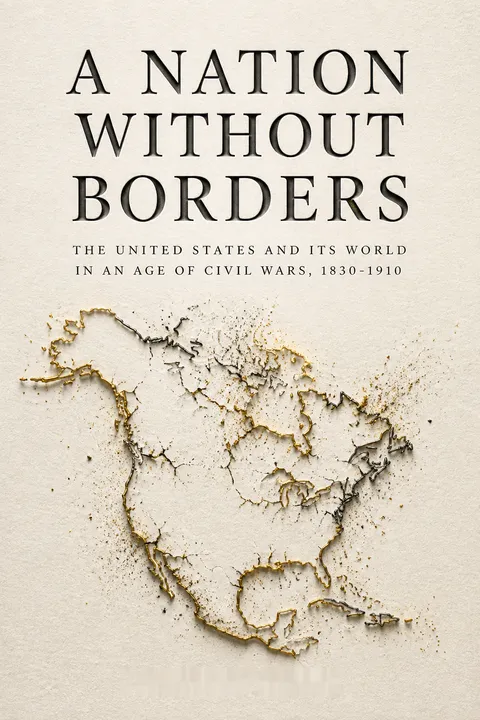
A Nation Without Borders suggests something rather different. It argues that the model of governance inherited from the British was empire; that from the birth of the Republic the United States was a union with significant imperial ambitions on the continent and in the hemisphere, many pushed by slaveholders and their allies...
Early imperial ambitions. The book argues that the U.S. was conceived as an empire, inheriting a governance model from the British. From its founding, the nation harbored significant imperial ambitions across the continent and the Western Hemisphere, often driven by powerful slaveholding interests. This perspective challenges the conventional view of the U.S. as initially a nation that later became an empire.
Continental expansion. Leaders like Jefferson envisioned an "empire of liberty" that would stretch across North America. The Louisiana Purchase in 1803, though fraught with constitutional ambiguities and made possible by the Haitian Revolution, dramatically expanded U.S. territory and set the stage for further westward movement. This expansion was not merely about settlement but about asserting dominance over vast new lands.
Slaveholders' influence. Slaveholders, particularly from the Deep South, were key drivers of this early imperial project. They sought new territories for the expansion of slavery, viewing it as essential for economic prosperity and political power. Their influence shaped foreign policy, pushing for the acquisition of areas like Texas and Cuba to secure and extend the "peculiar institution."
2. Slavery's National Reach Fueled Sectional Conflict
Although A Nation Without Borders clearly recognizes that distinctive types of slave societies emerged in the Deep South and, to a lesser extent, in the upper South, it also insists that slavery was national, not sectional, during the first six decades of the nineteenth century...
Slavery's pervasive influence. The book contends that slavery was a national, not merely a Southern, institution during the early 19th century. Its economic reach extended throughout the U.S. and globally, with Northern merchants and manufacturers deeply implicated in the cotton trade. This national entanglement meant that the conflict over slavery's future affected all regions.
"Sectionalism" as a construct. The idea of a stark "North" versus "South" divide was often a political construct, used in debates over slavery's expansion. While distinct slave societies existed, the primary struggle was often between the Northeast and the Mississippi Valley for continental control, uniting slaveholding and non-slaveholding expansionists within parties like the Democrats. This internal tension ultimately fractured alliances and led to war.
Racial prejudice. Jim Crow racism, often associated with the post-Civil War South, initially emerged in Northern states as they gradually abolished slavery. This highlights that racial prejudice and discrimination were widespread across the nation, not confined to the slaveholding regions. The national character of racism complicated efforts to address slavery and its aftermath.
3. Multiple Rebellions Challenged Central Authority
But the War of the Rebellion was only the largest of many rebellions that either called into question the sovereign authority of the federal government or insisted upon their own claims to sovereignty.
Beyond the Civil War. The Civil War, or "War of the Rebellion," was not an isolated event but part of a broader pattern of challenges to centralized state authority from 1830 to 1910. These included numerous domestic uprisings that questioned the federal government's sovereignty. This perspective reframes the Civil War as one manifestation of ongoing struggles over power and autonomy.
Diverse forms of resistance. Rebellions took various forms and involved diverse groups:
- Native Americans: Resisted settler colonialism and dispossession, notably in the Second Seminole War (the longest American war until Vietnam).
- Slaveholders: Advocated nullification in South Carolina and envisioned a slaveholding empire.
- Mormons: Sought to limit federal power in Utah Territory and establish their own State of Deseret.
- Filibusters: Launched privately financed operations against Cuba, Mexico, and Central America, violating U.S. neutrality laws.
- Secessionist sentiments: Emerged in California, the Midwest, and New York City during the Confederate rebellion.
Contested sovereignty. These "wars of the rebellions" demonstrated that the concept of federal sovereignty was constantly contested and reshaped. They highlighted the fragility of the Union and the persistent struggle of various groups to assert their own claims to self-governance against an expanding central state.
4. The West and Pacific as Imperial Proving Grounds
Indeed, it is impossible to grasp the significance of many of the important events of the nineteenth century—from Texas annexation to the U.S.-Mexican War, to the Civil War, to the developmental projects in the trans-Mississippi West—without recognizing the Pacific as an American destiny, real and imagined.
Pacific destiny. The Pacific coast was viewed as vital to U.S. interests and a gateway to future prosperity and global influence from the late 18th century. This "Pacific destiny" profoundly influenced major 19th-century events, including:
- Texas annexation
- The U.S.-Mexican War
- The Civil War
- Developmental projects in the trans-Mississippi West
Proving ground for empire. The West and South served as "proving grounds" for later overseas imperial projects. The experiences of economic and political subordination, ruthless exploitation, and encounters with diverse peoples of color (Native American, Hispanic, African American) in these regions laid the groundwork for future imperial ventures. This internal colonialism shaped the U.S.'s approach to external expansion.
California Gold Rush. The California Gold Rush, following the Mexican-American War, had a global impact, attracting migrants from across the Pacific and Atlantic. This influx led to intense competition and paramilitary conflicts, with Anglo-American miners asserting dominance and excluding non-white populations. The rapid, often violent, establishment of local authority and racial hierarchies in California foreshadowed later imperial dynamics.
5. The Civil War Forged a Centralized Nation-State
The U.S. had spent seven decades building an empire with a weak center, constructing a federal union with murky—and multiple—bases of sovereignty, but now the War of the Rebellion was enabling the ruling Republicans to define the boundaries of a nation-state.
From union to nation-state. The Civil War fundamentally transformed the U.S. from a loose confederation of states with ambiguous sovereignty into a centralized nation-state. The Republican-controlled federal government dramatically expanded its reach and authority, asserting its supremacy over individual states. This shift was a direct response to the slaveholders' rebellion and the need to preserve the Union.
Wartime state-building. The Lincoln administration and Republican Congress implemented unprecedented measures to finance the war and consolidate federal power:
- National banking system: Created a stable market for federal bonds and regulated currency.
- Protective tariffs: Boosted Northern manufacturing.
- Transcontinental railroads: Chartered with massive land grants and financial incentives, linking the nation.
- Territorial expansion: Creation of new territories (Colorado, Dakota, Nevada, Arizona, Idaho, Montana) under federal jurisdiction.
- Conscription: Imposed military drafts, asserting federal authority over individual citizens.
Redefining national identity. Lincoln's Gettysburg Address, delivered in 1863, articulated a new vision of the U.S. as a "nation, conceived in liberty, and dedicated to the proposition that all men are created equal." This rhetoric, though not immediately inclusive of all, laid the ideological foundation for a more unified and federally defined national identity, shifting from a "union" to a "nation."
6. Slaves' Agency Drove Emancipation and War Aims
What he would not readily have imagined was the source from which the drive for emancipation would most powerfully flow: the slaves themselves.
Slaves as political actors. Enslaved people actively shaped the course of the Civil War and the emancipation process. Their political awareness, fueled by information about the conflict and Lincoln's election, led to widespread expectations of freedom. They saw Lincoln as a potential ally and acted on these beliefs, often before official federal policy caught up.
Contraband policy. Slaves initiated their own rebellion through mass flight to Union lines, presenting themselves as "contrabands of war." This forced federal commanders, like Benjamin Butler, to confront the issue of slavery directly. The contraband policy, later ratified by Congress, effectively undermined the institution of slavery from within the Confederacy.
Black military service. The decision to arm African Americans, slave and free, was a pivotal moment, driven by military necessity and slave agency. Black soldiers, comprising over 10% of the Union Army, fought with ferocity, dispelling doubts about their capacity and challenging racial attitudes. Their participation transformed the war's objectives, linking the cause of the Union with the cause of emancipation.
7. Post-War Capitalism Sparked Widespread Resistance
But the alliance that came out of the war would endure, and in many respects become stronger, leaving those who had been enriched and had then run amok to pick up the pieces.
Rise of corporate power. The post-Civil War era saw the rapid consolidation of corporate capitalism, particularly in finance and industry. Railroads, mines, and manufacturing giants emerged, often through alliances with the federal government and fueled by massive capital accumulation. This new economic order concentrated wealth and power in the hands of a few, leading to widespread social and economic dislocations.
Economic crises. The panics of 1873 and 1893, linked to global financial shifts and overproduction, exposed the vulnerabilities of this new capitalist system. These depressions led to wage cuts, factory closures, and spiraling unemployment, intensifying class conflict and popular discontent across the nation. The economic turmoil fueled calls for reform and alternative economic models.
Labor and agrarian resistance. The rise of corporate power was met with fierce resistance from labor and agrarian movements. Organizations like the Knights of Labor and the Farmers' Alliance mobilized thousands of workers and farmers, protesting:
- High freight and interest rates
- Land monopolies
- Wage cuts
- Political corruption
They sought to challenge the hegemony of the marketplace and advocate for a more equitable distribution of wealth and power.
8. Reconstruction as a Dual Imperial Project
The 'reconstruction' of the South and the 'reconstruction' of the West thereby formed part of a sweeping national project.
Southern Reconstruction. Federal Reconstruction in the South aimed to suppress the slaveholders' rebellion, establish national authority, and integrate freedpeople into the body politic. Military Reconstruction Acts imposed martial law, enfranchised black men, and facilitated Republican rule, leading to a brief but significant political revolution where former slaves held office. This challenged the old social order and sought to redefine citizenship.
Western Colonialism. Simultaneously, the federal government pursued a colonial project in the trans-Mississippi West, suppressing Native American resistance and imposing new forms of control. Policies like the reservation system and the Dawes Act aimed to "civilize" Indians by forcing them to abandon communal land ownership and traditional ways of life. This process, often enforced by the military, cleared the way for capitalist development and white settlement.
Interconnected imperialisms. The book highlights the interconnectedness of these two "reconstructions." Military officers who served in the Civil War often went on to command forces in the Indian Wars, applying similar tactics of "total war." The federal government's assertion of sovereignty and its efforts to reshape social and economic relations in both the South and the West were integral to the formation of the American nation-state and its imperial reach.
9. Antimonopoly Movements Offered Alternative Futures
The Populist platform ratified in Omaha expressed, perhaps better than any other document of the period, the vision and limits of antimonopoly politics, together with the cooperative impulse that gave those politics their social distinctiveness.
Challenging concentrated power. Antimonopoly movements, rooted in republican ideals and fueled by the economic dislocations of industrial capitalism, sought to curb the power of large corporations and financial institutions. Figures like Henry George, with his "single tax" theory, argued that land monopoly was the root cause of poverty amidst progress. These movements aimed to restore economic independence for small producers and workers.
Diverse coalitions. Organizations like the Greenback Labor Party, the Knights of Labor, and the Farmers' Alliance built broad, cross-class coalitions. They united:
- Farmers and tenants
- Skilled and unskilled workers
- Blacks and whites (though often in segregated assemblies)
- Small manufacturers and shopkeepers
Their platforms advocated for monetary reform (greenbacks, free silver), public ownership of railroads and telegraphs, and cooperative economic models.
Vision of a cooperative commonwealth. These movements envisioned a "cooperative commonwealth" where the state would actively promote the welfare of "producers" and ensure a more equitable distribution of wealth. The subtreasury system, for example, proposed federal warehouses and low-interest credit for farmers, directly challenging the power of private finance and middlemen. Despite political defeats, these ideas laid crucial groundwork for future social democratic reforms.
10. Racial Reconstruction Hardened Segregation and Disfranchisement
Race, that is, was being reconstructed on both sides of a color line now drawn more deeply than ever.
Jim Crow's rise. Following the end of Reconstruction, white Democrats in the South systematically dismantled black political power and institutionalized racial segregation. Laws like the Mississippi Plan (1890) used poll taxes, literacy tests, and residency requirements to disfranchise black men, effectively nullifying the Fifteenth Amendment. This process created the "solid" Democratic South and cemented white supremacy.
Segregation as "modernity." Segregation, or Jim Crow, was presented by its advocates as a modern, rational way to manage race relations in an industrializing society. It aimed to prevent racial mixing and maintain white dominance in public spaces, particularly in rapidly growing Southern cities and on transportation networks. The Supreme Court's "separate but equal" ruling in Plessy v. Ferguson (1896) legitimized this system.
Black resistance and self-reliance. Despite the brutal repression and legal barriers, African Americans continued to resist and build their own institutions. Leaders like Booker T. Washington, while advocating accommodation, also promoted black self-help and economic development. Movements like the Niagara Movement and the NAACP, led by W.E.B. Du Bois, directly challenged segregation and demanded full civil and political equality, laying the foundation for future civil rights struggles.
11. New Imperialism Extended US Power Globally
The South and especially the West were proving grounds for new American imperial ambitions overseas.
Economic drivers. The deep depressions of the late 19th century, coupled with industrial overproduction, spurred a search for new markets abroad. American industrialists and financiers, many enriched by wartime contracts, looked to Latin America and Asia for investment opportunities and outlets for their goods. This economic imperative drove a new phase of American imperialism.
Strategic acquisitions. The Spanish-American War (1898) provided the U.S. with strategic territories in the Caribbean and Pacific. The annexation of Hawaii, Puerto Rico, Guam, and the Philippines was justified by military necessity and the need for coaling stations and naval bases to secure trade routes to Asia. This marked a significant shift from continental expansion to overseas empire.
"Civilizing mission." U.S. interventions were often framed as a "civilizing mission" to bring order, democracy, and progress to "backward" peoples of color. This rhetoric, however, masked racial prejudices and economic exploitation. The "Open Door" policy in China, advocated by Secretary of State John Hay, sought to ensure equitable commercial opportunities for all foreign powers, reflecting a desire for economic dominance without formal colonization.
12. The Mexican Revolution Redefined Borderland Dynamics
And it was there, on the border of the United States, that the long nineteenth century first gave way to the twentieth.
Challenge to US influence. The Mexican Revolution (1910-1920) profoundly impacted the U.S.-Mexico borderlands and challenged American imperial ambitions. The revolution, initially against the authoritarian Porfiriato regime, quickly evolved into a complex struggle involving diverse factions with radical social and agrarian demands, such as those led by Emiliano Zapata and Pancho Villa. This instability directly affected U.S. interests and security.
Borderland transformations. The revolution exacerbated existing tensions in the U.S. Southwest, particularly in southern Texas. Anglo-American expansion, fueled by railroad development, led to the dispossession of Tejano landowners and the imposition of Jim Crow-like racial and political exclusions. This created a combustible environment where Mexican revolutionary ideals resonated with disaffected Tejanos, leading to cross-border raids and violence.
Wilson's interventions. President Woodrow Wilson, despite his rhetoric of "self-determination," intervened militarily in Mexico (e.g., the occupation of Veracruz, Pershing's punitive expedition against Villa). These interventions aimed to protect American interests and influence the revolution's outcome, often supporting factions that favored stability and modernization over radical social change. The Zimmermann Telegram, proposing a German-Mexican alliance, further highlighted the border's strategic importance in global conflicts.
Review Summary
A Nation Without Borders covers 1830-1910, examining America's transformation from empire to nation-state through continental and overseas expansion. Reviewers praise Hahn's reinterpretation emphasizing imperialism, slavery's centrality, and marginalized perspectives including Native Americans, African Americans, and workers. The book focuses on rebellions shaping America's destiny, particularly the Civil War's role in centralizing power. While lauded for accessibility and research, some criticize its density, occasional disorganization, and interpretive framework overshadowing narrative clarity. Readers appreciate the corrective to traditional histories, though noting challenges for those unfamiliar with the period and concerns about skipped topics.
People Also Read









About the Author


Download PDF
Download EPUB
.epub digital book format is ideal for reading ebooks on phones, tablets, and e-readers.








































