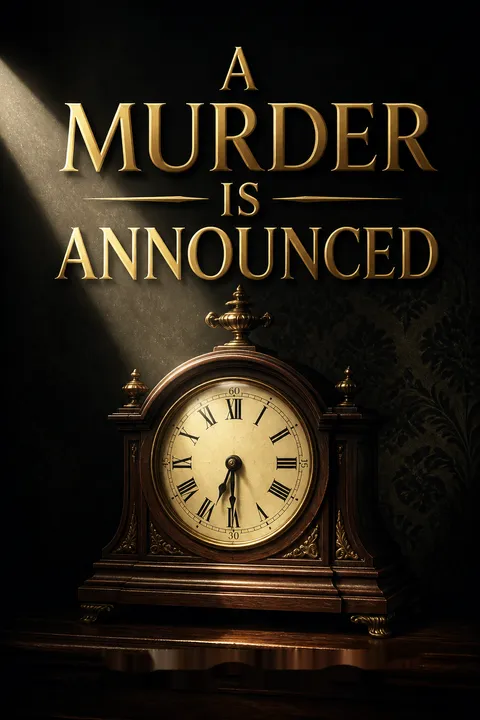

Plot Summary
An Announcement Upsets Cleghorn
An enigmatic advertisement in the local newspaper announces a murder to take place at Little Paddocks, Letitia Blacklock's home. The genteel residents of Chipping Cleghorn react with mixed amusement and anxiety, speculating about its origins—a practical joke, a new kind of invitation, or perhaps something sinister. Several neighbors, including the Swettenhams, the Easterbrooks, Miss Hinchcliffe and Miss Murgatroyd, and the vicar's wife, Bunch, debate whether to attend this peculiar gathering. Meanwhile, Letitia Blacklock and her companion Dora Bunner are also baffled by the notice, feeling unease mixed with resignation about village curiosity. This opening establishes the insular, interconnected world of Cleghorn just as fate quietly sets dreadful plans in motion.
Curious Guests Gather at Sundown
At six-thirty, a motley group converges at Little Paddocks: colonels and housewives, busybodies and cynics. Each comes under the pretense of dropping by, transparent in their true intent to witness the promised "murder." Letitia Blacklock hosts with measured calm, Bunny fusses, and Mitzi the nervous maid sees threats everywhere. The guests' interactions echo village gossip and layers of class and postwar malaise. Shadows of suspicion and anticipation fill the drawing room, along with sherry and Mitzi's cakes. The stage is set for either parlour game or disaster as the household prepares, each person unwittingly stepping into a carefully laid trap.
The Game Turns Deadly
Exactly as predicted, the lights fail, plunging the guests into darkness. A masked intruder bursts into the room shouting, "Stick 'em up!" Before anyone is sure if this is mock-play or threat, shots are fired: Letitia is grazed by a bullet, and chaos follows. In the confusion, the masked man is himself shot and collapses, dead. The stunned company discovers he's Rudi Scherz, a Swiss hotel clerk previously seen only briefly by Letitia and her companion. The shock among the guests—who moments before expected nothing more than mild scandal or entertainment—quickly turns to fear, suspicion, and the grim reality of murder.
Rudi Scherz: Stranger or Pawn?
The local police—led by Inspector Craddock—begin to probe the events. Who was Rudi Scherz, and what was his motive? As his questionable past emerges, hints swirl of petty theft, fraud, and perhaps blackmail. The idea that the "hold-up" was a botched robbery seems unsatisfying, especially to Miss Marple, who's soon drawn into the case. Residents replay their memories, but nobody can explain why Rudi—an outsider—would stage such a convoluted break-in and then either kill himself or stage a suicide. The sense grows that he was manipulated, and that someone closer to hand may have set him up as a disposable pawn.
Suspicions and Shadows Multiply
Each inhabitant and guest is scrutinized for motive, opportunity, and possible collusion. Julia and Patrick Simmons—Letitia's young relatives—deflect suspicion, while war widow Phillipa Haymes reveals little of herself. Mitzi's paranoia mixes truth with invention, and Bunny's muddled recollections foreshadow trouble. Local opinions swirl around foreignness, class, and village morality. Clues point in too many directions: the front and side doors, a swapped sherry bottle, stolen moments in the shrubbery, and a web of lies and omissions. The possibility grows that someone inside the house manufactured the drama for a hidden purpose.
Miss Marple Arrives in Town
Called to consult by her police acquaintances, Miss Jane Marple brings her legendary intuition to Cleghorn. She probes beneath the polite surface, dissecting facts others overlook—who could have moved inside the house in darkness, who was recognized or not, and how easily identity can be faked in a postwar, peripatetic world. Marple connects with the villagers, gathering stray threads of character and past histories. She is the first to suggest that Rudi was a "fall guy"—an expendable stooge who only believed he was part of a harmless charade. Layers of deception begin to unravel under her gentle but piercing scrutiny.
The Door Beside the Drawing Room
Inspector Craddock discovers that a supposedly sealed door in the drawing room has recently been oiled and unlocked, giving anyone inside a hidden escape route. This revelation exposes a critical flaw in everyone's account: during the blackout, someone could have slipped behind Rudi and fired the fatal shots under cover of darkness, then returned, unseen, as a "startled guest." The possibility that one of the household or "friends" is a cold-blooded killer becomes chillingly real. The most trusted and familiar faces now fall under suspicion in a world where even architectural details become evidence.
Pip, Emma, and Hidden Heirs
Miss Blacklock reveals that the wealthy Goedler fortune, to which she is soon heir, will revert—if she dies first—to the unknown children Pip and Emma, offspring of her employer's estranged sister. These heirs are the right age to be anyone in Cleghorn, feeding fears that they may already be among the suspects under assumed identities. Everyone's motives are now suspect, especially the young and mysterious. Inheritance becomes a motive for carefully plotted murder, and the truth about family ties, Europe's refugee migrations, and forged paperwork casts a long shadow over the peaceful English village.
Delicious Death and Bitter Aftertaste
The household prepares a lavish tea for Bunny's birthday. Mitzi bakes her special cake, "Delicious Death," and the neighbors mingle in forced festivity. But the party's cheer is superficial; tensions simmer, and Letitia seems anxious and distracted. After the guests depart, Bunny, complaining of a headache, takes what she believes is aspirin and goes to bed—only to be found dead by morning. The tablets have been laced with poison, intended for Letitia. The stakes have shifted: it is now certain the murderer is still within their ranks, and is willing to strike again.
Bunny's Birthday, Bunny's Fate
Bunny's death devastates Letitia, but Inspector Craddock sees the calculated nature behind the tragedy—the substitution of poison for medicine, amid the confusion of the day. As the search intensifies, letters and mementoes surface that further cloud questions of identity and inheritance. Miss Marple probes Bunny's confused but revealing statements, realizing that Bunny's very trustworthiness made her dangerous—she truly knew who "Letty" was, even if she didn't know she knew. The house becomes a place of dread, where "accidents" can happen to anyone, and loyalty and affection cannot be separated from lethal danger.
Letters, Lamps, and Lingering Secrets
Inspector Craddock discovers a trove of Letitia's letters to her deceased invalid sister Charlotte, maps out a family history riddled with pain, jealousy, and identity confusion. The letters provide hints that the two sisters were once indistinguishable, and catalog the grievances and small kindnesses which have festered over time. Simultaneously, Marple and Craddock unravel the trickery of the blackout: a lamp's frayed cord, arranged to short-circuit the lights at a specific moment, implicates only someone inside with foreknowledge—a clue Bunny almost identified. The past and present mesh, as every "minor" detail—photographs, violets, or misplaced pearls—becomes weighted with meaning.
Murgatroyd Remembers, Danger Returns
Miss Murgatroyd, under Hinchcliffe's questioning, reconstructs the events of the blackout and realizes the most crucial observation: at the moment of the attack, Letitia Blacklock was not standing where she claimed to be. Before she can fully tell anyone, she is found murdered—strangled moments after her realization. The killer, desperate to silence the only eyewitness to their deception, has struck again. Miss Marple, sensing the rising danger, accelerates her own quiet but relentless investigation. The once-safe rural world is now a hunting ground, and no one knows who will die next.
Miss Marple's List of Clues
Alone before the fire, Miss Marple organizes her thoughts in a list: lamps, violets, replaced bottles, memories of iodine and old-age pension fraud—all pieces of a larger pattern. She sees through confusion, recognizing that identity can be exchanged, the past can be re-written, and that kindness and cruelty sometimes share a face. Meanwhile, Craddock assembles everyone, focusing suspicion on the last three possible suspects: Julia, Mrs. Swettenham, and Mrs. Easterbrook. The labyrinth is closing in; every alibi, accent, and gesture is newly suspect under Marple's unblinking eye.
Three Women Under Suspicion
The atmosphere at Little Paddocks is taut, the suspects exhausted by fear. Marple ingeniously baits a trap by convincing Mitzi to "confess" to seeing Miss Blacklock with the gun, drawing out the killer's desperation. Under cover of seeming distraction, Miss Blacklock—her nerves shredded—attempts to murder Mitzi in the kitchen, exposing herself when she thinks no one is watching. The truth can no longer be denied. With Marple and the police as witnesses, the murderer's last gambit has failed, and the secret—nurtured over years—explodes into the open.
The Killer Among Us
Under interrogation and Marple's guiding commentary, the true narrative emerges: "Letitia Blacklock" is in fact her invalid sister Charlotte, who has spent years impersonating her dead sibling to claim the Goedler inheritance. The real Letitia died in Switzerland; Charlotte, always in the background, assumed her identity with Bunny as her only confidant. When Rudi Scherz—an orderly from Charlotte's past—appeared, she recognized a threat and engineered the complex ruse that became the "announced murder," hoping to eliminate him under cover of confusion. Every subsequent death was the result of Charlotte/Letitia's fear, spiraling into more violence to maintain her deception.
A Reunion—and a Revelation
After Miss Blacklock's confession collapses, Julia is shown to be Emma Stamfordis, one of the real Goedler heirs; her "brother" Pip is revealed as Phillipa Haymes. The inheritance passes rightfully to them, and Emma's masquerade is forgiven. The young couples—Emma and Patrick, Pip and Edmund—find closure and new beginnings. Mitzi emerges a minor hero, cherished her role in events. The surviving villagers are left to reconcile the traumas of evil within their midst. Miss Marple, as ever, sees everyone off with a gentle reminder to attend carefully to the overlooked and neighborly, for those can be the most dangerous.
Murder Explained, Marple Unmasks Truth
She walks the others through the genuine sequence of events: the devastating psychological damage Charlotte suffered, her longing for life and affection, her tragic partnership with Bunny, and her ultimate corruption by envy and opportunity. The lamp, the pearls, the doors, every understated clue is revealed as part of Charlotte's elaborate lie. Marple points out that crimes of the weak can be as deadly as those of the strong, especially when their suffering is paired with resentment. As she departs Cleghorn, the village slowly returns to its routines, forever altered by murder and truth.
Analysis
A Murder Is Announced interrogates trust, identity, and postwar uncertainty within the facade of idyllic English village life
Christie's novel delves beyond puzzle and pretense, exploring how trauma, economic upheaval, and personal insecurities distort lives and relationships. The central mystery—an announced murder that is both a spectacle and a smokescreen—serves as a metaphor for the fragility of reputations and the ease with which history and humanity can be rewritten. By mounting suspicion on those who appear most familiar and harmless—a devoted companion, a kindly hostess—Christie exposes the peril in trusting routine and surface, especially when the wounds of past deprivation meet the temptations of opportunity. The postwar setting amplifies the anxiety around migration, identification, and the erosion of social order, making the murder as much an indictment of communal complacency as of individual villainy. Miss Marple embodies the possibility of restoration, not by brute logic, but by attention, memory, and understanding of the heart. Christie's lesson is both cautionary and redemptive: evil, when ordinary, is most insidious; but so too is the potential for ordinary goodness to see, heal, and—ultimately—renew.
Review Summary
Readers largely praise A Murder Is Announced as one of Christie's finest works, celebrating its clever premise — a murder publicly advertised in a local newspaper — alongside its intricate plot, memorable characters, and satisfying resolution. Many highlight the atmospheric village setting, skillful red herrings, and Miss Marple's stronger presence compared to earlier installments. Some note the large cast can be overwhelming, and a few feel the ending is slightly forced. Overall, most consider it essential reading for mystery fans, with ratings clustering around 4–5 stars.
People Also Read


Characters
Letitia (Charlotte) Blacklock
Charlotte Blacklock begins as a shadowy, gentle companion to her stronger sister but steps into Letitia's identity after Letitia's death. Motivated by a lifetime of insecurity, self-effacement, and deprivation, she painstakingly reinvents herself as Letitia to inherit the Goedler fortune, aided only by the loyalty (and confusion) of Dora Bunner. Her fearful loneliness, exacerbated by the sudden threat of exposure, drives her from a calculated fraud into cold-blooded murder. Charlotte's psyche is a blend of envy, longing for love and normality, and increasing paranoia; her transformation into killer is both pathetic and chilling—she is pitiable and monstrous by turns.
Dora "Bunny" Bunner
Dora, Letitia's childhood friend, is drawn to Little Paddocks by both nostalgia and poverty. Her loyalty to her "Letty/Lotty" is unwavering, but her mind is easily confused, and her tendency to recall the past aloud endangers her without her knowing. Bunny represents kindly indulgence and social dependency—her affection is real, but her lack of acumen makes her dangerous to Charlotte's secret. Tragic in her dependency and childlike faith, she becomes a victim of her own naiveté, demonstrating how the vulnerable can threaten even as they yearn to help.
Miss Jane Marple
Miss Marple is the outsider whose intimate understanding of human nature and village psychology enables her to see patterns others miss. She combines apparent harmlessness with formidable shrewdness, approaching evil as a product of failed humanity rather than monstrous intent. Marple's strength is in seeing through social camouflage, both affectionately and critically. She's interested in people's tics, stories, and the telling oddment. Her emotional intelligence makes her a beacon of justice and compassion amid confusion; she sees the best and worst in people with clear eyes, bringing closure and relief to the community.
Inspector Dermot Craddock
Craddock brings both procedural acumen and emotional sensitivity to the investigation. Initially misled by red herrings and the expected logic of police work, he gradually learns to trust both hunches and the guidance of Marple's intuition. Craddock's growth is a journey from reliance on "facts" to deeper understanding of motive and psychology—recognizing that even the most ordinary-seeming can conceal destructive secrets. His respect for Marple and willingness to look beyond appearance allows him to solve the case and heal some of the emotional wounds left in Cleghorn.
Julia Simmons / Emma Stamfordis
As Julia, she is cool, clever, a bit aloof—a woman masking sharp survival instincts under an artful persona. Her masquerade as Blacklock's relative grants her safety and possible fortune, but she refrains from violence and ultimately confesses her true identity. Emma's journey is from shadowy hanger-on to justified heir, her adaptability and self-possession tested by suspicion and danger. She represents the European émigré, shaped by an unstable world, seeking both belonging and security but refusing the depths of duplicity that corrupted Charlotte.
Patrick Simmons
Patrick is the handsome, flippant young man who blunders humorously but loves deeply. He is both a red herring for suspicion and the means of Julia/Emma's redemption. Underneath the jokes and mischief lies loyalty and a certain innocence—he stands as a contrast to the darker manipulations around him. Patrick's development is from aimless playboy to mature, empathetic partner—a witness to the transformation wrought by unveiling hard truths.
Phillipa Haymes / Pip Stamfordis
Phillipa is Letitia's reserved, self-sufficient lodger, a war widow intent on creating stability for her son. Her past is tied to the Goedler fortune as the real "Pip." Phillipa's psyche is marked by repression, fear, and a longing for security; she faces suspicion with resilience but relief when the inheritance—rightfully hers—ends her isolation. She embodies the often-invisible traumas and aspirations of women after war—her survival is a victory of humility and persistence over the havoc wrought by greed.
Mitzi (Refugee Maid)
Mitzi is the emotional, melodramatic foreigner; unstable, gossipy, and full of imagined persecutions, yet sometimes glimpsing the dark heart of the household's secrets. Her mental fragility and eccentricities both hinder and advance the investigation. Mitzi is the perpetual outsider—a reminder of the war's refugee trauma and how societal exclusion breeds both tragedy and unwitting insight.
Miss Hinchcliffe
Miss Hinchcliffe is straightforward, skeptical, and fiercely devoted to Murgatroyd. Her practical, no-nonsense approach to the investigation moves the story forward, and her vengeful anger after Murgatroyd's death is a raw portrayal of grief and righteous outrage. Her loyalty underscores the emotional toll of violence and the essential decency threatened by community betrayals.
Amy Murgatroyd
Murgatroyd's goodness and lack of guile make her a nonentity to most, but her long memory and sense for detail endow her with the key realization of the night's events. Her murder is a final act of desperation from the killer; her quiet courage in reconstructing the scene results in her own death. Murgatroyd exemplifies the hazard of being a witness in a world where recognizing evil can be fatal.
Plot Devices
The Announced Murder and the Blackout
Christie's central device is the public "announcement" of murder—turning spectators into suspects—and the carefully synchronized blackout that hides the true crime. The darkness, coupled with the blinding torch, disorients victims and misdirects suspicion, enabling the killer to slip out and back, unseen. Christie uses the mechanics of domestic space—doors, lamps, familiar routines—to camouflage evil, exploring how "normal" can be the breeding ground for violence.
False Identity and Inheritance Motive
The ultimate deception is identity theft: Charlotte Blacklock's reinvention as her own sister exposes the ease with which family, friends, and institutions can be fooled. The inheritance plot—the reversion of fortune to "unknown" heirs—gives rational motive to what seems senseless violence, raising questions about trust, documentation, and the legacies of war, emigration, and fractured kinship in the mid-twentieth century.
Psychological Misdirection and Foreshadowing
Christie leverages the psychology of her characters—especially their perceptions, biases, and memories—to foreshadow the truth. The muddle of Bunny's recollections, the antics of Mitzi, and the forgetfulness of small details (like pearls or aspirin) all serve both as misdirection and as the thread leading to the solution. The narrative toys with reader expectations, exploiting stereotypes of gender, class, and the foreign to hide the real culprit in plain sight.
Community Surveillance and Village Claustrophobia
The intimacy and isolation of Chipping Cleghorn are both comforting and deadly. Everyone knows each other, and yet strangers can reinvent themselves with frightening ease. Gossip, habit, and the limits of curiosity form both the defense and the weakness of rural England. This device interrogates the myth of the "safe village," making paranoia (and the kindly neighbor) central to both detection and danger.
Miss Marple Series




About the Author
Other books by Agatha Christie





Download PDF
Download EPUB
.epub digital book format is ideal for reading ebooks on phones, tablets, and e-readers.








































