


Plot Summary
The Stranger at Dawn
Before sunrise, a widowed lady named Etheldreda1 hunts illegally on royal ground with her peregrine, Lucy, killing a rabbit for supper. She spends her scarce coin on sugar and lace, not meat, to maintain the illusion of gentility for her daughters. A dark-haired man with a foreign accent4 confronts her on the path, accusing her of poaching.
She trades sharp words, then spots a royal carriage rolling toward her estate. She bolts home through a hedge, terrified less of the stranger4 than of being recognized as the disheveled huntress beneath the lady. The story begins here: a woman living two lives, one title-deep and one mud-deep, racing to receive a message that might lift her family out of ruin.
The opening establishes Ethel's central contradiction: aristocratic performance laid over peasant labor. Hochhauser uses falconry as both livelihood and metaphor, a wild thing tamed by need. The woods function as a space of forbidden freedom, where rules and watchful eyes dissolve. Ethel's fear of recognition reveals that her real predator is not violence but social exposure, the collapse of the facade protecting her daughters. The unnamed stranger seeds a future reversal, while the approaching carriage announces that the outside world is about to breach her careful seclusion. The chapter frames survival as theater, and womanhood as a carapace worn for protection.
The Invitation That Excludes
The royal messenger proclaims a ball for the prince's5 name day, then reads a separate paper: the invitation extends only to Elin,2 Ethel's1 pale, virtue-obsessed stepdaughter, and her guardian. Ethel's1 own daughters, Rosamund7 and Mathilde,6 are pointedly omitted. The messenger insists the king does not err. Rosamund7 crumples in tears; Elin,2 clutching her late mother's booklet of female virtue, is astonished to be chosen at all.
Ethel1 knows the slight is deliberate, rooted in an old wound she has hidden from her children. The ball, rumored to be the prince's5 search for a wife, becomes her obsession: an unmatched marker of a daughter's worth, capable of compensating for their lack of dowry. She resolves to get her own blood through that door.
The exclusion converts a fairy-tale opportunity into a maternal battlefield. By inverting the Cinderella structure, the novel makes the stepmother the strategist and the favored stepdaughter the accidental beneficiary. Elin's reflexive quoting of moralisms exposes a worldview that mistakes propriety for protection, while Rosamund's tears and Mathilde's pragmatism map the daughters' opposed temperaments. The invitation crystallizes Ethel's governing belief: marriage is the only lifeboat for women without means, and a ball is the auction floor. The buried reason behind the snub creates narrative suspense, signaling that Ethel's past will determine her daughters' futures, a chain of consequence she cannot outrun.
A Boy and His Falcons
In flashback, young Etheldreda1 grows up a brewer's daughter, schooled both in practical craft by her father and in rigid etiquette by Agatha,14 a tutor who bloodied her knuckles to instill manners. She meets Henry Tremaine,8 the third of seven sons of a wealthy hawking family that summers nearby. Henry8 secretly teaches her the language and art of falconry, letting her hold his merlin.
Spying together on the family's falconers, they witness two men share a tender, illicit embrace and silently vow to tell no one. Their bond deepens into something neither will name, conducted in misty fields beyond the reach of chaperones and rules. Ethel1 discovers a self in the woods that the great hall would never permit her to be.
This origin sequence reframes Ethel's adult ferocity as the residue of a curtailed girlhood. Falconry, the discipline of teaching a wild creature trust through controlled fear, becomes the book's master metaphor for both love and mothering. The secret she keeps for the falconers establishes a lifelong theme: the world runs on concealed truths, and survival depends on knowing which doors to keep shut. Henry represents a rare reciprocity, a man who asks for her thoughts rather than her silence. The tutor Agatha lives on as an internalized voice, the colonizing force of feminine discipline that Ethel will spend the novel both obeying and resisting.
Wasps and a Severed Finger
A dazzling blond guest, Sigrid Camelia White,3 arrives and competes openly for Henry's8 attention, treating Ethel1 as beneath consideration. Consumed by jealousy, Ethel1 engineers a horseback ride along a treacherous route and steers the party toward a ground nest of wasps.
She swerves clear but says nothing as Sigrid's3 horse panics and topples; Sigrid's3 hand is crushed beneath it, mangling her fingers. In the aftermath, Henry,8 learning the quarrel was over him, kisses Ethel1 hard.
He defies his family's objection to a brewer's daughter and marries her. Ethel1 wears a pale blue organza wedding dress she sewed herself, a garment she comes to treat as armor and totem of her hard-won future. Her cruelty and her happiness arrive entangled, inseparable.
This is Ethel's moral origin wound, the seed she will keep harvesting. The deliberate non-warning, a sin of omission rather than commission, captures her lifelong ethical ambiguity: she chooses inaction and lets nature do her violence. Sigrid's lost finger becomes a literal mark of grievance that will compound across decades. The novel refuses to sanctify its heroine, insisting that protective love and predatory selfishness share a bloodline. The blue dress, stitched stitch by stitch, embodies her belief that women build their own escape routes through labor and artifice. Desire here is not romance but appetite, a hunger to consume and be consumed.
The Queen Who Got Everything
Weeks after the wedding, Sigrid3 writes gloating that she will marry the king's firstborn son, recasting Ethel's1 victory as a hollow consolation prize. The Tremaines, assumed to be friends of the future queen,3 are quietly frozen out of court instead: their charters revoked, tariffs withdrawn, fortunes bled away by Sigrid's3 vindictive influence.
Ethel1 and Henry8 build a few tender years and two daughters, Mathilde6 and Rosamund,7 before Henry8 dies suddenly of illness on a trading journey. Grief-stricken, Ethel1 tames a neglected, furious falcon she names Lucy.
Then Henry's father, Errol,17 announces he has arranged to marry the young girls, aged seven and eight, to brothers across the sea, with no provision for their mother. Ethel1 resolves to remarry to protect them.
Sigrid's ascent demonstrates the novel's bleak thesis: those who weaponize charm and obedience, who turn the rules into a ladder then a dagger, prosper, while the earnest are punished. The Tremaine ruin is Ethel's sabotage boomeranging back, sown wasps reaped as poverty. Henry's death strips away her one experience of reciprocal love, leaving mothering as her sole purpose. Lucy's taming dramatizes grief work: by quieting her own mind to win a terrified bird's trust, Ethel finds the disappearance she needs to survive mourning. Errol's cold arrangement exposes women and children as chattel, the brutal economics that make Ethel's subsequent calculations not villainy but maternal triage.
The Indecisive Lord
To stop her daughters being shipped abroad, Ethel1 courts and marries Lord Robert Bramley,10 a soft-handed widower so paralyzed by choice he cannot order wine. She gains a title, a grand crumbling hall, and a stepdaughter, Elin,2 a pampered, fainting child who clings to her dead mother's book of virtues and refuses Ethel's1 mothering.
When Ethel1 asks Robert10 to take down his first wife's portrait, he climbs the ladder himself, hesitates fatally, falls, and dies striking his head. His will is a trap: the estate passes to Ethel1 buried under unpaid taxes, while all liquid money is locked away as Elin's2 untouchable dowry. Ethel1 is left titled, housed, and destitute, bound to a daughter who will not love her2 and a mansion she cannot afford.
Robert's chronic indecision, fatal on a ladder, mirrors a man undone by the very passivity that made him marriageable to a woman seeking control. The marriage is openly transactional, and the novel asks whether deceit with noble purpose is truly deceit, anticipating its later moral relativism. Elin emerges as Ethel's permanent imbalance: a child who cannot be sculpted, who chooses cold pages over a living mother. The will dramatizes how patriarchal law immiserates widows while protecting bloodline daughters. Bramley Hall becomes the book's central symbol, a magnificent stage rotting from within, the perfect emblem of facade as survival and the unbearable weight women carry to keep it standing.
Begging at the Palace
Determined to get her daughters invited, Ethel1 dresses in borrowed finery and travels to the palace, waiting hours at the guardhouse before being admitted. The reunion with Sigrid3 is a slow humiliation: forced sugary tea, pointed reminders of Ethel's1 poverty, and Sigrid's3 airy cruelty.
Ethel1 must openly beg for her daughters' inclusion, laid bare before her old rival.3 To her shock, the dark-haired stranger from the woods reappears, now revealed as Counselor Otto Abensur,4 advisor to the royal family, who recognizes her.
Sigrid3 grants the request almost dismissively. As Otto4 escorts her out through endless opulent rooms, Ethel1 notices the queen's3 gloves conceal her missing finger, and the whole palace's east-facing curtains stay drawn, hiding something she cannot yet name.
The audience scene stages power as the ability to make another grovel. Sigrid's whipped cream and screened tea leaves render wealth as grotesque excess, opulence as an acidic bite rather than beauty. Ethel learns that her old triumph was never even remembered as a wound; she is beneath Sigrid's notice, a deeper humiliation than enmity. Otto's reappearance as the stranger collapses the woods and the court into one continuous surveillance. The drawn curtains and stuffed finger plant the novel's mystery machinery: this palace is built to conceal. Ethel's pride is the currency she spends, and the exchange leaves her victorious yet curdled, bitter at the cost of getting what she wanted.
The Carriage in the Ditch
Knowing Prince Simeon5 will hunt along a certain road, Ethel1 orchestrates an ambush of charm: she stages a picnic, props her daughters beside apple paintings, then shoves her own chaise into a ditch, cracking a wheel.
When the prince's5 caravan arrives, Simeon5 dismounts to help, captivated by Rosamund7 and Mathilde,6 while Otto4 eyes the suspiciously perpendicular wagon with a watchdog's distrust. Simeon5 sends the women home in his own carriage. Days later, a gift arrives: a painting of apples, because Simeon5 thinks the girls love them.
Otto4 delivers it along with Ethel's1 mother's cameo, the keepsake she had secretly pawned to fund the ball gowns, which he somehow knew to retrieve. Hope swells in the household; Rosamund7 believes herself favored.
Ethel's elaborate fakery reveals her conviction that fortune is not received but wrestled into shape with weathered hands. The picnic is pure theater, a tableau arranged for a single viewer, exposing how women must manufacture serendipity to compete. Simeon's easy charm and self-deprecation make him likable, a deliberate seduction of reader and characters alike. Otto's suspicion and his uncanny return of the cameo signal that he watches Ethel more closely than duty requires, an attention whose meaning remains ambiguous, threat or care. The apples, ubiquitous and humble, become a recurring motif of what is undervalued. Rosamund's blossoming hope sets up the cruelest reversal, the heart raised only to be dropped.
The Latecomer in Blue
At the ball, the daughters are presented; Simeon5 dances first with Rosamund,7 and hope blazes. Otto4 unexpectedly asks Ethel1 to dance, and their guarded sparring softens into something warmer. But concealed behind a curtain afterward, Ethel1 overhears Otto4 and Sigrid3 agree her daughters are unsuitable and must be discouraged.
Then Elin2 appears, transported in Moussa13 the jongleur's gilded carriage, dressed in Ethel's own pale blue wedding gown, altered without permission. Elin2 faints theatrically in the doorway; Simeon5 rushes to her, and dances with no one else for the rest of the night. By morning the kingdom buzzes that the prince5 has chosen the strange, pale latecomer,2 and Ethel's1 careful campaign for her own blood collapses.
The ballroom becomes a hall of mirrors where Ethel's schemes refract back wrong. The overheard verdict, unsuitable, brands her like Agatha's old punishments, the social hierarchy reasserting itself against the upstart. Elin's appropriation of the wedding dress is the novel's sharpest emotional dagger: the garment of Ethel's lost love repurposed by the stepdaughter she resents. Elin's faint, half manipulation and half genuine fragility, ironically performs the very helplessness that attracts Simeon. The dance with Otto introduces a counter-current of adult tenderness amid maternal defeat. Hochhauser stages the Cinderella climax as catastrophe for the stepmother, inverting whose dream comes true and at whose expense, the right outcome arriving through the wrong daughter.
Three Weeks to a Wedding
Simeon5 arrives the next morning, strolls the orchard with Elin,2 and announces their engagement, leaving Rosamund7 devastated. Summoned urgently, Ethel1 meets Sigrid3 inside a stifling carriage where the queen, oddly warm, sets the wedding three weeks off and frames the union as making them practically sisters.
Ethel1 swallows her humiliation: a royal marriage will still elevate all her daughters. But disaster strikes Bramley when the rotted roof of the west wing caves in, exposing rubble and sky.
With the prince5 intending to visit, Ethel1 orders the damage hidden at all costs. During a tense dinner, Simeon's5 strange talk of being kept in a cage unsettles her, and Otto4 discovers the ruined wing, declaring the structure dangerous and insisting the prince5 depart.
The compressed timeline and Sigrid's uncharacteristic warmth signal that something is being rushed past scrutiny. The caved roof literalizes the novel's structuring image, slender wrists holding up a falling house, now failing; Ethel's facade physically breaks. Simeon's cage metaphor is the chapter's buried alarm: walls keep danger out, but a cage keeps a threat contained, recoding the prince from charming heir to something monitored. Otto's intervention reads as officious obstruction yet conceals protective intent. Ethel's willingness to absorb shame for advancement shows her maternal calculus hardening into self-erasure. The dinner's falling dust and prowling counselor build dramatic irony: the reader senses corruption beneath the gilt before Ethel fully does.
The Princess in the Tower
A reluctant new servant, Morwen,15 a trained lady's maid hiding from her past, finally confesses what she knows: Princess Hemma,9 Simeon's5 sister, is pregnant and locked away, and the plan is to marry Simeon5 quickly so the baby can be passed off as Elin's2 firstborn. Mathilde6 overhears.
Driven by maternal dread, Ethel1 infiltrates the palace through its hidden servant passages, finds Hemma9 confined in a walled, gateless garden, and recognizes why Elin2 was chosen: the two pale, fair girls look nearly identical. Then Hemma9 delivers the unbearable truth, the child's father is Simeon5 himself, her own brother, who forced her. The crescent bite mark Ethel1 once glimpsed on Simeon's5 arm clicks into horror. The charming prince5 is a predator.
This is the novel's moral abyss, the moment fairy-tale gloss peels to reveal rot. Hemma's walled garden, manicured and inaccessible, is the perfect emblem of how power imprisons women under the guise of protection, bricking over inconvenient truths. The physical resemblance between Hemma and Elin exposes the brutal logic of bloodline preservation: Elin was selected as a body, a vessel chosen for camouflage. Morwen's terror illustrates how knowledge of royal crime is itself dangerous to hold. Ethel's distinction, that having a monster differs from enabling one, becomes the ethical hinge of the book. The revelation transforms her mission from social climbing into rescue, recasting cruelty and protection once more as the question the novel keeps asking.
Pursuit Across the Mud
Ethel1 confronts Sigrid3 directly, demanding the engagement be annulled, but the queen, baring her own missing finger, vows she would maim herself for her children and threatens ruin if the wedding fails. Otto,4 who knew of the pregnancy but not the incest, is shaken and tells Ethel1 to race home.
There she learns Simeon5 has already spirited Elin2 away in a defaced carriage. Otto4 and Ethel1 give chase across the rain-soaked countryside, bribing innkeepers, sleeping in a monastery hut, and slowly falling into a wary intimacy that flares into a kiss tasting of apple.
He confesses his own buried grief, a dead wife and son, and his purpose of keeping dangerous rulers calm. They corner Elin2 at an inn; when Simeon5 slaps her bloody, Otto4 draws his sword and they flee.
The pursuit braids two arcs: the rescue mission and Ethel's reluctant reopening of her own future. Sigrid's confession reframes her not as cartoon villain but as a mother monstrous in the same key as Ethel, both willing to commit anything for their children, raising the novel's discomfiting mirror. Otto's backstory, the cartographer who lost faith in sides after war erased his family, explains his ethic of harm reduction and his quiet steadfastness. The apple-flavored kiss marks Ethel choosing happiness over the carapace of reputation she has worn for decades. Elin's slap is the brutal evidence that finally cracks her faith in virtue's protective magic, the moment the maxims fail her.
The Beast at Bramley
Enraged at being defied and called a beast, Simeon5 arrives at Bramley alone in a storm, intent on destroying Ethel1 and her daughters. To spare the sleeping household, Ethel1 lures him toward the ruined wing, where he pins and strangles her beneath the open roof. As her vision dims, she musters a last whistle, the falconer's call.
Lucy, who had escaped days earlier and whom Ethel1 feared lost, plunges through the hole in the roof and tears at Simeon's5 face. He hurls the bird against the wall, killing her, and resumes choking Ethel.1 Then Elin,2 the girl of endless maxims, swings a fallen roof beam and clubs the prince5 dead. Ethel1 survives; Lucy does not. The monster5 lies broken on the rubble.
The climax fuses the novel's symbols into violent catharsis. Lucy, the wild self Ethel tamed through grief, returns to answer her keeper's call one final time, loyalty repaid with sacrifice, the falcon's instinct fulfilling what human strength could not. That Elin delivers the killing blow completes her arc from passive ornament to agent: virtue weaponized, the book hurled aside in deed before it is burned in fact. The ruined wing, the hidden shame Ethel labored to conceal, becomes the stage of her near-death and salvation, the collapsed facade finally serving her. The scene literalizes the epilogue's thesis: the most dangerous creature in the woods is a mother defending her young.
Burying the Prince
In the dark, Ethel1 and Elin2 haul Simeon's5 body to the cart, free and scatter his horses, and chop apart his carriage. The whole household, asking no questions, builds a great fire and burns the evidence; Elin2 throws her book of virtues into the flames, renouncing it. They carry the prince5 across the stream onto royal land and bury him in a shallow grave.
The next morning Sigrid3 arrives unannounced. Mud-caked and unbowed, Ethel1 bluffs perfect innocence, hinting only that Simeon5 left their inn alive, letting the queen3 glimpse the bruises on her neck. Sigrid,3 needing the marriage yet sensing nothing provable, departs for the last time. Together the family buries Lucy beneath the oak, hands resting on one another in shared grief.
The cover-up dramatizes solidarity as its own form of justice: a household of women and outcasts closing ranks without explanation, loyalty over law. Elin's burning of the booklet completes her transformation, abandoning inherited dogma for lived agency. Ethel's confrontation with Sigrid inverts their earlier dynamic; now Ethel holds the leverage, having nothing left to lose. The two mothers part as mirror monsters who understand each other too well. Lucy's burial channels the unspeakable grief over the killing into a sanctioned mourning, the falcon honored as teacher of loyalty, patience, and fidelity. The chapter resolves the facade theme: Ethel stops performing, having discovered that ruin, once faced, loses its power to terrify.
Epilogue
A year later, Simeon's5 body was never found; search parties combed everywhere but the royals' own land. Hemma9 was declared heir and bore her child, white-blond like herself, and rumor holds the queen3 passed it off as her own. Otto4 left the palace and has proposed to Ethel1 three times; she refuses marriage but keeps him by her side.
The daughters remain unwed by choice, learning to fly goshawks, birds needing no estate to hunt. Elin2 burned her book; Rosamund7 apprentices with a seamstress; Mathilde6 shadows her mother making cider, which they now sell openly. Ethel1 watches a wild hawk feed its young and tells her girls the only maxim that matters: you are the scariest thing in the woods.
The epilogue rejects the tidy bow, insisting all the women remain unmarried, a child was lost, and a body rots in the ground, then asks whether this is a happy ending. The shift from peregrines to goshawks, predators that hunt from the fist without need of land or rank, marks Ethel's freedom from the gentility she once chased. Marriage is reframed as a choice rather than a savior, and Otto's accepted presence without legal binding rewrites Ethel's relationship to consignment and ownership. The closing maxim completes the feminist inversion of the Cinderella tale: not be good and be chosen, but be formidable and refuse fear. Survival, the book concludes, belongs to those who stop hiding their teeth.
Analysis
Hochhauser reclaims the Cinderella myth by handing the pen to the wicked stepmother1 and discovering she was never wicked, only desperate. The novel dismantles the fairy tale's core lesson, that beauty and obedient virtue earn rescue by a prince, replacing it with a harder truth: in a world that treats women as chattel, marriage is not salvation but a precarious choice, and survival demands ferocity, calculation, and the willingness to be the scariest thing in the woods. Ethel1 narrates as a self-aware, morally compromised woman who insists she has presented her cruelties and her loves with an even hand, leaving the reader to judge. The book's central metaphor, falconry, threads everything: mothering as the imprinting of trust through fear, love as the daily weighing of need, the wild self tamed but never erased. Bramley Hall, magnificent and rotting, embodies the labor of facade, the slender wrists holding up a falling roof so daughters might float toward stability. Sigrid3 functions as Ethel's1 mirror, a mother monstrous in identical devotion, forcing the recognition that having a monster and enabling one are divided by a thin, agonizing line. The story's darkest turn, the incest hidden behind royal opulence, exposes how power bricks over its crimes and selects women as interchangeable vessels for bloodline preservation. Yet the novel resists nihilism. Its women, biological daughter and resented stepdaughter, cook and housekeeper, maid and minstrel, close ranks in wordless solidarity, forging a justice the law denies them. Elin's2 burning of her virtue book and the family's open turn to honest cider-making chart a movement from inherited dogma and performance toward lived agency. The refused tidy ending, all women unmarried, a child lost, a body buried, asks readers to redefine happiness not as being chosen, but as ceasing to hide one's teeth.
Review Summary
Lady Tremaine by Rachel Hochhauser is a reimagining of Cinderella from the "evil" stepmother's perspective, receiving overwhelmingly positive reviews (4.44/5). Readers praise the lyrical prose, complex characterization, and feminist themes exploring motherhood, sacrifice, and survival. The novel portrays Lady Tremaine as a twice-widowed mother desperately fighting to secure her daughters' futures in a patriarchal society, while Cinderella (Elin) is depicted as spoiled and lazy. Most reviewers appreciated the darker, realistic tone and unexpected plot twists, though some found the pacing slow or disliked the feminist approach. The audiobook narration by Bessie Carter received widespread acclaim.
Characters
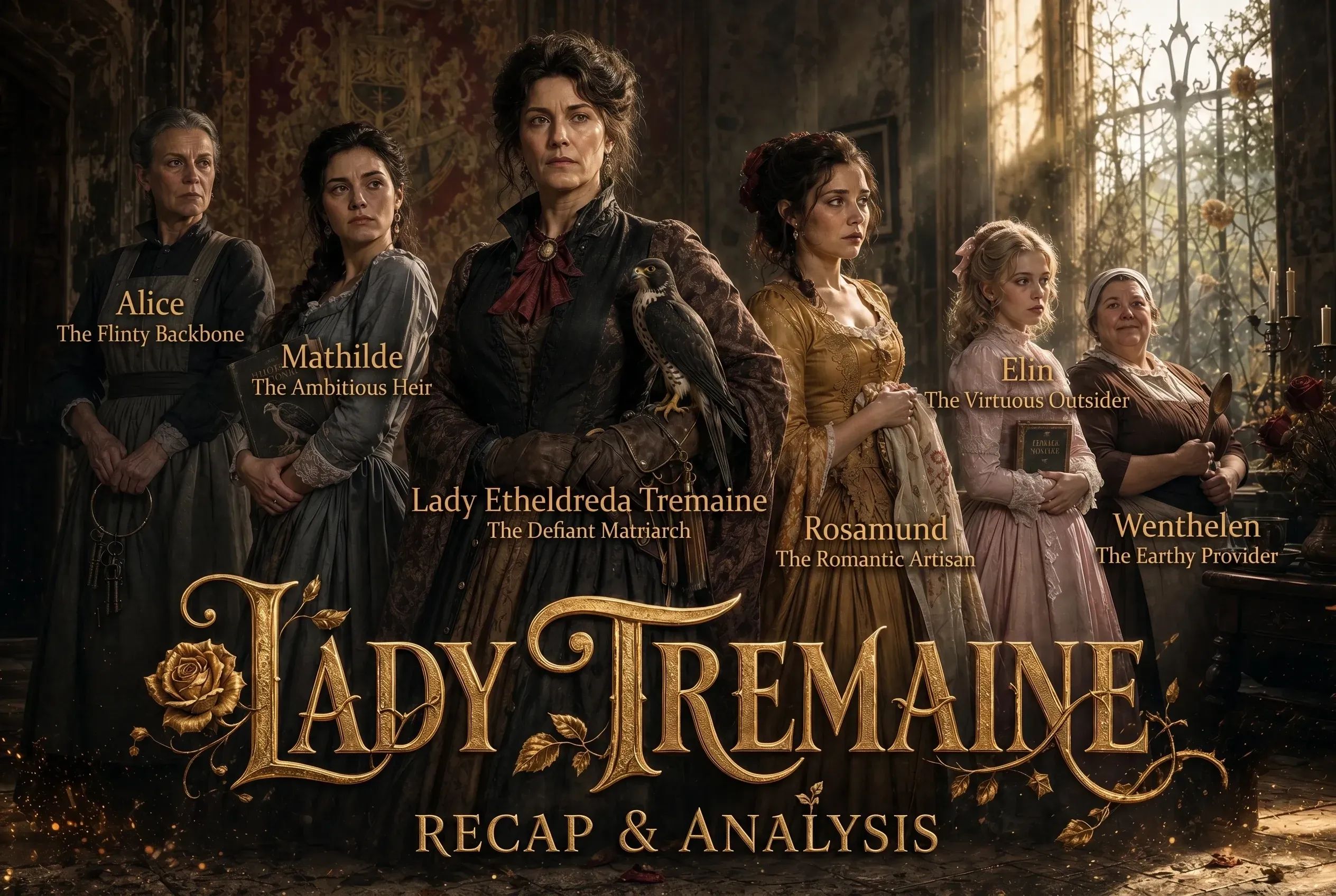
Etheldreda (Ethel)
Resourceful widowed motherThe narrator, a brewer's daughter raised among men and hardened by a punishing tutor14, who married into nobility and clawed out a title across two widowhoods. Ethel is fiercely intelligent, pragmatic to the point of ruthlessness, and animated by a single engine: protecting her daughters by any means. She maintains an elaborate facade of gentility over crushing poverty, hunting illegally at dawn and selling off her home piece by piece. Her psychology fuses tenderness with calculation; she loves through assessment, weighing odds, defying nature's balance the way only a mother can. Falconry is her truest language, a discipline of trust forged through fear. Beneath her carapace of manners lies a wilder, hungrier self she has spent decades suppressing, one capable of both cruelty and ferocious devotion.
Elin
Sheltered virtuous stepdaughterEthel's1 pale, fair-haired stepdaughter, daughter of the late Lord Robert10, raised as a pampered lady and orphaned young. Elin clings to her dead mother's booklet of female virtue as a surrogate parent, quoting maxims about gentleness and propriety that insulate her from a changed world. She faints under pressure, shirks labor she deems beneath her station, and refuses Ethel's1 mothering, convinced that being good and following rules will guarantee her rescue. Her delicacy is partly genuine fragility, partly a stubborn faith in gentility as her only inheritance. Beneath the affectation lies a lonely girl who lost a mother, a father, and a home, and who longs to build a family of her own. Her rigid worldview faces brutal testing throughout.
Sigrid
Beautiful vindictive queenOnce a dazzling blond guest who competed with Ethel1 for Henry8, now the queen, married to the king. Sigrid weaponizes charm and a brilliant, disarming smile that follows her insults, treating beauty as currency and marriage as freedom. Shrewd, vain, and capable of vast cruelty, she carries a literal grievance against Ethel1 and engineered the Tremaines' ruin. Her gloves conceal a missing finger, a wound she hides with cotton and pride. Yet she is also a mother monstrous in her devotion, willing to maim herself or anyone for her children. She mirrors Ethel1 uncomfortably: two women who learned that the world rewards those who turn its rules into weapons, raising the question of who is truly the monster.
Otto Abensur
Watchful royal counselorThe dark-haired, accented stranger Ethel1 first meets poaching in the woods, later revealed as advisor to the royal family. A former cartographer and soldier from a war-torn land, Otto lost a wife and infant son and now devotes himself to keeping dangerous rulers calm to spare bloodshed. Severe, terse, and perpetually scowling, he seems an obstructive bloodhound but proves steadfast and quietly protective. He disapproves of choosing wives at balls and of treating women like racehorses, yet conceals a dry humor and unexpected tenderness. His loyalty is to the kingdom and its constituents rather than to any single ruler. Beneath the charcoal-drawn hardness lies a grieving, principled man drawn to Ethel's1 resilience and hidden depths.
Simeon
Charming predatory princeThe popular heir whose name day ball drives the plot. Simeon presents as handsome, witty, self-deprecating, and weary of his guarded life, charming everyone he meets with practiced ease. He claims to dislike hunting and longs to slip his protective cage. But his charm masks something hollow and dangerous, a capacity to make others feel complicit in his desires while leaving them disoriented. His warmth can vanish into blank-eyed emptiness, and his metaphor of being caged hints darkly at why he is watched. He embodies the novel's interrogation of power and beastliness, the truth that to those without recourse, a king and a monster can be indistinguishable behind a closed door.
Mathilde
Sharp practical elder daughterEthel's1 firstborn, named for a battle she barely survived as a sickly infant. Tall, dark-haired, gray-eyed, and imperious, Mathilde is the hardest and most observant of the daughters, managing the household accounts and craving the falconry her mother1 forbids. She values self-sufficiency over romance and pushes Ethel1 toward honesty and agency. Her steely nature conceals deep loyalty and a fierce, protective love for her sister7.
Rosamund (Rosie)
Warm romantic younger daughterEthel's1 younger daughter, named rose of the world, broad-faced and charming where her sister is severe. A gifted needlewoman who clothes the whole family, Rosie is flirtatious, emotional, prone to tears, and openly hopeful about love and balls. She believes in affairs of the heart and is the most wounded by the engagement's turn. Her sweetness coexists with a child's faith in her mother's1 promises.
Henry Tremaine
Ethel's beloved first husbandThe third of seven sons of a wealthy hawking family, sandy-haired and kind, who taught young Ethel1 falconry and married her against his family's wishes. Patient, curious, and genuinely interested in her mind, Henry was the great love of Ethel's1 life and the father of her daughters. His memory and the falconry he gave her thread through everything she does.
Hemma
Hidden vulnerable princessSimeon's5 younger sister, sixteen, pale and fair like Elin2, kept confined in a walled garden and locked rooms. Conditioned to royal silence, she is intelligent and observant despite her isolation. Painted to look healthier than she is, she carries a devastating secret and a quiet courage, fiercely loyal to her former maid Morwen15 and desperate to have the truth known.
Robert Bramley
Indecisive second husbandA soft-handed, soft-spoken widower lord whose paralyzing indecision, unable even to choose between wine and sherry, made him easy for Ethel1 to shape. He doted helplessly on his daughter Elin2 and married Ethel1 hoping to give the girl a mother. Gentle and disappointing, he left a legacy that trapped rather than provided.
Alice
Loyal blunt housekeeperBramley's tall, gray, severe housekeeper who stayed when the staff fled and speaks her mind freely. She lives with the cook Wenthelen12 in an arrangement the household quietly accepts. Pragmatic, unflappable, and bending like a tree without breaking, Alice drives the chaise, manages the impossible, and offers Ethel1 terse, clear-eyed counsel.
Wenthelen
Devoted opinionated cookBramley's sturdy, red-faced cook who fishes for compliments and dotes on Elin2, whom she has known since birth. Warm, stubborn, and free with her opinions, she partners with Alice11 and treats the diminished household as family, softening Ethel's1 harder edges with maternal fussing over food and the girls.
Moussa
Itinerant clever jongleurA traveling minstrel with delicate hands, a pointed beard, and a gift for reinterpreting every event in his favor. He visits Bramley seasonally, trading song and dance lessons for cider and shelter. Resourceful and theatrical, he becomes an unexpected agent of transformation, improvising magic from paint, wig powder, and canvas.
Agatha
Cruel formative tutorThe pox-scarred, red-haired tutor hired to drill etiquette into young Ethel1, meting out lessons and punishments that bloodied her knuckles. Long gone, she survives as an internalized voice of feminine discipline that Ethel1 both obeys and fights throughout her life.
Morwen
Secretive former lady's maidA capable, broad-shouldered woman who arrives at Bramley seeking work without pay, reluctant to serve below her station. A trained lady's maid hiding from her past at the palace, she guards a dangerous secret and is fiercely attached to the princess she once attended9.
Lavinia Enright
Grating gossipy neighborThe wife of the district's largest landholder, often at court, who claims Ethel1 as her dearest friend. Talkative, status-obsessed, and self-important, she dresses her chinless twin daughters identically and pushes her son Finnian toward Ethel's1 girls, serving as both social ally and comic irritant.
Errol Tremaine
Cold patriarch father-in-lawHenry's8 silver-haired father, head of the once-wealthy hawking family. After Henry's8 death he coldly arranges to marry off Ethel's1 young daughters overseas, with no provision for their mother, treating his grandchildren as assets and triggering Ethel's1 desperate remarriage.
Plot Devices
Lucy the peregrine
Embodies Ethel's wild selfThe falcon Ethel1 tames from a furious, neglected bird after Henry's8 death becomes her companion, her grief-work, and the truest expression of the self she suppresses beneath gentility. Falconry, the art of teaching a wild creature trust through carefully administered fear, structures the novel's view of both love and mothering, with imprinting recast as parenting and the daily weighing of birds as the metering of need. Lucy recurs throughout, in the opening hunt, in the household's makeshift menagerie, and in the climactic crisis, where her instinct answers a desperate call. She anchors the book's argument that the most dangerous creature is one defending its young.
The blue wedding dress
Carries memory and betrayalThe pale blue organza gown Ethel1 sewed herself for her marriage to Henry8, treasured as armor, totem, and artifact of her lost happiness. Stored in a trunk for decades, it carries the warmth of his fingers undoing its many buttons and the grief of his absence. When it resurfaces, repurposed without permission, it becomes the novel's sharpest emotional weapon, the relic of one woman's love seized to serve another's ambition. The dress tracks the collision of past and present, and its severed sleeves, returned as a folded bundle, embody the inseparability of joy and sorrow that defines Ethel's1 life.
Elin's book of virtue
Externalizes inherited dogmaA worn booklet of female virtue that belonged to Elin's2 dead mother, which Elin2 carries everywhere and quotes incessantly, sounding maxims about gentleness, purity, and docility. It functions as a surrogate parent and a shield, encoding the belief that following rules guarantees reward and protection. Throughout the novel it marks Elin's2 refusal to adapt and her faith in propriety as salvation. Its presence measures her psychological stasis, and its eventual fate registers a profound shift, the abandonment of borrowed dogma for lived agency. The book crystallizes the novel's critique of the stories told to keep women obedient.
The drawn curtains and walled garden
Signals concealed royal rotAt the palace, every east-facing curtain stays shut, and a manicured garden sits enclosed by a new, gateless wall, accessible only from one set of rooms. These architectural concealments recur as Ethel1 moves through the sherbet-colored chambers and hidden servant passages, planting the suspicion that opulence is built to hide something. The drawn shades and bricked-over spaces literalize the novel's theme that power conceals its crimes behind beauty, that hierarchies have rings within rings and secrets walled away. The motif pays off when Ethel1 finally penetrates the concealment and discovers what the palace has been hiding.
Apples and cider
Humble worth versus opulenceBramley's orchard overflows with apples, a folly of abundance that the household presses into cider, the labor underpinning their survival. Apples recur as a running motif: in paintings used as props, in family crests improvised in gold paint, in the prince's5 clueless gift, in the kiss that tastes of fruit, and in the constant picking that marks the daughters' toil. They represent the unglamorous, undervalued substance of real life set against the kingdom's thoughtless wealth of sugar and silk. By the end, the family's open embrace of selling cider signals their release from the facade of gentility into honest, sustaining work.
Download PDF
Download EPUB
.epub digital book format is ideal for reading ebooks on phones, tablets, and e-readers.








































