


Plot Summary
Tending the Chained Vampire
Samara,1 a magicless void serving a fifteen-year sentence in Greymere, a prison where magic dies, survives by snapping rats' necks for the kitchen stew and shrinking from Nelson,6 the disgraced noble who torments the servants. When a new prisoner is whipped for hours, Nelson6 orders her to bring healing balm to Cell 48.
She finds not a mad witch but a vampire,2 bound in cursed copper, his back flayed to raw meat, his voice a silken lure that unsettles her more than his fangs. She tends him despite her revulsion, refusing his commands to unlock his chains and his whispered promise to free her too. She flees, slamming the iron door on those glowing red eyes.
The opening fuses Gothic captivity with class critique: Greymere is a machine that grinds the powerless, and Samara has internalized invisibility as survival. Her numbness to killing rats mirrors institutional dehumanization, yet her disgust at the flayed vampire betrays a stubborn moral core. The vampire's calm authority inverts the expected monster, planting the book's central tension between the cruelty humans commit and the cruelty they merely fear. His silk voice and refusal to beg reframe power as composure. Crucially, Samara's fear reads as rational, not weak, establishing an unreliable self-image that the narrative will systematically dismantle.
Nelson's Lie, One Broken Neck
The next day Nelson6 laughs at her countdown to freedom and delivers Greymere's cruelest truth: her release requires his signature, which he will never give. Realizing her sentence is a lifelong grave, Samara1 steals his skeleton key and returns to Cell 48, offering the vampire2 a deal: freedom from his shackles for safe passage out.
He gives his word, which she will learn matters. When the drunken Nelson6 stumbles upon them, the vampire2 snaps his neck with bored ease, then butchers six guards at the gate and drains one dry, hurling a corpse through the locked door. Samara1 steps into open night for the first time in twelve years, having unleashed a killer to buy her own escape.
The inciting collapse of hope converts a passive victim into an agent, but agency here is morally soiled: freedom purchased with others' blood. Nelson embodies petty bureaucratic sadism, the banal evil that outlasts dramatic villains. Samara's dark satisfaction at his death signals a fracture in her self-conception as merely gentle prey. The vampire's efficient slaughter is played without relish, distinguishing predation from Nelson's gleeful cruelty, an early argument the book keeps litigating. This is the point of no return: she has committed treason and cannot un-choose it, binding her fate to a creature whose word, uniquely, cannot be false.
A Bargain for Answers
Outside the ruined gates, Samara1 expects the creature2 to vanish, but he refuses, warning she will not survive the king's hunters or the wilds alone. He needs a favor only a mortal can grant: to petition the oracle-Librarians of Apante, the City of Answers, whose ancient wards bar vampires. They travel north for days, sleeping rough, while he leaves her drained rabbits, teases her mercilessly, and trades his name, Raphael,2 for hers.
In a tavern he thralls a barmaid, then discovers, to his surprise, that his mind-control fails completely on Samara. She learns he cannot lie, only command minds. Against every instinct drilled into her, she begins to trust the monster whose mere presence keeps every predator in the forest away.
The road narrative domesticates the monstrous through mundane intimacy: shared meals, teasing, exhaustion. Naming is the chapter's engine; Samara, unnamed and dehumanized for a decade, is revived by hearing her own name spoken with respect. Raphael's inability to lie becomes a moral fulcrum, transforming his every statement into a binding contract and making his kindness legible as truth rather than manipulation. Her immunity to thrall is quietly seeded as a mystery, information the reader banks. The dynamic reverses captivity: she chose to free him, and now chooses to walk beside him, negotiating survival on partial trust.
The Nice Boy Dies
In a village Samara1 meets Thomas,7 a charming acquaintance of the card-dealer who calls her pretty and pushes her toward the woods. She declines, unnerved by his insistence. When weather drives them to an inn, Thomas7 turns out to be the innkeeper and presses a suspicious dessert wine on her; Raphael2 snatches the glass, tastes the drug, and pours it out.
The next morning she finds Thomas7 pinning her against a stable post, and Raphael2 appears in a blur to twist his head off. His logic is glacial: the boy was weak, he was strong, he wanted it done. He reminds her that while she remains useful, she belongs to no one but him, staking a claim she cannot yet name.
Thomas is the book's sly subversion of the safe human suitor; his charm masks entitlement and predation more insidious than fangs. The drugged wine literalizes how ordinary men weaponize hospitality. Raphael's kill is ambiguous, both protective and possessive, forcing Samara to weigh violence done for her against violence done to her, a distinction that will haunt her moral accounting. Her disturbing ease in looking past the murder tracks her own erosion of squeamishness under survival pressure. The claim of ownership is troubling yet, given his honesty, functions as promise rather than threat, deepening the queasy romance.
The City of Answers
In Apante they watch Prince Marcel10 scatter multiplying coins during his royal pilgrimage, and Samara1 stares at the boy-prince10 with a recognition she carefully hides. Raphael2 at last whispers his question: how to obtain the Black Grimoire as soon as possible. She thinks it a fairy tale.
Inside the Great Library, a junior Librarian vaporizes a man who tries to force past the wards, and a horrified journeyman begs Samara1 to choose any other question before the binding magic drags the answer from him: the grimoire lies entombed in the marsh temple of Anagenni, guarded seven hundred years so only the worthy may claim it. She leaves with her single question squandered on a vampire's2 obsession and a hundred new ones of her own.
The Library dramatizes knowledge as both sacred and dangerous, its oracular magic a leftover of a persecuted order, echoing the kingdom's fear of anyone who knows more than the king. Samara's concealed reaction to Marcel plants a buried lineage, teasing that her origins exceed her prison identity. Spending her one irreplaceable question on Raphael's secret is a quiet devotion she rationalizes as freedom. The journeyman's terror signals that the grimoire is no myth, converting the quest into genuine stakes. The scene rewards Samara's insatiable curiosity, the trait she cannot suppress, which the plot will repeatedly punish and reward in equal measure.
The Monastery's Bloody Altar
Believing the Monastery shelters any repentant soul, Samara1 pledges herself and is led underground by the head priest, Devoin.8 To prove her worthiness, he forces her to scourge her own back, blow after blow, while robed acolytes watch in serene silence. When she collapses and begs for mercy, Devoin8 seizes the whip himself to finish her salvation.
Then blood sprays that is not hers: Raphael,2 who never truly left the city, slaughters the entire congregation and beheads the priest.8 Flayed and feverish, Samara1 reaches for the monster who came back for her before she faints. The sanctuary on which she staked her entire future becomes yet another lesson in how gods and men dress cruelty as grace.
The Monastery inverts the earlier prison, revealing that ostensibly holy refuge can be more predatory than the vampire. Devoin exploits Samara's desperate need to belong, weaponizing her self-abnegation, the very survival reflex that has defined her, into ritualized self-harm. The scene stages the book's thesis that monstrousness is a matter of choice and appetite, not species. Raphael's massacre parallels his earlier kills but lands as rescue, collapsing Samara's clean categories of good and evil. Her instinctive reach toward him, not away, marks a psychological turning: the creature she was taught to fear has become the only thing that keeps coming back.
Healing in the Hidden Cabin
Samara1 wakes in an abandoned cabin, tended for three days by Raphael,2 who offers his own blood to cure her infection. She refuses violently, swearing she would rather die than take it. Instead he changes her bandages with startling gentleness and cooks her genuinely inedible meals.
As she recovers, she tinkers with scavenged tools, mends her father's necklace, and receives an unexpected gift: the beaded belt she once lingered over in the market, proof he never believed she would truly join the Monastery. He explains that Anagenni is the goddess of death whom vampires revere, and that the grimoire holds power over death and undeath. When her strength returns, he announces they leave together for the marsh temple.
The convalescence is the romance's incubator, trading action for intimacy and reframing the predator as caretaker. Samara's refusal of his blood marks the one boundary she guards absolutely, dread of becoming what she fears, which the finale will violate with devastating irony. His clumsy cooking and thoughtful gift humanize immortality: even a six-hundred-year-old king is bad at eggs and shy about tenderness. The belt she coveted signals his attentiveness to desires she trains herself never to voice. Anagenni's introduction as death goddess quietly loads the thematic gun, aligning vampires, death, and the coming grimoire into a single mythic architecture.
The Temple and the Bite
In the onyx temple of Anagenni, Raphael2 navigates lethal wards, turns into a bat to light her path across a spiked chasm, and catches her when she falls. They reach the Black Grimoire pulsing on a black lectern, but its magic forbids any vampire to touch it. Drawn by its song, Samara1 opens the book against his warning and triggers a hail of copper arrows; Raphael2 throws himself over her and takes a dozen in the back.
To save his life she digs each arrow free with an improvised hook, then offers her throat. His bite floods her not with agony but with overwhelming pleasure, and, unknown to her, forges a permanent bond that lets him feel her every emotion for the rest of her life.
The temple sequence externalizes the relationship: he shields her body, she saves his, mutual sacrifice replacing the transactional bargain. Samara's compulsion to open the forbidden book reveals curiosity as both her gift and her wound, a desire for magic she is denied by nature. The bite reframes vampiric feeding as ecstatic rather than violating, complicating her horror with wanting, a shame she will wrestle for the rest of the novel. The invisible bond, delivered as accidental consequence, is the quiet hinge on which the climax turns, an intimacy so total it collapses the possibility of secrets between them, or so it seems.
The King No One Named
Raphael2 persuades Samara1 to seek passage west through vampire lands, promising sanctuary and a thousand gold pieces to translate the grimoire. They ride into Damerel, a city carved inside a mountain. When a noble lunges at the scent of her blood, Raphael2 tears the vampire's hands off and roars a warning through the halls: she is his, untouchable, or lives are forfeit.
The gathered crowd sinks to its knees, calling him their king. Samara,1 who freed and traveled for weeks with the Vampire King of the West2 without ever knowing it, faints amid a sea of red eyes. She wakes furious at his concealment, then strikes a second bargain: translate the grimoire, live under his protection, and leave rich.
The reveal recontextualizes every prior interaction: his arrogance was royalty, his composure command, his capture a mystery deepened. Samara's fury targets deception, yet vampires cannot lie, so his omission becomes a study in the ethics of withheld truth versus spoken falsehood. Her fainting among predators dramatizes overwhelm, but her immediate renegotiation shows the survivor reasserting control through contract. Being publicly Chosen makes her simultaneously safest and most exposed, a status that is protection and cage. The mountain-city, another windowless labyrinth, echoes Greymere, underscoring that Samara keeps trading one enclosure for another while insisting each is temporary.
A Cage of Comforts
Samara1 settles into Damerel under two guardians: Amalthea,3 the one-eyed oracle and royal adviser who dresses her like a doll and becomes her first real friend, and Iademos,4 the king's general, who teaches her to fight with a dagger. She learns the terrible weight of the blood bond: Raphael2 senses her emotions for life and has drained every human he ever fed on to avoid such links.
Terrified he will one day tire of her feelings, she pores over vampire lore and masters mental shields to wall off her heart. She discovers a society far stranger than the mindless beasts of her childhood: strict hierarchy, courts and due process, humans who disguise themselves as vampires, and music that dissolves her defenses.
The middle act builds the found-family that raises the eventual betrayal's cost. Amalthea's warmth and Demos's exacting patience give Samara relationships not premised on domination, a novelty she barely trusts. Learning the bond's history reframes Raphael's restraint with her as unprecedented tenderness while confirming his lethal pragmatism. Her mastery of mental shields, a skill born from lifelong emotional suppression, ironically equips her to deceive the one person who could always read her, foreshadowing tragedy. The kingdom's revealed complexity destabilizes her inherited prejudices, forcing the question the book circles: is a system with rules and beauty absolved of its predation?
The Spymaster in the Shadows
Hiding in an alcove to drink in the palace music, Samara1 is cornered by Titus,5 the Witch King's invisible spymaster, a man whose face she recognizes with dread. He dangles a royal pardon and a way home if she helps him deal a killing blow to the vampires, using her secret past as leverage she cannot risk exposing.
She refuses to betray Raphael2 yet cannot denounce Titus5 without revealing how she knows him. When Raphael2 races in, sensing her panic through the bond, she lies and blames the loud music. Consumed by guilt and caught between two kingdoms, she keeps the spy's presence hidden. Moved by her confessed love of music, Raphael2 quietly summons musicians from across his realm to play for her.
Titus imports the external plot, transforming a romance into a political trap. His menace is epistemic: he weaponizes Samara's undisclosed history, tightening the noose of her secrets. Her lie to Raphael, enabled by the very shields she learned to protect herself, marks the moment intimacy and self-preservation fatally diverge. The bond, once a violation, becomes the instrument of his tenderness, as he answers her distress not with interrogation but with music, the purest emotional language between them. The chapter stages divided loyalty as agony rather than choice, and the gift of musicians reveals a king who courts through generosity he never announces.
The Grimoire's Buried Truth
Samara's1 translation stalls until Damerel's ancient librarian corners her, having been secretly fed word of her project by Titus.5 He names her a servant of Anagenni and lunges to kill her; she unleashes a wasp card and drives her bronze dagger into his chest, watching him crumble to dust. The kill leaves her eerily calm, even proud.
Piecing together the opening passage at last, she uncovers the grimoire's secret: it belongs to a necromancer, a witch born once every two hundred years who commands death itself, and to whom the undead must bow. Raphael2 has hunted this scourge for centuries. She realizes the book is the one weapon that could make vampires fear, and hides the discovery from him.
The library attack completes Samara's arc from helpless prey to capable killer, and her calm satisfaction disturbs even her, evidence of a hardening she cannot fully own. The necromancer revelation retroactively reframes the entire quest: Raphael sought the grimoire not out of curiosity but to neutralize an existential threat. That Samara chooses to conceal this discovery marks her decisive pivot toward autonomy and away from him, seizing information as the only power a void can hold. The chapter converts a mystical MacGuffin into political dynamite and seeds the ultimate dramatic irony, the reader now circling a truth Samara herself has not yet grasped about who she is.
Kingdom of Beautiful Monsters
In open court Raphael2 exposes a vampiress who crippled her own nephew to win her lover immortality, then forces her to snap the newly turned man's neck as punishment; the theatrical cruelty makes Samara1 vomit. Defying her guardians, she sneaks into a blood den to see how humans are truly used, is nearly fed upon, and is saved once more by Raphael,2 who beheads the attacker and then kisses her against the wall.
Pressed for honesty, he admits he believes the blood hierarchy is just. When she later finds the mutilated body of a donor girl she had tried to help, her buried memory of watching a vampire shred her mother resurfaces. She resolves to steal the grimoire, find the necromancer, and answers Titus:5 yes.
This chapter forces the romance and the politics into open collision. The court punishment displays Raphael's justice as genuine yet grotesque, refusing to let his tenderness launder the culture he rules. The kiss and his unflinching honesty crystallize the impasse: because he cannot lie, he cannot pretend the system is fair when he believes it is. The dead donor collapses present and traumatic past, activating Samara's foundational wound and overriding her growing attachment. Her decision to betray is not villainy but grief and principle curdled into resolve. The tragedy is that both lovers are honest survivors whose truths are irreconcilable.
The Eclipse Betrayal
For the Tri-Lunar Eclipse, Amalthea3 foresees Raphael2 drinking from Samara1 at his throne. Titus5 slips into her chambers with a poison card keyed to his own magic, designed to kill the king through her tainted blood, along with the promised pardon. Draped in blood-red, Samara1 dances with Raphael,2 who confesses he brought the musicians for her and hunted down the donor's killer at her wish.
At the sacred moment, his fangs at her throat, she cannot go through with it and cries out no. She flees, but Titus5 corners her, gloating that he killed the donor, framed the librarian, and murdered her mother years ago. He stabs her with the poisoned blade. Raphael2 arrives too late to save her mortal life, and breaks his one vow, turning her.
The climax detonates every planted charge at once: the bond, the poison, the pardon, and Raphael's inability to lie, which makes his eve-of-betrayal confessions unbearable. Samara's refusal is the moral apex of her arc, choosing love and truth over vengeance and freedom, proving she is not the monster her past insists she is. Titus's triumphant confession reframes her entire life as engineered grief, weaponizing her deepest wound. Raphael's turning is the cruelest mercy: to save her he commits the single violation she forbade, an act of love that is simultaneously the ultimate betrayal, ensuring their reunion is founded on trespass.
Epilogue
Samara1 wakes in a copper-barred cell, heartless and transformed into the very creature she loathed. Raphael,2 poisoned through her blood, lies in a coma; Iademos,4 now cold and vengeful, guards her and condemns the void who nearly killed his king. When she hurls away the goblet of blood he offers and orders him to retreat, the ancient general4 obeys, his eyes glazing like a thralled human.
Only one being can command a vampire that way. She is the necromancer Raphael2 has hunted for centuries, the scourge born once in two hundred years. As the realization crystallizes, a feral smile takes her, and she vows to tear his kingdom apart, one fanged monster at a time.
The reversal is total and ironic: the powerless void becomes the apex predator vampires fear above all. Turning, meant as rescue, delivers Samara into the identity she resisted, then compounds it by revealing she embodies their mythic nightmare. Her involuntary thrall over Demos retroactively explains her lifelong immunity to vampire compulsion, closing a loop seeded from the first tavern. Emotionally, the epilogue weaponizes betrayal in both directions: Raphael broke his vow, and she poisoned him, leaving love tangled with vengeance. The feral smile signals a protagonist claiming monstrous power on her own terms, converting victimhood into agency and setting the sequel's engine roaring.
Analysis
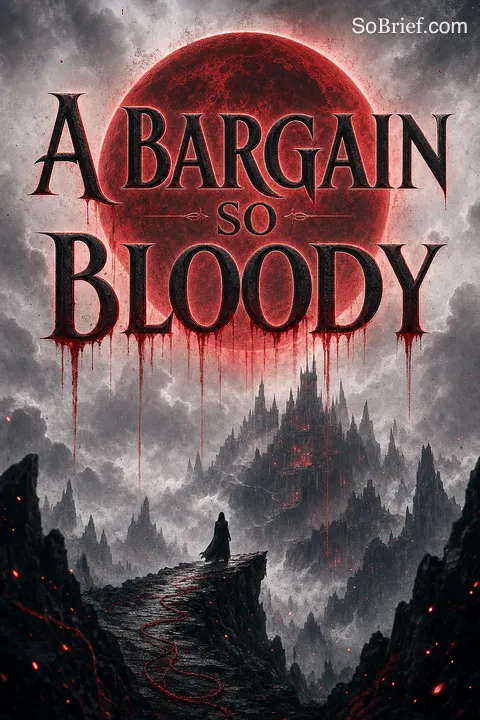
A Bargain So Bloody weaponizes the vampire romance to interrogate a harder question: who earns the label monster, the creature who kills by nature or the institution that engineers cruelty and calls it justice? Samara1 moves through a sequence of supposed sanctuaries, prison, monastery, mountain-kingdom, each of which brutalizes her under a different banner, while the actual vampire2 proves the only figure whose word is literally incapable of falsehood. Drake stages morality as a matter of appetite and choice rather than species, refusing easy absolution: Raphael2 is tender and honest and also genuinely believes his blood hierarchy is fair, a contradiction the narrative declines to resolve. The romance works because his inability to lie converts every kindness into verifiable truth, making trust legible in a world of manipulation. Psychologically, the book is a study of survival trauma. Samara's1 core wound, watching her mother torn apart, has fossilized into a survival grammar of silence, smallness, and the conviction that wanting anything openly guarantees losing it. Her arc measures the slow, dangerous work of reclaiming desire, courage, and voice, and the plot cruelly tests each gain: the mental shields born of emotional suppression become tools of deceit; the curiosity that is her joy repeatedly nearly kills her. The recurring motif of naming, of Raphael2 speaking Samara1 when everyone else erased her, frames identity itself as the book's deepest hunger. The climax achieves genuine tragedy because both lovers are honest survivors whose truths cannot coexist, and the turning that ends the novel is the perfect ironic knot: an act of love that violates the single vow she demanded, delivering her into the monstrous identity she feared and revealing she was, all along, the scourge her beloved was built to destroy. Belonging, the book suggests, can be indistinguishable from captivity, and power indistinguishable from grief.
Review Summary
People Also Read




Characters
Samara Koisemi
Void prisoner turned survivorA magicless void imprisoned as a child in Greymere, Samara has spent twelve years making herself small, silent, and invisible to survive. Her governing instinct is caution: want nothing openly, trust no one, endure. Beneath the frightened rat she believes herself to be lives a fierce, curious intelligence, a compulsive puzzle-solver who loves music, magic, and mending broken things. She carries her dead mother's teachings and a father's necklace like talismans against oblivion, aching above all to belong somewhere safe. Raised to equate desire with denial, she struggles to accept kindness or admit longing. Across the story she trades numb submission for hard-won courage, learning to defend herself, to feel, and to weigh loyalty against survival at devastating cost.
Raphael
Silk-voiced vampire she freesThe vampire Samara1 frees from Greymere is arrogant, lethal, and unsettlingly beautiful, a six-hundred-year-old predator who kills without remorse yet cannot speak a lie. He moves through the world with the certainty of someone who has never lost a fight and rarely been refused. Beneath the ruthlessness runs an unexpected tenderness: he cooks, gifts, and protects, courting through generosity he refuses to explain. A survivor to his marrow, he prizes strength and honesty above sentiment, and once forced onto a path not of his choosing. His fixation on obtaining a fabled grimoire drives the plot, but his growing devotion to Samara1, whom he calls his little dove and later his little viper, reshapes him and defines the story's aching central romance.
Amalthea (Thea)
One-eyed oracle and adviserA voluptuous, silver-haired seer who fled the Witch Kingdom's persecution of oracles, Amalthea now advises Raphael2 and speaks to him without a shred of deference. Warm, theatrical, and irreverent, she cheats at cards, hoards perfumes and shoes, and adopts Samara1 as the little sister she always wanted. Her foresight is imprecise but never wrong, a gift that isolates as much as it protects. She becomes Samara's1 first true friend and her fiercest defender.
Iademos (Demos)
King's general and trainerThe Vampire King's right hand and army general, Demos is disciplined, exacting, and unexpectedly patient. He trains Samara1 with a dagger, giving her space and blunt honesty rather than pity. His endless bickering with Amalthea3 masks evident affection. Trusted by Raphael2 above all others, he embodies loyalty as identity, a devotion that turns cold and dangerous the instant his king is threatened.
Titus
Invisible Witch Kingdom spymasterThe Storm-blooded King's shadowed hand, Titus is a witch spy who moves unseen through Damerel with a bitter almond scent and a serpent's patience. Cruel, contemptuous, and manipulative, he trades in pardons and poison, exploiting Samara's1 hidden past and childhood trauma to bend her to his ends. He despises voids and oracles alike, and treats every person around him as a disposable tool for the Crown.
Nelson
Petty Greymere overseerA disgraced noble's son who lords cruel authority over Greymere's servants, Nelson bullies, starves, and torments Samara1, holding the false key to her freedom. He is the small, gleeful evil of everyday power.
Thomas (Tom)
Charming village innkeeperA blond, dimpled card-dealer's friend and innkeeper who flatters Samara1 and calls her pretty. His easy charm conceals entitlement and predatory persistence, making him a deceptively dangerous figure on the road.
Devoin
Sadistic Monastery priestThe pious, self-satisfied head priest of Apante's Monastery, Devoin cloaks cruelty in doctrine, coercing converts into self-flagellation to prove their worth. He preys on the desperate need to belong.
Charlotte
Kind human healerA warm, matter-of-fact human healer in Damerel who tends Samara1, explaining bodily changes with patience and gentle authority, a rare figure of ordinary care within the vampire city.
Prince Marcel
Beloved witch heirThe Storm-blooded King's chestnut-haired heir, called the Bountiful, adored for scattering multiplying coins on his royal pilgrimage. His brief appearance stirs a hidden recognition in Samara1 about her buried origins.
Latia
Blood den matronThe heavily painted, self-covering owner of a Damerel blood den, Latia profits from human donors while insisting her operation is humane, embodying the exploitation Samara1 finds beneath the kingdom's order.
Plot Devices
Vampires cannot lie
Turns speech into binding truthA defining rule of vampire nature: they may deceive by omission, twist words, or command minds, but they physically cannot speak an untruth. The device transforms every declaration Raphael2 makes into a contract, letting Samara1 test his promises and slowly trust him against her instincts. It also raises the stakes of his silences, since what he refuses to say becomes as revealing as what he does. Crucially, it sharpens the tragedy of the climax, when his tender confessions cannot be dismissed as manipulation, and it contrasts with Samara1, a human who can lie, and does, weaponizing her mortal capacity for deceit to hide betrayal from the one being who reads her heart.
Cursed copper
Renders vampires mortally vulnerableAn alloy that saps vampiric strength and can wound or kill creatures normally near-invincible. It appears first as the shackles binding Raphael2 in Greymere, explaining how a king could be captured and whipped, and recurs as the arrows guarding the grimoire and the weapon that eventually pierces its intended target. Samara1 pockets the broken cuffs early as a talisman of defense and later fashions them into armor-like adornment, and her bronze dagger of similar make becomes her means of killing. Copper thus tracks the book's power reversals, the moments when the strong are made breakable, reminding readers that even monsters have a metal that unmakes them.
The blood bond
Links vampire to victim's emotionsWhen Raphael2 drinks from a living human, a permanent link forms that lets him feel that person's emotions ever after, a power so rare and intrusive that he has historically drained his victims to avoid it. Forged accidentally when Samara1 offers her blood to save his life in the temple, the bond becomes the emotional spine of the middle acts: it summons him to her distress, exposes her fear and desire, and motivates her frantic study of mental shielding. The shields she masters, ironically, let her conceal betrayal from the one creature who could always sense her, making the bond both the story's deepest intimacy and its cruelest blind spot.
The Black Grimoire
Weapon that commands the undeadA legendary tome entombed for seven centuries in the death goddess Anagenni's marsh temple, the grimoire pulses with magic and rejects any vampire's touch. Raphael's2 obsession with obtaining it launches the quest, and Samara's1 slow translation of its Old Runyk becomes her purpose in Damerel. Its buried truth reframes everything: the book belongs to a necromancer, a witch born once every two hundred years who wields dominion over death and to whom the undead must bow. It is the single instrument capable of making vampires afraid, which explains why Raphael2 has hunted its kind for centuries and why possessing the book becomes the object of political conspiracy and personal betrayal.
Thrall and her immunity
Mind control that mysteriously failsVampires can enthrall any human or witch with a single look, compelling obedience, and cards exist to resist it. Early on Raphael2 discovers his thrall simply does not work on Samara1, a quirk played first as mystery and mild comedy in a tavern. The immunity is quietly reinforced when even a murderous vampire's compulsion fails to hold her. This dangling thread pays off at the story's end, when Samara1 finds she can command a vampire as effortlessly as any thrall reverses upon its users, revealing that her lifelong resistance was never weakness or luck but the signature of the very power the entire plot has been circling.
Download PDF
Download EPUB
.epub digital book format is ideal for reading ebooks on phones, tablets, and e-readers.








































