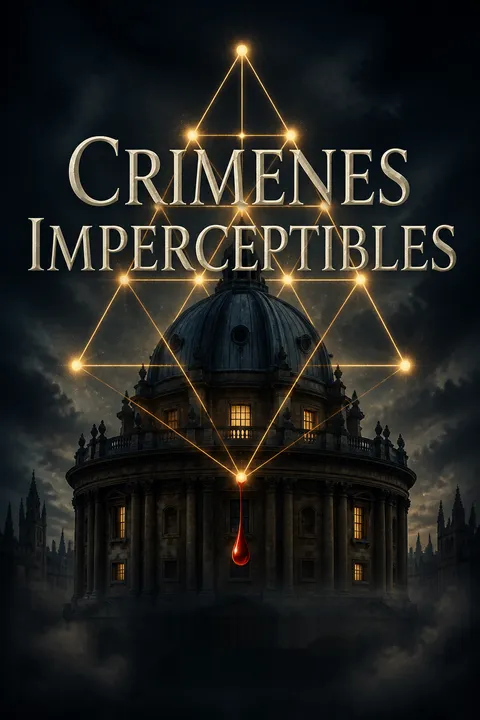

Resumen de la trama
Oxford Arrival, Quiet Beginnings
A postgraduate student from Argentina, newly arrived in Oxford, rents a room from Mrs Eagleton, an elderly war heroine. Immersed in the academic world, he quickly befriends his supervisor, Emily Bronson, and becomes infatuated by Beth, Mrs Eagleton's granddaughter and caretaker. Tennis, academic curiosity, and gentle social routines shape his days, while local colors and personal ambitions set the tone. Beneath an atmosphere of intellectual calm and ordinary beginnings, subtle undercurrents of loneliness, quiet longing, and displacement tinge his first experiences. He draws close to Beth, sensing her restlessness and secret pain in her domestic confinement and musical commitments. All seems poised for a year marked by study and light romance.
An Unseen Murder Occurs
Tragedy strikes when Mrs Eagleton is found dead at home. Both Seldom, a prominent mathematician whom the student admires, and the student himself arrive at the house at nearly the same time. Seldom, having received a strange note with an address, time, and a circle symbol, is shaken by finding his old friend dead. The police are called, and an investigation begins, while suspicions around the manner of death grow. The note suggests the killing is part of a deliberate, psychologically sophisticated series. For the protagonist and Seldom, the discovery is both horrifying and intellectually compelling, setting them on a path intertwining logic with life-and-death consequences.
Mathematical Symbols and Murder
Inspector Petersen interrogates those present and pieces together that the anonymous note's circle could be the first symbol in a calculated murder series. Seldom's recent bestseller discussing logical series and serial killer patterns is revealed as a possible inspiration for the killer, positioning Seldom as a direct recipient of the murderer's intellectual challenge. The murder methodology — minimal violence and subtlety — fascinates and disturbs Seldom, who sees echoes of logical uncertainty in the killer's approach. The mathematics student is drawn not only into police procedures but into an escalating intellectual puzzle, while emotional suspicions around Beth quietly emerge.
Seldom's Theories Unfurled
Walking through Oxford, Seldom explains his obsession with undecidable propositions in math and the complexity of finding true explanations in crime. He draws elegant parallels between logic's incompleteness and the ambiguity of evidence in criminal cases. He recounts histories, personal losses, and the challenge of deciphering meaning from minimal facts. The killer's use of symbols — potentially referencing series or philosophical ideas — remains enigmatic. The protagonist, wrestling with attraction and suspicion, becomes Seldom's sounding board as they trace murder, knowledge, and fate's eerie interrelations. The sense of being manipulated by hidden rules haunts both sleuth and student.
The Circle's Uncertainty
The investigation yields little hard evidence. Suspicions swirl, especially around Beth due to her inheritance, yet timelines barely clear her. The student finds himself an emotional anchor for Beth, whose grief and guilt seem entwined. Meanwhile, the idea of "imperceptible murders"—deaths that could occur unnoticed or appear natural—takes root in Seldom's mind. Both men sense that the killer's intellectual game is not just about violence but about showing something — perhaps about mathematics or the elusiveness of truth. A sense of invisible manipulation suffuses Oxford, and the protagonists realize their knowledge and help may prove as dangerous as their ignorance.
Tensions and Suspicions Rise
Newspapers speculate, and the pressure on Beth intensifies, while the forensic investigation finds subtle traces suggesting a planned smothering. The police pursue conventional motives—resentment, inheritance—but Seldom and the student grow sure that the killer is enacting a philosophical or mathematical vendetta, not merely personal vengeance. The narrative dances between romantic tension, intellectual admiration, and the anxiety of being watched or played. Beth's vulnerabilities and secrets are glossed over, while Seldom and the student contemplate if their own analytical skills are being tested or exploited by someone obsessed with patterns and proof.
The Second Symbol Emerges
A second murder is signaled by a message at the mathematics institute, now involving a simple fish symbol and referencing a death at the hospital: Clarck, an elderly comatose patient, dies with only a faint injection mark. Again, suspicion falls casually on those closest, but the link to Seldom suggests something deeper at play. Both murders are "minimal," blending into the background noise of expected mortality. Petersen, frustrated by the killer's ingenuity and the lack of hard leads, asks Seldom to help predict the next symbol — perhaps to pre-empt the next strike. The student and Seldom realize the murderer's series may relate to the most universal of mathematical progressions.
Patterns in Death
Seldom elaborates on mathematical aesthetics and the limits of reason, reflecting that most people — and apparently the murderer — are guided by a silent, almost artistic sense of what is "right." They visit Kalman, a former constructor of intelligence tests now brain-damaged and locked in repetitive, meaningless scribbles: a living metaphor for the paradoxes of rule-following and meaning-making. The killer's series seems aimed not at violence for its own sake but at creating a pattern intelligible to a mathematician, a puzzle about life, meaning, and perhaps fate itself. The student grows haunted by the idea that they're actors in someone else's proof.
Lives Hanging by Threads
A third symbolic message, this time a triangle, accompanies an onstage death: an elderly percussionist, already old and ill, dies dramatically yet naturally during a concert. Public panic grows, but these deaths share a profound subtlety: all the victims could have died at any time, and each lived longer than expected. Seldom and the student sense that the killer is choosing people whose continued existence seems a kind of statistical deviation. The police consider suspects within the orchestra, while philosophical conversations about fate, mortality, and the slippery nature of proof deepen the story's emotional resonance.
The Triangle at Blenheim
The public concert at Blenheim Palace becomes the scene of a chilling live "imperceptible" murder. In full view, the percussionist dies under suspicious yet plausibly natural circumstances. The message, the triangle symbol, is left as before. Petersen suspects the murderer is now operating with supreme boldness — or perhaps, that they've nearly completed their proof. As the series advances, so too does the sense of being trapped in a pattern: the mathematicians recognize the sequence as referencing the Pythagorean numbers and understand the killer may strike once more, following the tetraktys — a pyramid of ten points — as their plan's endpoint.
Death in the Spotlight
As mathematicians, including Seldom and the student, return from a breakthrough conference, a "blind triangle" accident occurs. A bus carrying children with Down syndrome crashes; all ten children perish, and organs are donated, saving another dying child, Caitlin. The murderer's pattern is revealed: each "murder" was an elaborate, callous act designed to culminate in this mass event, calculated to maximize chance for a transplant. The killer's reasoning — manipulating probabilities, exploiting social taboos — is monstrous yet terrifyingly logical, linking ancient mathematical symbolism to modern mortality statistics.
Reason's Elusive Aesthetic
Inspector Petersen untangles the psychological and philosophical background of the killer, Ralph Johnson, Caitlin's father. With poetic symmetry, each killing matches a symbolic number, and each death is orchestrated to further the sequence. The philosophical implications overwhelm Seldom, who realizes that his own intellectual elegance and need to "finish the proof" were unwittingly complicit. The series — both as crimes and as symbols — poses unanswerable questions about reason, moral responsibility, and the limits of knowledge. The boundary blurs between logic as a safe, harmless pursuit and logic as a weapon, unforgiving in its consequences.
Tetraktys and the Bus
The full pattern becomes clear: ancient Pythagorean symbols—circle, fish, triangle, tetraktys—each encoded in the method and number of their corresponding murders. The mass death of the children was, in the murderer's mind, justified by the chance to save his daughter. The students and Seldom reflect on how the series, while mathematically transparent in hindsight, was nearly invisible in the moment — a "perfect crime" not because it was unsolvable, but because it made the world complicit in its logic. The intellectual triumph of the mathematicians is rendered hollow by grief and horror.
Identity of the Murderer
Through police work and logic, Johnson is identified as both killer and bereaved father. The confluence of personal agony, obsession with symbolic meaning, and the cold logic of sequence drove him to manipulate people, fate, and death. The puzzle's solution comes too late to prevent tragedy, illustrating the moral ambiguity when intellectual aesthetics are prioritized over concrete human consequences. Petersen remains sympathetic — "what would you do for your child?" — but the cost is irrevocable. Seldom and the student are left contemplating their own indirect guilt in having "solved" rather than prevented the proof.
The Confession and Its Consequences
A twist recasts prior events: Seldom confesses to inventing the pattern after Mrs Eagleton's murder to protect Beth, who in despair and anger killed her grandmother. Hoping to shield her from punishment, he forged the initial "series," staging subsequent clues to shift suspicion and provide Beth an alibi. Fate, however, ran in parallel: his invention unwittingly licenses Johnson's real crimes. The series of logic and death becomes a chain reaction, a proof that creates its own reality. Seldom, burdened by guilt, seeks only understanding, not forgiveness.
Secrets Locked in Series
In the aftermath, all surviving principals reflect on their actions. Beth, freed from her grandmother's domination but orphaned by her crime, asks the protagonist what he will do with the knowledge. He chooses silence, torn between empathy, horror, and his own complicity. Seldom's meditations on history — the Assyrian frieze, the concealment of truth within repetition — frame the ultimate ambiguity: what remains hidden, what is revealed, and whether justice can ever be logical.
What Remains Unsaid
As life resumes its ordinary rhythms — rent paid, grant submitted, students moving forward — symbols and traces of the murders fade from public memory, but remain deeply embedded in the survivors. The badger, once a sign of irrational taboo, disappears, and so too do the stories' outward traces. Yet for Seldom, Beth, and the narrator, the emotional and intellectual consequences endure, reminders that in the series of human actions, meaning is always provisional.
Epilogue: The Badger's Path
The narrator, reflecting on the vanished traces of tragedy and survival's cost, feels the weight of what has been hidden as well as revealed. In personal choices, deceptions, and acts of omission, he reads the same ambiguity as in mathematical proofs: every resolution leaves more outside the frame. The story ends with a muted peace, shadowed by regret and the awareness that reason and love, like proofs, always leave unprovable remainders.
Analysis
In The Oxford Murders, Guillermo Martínez fuses the logic of mathematics with the mysteries of the human heart. The novel interrogates how far intellect can penetrate the tangled web of life — and when calculation becomes complicity. The killer's adoption of Pythagorean symbols and mathematical series as a mode of murder serves as a critique of the comforts and perils of abstraction: beneath every elegant proof lurks lived suffering, moral ambiguity, and the potential for misreading. The climactic revelation, that an artificial pattern invented to shield a loved one catalyzes genuine murders, crystallizes the novel's warning: the stories we tell in defense or in pursuit of knowledge change the world, sometimes tragically. Memory and evidence, proof and aesthetics, logic and love — all unravel in the face of fate, trauma, and the limits of reason. Martínez's adaptation of the crime novel is thus a meditation on truth: not only what can be proved, but what must be lived with.
Resumen de reseñas
The Oxford Murders receives mixed reviews, averaging 3.37/5. Readers appreciate its unique blend of mathematics, philosophy, and murder mystery, praising its intellectual depth and surprising ending. Many note it reads more as a philosophical exploration than a traditional mystery. Positive reviews highlight the engaging premise and mathematical intrigue, while critics cite underdeveloped characters, slow pacing, and overly academic dialogue. Some readers found the killer predictable. The novel's brevity is frequently mentioned, viewed both positively and negatively. A 2007 film adaptation received notably poor reviews.
También leyeron


Characters
The Protagonist (Unnamed Argentine Student)
Newly arrived in Oxford, the Argentine student serves as narrator and emotional axis. His role is that of witness, apprentice, and confidant—drawn into both romantic attachments and the unfolding mystery. He is both a figure of empathy (for Beth, Mrs Eagleton, and Seldom) and a mind captivated by intellectual challenge. Psychoanalytically, he balances desire for connection with an inclination to retreat into theory—torn between wanting to "solve" and wanting to understand. His development transforms him from observer to reluctant participant in moral dilemmas, ultimately forced to accept that some truths must remain unspoken for humanity's sake.
Arthur Seldom
Seldom embodies the intersection of genius and trauma. Revered for his work on logic and undecidability, he is haunted by personal loss: the death of his first wife and friends in an accident. His intellectual detachment is a shield against the pain of real-life consequences. Seldom's psychoanalytic core is guilt—fear that his conjectures influence events, not just describe them. His relationship with Beth is paternal yet ambiguous; his urge to protect her leads him into moral compromise, orchestrating an elaborate deception to shield her from law. In the end, he is burdened by the proof's real-world ramifications—unable to draw a clear line between thought and harm.
Beth
As Mrs Eagleton's granddaughter and primary caretaker, Beth symbolizes the cost of invisible labor and suppressed freedom. Scarred by personal loss and familial obligation, she is both resentful of, and attached to, her domestic prison. Her accidental confession of hatred, combined with the opportunity for independence, pushes her to an impulsive crime. Beth's psychological profile reveals repression, longing for release, and fear of being found unworthy. Her emotional world is rich but tightly bound, and the small, childish gesture of thumb-sucking at night speaks to long-delayed maturation. Ultimately, her fate is disappointment—freedom tinged with moral compromise and grief.
Mrs Eagleton
A brilliant figure in her youth, with connections to the Enigma codebreakers, Mrs Eagleton is now frail, observant, and ambiguously controlling. Her affection for Beth is entwined with expectation and self-absorption, and her past is a constant shadow over the household. As victim, she is paradoxical: both beloved and resented, her murder becomes the focus of overlapping motives—Beth's yearning for freedom and the killer's desire to begin a sequence. Psychoanalytically, she demonstrates the double-edged nature of familial dependence, and her death is simultaneously an occasion for guilt and relief.
Inspector Petersen
The consummate British detective, Petersen is methodical, incisive, and dedicated, yet ultimately outmaneuvered by the aesthetic logic of the crimes. His affection for his daughter is a recurring motif, and he is haunted by the question: "how far would you go for your child?" Petersen's personal and professional identities blur as he tries to weigh justice, sympathy, and mathematical reason. Despite his competence, he ultimately becomes a bystander to a game whose logic he cannot control—a critique of rationality's limits in the face of desperate love.
Ralph Johnson
Johnson, father of Caitlin (who needs a lung transplant), is the architect of the real murders. Seemingly ordinary, his emotional desperation and intellectual obsession drive him to engineer death—first for others, with clinical detachment and, ultimately, for himself. He is psychologically torn: between paternal devotion and the monstrous logic that justifies murder in the name of love. His pattern of escalation reflects both grandiosity and the desire to be understood by a community (mathematicians) who, he feels, have excluded him. Johnson is both victim and villain of a world dictated by rules and exceptions.
Lorna
Lorna is emotionally vibrant, physically expressive, and intellectually curious. As a tennis partner and lover for the narrator, she offers respite and normalcy, but is also deeply intertwined with the case—her observations and connections help unravel the medical details of the crimes. Lorna's psychoanalytic function is to embody warmth and vitality, but her background in reading crime novels reveals skepticism about idealized rationality. She represents intuition, lived experience, and the unpredictability of desire.
Frank Kalman
Once a designer of intelligence tests, Kalman's story reflects the collapse of pure logic into incoherence. Now severely brain-damaged, he compulsively writes only the name of a lost love, demonstrating the failure of rules to contain meaning. As a living analogy for the paradoxes discussed by Seldom and others, he represents the mind's fragile boundaries and the futility of seeking mechanical explanations for human behavior.
Emily Bronson
The protagonist's supervisor and a noted mathematician herself, Emily is understated but incisive. She gently steers the protagonist towards both academic and social experience, and her own love for mathematical elegance serves as a steady counterpoint to the chaos enveloping her colleagues. Her psychoanalytic presence is one of calm, patient understanding, and her kindness highlights the possibility of goodness even within a context filled with violence and ambiguity.
Podorov
A minor but thematically important figure, Podorov embodies the outsider's resentment and the ways in which merit, nationality, and opportunity are unequally distributed. His story — of being robbed of recognition and honor — parallels the unresolvable injustices that underlie the murders. He represents the dark side of intellectual life: rivalry, bitterness, and the enduring wounds of exclusion.
Plot Devices
Serial Symbolic Murder
The killer uses mathematical symbols — circle, fish, triangle, tetraktys — as both clues and taunts, constructing a sequence that forces observers to interpret, guess, or prove what comes next. The murders, staged as imperceptibly as possible, serve as both real crimes and abstract puzzles, explicitly inviting the mathematician Seldom into a competition of minds. The logic of the pattern is left ambiguous until the end, maximizing suspense.
Logical Series and Mathematical Aesthetics
The narrative uses the device of the infinite or unknowable series to frame the investigation: every new symbol can point to multiple continuations, making early deductions dangerous or misleading. The Pythagorean numbers and their historical symbolism become both a key and a red herring, with each solution generating new uncertainty — just as in Godel's theorem. The climax — the mass murder at the "blind triangle" — renders the abstract pattern horrifyingly concrete.
Personal Confession Cleverly Obscured
By making Seldom himself (and Beth, by extension) the origin of the "series," the novel deconstructs the classic detective narrative's faith in objective clues and logical deduction. The amateur detective unwittingly hides the initial crime by inventing an artificial pattern, which then inspires the actual murderer. The chain of intellectual events overtakes its creators and becomes self-sustaining.
Structural Dualities
Repeatedly, the novel juxtaposes the need for absolute proof in math with the impossibility of certainty in life and law. Characters — especially Seldom and the narrator — struggle with what can be shown versus what must be believed or hidden. The boundary between analysis and complicity becomes frighteningly thin.
Foreshadowing via Symbolism
Objects like the badger, the blanket, symbols on the Scrabble board, and stories from mathematical or magical history are set up as seemingly peripheral, but each returns to the core mystery. These cyclical motifs both mislead and prepare the reader to see the truth.
Descargar PDF
Descargar EPUB
.epub digital book format is ideal for reading ebooks on phones, tablets, and e-readers.








































